Ruth 1:2
Ruth 1:3
Ruth 1:4
Ruth 1:5
Ruth 1:6
Ruth 1:7
Ruth 1:8
Ruth 1:9
Ruth 1:10
Ruth 1:11
Ruth 1:12
Ruth 1:13
Ruth 1:14
Ruth 1:15
Ruth 1:16
Ruth 1:17
Ruth 1:18
Ruth 1:19
Ruth 1:20
Ruth 1:21
Ruth 1:22
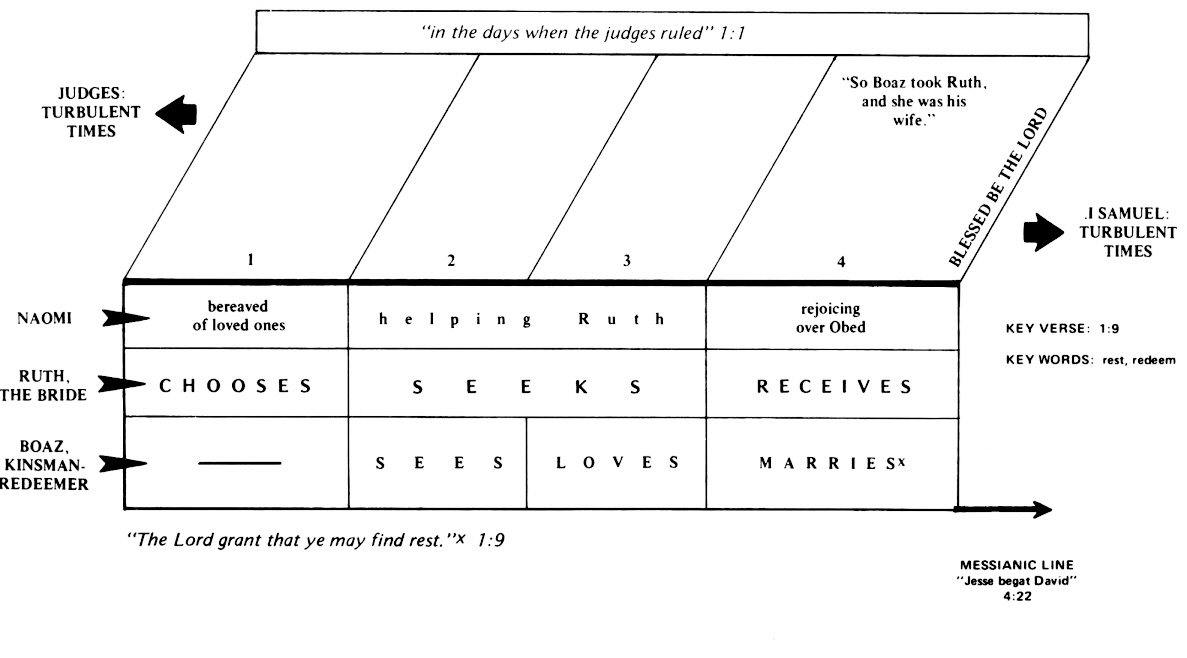
Irving Jensen's Survey of Bible (see his summary of Ruth online - page 392)
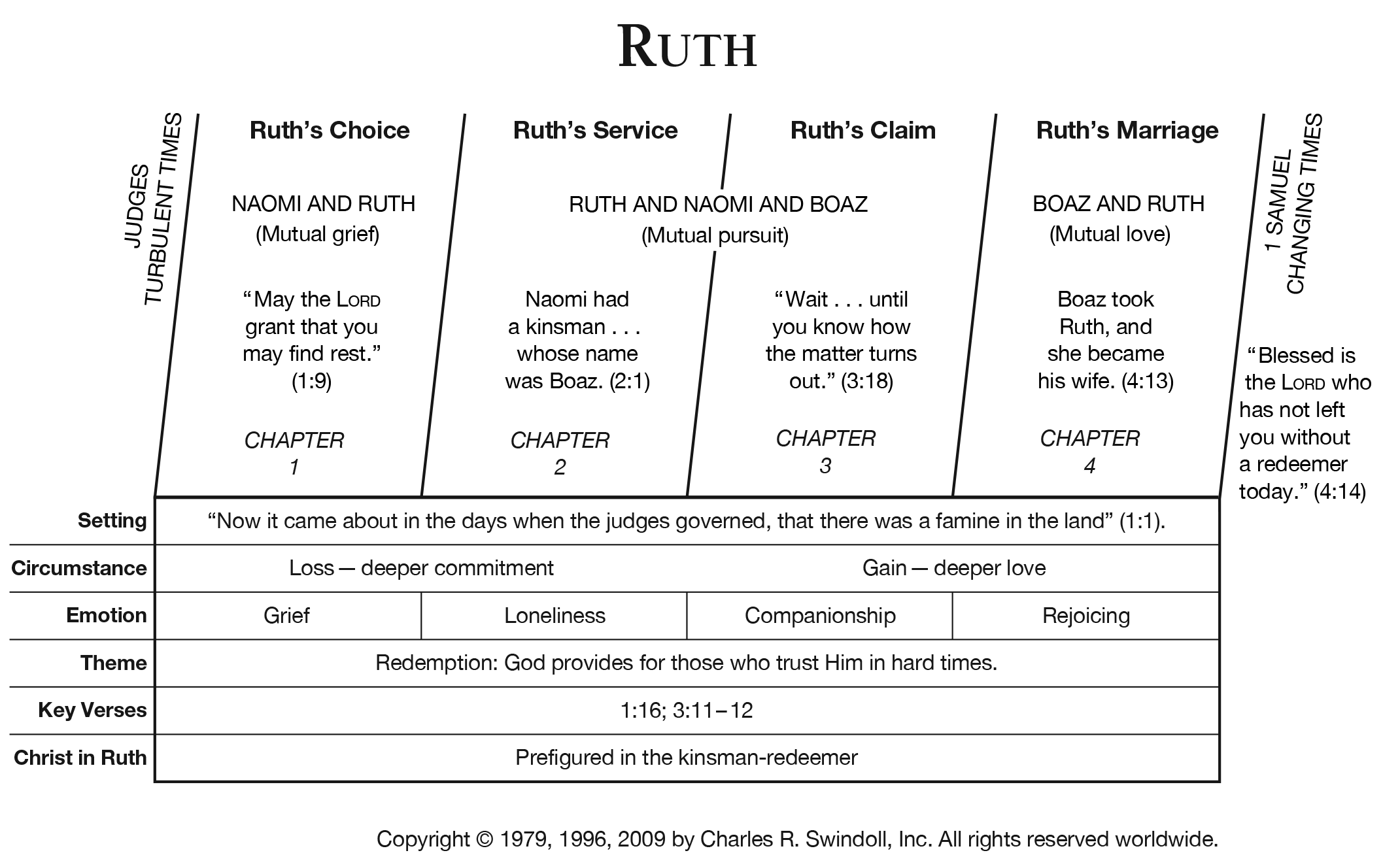
See Swindoll's summary chart of Ruth See Ruth Devotionals
|
RUTH: GOD PROVIDES |
|||
| Ruth 1 | Ruth 2 | Ruth 3 | Ruth 4 |
| Ruth's Choice | Ruth's Service | Ruth's Claim | Ruth's Marriage |
| Ruth's Resolve | Ruth's Rights | Ruth's Request | Ruth's Reward |
| Naomi and Ruth Mutual Grief |
Ruth and Naomi and Boaz Mutual Pursuit |
Boaz and Ruth Mutual Love |
|
| Ruth's Decision: Return with Naomi |
Ruth's Devotion: Provide for Naomi |
Ruth's Request: Redemption by Boaz |
Ruth's Reward: Relative of Messiah |
| Ruth and Naomi |
Ruth and Boaz |
||
| Death of Naomi's Family |
Ruth Cares for Naomi |
Boaz Cares for Ruth |
God Blesses with New Birth |
| Grief | Loneliness | Companionship | Rejoicing |
| Location: Plains of Moab |
Location: Fields of Bethlehem |
Location: Threshing floor of Bethlehem |
Location: Little town of Bethlehem |
| Time Lapsed: About 30 Years See Timeline |
|||
| Setting: Ru 1:1 Now it came about in the days when the judges governed Jdg 21:25+ In those days there was no king in Israel; everyone did what was right in his own eyes. |
|||

|
The Book of Judges |
|
|
RUTH |
JUDGES |
|
Spiritual |
Spiritual |
|
Purity |
Immorality |
|
Deciding for |
Pursuing Idols |
|
Devotion |
Disloyalty |
|
Love |
Lust |
|
Peace |
War |
|
Kindness |
Cruelty |
|
Obedience |
Disobedience |
|
Oasis |
Desert |
|
Faithfulness |
Faithlessness |
Ruth 1:19 So they both went until they came to Bethlehem. And when they had come to Bethlehem, all the city was stirred because of them, and the women said, "Is this Naomi?" (NASB: Lockman)
Septuagint (LXX): eporeuthesan (3PAPI) de amphoterai eos tou paragenesthai (AMN) autas eis Baithleem kai echesen (3SAAI) pasa e polis ep' autais kai eipon aute estin (3SPAI) Noemin
English of Septuagint: And they went both of them until they came to Bethleem: and it came to pass, when they arrived at Bethleem, that all the city rang with them, and they (feminine pronoun) said, Is this Noemin
BGT ἐπορεύθησαν δὲ ἀμφότεραι ἕως τοῦ παραγενέσθαι αὐτὰς εἰς Βαιθλεεμ καὶ ἤχησεν πᾶσα ἡ πόλις ἐπ᾽ αὐταῖς καὶ εἶπον αὕτη ἐστὶν Νωεμιν
Hubbard So the two of them went on until they reached Bethlehem. Now as soon as they entered Bethlehem, the whole city echoed with excitement over them. The women said, “Can this really be Naomi?”
KJV So they two went until they came to Bethlehem. And it came to pass, when they were come to Bethlehem, that all the city was moved about them, and they said, Is this Naomi?
NET So the two of them journeyed together until they arrived in Bethlehem. When they entered Bethlehem, the whole village was excited about their arrival. The women of the village said, "Can this be Naomi?"
BBE So the two of them went on till they came to Beth-lehem. And when they came to Beth-lehem all the town was moved about them, and they said, Is this Naomi?
CSB The two of them traveled until they came to Bethlehem. When they entered Bethlehem, the whole town was excited about their arrival and the local women exclaimed, "Can this be Naomi?"
ERV So they two went until they came to Beth-lehem. And it came to pass, when they were come to Beth-lehem, that all the city was moved about them, and the women said, Is this Naomi?
ESV So the two of them went on until they came to Bethlehem. And when they came to Bethlehem, the whole town was stirred because of them. And the women said, "Is this Naomi?"
GWN So both of them went on until they came to Bethlehem. When they entered Bethlehem, the whole town was excited about them. "This can't be Naomi, can it?" the women asked.
NKJ Now the two of them went until they came to Bethlehem. And it happened, when they had come to Bethlehem, that all the city was excited because of them; and the women said, "Is this Naomi?"
NAB So they went on together till they reached Bethlehem. On their arrival there, the whole city was astir over them, and the women asked, "Can this be Naomi?"
NIV So the two women went on until they came to Bethlehem. When they arrived in Bethlehem, the whole town was stirred because of them, and the women exclaimed, "Can this be Naomi?"
NJB The two of them went on until they came to Bethlehem. Their arrival set the whole town astir, and the women said, 'Can this be Naomi?'
NLT So the two of them continued on their journey. When they came to Bethlehem, the entire town was excited by their arrival. "Is it really Naomi?" the women asked.
NRS So the two of them went on until they came to Bethlehem. When they came to Bethlehem, the whole town was stirred because of them; and the women said, "Is this Naomi?"
YLT and they go both of them till their coming in to Beth-Lehem; and it cometh to pass at their coming in to Beth-Lehem, that all the city is moved at them, and they say, 'Is this Naomi?'
- Is this Naomi - Mt 21:10; Isa 23:7; Lam 2:15
- Ruth 1 Resources - Multiple Sermons and Commentaries
Related Passages: (EXAMPLES OF DANGER IN TRAVELING IN ANCIENT TIMES)
Ezra 8:22; 31 For I was ashamed to request from the king troops and horsemen to protect us from the enemy on the way, because we had said to the king, “The hand of our God is favorably disposed to all those who seek Him, but His power and His anger are against all those who forsake Him.” (8:31) Then we journeyed from the river Ahava on the twelfth of the first month to go to Jerusalem; and the hand of our God was over us, and He delivered us from the hand of the enemy and the ambushes by the way. (ED: Surely the good hand of the LORD was over Naomi and Ruth and delivered them safely back to Bethlehem!)
Luke 10:30 Jesus replied and said, “A man was going down from Jerusalem to Jericho, and fell among robbers, and they stripped him and beat him, and went away leaving him half dead.
BACK HOME AGAIN
IN BETHLEHEM
So they both went until they came to Bethlehem. And when they had come to Bethlehem, - They both" not "Naomi by herself." Naomi had gone out with a husband and sons who were now dead but she did not return alone, God providing Ruth to accompany, comfort and succor her. Ruth, a younger woman, doubtless could have gone faster, once again emphasizing the "others first" character of Ruth the Moabitess. Normally a trip from Moab (about 50+ miles) would take 7-10 days, the road descending about 4,500 feet from the high plains of Moab into the Jordan River Valley and then ascending 3,750 feet through the foothills of Judea. Needless to say, these two travelers would have looked weary and worn from the journey. Remember also that these were "the days of the judges" when the roads were anything but safe for men much less women (See Scriptures above). Once again one senses the protecting hand of the LORD watching over these two defenseless women on their dangerous journey thus assuring their safe arrival home. It is interesting that the more you meditate on the texts in the book of Ruth, the more you see the providential hand of the LORD permeating the passages!
Huey agrees commenting that "Nothing is told of events along the road back to Bethlehem; but considering that thieves frequently lurked along the roads, it must have been a dangerous trip for two unaccompanied women (cf. Ezra 8:22, 31; Jer 3:2; Luke 10:30). Observe the providential care of God that is implied so frequently throughout the Book of Ruth." (See context in The Expositor's Bible Commentary)
THOUGHT - And you also weary dear pilgrim (1Pe 1:1, 1Pe 2:11), then take heart that the One Who is the same "yesterday, today and forever" (Heb 13:8+) is providentially watching over your sojourn and "He who began a good work in you will perfect it until the day of Christ Jesus" (Php 1:6+) and will bring you safely to your eternal home (Jn 14:3)
All the city was stirred (hum/him) because of them - ICB = "all the people became very excited" The Hebrew for "stirred" paints a vivid portrait of the scene of a city in commotion. Today we might say they were all "shook up". The town was excited albeit probably somewhat in a state of dismay over Naomi's situation of "trading" 3 Israelite men for one Moabite woman! The Septuagint translates stirred with echeo means to resound like the sounding of a brass gong or the roar of ocean waves crashing down, giving us quite a vivid picture of this homecoming scene. Hubbard translates it "the whole city echoed with excitement over them." This twosome caused quite an "uproar" in Bethlehem, and were undoubtedly the "talk of the town". Their arrival could hardly be missed by anyone in Bethlehem including a man named Boaz! One wonders what would have happened if Ruth and Naomi had quietly slipped into town unnoticed? Would Boaz have known of their presence? It matters not for God left nothing to "chance". Is the stirring of the city not another subtle evidence of the providential hand of Yahweh? (That's rhetorical!)
Huey has an interesting comment on stirred writing that "The root of the word used to describe the town’s reaction on the arrival of the two women—hûm (“was stirred”)—is onomatopoeic and could be translated “the town hummed with the news of their arrival"....The commotion caused by Naomi’s return may have been from the joy of seeing her again or may describe the women’s shocked whispering about her abject, changed appearance. The NIV’s “Can this be Naomi?” suggests the latter, for the harsh treatment of the years had certainly altered her appearance. (See context in The Expositor's Bible Commentary)
Hubbard on stirred - The use of the Niphal (“to resound, echo, be in an uproar”) conjures up images of joyous shouting and happy, animated conversations in response to an event. Hence, at Solomon’s coronation the city of Jerusalem “resounded with joyous excitement” (1 K. 1:45), and the earth “echoed” with Israel’s joyful shouts at the arrival of the ark of the covenant in its camp (1 Sam. 4:5). Here one imagines excited citizens scurrying about the streets shouting the good news to others, who then do likewise. While the entire town buzzes with excitement over the new arrivals, the town women (Ru 1:19–21) articulate it: Can this really be Naomi? (See context in The Book of Ruth)
And the women said, "Is this Naomi?" - Knox's translation is a bit hard on the women describing them as "all the gossips!" Although "all the city" was in a commotion, it was chiefly the ladies who were the most excited at Naomi's return. Naomi must have been well known because they greet her by name although it had been over 10 years since they seen her. So while they clearly recognize her, they are stunned by the changes in her appearance, which is why they are in disbelief that it really is her.
Daniel Block - On the one hand, the fact of her epiphany, that she should show up at all, was remarkable enough. On the other hand, the years of grief and deprivation have surely taken their toll on Naomi’s form and visage. This one who had left Bethlehem as Naomi, “the pleasant one,” a robust woman in her prime, had returned as a haggard and destitute old woman. (Borrow Judges, Ruth. Vol. 6: New American Commentary)
Spurgeon writes of Naomi that "She had been absent ten years, but her character in her better days had stood high with the people; and therefore they were glad to see her return, though they wondered at her poverty. Her many griefs may have so altered her that even her former acquaintances asked, "Is this Naomi?" Such changes may come to us: may faith and patience prepare us for them. (The Interpreter)
Matthew Henry aptly observes that by their reaction and all the commotion over her arrival "it appears that she had formerly lived respectably, else there would not have been so much notice taken of her. If those that have been in a high and prosperous condition break, or fall into poverty or disgrace, their fall is the more remarkable… Those with whom she had formerly been intimate were surprised to see her in this condition; she was so much broken and altered with her afflictions that they could scarcely believe their own eyes, nor think that this was the same person whom they had formerly seen, so fresh, and fair, and gay: Is this Naomi? So unlike is the rose when it is withered to what it was when it was blooming. What a poor figure does Naomi make now, compared with what she made in her prosperity! If any asked this question in contempt, upbraiding her with her miseries (“is this she that could not be content to fare as her neighbours did, but must ramble to a strange country? see what she has got by it!”), their temper was very base and sordid. Nothing more barbarous than to triumph over those that are fallen. But we may suppose that the generality asked it in compassion and commiseration: “Is this she that lived so plentifully, and kept so good a house, and was so charitable to the poor? How has the gold become dim!” Those that had seen the magnificence of the first temple wept when they saw the meanness of the second; so these here. Note, Afflictions will make great and surprising changes in a little time. When we see how sickness and old age alter people, change their countenance and temper, we may think of what the Bethlehemites said: “Is this Naomi? One would not take it to be the same person.” God, by his grace, fit us for all such changes, especially the great change!"
Hubbard notes that "In Israel, names were not just labels of individuality but descriptions of inner character which in turn were presumed to influence the person's conduct… Recall Jacob ('schemer'; Gen. 27:36); Nabal ('fool'; 1Sa 25:25); Jesus ('Savior'; Mt 1:21). Similarly, to receive a new name signified a change in character and destiny (i.e., Abram to Abraham, Ge 17:5, 6, 7, 8; Jacob to Israel, Ge 32:29 [Eng. 28]; Simon to Peter, Mt. 16:17,18; Saul to Paul, Acts 19:9)." And Naomi is about to declare her "new name" because there had been a significant change in her state.
Stirred (01949)(hum/him) means to murmur, roar, rouse, be moved, ring again, make a (great) noise, shake, stir, confuse. It is a rare word denoting loud sound, such as ringing. The basic meaning of this root seems to be a severe disturbance, i.e. "to disturb greatly," "stir," "discomfit." In Dt 7:23 God as greatly disturbing (afflicting, confusing) the enemies until they are destroyed. Some uses emphasize the audible effects of the rousing as when Solomon was anointed King "so that the city (was) in an uproar." (1Ki 1:45) The verb means "shake, stir up" as with excitement in the city in (Ru 1:19 and 1Ki 1:45) or in the camp (1Sa 4:5). The Hiphil may be translated "stir," "make a disturbance" (Ps 55:2; Mic 2:12), but opinion on how to translate these passages, is divided.
Gilbrant - Hûm is a verb which means "to confuse" or "to go wild." It was promised that Israel would be triumphant in clearing the nations out of the land of Canaan as the Lord confused the inhabiting peoples so as to destroy them (Deut. 7:23). In the Niphal form, hûm means "to go wild." The earth "went wild" or "resounded" when the Israelites shouted upon the arrival of the Ark of the Covenant into their camp (1 Sam. 4:5). Cities also "went wild" during stirring events (Ru1:19; 1 Ki. 1:45). The NIV and NASB translate hûm in Ps. 55 as "am distraught" and "am surely distracted," respectively. Such translations have a passive sense of causation (i.e., "was caused to be confused"). Micah 2:12 has an alternate reading which results in the verb root hāmāh which means "to make noise." Such a translation fits the context well. (Complete Biblical Library)
Hum/him - 6x in 6v - noisy(1), resounded(1), stirred(1), surely distracted(1), throw(1), uproar(1). Deut. 7:23; Ruth 1:19; 1 Sam. 4:5; 1 Ki. 1:45; Ps. 55:2 = "I am upset and beside myself" = NET) ; Mic. 2:12
Ruth 1:20 She said to them, "Do not call me Naomi; call me Mara, for the Almighty has dealt very bitterly with me. (NASB: Lockman)
Septuagint (LXX): kai eipen (3SAAI) pros autas me de kaleite (2PPAM) me Noemin kalesate (2PAAM) me Pikran hoti epikranthe (3SAPI) en emoi o hikanos sphodra
English of Septuagint: And she said to them, Nay, do not call me Noemin; call me Bitter,' for the Mighty One has dealt very bitterly with me
BGT καὶ εἶπεν πρὸς αὐτάς μὴ δὴ καλεῖτέ με Νωεμιν καλέσατέ με Πικράν ὅτι ἐπικράνθη ἐν ἐμοὶ ὁ ἱκανὸς σφόδρα
Hubbard But Naomi told them, “Do not call me ‘Lovely’! Instead, call me ‘Bitter’ because Shaddai has made me very bitter.
KJV And she said unto them, Call me not Naomi, call me Mara: for the Almighty hath dealt very bitterly with me.
NET But she replied to them, "Don't call me 'Naomi'! Call me 'Mara' because the Sovereign One has treated me very harshly.
BBE And she said to them, Do not let my name be Naomi, but Mara, for the Ruler of all has given me a bitter fate.
CSB "Don't call me Naomi. Call me Mara," she answered, "for the Almighty has made me very bitter.
ERV And she said unto them, Call me not Naomi, call me Mara: for the Almighty hath dealt very bitterly with me.
ESV She said to them, "Do not call me Naomi; call me Mara, for the Almighty has dealt very bitterly with me.
GWN She answered them, "Don't call me Naomi Sweet. Call me Mara Bitter because the Almighty has made my life very bitter.
NKJ But she said to them, "Do not call me Naomi; call me Mara, for the Almighty has dealt very bitterly with me.
NAB But she said to them, "Do not call me Naomi. Call me Mara, for the Almighty has made it very bitter for me.
NIV "Don't call me Naomi, " she told them. "Call me Mara, because the Almighty has made my life very bitter.
NJB To this she replied, 'Do not call me Naomi, call me Mara, for Shaddai has made my lot bitter.
NLT "Don't call me Naomi," she responded. "Instead, call me Mara, for the Almighty has made life very bitter for me.
NRS She said to them, "Call me no longer Naomi, call me Mara, for the Almighty has dealt bitterly with me.
YLT And she saith unto them, 'Call me not Naomi; call me Mara, for the Almighty hath dealt very bitterly to me,
- The Almighty - Ge 17:1; 43:14; Job 5:17; 11:7; Rev 1:8-note; Re 21:22-note) (Job 6:4; 19:6; Ps 73:14-note; Ps 88:15-note; Isa 38:13; Lam 3:1-20; Heb 12:11-note
- Dealt - Job 6:4 19:6 Ps 73:14 88:15 Isa 38:13 La 3:1-20 Heb 12:11
- Ruth 1 Resources - Multiple Sermons and Commentaries
CALL ME BITTER
NOT PLEASANT!
She said to them, "Do not call me Naomi; call me Mara (from marar) - GWT "Don't call me Naomi Sweet. Call me Mara Bitter" Naomi heard the "buzz" among the women, and so responds with a pointed retort, saying in essence "No! I am not Naomi but Mara!" She is saying my given name Naomi no longer suits me! Her response addresses why she looks the way she does and why she is devoid of one husband and two sons! Naomi means pleasant (my joy, my delight, my bliss, my pleasantness, the loveable, agreeable, sweetness) but her life in Moab was largely unpleasant rather than joyful. And so on her return to Bethlehem, she quickly corrects her old-time acquaintances for calling her Pleasant, renaming herself Mara (“Bitter”), explaining that Shaddai had treated her bitterly.
It is interesting that the Israelites just having been freed from slavery in Egypt, chose Mara as the name of their first camp after crossing the Red Sea. (Ex 15:23) They interpreted the LORD'S testing at the bitter waters as "Bitter" and discounted the truth that God often uses bitter experiences to make His children better.
THOUGHT - You may be experiencing a difficult trial like Naomi, but keep in mind that God uses strong trials to build strong faith, or as Malloch puts in in poem…
Good timber does not grow in ease;
The stronger wind, the tougher trees;
By sun and cold, by rain and snows,
In tree or man, good timber grows.
Hubbard points out that "In Israel, names were not just labels of individuality but descriptions of inner character which in turn were presumed to influence the person’s conduct. The contradiction between her name (“Lovely”) and her fate, however, smacked of mockery. Thus, Naomi blurted, “ ‘Lovely’? Ha! Nothing could be farther from the truth!” Instead, Naomi scornfully asked to be called a name more appropriate to her situation (Bitter) Why this change of name? Because God himself has caused her fate (Shaddai has made me very bitter). Naomi repeated the language of v. 13 (mar-lî meʾōḏ, “I am very unfortunate”) but with two differences: here Shaddai is the verb’s subject and mrr is Hiphil, not Qal (hēmar šadday lî meʾōḏ). The changes underscore Yahweh’s direct responsibility for her misfortune and introduce a legal dimension to his action (cf. v. 21). In effect, Naomi joined Job in questioning God’s mysterious justice: “I am bitter—and Shaddai has made me so!”" (See context in The Book of Ruth or borrow The Book of Ruth New International Commentary on the Old Testament)
Call me Mara - Call me "Bitter"! Naomi did not have the advantage of reading Ruth 4, where she would learn that the lesson that the difficulties of her life were intended to make her better, not bitter. It all depends on how one responds, for indeed lessons in life make some people better and others bitter.
MARA [ISBE] - ma'-ra, mar'-a (marah, "bitter"): The term which Naomi applies to herself on her return from Moab to her native country (Ruth 1:20). Changed beyond recognition, she creates astonishment among her former acquaintances, who ask, "Is this Naomi?" She replies, "Call me not Naomi" (i.e. "pleasant" or "sweet"), but "call me Mara" (i.e. "bitter"). In the light of her bitter experience, and her present pitiable plight, the old name has become peculiarly inappropriate.
The comforts of God's grace are all the sweeter when they follow the troubles of life.
-- C H Spurgeon
Spurgeon comments that "God can soon change our sweets into bitters, therefore let us be humble; but he can with equal ease transform our bitters into sweets, therefore let us be hopeful. It is very usual for Naomi and Mara, sweet and bitter, to meet in the same person. He who was called Benjamin, or "the son of his father's right hand," was first called Benoni, or "the son of sorrow." The comforts of God's grace are all the sweeter when they follow the troubles of life. (The Interpreter)
Short digression by Spurgeon on trials and tests - "I understand drinking bitter medicine, if it is to make me well; but who would drink wormwood and gall with no good result to follow? I can understand toiling if a wage is in prospect, but I cannot see the sense of toiling when there is no reward for it. Now, you who love not God, your lives are not all flowers and sunshine. It is not all music and dancing with you now. I know you have your cares and troubles, you have your thorns in the flesh, and perhaps a great many of them; but you have no Saviour to run to. You are like a ship in a storm, and there is no harbour for you; you are as birds driven before the wind, and you have no nests in which to shelter, but must be driven for ever before the blast of Jehovah's wrath. Consider this, I pray you, meditate upon your condition and prospects, and when you have so done, may your heart cry out, "I would fain have God to be my friend." - Flashes of Thought.
CHS - Heir of heaven, your present trials are yours in the sense of medicine. You need that your soul, like your body, should be dealt with by the beloved Physician. A thousand diseases have sown their seeds within you; one evil will often bring on another, and the cure of one too frequently engenders another. You need, therefore, oftentimes to gather the produce of the garden of herbs which is included in your inheritance—a garden which God will be sure to keep well stocked with wormwood and with rue. From these bitter herbs a potion shall be brewed, as precious as it is pungent, as curative as it is distasteful. Would you root up that herb garden, would you lay those healing beds all waste? Ah, then, when next disease attacked you, how could you expect help? I know the good Physician can heal without the lancet if he will, and restore us without the balm, but for all that, he does not choose to do so, but will use the means of affliction, for by these things men live, and in all these is the life of their spirit. - Flashes of Thought
CHS - Just as the fever must be held in check by the bitter draught of quinine, so must the bitter cup of affliction rebuke our rising pride and worldliness. We should exalt ourselves above measure, and provoke the Lord to jealousy against us, were it not that trouble lays us low. None of us shall know until we read our biography in the light of heaven, from what inbred sins, foul corruptions, damnable uncleanliness, and detestable lusts we have been delivered, by being driven again and again along the fiery road of affliction. Adversities are the sharp knives with which God doth cut from us the deadly ulcers of our sins; these are the two-edged swords with which he slays our enemies and his own which lurk within us. - Flashes of Thought.
CHS - Severe trouble in a true believer has the effect of loosening the roots of his soul earthward, and tightening the anchor-hold of his heart heavenward. How can he love the world which has become so drear to him? Why should he seek lifter grapes so bitter to his taste? Should he not now ask for the wings of a dove that he may fly away to his own dear country, and be at rest for ever? Every mariner on the sea of life knows that when the soft zephyrs blow men tempt the open sea with outspread sails, but when the black tempest comes howling from its den they hurry with all speed to the haven. Afflictions clip our wings with regard to earthly things, so that we cannot fly away from our dear Master's hand, but sit there and sing to him; but the same afflictions make our wings grow with regard to heavenly things: we are feathered like eagles, we catch the soaring spirit, a thorn is in our nest, and we spread our pinions towards the sun. -- Flashes of Thought.
Scottish author George MacDonald told this story of a woman who had experienced a great tragedy in her life: "The heartache was so crushing and her sorrow so bitter that the one in distress exclaimed, 'I wish I'd never been made.' With spiritual discernment, her friend answered, 'My dear, you are not fully made yet; you're only being made, and this is the Maker's process!'" MacDonald wisely concluded, "We can let God take our troubles and make out of them a garment of Christian fortitude which will not only warm our souls but also serve to inspire others."
It has been said that God may have to break us in order to make us. Naomi could not sing in this chapter but by the end of the book, I think she would have gladly sung these words...
For all the heartaches and the tears,
For gloomy days and fruitless years
I do give thanks, for now I know
These were the things that helped me grow.
--Anonymous
For - Always pause and ponder this term of explanation - you will sometimes glean wonderful spiritual insights. Here Naomi is explaining to the women why she no longer thinks the name Naomi is appropriate, but that the better name is Mara. This explanation of her "new name" introduces the first of 4 "accusations" against God, each accusation using a name of God - (1) Shaddai (dealt bitterly), (2) Yahweh (brought me back empty), (3) Yahweh (witnessed against) and (4) Shaddai (afflicted me).
The Almighty (Shaddai) has dealt very bitterly (marar) with me - Some of the translations strike me as a bit harsh - JB = "for Shaddai has marred me bitterly" Moffatt = "Call me Mara, for the Almighty has cruelly marred me.” TLB = "for Almighty God has dealt me bitter blows." Dealt bitterly is in the perfect mood in Hebrew which speaks of completeness. Indeed given what had transpired in Ruth 1, Naomi's circumstances realistically were harsh. I am not sure one can say that Naomi herself was a "bitter" person. More to the point when she says the Almighty has dealt very bitterly with me, she is stating a fact. However there is no doubt that the fact of her harsh circumstances had impacted her which explains her desire to "change her name" from "pleasant" to "bitter". The Septuagint translates marar with the verb pikraino (cf pikría = bitterness) meaning to cause to become bitter or sharp as to the taste.
TECHNICAL NOTE - Naomi had used this same Hebrew verb marar in Ru 1:13+ explaining to the daughters-in-law "it is harder (marar) for me ("bitterness to me") than for you, for the hand of the LORD has gone forth against me.” The NET NOTE on Ruth 1:13 explains the two meanings of marar (one an emotion, the other a circumstance) writing that "The term מָרַר (marar) can refer to emotional bitterness: “to feel bitter” (1Sa 30:6; 2Ki 4:27; Lam 1:4) or a grievous situation: “to be in bitter circumstances” (Jer 4:18). So the expression can refer to emotional bitterness (SO TRANSLATED BY THE KJV, NKJV, ASV, RSV, NASB, NIV, NJPS, CEV, NLT) or a grievous situation (SO TRANSLATED BY THE NRSV, NAB, NCV, CEV margin). Although Naomi and her daughters-in-law had reason for emotional grief, the issue at hand was Naomi’s lamentable situation, which she did not want them to experience: being a poor widow in a foreign land.
Although, she did not know it at the time in returning to Bethlehem, Naomi went to the very place where bitterness could be removed and as J Vernon McGee explains "there was a blessing awaiting her… in Bethlehem that would… [make] the name Mara as unsuitable for her as she now supposed Naomi to be!"
Naomi refers to the One Who had dealt her a bitter hand as the Almighty which is the Hebrew word Shaddai (El Shaddai & Names of God). Shaddai is the Name God used when He confirmed His covenant with Abram, encouraging him with the declaration
"I am God Almighty (El Shaddai). Walk (Command - Lxx = euaresteo - be well pleasing in present imperative) before Me, and be blameless (tamim). (Genesis 17:1)
In Ruth 1:20-21 Shaddai is translated (in both uses) in the Septuagint (LXX) with the words ho hikanos, hikanos meaning considerable, competent, ample, adequate, enough, large enough or sufficient. Now take some of those meanings and "plug them into" this Name of God. Naomi is saying in essence my God is "the Sufficient (One)" "the (One Who is large) Enough" "the Adequate One" It is as if by using Shaddai - Almighty (seldom used outside of Genesis and Job), Naomi is expressing trust in Him even in the midst of her pain. God's various names always speak of His amazing attributes and in this context speaks of the One is fully capable to complete the good work He had begun (in both Naomi and Ruth). (cf Php 1:6+)
THOUGHT - Would it be that all God's people could see Him always as ample, adequate, competent, large enough, sufficient, etc when we are experiencing adversity. Open our eyes LORD to see Thee as Who Thou truly art -- "Large Enough" for any and every trial and affliction we will ever encounter. God has not promised to keep us from life's storms, but to keep us through them. Are you between a rock and a hard place? Take refuge in the Rock of Ages - play hymn.
Elsewhere the Septuagint usually translates Shaddai with the Greek pantokrator (pas = all + kratos = strength, dominion) meaning Ruler over all, Omnipotent or Almighty. One explanation of the derivation of Shaddai is that the term means "one of the mountain" a picture that might convey the picture of safety and sufficiency. Rabbinic analysis (Babylonian Talmud) holds that Shaddai is composed of the she ="Who" + day ="enough" and so literally "she-day" means the "One Who is Sufficient", which would be consistent with how the Septuagint translates "Shaddai" in the Ruth 1:20,21.
Shaddai - 48 OT uses - Gen. 17:1; 28:3; 35:11; 43:14; 48:3; 49:25; Exod. 6:3; Num. 24:4, 16; Ruth 1:20, 21; Job 5:17; 6:4, 14; 8:3, 5; 11:7; 13:3; 15:25; 21:15, 20; 22:3, 17, 23, 25, 26; 23:16; 24:1; 27:2, 10f, 13; 29:5; 31:2, 35; 32:8; 33:4; 34:10, 12; 35:13; 37:23; 40:2; Ps. 68:14; 91:1; Isa. 13:6; Ezek. 1:24; 10:5; Joel 1:15
It is not surprising that the majority of OT uses of Shaddai are in Job (31/48 uses - see above)! One observation from Job and Ruth 1:20,21 is that Suffering and Shaddai are seen together. Perhaps when we are in the darkness our hearts are prepared to better see clearly His Sufficiency and His Adequacy, for all our other earthly resources have come to naught. It is certainly true that when we come to the "end of our rope in Moab" and find that Jesus is all we have, we find that Jesus is all we have ever needed and that He is Enough.
In Job 5, Eliphaz, not exactly the best of comforters, speaks the following truth to Job…
Behold, how happy (or Blessed = how fully satisfied independent of the circumstances - The Hebrew word 'esher translated Blessed in Ps 1:1-note) is the man whom God reproves, so do not despise the discipline of the Almighty (Shaddai) (Job 5:17)
Comment: I'm not sure Job was despising the discipline of the Lord - eg, see his reaction to adverse circumstances in Job 1:21, 2:10. Nevertheless, Eliphaz's statement regarding blessing did prove true in Job's life, for after he was brought forth as gold (Job 23:10) he was blessed with greater intimacy - cp Job 42:5, 12, see also James 5:11, even as it would prove true in Naomi's life (cp Ru 4:14, 15)
The storms of our life prove the strength of our anchor.
The Lord may calm the storm around you,
but more often He'll calm the storm within you.
THOUGHT - Naomi's use of Shaddai (only in Ruth 1:20, 21) is not by accident, for to know a specific Name of God is to know His character and His attributes inherent in that Name. And so surely Naomi knows Shaddai as the God with Whom we have to do, Who allows suffering, but in that suffering is the ever Faithful One Who is always "enough" (cp 1Co 10:13+). He is "enough" in Himself. He is Self-sufficient. He has everything and He needs nothing. He is "enough" for each us if we are in covenant with Him for then we have all in Him, and we have enough in Him, enough to satisfy our deepest desires, enough to supply the defect of everything else in our life and enough to secure to us happiness for our immortal souls. This is the God with Whom Naomi, although experiencing bitter circumstances, was still intimate.
- Do you know God intimately as Shaddai?
- Have you come to the point in your personal relationship with God that He is enough? Is He sufficient to meet all your needs? (This is a "secret" that we must all learn in the God's "classroom" of affliction and abundance - Do you have a tender, teachable heart? see Php 4:11, 12+, Php 4:13+)
- Can Shaddai be trusted to fulfill the promises of His Word?
- What in your life looks impossible? Have you surrendered it fully to the Lord?
- Are you willing to wait upon Him to fulfill His promises?
- As we grow older, we can dwell on the failures and hardships of our past, or we can remember God's faithfulness, accept His discipline, and keep looking to the future in faith. It's the only way to avoid a bitter attitude.
Though wrinkles and weakness come with age
And life with its stress takes its toll,
Yet beauty and vigor can still be seen
When Jesus gives peace to our soul.
—D. De Haan
We cannot avoid growing old;but we can avoid growing cold.
Dealt… bitterly (04843) (marar) means to be bitter and conveys a sense of harshness, embitterment, offensiveness, affliction. Marar has the predominant sense of experiencing and causing bitterness in the sense of anguish and great distress.
Swanson writes that marar can mean to "suffer anguish, formally, be bitter, i.e., have a feeling or attitude of great suffering and anguish as an extension of the recoiling of tasting bitter food or drink, in some contexts there is an implication of a despising or even hating one’s circumstance or opponent (Ru 1:13; 1Sa 30:6; 2Ki 4:27; Jer 4:18; La 1:4+); (piel) be quite bitter (Ex 1:14; Isa 22:4+); (hif) grieve bitterly (Ru 1:20; Job 27:2; Zec 12:10+) (Swanson, J.. Dictionary of Biblical Languages with Semantic Domains : Hebrew Old Testament).
TWOT adds that "It is interesting to note that the Hebrews expressed tragic, unpleasant experiences in terms of the sense of taste, the bitter. Actually, we employ the same figure of speech in our English language; It was a galling experience; his actions were not in very good taste, I thought; your wife is always so tastefully dressed. (Harris, R L, Archer, G L & Waltke, B K Theological Wordbook of the Old Testament. Moody Press)
J. Gerald Janzen in an article entitled Job’s Oath in Review and Expositor (vol 99) writes that…Bitterness has to do with taste---to begin with, the taste of what one eats, and ultimately, one’s sense of life. Its binary opposite is sweetness. But bitterness and sweetness do not exist in parity. One is prior to the other. Sweetness marks the primal experience of the infant nursing at its mother’s breast… When Naomi (“Sweetie”) laments, “call me Mara, for the Almighty (šadday, hereafter “Shadday”) has dealt very bitterly with me,” this soul-mate of Job voices the deepest of traumas, the loss of all that gave life its sweetness: “I went away full, and the Lord has brought me back empty” (Ruth 1:20-21).
Devotional from F B Meyer on Ruth 1:20 - Call me not Naomi, all me Mara. -- So she spoke, as many have spoken since, not knowing that God’s ways are ways of pleasantness and all his paths peace, when they are not isolated from the plan of our life, but considered as parts of the whole. We cannot pronounce on any part of God’s dealing with us until the entire plan has been allowed to work itself out. How grieved God’s Spirit must be, who is lovingly doing his best, when He hears these words of murmuring and complaint! Let us lift the veil, and notice the pleasant things in Naomi’s life.
True, her husband and sons were dead; but their deaths in a foreign land had left her free to come back to her people and her God; to nestle again under the wings of Jehovah; and to share the advantages of the Tabernacle.
True, Orpah had gone back. Mahlon and Chilion were both buried in Moab; but she had Ruth, who was better to her than seven sons.
True, she had no male child to perpetuate her name; but the little Obed would, within a few months, be nestling in her aged arms, and laughing into her withered face.
True, she was very poor; but it was through her poverty that Ruth was brought first into contact with that good man, Boaz; and, besides, there was yet a little patrimony which pertained to her.
Yes, Naomi, like thousands more, thou must take back thy words. Thou didst deal bitterly with thine own happiness in leaving the Land of Promise for Moab; but God dealt pleasantly with thee in thy return and latter end. “Behold, the eye of the Lord is upon them that fear Him, upon them that hope in his mercy.” (Meyer, F. B.Our Daily Homily)
Samuel Ridout (from Gleanings from the Book of Ruth) has some interesting thoughts (with which you may or may not agree - Be Bereans! Acts 17:11+)…
There are several features to note in connection with the return. When they reach Bethlehem, the whole place is moved, “Is this Naomi?” What havoc her departure had wrought, and she is forced to confess the sad truth herself. How her few words tell the story, her heart not yet fully restored. “Call me not Naomi (pleasant), call me Mara (bitter): for the Almighty hath dealt very bitterly with me.” She calls Him by that dread name which emphasizes His power rather than His love and care. As she thinks of her once happy home, forgetting her own responsibility for the change, she seems to charge the Almighty with it all. But the next words confess the truth, “I went out full.” It was voluntary; she had not been compelled to go, and she was full when she went. “The Lord (Jehovah) hath brought me home again empty.” Self-will took her away: grace brought her home (ah, it was home still). Is this not the confession of every restored soul? We may have made many excuses for our departure from God; circumstances were against us, friends became cold, we were misunderstood—ah multiply them as we will, the one reason for departure from God is expressed in that one brief sentence, “I went out full.”
But in that confession the soul reaches God, for true confession can only be in His presence. So the next word is the covenant name, “Jehovah hath brought me home again.” We would never come back ourselves. It is only the power of unchanging grace that restores the wanderer; but for that we would still remain in the land of Moab. Nor could we be brought back in any other condition than empty. There must be the brokenness suggested by that, to make the soul willing to yield to God’s love.
But her condition is a witness of what an evil and bitter thing it is to depart from the Lord—a warning to all against the folly of turning away from the house of plenty.
Dear brethren, look at that poor desolate widow, crushed with apparently hopeless sorrow, her brightness all behind her—and see a picture of the soul that wanders from God. Ah! how many blighted lives, filled with bitter, unavailing regrets are there among the saints of God.
“It might have been,” says the aged man, looking back upon a lifetime of wasted energy and time. Who can measure the loss suffered by those who spend the life in gathering the “wood, hay, and stubble” of this world? Nor is such departure necessarily a moral declension. The world can be very upright, but it makes widows of God’s people who yield to its seductions.
It is always the time of harvest when the wanderer returns. Ah, let the proud, stubborn will be broken, let there be the words of confession, and how soon will the poor wanderer find the ripened harvest with all its abundance and its joy.
If God Gave Us No Thorn (John MacDuff, "The Leper-warrior" 1873)
God's dealings with His people are often incomprehensible. His name to them is that which He gave to Manoah, "Wonderful," "Secret," "Mysterious."
That wearing sickness,
that wasting heritage of pain,
these long tossings on a fevered, sleepless pillow,
—where is God's love or mercy here?
But the silence and loneliness of the sickbed is the figurative "wilderness," where He "allures" that He may "speak comfortably unto them, and give them their vineyards from thence" (Hosea 2:14, 15), rousing them from the contemptible dream of earthly happiness, from the sordid and the secular, from busy care and debasing solicitude—to the divine and the heavenly!
Or, that unexpected affliction of poverty—the crash of earthly fortune—the forfeiture of earthly gain—the stripping of cherished treasure, and sending those 'nursed in the lap of luxury' penniless on the world —where is God's mercy or love here?
But it is through this beneficial, though rough discipline, that God weans from the enervating influence of prosperity, leading them to exchange 'the mess of earthly pottage' for 'the bread of life'—perishable substance for the fine gold of heavenly wealth and durable riches!
Or, that cruel blighting of young hope and pure affection—the withering of some cherished gourd—the opening of 'early graves' for the loving and beloved; holiest ties formed, but the 'memory' of which is all that remains. Where is God's kindness and mercy in creating bonds only to sever them? raising up friends only to bury them?
The plaintive experience and utterance of the bereaved mother in Israel, is that of many, "Call me not Naomi, call me Mara, for the Almighty has dealt very bitterly with me!" (Ruth 1:20)
But the 'shallow rills' are dried by Him, in order to lead to the 'great Fountainhead'. The links of earthly affection are broken, in order that stronger and more enduring ones may be formed above. The rents have been made in the house of clay, only to render more inviting the eternal home in heaven—stimulating us to live more for that world where all is perfection—where we shall stand without a fault before the throne!
Yes, suffering Christian! believe it—your trials are designed by Him who sent them, to bring you nearer Himself! They are His own appointed gateways, opening up and admitting to great spiritual blessings!
The mother eagle is said purposely to put a 'thorn' into her nest to compel her young brood to fly. If God gave us no thorn—if He never disturbed the "downy nest of our worldly ease"—we might be tempted to remain grovelers forever! He knows us better! He loves us better!
The day will come when we shall joyfully testify, "Had it not been for these wilderness experiences—that protracted sickness—that loss of worldly position—the death of that cherished friend—I would still have been clinging to 'earth' as my portion, content with the polluted rill and the broken cistern, instead of drawing water out of the wells of salvation!"
Spiritually Barren Barrenness, whether physical or spiritual, can lead to bitterness in some of God's people. It can develop in the heart of a disappointed couple who cannot have a child. It can also occur when people serve God and see no results. A missionary couple who served diligently for many years with no visible fruit asked in frustration, "Have we wasted our lives?" A young pastor and his wife labored 5 years for a thankless, unresponsive congregation, pouring out their lives for their people. "Do they even care?" the woman asked. Zacharias and Elizabeth, mentioned in Luke 1, are a model for anyone who is facing physical or spiritual barrenness. The aged couple had an impeccable reputation, having faithfully and obediently served the Lord for many years (Lk 1:6). They had prayed for children, but none came. Yet instead of becoming bitter, they kept serving and obeying the Lord. In His time, God honored Zacharias and Elizabeth with a son named John, the one who would prepare the way for the Messiah (Lk 1:13-17).
To avoid developing a bitter spirit in your life, faithfully serve and obey the Lord in the place where He has called you. Trust God to bless you in His time, in His way, and according to His plan. —David C. Egner (Our Daily Bread, Copyright RBC Ministries, Grand Rapids, MI. Reprinted by permission. All rights reserved)
Lord, keep me from being bitter
When things don't go my way,
And grant me Your grace and wisdom
To do Your will today.
FitzhughBe faithful—and leave the results with God
Are You Full? As a boy, I laughed and cried as I read The Adventures Of Tom Sawyer and Huckleberry Finn. I gave little thought to the author of these books, though, until I saw a dramatized version of Mark Twain's life. Twain had his share of tragedy. He blamed himself for his younger brother's death in a steamboat accident at age 20, and for the death of his only son, who died from diphtheria at 19 months. He grieved bitterly over the deaths of two of his daughters—one from meningitis at age 23 and one from a heart attack at age 29. But instead of turning to God, Twain became bitter and pessimistic. When he died at 74, he was desperately lonely, unhappy, and hopeless. Mark Twain had an emptiness that could not be satisfied with money and fame. His success as a writer only increased his misery and sense of loss. His life illustrates the folly of living without God, which is described in Ecclesiastes 6:7-12. If only he had trusted Christ for salvation and looked to Him for comfort and fulfillment!
Have life's hardships left you feeling empty and bitter, or have they strengthened your relationship with God and made you better? Turn in faith to Christ, and "the God of hope [will] fill you with all joy and peace" (Ro 15:13+). —H V Lugt (Our Daily Bread, Copyright RBC Ministries, Grand Rapids, MI. Reprinted by permission. All rights reserved)
The sun that hardens clay to brick
Can soften wax to shape and mold;
So too life's trials will harden some,
While others purify as gold
—Sper
Life's trials should make us better—not bitter
A Bitter Attitude - Great emphasis is being placed on living longer and better. Advances in medical science are making it possible for more and more people. Yet in spite of this, none of us can avoid growing old. One day aging will overtake all of us, and our bodies will shut down.
What is preventable, however, is an attitude of bitterness and regret as we grow older. Look at the life of Moses. When he was 120 years old, he stood with the Israelites before they crossed the Jordan River and entered the Promised Land. He could not go with them because he had disobeyed the Lord when in anger he struck the rock in the wilderness (Numbers 20:12,24).
How easily Moses could have slipped into a self-pitying and resentful frame of mind! Had he not borne the burden of a stubborn and stiff-necked people for 40 years? Had he not interceded for them time after time? Yet at the end of his life he praised the Lord and urged a new generation of Israelites to obey Him (Deuteronomy 32:1, 2, 3, 4,45, 46, 47).
As we grow older, we can dwell on the failures and hardships of our past, or we can remember God’s faithfulness, accept His discipline, and keep looking to the future in faith. It’s the only way to avoid a bitter attitude.—Dennis J. De Haan (Our Daily Bread, Copyright RBC Ministries, Grand Rapids, MI. Reprinted by permission. All rights reserved)
Though wrinkles and weakness come with age
And life with its stress takes its toll,
Yet beauty and vigor can still be seen
When Jesus gives peace to our soul. —D. De HaanWe cannot avoid growing old; but we can avoid growing cold.
Naomi -
The women said to Naomi, “Blessed be the Lord, who has not left you this day without a close relative.” —Ruth 4:14
A wise person once told me, “Never be quick to judge whether something is a blessing or a curse.” The story of Naomi reminds me of this. The name Naomi means “my delight.” But when bad things happened to her, Naomi wanted to change her name to match her circumstances. After her husband and sons died, Naomi concluded, “The hand of the Lord has gone out against me!” (Ruth 1:13). When people greeted her, she said, “Do not call me Naomi; call me Mara, for the Almighty has dealt very bitterly with me” (Ru 1:20).
Rather than judge her circumstances in light of her identity as a follower of the one true God who had proclaimed unfailing love for His people, Naomi did what most of us tend to do: She judged God in light of her circumstances. And she judged wrongly. The hand of the Lord had not gone out against her. In fact, Naomi had a God-given treasure she had not yet discovered. Although Naomi lost her husband and two sons, she was given something totally unexpected—a devoted daughter-in-law and a grandchild who would be in the lineage of the Messiah.
As Naomi’s life shows us, sometimes the worst thing that happens to us can open the door for the best that God has to give us. — Julie Ackerman Link (Our Daily Bread, Copyright RBC Ministries, Grand Rapids, MI. Reprinted by permission. All rights reserved)
Loving Father, help me not to judge Your love for me
on the basis of whether today brings good news
or bad. Help me remember that You desire to use
my circumstances to make me more like Jesus. Amen.
God’s purpose for today’s events may not be seen till tomorrow.
A Tree of Healing - While waiting in the church parking lot, I switched on the car radio and heard the distinctive voice of Bible teacher J. Vernon McGee. “When the experiences of life are bitter,” he asked, “what can make them sweet?” Just then I glanced in the rearview mirror and saw a boy walking with his mother toward the church. He held her arm as they moved slowly, every step an effort because of his cerebral palsy. They had come to worship God.
So, what can sweeten the painful experiences of life? McGee’s answer: “Only the cross of Christ.” He cited the healing of the bitter waters of Marah in Exodus 15, which he saw as a prophetic picture of Christ’s sacrifice for our sin. Moses “cried out to the Lord, and the Lord showed him a tree. When he cast it into the waters, the waters were made sweet” (Ex 15:25+).
The New Testament uses “the tree” as a metaphor to describe the cross on which our Savior died. In 1 Peter 2:24+, for example, we read that Christ “Himself bore our sins in His own body on the tree.”,
Today, as we embrace all that the cross means, we can find healing of heart and the transforming power of God’s love that sweetens the bitterest waters of life.-D C McCasland (Our Daily Bread, Copyright RBC Ministries, Grand Rapids, MI. Reprinted by permission. All rights reserved)
Christ takes each sin, each pain, each loss,
And by the power of His cross
Transforms our brokenness and shame,
So that we may glorify His name.
—DJD
The cross of Christ can sweeten the most bitter experience of life.
Purge Out The Poison - My friend and I were standing in the parking lot of a restaurant where we had just finished lunch. While we were discussing the damage a bitter spirit can cause, he took out his New Testament and solemnly read Hebrews 12:15 to me: “Looking carefully … lest any root of bitterness springing up cause trouble, and by this many become defiled.”
In the six long decades since our conversation, the sad truth of that warning has been repeatedly verified by my experiences in pastoral ministry. Bitterness is a poison, and if not purged out by prayer, confession, and forgiveness, it does great emotional damage and destroys relationships. A little grudge that festers can become a devastating malignancy of soul. That’s why the advice in Hebrews must be diligently heeded.
Have you been holding fast to the memory of some insult, some event, some criticism? As Paul put it in Ephesians 4:26, “Do not let the sun go down on your wrath.” Take the proper steps to resolve the problem right away.
Holding a grudge poisons our spiritual lives. With the Holy Spirit’s help, let’s uproot any bitterness right now. It’s amazing how joyful our lives will be when we allow God to purge out the poison of bitterness. — by Vernon C. Grounds (Our Daily Bread, Copyright RBC Ministries, Grand Rapids, MI. Reprinted by permission. All rights reserved)
What are we to do when someone sins against us? (Lk. 17:3-4). According to Jesus, how many times are we to forgive? (Mt. 18:21-22).
To get rid of weeds of anger,
dig out the bitter roots.
What's Your "Attitude"? - One definition of the word attitude is "the angle of approach" that an aircraft takes when landing. Author Chris Spicer writes: "Attitudes are to life as the angle of approach is to flying." He adds, "Attitude is the way we choose to think about things; attitudes will cause us to react and behave in a certain way." He also says that attitudes are not inborn or accidental. They are learned and absorbed reactions; therefore they can be changed.
During my thirties, the Lord began convicting me of my wrong thinking toward myself, others, and life—negative, self-pitying, and bitter thinking. With the help of God's Word, I recognized my need for change in three main areas: my attitudes, actions, and reactions. But I feared I couldn't change. One day I read in Jeremiah 18 how the potter refashioned some marred clay (which is what I felt like) into a different vessel, as it pleased the potter. What I couldn't do, my great Potter could! I only needed to be cooperative clay.
Today this vessel is far from finished. But as I put myself in the Potter's hands, He keeps working on me and shaping my attitudes and actions. I call them Christ-attitudes, Christ-actions, and Christ-reactions.
The great Potter can do the same for you. —Joanie Yoder (Our Daily Bread, Copyright RBC Ministries, Grand Rapids, MI. Reprinted by permission. All rights reserved)
Have Thine own way, Lord! Have Thine own way!
Thou art the Potter, I am the clay;
Mold me and make me after Thy will,
While I am waiting, yielded and still.
—Pollard © 1935 Hope Publishing Co.
A change in the heart brings a change in behavior.
Ruth 1:21 "I went out full, but the LORD has brought me back empty. Why do you call me Naomi, since the LORD has witnessed against me and the Almighty has afflicted me?" (NASB: Lockman)
Septuagint (LXX): ego pleres eporeuthen (1SAAI) kai kenen apestrepsen me o kurios kai hina ti kaleite (2PPAI) me Noemin kai kurios etapeinosen (3SAAI) me kai o hikanos ekakosen (3SAAI) me
English of Septuagint: I went out full (abounding, complete), and the Lord has brought me back empty (empty handed): and why do you call me Noemin, whereas the Lord has humbled (made me low, assigned me to a lower place) me and the Mighty One has afflicted (mistreated, ill treated) me
BGT ἐγὼ πλήρης ἐπορεύθην καὶ κενὴν ἀπέστρεψέν με ὁ κύριος καὶ ἵνα τί καλεῖτέ με Νωεμιν καὶ κύριος ἐταπείνωσέν με καὶ ὁ ἱκανὸς ἐκάκωσέν με
Hubbard I left here full, but Yahweh has brought me back empty. Why, then, should you call me ‘Lovely’? Yahweh has testified against me, and Shaddai has heaped all this trouble on me!”
KJV I went out full, and the LORD hath brought me home again empty: why then call ye me Naomi, seeing the LORD hath testified against me, and the Almighty hath afflicted me?
NET I left here full, but the LORD has caused me to return empty-handed. Why do you call me 'Naomi,' seeing that the LORD has opposed me, and the Sovereign One has caused me to suffer?"
BBE I went out full, and the Lord has sent me back again with nothing; why do you give me the name Naomi, seeing that the Lord has given witness against me, and the Ruler of all has sent sorrow on me?
CSB I went away full, but the LORD has brought me back empty. Why do you call me Naomi, since the LORD has pronounced judgment on me, and the Almighty has afflicted me?"
ERV I went out full, and the LORD hath brought me home again empty: why call ye me Naomi, seeing the LORD hath testified against me, and the Almighty hath afflicted me?
ESV I went away full, and the LORD has brought me back empty. Why call me Naomi, when the LORD has testified against me and the Almighty has brought calamity upon me?"
GWN I went away full, but the LORD has brought me back empty. Why do you call me Naomi when the LORD has tormented me and the Almighty has done evil to me?"
NKJ "I went out full, and the LORD has brought me home again empty. Why do you call me Naomi, since the LORD has testified against me, and the Almighty has afflicted me?"
NAB I went away with an abundance, but the LORD has brought me back destitute. Why should you call me Naomi, since the LORD has pronounced against me and the Almighty has brought evil upon me?"
NIV I went away full, but the LORD has brought me back empty. Why call me Naomi? The LORD has afflicted me; the Almighty has brought misfortune upon me."
NJB I departed full, and Yahweh has brought me home empty. Why, then, call me Naomi, since Yahweh has pronounced against me and Shaddai has made me wretched?'
NLT I went away full, but the LORD has brought me home empty. Why call me Naomi when the LORD has caused me to suffer and the Almighty has sent such tragedy upon me?"
NRS I went away full, but the LORD has brought me back empty; why call me Naomi when the LORD has dealt harshly with me, and the Almighty has brought calamity upon me?"
YLT I went out full, and empty hath Jehovah brought me back, why do ye call me Naomi, and Jehovah hath testified against me, and the Almighty hath done evil to me?'
- the LORD has brought me back empty - 1Sa 2:7;2:8 Job 1:21
- Lord: Job 10:17 13:26 16:8 Mal 3:5
- Ruth 1 Resources - Multiple Sermons and Commentaries
Related Passages:
1 Samuel 2:7-8 "The LORD makes poor and rich; He brings low, He also exalts. He raises the poor from the dust. He lifts the needy from the ash heap"
Job 1:21 "Naked I came from my mother's womb, and naked I shall return there. The LORD gave and the LORD has taken away. Blessed be the name of the LORD."
NET I left here full, but the LORD has caused me to return empty-handed. Why do you call me 'Naomi,' seeing that the LORD has opposed me, and the Sovereign One has caused me to suffer?"
NAOMI CONTINUES TO
EXPLAIN HER NEW NAME
I went out full (male), but the LORD has brought me back (caused me to return - shub) empty (reqam) - NET = "I left here full, but the Lord has caused me to return empty-handed" She is saying that the name Naomi belongs to fullness, but Mara is more appropriate for her emptiness. In a sense she is telling the women that Yahweh has changed her name. But observe that she is also acknowledging that it was Yahweh Who brought her back home, despite her change in name. But as George Schwab points out "The “name” is one of the many things in the book of Ruth that needs to be redeemed." (AND WOULD BE) (See context in Expositor's Bible Commentary - Revised) Actually did Naomi really go out "full?" Remember the family went out because their stomach's were empty, so clearly that is not what she is describing. To Naomi being "full" was having her husband and sons alive. Their stomachs were empty but they were a "full" family. When a Jewish mother's husband died, her future could still be "full" or made secure by sons. The only thing she had left was Ruth the Moabitess, but will God's providence orchestrating the events she would soon no longer the "running on empty!"
Hubbard on I went out full - full refers specifically to her happiness as wife of Elimelech and mother of Mahlon and Chilion. Her life lacked nothing. Even the famine and migration drained no drops from that fullness; they were simply part of life, certainly nothing for which to blame God. That outlook contrasts sharply with her following statement: Yahweh has brought me back empty....It is theologically significant, however, that Naomi attributed nothing to chance but everything to Yahweh. In her view, there was no other force in the universe. (See context The Book of Ruth or borrow The Book of Ruth New International Commentary on the Old Testament)
Spurgeon writes that "When she had her husband, and sons, and property, she was full, and went her way to a foreign land, perhaps wrongly; but now she was bereft of all, she felt that God was with her in her emptiness, and had himself brought her back....(regarding LORD brought her back Spurgeon points out) "Ah! but He has brought you home again. Oh, if she would but have noticed the mercy there was in it all, she might still have spoken like Naomi; but now she speaks like Mara,—bitterness. Her husband and her two boys—all her heart’s delight—were with her when she went out; and now that they are gone."
Huey on I went out full -- "The position of "I" is emphatic and is intended to heighten the contrast with her current condition caused by the Lord--"empty" (i.e., widowed, childless, and poor)."(See context in The Expositor's Bible Commentary)
NET Note has an interesting note on brought me back empty - Empty-handed. This statement is highly ironic, for ever-loyal Ruth stands by her side even as she speaks these words. These words reflect Naomi’s perspective, not the narrator’s, for Ruth will eventually prove to be the one who reverses Naomi’s plight and “fills” her “emptiness.” Naomi’s perspective will prove to be inaccurate and the women will later correct Naomi’s faulty view of Ruth’s value (see Ru 4:15).
Note that four times in Ruth 1:20-21 Naomi uses God's names: (1) Shaddai (2) Jehovah -- Jehovah -- Shaddai. As discussed above in the explanation of her "new name" Naomi essentially makes 4 "accusations" against God, using a specific name of God - (1) Shaddai (dealt bitterly), (2) Yahweh (brought me back empty), (3) Yahweh (witnessed against) and (4) Shaddai (afflicted me).
Because God is Almighty and the All Sufficient I Am, despite the circumstances that might suggest otherwise, Naomi clearly acknowledged that He was in control, a truth which carries with it an implied hope and a hint of a better future. What Naomi cannot see is that the hand of the Lord will go out for her shortly! There is never reason for us to despair if we believe the hand of the Lord has gone out against me. If we will return to Him, His hand will go out for us again! Naomi had no idea - not the slightest - of how greatly God was going to bless her in a short time. Naomi, like Bethlehem (Ru 1:1+), would become "full" again when God visited her family (Ru 3:17+, Ru 4:13+).
J Vernon McGee - Now I do not know too much about mathematics, but I do know this: it's a long way between being full and being empty. Having zero and having everything is just about as far apart as you can put figures -- or put anything. On one hand, empty; on the other hand, full. She went out full; she comes back empty. Friend, may I say this, if you’re a child of God, you have been blessed with all spiritual blessings in the heavenlies (Ep 1:3+), and you have everything in Christ (cf 2Pe 1:3,4+). When you go out from His presence and lose your fellowship, you’re going to find out something. You’re going to find out that you get your whipping in the far country and you’re going to come home empty, and I mean empty (cf He 12:5-10+, He 12:11+). But, thank God, when you come home that way, just like the prodigal son did, you’ll find the Father waiting to receive you with outstretched arms (Lk 15:20+). He’ll bless you in a way that He’s never blessed you before. He’ll be very good to you. That’s the thing that happened to the prodigal son. A robe was given to him, a fatted calf was killed for a banquet—all of this for the boy who returned home." (See context in Thru the Bible)
Spurgeon writes that "It is most wise to observe and own the appointment of God in all that befalls us. Naomi here kissed the rod, and the hand which smote her. This is a most fitting spirit for a chastened believer, and our Lord is the great example of it, for he cried, "The cup which my Father hath given me shall I not drink it?" (The Interpreter)
YAHWEH TESTIFIES AGAINST
NAOMI AS IN COURT
Why do you call me Naomi, since the LORD has witnessed (anah) against me - NET "Why do you call me 'Naomi,' seeing that the LORD has opposed me." Notice her accusation. This is actually her third accusation, in which she pictures Yahweh as testifying against her. Naomi is portraying herself as a defendant in a legal action, saying that Yahweh has testified against her. In other words the LORD has witnessed against me pictures her as being prosecuted by an Adversary in a court of law. And then the implementation of the sentence, so to speak, was carried out by the Almighty (Shaddai).
And the Almighty has afflicted (rāʿa; LXX - tapeinoo) me - NET = "the Sovereign One has caused me to suffer?" Other versions are stronger Literal = caused disaster; ESV = "brought calamity on me" GWT = "done evil to me" NJB = "made me wretched." Naomi is expressing strong sentiments regardless of which translation you read. And as noted above (see note) this is the fourth accusation by Naomi against God. The Hebrew word afflicted (rāʿ) conveys the sense of breaking in pieces and is variously translated as to break, to inflict evil, to afflict, to harm, etc.
The Septuagint (LXX) translates the Hebrew verb afflicted with the Greek verb tapeinoo (to make lower, to humble) picturing Shaddai's affliction as humbling Naomi through the adversity He either sent or allowed (see Spurgeon's comment below regarding affliction from God). What Naomi seems to have forgotten is that in all the bitter experiences of His children, God is orchestrating and plotting for their good and His glory (Ro 8:28, Gen 50:20). If we believe this principle and recall it to mind when adversity knocks, we will not be blinded to His purposes like Naomi seemed to be, to the point that she was unable to recognize that God had already begun to reveal His grace in the provision of Ruth the Moabitess. Whether Shaddai sent the affliction or allowed it (as He allowed Satan to afflict Job), we must always remember that the affliction is never without a purpose.
Trapp - Not everyone reacts to trials the way Naomi did. "Many are humbled, but not humble; low, but not lowly. These have lost the fruit of their afflictions… and are therefore most miserable."
THOUGHT - That is a powerful statement -- specifically the phrase "FRUIT OF AFFLICTIONS!" Most of us (ME FOR SURE) tend to think of afflictions with a glass half-empty attitude. Trapp is saying don't waste the "fruit" God wants to bring forth in your life!
Spurgeon rightly observes that "it is a sweet thing to be able to trace the hand of God in our affliction, for nothing can come from that hand towards one of His children but that which is good and right. If you will think of those hands of which the Lord says, “I have graven thee upon the palms of My hands,” (Isa 49:16) you may rest assured that nothing can come from those hands but what infinite wisdom directs, and infinite love has ordained."
THOUGHT - God breaks things or allows them to be broken (or humbled) in order to make them useful for Him. If God has broken you or is humbling you in some area of your life, be encouraged that God can use this experience to make you more useful for Him. (I HAVE GONE THROUGH THE MOST DIFFICULT DARK TIME IN 36 YEARS AS A BELIEVER AND MUST CONFESS I WAS NOT REALLY CLINGING TO THE TRUTH I JUST WROTE! I AM ON THE OTHER SIDE OF THE DARK TUNNEL NOW AND BEGINNING TO SEE HIS HAND OF AFFLICTION AS FOR MY GOOD AND HIS GLORY. BUT IT TOOK A WHILE TO SEE IT!)
Hubbard says "In conclusion, one applauds the display of Naomi’s humanity by the narrator. Like Jeremiah, Job, and the psalmists, she stood open and honest before God in her suffering. If Ruth modeled devotion, Naomi modeled utter honesty. But one must avoid attributing Naomi’s suffering to some heretofore unmentioned sin, whether done by her, her family, or Israel as a nation. The narrator gives no grounds for doing so. Rather, Naomi’s words point to the mysterious and often (from a human perspective) unjust workings of God. Finally, one must realize that her outburst in fact assumes a positive view of God, namely, that he controls the universe, normally with justice. Her case is an exception—though not a rare one—but such is the mystery of God. (See context in The Book of Ruth)
Daniel Block sums up his impression of Naomi after reading chapter 1 - "With this final outburst by Naomi the curtain falls on Act 1. The narrative leaves the reader with ambivalent feelings toward the woman. On the one hand, she had responded to the report of Yahweh’s favor upon Bethlehem by setting out for home (v. 6), and then wishing upon her daughters-in-law the blessing of Yahweh the God of Israel (vv. 8–9). On the other hand, she seems to have conceded to pagan worldviews by acknowledging that Orpah had returned to her gods (v. 15). Naomi may have come back home in faith, but hers is a flawed faith. Unable to see human causation in Israel’s famine and in her own trials, the woman the neighbors greet is a bitter old woman. She does indeed ascribe sovereignty to God, but this is a sovereignty without grace, an omnipotent power without compassion, a judicial will without mercy. In a patricentric world where a woman’s security is found in her husband and her future is determined by her sons, she stands alone—except, of course, for this Moabite who has chosen to cast her lot with her. (Borrow Judges, Ruth. Vol. 6: New American Commentary)
Full (04392)(male) is an adjective meaning full, filled. The first use refers to "full prices" (Ge 23:9), then "full ears (of corn)" (Ge 41:7, 22), in Numbers 7 male is used 25x in reference to offerings of various types being "full." In Dt 6:11 God says He will give Israel "houses full of all good things" when they enter the Promised Land. Dt 33:23 describes the blessing of the LORD as "full" (to Naphtali). Isa 1:21 of Jerusalem that once was "full of justice." In Isa 6:1 the "train of (the Lord's) robe (was) filling the temple.' In Isa 51:20 the wrath of the LORD is described as full. In Jer 5:27 "their houses are full of deceit." In Isa 28:12 the King of Tyre was "full of wisdom." Ezekiel 1:18 says their rims were "full of eyes round about." Ezek 37:1 describes a valley "full of bones." Nah 3:1 "Woe to the bloody city, completely full of lies." A full woman is a pregnant woman (Eccl. 11:5). As Baker says male "It is used many more times in a figurative sense of being full of blessings (Deut. 33:23); wisdom (Deut. 34:9; Ezek. 28:12); justice (Isa. 1:21); confusion (Isa. 22:2); lies (Nah. 3:1). (Complete Word Study Dictionary- Old Testament)
Gilbrant - David wanted Araunah to give him his threshing floor for "full" price (1 Chr. 21:22, 24; cf. Gen. 23:9). Jeremiah 4:12 speaks of a "full wind," a strong wind. In Pharaoh's dream the seven lean heads of grain consumed the "full heads" (Gen. 41:7; cf. v. 22). The Bible speaks of the full blessing of the Lord (Deut. 33:23). There is a substantive usage in 2 Ki. 4:4 ("full vessels"; cf. Ecc. 11:5; Isa. 1:21). The psalmist wished that Yahweh would ensure that storehouses are full (Ps. 144:13); the sea is never full, despite continual flowing of rivers (Ecc. 1:7). Fully figurative use comes in with expressions that indicate a high degree of some quality or trait by which someone is characterized. Jeremiah 4:12 speaks of a full wind, a strong wind. People may be "full of wisdom," i.e., very wise (Ezek. 28:12); they may be "full of lies," inveterate liars (Nah. 3:1); or "full of deceit" (Jer. 5:27). Jerusalem is no longer "full of justice" (Isa. 1:21). Someone may be "full of the fury of the Lord," the object of the Lord's full anger (Isa. 51:20); or the full blessing of the Lord (Deut. 33:23). Ruth went out "full" (Ruth 1:21); she had everything she needed. Isaiah speaks of a city that is "full of shoutings" (Isa. 22:2), and Prov. 17:1 talks about a house "full of the feasting of strife." "Full of days" (Jer. 6:11) means that a person is old. A pregnant woman may be described as "full" (Ecc. 11:5). A more idiomatic usage gives the adjective an adverbial force, as in Ps. 75:8, where the wine is "full of mixture," i.e., fully mixed. In Nah. 1:10, the stubble is "fully dry," and in Jer. 12:6 the people "cry fully," i.e., cry loudly. (Complete Biblical Library)
Male - 64x in 63v - abundance(1), aloud(1), completely(1), filled(3), full(52), pregnant woman(1), strong(1), very old*(1), well(1), what is full(1), who were full(1). Gen. 23:9; Gen. 41:7; Gen. 41:22; Num. 7:13; Num. 7:14; Num. 7:19; Num. 7:20; Num. 7:25; Num. 7:26; Num. 7:31; Num. 7:32; Num. 7:37; Num. 7:38; Num. 7:43; Num. 7:44; Num. 7:49; Num. 7:50; Num. 7:55; Num. 7:56; Num. 7:61; Num. 7:62; Num. 7:67; Num. 7:68; Num. 7:73; Num. 7:74; Num. 7:79; Num. 7:80; Num. 7:86; Deut. 6:11; Deut. 33:23; Deut. 34:9; Ruth 1:21; 2 Sam. 23:11; 2 Ki. 4:4; 2 Ki. 7:15; 1 Chr. 11:13; 1 Chr. 21:22; 1 Chr. 21:24; Neh. 9:25; Ps. 73:10; Ps. 75:8; Ps. 144:13; Prov. 17:1; Eccl. 1:7; Eccl. 9:3; Eccl. 11:5; Isa. 1:21; Isa. 22:2; Isa. 51:20; Jer. 4:12; Jer. 5:27; Jer. 6:11; Jer. 12:6; Jer. 35:5; Ezek. 1:18; Ezek. 10:12; Ezek. 17:3; Ezek. 28:12; Ezek. 36:38; Ezek. 37:1; Amos 2:13; Nah. 1:10; Nah. 3:1
Empty (07387)(reqam from riq = to make empty, empty out) means empty, empty-handed. The adverb is also used in the sense of "not fulfilled," "unsuccessful" (2Sa 1:22). Two specialized meanings are also developed, "without family" (Ru 1:21) and "without reason" (Ps 7:5) The meaning "without cause" is found only twice (Ps 7:4 and Ps 25:3). Thee first use by Jacob describes how he would have been sent out empty-handed if God had not been for him. (Ge 31:42). God promised Moses that Israel would not leave Egypt "empty-handed." (Ex 3:21) Israel was not to come before Yahweh "empty-handed" (Ex 23:15, Ex 34:20). Israel was not to set a slave free and send him away "empty-handed" (Dt 15:13). Boaz instructs Ruth not to return to Naomi "empty-handed." (Ru 3:17). In Isa 55:11 God says "So will My word be which goes forth from My mouth; It will not return to Me empty, Without accomplishing what I desire, And without succeeding in the matter for which I sent it."
Gilbrant - An adverb derived from rîq, "to make empty," "to empty out," rêqām occurs sixteen times in a fairly wide range of contexts. It is best translated as "empty"; the context in which it appears usually indicates what should have filled empty hands.
Rêqām first appears when Jacob complained that Laban would gladly have sent him away with no possessions, despite his long years of service to him (Gen. 31:42). Similarly, Eliphaz accused Job of sending away widows empty-handed rather than providing them with food or money (Job 22:9). When Israel left Egypt, the Lord gave them favor with the Egyptians so that they would not have to go empty-handed; instead, they brought away large quantities of gold and other valuables (Exo. 3:21). The Law required that anyone who freed a Hebrew slave after the required seven years of service was not to send him away empty-handed, but was to provide him with meat, grain and wine (Deut. 15:13). Boaz urged Ruth not to go home without giving her an ample supply of barley as a gift for Naomi (Ruth 3:17). In some passages, rêqām refers to the failure to bring an offering for such occasions as the major feast days (Ex. 23:15; Deut. 16:16) or the redemption of a firstborn (Exo. 34:20). Even the Philistines feared to return the Ark of God without an accompanying offering for Yahweh (1 Sam. 6:3). When Naomi returned to Bethlehem, she lamented that God had brought her out full and brought her back empty—evidently a reference to her loss of family (Ruth 1:21). Jeremiah predicted that when God brought judgment to Judah, the nobles of Jerusalem would send out to get water but return with empty vessels (Jer. 14:3). Rêqām can also carry the meaning "without effect," "unsuccessful." In David's lament for the slain Saul, he declares that his sword never returned from battle without success, perhaps a poetic image of a sword always stained with the blood of Philistines (2 Sam. 1:22). A similar picture appears in Jeremiah's description of the arrows of the enemies of Babylon, which always found their mark (Jer. 50:9). Isaiah 55:11 declares that the Word of the Lord always hits its mark, never returning to its quiver without achieving its intended result. Two passages in the Book of Psalms use rêqām as an averb to mean "without cause," "for no reason." Both Pss. 7:4 and 25:3 speak of those who choose to be adversaries and attack treacherously for no legitimate reason. The psalmist thus has good reason to ask God for deliverance. (Complete Biblical Library)
Reqam - empty(6), empty-handed(8), without cause(2) - Gen. 31:42; Exod. 3:21; Exod. 23:15; Exod. 34:20; Deut. 15:13; Deut. 16:16; Ruth 1:21; Ruth 3:17; 1 Sam. 6:3; 2 Sam. 1:22; Job 22:9; Ps. 7:4; Ps. 25:3; Isa. 55:11; Jer. 14:3; Jer. 50:9
Afflicted (07489) rāʿaʿ The essential meaning of the root can be seen in its frequent juxtaposition with the root ṭôb (GOOD). Thus Moses concluded, “See I set before you today life and what is good [ṭôb], death and what is evil/bad [raʿ] (cf. Mic 3:2). Frequently they occur in the merism that one distinguishes “good and evil/bad” (2 Sam 14:17; 19:35; I Kgs 3:9; Isa 7:15; cf. here “tree of good and evil,” Gen 2:9, 17) Thus rāʿaʿ means to be bad, to do wrong.
This word includes all "bad" treatment of others that causes pain, suffering, harm or trouble (Gen. 43:6; Num. 11:11; Deut. 26:6; Ruth 1:21; Pss. 44:2; 105:15). In Deut. 15:10, rāʿaʿ carries the idea of being hostile toward someone.
The root of the word indicates breaking, in contrast to the word tāmam (08552), which means to be whole. For example, tree branches that break are bad (Jer. 11:16). The word also refers to moral evil: an eye could be evil, that is, covetous (Deut. 15:9); or a person could do evil (Gen. 44:5; Prov. 4:16; Jer. 4:22). The word also refers to physical evil: God harmed or punished those who provoked Him (Zech. 8:14); and Laban would have hurt Jacob without God’s prevention (Gen. 31:7). In addition, the word expresses sadness and describes the face or heart as being bad (1 Sam. 1:8; Neh. 2:3). The causative participle signifies an evildoer (Ps. 37:1; Isa. 9:17). The idiomatic phrase, to be evil in someone’s eyes, means to displease (Gen. 48:17; 2 Sam. 11:25; Jon. 4:1).
A SHORT DIGRESSION ON AFFLICTION - The psalmist had a proper perspective on affliction declaring that "It is good for me that I was afflicted (Lxx = tapeinoo - made low as of a mountain, cp Lk 3:5, figuratively humbled, abased - see related word tapeinos) that I may learn Thy statutes. (Ps 119:71+)
Spurgeon comments: It is good for me that I have been afflicted. Even though the affliction came from bad men, it was overruled for good ends: though it was bad as it came from them, it was good for David. It benefited him in many ways, and he knew it. Whatever he may have thought while under the trial, he perceived himself to be the better for it when it was over. It was not good to the proud to be prosperous, for their hearts grew sensual and insensible; but affliction was good for the Psalmist. Our worst is better for us than the sinner's best. It is bad for sinners to rejoice, and good for saints to sorrow. A thousand benefits have come to us through our pains and griefs, and among the rest is this -- that we have thus been schooled in the law. That I might learn thy statutes. These we have come to know and to keep by feeling the smart of the rod. We prayed the Lord to teach us (Psalms 119:66-note), and now we see how he has already been doing it. Truly he has dealt well with us, for he has dealt wisely with us. We have been kept from the ignorance of the greasy hearted by our trials, and this, if there were nothing else, is just cause for constant gratitude. To be larded by prosperity, is not good for the proud; but for the truth to be learned by adversity is good for the humble. Very little is to be learned without affliction. If we would be scholars we must be sufferers. As the Latins say, "Experientia docet", experience teaches. There is no royal road to learning the royal statutes; God's commands are best read by eyes wet with tears. (CHS)
It is good for me that I have been afflicted. If I have no cross to bear today, I shall not advance heavenwards. A cross (that is anything that disturbs our peace), is the spur which stimulates, and without which we should most likely remain stationary, blinded with empty vanities, and sinking deeper into sin. A cross helps us onwards, in spite of our apathy and resistance. To lie quietly on a bed of down, may seem a very sweet existence; but, pleasant ease and rest are not the lot of a Christian: if he would mount higher and higher, it must be by a rough road. Alas! for those who have no daily cross! Alas! for those who repine and fret against it! --From "Gold Dust", 1880. There are some things good but not pleasant, as sorrow and affliction. Sin is pleasant, but unprofitable; and sorrow is profitable, but unpleasant. As waters are purest when they are in motion, so saints are generally holiest when in affliction. Some Christians resemble those children who will learn their books no longer than while the rod is on their backs. It is well known that by the greatest affliction the Lord has sealed the sweetest instruction. Many are not bettered by the judgments they see, when they are by the judgments they have felt. The purest gold is the most pliable. That is the best blade which bends well without retaining its crooked figure. --William Secker, 1660.
It is good for me that I have been afflicted. In Miss E.J. Whately's very interesting Life of her Father, the celebrated Archbishop of Dublin, a fact is recorded, as told by Dr. Whately, with reference to the introduction of the larch tree into England. When the plants were first brought, the gardener, hearing that they came from the south of Europe, and taking it for granted that they would require warmth, -- forgetting that might grow near the snow line, -- put them into a hothouse. Day by day they withered, until the gardener in disgust threw them on a dung heap outside; there they began to revive and bud, and at last grew into trees. They needed the cold. The great Husbandman often saves his plants by throwing them out into the cold. The nipping frosts of trial and affliction are ofttimes needed, if God's larches are to grow. It is under such discipline that new thoughts and feelings appear. The heart becomes more dead to the world and self. From the night of sorrow rises the morning of joy. Winter is the harbinger of spring. From the crucifixion of the old man comes the resurrection of the new, as in nature life is the child of death. "The night is the mother of the day, And winter of the spring; And ever upon old decay, The greenest mosses spring." --James Wareing Bardsicy, in Illustrated Texts and Texts Illustrated, 1876.
It is good for me that I have been afflicted. It is a remarkable circumstance that the most brilliant colours of plants are to be seen on the highest mountains, in spots that are most exposed to the wildest weather. The brightest lichens and mosses, the loveliest gems of wild flowers, abound far up on the bleak, storm scalped peak. One of the richest displays of organic colouring I ever beheld was near the summit of Mount Chenebettaz, a hill about 10,000 feet high, immediately above the great St. Bernard Hospice. The whole face of an extensive rock was covered with a most vivid yellow lichen, which shone in the sunshine like the golden battlement of an enchanted castle. There, in that lofty region, amid the most frowning desolation, exposed to the fiercest tempest of the sky, this lichen exhibited a glory of colour such as it never showed in the sheltered valley. I have two specimens of the same lichen before me while I write these lines, one from the great St. Bernard, and the other from the wall of a Scottish castle, deeply embosomed among sycamore trees; and the difference in point of form and colouring between them is most striking. The specimen nurtured amid the wild storms of the mountain peak is of a lovely primrose hue, and is smooth in texture and complete in outline; while the specimen nurtured amid the soft airs and the delicate showers of the lowland valley is of a dim rusty hue, and is scurfy in texture, and broken in outline. And is it not so with the Christian who is afflicted, tempest tossed, and not comforted? Till the storms and vicissitudes of God's providence beat upon him again and again, his character appears marred and clouded by selfish and worldly influences. But trials clear away the obscurity, perfect the outlines of his disposition, and give brightness and blessings to his piety. Amidst my list of blessings infinite Stands this the foremost that my heart has bled; For all I bless thee, most for the severe. --Hugh Macmillan
That I might fear thy statutes. He speaks not of that learning which is gotten by hearing or reading of God's word; but of the learning which he had gotten by experience; that he had felt the truth and comfort of God's word more effectual and lively in trouble than he could do without trouble; which also made him more godly, wise, and religious when the trouble was gone. --William Cowper
That I might learn. "I had never known," said Martin Luther's wife, "what such and such things meant, in such and such psalms, such complaints and workings of spirit; I had never understood the practice of Christian duties, had not God brought me under some affliction." It is very true that God's rod is as the schoolmaster's pointer to the child, pointing out the letter, that he may the better take notice of it; thus he points out to us many good lessons which we should never otherwise have learned. --From John Spencer's "Things New and Old," 1658.
Solomon adds that "reproofs for discipline are the way of life" (Pr 6:23, cp Pr 6:20, 21, 22).
The psalmist records "Blessed is the man (or woman) whom Thou dost chasten (discipline, correct, instruct)" (Ps 94:12+)
Affliction keeps us from going astray for as the psalmist says "before I was afflicted (LXX = brought low, humbled) I went astray, but now I keep Thy word. (Ps 119:67+).
Spurgeon comments: Before I was afflicted I went astray. Partly, perhaps, through the absence of trial. Often our trials act as a thorn hedge to keep us in the good pasture, but our prosperity is a gap through which we go astray. If any of us remember a time in which we had no trouble, we also probably recollect that then grace was low and temptation was strong. It may be that some believer cries,
"O that it were with me as in those summer days before I was afflicted."
Such a sigh is most unwise, and arises from a carnal love of ease: the spiritual man who prizes growth in grace will bless God that those dangerous days are over, and that if the weather be more stormy it is also more healthy. It is well when the mind is open and candid, as in this instance: perhaps David would never have known and confessed his own straying if he had not smarted under the rod. Let us join in his humble acknowledgments, for doubtless we have imitated him in his straying.
Why is it that a little ease works in us so much disease? Can we never rest without rusting? Never be filled without waxing fat? Never rise as to one world without going down as to another! What weak creatures we are to be unable to bear a little pleasure! What base hearts are those which turn the abundance of God's goodness into an occasion for sin.
But now have I kept thy word. Grace is in that heart which profits by its chastening. It is of no use to plough barren soil. When there is no spiritual life affliction works no spiritual benefit; but where the heart is sound trouble awakens conscience, wandering is confessed, the soul becomes again obedient to the command, and continues to be so. Whipping will not turn a rebel into a child; but to the true child a touch of the rod is a sure corrective. In the Psalmist's case the medicine of affliction worked a change -- "but"; an immediate change -- "now"; a lasting change -- "have I" an inward change -- "have I kept"; a change towards God -- "thy word." Before his trouble he wandered, but after it he kept within the hedge of the word, and found good pasture for his soul the trial tethered him to his proper place; it kept him, and then he kept God's word.
Sweet are the uses of adversity, and this is one of them, it puts a bridle upon transgression and furnishes a spur for holiness. (CHS)
Prosperity is a more refined and severe test of character titan adversity, as one hour of summer sunshine produces greater corruption than the longest winter day. --Eliza Cook.
As men clip the feathers of fowls, when they begin to fly too high or too far; even so doth God diminish our riches, etc., that we should not pass our bounds, and glory too much of such gifts. --Otho Wermullerus.
Affliction thrice viewed and thrice blessed. I
Before affliction: straying.
In affliction: learning.
After affliction: knowing.
--C.A.D
Affliction brings Man Home
Man like a silly sheep doth often stray,
Not knowing of his way,
Blind deserts and the wilderness of sin
He daily travels in;
There's nothing will reduce him sooner than
Afflictions to his pen.He wanders in the sunshine, but in rain
And stormy weather hastens home again.
Thou, the great Shepherd of my soul, O keep
Me, my unworthy sheep
From gadding: or if fair means will not do it,
Let foul, then, bring me to it.
Rather then I should perish in my error,
Lord bring me back with terror;
Better I be chastised with thy rod
And Shepherd's staff, than stray from thee, my God.Though for the present stripes do grieve me sore,
At last they profit more,
And make me to observe thy word, which I
Neglected formerly;Let me come home rather by weeping cross
Than still be at a loss.
For health I would rather take a bitter pill,
Than eating sweet meats to be always ill.
--Thomas Washbourne, 1606-1687.
The writer of Hebrews reminds us that God "disciplines us for our good, that we may share His holiness" (Heb 12:10+) and that "all discipline for the moment seems not to be joyful, but sorrowful; yet to those who have been trained by it, afterwards it yields the peaceful fruit of righteousness. (Heb 12:11+)
And finally Peter instructs us that "In this you greatly rejoice, even though now for a little while, if necessary (it is necessary!), you have been distressed by various trials, that the proof of your faith, being more precious than gold which is perishable, even though tested by fire, may be found to result in praise and glory and honor at the revelation of Jesus Christ. (1Pe 1:6-7+)
Henry adds that "It well becomes us to have our hearts humbled under humbling providences. When our condition is brought down our spirits should be brought down with it. And then our troubles are sanctified to us when we thus comport (behave in a manner conformable to what is right, proper or expected) with them; for it is not an affliction itself, but an affliction rightly borne, that does us good.
Naomi may have had felt something like the psalmist who wrote that "if Thy law had not been my delight, then I would have perished in my affliction (Lxx = tapeinosis = experience of a reversal of fortunes, of being abased > low estate, spiritual abasement). (Ps 119:92)
Spurgeon: Unless thy law had been my delights, I should then have perished in mine affliction. That word which has preserved the heavens and the earth also preserves the people of God in their time of trial. With that word we are charmed; it is a mine of delight to us. We take a double and treble delight in it, and derive a multiplied delight from it, and this stands us in good stead when all other delights are taken from us. We should have felt ready to lie down and die of our griefs if the spiritual comforts of God's word had not uplifted us; but by their sustaining influence we have been borne above all the depressions and despairs which naturally grow out of severe affliction. Some of us can set our seal to this statement. Our affliction, if it had not been for divine grace, would have crushed us out of existence, so that we should have perished. In our darkest seasons nothing has kept us from desperation but the promise of the Lord: yea, at times nothing has stood between us and self destruction save faith in the eternal word of God. When worn with pain until the brain has become dazed and the reason well nigh extinguished, a sweet text has whispered to us its heart cheering assurance, and our poor struggling mind has reposed upon the bosom of God. That which was our delight in prosperity has been our light in adversity; that which in the day kept us from presuming has in the night kept us from perishing. This verse contains a mournful supposition "unless"; describes a horrible condition -- "perished in mine affliction"; and implies a glorious deliverance, for he did not die, but live to proclaim the honours of the word of God. (More notes)
Since Naomi did not perish but in fact made the positive choice to return to the "promised land", the house of bread, she must have had the habit of delighting herself in the Law of the LORD. Naomi knew that the tragedy that came into her life was not because of fate, chance, or blind fortune. She felt the tragedies were an example of God’s affliction but she could not see the end of His plan. She knew there was a sovereign God of heaven, and didn’t think she had just run into a string of "bad luck"!
It would have been easy for Naomi to focus on what she had lost. She had lost a husband, two sons, and one daughter-in-law. She had lost all kinds of material possessions. All she had left was one daughter-in-law, Ruth. But through that one thing she had left, God was going to bring unbelievable blessing into her life. But at the moment, all seemed lost! Hang on all those reading who feel like Naomi - trust in what God can do! All the good that happens in the future chapters begins her (God of course being the source): With Naomi’s godly repentance (click discussion of repentance) and honesty. It will make a difference not only in her life, but in the life of her daughter-in-law Ruth - and in the destiny of the nation Israel - and in your eternal salvation! Who knows what God will accomplish, both for now and eternity, if we make the choice to return to Him, not only in feelings, but in actions!
In his sermon on this passage Alan Carr writes…
Surely this is how Naomi found herself in Moab with a dead husband and two dead sons. She never meant for it to happen, but one day she woke up to find that she was miles away from where the Lord wanted her to be. This passage is all about how Naomi found her way home to Bethlehem and to the place fo blessing.
I know that I am preaching to some people who have allowed a little sin here or a little slackness there and today, you find yourself in a place, spiritually, that you never thought possible. You look around at all that you have lost as a result of your you backslidden condition and you wonder if there is hope for your spiritual restoration. The answer to that question is "Yes!" And this passage has something to say about how that can happen in your life. Let's watch as Naomi returns to Bethlehem and think on the thought "Coming Home The Hard Way."…
The trip from Moab to Bethlehem would have taken between 7-10 days. It would have required them to cross the river Jordan and to climb the 2000 plus feet in elevation required to reach Bethlehem. It would have been easy to stop short of the city, but they continued until they were where they were supposed to be! Ill. Repentance is the same way! Don't stop until you have come all the way back!)
A. To The City Of God's Praise - (Judah = Praise) Bethlehem was the place where the Lord was honored and exalted. There was no praise in Naomi's heart when she was in Moab. That child of God who is away from the Father's house cannot have a heart of praise, nor can their life be honoring to the Lord!
B. To The City Of God's Presence - (Ruth 1:6) God had visited His people in Bethlehem. While Naomi was in Moab, she was away from the Lord's presence! When a saint is away from the Lord's will, he cannot enjoy the presence of God! (Ill. Jonah - Jonah 1:3) When a believer returns, he can once again enjoy the blessed presence of the Lord, Ps 16:11.
C. To The City Of God's Provision - (Bethlehem = "House Of Bread") It was in the city of Bethlehem that Naomi would find the best of God's provisions. It was thee where she could be fed! So it is with the saint. God's best blessings are reserved for those who will stay close to where He is working!
D. To The City Of God's People - She returned to a place of kindred spirits and like-minded people. In Moab she was different! In Bethlehem, she belonged! So it is with the wayward child of God! Can you think of those who have wandered away from the place where (Sermons and Outlines)
Have You Turned?
Do not turn aside from following the Lord, but serve the Lord with all your heart. --1 Samuel 12:20
In May of 1998, the failure of a control processor on board the Galaxy IV communications satellite caused it to rotate out of position and turn away from the earth. In an instant, 40 million pagers became useless pieces of plastic. Hundreds of retail stores and scores of radio and TV stations were also affected--all because one satellite turned the wrong way. How many people would be affected if you or I turned away from God? Few of us realize the extent of our influence, but our obedience to God is vital because of our role in the church (1Co 12:12, 13, 14, 15, 16, 17) and the world (1Pe 2:9, 10, 11, 12 -see notes 1Pe 2:9; 10; 11; 12).
God charged His Old Testament people to be faithful to His covenant "so that there may not be among you man or woman or family or tribe, whose heart turns away today from the Lord our God, … and that there may not be among you a root bearing bitterness or wormwood" (Dt 29:18). A New Testament writer recalled this when he said we should be careful "lest anyone fall short of the grace of God; lest any root of bitterness springing up cause trouble, and by this many become defiled" (He 12:15-note). Are you out of position today? Turn back to God. Stay in contact with Him. You never know how many lives will be influenced by your decision. --D C McCasland (Our Daily Bread, Copyright RBC Ministries, Grand Rapids, MI. Reprinted by permission. All rights reserved)
What might cause me to turn away from God?
Is there any "root of bitterness" in my life?
Is there anything I need to confess to God right now?
True repentance turns from the wrong and returns to the right.
LIFE ON LEVEL ONE - In an ancient form of Chinese drama, plays were often performed on a two-level stage. On the first level, the drama would unfold in the natural sequence of the script, while on the second level the last act of the play would be acted out simultaneously. This gave the audience a distinct advantage—they knew how the story would end. In fact, it was not uncommon for the audience to yell to the actors on level one, warning them that their attitudes or actions were threatening the good outcomes of the final act of the play.
Life is a lot like living on “level one.” When life on level one is in the dumper, it’s easy to forget that the unseen hand of God is already at work to bring the last act to His glory and our good.
It was like that for Ruth and Naomi. Their “level one” was not a pretty picture. After the unexpected death of her husband and two sons, Naomi was left with her two daughters-in-law as a marginalized immigrant in Moab. In an age when men were the sole providers for their families and sons were a badge of honor to a woman, this was no small problem. The level-one cry of this destitute widow is understandable. “The Lord has afflicted me; the Almighty has brought misfortune upon me” (see note Ruth 1:21).
In Naomi’s excruciating pain, God was at work. Through Boaz’s noble response to Naomi’s destitute need for a kinsman-redeemer, God was in the process of designing a powerful picture of the rescuing work of Jesus to redeem our lives from hopelessness. It was also in God’s providence to place a Moabite woman in the line of Christ to prove that all, regardless of race or background, could be included in His saving grace (Matthew 1:5). How did He get a Moabitess to Bethlehem where she could marry into the line of Christ? He sent Naomi to Moab to bring one back! Without her knowing it, God was positioning Naomi to be greatly used of God.
So here’s the lesson. When level one is not a pretty picture, remember that God is the manager of all that plays out in our lives. We are not left to the winds of fate. I love the fact that He never wastes our sorrows and that His hidden hand is working to turn our sorrows into significance. Romans 8:28 assures us: “In all things God works for the good of those who love him.” So, chin up! The God who works on level two guarantees a good and glorious ending.
YOUR JOURNEY…Read Ro 8:28 (notes); Ro 8:29 (notes). According to verse 29, what is God’s purpose for my life? How does that affect my view of what is “good” for me? What challenges am I facing on level one right now? How does it help to know that God already knows what level two will bring? If my life were divided into acts like a play, what act would I be in right now? What act has been played out with an outcome that proved to be good for me? Adapted from an article originally written for the Our Journey devotional guide. (Our Daily Bread, Copyright RBC Ministries, Grand Rapids, MI. Reprinted by permission. All rights reserved)
Ruth The Gleaner by William Taylor succinctly summarizes several lessons from this first chapter of Ruth…
When they arrived at Bethlehem the people of the city made a great stir, and said, "Is this Naomi?" They recognized her as their old neighbor; and yet they saw that she was greatly changed--so greatly that they could hardly believe that it was she after all. Then on Naomi's side, also, there must have been some misgivings about those who thronged around her. They saw the alterations in her, but they were all unconscious of those in themselves. Ten years make deep marks in those over whom they pass, especially if they have reached the midtime of their lives; and they who say, "How changed you are," to those who revisit home after a long absence, might well enough use the first personal pronoun and include themselves in the ejaculation. But the external alterations are of small account. The more important changes are those which are not seen all at once; and perhaps when we compare ourselves with what we were, in character and experience long ago, we might each see reason to exclaim, "Is this really myself!" You may remember that very striking poem of Miss Procter's in which she represents one in mature life looking at a portrait of herself that had been taken long years before, and moralizing over the contrast between then and now in a strain that concludes with these two lines:
"And I marvel to see the stranger
Who is living in me today."
And so I think each of us may do. So at least Naomi did. As her old neighbors called her by the old name in the old street, and said, "Is this Naomi?" She might have said, "Yes, I am changed, I know it; but the deepest change is one you do not see, for my heart is heavy. Call me no more Naomi (' sweet '), for the Almighty hath dealt very bitterly with me. I went out full, and the Lord hath brought me home again empty: why call ye me Naomi, seeing the Lord hath testified against me, and the Almighty hath afflicted me?"
It was very sad. But the saddest thing was that the Bethlehemites made no response to her sorrow. Had she come back with pomp and glory and riches they would have made much of her; for the world always fawns upon prosperity, and those who need least of its attentions get the most. But Naomi's account of her circumstances seems to have damped the ardor of the welcome given her by her old neighbors. None of them invited her home, or offered her hospitality. She was too poor now to be acknowledged in that way; and after the first expressions of surprise at her appearance, they let her severely alone. Nobody proffered her assistance. Some might even criticize and say, "She did not know when she was well. If she had only stayed among her own kindred, she might have been as full as ever. But she would go. She made her own bed and she must lie on it now, hard as it is. And whatever possessed her to bring that young Moabitish woman with her, only to add to her burden, and make her perplexity the greater?" Ah, we known all about it. The rich have many friends; but they who come home empty from afar, come home full often to coldness and averted looks.
Still Naomi with all her sadness had a brave, believing heart, and as she looked down upon the ripened barley falling before the reaper in the fields beneath, she would be reminded of Him who has put for His people the rainbow of His covenant into every cloud of trial.
Now, returning over this deeply pathetic narrative, we may learn to recognize God's hand in everything. It is noteworthy how constantly Naomi did that. Look over the verses that have to-night been before us, and you will be greatly struck with the frequency with which this feature of her piety presents itself. She had heard "that the Lord had visited his people in giving them bread." She said that "the hand of the Lord had gone out against her," and again, that "the Lord had testified against her, and the Almighty had afflicted her." It is not likely that she either undervalued or overlooked secondary causes, but she believed that God was in and over all these causes, working out His own purposes through their operation. And she recognized in all that came upon her the will of God concerning her. No doubt she was wrong in supposing that Jehovah was acting bitterly towards her, but in that she erred with Jacob when he cried, "All these things are against me."
On the other hand, she was not wrong in believing that the Providence of God (Ed: Providence from Latin pro = beforehand, forward + videre = see > foresee, attend to!) is in and over all events, and it were well for us if we realized that truth. How this universal providence can be maintained without interfering either with the uniformity of the workings of what men call the laws of nature, or with the free agency of man, it may be impossible for us to explain; but that it is maintained I take to be established both by the testimony of history in general, and of individual experience in particular. And if we believe the words of Jesus, when He says that the hairs of our heads are numbered, and that a sparrow cannot fall to the ground without our Father (Mt 10:29, 30), we cannot hesitate to accept the doctrine, whatever mystery there may be about the mode of the divine operation.
Now, accepting that doctrine, we have in it an antidote both to pride in the time of prosperity, and to despondency in the season of adversity.
For if prosperity comes, it comes from God; and if adversity befalls us, it has been sent from God; and since He is love, and has shown that love by the sacrifice of His Son upon the Cross, we may be sure that if we are His people in Christ, He cannot mean anything but love to us, whatever He may permit to come upon us.
Naomi, therefore, was not wrong in tracing all her changes in condition to God, but she erred in ascribing any bitterness to God in His treatment of her. The Father loves the child as really when He administers the disagreeable medicine which is to recover him from disease as when He is dandling him upon His knees. The only difference is in the manner in which the love is shown, and that is accounted for by the differences in the circumstances of the child. In like manner adversity, how bitter soever it may be, is a manifestation of God's love to us, designed for our ultimate and highest welfare (cf He 12:5-11+).
Now this may well reconcile us to trial. I say reconcile us to it. It will not make the trial less, but it will help us to bear it, just as the wounded man is braced for the amputation of a limb, when he is told that it is indispensable if his life is to be preserved. There is a "needs be" for every affliction, otherwise it would not come upon us under the providence of a God of love; and He sends it not in bitterness to us, but as the necessary means of "making perfect that which concerneth us."
Then if He send prosperity, we owe that to His favor rather than to our own ability; or if in any sense we owe it to our own ability, then that ability is itself His gift. So our faith in that view of the case will keep us from self-conceit. Thus the true believer in God's universal providence, if his faith in that doctrine be intelligent, is preserved alike from pride and haughtiness of heart in fulness, and from despair in emptiness. That doctrine is to the Christian's heart what a compensation balance is to a chronometer, and gives him equanimity in all conditions, so that he can sing:
Father, I know that all my life is portioned out by Thee,
And the changes that are sure to come I do not fear to see
and all his desire is so to possess his soul, that he may fall in with God's plan, and do always the things which please Him.
Naomi did not all at once attain to that spirit, but she came to it at length, and we may accept the conclusion at which she ultimately arrived, as the premises from which we ought to reason. Why should we repeat either Jacob's unbelief or hers, when we see how kindly that was rebuked and condemned in both cases, by the result of that process the course of which so deeply distressed them? "Rest in the Lord, wait patiently for Him." (Psalm 37:7+) Let Him finish His work in you before you presume to say that He is dealing bitterly with you or testifying against you, for this is one instance in which the otherwise most questionable doctrine is true, that "the end justifies the means," and when you get to the end, you will exclaim, "He hath done all things well."
But as a second lesson from this simple story we may learn the duty of absolute frankness in our dealings with each other. Naomi could not think of taking her daughters-in-law with her without telling them what was before them. If she had not done this, and they had gone with her, then on their first experience of hardship they might have upbraided her for her selfishness and cruelty; so she put everything, delicately, indeed, yet fairly, before them. She told them the worst, so that if they went with her and had to endure that, they might never say that she had painted things all too rosily. If they were to be disappointed at all, she preferred that it should be in finding things better and not worse than she had indicated. Now, this is a matter of great importance, which is not, I fear, sufficiently considered by most people. When two parties are in negotiation, usually one of them is bent simply and only on success. He wishes, like an advocate, to gain his cause, and exaggerates all that tells for his side, keeping out of view altogether or depreciating everything against it; and the result, if he carries his point, is sure to be disappointment and estrangement. Some time ago certain parties in the old country were induced, through flattering, and, indeed, lying descriptions, to purchase some lands in Florida, and when they came out to take possession they found there nothing but bare and barren sand. Can you wonder that they exclaimed against the deceitfulness of Americans in general, and Florida land-agents in particular? But while we condemn such rascality as that, are we so sure that our own hands are clean? There is an old Roman maxim, Caveat emitar--"Let the buyer look after himself "--which has always seemed to me to have the rankest dishonesty beneath it, and which, I fear, is too often acted upon even among ourselves. Now, if we are going to sell anything, let us sell it for what it is, and not for what we know that it is not. If the buyer is mistaken, let us show him his mistake, even if we should at present lose money thereby; for if we do not, we shall not only do a dishonest act, but we shall lose him for a customer. It looks very "smart" to take advantage of the ignorance of him with whom you are dealing, but if you do, he will be "smart" enough never to give you the chance again, and if you go on in that way your business will very soon be at an end. The open, frank truthful policy, even as a policy, is always best; but it is more than a policy, it is a duty, and that cannot be evaded without sin.
Nor is it only in business that we need to imitate Naomi's frankness with her daughters-in-law. We ought to act on the same principle, also, in the church. If a congregation eagerly desires a certain man for a pastor, the members should set everything fairly before him, and he should be equally open and above-board with them. He ought not to impose on them with a few showy sermons, which he has elaborated for the captivating of the multitude, and they ought not to cover up everything that is difficult or disagreeable among them. Thus neither will be disappointed in the other. And, in general, if we see a friend bent upon a course of any sort under an entire misapprehension of what the consequence shall be, we ought, in justice to ourselves and in faithfulness to him, to put before him with all delicateness, yet with absolute truthfulness, that which he will have to face. Then if he will he will, but we, at least, have endeavored to secure that he should know what he is doing.
In this connection who can forget the absolute honesty of the Lord Jesus Christ in His invitations to men to become His disciples? He promised them rest, indeed, but it was rest to their souls, and He never kept out of view the difficulties which they would have to encounter if they sought to act on His principles. Here are the terms of discipleship as laid down by Himself: "If any man be willing to come after Me, let him renounce self and take up his cross daily and follow Me ;" and, as you remember, he exhorted some who were more sentimental than serious to sit down and count the cost, lest, having put their hands to the plough, they should look back and so prove unworthy of Him. Now, that procedure of our Lord is valuable not only as teaching inquirers what they must expect if they become His disciples, but also as an example to us all to deal with absolute honesty and frankness with all with whom we have any negotiations, and sure I am that if we all did so there would be fewer criminations and recriminations between those who ought to dwell in harmony and love. It cost Naomi a good deal to say what she did to her daughters-in-law, but it would have cost her more if she had allowed Orpah to go forward blindfold to Bethlehem, for when the eye-opening came there would have been a painful rupture, followed, perhaps, by constant embitterment.
But a third lesson from this narrative is the value of decision. Look at these words: "When she saw that she was steadfastly minded to go with her, she left off speaking unto her." Ruth's firmness put a stop to Naomi's entreaties. And it is the same always. When Paul would go up to Jerusalem, despite the tears of his friends, they ceased their importunity and said, "The will of the Lord be done." And if a man is seen to be decided in his stand for Christ, antagonists will give over assailing him. There is nothing in the use of which men are more discriminating than entreaty, argument, or influence. So long as the object of their solicitude is wavering they will bring all their batteries to bear upon him, for there is still the hope that he will yield. But when he comes openly and determinedly out for Christ they will waste no more ammunition on him. They leave him thenceforth alone, and attack some one else. Thus decision, while it may require an effort to make it, is, after it is made, a safeguard against assault. The attack is reserved for those who are yet undecided, but the decision silences all further importunity. So long as a vessel has no flag at her mast-head, the sea-robber may think it safe to attack her; but let her hoist the flag of this nation, and that will make the assailant pause. In like manner, the hoisting over us of the banner of the Cross, being a symbol of decision, is also an assurance of protection. Up with it then, my hearer, and keep it up; for while it shows that you have decided to be His, it places you also under His divine protection, and there you are secure. Take your stand--manfully, prayerfully, and determinedly; and when others see that you have done so they will let you alone.
Finally. This story shows us the difference between mere amiability and devotion. Orpah was a good, kindly-disposition woman, thoroughly amiable, very friendly to Naomi, but not willing to make the greatest sacrifice for her. When it came to the point where she had to choose between the utter sacrifice of herself for Naomi and the return to her mother's house, then, amiable as she was, she went back to Moab. But Ruth's devotion was self-for-getting, and, at whatever sacrifice, she would go with Naomi to Bethlehem. Now, without pronouncing any condemnation on Orpah, I may take these two widowed sisters as types of two classes in their relation to Christ. On the one hand there are some who allege that they are not opposed to the gospel. On the whole they rather think well of it. They attend its ordinances. Up to a certain point they are its friends. But after a time they come to a fork in the road, where they must either part with Christ and His salvation or give up some heart-idolatry which they have long cherished; and there they halt. They are not willing to give that up even for Him. They have amiability, but not devotion-their center is self, not Christ. But there are others who will follow the Lord no matter at what cost or sacrifice; for it is the Lord they are thinking of and devoted to, not self. Now to which of these two classes do you belong? Are you unwilling to renounce self for Christ? Then let the words of Ruth determine you. Cleave fast to Christ. He is going to a glorious land--the home of joy and love. His lodging is a chamber whose window openeth towards the sun rising, the name of which is Peace. His people are a happy people; His God is a faithful God; His death is a victorious death; His burial is a hopeful burial, to be followed by a glorious resurrection. There is not another of whom these things can be said with truth--therefore cleave to Him through good report and through evil report, and He will give you an abundant entrance into His Father's house on high. (William M. Taylor. Ruth The Gleaner)
Ruth 1:22 So Naomi returned, and with her Ruth the Moabitess, her daughter-in-law, who returned from the land of Moab. And they came to Bethlehem at the beginning of barley harvest. (NASB: Lockman)
Septuagint (LXX): kai epestrepsen (3SAAI) Noemin kai Routh e Moabitis e numphe autes epistrephousa (PAPFSN) ex agrou Moab autai de paregenethesan (3PAPI) eis Baithleem en arche therismou krithon
English of Septuagint: So Noemin and Ruth the Moabitess, her daughter-in-law, returned from the country of Moab; and they came (showed up publicly at) to Bethleem in the beginning of barley harvest
BGT καὶ ἐπέστρεψεν Νωεμιν καὶ Ρουθ ἡ Μωαβῖτις ἡ νύμφη αὐτῆς ἐπιστρέφουσα ἐξ ἀγροῦ Μωαβ αὐταὶ δὲ παρεγενήθησαν εἰς Βαιθλεεμ ἐν ἀρχῇ θερισμοῦ κριθῶν
KJV So Naomi returned, and Ruth the Moabitess, her daughter in law, with her, which returned out of the country of Moab: and they came to Bethlehem in the beginning of barley harvest.
NET So Naomi returned, accompanied by her Moabite daughter-in-law Ruth, who came back with her from the region of Moab. (Now they arrived in Bethlehem at the beginning of the barley harvest.)
BBE So Naomi came back out of the country of Moab, and Ruth the Moabitess, her daughter-in-law, with her; and they came to Beth-lehem in the first days of the grain-cutting.
CSB So Naomi came back from the land of Moab with her daughter-in-law Ruth the Moabitess. They arrived in Bethlehem at the beginning of the barley harvest.
ERV So Naomi returned, and Ruth the Moabitess, her daughter in law, with her, which returned out of the country of Moab: and they came to Beth-lehem in the beginning of barley harvest.
ESV So Naomi returned, and Ruth the Moabite her daughter-in-law with her, who returned from the country of Moab. And they came to Bethlehem at the beginning of barley harvest.
GWN When Naomi came back from the country of Moab, Ruth, her Moabite daughter-in-law, came along with her. They happened to enter Bethlehem just when the barley harvest began.
NKJ So Naomi returned, and Ruth the Moabitess her daughter-in-law with her, who returned from the country of Moab. Now they came to Bethlehem at the beginning of barley harvest.
NAB Thus it was that Naomi returned with the Moabite daughter-in-law, Ruth, who accompanied her back from the plateau of Moab. They arrived in Bethlehem at the beginning of the barley harvest.
NIV So Naomi returned from Moab accompanied by Ruth the Moabitess, her daughter-in-law, arriving in Bethlehem as the barley harvest was beginning.
NJB This was how Naomi came home with her daughter-in-law, Ruth the Moabitess, on returning from the Plains of Moab. They arrived in Bethlehem at the beginning of the barley harvest.
NLT So Naomi returned from Moab, accompanied by her daughter-in-law Ruth, the young Moabite woman. They arrived in Bethlehem in late spring, at the beginning of the barley harvest.
NRS So Naomi returned together with Ruth the Moabite, her daughter-in-law, who came back with her from the country of Moab. They came to Bethlehem at the beginning of the barley harvest.
YLT And Naomi turneth back, and Ruth the Moabitess her daughter-in-law with her, who hath turned back from the fields of Moab, and they have come in to Beth-Lehem at the commencement of barley-harvest.
- Beginning of the barley harvest - Ru 2:23 Ex 9:31,32 2Sa 21:9
- Ruth 1 Resources - Multiple Sermons and Commentaries
GOD'S PROVIDENCE:
RIGHT PLACE & TIME
So Naomi returned (shub/shuv), and with her Ruth the Moabitess, her daughter-in-law, who returned from the land of Moab - The text has been dialogue since Ru 1:7 but now the narrator inserts his comment. This last verse in chapter 1 in some ways goes better with Ruth 2 as it prepares us for the next scene in the grain fields in chapter 2. It is interesting that this is the first time Ruth is identified as the Moabitess.
The Targum (translation of Hebrew OT into Aramaic, sometimes literal but other times as loose paraphrase like the one here) for this verse reads “They came to Bethlehem on that day in which the children of Israel began to mow the sheaf of barley which was to be waved before the Lord.” It is worth noting that although she referred to herself now as Mara or Bitter, the Holy Spirit still sees her as Naomi or pleasant. She may have been (or felt) "bitter" in heart, but the Lord still referred to her as Naomi or pleasant for He Who knows the beginning from the end had some "pleasant" blessings ahead for this downcast Old Testament saint
Ruth the Moabitess - This is the Spirit's designation of Ruth five times in this book (Ruth 1:22; Ruth 2:2; Ruth 2:21; Ruth 4:5; Ruth 4:10). It is as if He wants us not to lose sight of the fact that she has been extracted from a place in perdition to a place in paradise and if God can do that for such a despised Moabite whose nation worshiped the abominable idol Chemosh, He can do that for anyone who thinks they are too far from God or "too far gone" to be redeemed!
Constable adds that Ruth the Moabitess "is one way in which he drew attention to the fact that God used even a non-Israelite, from an enemy nation, to bring blessing to Israel. The key to her being this source of blessing emerges in the first chapter. It was her faith in Yahweh and her commitment to His people. Throughout human history this has always been the key to God's using people as His channels of blessing. It is not their origins or backgrounds but their faith in and commitment to Yahweh that make them usable. (Ruth Notes) (ED: One is reminded of Paul's words in 1Cor 1:26-27+ that "there were not many wise according to the flesh, not many mighty, not many noble.")
Henri Rossier has an interesting take on Ruth 1… How precious and touching is the journey of these two afflicted women returning to Bethlehem! Naomi had gone out rich and full and she was returning poor and empty. Was there any desolation to be compared with hers? Deprived of her husband and her two sons, too old again to belong to a husband, with no human hope of an heir, Naomi was a true picture of Israel: for her everything on the side of nature and the law was ended. Moreover, the hand of the Lord was stretched out against her and the Almighty Himself, who it seemed ought to have been the support of her faith, filled her with bitterness under the weight of His chastening. She had exchanged her name “My pleasantness” for that of “Mara” (meaning Bitterness), because Jehovah's hand had gone out against her and the Almighty had dealt very bitterly with her. Her companion Ruth, likewise a widow and without children, (but who had never yet borne children), and who was moreover a foreigner, the daughter of a cursed people, had not known Israel's past blessings and had no right to their promises. So these two went together, the one fully recognizing her condition and the hand that was weighing down upon her, and the other having no connection with God other than her faith and Naomi. Their path is strewn with difficulties but they see a shining star guiding them. Grace has dawned: God had visited His people to give them bread. The two women return to Bethlehem at the beginning of the barley harvest, thus coming to the place of blessing at the very moment it is being dispensed. There they will find Boaz! Readers who are even slightly familiar with prophecy cannot fail to see in this scene a picture of Israel's past history and of the Lord's ways toward them in the future. Although they have been driven among the heathen on account of their unfaithfulness, certain bonds still subsist between the people and God. Has not the Lord said through one of their prophets: “Although I have removed them far off among the nations, and although I have scattered them among the countries, yet will I be to them as a little sanctuary in the countries whither they are come” (Ezek 11:16). But their Elimelech is dead; the only head of the family of Israel, Christ the Messiah, has been cut off; and so the nation has become like a widow deprived of children and barren in the midst of the Gentiles. But when she acknowledges and accepts God's judgment upon her and drinks this cup of bitterness in humiliation, then the dawn of a new day will arise for this poor people. God's ancient Israel, in their ripe old age the object of God's ways in foreign lands, in its bitterness of soul sets out once again to find the blessings of grace. With ancient Israel a new Israel rises up, a Lo-ammi who was “not His people,” but who, springing as it were from Ruth, return as a poor remnant from the fields of Moab in order to become “the people of God.” They are presented to us under the figure of a foreigner because on the basis of the law they have no right to the promises, and because new principles, principles of grace and faith, bring them into relationship with the Lord. On this basis God will recognize them as His people and give them a place of high honor, associating them with the glory of David and of the Messiah. A refreshing fountain has sprung up out of fruitless ground: a fountain which, however, sprang up only at that moment when all human hope was lost. This fountain becomes a stream, a deep, wide river, the river of divine grace carrying Israel to the ocean of messianic and millennial blessings! (Ruth Commentary)
SPRINGTIME IN
BETHLEHEM
And they came to Bethlehem at the beginning of barley harvest - GWT says "They happened to enter Bethlehem just when the barley harvest began" The GWT suggests (by using the word "happened") that their arrival was happenstance (a chance circumstance) and just happened to be when the first grain harvest was commencing. Having seen God's hand as very active "behind the scenes" throughout this chapter, it comes as little surprise that Shaddai (the Sufficient One - note) is able to bring Ruth and Naomi into the city at just the right time --not in the middle or the end of the barley harvest at the end but at the beginning. The events in our life and the timing of those events are in Jehovah's hand. In the gospel of John, Jesus reminds us that believers are not only in His "hand" but in His "Father's hand" (Jn 10:28 10:29) and so it follows that everything that enters into our life has to be filtered through the powerful hand of our loving Father. Do you really believe this?
THOUGHT - It was God who took away the famine and opened a way home. God's timing is never off. We may get in a hurry or lag behind, but God is the Master of time. His plans always take place in the "fullness of the time" (Gal. 4:4). Never a moment too soon or a second too late, but at the appropriate time He brings about His perfect will. Trust your time to God. He is a billion times better than an atomic clock. At the right time, He will open the way for you. God is never in a hurry because He is in control of time.
Wiersbe - It was barley harvest when the two widows arrived in Bethlehem, a time when the community expressed joy and praise to God for His goodness. It was spring, a time of new life and new beginning. Alexander Whyte often told his Edinburgh congregation that the victorious Christian life is "a series of new beginnings," and he was right. Naomi was about to make a new beginning; for with God, it's never too late to start over again. Are you trusting God for your new beginning? After all, with God at your side, your resources are far greater than your burdens. Stop staring at the wall and, by faith, get up and open the door to a brand-new tomorrow. (See context in The Bible Exposition Commentary)
BARLEY [SMITH] is one of the most important of the cereal grains, and the most hardy of them all. It was grown by the Hebrews, (Leviticus 27:16; 8:8; Ruth 2:17) etc., who used it for baking into bread chiefly among the poor, (Judges 7:13; 2Kings 4:42; John 6:9,13) and as fodder for horses. (1Kings 4:28) The barley harvest, (Ruth 1:22; 2:23; 2Samuel 21:9;10) takes place in Palestine in March and April, and in the hilly district as late as May. It always precedes the wheat harvest, in some places by a week, in others by fully three weeks.
Barley means a hairy or bristling thing so called because of the rough and prickly beard covering the ears of grain.
Beginning of the barley harvest is a wonderful time phrase, indicating that Naomi and Ruth arrived in the Springtime, because barley was the first grain to be harvested in either March or April, while wheat was the last to be harvested. Springtime was a perfect time for two downtrodden widows to arrive -- flowers blooming on the Bethlehem hillsides -- new life becoming manifest after a long barren winter when everything dies -- and the time of celebration of the Feast of Unleavened Bread and Feast of Firstfruits. (Lev 23:1-14+) (see First-fruits)
Leviticus records the institution of these two festivals - When you enter the land which I am going to give to you and reap its harvest, then you shall bring in the sheaf of the first fruits (barley was the first grain) of your harvest to the priest. And he shall wave the sheaf before the LORD for you to be accepted; on the day after the Sabbath the priest shall wave it. (Lev 23:10, 11+)
During March or April some barley would be ready for harvest; and it would be plucked, bound together (this constitutes a "sheaf") and waved before the LORD on the day after the Sabbath. The very word "Firstfruits " means in essence that "There is more to come." The sheaf of firstfruits waved before the Lord thus signified two things.
First as shown below it was an acknowledgment that God Alone brought the grain out of the earth. Life comes from Him. And second, it was also a pledge of a greater harvest to come.
Paul writes that "Christ has been raised from the dead, the first fruits of those who are asleep. For since by a man came death, by a man also came the resurrection of the dead. For as in Adam all die, so also in Christ all shall be made alive. But each in his own order: Christ the first fruits, after that those who are Christ's at His coming. (1Cor 15:20-23+)
According to the traditional view of the crucifixion of Christ on Friday (14th of Nisan), He rose on the 16th day of Nisan, the first day of the week, a Sunday—the day referred to as the Feast of First Fruits. Just as the first ripe barley was a promise of the remainder of the harvest, so also Christ’s resurrection assures every believer of his or her bodily resurrection at His return. And so the divinely controlled time of Naomi and Ruth's arrival in Bethlehem resonates with Messianic overtones. How fitting that Ruth who would one day be in the line of the Messiah, should arrive at such a time as this. How fitting for Naomi who had come back "empty" would return during a season pre-figuring Messiah's resurrection which guarantees that all who put their faith in Him will also gain immortality through resurrection.
| Gregorian Calendar |
Jewish Calendar |
Farming Year |
Special Days |
| March to April |
Month One Nisan (Abib) |
Latter Rains Barley harvest Flax harvest |
Nisan 14: Passover (Ex 12:1-11, Lev 23:5) Nisan 15-21: Unleavened Bread (Lv 23:6, 7, 8) Nisan 21: First-fruits (Lv 23:9, 10, 11, 12, 13, 14) |
It is interesting that the book of Ruth is read by the Jews on the Feast of Weeks (Pentecost) occurring 50 days after the Feast of Unleavened Bread, corresponding to the time of the wheat harvest and serving as picture of the coming of the promised Holy Spirit and the birth of the church (Acts 2:1-7+)
Sweet providence as well as bitter providence comes to Naomi in chapter one. God lifts the famine and opens a way home for Naomi. He gives her an amazingly devoted and loving daughter-in-law to accompany her. And preserves a kinsman of Naomi's husband who will some day marry Ruth and preserve Naomi's line. But Naomi sees none of this… at least not yet. By the grace of God, Naomi’s emptiness will become fullness, and her sorrow will turn to joy. As this story progresses you will see Naomi return to her roots and to full faith in her faithful Shaddai. Remembering God’s past faithfulness provides powerful reassurance in present crises. If God has been our help in ages past, He’ll be our hope for years to come. If He has begun a good work in us, He’ll carry it on to completion until the day of Christ Jesus. He hasn’t led us this far just to let us drown in bottomless seas of sorrow. The Lord will make a way, for He has a history of doing just that.
Praise Him for His grace and favor
To our fathers in distress;
Praise Him, still the same as ever,
Slow to chide and swift to bless.
Alleluia! Alleluia! Glorious is His faithfulness.
F B Meyer writes on Ruth 1:19-22 The welcome back. -- Naomi's deep sorrow moved the city. The "pleasantness" had been turned into "bitterness" in her absence; but the welcome back was sincere on the part of the villagers. Nothing can so support us in sorrow as human love and sympathy, and the consciousness that under all secondary causes there is the purpose and hand of the Almighty Himself, dealing with us. Thus the Marah springs of our bereavements are staunched and transformed. The cup which my Father hath given me, shall I not drink it? (John 18:11). The time of the return to Bethlehem (the beginning of barley-harvest) was probably in the month of April. (Choice Notes on Joshua through 2 Kings)
Guzik It would have been easy for Naomi to focus on what she had lost. She had lost a husband, two sons, and one daughter-in-law. She had lost all kinds of material possessions. All she had left was one daughter-in-law, Ruth. But through that one thing she had left, God was going to bring unbelievable blessing into her life. But at the moment, all seemed lost! Hang on Naomi - trust in what God can do! All the good that happens in the future chapters begins her: With Naomi's godly repentance and honesty. It will make a difference not only in her life, but in the life of her daughter-in-law Ruth - and in the destiny of the nation Israel - and in your eternal salvation! Who knows what God could accomplish, both for now and eternity, if you would turn towards Him today, not only in feelings, but in actions! (Ruth 1)
Wiersbe - Alexander Whyte often told his Edinburgh congregation that the victorious Christian life is “a series of new beginnings,” and he was right. Naomi was about to make a new beginning; for with God, it’s never too late to start over again. Are you trusting God for your new beginning? After all, with God at your side, your resources are far greater than your burdens. Stop staring at the wall and, by faith, get up and open the door to a brand-new tomorrow. (See context in The Bible Exposition Commentary)
Fortner - God will do whatever must be done to correct his erring children and turn their hearts to him again. How many illustrations we have in the Scriptures. Naomi is but one. Naomi lived in Moab for ten years. Lot lived in Sodom a long, long time. Samson did not lose his hair the first time he laid his head in Delilah’s lap. David spent a full year without communion with his God. All of them suffered much because of their sinful behavior. But the Lord God will never lose one of his own. He says, "Give me thine heart;" and if we are his, he will see to it that we give him our hearts. What should our attitude be when we see great changes like this in the lives of our friends or experience them ourselves in God’s good providence? May God the Holy Spirit seal to our hearts this portion of his Word by making it beneficial to our souls and by making us useful to one another. When we see one of God’s people suffering great adversity, let us be kind, gracious, and sympathetic, even when we know they have brought the trouble upon themselves (Eph 4:32+; Gal 6:2+). Let us relieve them if we are able, and love them if we cannot relieve them. When they return, when the Lord has recovered them, we should always receive them into our hearts with open arms. How often? Our Lord says, until seventy times seven. In other words, let there be no limit to our forgiveness of one another, just as there is no limit to our heavenly Father’s forgiveness of us. When the Lord God fills our cup with bitterness, let us seek by his grace to be content, even when we are made to suffer adversity (Php 4:12+). As Naomi was bettered by her bitterness in life and Job was advanced by his adversity (Job 42:10-16), so shall we be at God’s appointed time (Ro 8:28-30+). Let us, therefore, set our hearts upon the world to come (2Cor 4:17, 18+, 2Co 5:1+). Though we are unworthy of the least of God’s mercies, the Lord God has done great things for us. All things are ours now. Eternal glory and eternal happiness await us. The Lord knows exactly what he is doing. (Sermon Notes)
THOUGHT - Beloved do your present circumstances picture a "frowning providence"? Take heart from Naomi and Ruth's "cloudy" circumstances for they will soon understand that "behind the frowning providence He hides a smiling face". Amen.
God Moves in a Mysterious Way
His wonders to perform;
He plants His footsteps in the sea,
And rides upon the storm.
God Moves in a Mysterious Way is reportedly the last hymn William Cowper wrote, with a fascinating (though unsubstantiated) story behind it. Cowper often struggled with depression and doubt. One night he decided to commit suicide by drowning himself. He called a cab and told the driver to take him to the Thames River. However, thick fog came down and prevented them from finding the river (another version of the story has the driver getting lost deliberately). After driving around lost for a while, the cabby finally stopped and let Cowper out. To Cowper’s surprise, he found himself on his own doorstep: God had sent the fog to keep him from killing himself. Even in our blackest moments, God watches over us.
See also John Piper's bio on Cowper - Insanity and Spiritual Songs in the Soul of a Saint
Returned (7725) (shub/shuv) describes movement back to the point of departure or reversal of direction. Shub essentially means to turn (Josh 19:12), to return (Ge 3:19), to turn back (Ex 14:2), to do again, to change, to withdraw, to bring back, to reestablish, to be returned, to bring back, to take, to restore, to recompense, to answer, to hinder. Shub essentially refers to a reversal or change of direction, an “about face.”This same Hebrew verb is used in Ru 4:15+ where God is referred to as "a Restorer (Shub) of life". (cf Ps 23:3+ "He restores [shub] my soul")
Shuv/shub - 13x in Ruth - a key word in Ruth 1- Ruth 1:6, 7, 8, 10, 11, 12, 15, 16, 21, 22; 2:6; 4:3, 15
The Septuagint (LXX) uses an interesting Greek verb, epistrepho (word study) (1994) (from epí = motion toward + strépho = turn) to translate shub. The LXX uses epistrepho some 416 times to convey the ideas of restore, return or repent, any or all of these ideas being compatible with Naomi's "return". Epistrepho literally means a change of direction and figuratively also refers to such a change which conveys the idea of repentance or the change of one's mind. For example epistrepho is used by Paul to describe the formerly pagan worshipping Thessalonians who "turned to (epistrepho) God from idols to serve a living and true God (1Th 1:9, 10+) (Comment: Moabites were also idol worshippers but as we shall soon see Ruth the Moabitess was well along the spiritual path of turning from empty idols to the Living God!)
Just in Time - Woodrow Kroll
According to Business Week, time technicians at the National Institute of Standards & Technology recently switched to an atomic clock based on the vibrations of cesium atoms. It will take 300,000 years to gain or lose a single second. But NIST scientists are working on an even better model: a single mercury ion will be trapped in a vacuum by laser beams and cooled to its lowest possible energy level. The atom's oscillations will then be so stable that the new timepiece should be accurate to within one second in ten billion years.
Yet God's timing is even more accurate than that. He brought Naomi and Ruth back from Moab just as the barley harvest was beginning. This had a twofold significance. By God's good timing, they returned at a season when food would be available for a destitute widow and her daughter-in-law. The law of gleaning (Lev. 19:9; 23:22) allowed the poor to follow the harvesters and gather any stray stalks of grain. In fact, the corners of the field were to be left deliberately unharvested so the less fortunate would be provided for. But it was also perfect timing because, most likely, it was only during the harvest season that Boaz regularly visited his fields. This provided an occasion for Ruth and Boaz to meet and develop a relationship. God's timing is never off. We may get in a hurry or lag behind, but God is the Master of time. His plans always take place in the "fullness of the time" (Gal. 4:4). Never a moment too soon or a second too late, but at the appropriate time He brings about His perfect will. Trust your time to God. He is a billion times better than an atomic clock.
At the right time, He will open the way for you. God is never in a hurry because He is in control of time.
James Smith - Handfuls of Purpose - THE STORY OF RUTH RUTH, THE DECIDED PILGRIM
CHAPTER 1.—“Choose ye this day.”
The book of ruth, like the Song of Solomon, is full of grace and truth. It evidently belongs to the times of the Judges, perhaps to the early days of Gideon, when the Midianites prevailed and “destroyed the increase of the earth,” thereby causing a “famine in the land” (Judges 6:1–6), which constrained this “certain man” to sojourn in Moab (v. 1).
Verse 2, “And they came into the country of Moab, and continued there.” Famine drove them there, and Moabitish connection kept them there. “In the days of adversity consider”—for adversity will either drive a Christian nearer his God or nearer the world. If faith does not cling to Him the flesh will drag from Him. Did ever any believer make anything of going to Egypt for help? What did Lot make? or the Prodigal, or Elimelech? Naomi lost both her husband and sons through her journey to Moab. It was all right to go to Egypt for help when Joseph was there, because there was corn in Egypt; but now the true Joseph has been exalted to Heaven, and woe must come upon them that seek help apart from Him. Those who go to the world for help instead of to Him are likely to come back like Naomi a weeping widow bereft of all, or like the Prodigal, repentant in shameful rags.
“Then she arose” (v. 6). The Prodigal also remembered his father’s house in the far country, and said, “I will arise.” “Naomi heard that the Lord had visited His people, and given them bread,” and this was gospel to the afflicted wanderer. She believed the tidings, and her faith brought her back. She heard, she believed, she acted. “Faith cometh by hearing.” The Gospel of God is good news from a far country. Man has wandered far from God. The good news has reached the world, that God has visited the people in the person of His Son, and given them bread—“The Bread of Life.” Oh! that the weary, famished, broken-hearted wanderers who have heard the good tidings would, like Naomi, “Arise.” Many have heard this blessed Gospel in the far country of alienation, but how few have believed the report; the majority seem content to dwell in Moab, and feed on the husks that the swine do eat.
“She went forth OUT of the place” (v. 7). There cannot be a returning without a separation. “Come out from among them, and be ye separate” (2 Cor. 6:17). If Heaven would be gained the world must be shunned; if you would eat at the Father’s table the swine-troughs must be forsaken. “Ye cannot serve God and mammon” (Luke 16:13). Choose whom ye will serve. “If any man love the world, the love of the Father is not in Him” (1 John 2:15).
“Surely we will return with thee unto thy people” (v. 10). This is the language of Ruth and Orpah, and seemingly both alike earnest. But those who would follow the religion of Jesus Christ must endure trial, and to stand must be decided. There are many Orpahs who, through adversity or excitement, run well for a time, but by and by they forsake, like Demas, because they love the world, and not unfrequently do such sever themselves, like Orpah, with the kiss of pretended friendship. Rest, in the Moab of this present evil world, is what rebel man would like; but Matthew 11:28 is God’s way.
“And Naomi said, Why will ye go with me?” (v. 11). The motives of every professed disciple must be tested. No earthly inducement is offered. No worldly preferment can be gained. “I am too old to have an husband.” Undying love alone to the Person of Jesus will spurn every worldly temptation and go forward.
“Behold thy sister has gone back” (v. 15). Why? Was not Bethlehem in her eye? Ah, yes! but Moab was in her heart. “Remember Lot’s wife.” There is no neutral standing; it must be either back to your people and your gods, or “thy people shall be my people, and thy God my God.” It becomes those who name the Name of Jesus to depart from all iniquity. There may be mouth profession where there is heart division, and to trust in profession is to lean on a shadow.
In verse 7 Orpah went out; in verse 15 we see her gone back. The going back of one will always prove an additional trial to another; but see how Ruth overcomes the temptation. She said: “Entreat me not to leave thee.” What decision there is in the words and tone of her reply, and why so decided, and why did Naomi cease to try her? Because she was “steadfastly-minded” (v. 18). The double-minded are unstable. Her heart was fixed. Would that all the disciples of Jesus were like-minded. She could truly say: “One thing I do, forgetting the things that are behind, I press toward the mark for the prize of the high calling” (Phil. 3:14). And did she not gain the prize of the high calling when she was made the wife of the wealthy Boaz? “Let no man take thy crown” (Rev. 3:11).
Every true believer in Jesus can use the language of Ruth in a deeper spiritual sense. They can say: “Whither Thou goest I will go, where Thou lodgest I will lodge; Thy people shall be my people, Thy God my God.” They can also add: “Where Thou diest I have died, and there have I been buried (but now risen again, and nothing shall part Thee and me. Neither life not death, nor any other creature shall be able.” Every Gospel hearer makes their choice either to go “out” or “to go back.” What is your choice? “Wilt thou go with this man?” was asked of Rebekah. Her reply was, “I will go.” In Luke 14 they began to make excuse; in 2 Chronicles 30:10, “they laughed them to scorn.”
“So they two went until they came to Bethlehem” (v. 19). Can two walk together except they be agreed? Here we are reminded of the two on their way to Emmaus. Naomi and Ruth walking together is a beautiful picture of our fellowship one with another on our way to the heavenly Bethlehem (house of bread) with the mutual understanding that naught but death can part us; but our walk with the Lord Jesus death cannot even interrupt. “Because I live, ye shall live also” (John 14:19).
Bethlehem may represent the Church; so we read, when they came to Bethlehem all the city was moved about them. There was joy in the house when the Prodigal came back: there is joy among the angels when one sinner repenteth. This joy is real, because the Church is a family in nature as well as in name.
But they say in astonishment: “Is this Naomi?” (v. 19). What a change, few perhaps can recognise her. Ah! the far country experience is generally a sad one, the pleasant is turned into bitterness, plenty transformed into poverty, fullness gives place to emptiness. She has to confess, “I went out full, and the Lord hath brought me home again empty” (v. 21). So with the Prodigal. He gathered all together, but he came home empty, and if the servants did not know him, the father did, and that too a long way off. You remember how the man came back that went down to Jericho and fell among thieves.
If a Christian backslides down into the world, how can he escape being robbed of all he possesses, robbed of his peace, his joy, and his testimony, and when the Lord brings him back (for the Lord will bring him back), it will be in sorrow, shame, and in bitterness of soul, but yet Ruth may be with him, a child of the far country, an experience that will be a blessing to him in the future.
Now, Naomi in reviewing her wilful wanderings, has to acknowledge that “the Lord hath testified against me” (v. 21). He testifies against every backslider. Are you as near the Lord as you used to be? Is He testifying against you? Return, O wanderer, to thy home!”
OUTLINE OF CHAPTER I
I. A God-Dishonouring Choice (vv. 1, 2). Elimelech means, “My God is King.” Why, then, should he go to Moab, and come under Chemosh, the fire-god of the heathen? When we fail to trust the true God we come under the power of the god of this world.
II. A Miserable Experience (vv. 3–5). Naomi lost her husband and two sons in the far country. Forsaking God for worldly advantages and material prosperity will surely bring soul misery.
III. A Soul-Moving Story (v. 6). “The Lord had visited, and given them bread.” Such is the Gospel, the story of Divine supply for the needy.
IV. A Testing Time (vv. 7–13). “She went forth.” Faith leads to definite action. Her action powerfully influences others. Ruth and Orpah are both deeply moved. “They, seeing your good works” (Matt. 5:16).
V. A Final Decision (vv. 14–18). The one follows no more, the other clings as for very life. The unstable kiss and go back. The steadfastly minded leave all and press on.
VI. A Humbling Confession (v. 21). “I went out full, but come back empty.” Yes, we need to be emptied that we might be restored to faith in God. But, thank God, the way back is still open.
VII. A Hearty Welcome (v. 19). “All the city was moved.” To come back to a life of simple trust in God is to come into the warmth of a home. Such a backcoming is always seasonable (v. 22)—the beginning of harvest.