 |
|
Jesus Birth and Early Years |
|
|

|
Sermon on the Mount |
|||
| Matthew 1 | Matthew 2 | Matthew 3 | Matthew 4 |
|
What is our main purpose today? Establish the context for the Sermon on the Mount What is so critical about context? Reading the Scriptures in context is the best way to arrive at the correct interpretation (only one is correct). Accurate interpretation is mandatory for valid application. (can have many) What are the main divisions of Mt 1? Mt 1:1-17 Genealogy of Jesus Christ Mt 1:18-25 Birth of Jesus Christ Mt 1:1-17 5 women are mentioned, 2 of whom are harlots (Tamar, Rahab), one an adulteress (wife of Uriah = Bathsheba), 3 are Gentiles (Tamar, Rahab, Ruth the Moabitess) In light of these truths... What one word could describe the first 17 verses? Grace... How so? Scripture elevates women to a stature equal with men. Scripture places undeserving sinners, women and Gentiles in the line of Jewish Messiah! That is manifold unmerited favor! What sin are you carrying around like a heavy burden? Is God able to lift it? What other features are unique about Matthew's genealogy? (cf Lu 3:23-38) 3 sets of 14 generations. Significance ? but Matthew a tax collector likes numbers in this gospel Luke gives a completely different genealogy (cf Luke 3:23-38-note). Matthew (whose purpose is to present Christ as King) documents the kingly or royal line (through male heirs) and thus gives Joseph's lineage beginning with Abraham, the father of the Jews and "ascending" from there to Jesus Christ. Luke presents the genealogy through Mary's line (see note) documenting Jesus' (last Adam 1Co 15:45) physical line beginning with Jesus and "descending" to "Adam, the son of God" (Lu 3:38-note). (Click for more discussion) How does Matthew begin the list? Why? Jesus Christ He is especially addressing the Jewish reader. The Jews considered Abraham their "father" and David as their greatest king both of whom the Messiah was prophesied to come from. (cf David = 2 Sa 7:13-14, Abraham = Genesis 12:1-3, 22:18, Gal 3:16) Jesus = Hebrew Yeshu'a (Joshua) = Jehovah is Help or Yahweh is salvation. Christ (Gk Christos) = Messiah (Heb Mashiach) = "Anointed One" (cf Da 9:25-26) Why would Matthew begin with a genealogy? One could consult the genealogical records that had been preserved and were present in the Temple. What happened to those records in 70AD when Titus the Roman general destroyed the Temple? And why would this fact be significant? They were lost forever. Jesus Christ was the culmination and they were no longer needed. Note that no Jewish leader disputed His lineage, only His message! Mt 1:18-25 Virgin: noted three times Mt 1:18 "before they came together" Mt 1:23 "virgin" ( = Isa 7:14) Mt 1:25 "kept her a virgin" (knew her not) (See note on "virgin") Mary though a virgin would bear a Son conceived by the Holy Spirit Why did Joseph a righteous man desire to put her away secretly (divorce her)? She was pregnant. Jewish marriage consisted of 3 stages: engagement (usually done by parents, not binding), betrothal (binding as marriage albeit not yet physically consummated), formal wedding ceremony. Betrothal could only be broken by divorce. What do we learn about Joseph that shows him to be "a righteous man"? He obeyed without argument or questioning the angel of the Lord's instruction (took her as his wife, kept her a virgin, named Him Jesus) What does Matthew appeal to repeatedly to validate his record of Jesus Christ (birth, early life and ministry)? Old Testament Scriptures Note that in the NAS translation one can easily discern an OT quotation in the NT because these quotes are in ALL CAPS. Mt 1:21, 23 What is the significance of His names? Name speaks of character in Scripture Jesus = His purpose to save His people (Israel) from their sins. Immanuel = God with us Take a moment to bow down and worship Him... Play: O Come, O Come, Emmanuel; Immanuel, We Sing Thy Praise; He Shall Be Called |
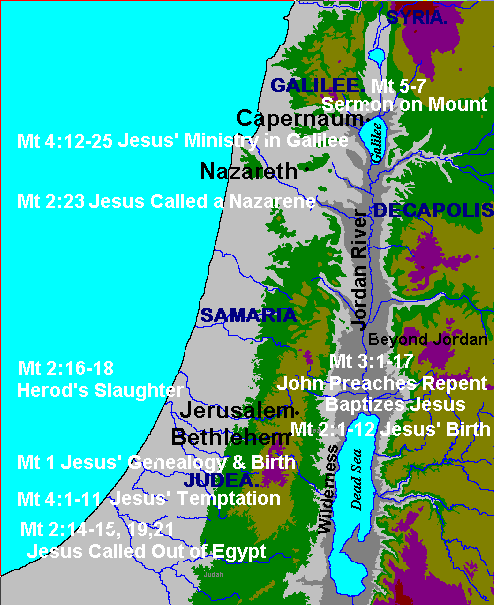
What are the 4 geographic locations in this drama? 1) Jerusalem - Mt 2:1, 2:3 2) Bethlehem - Mt 2:1, 2:5-6, 2:8, 16 3) Egypt - Mt 2:13-15, 19 4) Nazareth - Mt 2:23 (cf 4:13) Who are the 4 groups of "actors" in Jerusalem and what are their "re-actions" to Messiah "the King"? 1) Magi: from east, seek to worship He Who is born "King of the Jews" Mt 2:1-2
What does a A "kingdom" - keep that thought in mind in Mt 3:2, 4:17, 23, 5:3, 10, 19, 20, 6:10, 6:13, 6:33, 7:21) Worship (pros = before + kuneo = kiss) to kiss toward, throw kisses as one bows to their knees sometimes in the Orient touching their forehead to the ground 2) Herod: troubled (Click) (Mt 2:3), deceptive (liar) (Mt 2:7-8), murderer (Mt 2:16-18) 3) All Jerusalem: troubled (Mt 2:3) 4) Chief priests & scribes: knowledge without action (indifferent) What did the chief priests and scribes clearly understand? OT prophecy in Micah 5:2 of Messiah's specific place of birth At this time extra-biblical sources report that (1) there were as many as 60 men purporting to be the Messiah and (2) there was a general feeling that the Messiah would arrive. And yet the priests and scribes were indifferent! (cf Luke 3:15 realizing that this was some 30 years later) How does the (Gentile) Magi's attitude toward Messiah contrast with (Jewish) priests and scribes? Rejoiced to see His star (Mt 2:10), Fell down and worshiped Him (Mt 2:11), Presented Him gifts (Mt 2:11) Note order: See Him, fall down, worship, then present gifts - He wants us to present ourselves to Him (cf 2 Cor 8:5, Ro 12:1) before we present our gifts and service to Him. Are you serving and yet not worshiping beloved? When wise men came seeking for Jesus from far, With rich gifts to greet Him and led by a star, They found in a stable the Savior of men, A manger His cradle, so poor was He then. Though laid in a manger, He came from a throne, On earth though a stranger, in Heaven He was known. How lowly, how gracious His coming to earth! His love my love kindles to joy in His birth. (R. Slater, Play hymn) What 4 Messianic prophecies are fulfilled in Mt 2? Birth place - Bethlehem Mt 2:6 = Mic 5:2 Callout of Egypt - Mt 2:15 = Ho 11:1 Herod's attempt to kill - Mt 2:18 = Jer 31:15 Home in Nazareth - called a Nazarene Mt 2:23, no single prophet |
What are the main divisions in Matthew 3? Mt 3:1-12: John ("Gift of Jehovah") the Baptist's ministry Mt 3:13-17: Jesus' Baptism (cf. Mark 1:9-11; Luke 3:21, 22-note; John 1:32-34) Note that some 30 years elapsed (Luke 3:1 gives time) between the return of Jesus, Joseph and Mary from Egypt to Nazareth (cf Mt 2:23 and 3:1. Only Lu 2:39-52 gives any information on these years) Mt 3:1-12 Isaiah the prophet Mt 3:3 = Isaiah 40:3 What was John's purpose? Cry out in the wilderness and make ready the way of the Lord, make His (Messiah) paths straight (cf Mal 3:1) How did John prepare the way for Messiah? Preaching (Click note) "Repent" (Click) (present imperative) John was calling the Jewish audience to have a radical change of thinking. It does not mean as many English dictionaries define it simply to "be sorry about" or "to regret". (See excellent Scriptural picture of repent in 1Thes 1:9) Stop for a moment and try to picture the scene of this strangely dressed man all of a sudden appearing and "making a public proclamation with that formality, gravity, and authority which must be listened to and obeyed, in the uninhabited region of Judaea" (not in Jerusalem where all the religious people lived!). Keep the historical context in mind. Israel had not heard from God for 400 years - now after 4 centuries of silence they hear God's prophetic word through John and of all places in the barren region of the Judean desert! One had to want to hear a word from God to come to this desolate pulpit! And what a message it was! (cf Elijah 1 Ki 18:21) Play: Repent the Kingdom Draweth Nigh Mt 3:8 How can one recognize repentance as genuine? Fruit (cf Mt 7:16-20, 23, 24) A change of mind should be accompanied by a change of conduct (fruit as manifest in one's thoughts, words and deeds!) (See note) (See word study on fruit = Greek word karpos) What did John give as positive motivation to encourage the Jews to manifest a radical change of thinking? The Kingdom of Heaven was at hand = had come near and was imminent! (remember John's purpose was to prepare the way for the King cf Isa 40:3)
Messiah the King was about to step onto the stage of history! So as the Amplified Version says "think differently; change your mind, regretting your sins and changing your conduct" "Kingdom of heaven" (Click discussion) is used 32 times (31 verses) (click uses) and only by Matthew. Mt 3:5-6 What else was John doing besides preaching? Baptizing in the Jordan River those who had confessed their sins. (See note) Mt 3:7-12 How did John's message change when "he saw many of the Pharisees and Sadducees coming for baptism" (see note on "vipers")? How would you sum it up in these verses? "Turn or burn" Repent or experience coming judgment Bring forth fruit in keeping with repentance - Mt 3:8 Have a change of thinking (repent) and stop thinking that because as a Jew one could claim Abraham as physical father assured escape from the wrath to come - Mt 3:9 (see note) "Change your thinking" This was John's clear call and do it now because the Kingdom (and the King) is near. Otherwise you will experience the alternative, the fire of judgment and God's wrath. John pictures judgment in several ways: 1) Wrath to come (Mt 3:7) 2) Axe at the root of the trees - trees that do not bear good fruit will be "cut down and thrown into the fire" (Mt 3:10), 3) Baptism "with...fire" (Mt 3:11) 4) Burning "up the chaff with unquenchable fire" (Mt 3:12) Mt 3:13-17 To baptize him What was John's reaction? Tried to prevent Him What was Jesus' rationale? To fulfill all righteousness - interpretation is debated but at least part of the answer seems to be that He might fully identify with those He came to rescue. What happened at Jesus' baptism? Spirit of God descended on Him as a dove His Father spoke from heaven "This is My beloved Son in Whom I am well pleased" What do you learn about God in these verses? What doctrine is portrayed? The Trinity God was pleased that Jesus had fulfilled all righteousness |
What are the main divisions in Matthew 4? Mt 4:1-11: Temptation of Jesus Mt 4:12-17 Jesus' Ministry Begins Mt 4:18-22 Jesus Calls His Disciples Mt 4:23-25 Jesus in Galilee Teaching, Preaching, Healing Mt 4:1-11 What are the circumstances leading to Jesus' temptation? When? "Then" = follows His baptism and His Father's praise How? Spirit led Him (cf "full of the Spirit" Lu 4:1, 14, 18, Mk 1:12 adds that "immediately the Spirit impelled [ekballo = threw out, jettisoned] Him out into the wilderness") What purpose? To be tempted (cf Heb 2:18, 4:15-16, 5:2, 5:7-9) What are the names of the Jesus' opponent? Mt 4:1, 5, 8, 11 Devil Diabolos (dia = between + ballo = throw) his name = his purpose = "to throw between" = cause division Mt 4:3 Tempter (only in 1Th 3:5, cf same verb used in Mt 16:1, 19:3, 22:18, 22:35, note who "tests" Him; pictured in Ge 3:1, 4-5) Mt 4:10 Satan (false accuser Zec 3:1, adversary, cf Job 1:6-12, 2:1-8, 2Sa 24:1 = 1Chr 21:1, Luke 22:31, 1Pe 5:8-9, Rev 12:9-10) How does Jesus counter the Devil's 3 temptations? With the Word of God
Mt 4:12-17 Where does Jesus begin His ministry and why? Galilee because He heard John had been taken into custody (This marks Jesus' official beginning of His public ministry) (cf, "Jesus returned to Galilee in the power of the Spirit" Lu 4:14) First to Nazareth then left (Lu 4:16-30 explains why He left) Jesus went and settled in Capernaum What was significant about His travels? Fulfilled prophecy Isaiah 9:1-2 - Land of Zebulun & Naphtali = Galilee of the Gentiles (so named because Galilee lay on the route thru which all Gentiles passed in and out of Israel) Note providential outworking of God - John in prison leads to Jesus moving into Galilee to fulfill prophecy. Once again Matthew is appealing to the Jews who should have known the OT Scriptures. How were the people described (Mt 4:16)? Sitting in darkness - saw a great light Shadow of death - a light dawned Jesus = the "Great Light" (cf Jn 1:9, 8:12, 12:46) How did He shine His light (Mt 4:17)? Preached - Repent, for the Kingdom of heaven is at hand. (cf Mark 1:15 "The time is fulfilled, and the kingdom of God is at hand; repent and believe in the gospel.") (His Light was also seen in Mt 4:23 in His teaching, preaching and healing) Who is proclaiming this message about the Kingdom of Heaven? (cf Mt 2:2) The "King of the Jews"!
Mt 4:18-22 Who does Jesus call and what is their response? Peter, Andrew, James and John - all fisherman Immediately left... followed (Mt 4:20,22) What does the picture of "left...followed Him" define? Disciple What did they leave? What did it Their livelihood (nets, boat, father ~ relatives) (Note) Mt 4:23-25 What was Jesus doing throughout all Galilee? Teaching in synagogues Preaching the gospel of the Kingdom (cf Mk 1:15) Note: This "good news" is most likely not the same as the "gospel" of His death for our sins, burial and resurrection (cf 1Cor 15:1-5) because this was the beginning of His ministry. The good news for His audience of Matthew 4 would have been that the kingdom (King) had come into their midst. Healing every kind of disease and sickness Note: Jesus' message and miracles set Him distinctly apart from the many false "Messiahs" that according to extra-biblical sources had arisen at that time What was News spread Large crowds followed Where were Syria, Galilee, Decapolis, Jerusalem, Judea, beyond (east of) the Jordan |
|
Sermon on the Mount |
||||
| Matthew 5 | Matthew 6 | Matthew 7 | ||
|
Where is Jesus? On the mountain Sitting down- when Rabbis sat down it indicated that what they were going to say was official Teaching Disciples are present Great multitudes (large crowds) (cf Mt 4:25, 5:1, 7:28, 8:1) What is the first major division of Matthew 5? What is repeated? Mt 5:3-12 Blessed...nine times What happens to the "blessed" in Mt 5:10-12? Persecution (not a popular topic to preach from the pulpit!) Why? What relationship might this treatment have to what Jesus has just taught? For the sake of righteousness (those qualities demonstrated in Mt 5:3-9) What does "righteousness" mean (in simple terms)? righteousness = is what is right before God. The world knows another type of righteousness = that which is right before men. Watch Jesus contrast these two types of righteousness in His teaching that follows righteousness is can also be defined as Right character (inner) before God and right conduct (external motivated by inner) before men. righteousness is what is right according to God's standards (His Word, His character) God's righteousness is all that God is, all that He commands, all that He demands, all that He approves, all that He provides (through Christ). How does Jesus describe the blessed in Mt 5:13-16? Salt - adds flavor, preserves, etc Light - shines, shows the way in darkness, etc What is the relationship to the previous verses Mt 5:3-12? These word pictures (metaphors) describes the calling (the purpose) of those who are the "blessed" What is the main subject of the next division Mt 5:17-20? (Clue: How does Jesus begin?) The Law and the Prophets = Old Testament (OT) (another synonym for the OT is the word "Scriptures", eg Mt 21:42) What does Jesus say about His relationship to the Law and the authority of the Law? He fulfills the Law and the Prophets What happens to those who annul or do away with the commands Mt 5:19? Least in the Kingdom of Heaven Who might Jesus have been speaking to with this warning? Jesus was alluding to the scribes and Pharisees. What is the righteousness Jesus says one needs in order to enter the Kingdom of heaven? Greater than the Scribes and Pharisees Scribes = writers learned in the Mosaic law and in sacred writings Pharisees = the religious leaders who originated during the 400 years of silence (inter-testament period between the Old and New Testaments) who held strictly to the Law and added many commandments and traditions to God's Law. (see description) This is the key verse of the Sermon on the Mount which describes the righteous lifestyle of those who enter the Kingdom of Heaven What did you learn about the Kingdom of Heaven in Mt 5-7?
What does this statement imply about those who are truly part of the Kingdom of Heaven? How does this relate to the church today? They are not necessarily the "super" religious. What is the pattern Jesus uses in the last major section of Mt 5:21-48? "You have heard..." What had they heard? The Law Why does Jesus make the contrasting declaration "but I say"? Is He adding a new "stroke" to the Law? Is He annulling the Law and teaching His disciples and the multitudes to do the same? Clearly He is not adding to, changing or annulling the Law = He specifically addressed those issues in (Mt 5:17-20) Jesus took the Law to it's deeper meaning, explaining the heart of the Law. What kind of righteousness does Jesus proceed to explain in this section (Mt 5:21-48)? True righteousness - a righteousness demanded by the Father A new way of thinking about righteousness ("you have heard" ... "but I say") What is another way to describe a "new way of thinking"? Repentance What did John (Mt 3:2) and Jesus (Mt 4:17) preach was necessary to enter the Kingdom of heaven? Repentance - So what does Jesus seek to do to show them regarding their thinking? Change the way they think about righteousness - not external righteousness they had been taught by their Scribes and Pharisees but internal righteousness as He explains - then you will enter the Kingdom of Heaven What are the basic Laws that they had heard taught, that Jesus now takes to a deeper level ("but I say")? Mt 5:21-26 Murder Mt 5:27-30 Adultery Mt 5:31-32 Divorce Mt 5:33-37 False vows Mt 5:38-42 Eye for an eye Mt 5:43-47 Love your enemy What impossible standard does God call His audience (and each of us) to in Mt 5:48? To be Perfect like His Father How does Mt 5:48 The greater righteousness that Jesus called His audience to in Mt 5:20 is ultimately the righteousness of His Father |
What is the key verse that helps unlock Matthew 6:1-18? M 6:1 is the key verse - Jesus' warns his audience to beware of practicing their righteousness before men to be noticed by them. Matthew 6:1-18 then practical righteousness contrasting it with genuine righteousness Matthew 5:21-48 is about perverted righteousness What are the general categories of practical righteousness which Jesus addresses? What word introduces them? When...Mt 6:2, 5, 7 Whenever... Mt 6:16
Did you read each of these "when..." by first reading Mt 6:1? Try it... Mt 6:1 > 6:2 Mt 6:1 > 6:5-6 Mt 6:1 > 6:7-15 Mt 6:1 > 6:16 What are key repeated words in Matthew 6:1-18? Reward (Mt 6:1, 2, 4, 5, 6, 16, 18) Father (Mt 6:1, 4, 6, 8, 9, 14, 15, 18 What is Jesus' point? Does He teach one should not be motivated by rewards? He does not condemn rewards He condemns the practice when it is performed to please men not our Father In short He condemns a wrong motive for rewards In Matthew 6:19-34 Jesus teaches several things not to do. What does He say not to do and what is the contrast He presents? Mt 6:19 Do not story up for yourselves treasures on earth Mt 6:20 In contrast ("but") Store up for yourselves treasures in heaven Mt 6:21 What does where you store your treasure teach? Where your heart is - remember that the Jews were used to performing acts according to the letter of the Law but were not obeying from the heart. What does Jesus teach is not possible according to Mt 6:24? No one can serve two masters What master competes with God? Mammon Now keeping context in mind (treasure on one side and mammon on the other) what is Jesus teaching about the clear eye versus the bad eye in Mt 6:22-23? He is referring to the eye as the organ which sees and which desires what it sees. If it covets treasure on earth or mammon, it is not clear but will fill the body with darkness. What is the main subject in Mt 6:25-34? Worry What was the worry over? Things What does Jesus say not to do? Mt 6:25 Do not be worried about your life Mt 6:31 Do not worry about what you will eat, drink or wear What is Jesus' prescription for worry over necessities of life (Mt 6:33)? Seek first His kingdom and His righteousness All these things |
What does Jesus command against in Matthew 7:1-5? Do not judge Why not judge? To judge is to suffer To judge is to be blind to one's own faults (Mt 7:3-5) What is Jesus saying - is He saying one should never exercise discernment? No, because in Mt 7:5 he affirms the speck removing ministry as long as the log has been removed from our own eye. (Compare also Mt 7:6, 15-21) What is Jesus instruction Do not give what is holy to dogs Do not throw your pearls before swine Note that determining who is a "dog" or "swine" involves some discernment (~judgment)! We'll discuss these in later lessons What does Jesus command in Mt 7:7-11? Why repeat prayer now? What is the context? Prayer - Ask, seek, knock All (present imperative) = keep on asking, keep on seeking, keep on knocking We need God's wisdom to judge correctly (cf Solomon's request 1 Ki 3:9) We need God's heart and power to fulfill the command in Mt 7:12 What is Jesus' instruction in Mt 7:12 and how do many refer to this verse? Treat people This is the golden rule The Law and Prophets taught how to do this, but His audience needed a change of thinking. Jesus spoke of the heart of the Law. Our righteous treatment of others should not be for outward show but from the heart to please our Father. Which of Jesus' instructions hits home to you? On which of these do you need to have a change in the way you think so that you change the way you act? What is the tenor of the last section of Jesus' sermon (Mt 7:13-27)? Jesus gives clear warnings... Mt 7:13-14 2 Gates, 2 Ways Mt 7:15-20 False prophets - 2 Trees known by their fruits (cf Mt 3:8) Mt 7:21-23 False profession (relate this to Mt 5:20) - The problem is that the person has religious activity but continually practices lawlessness (cf Mt 3:8) Mt 7:24-27 False foundation - 2 Builders and 2 Houses - Hearing Jesus' words without obedience will bring a great fall What was the crowd's reaction to the Sermon? Why? Amazement Teaching with authority not as one of their scribes (who quoted the various rabbis and so-called experts of the Law) - Jesus' voice had an unusual, unmistakable ring of authority and no wonder, for they were listening to the King Himself! What is your reaction to Jesus' Sermon on the Mount? Amazed? Convicted that you need a change of thinking in some area? Continue this study that you might have your thinking more and more conformed to the mind of Christ (cf 1Co 2:16). You will know how to be obedient from the heart. Summary Mt 1: Jesus' genealogy & birth Mt 2: Magi, Herod, Jesus to Egypt then Nazareth Mt 3: John the Baptist, repent, Jesus baptized Mt 4: Jesus Tempted, preached repent Mt 5: Blessed, You've heard but I say Mt 6: Giving, praying, fasting Don't store up, Don't worry, Seek first Mt 7 Don't Judge, 2 gates, 2 trees, false profession, 2 foundations Do you really want to be righteous? |
||
The genealogy of Jesus Christ, the Son of David, the Son of Abraham...
This introduction reflects the fact that Israel was anticipating the arrival of their long promised King, but most of the Jews misunderstood the coming King's purpose. Most were looking for a political king who would overthrow the crushing Roman rule. And so Matthew presents the royal blood line of the King of the Jews. Comparison of Matthew's genealogy with Luke's genealogy can be confusing and lead one to believe that they are two entirely different genealogies, which they are. The simple explanation is that Matthew gave Messiah's ancestry through his step father Joseph and Luke presented his physical blood line through Mary's ancestors.
Matthew's Genealogy > Through Joseph > Royal line
Luke's Genealogy > Through Mary > Physical line
Second Samuel records the prophesied line of the future King, God speaking to King David through the prophet Nathan, declaring...
"When your days are complete and you lie down with your fathers, I will raise up your descendant after you, who will come forth from you, and I will establish his kingdom. He shall build a house for My name, and I will establish the throne of his kingdom forever. (2 Samuel 7:12-13)
This declaration is often referred to as the "Davidic Covenant" although the word "covenant" or the act of cutting of a covenant is not specifically stated. To be sure it was a promise from Jehovah which Matthew shows (in the context of his entire gospel) is fulfilled in one person alone, the person of Jesus Christ.
Now if you've looked at Luke's genealogy, you may still be somewhat confused. Luke begins...
And when He began His ministry, Jesus Himself was about thirty years of age, being supposedly the son of Joseph, the son of Eli (Heli) (Luke 3:23-note)
Luke affirms the Virgin Birth by the phrase "being supposedly...son of Eli. From Matthew's genealogy we know that Joseph was Jacob's son by birth, for Matthew records...
and to Jacob was born Joseph the husband of Mary, by whom was born Jesus, who is called Christ. (Matt. 1:16)
So who is Joseph's father? Jacob or Eli? It cannot be both. The clue is "being supposedly...son of Eli (Heli)" (or as the NCV paraphrases it "People thought that Jesus was Joseph’s son") which is another way of saying that yes Jesus was related to Joseph who was His step-father. Joseph was also related to Eli, but via his betrothal and marriage to Mary, as this was Mary's physical father. Thus Eli was Joseph's father in law. In short, Luke's record is apparently the genealogy of Jesus through His mother, Mary. Below is a simple diagram (from Believer's Study Bible) summarizing the facts concerning the two genealogical records of Jesus.
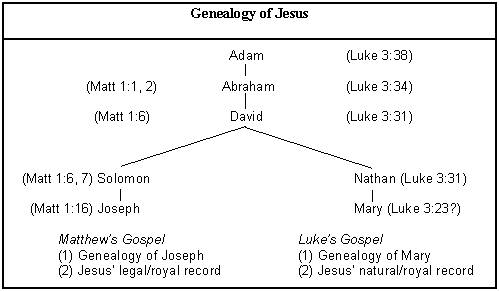
Chart From Bible Knowledge Commentary
Matthew began with Abraham and went forward in time. Luke began with Jesus and went backward in time, including but going past Abraham's time (Luke 3:34) all the way back to the beginning, to "Adam, the son of God" (Lu 3:38).
Morris in the Defender's Study Bible explains Luke's genealogy this way...
Joseph was clearly the son of Jacob (Matthew 1:16), so this verse should be understood to mean "son-in-law of Heli." Thus, the genealogy of Christ in Luke is actually the genealogy of Mary, while Matthew gives that of Joseph. Actually the word "son" is not in the original, so it would be legitimate to supply either "son" or "son-in-law" in this context. Since Matthew and Luke clearly record much common material, it is certain that neither one could unknowingly incorporate such a flagrant apparent mistake as the wrong genealogy in his record. As it is, however, the two genealogies show that both parents were descendants of David--Joseph through Solomon (Matthew 1:7-15), thus inheriting the legal right to the throne of David, and Mary through Nathan (Luke 3:23-31-note), her line thus carrying the seed of David, since Solomon's line had had been refused the throne because of Jeconiah's sin. (Bolding added)
There is still one "sticky point". The following explanation is somewhat confusing but read it slowly with the corresponding Scriptures. In the preceding note by Morris, he makes mention of Jeconiah who is in the legal or royal line of Joseph (see Mt 1:11,12). Jeconiah (sometimes called Coniah) was a descendant from David through Solomon. Jeconiah was the last king of Judah in the direct line from King David. When he was deported to Babylon by Nebuchadnezzar (2Chronicles 36:10), Jeconiah's uncle Zedekiah was assigned to rule Judah for a brief reign, but he also was put down, and no later king related to David was ever able to regain the throne. So it might appear as if God had broken His promise to David "I will establish the throne of his kingdom forever." (2 Sa 7:14) But look at the diagram above and note that it "splits" at King David, one branch going through King Solomon and the other through the physical line, Nathan, one of David's physical sons. King Jeconiah arose from King Solomon's line but read God's decree upon Jeconiah and his line
"Thus says the LORD, 'Write this man down childless (1Chr 3:17-18 indicate that Jeconiah actually had sons - he was "childless" in the sense that none of his offspring would ever occupy David's throne as shown in the latter part of this verse) . A man who will not prosper in his days, for no man of his descendants will prosper sitting on the throne of David or ruling again in Judah.'" (Jeremiah 22:30)
Compare the preceding verse with God's reiteration of His promise to David, which Jeremiah records as a prophecy of Messiah...
'In those days and at that time I will cause a righteous Branch of David (the Messiah) to spring forth; and He shall execute justice and righteousness on the earth. 'In those days (describes His second coming at the end of Daniel's Seventieth Week at which time He establishes His Millennial Kingdom) Judah shall be saved (cf Ro 11:26-27, Zech 12:10, 13:7-9 where the "all" of Romans 11:26 equates with the believing remnant, the 1/3 of Jews that come through the Great Tribulation having placed their faith in Messiah), and Jerusalem shall dwell in safety (Millennial Kingdom); and this is the name by which she shall be called: the LORD is our righteousness (Millennial Kingdom).' "For thus says the LORD, 'David shall never lack a man to sit on the throne of the house of Israel" (the only way that David could have a legitimate heir was through the "non-cursed" line of Nathan) (Jeremiah 33:15-17)
So God solves this obvious dilemma by providentially ordering that Messiah would come through King David's son, Nathan, who had no curse (that his line could not give birth to a king) and therefore who could give rise to a physical heir who could qualify as a King from the line of David. Thus Luke records Messiah's descent through Nathan to Mary (the "seed of the woman" Genesis 3:15).
In fairness, not everyone agrees with the above explanation and that perfect and completely satisfactory resolution of Matthew's and Luke's genealogies is difficult to establish. On the other hand, what is clearly established is that Messiah descends physically from the line of David and thus fulfills the God's immutable promise that David would have have an heir on the throne forever. Amen!
Troubled (5015) (tarasso) means agitated, shaken like water in a glass sharply jarred, causing inward commotion which takes away one's calmness of mind, disturbs one's equanimity and makes one restless. It can mean to strike one's spirit with fear and dread. To render anxious or distressed. To perplex the mind by suggesting scruples or doubts. Figuratively of the mind, stirred up, troubled, disturbed with various emotions such as fear.
Baker New Testament Commentary ties these first three chapters together commenting that...
In chapters 1 and 2 Matthew has revealed to us the greatness of the Christ, the true Son of David, the One to whom even wise men from the east rendered homage. It is proper that a king, especially such a king, have a herald to proclaim his approach. This herald was John the Baptist...Everything about John was startling: his sudden emergence, manner of dress, choice of food, preaching, and baptizing...He was preaching in “the wilderness of Judea,” a term indicating the rolling bad lands between the hill country of Judea to the west, and the Dead Sea and lower Jordan to the east, stretching northward to about the point where the Jabbok flows into the Jordan. It is indeed a desolation, a vast undulating expanse of barren chalky soil covered with pebbles, broken stones and rocks. Here and there a bit of brushwood appears, with snakes crawling underneath (see verse 7). It is clear, however, from Matt. 3:5 (cf. John 1:28) that the terrain of John’s activity extended even to the east bank of the Jordan. It included the entire region around—i.e., on both banks of this part of—the Jordan. (Hendriksen, W., & Kistemaker, S. J. Vol. 9: New Testament commentary : Exposition of the Gospel According to Matthew. Grand Rapids: Baker Book House)
Preaching (2784) (kerusso) primarily means to herald or cry out in public. It was used of the official whose duty it was to proclaim loudly and extensively the coming of the king. Kerusso conveys a suggestion of formality, gravity and an authority which must be listened to and obeyed. Greco-Roman rulers had special heralds made announcements to the people, having been commissioned by the ruler and making their announcements in a loud, clear voice so everyone could hear. The herald described not an ambassador but a messenger with a proclamation to be heard and heeded. In the ancient world not to heed the ruler’s herald was serious and to abuse the messenger was even worse.
A T Robertson discussing John's amazing wardrobe wonders...
Would such an uncouth figure be welcome today in any pulpit in our cities? (Word Pictures in the New Testament)
The Amplified Version has a nice "definition" of "repent" built into the translation (one of the advantages of checking this version, the phrases in parentheses functioning almost like a "mini-lexicon" if you will)...
And saying, Repent (think differently; change your mind, regretting your sins and changing your conduct), for the kingdom of heaven is at hand.
Repent (metanoeo) (Click word study of related noun form metanoia) means to have another mind and so to change one's mind and to think differently. It means to turn around, to change direction or to change the mind and will. It does not denote just any change, but always a change from the wrong to the right, away from sin and to righteousness. This change of mind may be preceded by sorrow (cf 2Co 7:8-11); but sorrow for sin, though it may cause repentance, is not repentance. To repent is to demonstrate a godly sorrow for sin, to turn around and to go in the opposite direction. John A. Broadus (Commentary on Matthew) observes that “wherever this Greek word is used in the New Testament the reference is to changing the mind and the purpose from sin to holiness.”
For an excellent illustration of repentance see 1 Thes 1:9-10-note (Paul is speaking about the Gentile converts in Macedonia and Achaia).
Baker NT Commentary notes that John's "message was not prolix but pithy, not soothing but soul-searching, not flattering but frightening, at least to considerable degree. He was a preacher of imminent doom (see Mt 3:7, 10), a catastrophe that could be avoided only by a, radical turnabout of mind and heart. (ibid)
The Bible Knowledge Commentary notes that "The concept of a coming kingdom was well known in Old Testament Scriptures. But the idea that repentance was necessary in order to enter this kingdom was something new and became a stumbling block to many Jews. They thought that as children of Abraham they would automatically be granted entrance into Messiah’s kingdom. John’s message, however, was that a change of mind and heart (metanoeite, “repent”) was necessary before they could qualify for the kingdom. They did not realize how far they had drifted from God’s Law and the requirements laid down by the prophets (e.g., Mal 3:7-12). (Walvoord, J. F., Zuck, R. B., & Dallas Theological Seminary. The Bible knowledge commentary : An exposition of the scriptures. Wheaton, IL: Victor Books)
Kingdom of heaven: (see related discussion on "the Kingdom") Matthew is the only Gospel to use this specific phrase, the other Gospel's using the phrase "Kingdom of God". Most authorities agree that since Matthew's target audience was primarily Jews, he avoided using the name "God" so as not to offend the Jews who traditionally neither pronounced or wrote the name "God". As we shall see in the Sermon on the Mount, the its primary meaning of "Kingdom of heaven" is on “God’s kingly rule.” That is, the basic emphasis is on the actual rule of God as an activity, rather than on the realm or territory over which He rules. This will become clearer in later studies. Click here to study over 100 uses of the "Kingdom" most of which refer to the Kingdom of Heaven/God.
John MacArthur has a discussion of "kingdom of heaven" writing that...
Although the precise phrase is not found there, the kingdom of heaven is basically an Old Testament concept. David declares that “the Lord is King forever and ever” (Ps. 10:16; cf. Ps 29:10), that His kingdom is everlasting, and that His dominion “endures throughout all generations” (Ps. 145:13). Daniel speaks of “the God of heaven [who] will set up a kingdom which will never be destroyed” (Dan 2.:44; cf. Ezek 37:25), a “kingdom [that] is an everlasting kingdom” (Dan. 4:3). The God of heaven is the King of heaven, and the heavenly kingdom is God’s kingdom. Matthew uses the phrase kingdom of heaven thirty-two times, and is the only gospel writer who uses it at all. The other three use “the kingdom of God.” It is probable that Matthew used kingdom of heaven because it was more understandable to his primarily Jewish readers. Jews would not speak God’s name (Yahweh, or Jehovah), and would often substitute heaven when referring to Him-much as we do in such expressions as “heaven smiled on me today.” There is no significant difference between “the kingdom of God” and the kingdom of heaven. The one phrase emphasizes the sovereign Ruler of the kingdom and the other emphasizes the kingdom itself, but they are the same kingdom. Matthew 19:23-24 confirms the equality of the phrases by using them in interchangeably.
The kingdom has two aspects, the outer and the inner, both of which are spoken of in the gospels. Those aspects are evident as one moves through Matthew.
In the broadest sense, the kingdom includes everyone who professes to acknowledge God.
Jesus’ parable of the sower represents the kingdom as including both genuine and superficial believers (Matt. 13:3-23), and in His following parable (Matt 13:24-30) as including both wheat (true believers) and tares (false believers). That is the outer kingdom, the one we can see but cannot accurately evaluate ourselves, because we cannot know people’s hearts. The other kingdom is the inner, the kingdom that includes only true believers, only those who, as John the Baptist proclaimed, repent and are converted. God rules over both aspects of the kingdom, and He will one day finally separate the superficial from the real. Meanwhile He allows the pretenders to identify themselves outwardly with His kingdom.
God’s kingly rule over the hearts of men and over the world may be thought of as having a number of phases.
The first is the prophesied kingdom, such as that foretold by Daniel (Da 2:44).
The second phase is the present kingdom, the one that existed at the time of John the Baptist and that he mentions. It is the kingdom that both John and Jesus spoke of as being at hand (cf. Mt 4:17).
The third phase may be referred to as the interim kingdom, the kingdom that resulted because of Israel’s rejection of her King. The King returned to heaven and His kingdom on earth now exists only in a mystery form. Christ is Lord of the earth in the sense of His being its Creator and its ultimate Ruler; but He does not presently exercise His full divine will over the earth. He is, so to speak, in a voluntary exile in heaven until it is time for Him to return again. He reigns only in the hearts of those who know Him as Savior and Lord. For those “the kingdom of God is … righteousness and peace and joy in the Holy Spirit” (Ro 14:17). (ED: ELSEWHERE MACARTHUR REFERS TO THIS AS THE "SPIRITUAL" KINGDOM OF GOD.)
The fourth phase can be described as the manifest kingdom, in which Christ will rule, physically, directly, and fully on earth for a thousand years, the Millennium (see notes on this website re: Millennium 1, Millennium 2, Millennium 3). In that kingdom He will rule both externally and internally-externally over all mankind, and internally in the hearts of those who belong to Him by faith.
The fifth, and final, phase is the “eternal kingdom of our Lord and Savior Jesus Christ,” which “will be abundantly supplied” to all of His own (see notes 2 Peter 1:11).
(MacArthur, J. 1989. Matthew. Chicago: Moody Press) (Bolding added)
The topic Kingdom of God (synonymous term = Kingdom of Heaven) can be confusing as the interpretation depends on the context in which it is used - It can mean a spiritual Kingdom, a Millennial Kingdom or a Kingdom in the New Heaven and New Earth (See table below). Many who espouse the teaching of replacement theology or supersessionism do not accept a literal earthly Kingdom of God. I am firmly convinced (from Scripture) that there will be a literal earthly Kingdom of God ruled by the King of kings, the Lord Jesus Christ. For that reason I have several detailed discussions on the Kingdom of God in the commentaries on the following verses (there is some repetition and overlap)...
- Luke 17:20-21-commentary
- Luke 19:11ff-commentary
- Acts 1:6-commentary
- Matthew 5:3 - commentary
|
THE KINGDOM OF |
||
| Internal Invisible |
In Hearts of Believers |
Present Age (Between 1st & 2nd Comings) |
| External Visible |
Literal On earth |
Messianic Age (After 2nd Coming) |
| External Visible |
Literal New Earth |
Eternal Age (After Christ gives Kingdom to Father) |
- Internal, Invisible - in hearts of believers only - in this present age (between Christ's First and Second Comings)
- External, Visible - literal earthly Kingdom - will include both believers ("internal" aspect of Kingdom) and unbelievers - in the next age (After Christ's Second Coming)
- External, Visible - literal heavenly Kingdom - only believers ("internal" aspect of Kingdom) - following age #2 (After Christ gives the Kingdom to His Father)
Mt 3:6 they were being baptized
Being baptized (click study of Greek verb baptizo) is in the imperfect tense which presents a vivid picture of over and over John was carrying out this act) by him in the Jordan River, as they confessed their sins.
The parallel passage in Luke reads...
And he (John the Baptizer) came into all the district around the Jordan, preaching a baptism of repentance for the forgiveness of sins. (Luke 3:3-note)
The idea is not that the baptizing saved anyone but that the only acceptable recipients of John's baptism were those who were willing to repent. The remission of sins, having already been accomplished in repentance, was symbolized in baptism. The New Living Translation helps us see this truth paraphrasing it as...
Then John went from place to place on both sides of the Jordan River, preaching that people should be baptized to show that they had turned from their sins and turned to God to be forgiven.
Pharisees - see word study on pharisaios (See Self-righteousness) originated in the 400 years between the Old and the New Testaments and by the time of Jesus were the most influential party among the people. Pharisees believed in the resurrection, angels, spirits and the coming of the Messiah but their primary "strength" was their knowledge of the Law. In fact they had reduced God's Law to a code of 365 negative commandments and 250 positive commandments, both of which included many of their own interpretations (think of Jesus' description "you have heard"... "but I say"). They claimed their interpretations came from direct inspiration and were God given. The upshot is that what they taught the average Jew was in essence a perversion of God's original Law. This fact explains why Jesus was so "hard" on the Scribes and Pharisees. As a result of their distorted teaching, sin had become reduced only to external acts, rather than being related to the internal condition of one's heart. Thoughts, words and deeds were declared "right or wrong" because an external condition was judged to have been absent or present (respectively). William Barclay gives a number of examples of this attention to the external at the expense of neglecting the internal. For example, if a Jew gave an offering (alms) to the poor on the Sabbath, the distortion of the Law stated that they could only give if the beggar placed his hand through the door to receive the offering. If the Jew making the offering extended his own hand out of the door to give the alms to the beggar, he was considered to have broken the Sabbath! Are their any traditions you are holding to which are not Biblical?
Easton's Bible Dictionary writes that Pharisees were...
Separatists (Heb. persahin, from parash, "to separate"). They were probably the successors of the Assideans (i.e., the "pious"), a party that originated in the time of Antiochus Epiphanes in revolt against his heathenizing policy. The first mention of them is in a description by Josephus of the three sects or schools into which the Jews were divided (B.C. 145). The other two sects were the Essenes and the Sadducees. In the time of our Lord they were the popular party (John 7:48). They were extremely accurate and minute in all matters appertaining to the law of Moses (Matthew 9:14; 23:15; Luke 11:39; 18:12). Paul, when brought before the council of Jerusalem, professed himself a Pharisee (Acts 23:6-8; 26:4,5).
There was much that was sound in their creed, yet their system of religion was a form and nothing more. Theirs was a very lax morality (Matthew 5:20; 15:4,8; 23:3,14,23,25; John 8:7). On the first notice of them in the New Testament (Matthew 3:7), they are ranked by our Lord with the Sadducees as a "generation of vipers." They were noted for their self-righteousness and their pride (Matthew 9:11; Luke 7:39; 18:11,12). They were frequently rebuked by our Lord (Matthew 12:39; 16:1-4).
From the very beginning of his ministry the Pharisees showed themselves bitter and persistent enemies of our Lord. They could not bear his doctrines, and they sought by every means to destroy his influence among the people. (Easton's Bible Dictionary)
William Barclay describes the Pharisees noting that...
In many ways the Pharisees were the best people in the whole country. There were never more than 6,000 of them; they were what was known as a chaburah, or brotherhood. They entered into this brotherhood by taking a pledge in front of three witnesses that they would spend all their lives observing every detail of the scribal law. What exactly did that mean? To the Jew the Law was the most sacred thing in all the world. The Law was the first five books of the Old Testament. They believed it to be the perfect word of God. To add one word to it or to take one word away from it was a deadly sin. Now if the Law is the perfect and complete word of God, that must mean that it contained everything a man need know for the living of a good life, if not explicitly, then implicitly. If it was not there is so many words, it must be possible to deduce it. The Law as it stood consisted of great, wide, noble principles which a man had to work out for himself. But for the later Jews that was not enough. They said: “The Law is complete; it contains everything necessary for the living of a good life; therefore in the Law there must be a regulation to govern every possible incident in every possible moment for every possible man.” So they set out to extract from the great principles of the law an infinite number of rules and regulations to govern every conceivable situation in life. In other words they changed the law of the great principles into the legalism of by-laws and regulations.
The best example of what they did is to be seen in the Sabbath law. In the Bible itself we are simply told that we must remember the Sabbath day to keep it holy and that on that day no work must be done, either by a man or by his servants or his animals. Not content with that, the later Jews spent hour after hour and generation after generation defining what work is and listing the things that may and may not be done on the Sabbath day. The Mishnah is the codified scribal law. The scribes spent their lives working out these rules and regulations. In the Mishnah the section on the Sabbath extends to no fewer than twenty-four chapters. The Talmud is the explanatory commentary on the Mishnah, and in the Jerusalem Talmud the section explaining the Sabbath law runs to sixty-four and a half columns; and in the Babylonian Talmud it runs to one hundred and fifty-six double folio pages. And we are told about a rabbi who spent two and a half years in studying one of the twenty-four chapters of the Mishnah.
The kind of thing they did was this. To tie a knot on the Sabbath was to work; but a knot had to be defined.
“The following are the knots the making of which renders a man guilty; the knot of camel drivers and that of sailors; and as one is guilty by reason of tying them, so also of untying them.”
On the other hand knots which could be tied or untied with one hand were quite legal. Further,
“a woman may tie up a slit in her shift and the strings of her cap and those of her girdle, the straps of shoes or sandals, of skins of wine and oil.”
Now see what happened. Suppose a man wished to let down a bucket into a well to draw water on the Sabbath day. He could not tie a rope to it, for a knot on a rope was illegal on the Sabbath; but he could tie it to a woman’s girdle and let it down, for a knot in a girdle was quite legal. That was the kind of thing which to the scribes and Pharisees was a matter of life and death; that was religion; that to them was pleasing and serving God.
Take the case of journeying on the Sabbath. Ex16:29 says:
“Remain every man of you in his place; let no man go out of his place on the seventh day.”
A Sabbath day’s journey was therefore limited to two thousand cubits, that is, one thousand yards. But, if a rope was tied across the end of a street, the whole street became one house and a man could go a thousand yards beyond the end of the street. Or, if a man deposited enough food for one meal on Friday evening at any given place, that place technically became his house and he could go a thousand yards beyond it on the Sabbath day. The rules and regulations and the evasions piled up by the hundred and the thousand.
Take the case of carrying a burden. Jeremiah 17:21–24 said:
“Take heed for the sake of your lives and do not bear a burden on the Sabbath day.”
So a burden had to be defined. It was defined as “food equal in weight to a dried fig, enough wine for mixing in a goblet, milk enough for one swallow, honey enough to put upon a wound, oil enough to anoint a small member, water enough to moisten an eye-salve,” and so on and on. It had then to be settled whether or not on the Sabbath a woman could wear a brooch, a man could wear a wooden leg or dentures; or would it be carrying a burden to do so? Could a chair or even a child be lifted? And so on and on the discussions and the regulations went.
It was the scribes who worked out these regulations; it was the Pharisees who dedicated their lives to keeping them. Obviously, however misguided a man might be, he must be desperately in earnest if he proposed to undertake obedience to every one of the thousands of rules. That is precisely what the Pharisees did. The name Pharisee means the Separated One; and the Pharisees were those who had separated themselves from all ordinary life in order to keep every detail of the law of the scribes.
Sadducees - see articles on Sadducees
The origin of this Jewish sect cannot definitely be traced. It was probably the outcome of the influence of Grecian customs and philosophy during the period of Greek domination. The first time they are met with is in connection with John the Baptist's ministry. They came out to him when on the banks of the Jordan, and he said to them, "O generation of vipers, who hath warned you to flee from the wrath to come?" (Matthew 3:7.) The next time they are spoken of they are represented as coming to our Lord tempting him. He calls them "hypocrites" and "a wicked and adulterous generation" (Matthew 16:1-4; 22:23). The only reference to them in the Gospels of (Mark 12:18-27) and (Luke 20:27-38) is their attempting to ridicule the doctrine of the resurrection, which they denied, as they also denied the existence of angels. They are never mentioned in John's Gospel. There were many Sadducees among the "elders" of the Sanhedrin. They seem, indeed, to have been as numerous as the Pharisees (Acts 23:6). They showed their hatred of Jesus in taking part in his condemnation (Matthew 16:21; 26:1-3,59; Mark 8:31; 15:1; Luke 9:22; 22:66). They endeavoured to prohibit the apostles from preaching the resurrection of Christ (Acts 2:24,31,32; 4:1,2; 5:17,24-28). They were the deists or skeptics of that age (denied resurrection). They do not appear as a separate sect after the destruction of Jerusalem (Easton's Dictionary)
Viper (Greek = echidna) was an adder or other poisonous snake, and here is used figuratively to describe the character and conduct of the Jewish religious leaders, the Pharisees and Sadducees, who at this time were coming out to be baptized by John, probably because so many Jews had already come out to John.
Literally a viper was a small poisonous snake that lived primarily in the desert regions of Palestine (e.g., the wilderness of Judea which was essentially a barren, rocky desert like area and was where John was crying "Repent" and baptizing those who had confessed their sins). Because the viper looked like a dried twig when they were still, a person collecting wood for a fire would often pick one up inadvertently and be bitten, as happened to Paul on the island of Malta (Acts 28:3). That particular viper was deadly, and when Paul suffered no harm from the bite, the superstitious islanders thought he was a god (Acts 28:6). Vipers therefore had the understandable reputation for being both deadly and deceitful.
Jesus later in his ministry also twice (Mt 12:34, 23:33) referred to the unbelieving and unrepentant Pharisees and Sadducees a “brood of vipers”. Neither of the pithy messages of John the Baptist nor of Jesus had any positive effect on those perverted, "pious" men, but served only to harden their unbelief toward the King and their opposition toward His Gospel of the Kingdom, and His righteous messengers.
It is interesting to note that in pagan Greek culture, the viper (echidna) had long been associated with evil. In Greek mythology the name echidna was given to a monster deity that was half snake and half woman and that gave birth to other monsters, including the murderous sphinx of Thebes.
By the time of Christ, the term "viper" was universally associated with extreme wickedness and danger. Therefore when John the Baptist and later Jesus called the Pharisees, Sadducees and Scribes (Mt 23:29) a brood of vipers, He was declaring them to be both evil and deadly.
Fruit in keeping with repentance
There must be a genuine change in one’s lifestyle. A person who has truly repented will stop doing evil and begin to live righteously. Along with a change of mind and attitude, true repentance will begin to produce a change in conduct. (See separate word studies on fruit, keeping and repentance)
A T Robertson comments that
John demands proof from these men (Ed note: he is addressing the Pharisees and Sadducees) of the new life before he administers baptism to them. “The fruit is not the change of heart, but the acts which result from it” (McNeile). It was a bold deed for John thus to challenge as unworthy the very ones who posed as lights and leaders of the Jewish people. “Any one can do acts externally good but only a good man can grow a crop of right acts and habits” (Bruce). (Robertson, A. Word Pictures in the New Testament)
The Baker NT Commentary adds that...
repentance, if it is to be genuine, must be accompanied by fruit-bearing. A merely outward confession of sin will never do. A mere desire to be baptized, as if this rite were a wonder-working charm, has no positive value. There must be that inward change which expresses itself outwardly in God-glorifying conduct, fruit-bearing in keeping with conversion. According to Luke 3:10–14 this fruit-bearing must include such items as generosity, fairness, thoughtfulness, and contentment; according to Matt. 23:23, justice, mercy, and faith; and in view of the manner in which the Baptist descriptively addresses these Pharisees and Sadducees (“You offspring of vipers”), there must be uprightness. On fruit-bearing see also Matt. 5:20–23; 7:16–19; 12:33; 13:8, 23; 16:6, 11, 12; Mt 23; Luke 13:6–9; John 15:1–16; Gal. 5:22, 23; Eph. 5:9; Phil. 1:22; 4:17; Col. 1:6; Heb. 12:11; 13:15; and James 3:18. (Ibid, p204)
'We have Abraham for our father'
The Jews thought that having Abraham as their ancestor assured them of entry into the "kingdom of heaven", but they were sorely deceived as John declares. John the Baptist was fully aware of the fact that physical descent from Abraham did not guarantee being a true son of Abraham. (cf Ro 2:28-29)
Many Jews believed that salvation was based on their obedience to God in being circumcised, and that, therefore, their eternal security rested in that rite. In his commentary on the Book of Moses, Rabbi Menachem wrote,
“Our Rabbins [rabbis] have said that no circumcised man will ever see hell”
The book Akedath Jizehak taught that
“Abraham sits before the gate of hell, and does not allow that any circumcised Israelite should enter there” (fol. 54, col. 2).
A T Robertson adds that...
John touched the tender spot, their ecclesiastical pride. They felt that the “merits of the fathers,” especially of Abraham, were enough for all Israelites. At once John made clear that, reformer as he was, a breach existed between him and the religious leaders of the time. (Word Pictures in the New Testament)
the winnowing fork is in His hand...
Dwight Pentecost comments that...
In a very graphic way John transported his hearers to the harvest field. After the grain had been cut it was brought to the threshing floor, and the threshing sledge was dragged over it by oxen; then the grain was cast into the air in the evening when the breezes blew, so that the breeze might blow the chaff away and leave only the grain. John warned the nation Israel, in the light of his promise that Messiah was coming, that the Old Testament made it very clear that only the righteous, the redeemed, will be received into His Kingdom. The people had been convicted by John’s preaching of their unworthiness, their unrighteousness, and their sin. On one hand they were thrilled with the message of the fulfillment of the promise that Messiah was coming; on the other, they stood convicted of their unworthiness to meet Him. They were torn between the two, the desire to see Him and fear that they would be rejected by Him. (Pentecost, J. D. Design for living: Lessons in holiness from the Sermon on the mount. Page 15. Grand Rapids, MI: Kregel Publications)
Jesus endured the fullest force of temptation. Whoever yields before the end has never felt the worst part of the trial, which is always just before Satan gives up. It is because our Lord Jesus resisted to the very end that He knows, as no one else has ever known, just how severe the worst strain of temptation can be This is why He is so perfectly understanding as He helps us to overcome (Heb 2:18, 4:15, 16).
Follow Me and I will make you fishers of men
Wiersbe notes that...
The term “fishers of men” was not new. For centuries, Greek and Roman philosophers had used it to describe the work of the man who seeks to “catch” others by teaching and persuasion. “Fishing for men” is but one of many pictures of evangelism in the Bible, and we must not limit ourselves to it. Jesus also talked about the shepherd seeking the lost sheep (Luke 15:1–7), and the workers in the harvest-field (John 4:34–38). Since these four men were involved in the fishing business, it was logical for Jesus to use this approach. (The Bible exposition commentary. Wheaton, Ill.: Victor Books)
MacDonald writes that...
By responding to the call of Christ, these fishermen became key figures in the evangelization of the world. Had they remained at their nets, we would never have heard of them. Recognition of the lordship of Christ makes all the difference in the world. (Believer's Bible Commentary : Old and New Testaments. Nashville: Thomas Nelson)
BKC adds that...
Jesus now called these fishermen to leave their profession behind and to begin following Him permanently. He would take them from fishing for fish and make them fishers of men. The message of the coming kingdom needed to be proclaimed widely so that many could hear and could become, by repentance, subjects of His kingdom. (The Bible knowledge commentary : An exposition of the scriptures. Wheaton, IL: Victor Books)
teaching...proclaiming the gospel of the kingdom
MacArthur explains that...
Teaching is from didasko, from which we get didactic and which refers to the passing on of information-often, but not necessarily, in a formal setting. It focused on content, with the purpose of discovering the truth-contrary to the forums so popular among Greeks, where discussion and the bantering about of various ideas and opinions was the primary concern (see Acts 17:21). Synagogue (see sunagoge) teaching, as illustrated by that of Jesus, was basically expository. Scripture was read and explained section by section, often verse by verse....Proclaiming is from a term (kerusso) often translated “to preach.” The root idea is to herald, or cry out. Whereas didasko relates to explaining a message, kērussō relates simply to announcing it. While interpreting the Old Testament in His teaching He also was proclaiming the gospel of the kingdom, announcing the fact that God’s long-promised Messiah and King had come to establish His kingdom. He continued and extended the heralding that John the Baptist had begun... Gospel means “good news,” and it was the good news that the kingdom was coming that Jesus preached throughout Galilee. That was the supreme truth, the great good news, around which all of His teaching centered. From His baptism to His ascension Jesus preached the kingdom. “Until the day when He was taken up,” Luke tells us, Jesus was “speaking of the things concerning the kingdom of God” (Acts 1:2–3)....Jesus’ healing was a divine verification. His words should have been sufficient evidence of His Messiahship, as they were for those who truly believed. The disciples left everything to follow Jesus before He performed a miracle of any sort. Many heard Him and believed in Him who had no need of healing for themselves or for their family or friends. (MacArthur, J. (1989). Matthew. Chicago: Moody Press)
B. B. Warfield said,
“When our Lord came down to earth He drew heaven with Him. The signs which accompanied His ministry were but the trailing clouds of glory which He brought from heaven, which is His home. The number of the miracles which He wrought may easily be underrated. It has been said that in effect He banished disease and death from Palestine for the three years of His ministry. One touch of the hem of His garment that He wore could heal whole countries of their pain. One touch of His hand could restore life.”
Robertson writes that...
Rumor (akoe) carries things almost like the wireless or radio. The Gentiles all over Syria to the north heard of what was going on in Galilee. The result was inevitable. Jesus had a moving hospital of patients from all over Galilee and Syria. “Those that were sick”, literally “those who had it bad,” cases that the doctors could not cure. (Word Pictures in the New Testament)
Great multitudes followed Him...
Constable writes that...
When Matthew wrote that multitudes followed Jesus, he did not mean that they were thoroughly committed disciples, as the text will show. Some were undoubtedly ardent disciples, but others were simply needy or curious individuals who followed Jesus temporarily. These people came from all over Galilee, Decapolis (the area to the east of Galilee as far north as Damascus and as far south as Philadelphia), Jerusalem, Judea, and east of the Jordan River. Many of these had to be Gentiles. (Tom Constable's Expository Notes on the Bible)
John MacArthur introduces this section with the following comments...
Here begins what has traditionally been called the Sermon on the Mount. Though Jesus repeated many of these truths on other occasions, chapters 5–7 record one continuous message of the Lord, delivered at one specific time. As we will see, these were revolutionary truths to the minds of those Jewish religionists who heard them, and have continued to explode with great impact on the minds of readers for nearly two thousand years. Here is the manifesto of the new Monarch, who ushers in a new age with a new message. (MacArthur, J. Matthew. Chicago: Moody Press)