|
|
|
Click to enlarge |
|
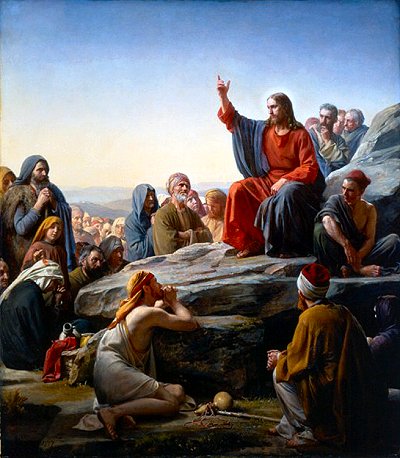
Sermon on the Mount |
||||||||||||
|
Review: Mt 5:20 is the main statement summarizing all that Jesus taught. - the righteousness necessary to enter the Kingdom of Heaven is that which surpasses that of the scribes and Pharisees. In Mt 5:3-9 Jesus began with a description of the character who are truly the blessed, those who are really part of the kingdom of heaven. Mt 5:10-12, Jesus explained their conflict Mt 5:13, 14-16 He emphasized the goal of their conduct. Then Jesus explained that one who is part of the kingdom of heaven obeys the Law from the heart to please God, not just externally to please men. In Mt 6 Jesus taught about the practicing of righteousness is to be carried out in secret for our Father's eyes, not to be noticed by men. Jesus was explaining what He meant by righteousness surpassing that of the scribes and Pharisees. He gave illustrations of what they did and how true righteousness, the kind necessary to enter the kingdom, was different. In Mt 6:19-34 and Mt 7:1-5 Jesus explained in a series of "do not" statements the things which true believers should not do. He explained in Matthew 7 that those who practice God honoring righteousness do not "judge" (condemn) by their own standard, which is what the scribes and Pharisees did, their standard being self-righteousness. Matthew 7:6: What is the last "do not" statement Jesus taught? Jesus instructed citizens of the Kingdom of Heaven not to give what is holy to dogs or hogs. Holy things are not to be thrown to those who have no care for them. Dogs and swine don't value the holy or pearls. It means nothing to them. It could be just the cause for them to turn on the one giving and tear him to pieces. So this is a time when judgment is to be made, judgment as to who is a dog or a swine. In sum, there are those with whom believers come in contact to whom the "holy" should not be shared. It would not be considered valuable to them, and would give cause for attack. In the time of Jesus there were many wild dogs roaming the city streets and countryside. They were scavengers, hungry, ready to attack for food. The wild boar was a vicious animal, also. Pigs, in general, were unclean to the Jews. Given the low esteem in which both of these animals were held, and the nature of their actions in this verse, Jesus is clearly not referring to those who simply resist the gospel, but who overtly go on the offensive against it. (for more detail see comments on Matthew 7:6) What do dogs and hogs refer to? What do the cross references add? Philippians 3:2 Paul calls those who oppose the gospel by faith "dogs", in context most likely a reference to the Judaizers who added Law to grace as a prerequisite for salvation. Amazingly Paul, a Jew, called the Jewish false teachers dogs. He warned the Philippians to beware of those who call others dogs, but in reality are dogs themselves. The apostle’s description is fitting. Are dogs unclean and filthy? So are the false teachers. Are dogs vicious and dangerous, and to be avoided? So are the false teachers. So are all those who teach salvation by works. 2 Peter 2:22 Peter refers to the false teachers who heard the truth, even knew the truth but the Truth did not know them (Mt 7:21-23) and whose return to their filthy condition ultimately demonstrated their unsaved nature. Rev 22:12 Refers to unbelievers who will not be allowed into the God's Kingdom in the New Heaven and Earth and are confined to the Lake of Fire. Practical application: Do you handle holy truth with respect, not throwing it to those who don't value it. Did the scribes and Pharisees really value the holy, or were they only interested in their own standard of what was holy, righteous, keeping the law? There are many "in church" who are hypocrites, like the scribes and Pharisees and they are some of the ones who profane the holy, turn and attack those who try to give them the holy, the truly valuable. Have you ever been shocked and surprised by a vicious, unwarranted attack from those in the church? (cf persecuted for the sake of righteousness Mt 5:10-12). What did the Cross references add? Mt 10:11-15 Jesus instructs the disciples to offer peace but if it refused (not received or heeded), leave and shake off the dust, for those who refuse light will be judged to a greater degree than Sodom and Gomorrah. Acts 18:1-6: Paul reasoned with the Jews in the synagogue trying to persuade them, but when they resisted (array against) and blasphemed, he shook out his garments, declared their blood on their own head and directed his steps henceforth to the Gentiles ("dogs" to the Jews but in this context the ones who would be open to the Gospel). Titus 3:10-11 Paul gives Titus a command to continually shun or reject a man who causes divisions (Greek = hairetikos) for such a man was perverted, continually sinning and self-condemned. |
||||||||||||
| Matthew 7:7-12 Mt 7:7-8, 7:9-11, 7:12 |
||||||||||||
|
What does this section deal with? Has Jesus discussed this topic before? Why does He mention it again and at this point? Prayer which occupies a major portion of the Sermon. The context helps us understand why He mentions prayer again. He has just stated we should not judge (inappropriately or with condemnation) but then warns us not to give holy things to dogs and hogs. So we need wisdom to know who the dogs and hogs are and prayer will aid our determination (cf Ja 1:5-6 prayer for wisdom). In the larger context however, it is very likely that Jesus repeats prayer because He realizes that the righteous standard (the one which surpasses the righteousness of the scribes and Pharisees) He has placed before us from Mt 5:21-7:6 is impossible to fulfill in our strength and we need to continually remain dependent upon God and persistent prayer reflects that dependence and that trust that He will answer us according to His good and perfect will. It is also impossible to fulfill His command in the following (immediate context) verse. Mt 7:7: How should we pray? Jesus commands (present imperative) Kingdom citizens to continually ask, seek and knock. To live a righteous life, believers are to be asking of their heavenly Father. When they receive from Him what they ask, then others will see and glorify Him. How can one discern who is a dog or a sow? One way is to ask the Father for wisdom. Mt 7:8 What is His promise for those who make it the habit of their lives to commune with the Most High God in prayer? Will receive, find and have opened Keep on seeking, from the heavenly Father, keep on knocking—it's a privilege, but also a responsibility of the believer. The heavenly Father desires for His children to find and for things to be opened to them as result of seeking Him and His kingdom. Ask, seek, knock, by faith; believing that He will answer according to His Word. Mt 7:9-11 How does Jesus further characterize the nature of our Father's responses to prayer? He makes the analogy of a father, whose son makes very reasonable requests (bread, fish), emphasizing that an earthly father responds by giving good gifts. Jesus says "how much more" (cf to a believer's worth in the Father's eyes as "much more" in Mt 6:25-34) will our Father give what is good to those who ask Him. Mt 7:12 How does Jesus conclude this segment on prayer? What should our Father's beneficent (good) treatment of us as His children inspire and motivate us to do to others? Why… what will our action fulfill? What part does prayer play in our ability to accomplish this otherwise impossible task? Treat them the way you want them to treat you This is the "Golden Rule"! Our treatment of others as we wish them to treat us is the essence of or the fulfillment of "the Law and the Prophets". What does Jesus mean by his explanation that "this the Law and the Prophets"? How do the cross references - Romans 3:20, 3:21-22, Matthew 5:17-18, 22:35-40 - help understand? Note that Mt 7:12 brings the discussion of the law to a conclusion with "In everything, therefore… " and summarizes Jesus' teaching from Matthew 5:17 to this point (specifically His teaching on righteousness from the heart in contrast to external "self" righteousness and "self" righteousness practiced before men versus genuine righteousness practiced before God in secret). In Romans 3:21 this phrase refers to the entire Old Testament which witnessed to the righteousness God requires In Mt 5:17-18, 19-20 Jesus emphasizes that He did not come to abolish the Law or the Prophets (the OT) but to fulfill it, thus fulfilling all the requirements for righteousness. Our righteousness must surpass that of the Scribes and Pharisees in order to enter the Kingdom of Heaven. Mt 22:35-40 Jesus sums up the Law and the Prophets (and the practical righteousness thereof) in the commandments to love God above all and love our neighbor as ourselves. In Mt 7:12 Jesus is saying that in light of the way our Father treats us, out of our love and submission to Him, we treat others the way we want to be treated which is the essence of the practical righteousness described and demanded by the Old Testament. How would you characterize such righteousness… broad or narrow? Clearly it is a narrow way that leads to true life in the Kingdom of Heaven, now and forever. |
||||||||||||
|
Mt 7:13-14: How does Jesus apply all that He has explained? He calls for a decision… it's a command (aorist imperative) which calls for urgent, effective action on the hearer's part) The listener is called to "enter" the narrow gate! Do it now! Do not put off tomorrow what you must do today! What are the two gates and ways and how are they characterized? Gate/Way #1 = gate =narrow, small, way = narrow Gate/Way #2 = gate = wide, way = broad What is the narrow gate (gate… small) and the way that is narrow? It is a righteousness that surpasses that of the Scribes and Pharisees, who were entering the wide gate and the broad way of works righteousness. Elsewhere in the Scripture, the narrow gate/narrow way is synonymous with faith in Jesus Christ, and His fully satisfactory, once for all, substitutionary atoning sacrifice for our sins. To this person His perfect righteousness is placed on their "account" (reckoned) and they become citizens of the Kingdom of Heaven. What are the destinations of each path and how is each described in terms of "popularity"? Gate/Way #1 = life (few find it) Gate/Way #2 = destruction (many enter through it)
Note: "Destruction" does not signify annihilation, but loss of all purpose for which one was created. |
||||||||||||
|
Matthew 7:15-20 |
||||||||||||
|
What topic does Jesus address? Why here? What initial word of warning? False prophets - He has just explained the narrow road, and the implication is that "false prophets" will mislead their adherents down the broad way that leads to destruction. Beware (cf Matthew 6:1 regarding practicing our righteousness before men in order to be seen by them) is a command (present imperative) that we are to continually be alert and on guard for these false prophets whose effect is so harmful. Matthew 7:15-16 What will make it difficult to identify them? What is there true character? They where sheep's clothing and so will look innocent and dumb but they are not. They have an external appearance of being believers Their inner character is that of ravenous wolves (who devour sheep). Matthew 7:16, 7:17-20 How can "sheep" discern (cf Judging Mt 7:1-2) their presence? Jesus says we are to know them by their fruit where "know" is epiginosko which conveys the idea that we can fully know them in this manner. We are to observe them as if they were "fruit trees" and discern the character of the fruit they produce - in sum all that Jesus taught from Mt 5:21 to this point characterizes the "peaceful fruit of righteousness" of a genuine believer and cannot be borne by "thorn bushes"!… remember that it may take some time for bad fruit to be borne but it will eventually show itself!
Bad fruit = bad tree Good fruit = good fruit What will be their end if they are ravenous wolves who are bearing bad fruit? They will be cut down and thrown into the fire (of gehenna, fires of hell will torment them forever!) How should we "judge" for false teachers? What are some general pointers from the Sermon on the Mount? Don't evaluate on merely the external works of the person (prophesy, cast out demons, perform miracles, things which might seem to be quite "convincing" of their authenticity). Determine whether he or she only does things to be noticed by men Evaluate how he or she treats others. Evaluate whether he or she judges by their own standard of what is spiritual! (and if you don't do it their way, you are not "spiritual"!) ><> ><> ><> Jer 5:31 What was (is) the tragic truth about false prophets in Israel (in our day)? The people loved to hear false prophets. In contrast, Jeremiah was far from popular! The heart condition of fallen man has not changed! Jer 23:16-40 What are the major points about true and false prophets in this instructive section? Jer 23:16 Their prophesying leads the hearer into futility (because it is their imagination not the word of God) Jer 23:17 Prophesy peace and no calamity (no judgment for those who walk in stubbornness of heart) - when in fact judgment was imminent! Jer 23:18 The true prophet will stand in the council of the Lord and His Word (which he heeds) Jer 23:21 God neither sends nor speaks to false prophets Jer 23:22 True prophets listen to God and speak a message that turns people from their evil ways. True prophets stand in the Lord's council, hear His Word and give heed to it. The basis for evaluating prophets is God's Word. Jer 23:25 False prophets speak in God's Name (cf "Lord, Lord" Mt 7:21) and say tell of their dreams Jer 23:26 False prophets prophesy falsehood and deception of their own heart (self deceived) Jer 23:27 Goal is to make people forget the Name of God (which speaks the truth about His character) (cf v25) Jer 23:28 God compares their dreams with straw versus His Word which is grain (one worthless, other nourishing) Jer 23:29 God exalts His Word over dreams of straw - like fire, like a hammer which shatters rock Jer 23:30-32 God is against them (3x). They steal each others' messages! They say "The Lord declares… !" Jer 23:32 They prophesied false dreams - lead people to sin - do not have the slightest benefit to people Jer 23:33 They ask about judgment ("What oracle?") Jer 23:36 (This is a very important truth to emphasize for we see this occurring in our day!) The phrase "the oracle of the Lord" (NLT "prophecy from the Lord") is not to be used (see NLT and NIV renderings) to give authority to one's own ideas, which actually pervert the Word of God. Verse 36 says that it is merely their own words which they claim as "the oracle of the Lord"—"a word from the Lord," "the Lord told me," etc. Jer 23:38-40 If they use the phrase "this is the prophecy of the Lord" they will be punished with everlasting reproach Summary: False prophets speak a false word which distorts the true Word and which comes from dreams from the deception of their own hearts and which they try to authenticate by saying "The Lord says" or "This is a prophecy of the Lord"! Their doom is certain! They sounded "spiritual," "miraculous," but they did have not the slightest benefit for the people who they led into sin. Beware of those who boast in what they have "heard from the Lord" or "the Lord told me" and always cross check it with the pure milk of the Word! 2 Peter 2:1-22 What are the main characteristics of false teachers? 2Pe 2:1: Come from within the church, secretly introduce (false laid down besides truth) destructive heresies which ultimately deny Jesus who bought them and bring their destruction 2 Peter 2:2: They are sensual (lack of restraint, excesses, especially sexual excess) and many follow after, truth is blasphemed because of them. 2 Peter 2:3 Greedy, exploit (make merchandise of - idea is to get your money) with false ("plastic") words 2 Peter 2:10 Indulge their flesh, despise authority, daring (bold, presumptuous), self-willed ( so pleased with himself that nothing else pleases him and he cares to please nobody - he obstinately maintains his own opinion, or asserts his own rights, while he is reckless of the rights, opinions and interests of others). 2 Peter 2:10-11 They are quite ready to rail against angels and other dignities (cf Jude 9), something even the holy angels do not do, for even wicked humans still were created in God's image. Only Satan has the effrontery to do this (Rev 12:10). 2 Peter 2:12 Like animals driven by instinct 2 Peter 2:13 Count it a pleasure to revel in broad daylight, deceitful while eating with you 2 Peter 2:14, 2:15 Eyes full of adultery, unable to cease from sin, enticing unstable people to sin, heart trained or exercised in greed and covetousness, accursed, like Balaam who loved the wages of wickedness 2 Peter 2:18 Arrogant, boastful, bragging, entice others by appealing to the lustful desires of our sinful (flesh) nature and by sensuality (same word as in 2Pe 2:7 and Jude 1:4) 2 Peter 2:19 Promise freedom but are slaves of corruption (ruin, decay, destruction) - by what a man is overcome by this he is enslaved 2 Peter 2:20 They know about Jesus but He does not know them (cf Mt 7:23) and when they again entangle in the defilements of the world this is a worse state than before 2 Peter 2:22 Like dogs and hogs… they do what comes naturally because they have never been changed supernaturally Summary: From inside the body of Christ, teach error next to truth, deny Christ, greedy, sensual, arrogant, money driven, lost forever Beware of those who lean toward an emphasis on the sensual and the emotional in "spiritual things." Ezekiel 34:1-12: What does God say about false prophets in these passages? Woe to them for they have been feeding themselves not their flocks, not strengthened the sick, not healed the diseases, not bound up the broken, not brought back the scattered, not sought the lost, but dominated them (ruled them with force and cruelty) Self-centeredness, self-aggrandizement, self-gain are things to beware of in those who would desire to lead the flock of God. Mt 3:7-12: What does John the Baptist discern about the false teachers, the Pharisees? Like vipers (deadly, sneaky snakes of the Middle East), claim Abraham as father but no fruit to show they have genuine repentance, those who never receive Christ will be "cut down" and thrown into the fire (speaks of the eternal torment in the Lake of Fire, which is unquenchable). The fire speaks of the judgment when Jesus comes to gather the wheat (believers, righteous) and burn the chaff (unbelievers, unrighteous) with unquenchable fire. Radio Bible Class Booklet: How To Identify A Dangerous Religious Group |
||||||||||||
|
Matthew 7:21-23 |
||||||||||||
|
Matthew 7:21, 22-23 What does Jesus teach that helps us determine who is a bad tree with bad fruit? Is it what they say and do? It is not what they say (Lord, Lord), or what they do (prophesy, cast our demons, perform many miracles - Why might this group think they are going to heaven?) but how they live in relationship to the will of the Father. ) These things (prophesy, cast our demons, perform many miracles) are not indicative of righteousness and those who practice lawlessness can ostensibly carry out these things which explains why they can masquerade as sheep or genuine believers. Matthew 7:21 For clarification, what does it mean to do the "will of My Father"? This speaks of one who is obedient to the word of God in deeds (life) not just in words (lips). The obedience by no means saves them but demonstrates that they are saved. To be continually disobedient to the Word conversely demonstrates no fruit in keeping with repentance (i.e., a profession of faith but no possession of the Holy Spirit Who is at work in the genuine believer both to will - give them the urging, the desire, the "want to" - to obey and the power to obey God's Word). What does Jesus declare to those who as a habit of their life do not do the will of His Father? Jesus will declare to them that He never (at any point in time) knew them (speaking of a genuine, intimate and ultimately saving personal relationship with Himself, which is by grace through faith) They are to depart from His presence (He will judge them one day at the Great White Throne judgment and sentence them to the Lake of fire, see Revelation 20:11-14). Mt 7:23: What does Jesus re-emphasize about the lifestyle (practice** = present tense) of those who He does not know? He re-emphasizes that their lifestyle was one of habitual lawlessness (John teaches that it is synonymous with "sin" 1John 3:4) In other words these people were continually "missing the mark" of God's demand of perfect righteousness (available only in His Son, Christ Jesus). How would you explain what it means in Mt 7:23 to practice lawlessness (work iniquity, KJV)? **Practice (2038) (ergazomai from érgon = work) means to engage in an activity involving considerable expenditure of effort. It was used to describe one toiling energetically and diligently in the vineyard. Jesus is not saying that they fall into sins (which can be the experience of genuine believers) but that they continually work in order to violate the law. Lawlessness (458) (anomia from a = without + nomos = law) can be described as living as though one's own ideas are superior to God's. Lawlessness says, "God may demand it but I don't prefer it." Lawlessness says, "God may promise it but I don't want it." Lawlessness replaces God's law with my contrary desires. I become a law to myself. Lawlessness is rebellion against the right of God to make laws and govern His creatures. Point to ponder: What is the clear warning for those who have made a profession of Christ? The question is "Has there been a change in your life? You are a new creature with a new indwelling Spirit, the Holy Spirit, Who will give you the desire to gravitate toward holiness. If the general tenor of your life is toward lawlessness rather than holiness, then you need to ask whether your profession is a true possession of Christ's Spirit or is self-deception, which is ultimately the worst variety of deception. |
||||||||||||
|
Mt 7:24-25, 26-27: What is Jesus contrasting? Two foundations (there is no difference per se in the houses) Note: Jesus begins with "therefore"… His point is that simply hearing His great sermon does not change one's life and eternal destiny. One must respond to the truth, recognizing his or her poverty of spirit and need for God to do a work in their heart. What are the foundations and what do they represent? Matthew 7:24-25 Wise = build house on the rock (mentioned twice for emphasis) survived the storm = hear Jesus' sermon and act Mt 7:26-27 Foolish = builds House on sand but falls with great fall in the storm = hear Jesus' sermon and does not act on them The one who "hears these words … and acts on them" is the one who does the will of the Father. The one who hears but does not act is the one who practices lawlessness. Righteousness does His will, fulfills the Law by the Spirit Lawlessness violates the Law. What is Jesus saying? Is He saying that works of the wise man resulted in his salvation? From the remainder of the NT, salvation is by faith alone but a faith that is genuine responds to Jesus' words, by the power of the Spirit (even though there is no mention of the Spirit in the sermon) Is your spiritual house founded on the rock of Jesus' words, God's Word the Bible? Or is it on unstable sand, false teaching (such as works based righteousness like the Pharisees), suppositions, etc.? |
||||||||||||
| What was the result of Jesus' teaching? Why this result?
The were astonished and amazed (ekplesso [1605] = struck out of their senses by a strong feeling, such as wonder) because of Jesus' authority in teaching. His Word was inspired and perfectly in concert with the OT Scriptures in contrast to the teaching of the scribes and Pharisees. Jesus taught with authority. He is God; He had the authority to teach as He did. He taught the truth, what true righteousness is and how to enter the kingdom of heaven. Jesus' teaching was foreign to those who had been used to hearing from the scribes who only had the external keeping of their laws. This teaching receives the same reaction from many in modern times. They are truly amazed that this teaching is in the Bible. What is your response to His teaching in the Sermon on the Mount? Astonished? Amazed? Apathetic? |