Titus 1:2
Titus 1:3
Titus 1:4
Titus 1:5
Titus 1:6
Titus 1:7
Titus 1:8
Titus 1:9
Titus 1:10
Titus 1:11
Titus 1:12
Titus 1:13
Titus 1:14
Titus 1:15
Titus 1:16
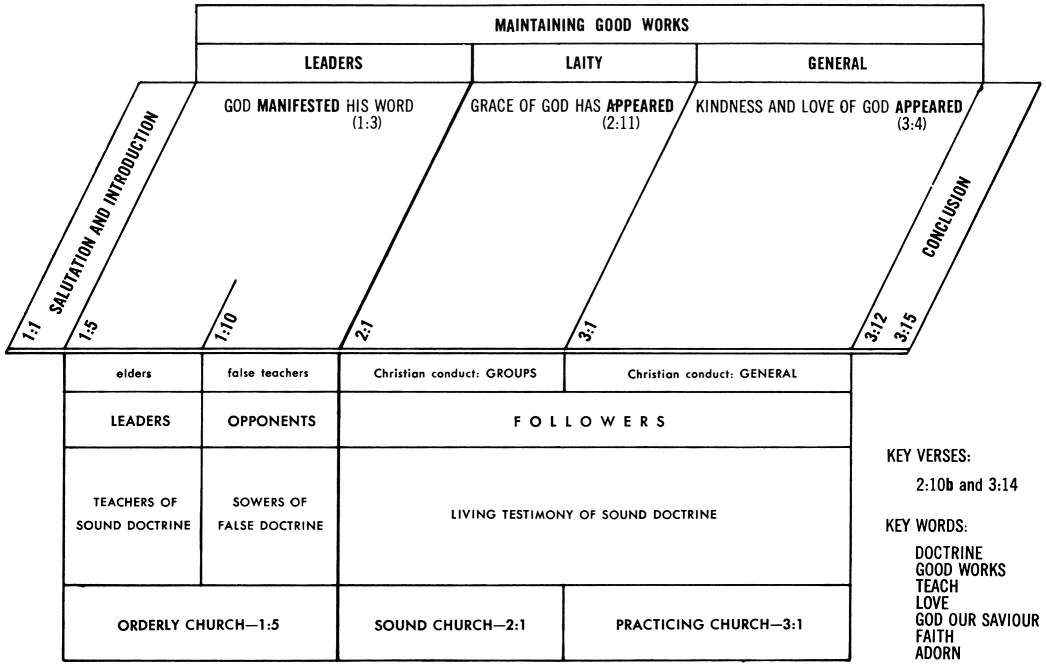
ADORNING THE DOCTRINE OF GOD
Click chart to enlarge
Charts from Jensen's Survey of the NT - used by permission
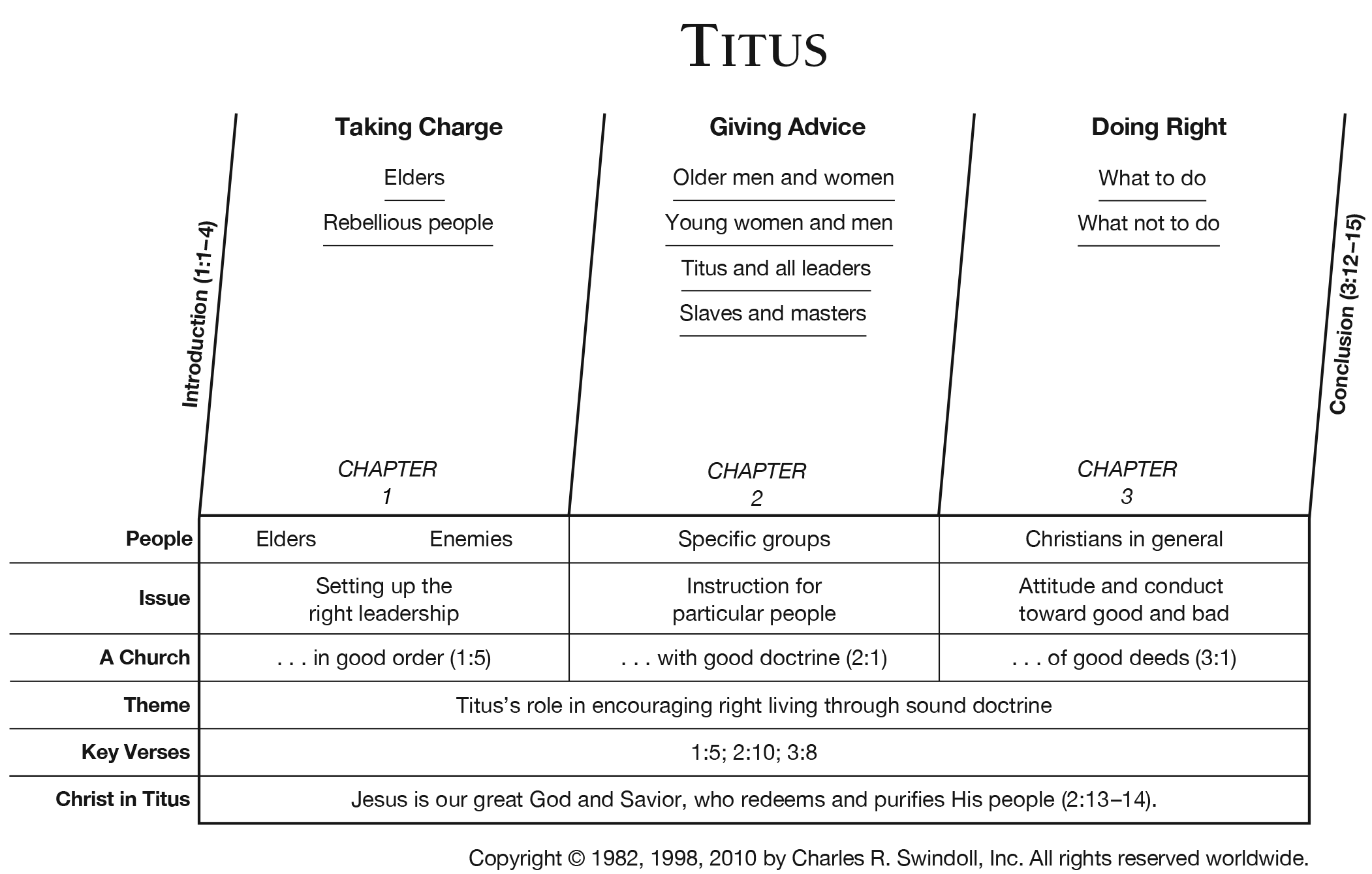
See Summary Chart by Charles Swindoll
Chart below from Michael J. Penfold
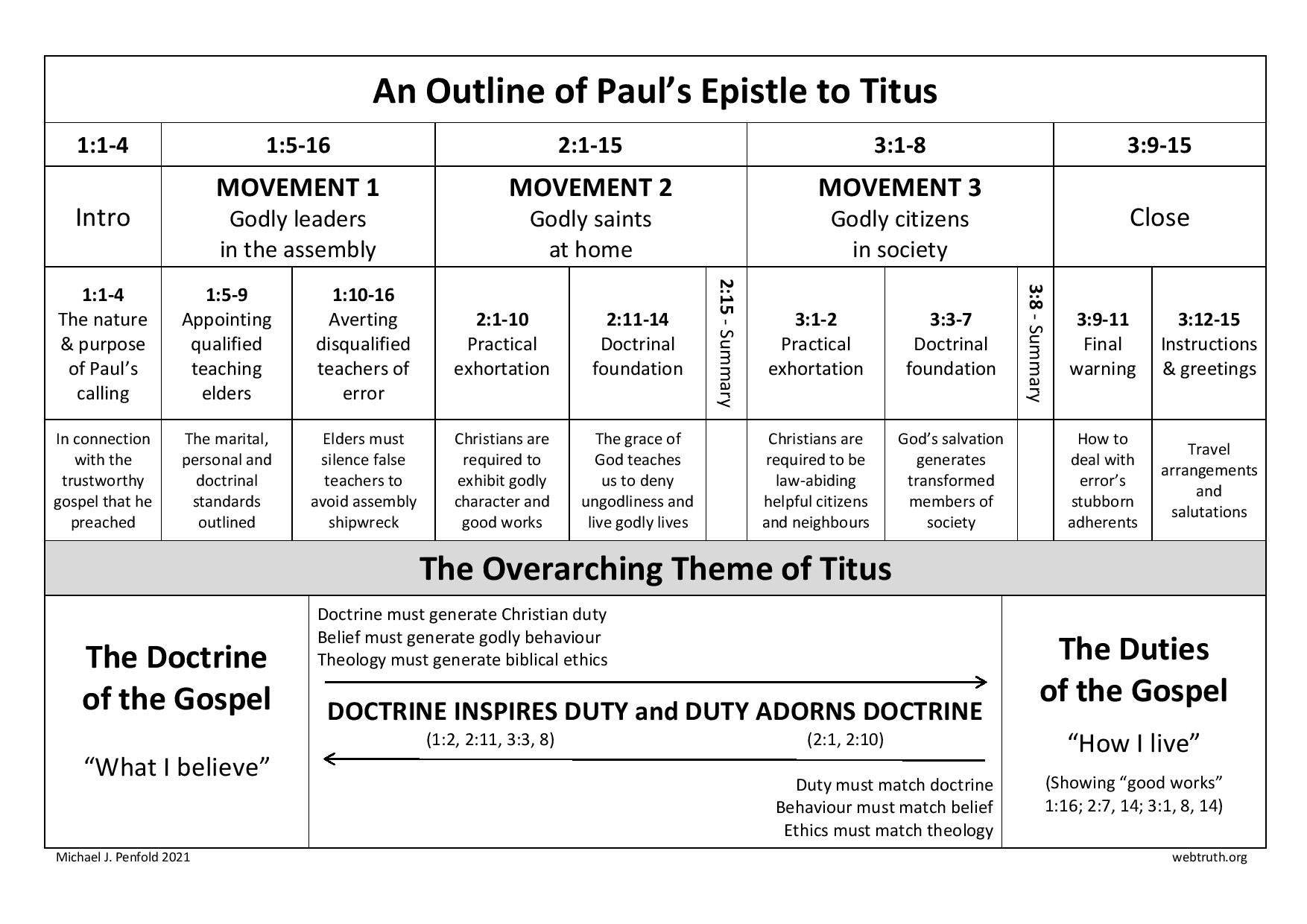
|
Focus |
Appoint Elders |
|||
|
Divisions |
Ordain |
Rebuke |
Maintain |
|
|
Topics |
||||
|
Topics |
Organization |
Offenders |
Operation |
|
|
Place |
Probably Written from either Corinth or Nicopolis (cf. Titus 3:12). |
|||
|
Time |
Circa 63 AD |
|||
|
Modified from Talk Thru the Bible |
||||
Titus 1:1 Paul, a bond-servant of God and an apostle of Jesus Christ, for the faith of those chosen of God and the knowledge of the truth which is according to godliness (NASB: Lockman)
Greek: Paulos doulos theou, apostolos de Iesou Christou kata pistin eklekton theou kai epignosin aletheias tes kat' eusebeian
Barclay: This is a letter from Paul, the slave of God and the envoy of Jesus Christ, whose task it is to awaken faith in God’s chosen ones, and to equip them with a fuller knowledge of that truth, which enables a man to live a really religious life (Westminster Press)
KJV: Paul, a servant of God, and an apostle of Jesus Christ, according to the faith of God's elect, and the acknowledging of the truth which is after godliness;
Phillips: Paul, servant of God and messenger of Jesus Christ in the faith God gives to his chosen, in the knowledge of the truth that comes from a God-fearing life (Phillips: Touchstone)
Wuest: Paul, God’s bondslave and an ambassador of Jesus Christ in accordance with the Faith [the Christian faith] of God’s chosen-out ones and a precise, experiential knowledge of truth which is in accordance with piety towards God,
Young's Literal: Paul, a servant of God, and an apostle of Jesus Christ, according to the faith of the choice ones of God, and an acknowledging of truth that is according to piety
PAUL A BONDSERVANT OF GOD: Paulos doulos theou :
- Bondservant 1 Chr 6:49; Ro 1:1; 1:9; 15:16; 16:18; Jn 12:26; 13:14-16; 15:15, 20, Acts 27:23; 2Cor 4:5; Ga 1:10; Php 1:1; Titus 1:1; Jas 1:1; 2Pet 1:1; Jude 1:1; Rev 1:1; 22:6 ,9
- Titus 1 Resources - Multiple Sermons and Commentaries
SOLD OUT TO
ONE MASTER, GOD
Paul a bondservant of God - "a slave of God" (NET)
Bondservant (1401) (doulos) The first four verses of this letter in the form of a greeting, are actually one long "truth packed" sentence. In the ancient world the sender "signed the letter" at the beginning not at the end as is the modern custom.
Wayne Barber says he wishes we still did like in Paul's day. Then Wayne says he could quickly determine whether he was going to spend much time reading the letter depending on his estimation of the sender. Paul is a sender that clearly deserves our attention. Saul was his Jewish surname and Paul (meaning "little") his Roman surname. In Acts Saul is the only name used until Acts 13, at which time "the Holy Spirit said "Set apart for Me Barnabas and Saul for the work to which I have called them." (Acts 13:2) He undoubtedly used the name Roman (more "gentile") Paul because of his call to go to the Gentiles and because it (Paul = "little") expressed his attitude about who he was as a recipient of God’s grace (cf 1Cor 9:22, 1Cor 15:10; 1Ti1:12-17).
Bondservant (doulos) is the most abject servile term in the Greek to describe a slave who completely surrenders himself to the will and authority of another. Paul is saying that he has sold himself into slavery to His God and now his will was "swallowed up" in the will of his Master. Here the "Master" is "God" but in all the other uses he refers to himself as a bondservant of "Christ" (Ro 1:1, Gal 1:10, Php 1:1, for an interesting study observe the 25 NT uses of "bondservant(s)" in the NT = Luke 2:29; Acts 4:29; 16:17; Ro 1:1; 2Cor 4:5; Gal 1:10; Phil 1:1; 2:7; Col 1:7; 4:7; 2Ti 2:24; Titus 1:1; Jas 1:1; 2 Pet 1:1; Jude 1:1; Rev 1:1; 2:20; 7:3; 11:18; 15:3; 19:2, 5; 22:3, 6).
He was bound to God and to Christ Jesus in bands so strong that only death could break them. Before salvation, Paul’s will was swallowed up in the will of Satan (Torrey's Topic "Spiritual Bondage") but in the death of his old man and his identification with Christ (Ro 6:3), the bondage to Satan was broken. As Paul explained in (Ro 6:22) believers have "been freed from sin and enslaved to God" and are no longer their own for they “have been bought with a price” (1Co 6:20), having being “redeemed not with perishable things like silver or gold…but with precious blood, as of a lamb unblemished and spotless, the blood of Christ” (1Pe 1:18, 19). And because we no longer belong to ourselves, we “should no longer live for [ourselves], but for Him Who died and rose again on [our] behalf” (2 Co 5:15). He could have boasted of his unique calling as apostle to the Gentiles, who was granted full privilege and authority alongside the Twelve. He could have boasted of being “caught up to the third heaven… into Paradise” (2Co 12:2, 4), of his gift of miracles, and of being chosen as the human author of a great part of the Scriptures of the new covenant. He chose, rather, to identify himself foremost as a bond-servant of God. (2Pe 1:1)
Donald Grey Barnhouse has this interesting note on "bondservant" paraphrasing truths found in the Old Testament: "The early men of Israel had in their economic system set forth in the laws of Moses, regulations governing the man who got into debt. He became the property of his creditor, in very fact, his slave. But the slavery had a termination. When the 7th year rolled around, all of these slaves were liberated and could go forth once more as their own masters. Some of them, however, realized certain things about their own lack of ability to maintain themselves in the rugged economy of a cruel world. They remembered that when they had been their own freemen they had not eaten well, but that now, under kind masters, they were well-housed and well-fed. They looked toward their future freedom with some trepidation as they realized that they might soon be, once more, in a life of hunger and cold. No doubt there were some who sought to escape the bondage of hard taskmasters, but there were others who knew the kindness and love of their master’s heart. The Law provided a way for them to remain as slaves to their kind masters. Such a one could go to his owner and tell him that he desired to remain a slave. He would then be taken to the tabernacle where the priest would lead him to the doorpost and bored a hole in the lobe of his ear with an awl. From that time on he was the slave of his master. Wherever he walked, his ear proclaimed the character of his master." (cf, ""But if the slave plainly says, 'I love my master, my wife and my children; I will not go out as a free man then his master shall bring him to God, then he shall bring him to the door or the doorpost. And his master shall pierce his ear with an awl; and he shall serve him permanently,' Ex 21:1, 2, 3, 4, 5, 6, see similar teaching in Dt 15:12, 13, 14, 15, 16, 17, 18) (See Romans, vol 1: Man's Ruin: Exposition of Bible Doctrines)
Hampton Keathley adds this practical note regarding "bondservant": "This is a clear illustration that the issue of our ability to be and do what God has called us to by way of our gifts, abilities, and opportunities is related to voluntarily living as bondslaves of God. Our problem is we too often want to call the shots; we want God to approve our choices. Let it be said that true freedom is not the ability to do as we please, but the ability to do as we ought by the grace and enablement of God. “No one ever becomes a successful servant of God until he chooses to make God’s will his own will. Paul’s will was not crushed but he imbibed the will of his Master as his own. Do we profess to be servants of God yet continue to insist on carrying out our own will for our lives?” Do we present our list to God for what we would like to do for life and ministry or for what we think is best for us and then ask Him to seal that with His approval? Living and serving as slaves of God naturally applies to every possible area of life—personal life, family, church, vocation, recreation, leisure, civic responsibilities, ministry, etc. As bondslaves who have been bought by the redemptive work of Christ, we belong to God (1Co 6:20; 1Pe 1:18, 19-see note 1Pe1:18; 19). This means we are to be totally dependent on the Lord Jesus for both His supply and our calling and responsibilities in the world. This naturally leads to Paul’s next statement." (bolding added) (Reference)
AND AN APOSTLE OF JESUS CHRIST: apostolos de Iesou Christou :
- Titus 1 Resources - Multiple Sermons and Commentaries
"the envoy of Jesus Christ" (Barclay)
Apostle (652) (apostolos from apo = from + stello = send forth) refers to one sent forth by another. In secular Greek it was used of an admiral of a fleet sent out by the king on special assignment. At times in the NT apostle carried the broad meaning of one who sent as a messenger or delegate with instructions from a group or an individual (cf 2Cor 8:23, Philippians 2:25).
In the present context Paul uses apostle in its more common specialized or restricted meaning to denote one whom Jesus chose, trained, and commissioned to be His representative. In Acts 1:21, 22 the Apostle Peter delineates the necessary qualifications of this latter group: "Therefore it is necessary that of the men who have accompanied us all the time that the Lord Jesus went in and out among us--beginning with the baptism of John until the day that He was taken up from us--one of these must become a witness with us of His resurrection."
Thus an apostle was an ambassador representing Jesus and possessing the authority and power of His Lord. Apostolos was a technical word in secular Greek used of one sent from someone else with credentials on a mission. Just after Paul's conversion, Ananias was fearful of Paul but Jesus informed him that Paul was "a chosen instrument of Mine, to bear My name before the Gentiles and kings and the sons of Israel" (Acts 9:15) From that day forward Paul was a man with a mission having been commissioned by Christ Himself, Whose will was made known in (Acts 9:15 22:14, 15, 21 26:16, 17,18). Paul further explained that he was "an apostle (not sent from men nor through the agency of man, but through Jesus Christ and God the Father, Who raised Him from the dead" (Gal 1:1) . Paul was commissioned as Christ's "chosen instrument" (Acts 9:15) and ambassador to the Gentiles with a message of reconciliation (Ro 5:11, 2Co 5:18,19), a message that he "neither received… from man, nor was… taught, but … through a revelation of Jesus Christ." (Gal 1:12). In (Ro 1:5) Paul added that "through (Jesus Christ our Lord) we have received grace & apostleship to bring about the obedience of faith among all the Gentiles for His name's sake".
Paul's obedience to his apostleship was a natural overflow of his submission as a bondservant to the Lordship of Jesus Christ. In (Acts 22:10) we are told that the first words out of his mouth were, “'What shall I do, Lord?" Then, in recounting the events of his conversion and commission by the Lord Jesus to King Agrippa, Paul said, "Consequently, King Agrippa, I did not prove disobedient to the heavenly vision, but kept declaring both to those of Damascus first, and also at Jerusalem and then throughout all the region of Judea, and even to the Gentiles, that they should repent and turn to God, performing deeds appropriate to repentance." (Acts 26:19, 20)
Barnhouse adds that "The secret of Paul’s greatness is indicated in the order of these two words. He was first a bondslave, utterly surrendered to the Lord, and then he was a sent one…thus he was willing to follow the Word of God and be not only the bondslave of Jesus Christ but the apostle to the Gentiles." (See Romans, vol 1: Man's Ruin: Exposition of Bible Doctrines)
It is of note that Paul refers to himself as an "apostle" in all the so-called pastoral epistles, most likely because he is claiming authority to give instructions to facilitate the healthy functioning of the church. The authority of Paul's message did not derive from the messenger but from the Sender.
Hampton Keathley has an interesting thought on this passage writing that "As believers in Christ, God has “delivered us from the power of darkness and transferred us to the kingdom of the Son He loves, in whom we have redemption, the forgiveness of sins (Col 1:13, 14-see notes Col 1:13; 1:14). We are not, therefore, of this world, but we have been left in this world as ambassadors and representatives of the Lord Jesus (Jn 17:15, 16, 17, 18, 19 2Cor 5:20). For this the Lord Jesus has gifted each of us (1 Peter 4:10) and as He has gifted us, so He has called. What He has gifted us to do He has called us to do and vice versa. (Ed note: Click for chart on Spiritual Gifts) Thus, the apostle immediately identified his calling and the primary place where he was to exercise his service as a bondslave. He is “an apostle of Jesus Christ.” By the designation, “a slave of God,” he pointed to his personal relationship to God, but here he pointed to his official responsibility within the body of Christ according to the will of God (Ro 1:1; 1Cor 1:1, 12:4, 5)… While we do not all have the same gifts (1Co 12:29), in placing every believer into the body of Christ, God has gifted each one with different gifts for the mutual edification of the body of Christ and for the glory of God (1Cor 12:4, 5). Building on the truth that we are to live as voluntary slaves of God, our need is to discern the gifts and the place of ministry to which the Master has called us and to use our gifts accordingly (Ro 12:3, 4, 5, 6 -see notes Romans 12:3ff; 1Pe 4:10)." (Reference)
Jesus (2424) (Iesous) is from the Hebrew Yeshu'a which means Yahweh is salvation. Jesus officially appointed Paul Luke recording the official announcement by our Lord Who declared
"He is a chosen instrument of Mine to bear My name before the Gentiles kings the sons of Israel (Acts 9:15) "
Christ (5547) (Christos from chrio = to rub or anoint, consecrate to an office - See also Messiah - Anointed One) refers to the Anointed One and thus is a title of the Messiah, the divine One (fully God) the Jews were looking for and of Whom the OT bore prophetic witness. Paul is clearly declaring that he did not teach and write by his own authority but by the dual yet totally unified authority of the Son, Christ Jesus, and God the Father ('by the will of God"). Thus whatever follows in this letter deserves to be heard and heeded.
Using this combined title, Jesus Christ, Paul affirms his full conviction that the human Jesus was also the Christ, the One about Whom the Scriptures foretold, the anointed Messiah, the Bringer of messianic redemption (cf Acts 3:20)
Note also that both Iesous and Christos are masculine singular genitive, the genitive case signifying possession, the point being that Paul regarded himself as the property of his Lord! Believers of every age should do no less, for as Paul explains…
Or do you not know that your body is a temple of the Holy Spirit who is in you, whom you have from God, and that you are not your own? For you have been bought with a price: therefore glorify God in your body. (1Cor 6:19, 1Co 6:20)
(Jesus) gave Himself for us, that He might redeem us from every lawless deed and purify for Himself a people for His own possession, zealous for good deeds. (see note Titus 2:14)
FOR THE FAITH OF THOSE CHOSEN OF GOD AND THE KNOWLEDGE OF THE TRUTH: kata pistin eklekton theou kai epignosin aletheias :
- Jn 10:26,27; Acts 13:48; Eph 2:8; 2Th 2:13,14; 1Ti 1:5
- Titus 1 Resources - Multiple Sermons and Commentaries
For - This is the preposition "kata" which can mean according to but can also be used to express the goal or purpose (“for the purpose of", "to further") and finally can be translated in the sense of “with reference to, with respect to.” Scholars differ on their interpretation of Paul's intended meaning but most favor the idea that Paul's apostolic mission was for the purpose of or the furtherance of Christian faith and knowledge. For example, the following translations favor the idea of "for the purpose of" translating this as: "for the faith" (NIV), "for the sake of the faith" (NRSV ), "for building up the faith" (Weymouth) "to further the faith" (NET), and finally "for the faith" (NASB). Several things suggest that kata is best understood here in the sense of purpose for it is keeping with the overall ministry and mission of Paul's apostleship and the preaching of gospel, as well as his call to build up the body of Christ, and establish churches sound in the faith. As an apostle, Paul’s mission was to promote the faith of God’s elect and their knowledge of the truth.
The faith (4102) (pistis) (see study of this phrase "the faith) can be interpreted as reference to the faith necessary for salvation (subjective), as used by Paul this way in Romans where he teaches that "faith comes from hearing, and hearing by the word of Christ" (Ro 10:17-note).
Others favor an objective sense, and interpret "the faith" in this verse as a reference to the general body of Christian doctrine, as exemplified by Jude's call to the "called, beloved… and kept" (Jude 1:1-note) to "contend earnestly for the faith which was once for all handed down to the saints " (Jude 1:3-note, similar meaning in Acts 6:7, Gal 1:23-note, 1Ti 4:1), the latter example clearly not referring to an act of faith or believing exerted by the saints, but the to the Christian faith or that body of truth which we call the doctrines of Christianity and which are contained in the Word of God, and which in many contextual uses is synonymous essentially with the gospel. Generally when the latter meaning is in view faith is preceded by the definite article in the Greek which is not present in this case even though the English translation is "the faith". You will have to decide for yourself from the context which interpretation you favor. (Click for explanation of the phrase "the faith (pistis)" as it refers to the body of Christian doctrine)
Chosen (1588) (eklektos [word study] from eklegomai = to choose, select or pick out for one's self - from root verb kaleo [word study]) describes those who were selected out of a larger number, but (and this is very important!) it does not imply the rejection of those not chosen (cf the other similar uses of eklektos Ro 8:33, Col 3:12, 2Ti 2:10).
Eklektos - 22x in 22v - NAS = choice(2), choice man(1), chosen(1), chosen(9), chosen one(1), elect(8).Mt 22:14; 24:22, 24, 31; Mark 13:20, 22, 27; Luke 18:7; 23:35; Rom 8:33; 16:13; Col 3:12; 1 Tim 5:21; 2 Tim 2:10; Titus 1:1; 1 Pet 1:1; 2:4, 6, 9; 2John 1:1, 13; Rev 17:14.
Eklektos - 80x in the non-apocryphal Septuagint (LXX) - Gen 23:6; 41:2, 4f, 7, 18, 20; Ex 14:7; 30:23; Num 11:28; Deut 12:11; Jdg 20:15, 34; 1 Sam 24:2; 26:2; 2 Sam 8:8; 21:6; 22:27; 1 Kgs 4:20, 23; 2 Kgs 8:12; 19:23; 1 Chr 7:40; 9:22; 16:13; 18:8; Ezra 5:8; Neh 5:18; Esther 8:12; Job 37:11; Ps 18:26; 78:31; 89:3, 19; 105:6, 43; 106:5, 23; 141:4; Pr 8:19; 12:24; 17:3; Song 5:15; 6:9f; Isa 22:7f; 28:16; 40:30; 42:1; 43:20; 45:4; 49:2; 54:12; 65:9, 15, 23; Jer 3:19; 10:17; 22:7; 25:34; 31:39; 46:15; 48:15; Lam 1:15; 5:13f; Ezek 7:20; 19:12, 14; 25:9; 27:20, 24; 31:16; Dan 11:15; Amos 5:11; Hab 1:16; Hag 2:7; Zech 7:14; 11:16;
Although any illustration of this precious divine truth will fall short picture the process of separation that is utilized in retrieving scrap metal. Salvage yards use giant electromagnets to lift and sort scrap metal. When the magnet is turned on, the magnetic force draws all the metal containing iron, but has no effect on other metals like aluminum, brass, copper, etc. In a similar way, picture God’s elective will irresistibly drawing to Himself those whom He has predetermined to love and forgive, while having no effect on those whom He has not. The word chosen or election in every secular use express the idea that a part has been claimed from a greater quantity, by an independent act of decision for a particular purpose, that the remainder has been passed over, but not that the remainder has been actively rejected. For more discussion on this "touchy" topic see notes in this site on Romans 9-11. The term chosen (or "elect") is virtually always used by Paul believers, of those who have accepted the gospel message and which emphasizes their security before God.
Expositor's - "God's elect" are those who have responded to God's call through the gospel. The expression embodies a true balance between the divine initiative and the human response. Although surrounded with mystery, the biblical teaching on election is for believers and is intended as a practical truth. It assures faithful, struggling believers that their salvation is all of God from beginning to end." (See The Expositor's Bible Commentary - Abridged Edition- Page 1241)
- See Sermon on Election by C H Spurgeon
Griffin comments that "The doctrine of divine election firmly establishes the believer’s eternal security. God has not left the believer’s assurance of salvation captive to changing feelings or faltering faith. Rather, the faithfulness of God demonstrated in His divine election secures the believer’s salvation in the will and purposes of God Himself. (T. D. Lea and H. P. Griffin, Jr. 1, 2 Timothy, Titus, page 265)
Hiebert adds that "although surrounded with mystery, the biblical teaching on election is for believers and is intended as a practical truth. It assures faithful, struggling believers that their salvation is all of God from beginning to end. (Titus and Philemon. Moody. 1957)
Knowledge (1922) (epignosis [word study] from gnosis = knowledge gained by experience + epi = here used to intensify the meaning) refers to a full, precise knowledge thus signifying a more complete, more thorough, larger knowledge than that found in gnosis.
Epignosis - 20x in 20v - Ro 1:28; 3:20; 10:2; Eph 1:17; 4:13; Phil 1:9; Col 1:9f; 2:2; 3:10; 1 Tim 2:4; 2 Tim 2:25; 3:7; Titus 1:1; Philemon 1:6; Heb 10:26; 2 Pet 1:2f, 8; 2:20.
Epignosis - 5x in the non-apocryphal Septuagint - 1 Kgs 7:14; Pr 2:5; Note the uses in Hosea - Hos 4:1, 6; 6:6
Epignosis also implies not just "knowing" the truth but implies a more intimate and personal relationship the truth. Epignosis is thus a knowledge laying claim to personal involvement in the truth.
Of the truth (225) (aletheia) refers to the correct correspondence between a reality and a declaration which professes to set it forth. Words are true when they correspond with objective reality: persons and things are true when they correspond with their profession. Hence a truth is a declaration which has corresponding reality, or a reality which is correctly set forth. Since God is Himself the great reality, that which correctly sets forth His nature is pre-eminently the Truth and in context this "truth" almost certainly refers to "truth" which saves which is tantamount to or equates with the gospel. Paul uses the phrase "knowledge of the truth" several times: In (1Ti 2:4) where God our Savior "desires all men to be saved and to come to the knowledge of the truth.". Paul describes those in opposition as those to whom "God may grant… repentance leading to the knowledge of the truth" (2Ti 2:25) In (2Ti 3:7) this phrase describes weak women who "always learning and never able to come to the knowledge of the truth" (Hebrews 10:26) The gospel is the truth about man's lostness due to sin and God's righteousness which is available by belief in Jesus Christ's finished work on Calvary.
Larry Richards - Christian truth is a revelation of reality. To “know” this truth is to accept its reality and to live by it and thus to be led into godliness. Christian truth can never be isolated from morality, as if knowing God’s truth were a mere intellectual exercise. Knowing is actually commitment to realities that must be expressed in our life. (The Bible Reader's Companion)
WHICH IS ACCORDING TO GODLINESS: tes kat' eusebeian
- Titus 2:11,12; 1Ti 1:4; 3:16; 6:3; 2Pe 1:3; 3:11
- Titus 1 Resources - Multiple Sermons and Commentaries
THE INTIMATE CONNECTION BETWEEN
TRUTH AND GODLINESS
According to is the preposition kata again and in this context expresses the goal or purpose (“for the purpose of", "to further") of the "knowledge of the truth".
The NAS translation although accurate to the Greek, fails to bring out the meaning as clearly as do several other translations --
-
knowledge of the truth that is in keeping with godliness" (NET Bible)
-
the knowledge of the truth that leads to a godly life" (NIV)
-
the Truth which belongs to and harmonizes with and tends to godliness" (Amplified)
-
to teach them to know God's truth -- the kind of truth that changes lives'' (Living Bible)
-
the knowledge of the truth that leads to true religion" (New Jerusalem Bible),
-
the truth that shows them how to live godly lives" (NLT)
-
the knowledge of the truth that leads to a godly life" (God's Word Translation)
-
truth that leads to godliness" (Int'l Std Version)
Barclay translates it "enables a man to live a really religious life", which is probably close to the original meaning but I personally do not like the term "religious life" and would prefer "godly life".
The Phillip's paraphrase completely misses the point and is an inaccurate rendering of the Greek -- "the knowledge of the truth that comes from a God-fearing life". (Phillips: Touchstone)
Phillip's statement is true, but is not the true meaning of this verse. Thus you can see it is important to be very careful when reading paraphrased translations. If you have not committed to learning the Greek you should give consideration to doing so especially if you are a teacher.
Hiebert explains "Truth… according to godliness" noting that "There is an intimate connection between truth and godliness. A vital possession of truth is inconsistent with irreverence…Real truth never deviates from the path of piety. A profession of the truth which allows an individual to live in ungodliness is a spurious profession” (Bolding added)
The Greek scholar A T Robertson translates the phrase as "The (truth) with a view to godliness.
The combination of faith and full knowledge of the truth is to bring godliness on the basis of [UPON or IN] the hope of life eternal.
Divine truth and godliness are inextricably related. No matter how sincere our intentions might be, we cannot obey God’s will if we do not know what His will is ("knowledge of the truth"). We cannot be godly if we do not know what God is like and what He expects of those who belong to Him. The truth of the Gospel changes one's pattern of life from ungodliness to godliness and holy living and if it does not, either a spurious gospel has been presented or the genuine gospel has not been truly received or believed, a dangerous state of delusion in which to live. And even a more tragic state in which to die!
Puritan Richard Baxter in The Reformed Pastor: emphasizes this intimate association of truth with godliness exhorting pastors to "Take heed to yourselves, lest your example contradict your doctrine, … lest you unsay with your lives what you say with your tongues; and be the greatest hinderers of the success of your own labors…. One proud, surly, lordly word, one needless contention, one covetous action, may cut the throat of many a sermon, and blast the fruit of all that you have been doing…. Let your lives condemn sin and persuade men to duty."
Theology itself - (An excerpt from a letter of Legh Richmond to his son) "The teaching that promotes godliness." (1 Timothy 6:3) "The knowledge of the truth that leads to godliness." (Titus 1:1) It is much easier to be a 'Bible scholar'--than a sincere Christian. It is much easier to be a 'theologian'--than a true pastor. Theology itself, important as are its themes--sinks into a mere science of literary attainments, unless accompanied by an earnest and devotional application of its principles to the soul. You should not only study the Scriptures--but always be pondering some searching experimental book, as a bosom companion. A love of such reading--proves a useful test of pious character. There are many books about religious matters, which, after all--do not bring home vital piety to the heart. (Ref)
A W Pink writes "How many there are today who suppose that if they have trusted in Christ, all is sure to be well with them at the last—even though they are not personally holy. Under the pretense of honoring faith, Satan as an angel of light, has deceived and is now deceiving multitudes of souls! When their "faith" is examined and tested, what is it worth? Nothing at all—so far as insuring an entrance into heaven is concerned: it is a powerless, lifeless, fruitless thing. The faith of God's elect, is unto "the knowledge of the truth that leads to godliness" (Titus 1:1). It is a faith which purifies the heart (Acts 15:9), and it grieves over all impurity. It is a faith which produces an unquestioning obedience (Hebrews 11:8). They therefore do but delude themselves, who suppose they are daily drawing nearer to heaven—while they are following those courses which lead only to hell. He who thinks to come to the enjoyment of God without being personally holy, makes Him out to be an unholy God, and puts the highest indignity upon Him. The genuineness of saving faith is only proved as it bearsthe blossoms of experimental godliness and the fruits of true piety." (Personal Holiness)
Spurgeon put it quite pithily declaring that "Periodical godliness is perpetual hypocrisy!"
C H Spurgeon also adds that "True Faith = True Godliness" writing "You will never find true faith unattended by true godliness; nor will you ever discover a truly holy life which does not have at its root a living faith based upon the righteousness of Christ. Woe to those who seek one without the other! There are some who cultivate faith and forget holiness. These may be very high in orthodoxy, but they shall be very deep in condemnation, for they hold the truth in unrighteousness. There are others who have strained after holiness of life, but have denied the faith, like the Pharisees whom the Master said were ‘whitewashed sepulchers.’ We must have faith, for this is the foundation; we must have holiness of life, for this is the superstructure. We need the superstructure of spiritual life if we would have comfort in the day of doubt. But do not seek a holy life without faith, for that would be to erect a house which can afford no permanent shelter, because it is not founded on a rock."
Joseph Alleine (1671) would have agreed with Spurgeon's assessment of part-time piety! Read Alleine's sobering, pithy treatise on the danger of profession of Christ without truly experiencing possession of Christ! Alarm to the Unconverted: Mistakes about Conversion
The rich are not always godly
but the godly are always rich.
Godliness (2150) (eusebeia from eu = well + sebomai = reverence. Sebomai is in turn derived from "seb" which refers to sacred awe or reverence exhibited especially in actions) most literally means "well worship". It describes reverence or awe that is well directed. Eusebeia is true religion that displays itself in reverence before what is majestic and divine in worship and in a life of active obedience which befits that reverence. Eusebeia is a term used, not of God, but of men. Click for more discussion on godliness.
Eusebeia -15x in 15v in the NAS = Acts 3:12; 1Ti 2:2; 1Ti 3:16; 1 Ti 4:7, 8; 1 Ti 6:3, 5, 1 Ti 6:6, 1 Ti 6:11; 2 Ti 3:5; Titus 1:1; 2 Pe 1:3, 2 Pe 1:6, 7; 2 Pe 3:11
Eusebeia is found in the papyri referring to piety, reverence, loyalty as exhibited towards parents or deities. Such piety involved the offering of sacrifices and other cultic activities. It also meant honoring the gods by respecting elders, masters, rulers, and all the orders of life thought to be under the protection of the gods. Thus we read that the Platonists defined eusébeia as “;right conduct in regard to the gods.;” The Stoics said it was “;knowledge of how God should be worshipped.;” Lucian said it described one who was “;a lover of the gods.;” Finally, Xenophon said it characterized one who was “;wise concerning the gods;”. In short one can see that even the secular idea of this word conveyed a concern and piety for deity (albeit tragically not the true and Living God). Christianity took eusébeia and used it to describe the awesome respect that should be accorded to God. This attitude of one's heart is reflected in lifestyle characterized by reverence toward God and respect for the beliefs and practices related to Him.
William Barclay - godliness, eusebeia is one of the great and almost untranslatable Greek words. It describes reverence both towards God and man. It describes that attitude of mind which respects man and honors God. Eusebius defined it as "reverence towards the one and only God, and the kind of life that he would wish us to lead." To the Greek, the great example of eusebeia was Socrates whom Xenophon describes in the following terms: "So pious and devoutly religious that he would take no step apart from the will of heaven; so just and upright that he never did even a trifling injury to any living soul; so self-controlled, so temperate, that he never at any time chose the sweeter in place of the bitter; so sensible and wise and prudent that in distinguishing the better from the worse he never erred" (Xenophon: Memorabilia, 4, 8, 11). Eusebeia comes very near to that great Latin word pietas, which Warde Fowler describes thus: "The quality known to the Romans as pietas rises, in spite of trial and danger, superior to the enticements of individual passion and selfish ease. Aeneas' pietas became a sense of duty to the will of the gods, as well as to his father, his son and his people; and this duty never leaves him." Clearly eusebeia is a tremendous thing. It never forgets the reverence due to God; it never forgets the rights due to men; it never forgets the respect due to self. It describes the character of the man who never fails God, man or himself. Godliness, eusebeia is the reverence of the man who never ceases to be aware that all life is lived in the presence of God. (1 Timothy 2 - William Barclay's Daily Study Bible)
Vine - Eusebeia - from eu, "well," and sebomai, "to be devout," denotes that piety which, characterized by a Godward attitude, does that which is well-pleasing to Him. This and the corresponding verb and adverb (see below) are frequent in the Pastoral Epistles, but do not occur in previous Epistles of Paul. The Apostle Peter has the noun four times in his 2nd Epistle, 1:3,6,7; 3:11. Elsewhere it occurs in Acts 3:12; 1 Timothy 2:2; 3:16; 4:7,8; 6:3,5,6,11; 2 Timothy 3:5; Titus 1:1 . In 1 Timothy 6:3 "the doctrine which is according to godliness" signifies that which is consistent with "godliness," in contrast to false teachings; in Titus 1:1 , "the truth which is according to godliness" is that which is productive of "godliness" in 1 Timothy 3:16 , "the mystery of godliness" is "godliness" as embodied in, and communicated through, the truths of the faith concerning Christ; in 2 Peter 3:11 , the word is in the plural, signifying acts of "godliness." (Godliness, Godly - Vine's Expository Dictionary)
Eusébeia is that piety which is characterized by a Godward attitude and does that which is well–pleasing to Him.
Eusebeia is “;true religion;” or “;true worship;” and describes the person who gives God His rightful place by worshiping Him properly. Genuine worship is more than ;relevant; programs or catchy choruses — it reflects right reverence for God (godliness).
Marvin Vincent says that eusebeia - is from eu, well, and sebomai, to worship, so that the radical idea is worship rightly directed. Worship, however, is to be understood in its etymological sense, worth-ship, or reverence paid to worth, whether in God or man… In classical Greek the word is not confined to religion, but means also piety in the fulfilment of human relations… Even in classical Greek, however, it is a standing word for piety in the religious sense, showing itself in right reverence; and is opposed to ungodliness, and profaneness." Vincent goes on to quote a secular definition of eusébeia which is defined as “The recognition of dependence upon the gods, the confession of human dependence, the tribute of homage which man renders in the certainty that he needs their favor — all this is eusébeia, manifest in conduct and conversation, in sacrifice and prayer." Vincent adds that this secular "definition may be almost literally transferred to the Christian word. It embraces the confession of the one living and true God, and life corresponding to this knowledge." (Bolding added. Vincent, M. R. Word Studies in the New Testament. Vol. 1, Page 3-677)
Eusebeia does not imply an inward, inherent holiness but is more accurately an externalized piety. Wuest adds that eusébeia is "a holy reverence or respect for God, piety towards God. The word does not refer to a person’s character as such, but to his attitude towards God." (Wuest's Word Studies from the Greek New Testament)
C H Spurgeon in his sermon on a "form of godliness" (Read this pithy sermon "The Form of Godliness without the Power) offers several descriptions of true godliness, first asking…
What is that power? God Himself is the power of godliness, The Holy Spirit is the life and force of it (cp Jn 6:63).
- Godliness is the power which brings a man to God, and binds him to Him.
- Godliness is that which creates repentance towards God, and faith in Him.
- Godliness is the result of a great change of heart in reference to God and his character.
- Godliness looks towards God, and mourns its distance from Him; godliness hastens to draw nigh, and rests not till it is at home with God.
- Godliness makes a man like God. Godliness leads a man to love God, and to serve God; it brings the fear of God before his eyes, and the love of God into his heart.
- Godliness leads to consecration, to sanctification, to concentration.
- The godly man seeks first the kingdom of God and His righteousness (Mt 6:33), and expects other things to be added to him.
- Godliness makes a man commune with God, and gives him a partnership with God in his glorious designs; and so it prepares him to dwell with God for ever.
Many who have the form of godliness are strangers to this power, and so are in religion worldly, in prayer mechanical, in public one thing, and in private another. True godliness lies in spiritual power, and as they are without this, they are dead while they live. (Excerpt from The Form of Godliness without the Power)
John MacArthur - Godliness is a right attitude and response toward the true Creator God; a preoccupation from the heart with holy and sacred realities. It is respect for what is due to God, and is thus the highest of all virtues. (See 1 Timothy Commentary)
The source of godliness is Christ Himself, Paul writing that "by common confession great is the mystery (hidden, sacred truth that is revealed in the NT) of godliness (eusebeia): He who was revealed in the flesh, was vindicated in the Spirit, beheld by angels, proclaimed among the nations, believed on in the world, taken up in glory." (1Ti 3:16)
John MacArthur comments that the mystery of godliness "refers to the great truth of salvation and righteousness through Christ, which produces godliness (eusebeia) in those who believe. It is also possible to understand the mystery of godliness as a reference to Jesus, Who was the very revelation of true and perfect “;godlikeness;” since He was God. Godliness, then, first refers to the incarnation and secondly to those who are saved and become the godly in Christ. (See 1 Timothy Commentary - Page 139)
GODLINESS IS ULTIMATELY
GOD-LIKENESS
Peter in one of the great verses in Scripture states that Christ's "divine power has granted to us everything pertaining to life and godliness (eusebeia), through the true (full, personal, experiential) knowledge of Him Who called us by His own glory and excellence." (2Pe 1:3) This reassuring verse clearly states that our Lord has made full provision for us to live a life pleasing to Him. This is our potential. But Peter states that it comes through the knowledge of Christ (which implies we must study and meditate on the Scriptures the Bible, pray, meditation… are you growing in the grace and knowledge of Him? cp 2Pe 3:18).
Godliness is not "letting go and letting God." There is no such thing as drifting into godliness. In fact the "stream of tendency" is against us! It is vital to remember that growth in godliness calls for strenuous involvement on our part. Thus Peter says "Now for this very reason also, applying all diligence, in your faith (faith is the foundation) supply moral excellence and in your moral excellence, knowledge and in your knowledge, self-control and in your self-control, perseverance and in your perseverance, godliness (eusebeia) and in your godliness (eusebeia), brotherly kindness, and in your brotherly kindness, love." (notes 2Pe 1:5; 1:6; 1:7)
Diligence is placed forward in the Greek for emphasis and denotes quick movement or haste as well as earnestness or zeal in performance. Peter is calling for an eager, zealous attitude which is the opposite of sluggishness and self-indulgence. Furthermore, the use of "all" underlines the comprehensiveness - the diligence must be neither halfhearted nor selective. How are you faring in this area beloved?
Paul similarly emphasizes the need to work out our salvation (Php 2:12, Php 2:13), exhorting Timothy to “have nothing to do with worldly fables fit only for old women. On the other hand, discipline (pictures rigorous, self-sacrificing training athletes undergo in the gym) yourself for the purpose of godliness (eusébeia);”. (1Ti 4:7) Just as the Greek athlete exercised with a view to winning in the contests, Timothy (and all believers) is exhorted to exercise with a view to excelling in godliness. Spiritual self-discipline is the path to godly living.
Jerry Bridges author of a book I highly recommend (it's not that long) on the The Practice of Godliness (borrow) (read some of the reviews!) (see also Study Guide) said…
Godliness… is devotion to God which results in a life that is pleasing to him… It is impossible to practice godliness without a constant, consistent and balanced intake of the Word of God in our lives… The truly godly person is not interested in becoming rich. He possesses inner resources which furnish riches far beyond that which earth can offer… The words 'godly' and 'godliness' actually appear only a few times in the New Testament; yet the entire book is a book on godliness… There is no higher compliment that can be paid to a Christian than to call him godly.
Godliness is no optional spiritual luxury for a few quaint Christians of a bygone era or for some group of super-saints of today. It is both the privilege and duty of every Christian to pursue godliness, to train himself to be godly, to study diligently the practice of godliness. We don’t need any special talent or equipment. God has given to each one of us “everything we need for life and godliness” (2Pe 1:3). The most ordinary Christian has all that he needs, and the most talented Christian must use those same means in the practice of godliness…
Enoch walked with God (Ge 5:21, 22, 23, 24, He 11:5); he enjoyed a relationship with God; and he pleased God. We could accurately say he was devoted to God. This is the meaning of godliness. The New Testament word for godliness, in its original meaning, conveys the idea of a personal attitude toward God that results in actions that are pleasing to God. This personal attitude toward God is what we call devotion to God. But it is always devotion in action. It is not just a warm, emotional feeling about God, the kind of feeling we may get while singing some grand old hymn of praise or some modern-day chorus of worship. Neither is devotion to God merely a time of private Bible reading and prayer, a practice we sometimes call “devotions.” Although this practice is vitally important to a godly person, we must not think of it as defining devotion for us. (Borrow The Practice of Godliness page 54)
Godliness will not come automatically, but requires strenuous effort. Beloved, how are you doing in your growth in godliness? Are you making every effort, every day, to exercise self-discipline? Paul goes on to explain that whatever it takes it's worth it "for bodily discipline is only of little profit, but godliness (eusébeia) is profitable for all things, since it holds promise for the present life and also for the life to come." (1Ti 4:8) Every saint should meditate on the "trustworthy statement" (cf 1Ti 4:9) that a "daily investment" in godliness (whatever the cost in self-discipline and self-denial) will yield profits not only in the present but all eternity!
Jim Elliot - He is no fool who gives what he cannot keep to gain what he cannot lose.
John Calvin - Godliness separates us from the pollutions of the world, and by true holiness unites us to God.
Paul warned Timothy that "If anyone advocates a different doctrine, and does not agree with sound (healthy, wholesome, giving spiritual health) words, those of our Lord Jesus Christ, and with the doctrine conforming to godliness (eusébeia)." (1Ti 6:3)
Any doctrine that does not encourage, promote and in the end result in godly behavior is not based on Scripture. Conversely, a godly life is a good indicator one is being fed healthy, wholesome doctrine. As Erwin Lutzer put it "The difference between worldliness and godliness is a renewed mind."
In his second epistle to Timothy Paul warns him about a fake eusébeia, for certain men were "holding to a form of godliness, although they have denied its power and avoid (present imperative = command to make it your practice to avoid) such men as these." (2Ti 3:5)
Weymouth - They will keep up a make-believe of piety and yet exclude its power.
Phillips (paraphrase) - They will maintain a façade of ‘religion’ but their conduct will deny its validity.
These men, like the pious, religious Pharisees, have an external appearance suggesting godliness but lacked the "real thing". They may have made a profession that they believe in Christ, but by their ungodly behavior, they show that they do not possess "the mystery of godliness" and thus are living a lie. They have no fruit in their life that evidences the power of God in their lives. They may have been reformed, but never regenerated. They may profess but do not possess Christ. They want to be religious and to have their sins at the same time, a dichotomy genuine godliness will not allow.
Paul warns Timothy of purveyors of unsound (false) doctrine "who suppose that godliness (eusébeia) is a means of gain." (1Ti 6:5) Simply stated these pseudo-saints peddled their phony professions of piety for personal profit. Times haven't changed much have they? Paul goes on to say that "godliness (eusébeia) actually is a means of great gain, when accompanied by contentment." (1Ti 6:6)
"Contentment" (autarkeia) actually means an inner sufficiency that keeps one at peace in spite of outward circumstances. Paul using the related word (autarkes) declare "Not that I speak from want; for I have learned to be content (autarkes) in whatever circumstances I am." (Php 4:11)
This inner satisfaction is a "fruit" of godliness in the heart, not wealth in the hand. Dependence on material things will never bring genuine inner peace. As MacDonald says "to have real godliness and at the same time to be satisfied with one’s personal circumstances is more than money can buy." (Borrow Believer's Bible Commentary)
In Paul's last use of eusébeia in first Timothy, he exhorts his protégée to “flee (present tense = continually) from these things (like "love of money"), you man of God and pursue (present tense = continually press on decisively toward) righteousness, godliness (eusébeia), faith, love, perseverance and gentleness.;” (1Ti 6:11) As alluded to earlier godliness is not automatic but involves life long discipline and effort.
In the last NT use of eusebeia Peter teaches that godliness is the heart and soul of Christian character writing that "Since all these things are to be destroyed in this way (heavens passing away, earth burned up), what sort of people ought you to be in holy conduct and godliness looking for and hastening the coming of the day of God, on account of which the heavens will be destroyed by burning, and the elements will melt with intense heat!" (2Pe 3:11, 12)
Godliness is a practical awareness of God in every aspect of life.
Godliness is not talking godly but living godly.
Godliness reflects an attitude centered on living out one's life in God's presence with a desire motivated by love for Him and empowered by His grace to be pleasing to Him in all things.
Godliness refers to having the proper attitude and conduct before God in everything.
J I Packer - Godliness, to the Puritans, was essentially a matter of conscience, inasmuch as it consisted in a hearty, disciplined, ‘considerate’ (thoughtful) response to known evangelical truth, and centered upon the getting and keeping of a good conscience. (Borrow A Quest for Godliness: The Puritan vision of the Christian life)
Godliness refers to the true reverence toward God which comes from knowledge. It is a right attitude toward God and His holiness, majesty, and love
ISBE - Godliness, as denoting character and conduct determined by the principle of love or fear of God in the heart, is the summing up of genuine religion. There can be no true religion without it -- only a dead “;form;” (2Pe 3:5;). (Godliness -The International Standard Bible Encyclopedia:1915 edition J. Orr, Ed)
J. Knox Chamblin writes that…
Godliness is the reverent awareness of God's sovereignty over every aspect of life, and the attendant determination to honor him in all one's conduct. "Godliness" and "holiness" denote one reality (the terms are joined in 1Ti 2:2; and 2Pe 3:11).
Godliness depends on knowing God's revealed truth. Paul speaks of "the knowledge of the truth that leads to godliness" (Titus 1:1), and of "godly sorrow … that leads to salvation" (2Co 7:10). Peter declares that God's "divine power has given us everything we need for life and godliness through our knowledge of him" (2Pe 1:3). God imparts knowledge of himself by revealing his Son.
The godly person is committed to obeying God in the world: "We know that God does not listen to sinners. He listens to the godly man who does his will" (Jn 9:31). The shape of obedience is clarified by the terms to which "godliness" is joined. "But you, man of God, … pursue righteousness, godliness, faith, love, endurance and gentleness" (1Ti 6:11). "Make every effort to add to your faith goodness; and to goodness, knowledge; and to knowledge, self-control; and to self-control, perseverance; and to perseverance, godliness; and to godliness, brotherly kindness; and to brotherly kindness, love" (2Pe 1:5-7)—qualities which, in turn, deepen one's "knowledge of our Lord Jesus Christ" (2Pe 1:8). Christ, moreover, furnishes power for the godly life: "Why do you stare at us as if by our own power or godliness we had made this man walk?" asks Peter (Acts 3:12). Without divine power, godliness becomes an empty form (2Ti 3:5).
Godliness in both respects (knowledge of God and holiness of life) is jeopardized by the propagation of falsehood: "If anyone teaches false doctrines and does not agree to the sound instruction of our Lord Jesus Christ and to godly teaching, he is conceited and understands nothing. He has an unhealthy interest in controversies and quarrels about words that result in envy, strife, malicious talk, evil suspicions, and constant friction between men of corrupt mind, who have been robbed of the truth and who think that godliness is a means to financial gain" (1Ti 6:3, 4, 5). Accordingly, "the wrath of God is being revealed from heaven against all the godlessness and wickedness of men who suppress the truth by their wickedness" (Ro 1:18).
Godliness is costly: "everyone who wants to live a godly life in Christ Jesus will be persecuted" (2Ti 3:12). Hope of eternal life enables them to endure. "The Lord knows how to rescue godly men from trials and to hold the unrighteous for the day of judgment" (2Pe 2:9; 3:11, 12). "Train yourself to be godly. For physical training is of some value, but godliness has value for all things, holding promise for both the present life and the life to come" (1Ti 4:7, 8). Grace teaches us "to say ‘No' to ungodliness and worldly passions, and to live self-controlled, upright and godly lives in this present age, while we wait for the blessed hope—the glorious appearing of our great God and Savior, Jesus Christ" (Titus 2:12, 13). Seeing this life in light of the next encourages "godliness with contentment" (1Ti 6:6, 7). (Godly, Godliness - Baker's Evangelical Dictionary of Biblical Theology - excellent resource)
Easton defines godliness as "the whole of practical piety. It supposes knowledge, veneration, affection, dependence, submission, gratitude, and obedience. (Godliness - Easton's Bible Dictionary - Bible Dictionary)
Related Resources:
- What does it mean that godliness with contentment is great gain (1 Timothy 6:6)?
- Is cleanliness next to godliness?
- What does it mean to have a form of godliness but deny its power in 2 Timothy 3:5?
- What does the Bible say about being a godly woman?
- Practical Godliness - A W Pink
- The Exercise and Profit of Godliness - J C Philpot
- The Godly Man's Picture (or book) - Thomas Watson
- The Great Gain of Godliness - Thomas Watson
- The Power of Godliness - James Smith - Excerpt: "Godliness has been represented as devotion. But devotion is but a part of godliness — and a very small part of it too. Godliness embraces God's work in the man, and the man's work for God. It is God-likeness. The godly man has the image of God impressed on his heart. He is new-created, that he may bear the likeness of Jesus. He is renewed in knowledge, after the image of him that created him. The moral perfections of God are stamped on his. Justice, truth, holiness, mercy, and love, are his characteristics: and in proportion to the depth and power of the work of the Holy Spirit in his heart — do these things appear in his life. To be perfectly like God, in his moral excellencies, is the abiding desire of his soul. For this he labors. For this he prays. At this he aims. And looking forward to his future destination, he says, "I shall be satisfied, when I awake with your likeness." He loves holiness above all things else, and so far as he is godly — he has no sympathy with sin. In Godliness there is power. Viewed as the work of the Holy Spirit in a man, (ED: DON'T MISS THIS - THE SPIRIT IS THE POWER FOR TRUE GODLINESS!) it is a powerful work."
- American Tract Society Godly
- Baker Evangelical Dictionary Godly, Godliness
- Charles Buck Dictionary Godliness
- Easton's Bible Dictionary Godliness
- Holman Bible Dictionary Godliness
- Hastings' Dictionary of the NT Godliness
- Morrish Bible Dictionary Godliness
- Vines' Expository Dictionary Godliness, Godly
- Watson's Theological Dictionary Godliness
- International Standard Bible Encyclopedia Godliness; Godly
- McClintock and Strong's Bible Encyclopedia Godliness
- The Jewish Encyclopedia Godliness
- King James Dictionary Godly Godliness
GODLINESS, n. from godly. Piety belief in God, and reverence for His character and laws. A religious life a careful observance of the laws of God and performance of religious duties (ENABLED BY THE HOLY SPIRIT), proceeding from love (Gal 5:22) and reverence for the divine character and commands. Christian obedience. Godliness is profitable unto all things. 1 Timothy 4:8 .
Barton - Godliness means correct behavior and genuine Christian faith, first in the heart but also in visible expression according to the standard of God’s Word. It takes self-control, continual work, and commitment day by day as we strive to please God despite our sinfulness and weaknesses. But as we can train our bodies for physical feats, we can approach the various aspect of our spiritual life as training in godliness." (See 1 & 2 Timothy and Titus - Page 83)
Godliness means more than religious profession and godly conduct; it also means the reality and power of a vital union with God.
Godliness refers to behavior that reflects the character of God and presupposes a desire to please God in all the relationships of life.
Godliness embodies reverence toward God, a genuine, heartfelt acknowledgment of His holiness.
John Piper - Godliness… means a love for the things of God and a walk in the ways of God.
Meisinger - Godliness is godly living, living according to the will of God. It is the kind of obedience that results from walking in the Spirit (Ro 8:4) (Meisinger, George: Chafer Theological Seminary Journal V1)
Godliness is that inner attitude of reverence which seeks to please God in every thought, word or deed.
Godliness desires to be rightly related to both God and men, and brings the sanctifying presence of God into every relationship of one's life.
Godliness is living one's life with a "Coram Deo" mindset, ever as before the face of God.
Godliness is a practical awareness of God in every area of life—a God-consciousness.
The godly man or woman lives above the petty things of life, the passions and pressures that control the lives of others. The godly individual seeks to do the will of God making the kind of decisions that are right and noble, not taking the "easy" path simply to avoid either pain or trial. That's Biblical godliness!
John MacArthur - To be godly is to live reverently, loyally, and obediently toward God. Peter means that the genuine believer ought not to ask God for something more (as if something necessary to sustain his growth, strength, and perseverance was missing) to become godly, because he already has every spiritual resource to manifest, sustain, and perfect godly living (See 1 & 2 Peter - Page 70)
Any "Christian" teaching which claims that religious knowledge emancipates from the obligations of morality is false!
Those gripped by God's truth walk in harmony with the demands of the gospel in the power of the Holy Spirit. They understand that there is an intimate connection between a living, dynamic possession of truth and genuine godliness--a lesson the Cretan church needed to learn and to live out before an island filled with ungodliness.
Why is truth that manifests itself in godliness so important? The renowned nineteenth-century Scottish preacher Alexander Maclaren answers this question writing that
The world takes its notions of God, most of all, from the people who say that they belong to God’s family. They read us a great deal more than they read the Bible. They see us; they only hear about Jesus Christ
The foundation for a credible witness by the Cretan saints to the veracity of the gospel was not so much what they said as how they lived.
Charles Stanley - Godly people order their lives around godly counsel. They seek friends with fellow believers, not with the lost. They get enjoyment, encouragement, and refreshment from the Word of God. Godly people will successfully stand the storms of life, are fruitful, and prosper in all they do. Godly people are contented. They are not anxious or fretting. A sweet quietness marks them. The beginning of being a godly person is receiving Jesus Christ as Savior. That’s the foundation to build on." (Stanley, C. F. In Touch with God. Nashville: Thomas Nelson)
J.C. Ryle, in the introduction to a book of biographical sketches of Christian leaders such as George Whitefield and John Wesley made the following statement -- "They taught constantly the inseparable connection between true faith and personal holiness. They never allowed for a moment that any church membership or religious profession was the proof of a man’s being a true Christian if he lived an ungodly life. A true Christian, they maintained, must always be known by his fruits; and those fruits must be plainly manifest and unmistakable in all relations of life. “No fruits, no grace,” was the unvarying tenor of their preaching." (Christian Leaders of the Eighteenth Century. page 28. Edinburgh: Banner of Truth.) (Bolding added)
John MacArthur - There is no effective spiritual ministry apart from personal godliness, since ministry is the overflow of a godly life." He quotes "J. Oswald Sanders (who) wrote, “;Spiritual ends can be achieved only by spiritual men who employ spiritual methods;” (MacArthur, John: 1Timothy Moody Press)
R. C. Sproul in Pleasing God, writing on the association of sound doctrine and godly living, says that "We must reject a false dichotomy between doctrine and life. We can have sound doctrine without a sanctified life. But it is extremely difficult to progress in sanctification without sound doctrine. Sound doctrine is not a sufficient condition to produce a sound life. It does not yield sanctification automatically. Sound doctrine is a necessary condition for sanctification. It is a vital prerequisite. It is like oxygen and fire. The mere presence of oxygen does not guarantee a fire, but you can’t have a fire without it." (See Pleasing God: Discovering the Meaning and Importance of ... - Page 185) (Bolding added)
Donald Whitney - Godly people are disciplined people. It has always been so. Call to mind… heroes of church history… they were all disciplined people. In my own pastoral and personal Christian experience, I can’t say that I’ve ever known a man or woman who came to spiritual maturity except through discipline. Godliness comes through discipline." (Borrow Spiritual Disciplines for the Christian Life. NavPress, 1991)
Titus 1:2 in the hope of eternal life, which God, who cannot lie, promised (3SAMI) long ages ago, (NASB: Lockman)
Greek: ep' elpidi zoes aioniou, en epeggeilato (3SAMI) o apseudes theos pro chronon aionion,
Barclay: and whose whole work is founded on the hope of eternal life, which God, who cannot lie, promised before time began. (Westminster Press)
KJV: In hope of eternal life, which God, that cannot lie, promised before the world began;
Phillips: and in the hope of the everlasting life which God, who cannot lie, promised before the beginning of time (Phillips: Touchstone)
Wuest: upon the basis of an expectation of life eternal which God who cannot lie promised before eternal times (Eerdmans)
Young's Literal: upon hope of life age-during, which God, who doth not lie, did promise before times of ages,
- Titus 2:7,13, 3:7 Jn 5:39, 6:68 Ro 2:7, 5:2,4 Col 1:27 1Th 5:8 2Ti 1:1, 2Ti 2:10 1Pe 1:3,4 1Jn 2:25, 3:2,3 Jude 1:21
- Titus 1 Resources - Multiple Sermons and Commentaries
THIS HOPE IS NOT HOPE SO
BUT HOPE SURE!
In (epi) - The Greek preposition epi which means "upon" or in this context "based upon". The preposition suggests that such hope is the basis on which the superstructure of genuine godliness is built, our future hope being a motivating and even "energizing" truth that effects the daily choices we make. Our hope reminds us that we are simply passing through this world and that it is not our home. Or epi could mean "with a view to" Paul's thought then being that all of his ministry is “with a view to” the absolute certainty (hope) of eternal life.
Hope (1680) (elpis) is an absolute certainty of future good. Hope is the desire of some good with the expectation of obtaining it. In the OT there are several Hebrew words translated "hope" but each has the idea of inviting us to look ahead eagerly with confident expectation, the same idea conveyed by elpis. Each Hebrew word for "hope" calls for patience, reminding us that the fulfillment of our hope lies in the future ("hold on… the best is yet to come").
In context Paul is reminding believers that the hope they are to hold fast to is that they will live forever in the presence of God. Implicit in that HOPE is the certainty of our future resurrection when we receive our glorified immortal bodies (cf Acts 28:20, 23:6, 24:15 - note that the last verse especially links ''hope'' with future resurrection). From a practical standpoint "hope" is a Biblical truth that we should be actively, expectantly looking for (and encouraging one another with - cp He 3:13!). If we are actively looking and patiently waiting for the fulfillment of our future hope, it will motivate a present behavior and lifestyle which is Godward and thus godly. This principle is well illustrated in (Titus 2:11, Titus 2:12, Titus 2:13 1Jn 3:2, 1Jn 3:3, cp 1Ti 4:7, 8, 1Ti 4:9, 10)
The "hope of eternal life" gives an encouragement to all believers of the necessity & value of living a holy life today so that our we are enabled (by a renewed, transformed mind with "right thinking") to endure whatever suffering we may experience for the sake of Christ, even exulting or boasting "in our tribulations, knowing that tribulation brings about perseverance & perseverance, proven character and proven character, hope" which Paul goes on to explain is a quality of hope unlike the world's "hope", for this hope "does not disappoint, because the love of God has been poured out within our hearts through the Holy Spirit Who was given to us." (Ro 5:2, 3, 4, 5-see notes Ro 5:2, 5:3, 5:4, 5:5).
John Calvin comments "This (phrase "in the hope of") undoubtedly denotes the cause; for that is the force of the Greek preposition epi (upon) and therefore it may be translated, “;On account of the hope,;” or “;On the hope.;” True religion and the practice of godliness — begin with meditation on the heavenly life."
Adrian Rogers asks "What does hope mean? To most people today, it means "maybe." Perhaps a strong desire. But the word "hope" in the Bible does not mean the same thing as it does to our modern world. "Hope" in the biblical sense means a bedrock assurance based on the promises of God.
That's the reason why the Bible calls the second coming of Jesus the "blessed hope." (Titus 2:13) This kind of hope is assurance mingled with anticipation. It is not a "blessed maybe" but a "blessed assurance." How do we know? Because He said so. He's not here yet, but we know He's coming. Our hope has an unshakable promise. This phrase can be translated, “upon the basis of a hope of life eternal." Paul sought to invigorate their present Christian walk by encouraging them with the truth about their sure future hope." (What Every Christian Ought to Know Day by Day)
Future looking
facilitates
Godward living
What are you fixing your hope on today? What you are looking (hoping) for will determine what you are living for. The psalmist discovered the secret of "hope"
Why are you in despair, O my soul?
And why have you become disturbed within me?
Hope in God, for I shall again praise Him
For the help of His presence.
(Psalm 42:5-see commentary)
Jeremiah lamented that his "soul has been rejected from peace… (and) forgotten happiness" until he discovered the "secret" --
This I recall to my mind therefore I have hope.
The LORD'S lovingkindnesses indeed never cease,
For His compassions never fail.
They are new every morning
Great is Thy faithfulness.
The LORD is my portion," says my soul,
Therefore I have hope in Him.
(Lamentations 3:21, 22, 23, 24)
Hope is initiated in a person's heart upon reception of the gospel (Co 1:5) and ultimately is not a concept or principle but is the Person "Christ Jesus, Who alone is a sinner's hope" (1 Ti 1:1).
Remember too that once received the ongoing source of hope is 'through the encouragement of the Scriptures" (Ro 15:4) (Are you daily living by "every word that proceeds out of the mouth of God?").
Paul prayed for believers "that the eyes of (our) heart may be enlightened, so that (we) may know what is the hope of His calling." (Eph 1:18)
Hope is a "helmet of salvation" for we know that "God has not destined us for wrath but for obtaining salvation through our Lord Jesus Christ" (;1Th 5:8) which is referred to as the "hope of eternal life" in this verse in Titus.
Spurgeon - It is reported that in the Tamul language there is no word for hope. Alas! poor men, if we were all as destitute of the blessed comfort itself as these Tamul speakers are of the word! What must be the misery of souls in hell where they remember the word, but can never know hope itself!
Spurgeon - Christ: Our Only Hope - On a huge cross by the side of an Italian highway hung a hideous caricature of the Beloved of our souls, who poured out his life for our redemption. Out of reverence to the living Christ we turned aside, disgusted from the revolting image, but not until we had espied the words Spes Unica, in capitals over its head. Here was truth emblazoned on an idol. Yes, indeed, Jesus, our now exalted, but once crucified Lord is the sole and only hope of man. Assuredly, O Lord Jesus, thou art spes unica to our soul. 'Other refuge have we none, Hangs our helpless soul on thee.' We found this diamond in the mire of superstition: does it sparkle any the less?
Spurgeon - Once on a time, certain strong laborers were sent forth by the great King to level a primeval forest, to plough it, to sow it, and to bring to him the harvest. They were stout-hearted and strong, and willing enough for labor, and much they needed all their strength and more. One stalwart laborer was named Industry: consecrated work was his. His brother Patience, with thews of steel, went with him, and tired not in the longest days under the heaviest labors. To help them they had Zeal, clothed with ardent and indomitable energy. Side by side there stood his kinsman Self-denial, and his friend Importunity. These went forth to their labor, and they took with them, to cheer their toils, their well-beloved sister Hope; and well it was they did, for they needed the music of her consolation ere the work was done, for the forest trees were huge and demanded many sturdy blows of the axe ere they would fall prone upon the ground. One by one the giant forest kings were overthrown, but the labor was immense and incessant. At night when they went to their rest, the day's work always seemed so light, for as they crossed the threshold, Patience, wiping the sweat from his brow, would be encouraged, and Self-denial would be strengthened by hearing the sweet voice of Hope within singing, 'God will bless us, God, even our own God, will bless us.' They felled the lofty trees to the music of that strain; they cleared the acres one by one, they tore from their sockets the hug' roots, they delved the soil, they sowed the corn, and waited for the harvest, often much discouraged, but still held to their work as by silver chains and golden fetters by the sweet sound of the voice which chanted so constantly, 'God, ever our own God, will bless us.' They never could refrain from service, for Hope never could refrain from song. They were ashamed to be discouraged, they were shocked to be despairing, for still the voice rang clearly out at noon and eventide, 'God will bless us, God, even our own God, will bless us.' You know the parable, you recognise the voice: may you hear it in your souls to-day!
Hope as you can see is a deep well, which is well worth lingering over if you have time. To renew your mind with this great Biblical truth go over the following Scriptures, asking what each teaches about the "source" of hope, the stabilizing effect of the truth, the sanctifying effect, etc. Then study the chart summary at the end of the references --
Job 8:13 27:8, Ps 31:24 Ps 42:5-6 71:5 119:49-50 130:7 146:5 Pr 10:28 13:12;Jer 14:8 29:11; Jn 5:45 Acts 2:26 23:6, 24:15 26:6 28:20; Ro 4:18 5:1-2; 8:25 12:12 15:4 15:13 1 Co 13:13 15:19, 21-23 2 Cor 3:12 Eph 1:15-18, 2:12 4:2–5;Gal 5:5, 6 Col 1:4, 5 1:279;1Th 1:3; 2:19; 4:13-18 5:8; 2 Th 2:16; 1 Ti 1:1; Titus 2:11, 12, 13; 3:7 Heb 6:11 6:18, 19, 20 7:19 10:22, 23, 24; 1Pe 1:3 1:21, 22 3:15; 1 Jn 2:25; 1 Jn 3:2, 3 ; Jude 1:21
RELATED RESOURCES ON HOPE
- The Blessed Hope: Part 1
- The Blessed Hope: Definition
- The Blessed Hope: Source of
- The Blessed Hope: Part 2
- The Blessed Hope: Stabilizing Effect
- The Blessed Hope: Sanctifying Effect
- Other resources on the Blessed Hope
- Baker's Evangelical Dict. of Biblical Theology - William Nelson
- Torrey Topical Textbook Hope
- Holman Bible Dictionary Hope Future Hope
- Hastings' Dictionary of the Bible Hope
- Hastings' Dictionary of the NT Hope Hope
- Titus 3:7: Our Hope Eternal Life!
- There Is Hope 1 Kings 19:4 - No one is hopeless who knows the God of hope.
- Waiting Philippians 3:20 - The greatest joy on earth is to have the sure hope of heaven.
- What Keeps Us Going Philippians 1:21 - Those who are prepared to die are most prepared to live.
- Responding With Hope Colossians 4:2-6 - Each day, we are to yield ourselves fully to Jesus, so that we may live wisely and respond graciously to others about the One who gives us the assurance of eternal life. A Christlike life can be a message of hope to a searching world.
- Too Much With Us Ro 8:15 - No one is hopeless who knows the God of hope.
- A Living Hope 1 Peter 1:3-9 - If you have a living hope in Christ, you can deal with your past because of your future. God's glorious best for you lies up ahead. Christians can cope with their past because of their hope in the future.
- Treadmill Pr 4:18 - Life without Christ is a hopeless end; life with Christ is an endless hope.
- Do You Have Hope? 1 Thes 1:9-10 - If Christ lives in your heart, you have a living hope.
- Prepare To Live Ro 15:13 - No one is hopeless who hopes in God.
- Reason To Hope Lam 3:25 - God "alone gives the refreshment of hope, and therefore we too can proclaim, "Great is Your faithfulness."
- The Hope Of The Heart Romans 4:13-25 - Are you looking for hope? Then search the Scriptures diligently and claim the promises of God that apply to you. Promises truly are the hope of the heart, and God always keeps His word. The future always looks bright when viewed through the window of God's promises.
- Source Of Hope Lam 3:25 - Feeling hopeless reminds us that we are helpless without God.
- Seeing With Hope Ro 4:18 - Hope, like an anchor, is fixed on the unseen.
- A Living Hope 1 Pet 1:3 - Christians can cope with their past because of their hope in the future.
- Hopeful Derelicts Luke 7:48 - In Christ, the hopeless find hope.
- The Brightest Hope Rev 7:17 - Hope in the God of all our tomorrows provides optimism for the future and gives strength for today… Even in the bleakest times, Christians have the brightest hope.
- The Book Of Hope Psalm 119:97-104 - That Book, the Word of God, gives us real hope—a hope backed by all the authority, truth, and power of God. Many books can inform, but only the Bible can transform.
- The King Could Mt 19:26 - When the broken pieces of life seem beyond hope of repair, don't give up. We have a King who can put people back together again
- Do You Have Hope? 1 Thessalonians 1:1-10 - If Christ lives in your heart, you have a living hope.
- Finding New Hope Ps 42:5 - Don't give in to despair! Remind yourself of God's goodness and love. Talk to Him. He will meet your needs. He'll lead you in paths of love and light and joy where you will find new hope.
- A City Of Smiles Rev 21:4 - Hope in the heart puts a smile on the face.
- Hope In The Sad Times Lam 3:26 - It's remarkable! No matter what we might be suffering, we can be sure that God will never leave us hopeless.
- Letdown Lk 2:19-20 - Feeling let down today? Try looking up.
- Renewed Hope 1 Ki 19:4 - God gives hope to us as we give help to others.
- Where to Look Heb 12:1-2 - Corrie ten Boom lived through the hellish life of Nazi concentration camps—a place where hope was lost for most people. She survived to tell her story of unfaltering faith and tight-fisted hope in God. Looking to Jesus, my spirit is blest, The world is in turmoil, in Him I have rest; The sea of my life around me may roar, When I look to Jesus, I hear it no more. —Anon.
- The Need For Hope — (Booklet) Note that this is a booklet on the New Age Movement but in chapter 3 (page 15) there is a section entitled "The Need for Hope" - A brilliant psychiatrist and observer of human nature, Victor Frankl was a Jewish survivor of the German concentration camps. As a prisoner living for many months on the knife-edge between death and life, he witnessed time and again the essential human need for meaning. He noted that survival in the camps wasn't as dependent on physical strength as it was on the possession of a deeply felt reason to live. He observed that prisoners usually died if they lost hope and had no purpose for carrying on.
- Does God Want Me Well? — (Booklet) Finding hope in pain or illness
- AIDS: Finding Hope And Compassion — (Booklet) Our world is shrinking by the day. Global travel, a global economy, and advancing technology have drawn the world together more than ever before. But something else ties our world together—the AIDS crisis, which can no longer be viewed as “someone else’s problem.” This epidemic has grown to such a magnitude that it’s now everyone’s problem.
- When Fear Seems Overwhelming: Finding Courage & Hope — (Booklet) Fear wears many faces—being worried about what others may think of you, or being anxious about getting accepted at the college you’ve dreamed of attending, or being nervous while performing at a music recital, or refusing to speak in front of a crowd. Fear is the knot in the pit of your stomach that makes you wish you could just disappear. In a world filled with danger and uncertainty, one thing is certain—we cannot escape fear. So how are we to respond when we feel afraid? Let’s take a look at what the Bible teaches about the source of our fears, why we fear, how fear helps or harms us, and how we can overcome debilitating fears that hinder healthy living.
- No Disappointment The promise of heaven is not empty hype but eternal hope.
OF ETERNAL LIFE: zoes aioniou :
- 41 uses of phrase "eternal life" in NT = Matt 19:16, 29; 25:46; Mark 10:17, 30; Luke 10:25; 18:18, 30; John 3:15f, 36; 4:14; 5:24, 39; 6:27, 40, 47, 54, 68; 10:28; 12:50; 17:2f; Acts 13:46, 48; Ro 2:7; 5:21; 6:22f; Gal 6:8; 1 Tim 1:16; 6:12; Titus 1:2; 3:7; 1 John 1:2; 2:25; 3:15; 5:11, 13, 20; Jude 1:21) (Mt 25:46; Mk 10:17 10:30 Jn 3:15,16; 6:54; 10:28; 17:2; Ro 5:21; 6:23; 1Ti 6:12; 6:19 1Jn 5:11, 12 5:13 5:20
- Titus 1 Resources - Multiple Sermons and Commentaries
Related Resources:
- Eternal Life - Baker's Evangelical Dictionary of Biblical Theology
- Easton's Bible Dictionary Eternal Life
- Holman Bible Dictionary Eternal Life
- Hastings' Dictionary of the NT Eternal Life (2) Eternal Life
- McClintock and Strong's Bible Encyclopedia Eternal Life
- The Jewish Encyclopedia Eternal Life
- What is eternal life?
- Got Eternal Life? Do you know for sure that you will have eternal life in Heaven with God?
- Is there life after death?
- What does John 3:16 mean?
- What is the river of life?
- What things in this world have a true eternal value?
- What did Jesus mean when He promised an abundant life
- Is there a difference between the book of life and the Lamb's book of life?
- Is it possible for a person's name to be erased from the Book of Life?
- What is eternal death?
- Titus 3:7: Our Hope Eternal Life!
The promise of eternal life God brought to a living reality in history in the living message of the glorious Gospel of Jesus Christ that because He is alive forever, so too all in Him will be alive forever with Him in Heaven.
THOUGHT - That's a promise that is almost beyond believing but it is worth receiving by faith because it is given by the non-lying God Who does not change His mind! Have you received the Gospel by faith? Do you believe the glorious Gospel? And even if you are saved, the question is are you living in the power provided by the glorious Gospel (cf Eph 5:18)? If not, you are living life on a low plane. You need to cut ties with the shiny seductive snares of this world, for the present godless, God hating world is passing away and even its lusts (1 Jn 2:17)! Why not jettison those "lusts" today and by the Spirit put sin to death (Ro 8:13)? That's a rhetorical question, dear brother or sister in Christ. One reason many genuine disciples of Christ cannot enjoy the fullness of joy and life in Christ available through His Spirit is that we are still "tethered" to the values of this fallen world. Perhaps is is time for you to do "inventory" of your spiritual life and where you place you value (check you credit card or check book if you need help discerning this), doing so in light of eternity. Beloved, your life is vapor, a passing shadow. What you do today counts for eternity. Don't waste your life. Redeem every precious second God has given you. And don't procrastinate! Begin today! Now! This moment!
Eternal (166) (aionios) means perpetual, everlasting, lasting forever or enduring through all time and even after time is no more as we know it today. There are two "classes" of eternal, one which has no beginning and will have no end and which applies only to God. The other "eternal" is that which, having a beginning, will have no end, but henceforth will exist forever and includes every human being, for mankind was created for immortality according to Jesus who said that the unrighteous would be cast "into eternal punishment but the righteous into eternal life." (Mt 25:46)
Eternal (aionios) is that which operates simultaneously outside of time, inside of time and beyond time! This gives the believer's temporal life everlasting meaning as he or she walks by faith.
THOUGHT - How would you describe your (brief) walk in your time on earth? Be assured that how you walk now will have "repercussions" that "reverberate" eternally ("outside of time")!
John writes that "this is the promise which He Himself made to us: eternal life." (1Jn 2:25)
All three of the synoptic gospels emphasize the glorious future hope promised to every believer -- "everyone who has left houses or brothers or sisters or father or mother or children or farms for My name's sake, shall receive many times as much ("a hundred times as much now in the present age" Mk 10:30) and ("in the age to come" Mk10:30) shall inherit eternal life." (Mt 19:29, cf Lk 18:30)
Life (2222) (zoe) means the absolute fullness of life, both essential and ethical, which alone belongs to God the Giver of life. Truly meaningful life, life on the "highest plane", life that really is worthwhile is found only in "the promise of life in Christ Jesus". (2Ti 1:1) Who came so that we might have life and might have it abundantly (Jn 10:10). Eternal life then is the life of the Lord Jesus Himself. It is a life that is capable of enjoying the things of God down here, and a life that will be equally suitable to our heavenly home.
JESUS "DEFINES"
ETERNAL LIFE
Jesus said "This is eternal life, that they may know Thee, the only true God, and Jesus Christ whom Thou hast sent." (Jn 17:3) Know God (through Jesus), know eternal life. No God, no eternal life.
Eternal life is the present possession of the believer because of his or her relationship with the Lamb Who takes away the sins of the world but it is also our future hope when we will receive our glorified bodies and be forever free from sin, sickness, sorrow, suffering, and death (Php 3:20, 3:21).
The opposite of eternal life is eternal death, the abiding wrath of God for John taught that "He who believes in the Son has eternal life but he who does not obey the Son shall not see life, but (note the striking contrast) the wrath of God abides (present tense = continually) on him." (Jn 3:36)
All who have eternal life show it in very definite ways -- they acknowledge Jesus Christ as their Lord and Savior, they love God, they love the children of God, they obey His commandments, and they do not go on sinning. These are some of the hallmarks of eternal life. John wrote his first Epistle so that all who have these family traits may know that they have eternal life. (1Jn 5:13)
Keathley adds that "Eternal life is a life with eternal ramifications that are not only future, but is to so encompass our daily existence that it becomes a controlling and directing force… Our need is to take hold of our eternal life and live in the light of its significance and meaning both for time and eternity."
Vincent says; “Your new spiritual life is no longer in the sphere of the earthly and sensual, but is with the life of the risen Christ, who is unseen with God.”
Wuest further explains that "eternal life which is given to the believing sinner is not a mere abstraction, not some spiritual energy or dynamic, but a Person, the Lord Jesus. Paul speaks of “Christ, our life” (Col 3:4). John speaks of “the Word of the life” (1Jn 1:1). The life here is eternal life. It has the definite article in the Greek, pointing out the particular life which the Scriptures reveal, not here the Greek word speaking of the necessities of physical life, such as food, clothing and shelter, but the word referring to the principle of life… The part of the Christian in the plan of salvation, is to allow Him to act freely in him, so that He can manifest Himself through that saint. The secret of this is in yielding to the ministry of the Holy Spirit, trusting Him to enthrone Jesus in his heart." (Wuest's Word Studies from the Greek New Testament)
Since we as believers have eternal life by the work of the Holy Spirit in us, let us live out the new life by the power of the same Spirit not by trying to keep a set of rules of do's and don'ts. The Law never could give life, and was never intended to be the Christian’s rule of life.
Barclay - The whole message of the apostle is founded on the hope of eternal life. Again and again the phrase eternal life recurs in the pages of the New Testament. The word for eternal is aionios; and properly the only one person in the whole universe to whom that word may correctly be applied is God. The Christian offer is nothing less than the offer of a share in the life of God. It is the offer of God's power for our frustration, of God's serenity for our dispeace, of God's truth for our guessing, of God's goodness for our moral failure, of God's joy for our sorrow. The Christian gospel does not in the first place offer men an intellectual creed or a moral code; it offers them life, the very life of God. (ii) To enable a man to enter into that life, two things are necessary. It is the apostle's duty to awaken faith in men. With Paul, faith always means one thing--absolute trust in God. The first step in the Christian life is to realize that we can do nothing except receive. In every sphere of life, no matter how precious an offer may be, it remains inoperative until it is received. The first duty of the Christian is to persuade others to accept the offer of God. In the last analysis, we can never argue a man into Christianity. All we can say is, "Try it, and see!" (iii) It is the apostle's duty also to equip others with knowledge. Christian evangelism and Christian education must go hand in hand. Faith may begin by being a response of the heart, but it must go on to be the possession of the mind. The Christian gospel must be thought out in order to be tried out. No man can live for ever on the crest of a wave of emotion. The Christian life must be a daily loving Christ more and understanding him better. (iv) The result of faith and knowledge must be a truly religious life. Faith must always issue in life and Christian knowledge is not merely intellectual knowledge but knowledge how to live. Many people have been great scholars and yet completely inefficient in the ordinary things of life and total failures in their personal relationships. A truly religious life is one in which a man is on the right terms with God, with himself and with his fellow-men. It is a life in which a man can cope alike with the great moments and the everyday duties. It is a life in which Jesus Christ lives again. It is the duty of the Christian to offer to men the very life of God; to awaken faith in their hearts and to deepen knowledge in their minds; to enable them to live in such a way that others will see the reflection of the Master in them. (Titus 1 - William Barclay's Daily Study Bible)
WHICH GOD WHO CANNOT LIE: ho apseudês theos ho apseudes theos:
- Nu 23:19; 1 Sa 15:29; Heb 6:17, 6:18
THE NON-LYING
GOD!
Is this not in fact an "attribute" of God? I think so. And Oh, what an encouraging, faith strengthening attribute it is!
Spurgeon - When we read this passage—“God, who does not lie”—we understand that His very nature cannot lie, for He hates lies. Wherever there is a lie God is its enemy. It was to overcome the lie of sin that God sent His Son to bleed, and every day the thoughts of God are centered upon the extermination of evil and the extension of His own truth. Nothing can set forth in words to us the hatred and detestation that God has in His heart of anything that is untrue. Oh that we knew and felt this and would glow with the same anger, seeking to exterminate the false, slaying it in our own hearts, and giving it nothing to feed upon in our temper, our conversation, or our deeds. When we are told in Scripture that God cannot lie, there is usually associated with the idea the thought of immutability, as for instance, “God is not a man that he should lie, nor a son of humankind that he should change his mind” (Num 23:19). The word “lie” here includes beyond its ordinary meaning the thought of change, so that when we read that God cannot lie we understand by it not only that He cannot say what is untrue, but that having said something that is true He never changes from it and does not by any possibility alter His purpose or retract His word. This is very consolatory to the Christian—that whatever God has said in the divine purpose is never changed. The decrees of God were not written upon sand but upon the eternal brass of His unchangeable nature. We may truly say of the sealed book of the decrees, “Has he said, and will he not do it? And has he spoken, and will he not fulfill it?” (Num 23:19) God never changes, then, as to His purpose, and here is our comfort. If He has determined to save us—and we know He has, for all who believe in Him are His elect—then we shall be saved. Heaven shall never by any possibility be defeated by hell. Hell and earth may combine together to destroy a soul that rests upon Christ, but while God’s decree stands fast and firm that chosen soul is safe. Since that decree never can be removed, let us take confidence and rejoice. No promise has ever been altered, and no threatening either. Still is His promise sure. But we must not, while talking in this manner, forget the primary meaning: that He cannot be false in His thoughts, words, or actions. There is no shadow of a lie upon anything that God thinks or speaks or does. He cannot lie in His prophecies. How solemnly true they have been! All the words of the Lord are sure. The prophecies will be as true as they have been. The book of Revelation, though we may not comprehend it today, will doubtless be fulfilled in every stroke and in every line, and we shall marvel how it was that we did not know its meaning. But at present it is enough for us to know its truth—its meaning shall only be learned as the events explain the prophecy. As God is true in His prophecies, so He is faithful to His promises. Do you and I have a confidence in these? If so, let us try them. Sinner, weeping and bemoaning yourself, God will forgive you your sin if you believe in Jesus. If you will confess that He is faithful and just to forgive you, He has promised to do so and He cannot lie. Christian, if you have a promise today laid upon your heart, if you have been pleading it, perhaps for months, and it has not been fulfilled, I pray you gather fresh courage and again renew your wrestling. Go and say, “Lord, I know you cannot lie; therefore fulfill your word unto your servant.” If the promises of God were not kept, God would lie. They must therefore be fulfilled. Let us believe that they will be and go to God, not with a wavering spirit that half hopes that the word may be true, but with the full assurance that they cannot fail. As certainly as we know that day and night shall not cease and that summer will not fail, so surely let us be convinced that every word of the Lord shall stand.
This truth about the God of Truth presents a dramatic contrast to the behavior of the unsaved Cretans ("always liars" - Titus 1:12)
Cannot lie (893) (apseudes from a = without + pseudes = untrue, deceit, false, liar) describes one free from all deceit or falsehood and so truthful or trustworthy and is used only in this verse in the NT and only of God. In context the certainty of eternal life is guaranteed because God “cannot lie.”
The Greek is "o apseudes theos" which is more literally rendered "the non-lying God!" Or the "without deceit God". The God incapable of lying. This is a comforting truth we probably too often take for granted but it is good to be reminded that "God is not a man, that He should lie, Nor a son of man, that He should repent; Has He said, and will He not do it? Or has He spoken, and will He not make it good? (Nu 23:19)
The prophet Samuel reminded disobedient King Saul that God “the Glory of Israel, will not lie” (1Sa 15:29).
God is the essence of Truth. Jesus is "the Truth" Jn 14:6 and is "Faithful and True" Rev 19:11 and the Holy Spirit is "the Spirit of truth Who proceeds from the Father" (Jn 15:26). It follows that it is “impossible for God to lie” (Heb 6:18). In marked contrast “whenever [the devil] speaks a lie, he speaks from his own nature; for he is a liar, and the father of lies” (Jn 8:44), but whenever God speaks, He speaks from His own nature which is truth, because He is the Father of truth. God's character backs up His promise of eternal life making a believer's certain "hope" radically different from the world's "hope so".
Solomon reminded Israel that "not one word has failed of all His good promise" (1Ki8:56) which should cause all God's children to seek to live as more than conquerors in this present evil age as we fix our hope completely on the faithfulness of "the non lying God."
PROMISED LONG AGES AGO: en epeggeilato (3SAMI) pro chronon aionion:
- 2Ti 1:1; 1:9 Rev 17:8) (Pr 8:23-31; Mt 25:34; Jn 17:24; Acts 15:18; Ro 16:25; 1Pe 1:20, 21, 22, 23; Rev 13:8
- Torrey's Topic "Promises of God"
- Titus 1 Resources - Multiple Sermons and Commentaries
Promised (1861) (epaggello) means that even in eternity past God announced and pledged with solemnity and certainty the transaction that He was going to perform in regard to sinners.
In the present context the promise which "He Himself made to us" is "eternal life." (1Jn 2:25)
Keathley - "Paul goes on to show that this eternal life promised was not a last-minute decision that God scrambled to come up with after man’s fall into sin as recorded in Genesis 3. This promise stretches back into eternity past. This means it has the seal and certainty of the eternal wisdom of God." And as the patriarch Abraham experienced, what God promises, He is "able also to perform." (Ro 4:21, cf 1Th 5:24, Heb 10:23)
Webster defines a "promise" as a "legally binding declaration that gives the person to whom it is made a right to expect or to claim the performance or forbearance of a specified act."
A promise is a word that goes forth into unfilled time. It reaches ahead of its speaker and its recipient, to mark an appointment between them in the future.
A promise may be an assurance of continuing or future action on behalf of someone, a solemn agreement of lasting relationship as in the concept of covenant or finally a promise may be simply the announcement of a future event.
Unger divides Biblical promises into four categories - (1) those relating to the Messiah; (2) those relating to the church; (3) those relating to the Gentiles; and (4) those relating to Israel as a nation, now nationally set aside but yet to be restored. (Unger, M. F., Harrison, R. K., Vos, H. F., Barber, C. J., & Unger, M. F. The New Unger's Bible Dictionary. Chicago: Moody Press)
God has made a solemn binding (covenant) pledge to grant eternal life to sinners. We often lose sight of the fact that God did not have to promise anything to sinful people. As Paul wrote earlier "all the promises of God in (Jesus) are Yes, and in Him Amen" (2Cor 1:20, cf Christ confirms or makes sure "the promises given to the fathers" -- Ro 15:8) for Jesus "is the Mediator of a new covenant, in order that since a death has taken place for the redemption of the transgressions that were committed under the first covenant, those who have been called may receive the promise of the eternal inheritance." (Heb 9:15) And so we can be secure in our salvation because it was promised by God. Nothing is as sure as the word of God, Who cannot lie, Who cannot be deceived, and Who will not deceive. There is no risk in believing what He says. In fact nothing is more reasonable than for the creature to believe his Creator. As Joshua (Josh 23:14) reminded the "children of promise" in the OT
not one word of all the good words which the LORD your God spoke concerning you has failed; all have been fulfilled for you, not one of them has failed.
He is "the same yesterday and today, yes and forever." (Heb 13:8) If by chance dear reader you have never accepted God's glorious promise of eternal life, take note of the warning from the writer of Hebrews
Therefore, let us fear lest, while a promise remains of entering His rest, any one of you should seem to have come short of it. For indeed we have had good news preached to us, just as they also; but the word they heard did not profit them, because it was not united by faith in those who heard. For we who have believed enter that rest. (Heb 4:1, 2, He 4:3a)
><>><>><>
In God We Trust - A dollar is just a scrap of paper, printed in green ink. What gives it value is the promise printed on it by the government. Because we take the government at its word, we believe the dollar’s promise and the dollar becomes valuable to us. Similarly, the Bible is just a book. Its pages are loaded with words just like any other book. What gives it value are the promises represented by those words and the One who stands behind them. When someone makes a promise to us, we weigh the trustworthiness of the words by his or her character. When it comes to taking God at his word, we can likewise measure credibility by character. Obviously, we have nothing to worry about there! “In God we trust.”
><>><>><>
Why Keep the Faith? - You must continue in the things which you have learned and been assured of. —2 Timothy 3:14 Many Christians are on the front lines of some very important battles. Some are speaking out on social issues and moral decline. Others are helping to relieve suffering and battling the effects of poverty. Still others are trying to make a difference in government or entertainment. Sometimes these battles are won, but often the other side gains ground. It can be a discouraging effort. When we lose a skirmish on the front lines of today’s battles, how does that affect us? We may feel discouraged, but we need not feel hopeless. We know Christ will win ultimately, and we can be encouraged because there are some things that cannot be taken away from us:
• Jesus Christ’s continual presence with us (Heb. 13:5).
• The Lord’s promise of eternal life (Titus 1:2).
• The Holy Spirit’s indwelling (1 Cor. 6:19).
• Access to our heavenly Father through prayer (Eph. 2:18).
• Spiritual gifts to serve the body of Christ (1 Cor. 12).
It hurts to lose a battle in the daily fight for what is right. But as Paul made clear in 2 Timothy 3, it should come as no surprise. We are called only to be faithful. And when we contemplate what Christ has given to us, we’ll never have to wonder why we should keep the faith.
Day by day perform your mission,
With Christ’s help keep at your tasks;
Be encouraged by His presence—
Faithfulness is all He asks. —HGB
Having the Holy Spirit on the inside
prepares you for any battle on the outside.
><>><>><>
Reserved In Heaven - An inheritance incorruptible … reserved in heaven for you, who are kept by the power of God. —1 Peter 1:4-5 A friend of mine spent several months rebuilding an old Ford Bronco and turning it into an off-road vehicle for use here in Idaho. He kept it in his garage under lock and key. When Christmas came, Gary thought, What better place to hide my daughter Katie’s present. Shortly before Christmas, someone asked Katie what she was getting for Christmas. “Oh,” she replied, “I already have it. It’s a bicycle in a box under the Bronco in the garage!” I don’t know what methods Katie used to discover her present. But I do admire her unshakable confidence that the bike was hers even though she did not yet have it in her hands. That confidence reminds me of the apostle Peter’s words: “[God] has begotten us again to a living hope through the resurrection of Jesus Christ from the dead, to an inheritance incorruptible and undefiled and that does not fade away, reserved in heaven for you, who are kept by the power of God through faith for salvation ready to be revealed in the last time” (1 Peter 1:3-5). What is reserved for us? Our inheritance—heaven, and a legacy beyond description that rests on the certainty of eternal life, “which God, who cannot lie, promised before time began” (Titus 1:2).
I am living for the moment
When before His feet I fall,
And with all the host of heaven
Own Him Lord and King of all.
—Christiansen
A Christian’s future is as bright as the promises of God.
><>><>><>
Long ages ago -- The Greek reads literally "before eternal times" or before the times of the ages, that is, before time began to be reckoned by aeons. Eternal life is a hope from God promised before time began and then in time "promised (through the gospel) beforehand through the prophets in the Holy Scriptures" (Ro 1:2). The original promise was made and ratified in eternity past. Our gracious God “called us with a holy calling…in Christ Jesus from all eternity” (2Ti 1:9), having chosen "us in Him (Christ) before the foundation of the world" (Eph 1:4) and having "predestined us to adoption as sons through Jesus Christ" (Eph 1:5) His eternal will was manifested in His “eternal covenant [through] Jesus our Lord” (Heb 13:20).
The amazing truth herein is that God's plan of redemption for sinners did not come after men fell but before man was even created! Before God provided the marvelous promise of forgiveness and heaven to sinful mankind, He had given a promise to His beloved Son. What wondrous love is this?
What Wondrous Love is This
(Play)
What wondrous love is this, O my soul, O my soul!
What wondrous love is this, O my soul!
What wondrous love is this that caused the Lord of bliss
To bear the dreadful curse for my soul, for my soul,
To bear the dreadful curse for my soul.