Titus 1:2
Titus 1:3
Titus 1:4
Titus 1:5
Titus 1:6
Titus 1:7
Titus 1:8
Titus 1:9
Titus 1:10
Titus 1:11
Titus 1:12
Titus 1:13
Titus 1:14
Titus 1:15
Titus 1:16
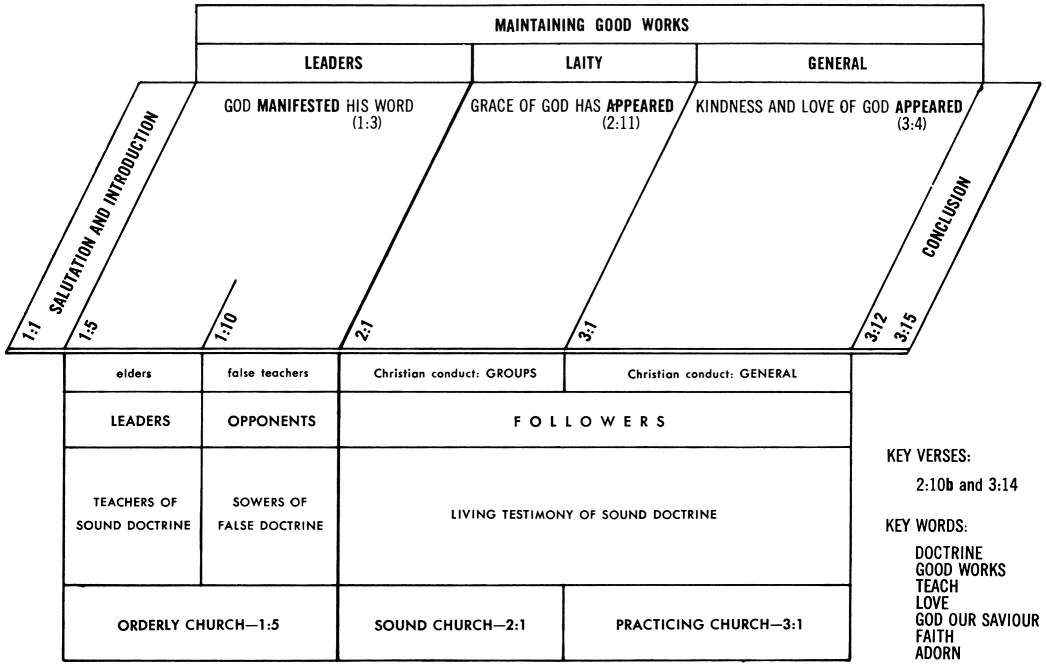
ADORNING THE DOCTRINE OF GOD
Click chart to enlarge
Charts from Jensen's Survey of the NT - used by permission
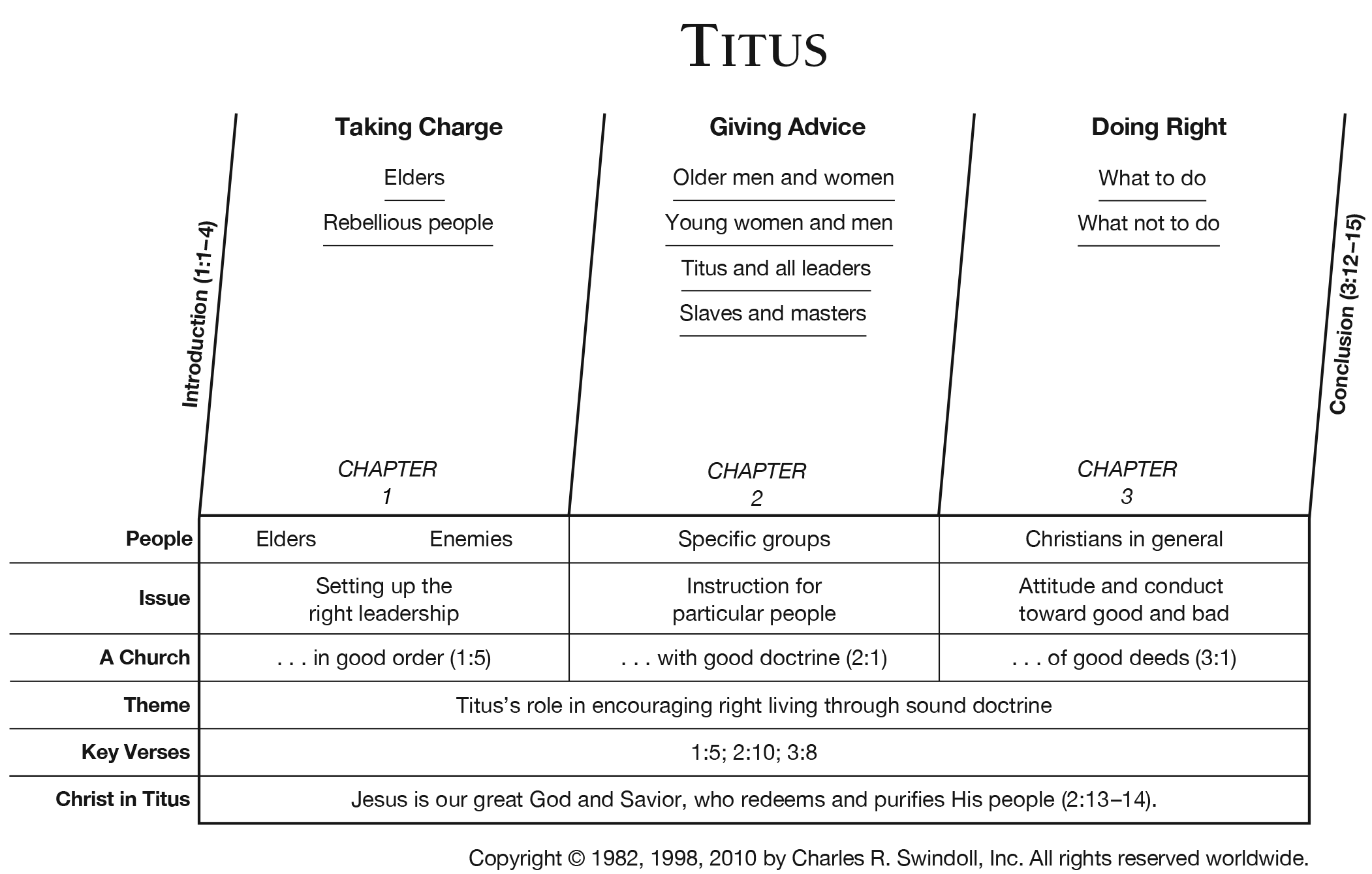
See Summary Chart by Charles Swindoll
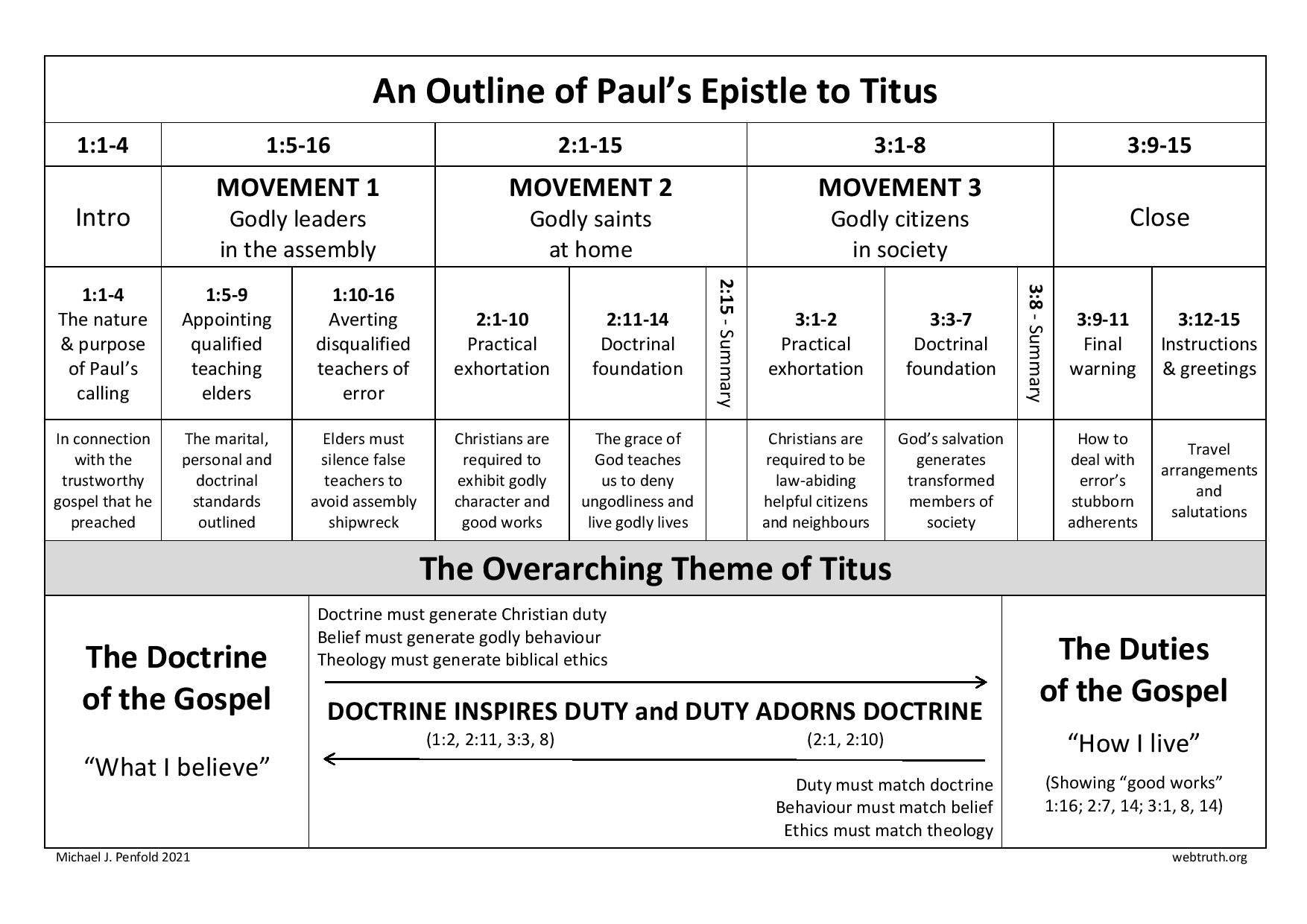
Chart below from Michael J. Penfold
|
Focus |
Appoint Elders |
|||
|
Divisions |
Rebuke |
Maintain |
||
|
Topics |
||||
|
Topics |
Organization |
Offenders |
Operation |
|
|
Place |
Probably Written from either Corinth or Nicopolis (cf. Titus 3:12). |
|||
|
Time |
Circa 63 AD |
|||
|
Modified from Talk Thru the Bible |
||||
Titus 1:10 For there are (3PPAI) many rebellious men, empty talkers and deceivers, especially those of the circumcision (NASB: Lockman)
- Acts 20:29; Ro 16:17;16:18 2Co11:12, 13, 14, 15 Ep 4:14; 2Th 2:10;11, 12 1Ti1:4; 1:6, 6:3; 6:4, 6:5 2Ti 3:13; 4:4; Jas 1:26; 2Pe 2:1,2:2 ; 1Jn 2:18; 4:1; Rev 2:6, 14)
for there are many both insubordinate (YLT)
who will not recognise authority (Phillips)
who are refractory (Wuest), who refuse to obey (TLB)
disorderly and unruly men (Amp)
who don't respect authority (CEV)
who rebel against right teaching (NLT)
who refuse to obey (ICB)
there are plenty of insubordinate creatures (Moffatt)
many rebellious spirits abroad (Knox)
there are far too many who are out of control (NEB)
For there are many that spurn authority (WNT)
incorrigible (Erasmus)
For (1063) (gar) is a conjunction that introduces the logical reason overseers must refute (and be equipped to do so) those who are opposed.
Many (4183) (polus) speaks of a great number or quantity.
Rebellious (506) (anupotaktos from a = without + hupotásso = to subject or arrange [troops] in a military fashion under the command of a leader, sit under in an orderly manner) in the active use describes those who cannot be subjected to control, disobedient, unruly, refractory, undisciplined. They refuse submission to authority. The are ungovernable for they refuse to be subject to any control. They are unruly, disregarding restraint, insubordinate, unwilling to submit, disorderly, headstrong, intractable, undisciplined, and out of control (uncontrollable).
Calvin says these men
cannot endure to be brought to obey and… throw off the yoke of subjection.
They would not submit to God’s Word or to the authority of God’s servant.
Anupotaktos was used in this same chapter describing the elder qualifications as
Titus 1:6 namely, if any man be above reproach, the husband of one wife, having children who believe, not accused of dissipation or rebellion.
There are only two other uses of anupotaktos in Scripture…
1Timothy 1:9 realizing the fact that law is not made for a righteous man, but for those who are lawless and rebellious, for the ungodly and sinners, for the unholy and profane, for those who kill their fathers or mothers, for murderers. (Comment: In this context, anupotaktos refers to unbelievers - lawless, ungodly, sinners, unholy, profane, etc).
Hebrews 2:8 Thou hast put all things in subjection under his feet." For in subjecting all things to him, He left nothing that is not subject to him. But now we do not yet see all things subjected to him. (Comment: In this context, anupotaktos means not made subject, unsubjected and thus independent)
They are rebels who unwilling to submit to authority. Being a law unto themselves and representing the first rebel Satan, they do not recognize the authority of God’s Word or of His Spirit, much less that of His divinely called preachers and teachers. Even when their erroneous doctrine and immoral living are exposed, they are inclined to defy correction and discipline by the true church.
Beware of teachers who will not put themselves under authority. And since there were "many" it was all the more imperative for Titus to appoint elders in every city for Titus no matter how persuasive in refuting these men, would hardly have had time to deal with their growing numbers. Jude also described rebellious men who "by dreaming, defile the flesh and reject authority." (Jude 1:8)
Paul had predicted that there would be men who would come in among the church (an "inside job") and would not spare the flock (Acts 20:29).
EMPTY TALKERS: mataiologoi:
vain-talkers (YLT)
who talk nonsense (Phillips, NJB)
who are idle (vain, empty) and misleading talkers (Amp)
they engage in useless talk (NLT)
people who talk about worthless things (ICB)
vain jangling (Vincent)
senseless talkers (Berkley)
who impose on people with their empty arguments (Moffatt)
disobedient babblers (Conybeare)
given to idle and misleading talk (WNT)
all noise, empty parade, and no work (Clarke)
empty chatterers (McGee)
Empty talkers (3151) (mataiologos from mataios = vain, empty, profitless, fruitless, aimless = building houses on sand, chasing the wind, shooting at stars, pursuing one's shadow + lego = talk) are vain talkers, idle talkers, foolish prattlers who speak only worthless nonsense. These folks are babblers with nothing to say. The root mataios described heathen worship (mataios is used as a word for idols in Acts 14:15, 2Ki 17:15, Jer 2:5, 8:19), specifically worship which produces no goodness of life and nothing of eternal value! He is one who utters empty, senseless things. A windbag!
Titus 1:10 is the only use of mataiologos in the Bible
The related word mataiologia means “empty prattle” and is used in for those who forsake sincere faith.
1Timothy 1:6 For some men, straying from these things, have turned aside to fruitless discussion
These people in Crete could talk glibly but all their talk was ineffective in bringing anyone one step nearer goodness. Their talk produced no spiritual benefits, and in fact robbed the hearers of the truth which led them into error. The Cynics used to say that all knowledge which is not profitable for virtue is vain. The teacher who simply provides his pupils with a forum for pleasant intellectual and speculative discussion teaches in vain. Shakespeare would describe them as “full of sound and fury, signifying nothing.”
Vincent has an unusual note writing that…
Vain jangling… illustrates the writer’s fondness for unusual compounds. Jangling is an early English word from the old French jangler, comp. jongleur a teller of tales. Hence jangling is empty chatter. So Chaucer,
“Them that jangle of love.” Shakespeare,“ This their jangling I esteem a sport.” (Mids. Night’s Dream. iii. 2) (Word studies in the New Testament 4:205-206)
Calvin adds that they
occupy themselves with nothing but useless subtleties (contrast holding fast the faithful word & sound doctrine) … because they contribute nothing to piety and the fear of God.
What these men said may have impressed their hearers, but the words lacked substance. Historically “empty talkers” were frequent in the ranks of many of the pseudo-intellectuals in the ancient world. Jeremiah described a similar breed of men in Israel writing that
The prophet who has a dream may relate his dream, but let him who has My word speak My word in truth. What does straw have in common with grain? (Jer 23:28).
They led God's
people astray by their falsehoods and reckless boasting yet (God) did not send them or command them, nor do they furnish this people the slightest benefit... (Jer 23:32)
AND DECEIVERS: kai phrenapatai:
mind-deceivers (YLT)
it blinds people to the truth (TLB)
who delude people's minds (JNT)
and lead others into the wrong way (ICB)
Deceivers (5423) (phrenapates from phren = mind + apatáo = lead astray, deceive) is literally "a mind deceiver" or one who leads one's mind astray! Instead of leading men to the truth they led them away from it. The deliberately cause someone to believe something that is not true. They cause others to accept as true or valid what is false or invalid.
In the church, deceivers disguise themselves as believers and as teachers of truth. They typically disguise their deceit in ''Biblese'' language, for they are familiar with all the Christian buzz words. Paul wrote to Timothy that
"evil men and impostors will proceed from bad to worse, deceiving and being deceived." (2Ti 3:13-note)
Unfortunately these men have seldom had difficulty attracting an audience. In Paul's last known communication, he warned Timothy that the time would come when men would
“not endure sound doctrine but wanting to have their ears tickled, they (would) accumulate for themselves teachers in accordance to their own desires and (would) turn away their ears from the truth, and (would) turn aside to myths.” (see note 2 Timothy 4:3; 4:4).
In his first epistle to Timothy Paul warned that
"in later times some will fall away from the faith, paying attention to deceitful spirits and doctrines of demons." (1Ti 4:1).
ESPECIALLY THOSE OF THE CIRCUMCISION: malista hoi ek peritomes:
- Acts 15:1; 15:24; Gal 1:6, 7, 8; Gal 2:4; 3:1; 4:17, 18, 19, 21; 5:1; 5:2, 5:3, 5:4; Php 3:2; 3
especially those with Jewish connections (NET)
of the circumcision group (NIV)
this is especially true of those who insist on circumcision for salvation (NLT)
I am talking mostly about those who say that all non-Jews must be circumcised (ICB)
particularly those who have come over from Judaism (Moffatt)
Circumcision (4061) (peritome [word study] from perí = around + témno = cut off) refers literally to cutting and removal of the foreskin. but in this context refers to Jews. Paul used this identical phrase describing the party of the circumcision (Gal 2:12).
In Paul's letter to Philippi he warned believers to
"beware of the false circumcision" (Php 3:2-note) identifying himself as "the true circumcision, who worship in the Spirit of God and glory in Christ Jesus and put no confidence in the flesh" (Php 3:3-note)
From Acts we known that Jews lived in Crete (Acts 2:11), and from Paul's comments, a number of them were Judaizers, men who attempted to place believers back under the Law, seeking to impose OT ceremonial standards (eg, rules about foods and washings) and sometimes even rabbinical traditions, which amounts to a practical denial of the all-sufficiency of the finished work of Christ and the grace that flows from His Cross.
Luke records that
"some men came down from Judea and began teaching the brethren, "Unless you are circumcised according to the custom of Moses, you cannot be saved." (Acts 15:1)
These men were seeking to persuade men that they needed more than Christ and more than grace in order to be saved. They were intellectualists for whom the truth of God was too simple and too good to be true.
Smooth Talkers (Titus 1:5-16) Speak the things which are proper for sound doctrine. --Titus 2:1 A man who was trying to explain the meaning of the word oratory commented with tongue in cheek, "If you say black is white, that's foolishness. But if while you say black is white you roar like a bull, pound on the table with both fists, and race from one end of the platform to another, that's oratory!"
We can quickly be swept off our feet by the way people express themselves, even though we have some questions about their message. Jude warned us about those whose mouths speak "great swelling words" (v.16). The masses are often moved more by style than by content.
According to Paul, the time will come when people will turn away from the truth of sound doctrine and tolerate only those who entertain and make people feel good (2Ti 4:3, 4). So we must carefully analyze and evaluate in the light of the Scriptures everything we hear--even what is taught and proclaimed by the most eloquent of speakers. We must not allow ourselves to be swayed by mere oratory--especially in the church! We need to be sure that the Bible teachers we listen to are "speaking the truth in Christ and not lying" (1Ti 2:7).
Don't let "idle talkers and deceivers" (Titus 1:10) confuse you. Eloquence is never a substitute for truth. —Richard De Haan (Our Daily Bread, Copyright RBC Ministries, Grand Rapids, MI. Reprinted by permission. All rights reserved)
We must beware of speakers who
Distort and twist God's Word;
They'll entertain and motivate,
And call the truth absurd. --Sper
To recognize Satan's lies, focus on God's truth
Titus 1:11 who must (3SPAI) be silenced (PAN) because they are upsetting (3PPAI) whole families, teaching (PAPMPN) things they should (3SPAI) not teach for the sake of sordid gain. (NASB: Lockman)
Greek: ous dei (3SPAI) epistomizein, (PAN) hoitines holous oikous anatrepousin (3PPAI) didaskontes (PAPMPN) a me dei (3SPAI) aischrou kerdous charin.
Barclay: They must be muzzled. They are the kind of people who upset whole households, by teaching things which should not be taught in order to acquire a shameful gain. (Westminster Press)
KJV: Whose mouths must be stopped, who subvert whole houses, teaching things which they ought not, for filthy lucre's sake.
Phillips: They must be silenced, for they upset the faith of whole households, teaching what they have no business to teach for the sake of what they can get. (Phillips: Touchstone)
Wuest: whom it is a necessity in the nature of the case to be reducing to silence, who are of such a character as to disrupt whole families, teaching things which they ought not for the sake of dishonest gain.(Eerdmans)
Young's Literal: whose mouth it behoveth to stop, who whole households do overturn, teaching what things it behoveth not, for filthy lucre's sake.
WHO MUST BE SILENCED: ous dei (3SPAI) epistomizein (PAN):
- Titus 1:9; 3:10; Ps 63:11; 107:42; Ezek 16:63; Lk 20:40; Ro 3:19; 2Cor 11:10
whose mouth it behoveth to stop (YLT)
whom it is a necessity in the nature of the case to be reducing to silence (Wuest)
They must be muzzled (Barclay)
whose mouths must be stopped (KJV)
Must (1163) (dei) is from deo = to bind or tie objects together, put in prison and also root of doulos, bond-servant) refers to what is not optional but needful (binding) out of intrinsic necessity or inevitability. Dei refers to inward constraint which is why it is often translated "must". Dei describes that which is under the necessity of happening or which must necessarily take place, often with the implication of inevitability. Dei To express the sense of necessity dei is translated "one ought", "one should", "one has to" or "one must".
It is necessary! These rebels proclaiming their empty talk could not be allowed to continually speak but to the contrary must be continually "muzzled"!
Be silenced (1993) (epistomizo from epí = upon, + stoma = mouth) originally meant to put something upon the mouth so as to stop it or reduce it to silence. It was used to describe placing a bit into the horse’s mouth. The idea is to close the mouth by means of applying a muzzle or a gag and is used figuratively to refer to preventing someone from talking.
Epistomizo was used to describe the putting on the mouth-piece of a flute.
These individuals should have a bit and a bridle so to speak. The noun form is used of the “stop” of a water pipe. The verb used metaphorically means to reduce to silence.
Vincent translates it as “whom it is necessary to silence.”
These men must be silenced but this rendering could be misleading, as this expression is used to refer to killing someone, which is not Paul’s intention. “You must stop them from talking” is really the idea.
Titus must continually (present tense) place something over their mouth, stopping their mouth so that they are "muzzled, bridled or gagged". How? The best way to counter false teaching is to offer true teaching, and the only truly unanswerable teaching is the teaching of a Christ-glorifying, Word-ordered, Spirit-controlled life.
Today in the Word - The old cliché says that silence is golden. The truth of this statement, however, depends upon the nature of that silence. When false doctrine is being taught, the silence of those who know the truth leads to immeasurable damage. That’s why Paul says that it’s the false teachers who “must be silenced.” In our age of religious pluralism and ethical relativism, Christians may find it hard to confront those who disagree with the basic truths of the Christian faith. Yet if we ignore false teaching, Paul warns that it will spread from individuals to families to entire churches. We can’t afford to be silent.
BECAUSE THEY ARE UPSETTING WHOLE FAMILIES: hoitines holous oikous anatrepousin:
- Mt 23:14; 2Ti 3:6
they are ruining whole families (GWT)
They are destroying whole families (ICB)
who are of such a character as to disrupt whole families, (Wuest)
they upset the faith of whole households (Phillips)
who subvert whole houses (KJV),
who whole households do overturn (YLT),
they have already turned whole families away from the truth (NLT)
bc by it whole families are turned away from the grace of God (TLB)
Because - Always pause to observe these terms of explanation.
Paul explains why it is absolutely necessary to stop these men from talking… it has to do with the effects of their words on entire families.
Upsetting (396) (anatrepo from ana = again + trepho = turn) literally means to overturn, and is used this way in John 2:15 where Jesus "overturned (anatrepo) their tables (of the moneychangers)."
Anatrepo is used figuratively in Titus 1:11 and 2 and means undermine, ruin, overthrow or subvert -- these effects being as the result of false teaching.
2 Timothy 2:18 men who have gone astray from the truth saying that the resurrection has already taken place, and thus they upset the faith of some. (see note)
Here in Titus 1:11, anatrepo is in the present tense indicating that this was already transpiring at the time of the writing of this letter and that it was the lifestyle or habitual activity of these men - they were continually causing trouble with regard to the faith or beliefs of others and so undermining their faith.
Anatrepo is used 4 times in the Septuagint (LXX) (Ps 118:13; Pr 10:3; 21:14; Eccl 12:6)
Whole (3650) (holos) means that the subversion was thorough and complete in extent. They were "good" at their "bad" work which is why they needed to be dealt with. The problem had affected every member of each one of these families!
Families (3624) (oikos) means a dwelling or place for habitation and by implication refers to a family (more or less related), a home, a household.
TEACHING THINGS THEY SHOULD NOT TEACH: didaskontes ha me dei:
Teaching (1321) (didasko) means to provide instruction in a formal or informal setting teaching in such a way that the will of the one taught becomes conformed to the teaching taught, thus causing the student to change his or her mind saying in essence "''I won't do it this way, but I will do it this way because I've learned this doctrine or this teaching.''
Doctrine determines the direction of our behavior -- either are we gradually, inevitably being conformed to world, squeezed into it's evil mold or are we being supernaturally transformed (by exposure to the Word of Truth taught by the Spirit and Spirit filled men - cp Mt 4:4, Jn 6:63) to God (Ro 12:2-note)? Clearly these teachers were continually (present tense) teaching "doctrine" that was fundamentally upsetting.
FOR THE SAKE OF SORDID GAIN: aischrou kerdous charin:
- Titus 1:7; Isa 56:10; 11 Jer 8:10; Ezek 13:19; Mic 3:5 3:11; Jn 10:12; 1Ti 6:5; 2Pe 2:1, 2:2, 2:3)
for filthy lucre's sake (KJV)
This is the shameful way they make money (GWT)
They teach them only to cheat people and make money (ICB)
Such teachers only want your money (NLT)
Sordid (150) (aischros from aischos = baseness, disgrace) refers that which is indecent, dishonorable, "ugly", socially or morally unacceptable, shameful or base. (See related combined word aischrokerdos)
Aischros was a term especially significant in an honor-shame oriented society (a trait that did not characterize Crete!) and was used generally in reference to that which fails to meet expected moral and cultural standards.
The Cretans historically had a bad reputation for itinerate "prophets for profit" (Polybius, Livy, Plutarch).
NIDNTT - The root aisch- refers originally to that which is ugly and disgraceful. aischuno (the verb form) (Homer onwards) thus meant originally to disfigure, make ugly. The verb is found in Greek literature almost exclusively in the middle or passive with the meaning to feel shame, be ashamed, or to be confounded, be disconcerted. (Brown, Colin, Editor. New International Dictionary of NT Theology. 1986. Zondervan)
Aischros is use 4 times in the NT (see below) and 6 times in the Septuagint (LXX) (Genesis 41:3, 4, 19, 20, 21) and is translated in NT as: disgraceful(2), improper(1), sordid(1)
1 Corinthians 11:6 For if a woman does not cover her head, let her also have her hair cut off; but if it is disgraceful for a woman to have her hair cut off or her head shaved, let her cover her head.
1 Corinthians 14:35 And if they desire to learn anything, let them ask their own husbands at home; for it is improper for a woman to speak in church.
Ephesians 5:12 for it is disgraceful even to speak of the things which are done by them in secret.
Gain (2771) (kerdos) refers to a gain, an advantage, a profit. Kerdos is that which is gained or earned, especially the difference between an initial outlay and the subsequent amount earned.
In this verse the KJV translates it as "lucre" which is "filthy".
Kerdos is found 3 times in the Bible…
Philippians 1:21 For to me, to live is Christ, and to die is gain. (note)
Philippians 3:7 But whatever things were gain to me, those things I have counted as loss for the sake of Christ. (note) (Comment: Kerdos describes what is in the profit column; zemia (“loss, disadvantage”) what is in the loss column)
The NLT picks up the tenor translating it as "Such teachers only want your money."
Spurgeon - If the lust of wealth enters into the heart, it rots it to the core. The apostle cries, “Your wealth has rotted” (Jas 5:3); truly, the man becomes cancerous and cankered too.
The whole motivation for their actions is financial profit. Teachers only after the saint's money is a distinct mark of false teachers for they love money and "suppose that godliness is a means of gain" (1Ti 6:5, cf 1Ti 3:3, 8) When one looks on his teaching simply as a career designed for personal advancement and profit, he is in a perilous condition.