Titus 1:2
Titus 1:3
Titus 1:4
Titus 1:5
Titus 1:6
Titus 1:7
Titus 1:8
Titus 1:9
Titus 1:10
Titus 1:11
Titus 1:12
Titus 1:13
Titus 1:14
Titus 1:15
Titus 1:16
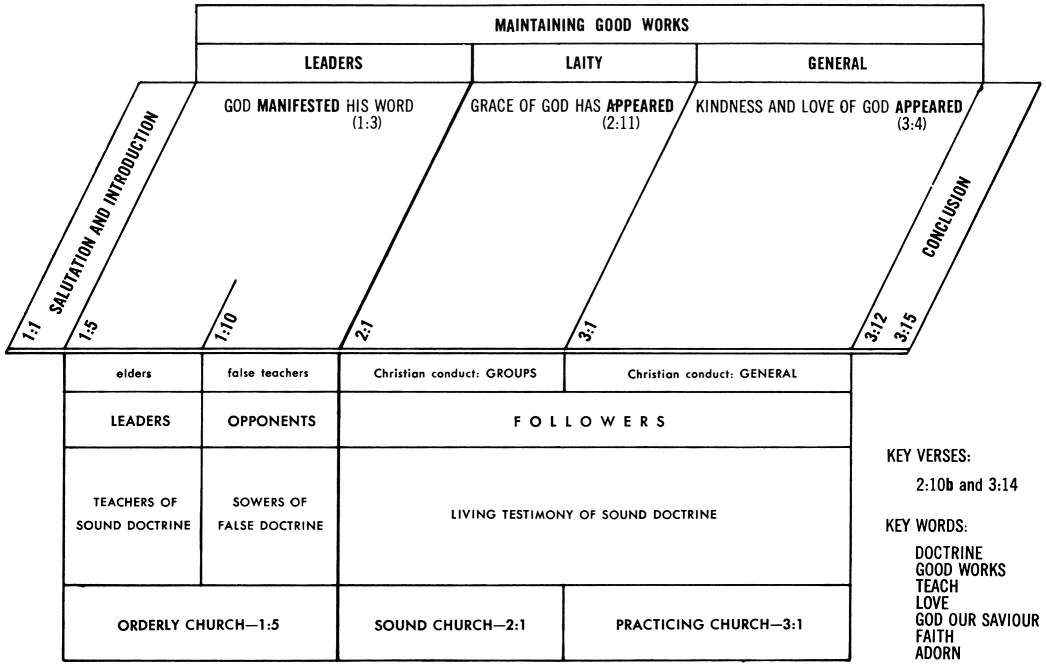
ADORNING THE DOCTRINE OF GOD
Click chart to enlarge
Charts from Jensen's Survey of the NT - used by permission
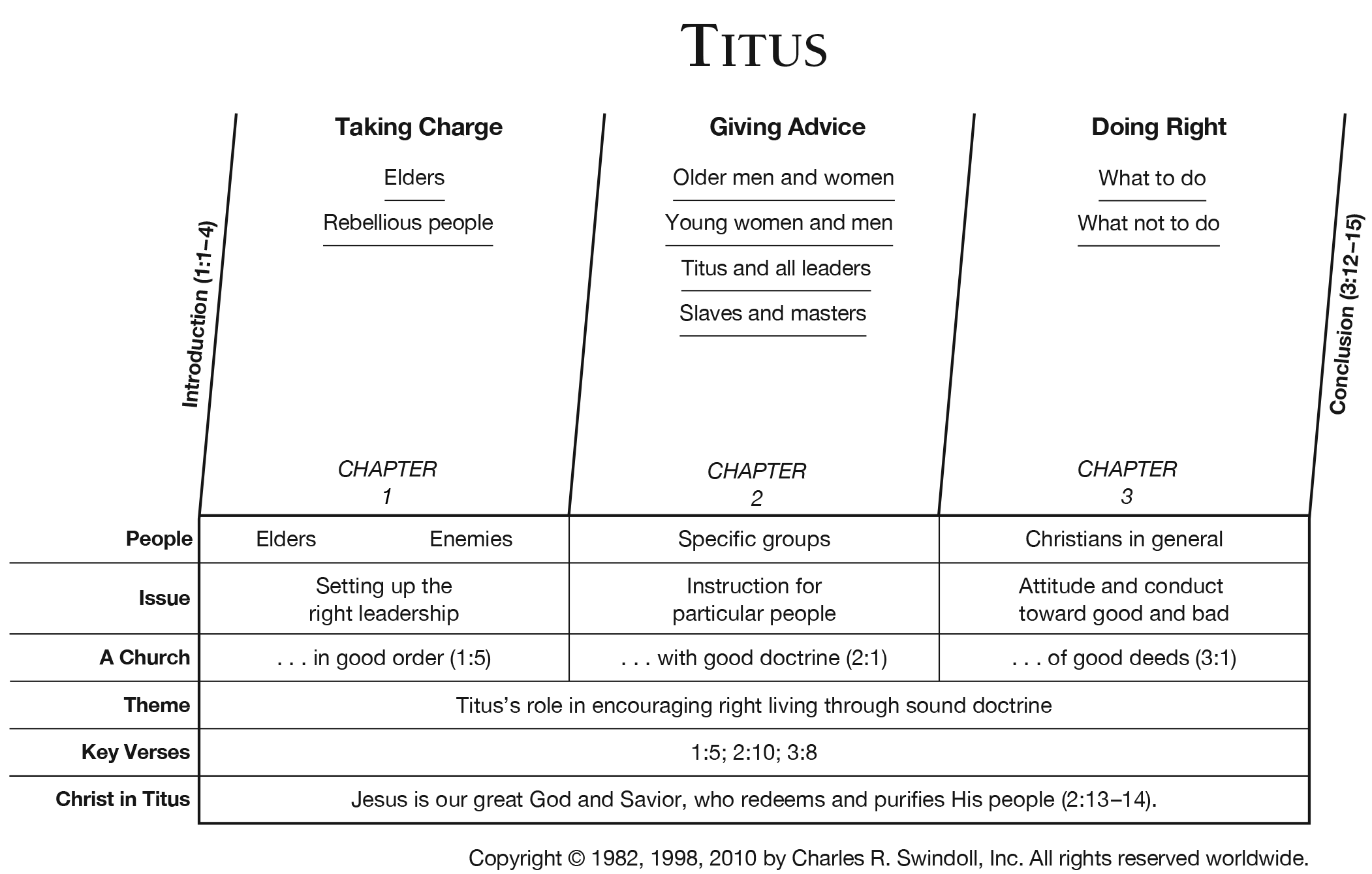
See Summary Chart by Charles Swindoll
Chart below from Michael J. Penfold
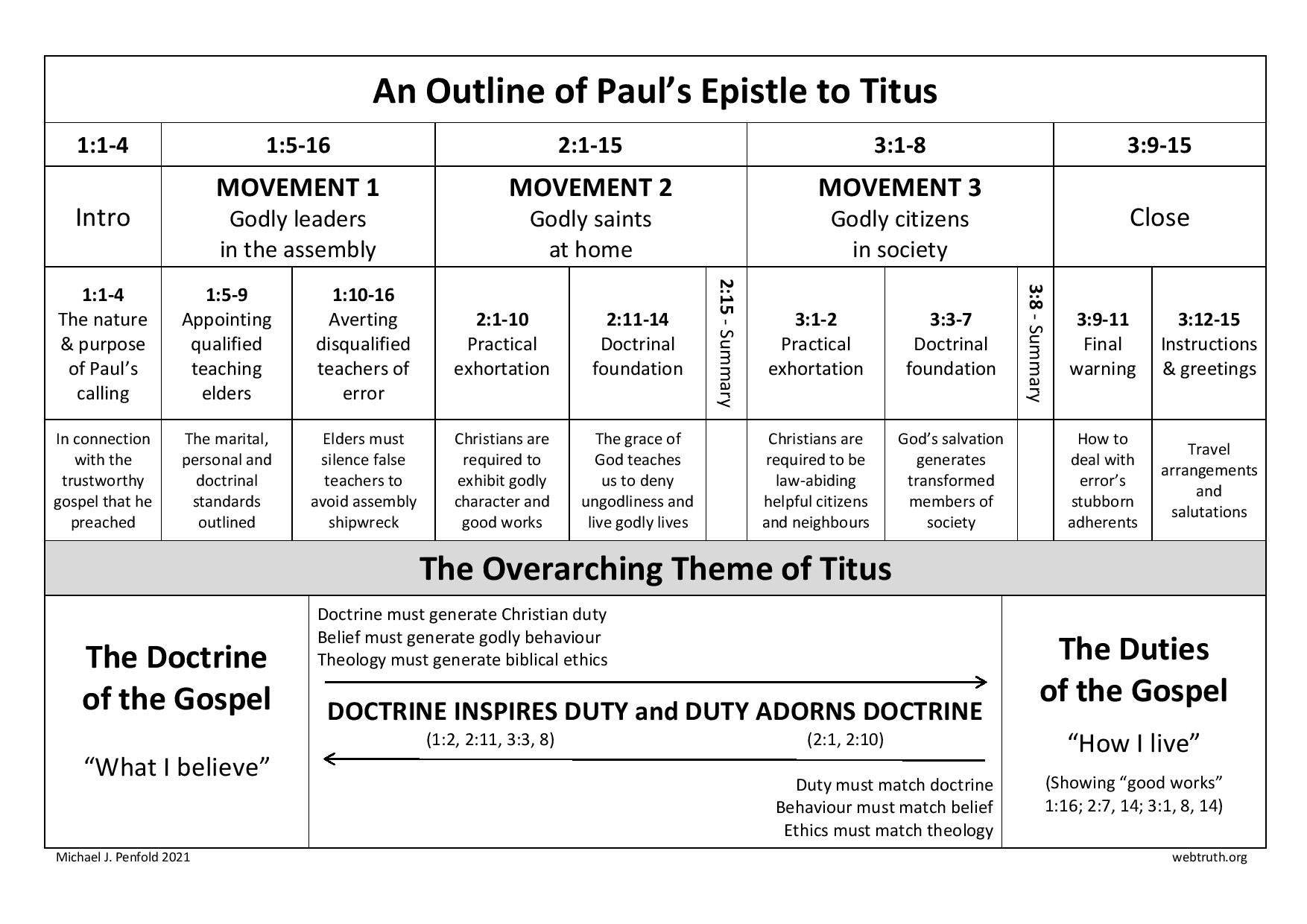
|
Focus |
Appoint Elders |
|||
|
Divisions |
Rebuke |
Maintain |
||
|
Topics |
||||
|
Topics |
Organization |
Offenders |
Operation |
|
|
Place |
Probably Written from either Corinth or Nicopolis (cf. Titus 3:12). |
|||
|
Time |
Circa 63 AD |
|||
|
Modified from Talk Thru the Bible |
||||
Titus 1:5 For this reason I left you in Crete, that you would set in order what remains and appoint elders in every city as I directed you, (NASB: Lockman)
Greek: Toutou charin apelipon (1SAAI) se en Krete, hina ta leiponta (PAPNPA) epidiorthose (2SAMS) kai katasteses (2SAAS) kata polin presbuterous, os ego soi dietaxamen (1SAMI)
Barclay: The reason why I left you in Crete was that any deficiencies in the organization of the Church should be rectified, and that you might appoint elders in each city as I instructed you. (Westminster Press)
Amplified: [These elders should be] men who are of unquestionable integrity and are irreproachable, the husband of [but] one wife, whose children are [well trained and are] believers, not open to the accusation of being loose in morals and conduct or unruly and disorderly. (Amplified Bible - Lockman)
KJV: For this cause left I thee in Crete, that thou shouldest set in order the things that are wanting, and ordain elders in every city, as I had appointed thee:
Phillips: I left you in Crete to set right matters which needed attention, and gave you instructions to appoint elders in every city. (Phillips: Touchstone)
Wuest: On this account I left you behind temporarily in Crete, in order that you should set right the things which remain to be done, and appoint [as overseers] in every city [men who are] elders, as I gave you a charge
Young's Literal: For this cause left I thee in Crete, that the things lacking thou mayest arrange, and mayest set down in every city elders, as I did appoint to thee;
Click to enlarge
Mt Ida on Crete
FOR THIS REASON I LEFT YOU IN CRETE: toutou charin apelipon (1SAAI) se en krete:
- Acts 2:11; 27:7,12; 21
- Titus 1 Resources - Multiple Sermons and Commentaries
"The reason I left you in Crete was… ". (NET)
"The reason I left you behind in Crete was for you to organize everything that still had to be done and appoint elders in every town… " (NJB)
"I left you behind temporarily" (Wuest)
For this reason explains why Paul left Titus in Crete. We have to read on to find out the full meaning.
Spurgeon - While reading this book, we must understand that Titus was sent to Crete to superintend the preaching of the gospel throughout that island. Crete was at that time inhabited by a people who were only partially civilized and sunk in the very worst of vices. Paul, therefore, tells Titus to speak to them about things that would hardly be mentioned to Christians nowadays. appoint elders in every town
Left (620) (apoleipo) means to cause or permit to remain in a place upon going away and thus to leave behind. Writing from prison Paul gave instructions to "bring the cloak which I left (apoleipo) at Troas… ". So just as Paul had at one time been in Troas and left his cloak, at some time in the past he had been in Crete with Titus.
Apoleipo implies that the "being left behind" was temporary, rather than permanent.
Wuest makes an interesting, albeit somewhat speculative observation noting that Crete = "was not visited by Paul on any of his first three missionary journeys (Ed note: At least there is no record of such visit in Acts or the Pauline epistles). He touched there on his way to Rome as a prisoner of the Roman Empire, but at that time, Titus was not with him (cf Acts 27:8+). This is one of the facts which indicates that Paul was liberated from his first Roman imprisonment and spent some time in missionary work. Here he refers to the time when he the churches they had founded." (Wuest, K. S. Wuest's Word Studies from the Greek New Testament: Studies in the Vocabulary of the Greek New Testament: Grand Rapids: Eerdmans)
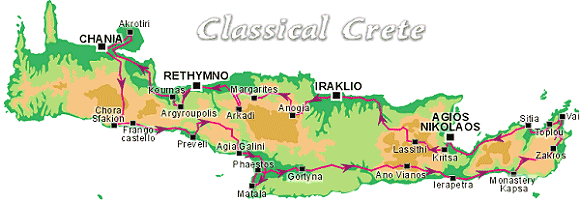 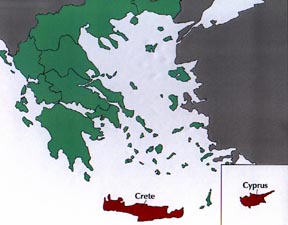 |
Crete (2914) (click maps to enlarge) is the fourth largest island (150 long & 6-35 miles wide) in the Mediterranean and the largest Grecian island (population ca 500,000 in 2003) and is situated approximately 60 miles SE of Greece and 110 miles SW of Turkey. A mountain range with peaks up to 9,000 feet (Mt Ida is said to be the "birthplace" of Zeus which gives one a sense of the prevalent influence of myth and legend which in turn was reflected in the behavior and morals of Cretans) runs the length of the island and slopes sharply on the southern coast, so that most of the inhabitants live on the more gradually sloping northern oast, so that most of the inhabitants live on the more gradually sloping northern coast. A highly developed civilization (Minoan 3000–1100 bc) once existed in Crete but was suddenly and dramatically destroyed in a mysterious manner about 1700 bc. Crete is roughly equidistant from Europe, Africa and Asia and this strategic location along with its fertile land, made Crete a prize of war and commerce and accordingly Crete was conquered and annexed by Rome in BC 67. The Cretans were renowned as good sailors, skilled archers, and experts in ambush and lying (Titus 1:12), the latter frequently alluded to in classic writings. The untruthfulness of Cretans was so ingrained that there was even a Greek term (kretizein) meaning “to act the Cretan,” which was a synonym meaning to play the liar.
Hiebert adds that "the moral level of its inhabitants was deplorable. Their ferocity and fraud were widely attested; their falsehood was proverbial; the wine of Crete was famous, and drunkenness prevailed."Into this ungodly mission field Paul had planted Titus to organize the church ("appoint elders in every city") and to "speak and exhort and reprove with all authority" (Titus 2:15).
Titus must have taken "heed to the ministry which" he had "received in the Lord" (Col 4:17) for even today the name of Titus is honored in many villages, churches, and monasteries in Crete.
THAT YOU WOULD SET IN ORDER WHAT REMAINS: hina ta leiponta (PAPNPA) epidiorthose (2SAMS) :
- 1Chr 6:32; Eccl 12:9; Is 44:7; 1Cor 11:34; 14:40; Col 2:5
- Acts 14:21, 22, 23; 2Ti 2:2
- Titus 1 Resources - Multiple Sermons and Commentaries
Paul left Titus that he "might set right what was defective and finish what was left undone" (Amp)
"so that you might set right what remains to be done" (NAB)
"to do what still needed to be done" (GWT)
"so that you could put in order the things that still needed doing" (TEV)
"so that you might do what was necessary to put things in order there," (BBE)
"that you might straighten out what was left unfinished" (NIV)
"that you might amend what was defective," (RSV)
"so that you could finish doing the things that still needed to be done" (ICB)
"that any deficiencies in the organization of the Church should be rectified" (Barclay)
"correcting those things which are still wanting." (Calvin)
That (2443) (hina) is a preposition marking the beginning of a purpose clause as Paul now explains why he had left Titus behind in Crete. See value of observing this strategic term of purpose or result (e.g., so that, in order that, that, as a result)
Paul as the "wise master builder (had) laid a foundation, and another (Titus) is building upon it" (1Cor 3:10), carrying forward the building up of the body of Christ in Crete.
Calvin "Titus held some additional charge, which consisted in giving a form to churches that had not yet been properly arranged, and in appointing a fixed kind of government accompanied by discipline. Having laid the foundation, Paul departed; and then it became the duty of Titus to carry the work higher, that the building might have fair proportions."
Set in order (only here in NT) (1930) (epidiorthoo from epi = upon + dia = through, intensifies meaning + orthos = straight, erect, upright; English = orthodontist - straightens crooked teeth or orthopedist who sets broken bones) means to set right, to set in order, to correct in addition to what has already been corrected, to finish setting in order, to have deficiencies set right also, to complete unfinished reforms.
Epidiorthoo was used by medical writers to describe the setting broken limbs or straightening crooked ones.
The use of the middle voice is "reflexive" and implies that Titus himself (himself is a reflexive pronoun) is personally involved in the process, and not merely giving orders to others. Titus like an "spiritual" orthodontist or orthopedist is to set right again what was still in a defective state.
Vine says this verb used "in the sense of setting right again what was defective, a commission to Titus, not to add to what the Apostle himself had done, but to restore what had fallen into disorder since the Apostle had labored in Crete." ( Vine's Complete Expository Dictionary of Old and New Testament Words)
Epidiorthoo conveys the idea of to further set straight and therefore implies that Paul had begun the work of setting in order the things that were defective and that now Titus is to continue that same work. In other words Titus primary task was not to evangelize but to straighten out the churches that were already in existence yet deficient in organization and in need of sound doctrine which produces godly living. He was charged with the task of correcting and setting straight certain doctrines (e.g., Titus 1:10, 11, 13, 14; 2:1) and practices (e.g., Titus 1:12, 16; 3:9) that had become defective. There were false teachers to be silenced, and there was the pressing need for recognized spiritual leadership in the assemblies. He left Titus to handle these matters.
Hiebert quoting Greene explains that "Setting in order churches that have gone wrong is a delicate and large task-more difficult in many ways than evangelizing new fields. False teachings are hard to correct, and when sin gets into a church, it is difficult to dislodge it."
As Wiersbe quipped "The church is a body, and the pastor must occasionally be a “spiritual physician” and set some bones. (Wiersbe's Expository Outlines on the New Testament. Wheaton, Ill.: Victor Books)
Remains (3007) (leipo) as alluded to above refers to those things in the organization of the churches which were left unfinished or "wanting". We can see Paul's heart is not to leave and forget about those he has spent time with but as in this case leaving Titus to tend to their needs.
Calvin calls us to "observe the modesty of Paul who willingly permits another person to complete the work which he had begun. And, indeed, although Titus is greatly inferior to him, he does not refuse to have him for a “corrector,” to give the finishing hand to his work. Such ought to be the dispositions of godly teachers; not that every one should. labor to make everything bend to his own ambitious views, but that they should strive to assist each other, and that, when any one has labored more successfully, he should be congratulated and not envied by all the rest.
AND APPOINT ELDERS IN EVERY CITY AS I DIRECTED YOU: kai katasteses (2SAAS) kata polin presbuterous os ego soi dietaxamen (1SAMI) :
- Titus 1 Resources - Multiple Sermons and Commentaries
appoint presbyters in every town" (NAB)
appointing spiritual leaders in every city " (GWT)
placing men in authority over the churches in every town, as I said to you;" (BBE)
I left you there also so that you could choose men to be elders in every town" (ICB)
and that you might appoint elders and set them over the churches (assemblies) in every city as I directed you." (Amp)
And (kai) introduces an emphatic, specific detail that required the attention of Titus. The point is that the assemblies of Christians in the various cities did not have sufficient organization or spiritual leadership.
To appoint elders - See article by Mark Dever - Looking For a Few Good Men
Jamieson, Fausset and Brown add that "The appointment of presbyters was designed to check idle talk and speculation, by setting forth the faithful word.”
Spurgeon - The gospel had been preached in Crete, and converts made, but the churches needed to be properly constituted. Churches without elders are like an army without officers. Those err greatly who despise order.
Appoint (2525) (kathistemi from katá = down + hístēmi = to set or stand) means literally “to stand or set down".
Friberg sums up the three basic meanings - "(1) conduct, bring, lead to (Acts 17.15+); (2) set in an elevated position appoint, put in charge (Luke 12.42); (3) with a double accusative make someone something, cause to be in a certain position or state (2Pe 1.8); passive be made, become (James 4.4)" (Analytical Lexicon)
Louw-Nida on kathistemi - 1. appoint, put in charge, designate (Mt 24:45); 2. cause to be, make (Ac 7:10, 27, 35; Ro 5:19+)
Most of the NT uses of kathistemi are figurative and refer to "setting someone down in office" or appointing or assigning a person to a position of authority. To put in charge or to appoint one to administer an office. To set in an elevated position. Westcott says that it is "the ordinary word for authoritative appointment to an office." R. J. Knowling in The Expositor's Greek Testament adds that kathistemi "implies at all events an exercise of authority." By itself, the word does not necessarily imply a formal “ordination” ceremony of any sort, only that such persons were to be installed in office. Titus was thus to constitute elders in the churches, city by city.
Mounce - kathistēmi has a variety of nuances of NT. It can signify leading or escorting; in Acts 17:15+, a group of men escort Paul. But its predominant use is for “appointing” a person to an office or “putting a person in charge” of something. This includes appointing people to the positions of deacons (Acts 6:3), elders (Tit 1:5), and the high priest (Heb 5:1). It is also used in the parable of the talents for the king’s decision to put the owners of ten and five talents to be “put in charge” of many things in the kingdom of heaven (Mt 25:21, 23; cf. also 24:47). (Mounce's Complete Expository Dictionary of Old and New Testament Words)
NIDNTT - CL kathistēmi is a compound of histēmi, stand, place, set. It has three main meanings which are basic for our understanding of its NT use: (a) lead or bring in; (b) appoint, especially to an office or position; (c) bring it to pass that, and in perf. (intrans.) have become something, appear as. This expresses both the objective fact and also the subjective representation of, or judgment on, a matter (A. Oepke, TDNT III 444 f.). OT The commonest meaning in the LXX is to place somewhere, and appoint to an office (cf. Deut. 17:15; 1 Sam. 8:1; Ps. 105:21). NT Meaning (a) is found only in Acts 17:15+ “those who conducted Paul”; (b) is found in Acts 6:3+ of deacons, Tit. 1:5 of elders, Heb. 5:1; 8:3 of the high priest, Matt. 24:45 par. of the controller of a household. The usage (c) is theologically important, and occurs in Rom. 5:19; Jas. 4:4; and 2 Pet. 1:8. Rom. 5:12–21 is a passage of major theological importance. In it → Adam and → Christ are contrasted. Adam’s act of disobedience has binding results for all; they stand there (katestathēsan) as sinners. Through Christ’s obedience they are to be reckoned (katastathēsontai) as righteous. In v. 19 this contrasted pair of facts is thus in each case described by kathistēmi. Paul uses this verb to describe God’s judgment on man; he draws on the language and ideas of the OT and late Jud. This anthropomorphic way of expressing it presents two contrasting aspects: existence as a sinner and → justification. The decisive event is seen to be Christ’s obedience even to death (cf. Phil. 2:5–11). Through it the real possibility is granted to all of standing as righteous before God. Adam here is a representative of “man” used to illustrate the fact of man’s being a “sinner” because of his disobedience. ([Tr.] cf. the discussion of Rab. teaching on Adam in W. D. Davies, Paul and Rabbinic Judaism, 19552, 36–57.) The reality of man under the judgment of God, as seen by faith, is revealed to him above all in the salvation from his lost state which is offered to him.
In Acts 17:15+ kathistemi means to conduct or "bring down" to a certain place.
In Romans 5:19 kathistemi means to "set down", to constitute (to give formal existence to; to make a thing what it is), to cause or show someone to be (either sinner or righteous)
Kathistemi is used 22x and is translated in the NAS as - appoint(1), appointed(4), appoints(1), conducted(1), made(5), makes(1), put in charge(7),render(1), set(1).
Matthew 24:45 "Who then is the faithful and sensible slave whom his master put in charge (set you over, assigning to a position of authority) of his household to give them their food at the proper time?
Matthew 24:47 "Truly I say to you, that he will put him in charge of all his possessions.
Matthew 25:21 (Jesus in the parable of the talents describes the master's declaration) "His master said to him, 'Well done, good and faithful slave; you were faithful with a few things, I will put you in charge of many things, enter into the joy of your master.'
Matthew 25:23 "His master said to him, 'Well done, good and faithful slave; you were faithful with a few things, I will put you in charge of many things; enter into the joy of your master.'
Luke 12:14 But He said to him, "Man, who appointed Me a judge or arbiter over you?"
Luke 12:42 And the Lord said, "Who then is the faithful and sensible steward, whom his master will put in charge of his servants, to give them their rations at the proper time?
Luke 12:44 "Truly I say to you, that he will put him in charge of all his possessions.
Acts 6:3+ "But select from among you, brethren, seven men of good reputation, full of the Spirit and of wisdom, whom we may put in charge of this task.
Acts 7:10+ and rescued him from all his afflictions, and granted him favor and wisdom in the sight of Pharaoh, king of Egypt; and he made him (put him in charge as) governor over Egypt and all his household.
Acts 7:27+ "But the one who was injuring his neighbor pushed him away, saying, 'Who made (put you in charge as) you a ruler and judge over us?
Acts 7:35+ "This Moses whom they disowned, saying, 'Who made you a ruler and a judge?' is the one whom God sent to be both a ruler and a deliverer with the help of the angel who appeared to him in the thorn bush.
Acts 17:15+ Now those who conducted Paul brought him as far as Athens; and receiving a command for Silas and Timothy to come to him as soon as possible, they departed.
Romans 5:19+ For as through the one man's disobedience the many were made (constituted) sinners, even so through the obedience of the One the many will be made (constituted) righteous.
Ralph Earle on "made" or "constituted" - Sanday and Headlam translate the verb "were constituted . . . shall be constituted," but add: "The Greek word has the same ambiguity as the English." They hold that men were constituted sinners "prior to and independently of their own deliberate act of sin" (p. 142). But Denney says, more correctly, that this did not take place "immediately and unconditionally," but "mediately through their own sin" (EGT, 2:630). Yet there is truth in Meyer's statement: "Thus through the disobedience of the one man, because all had part in it, has the position of all become that of sinners" (p. 217). Because Adam was the federal head of the human race, there is a sense in which all mankind was involved in his disobedience and fall. (Word Meanings)
Sanday and Headlam on ‘shall be constituted.’ - But in what sense ‘constituted’? The Greek word has the same ambiguity as the English. If we define further, the definition must come from the context. Here the context is sufficiently clear: it covers on the one hand the whole result of Adam’s Fall for his descendants prior to and independently of their own deliberate act of sin; and it covers on the other hand the whole result of the redeeming act of Christ so far as that too is accomplished objectively and apart from active concurrence on the part of the Christian. (Romans)
Zodhiates explains why kathistemi is used instead of ginomai in Ro 5:19 - “For as by one man’s disobedience many were made [katestáthēsan, aor. pass. indic.] sinners, so by the obedience of one shall many be made [katastathésontai, fut. pass. indic.] righteous.” Another synonym which was not used is gínomai (1096), to become, or, in this case, to make. To have used this latter word would have actually meant that God is responsible for making transgressors. As a judge does not make lawbreakers or bear moral responsibility for what they do, so it is with the Lord. God does not make sinners or cause them to sin, but He declares them to be such. He set the consequence of the disobedience of man, but He was not responsible for that disobedience. The verb kathístēmi used in this regard means that God has set or placed man in a definite place or position, that of the transgressor, but He did not make him a transgressor. The responsibility is entirely man’s. (The Complete Word Study Dictionary: New Testament - excellent resource)
Vincent writes that kathistemi is "Used elsewhere by Paul only at Titus 1:5 (note), in the sense of to appoint to office or position. This is its most frequent use in the New Testament. See Matt. 24:25; Acts 6:3; 7:10; Heb. 5:1, etc. The primary meaning being to set down, it is used in classical Greek of bringing to a place, as a ship to the land, or a man to a place or person; hence to bring before a magistrate (Acts 17:15). From this comes the meaning to set down as, i.e., to declare or show to be; or to constitute, make to be. So 2 Pe 1:8 (note); James 4:4; 3:6. The exact meaning in this passage is disputed. The following are the principal explanations:
1. Set down in a declarative sense; declared to be.
2. Placed in the category of sinners because of a vital connection with the first transgressor.
3. Became sinners; were made. This last harmonizes with sinned in Ro 5:12. The disobedience of Adam is thus declared to have been the occasion of the death of all, because it is the occasion of their sin; but the precise nature of this relation is not explained. (Romans 5: Greek Word Studies)
Titus 1:5+) For this reason I left you in Crete, that you might set in order what remains, and appoint elders in every city as I directed you,
Hebrews 5:1+) For every high priest taken from among men is appointed (passive voice = they did not appoint themselves) on behalf of men in things pertaining to God, in order to offer both gifts and sacrifices for sins;
Hebrews 7:28+) For the Law appoints men as high priests who are weak, but the word of the oath, which came after the Law, appoints a Son, made perfect forever.
Hebrews 8:3+) For every high priest is appointed to offer both gifts and sacrifices; hence it is necessary that this high priest also have something to offer.
James 3:6+ And the tongue is a fire, the very world of iniquity; the tongue is set among our members as that which defiles the entire body, and sets on fire the course of our life, and is set on fire by hell.
James 4:4+ You adulteresses, do you not know that friendship with the world is hostility toward God? Therefore whoever wishes to be a friend of the world makes (shows or exhibits himself) himself an enemy of God.
2 Peter 1:8+) For if these qualities are yours and are increasing, they render (make or cause you to experience) you neither useless nor unfruitful in the true knowledge of our Lord Jesus Christ.
Kathistemi is used about 136 times in the non-apocryphal Septuagint (LXX) --
Ge. 39:4f; 41:33f, 41, 43; 47:5; Exod. 2:14; 5:14; 18:21; Num. 3:10, 32; 4:19; 21:15; 31:48; Deut. 1:13, 15; 16:18; 17:14f; 19:16; 20:9; 25:6; 28:13, 36; 32:25; Jos. 6:23; 8:2; 9:27; 10:18; 20:3, 9; 1 Sam. 1:9, 26; 3:10; 5:3; 8:1, 5; 10:19, 23; 12:7, 16; 18:13; 19:20; 22:9; 29:4, 10; 30:12; 2 Sam. 3:39; 6:21; 15:4; 17:25; 18:1; 1 Ki. 2:35; 4:5, 7, 27; 5:16; 11:28; 2 Ki. 7:17; 10:3; 22:5, 9; 25:22f; 1 Chr. 6:31; 9:29; 11:25; 12:18; 22:2; 26:32; 2 Chr. 11:15, 22; 12:10; 17:2; 19:5, 8; 21:5; 24:11; 25:3; 28:15; 29:4; 31:13; 33:14; 34:10; 36:1, 4; Ezr. 7:25; Neh. 12:44; 13:19; Esther 2:3; 3:13; 5:1; 8:2, 12; Job 16:12; Ps. 2:6; 8:6; 9:20; 18:43; 45:16; 97:1; 105:21; 109:6; Prov. 29:14; Is 3:13; 49:8; 62:6; Jer. 1:10; 6:17; 20:1; 23:3; 29:15; 30:24; 40:4, 7, 11; 41:2, 18; 44:28; 46:4; Ezek. 34:18; Dan. 1:11, 20; 2:21, 24, 38, 48f; 3:12, 30; 4:1, 31; 5:11; 6:1, 3f, 28
Vincent comments that the primary meaning of kathistemi is "to set down, it is used in classical Greek of bringing to a place, as a ship to the land, or a man to a place or person; hence to bring before a magistrate… From this comes the meaning to set down as, i.e., to declare or show to be; or to constitute, make to be. (Word studies in the New Testament: Vol. 3, Page 1-64)
Kathistemi is used in Acts meaning to bring to a certain place or to conduct, Luke recording "Now those who conducted Paul brought him as far as Athens; and receiving a command for Silas and Timothy to come to him as soon as possible, they departed. (Acts 17:15)
Kathistemi means to "to make someone something" and is used by Paul explaining that "as through the one man’s disobedience the many were made (constituted - kathistemi) sinners, even so through the obedience of the One the many will be made (constituted - kathistemi) righteous." (see note Romans 5:19)
William Newell writes that "There is no more direct statement in Scripture concerning justification than we find in" this verse. By the one act of Adam in disobeying God, the human race was constituted sinful, and this by the judicial act of God. Likewise, by the one act of obedience of the Lord Jesus, all who believe are constituted righteous, and this by the judicial act of God.
Paul was assigning Titus, "setting him down" (giving him charge) to a position of authority over the believers in the assemblies of Christians in the various cities of Crete. Now that Paul had gone, Titus was in charge. Appoint is preferable to the KJV rendering ordain, as there is nothing in the context to imply a formal ecclesiastical ordination. This was to an appointment, for the recognition of the local churches, of those who had already been raised up and qualified by the Holy Spirit, and had given evidence of this in their life and service. Similarly , the writer of Hebrews says that "every high priest taken from among men is appointed (kathistemi) on behalf of men in things pertaining to God, in order to offer both gifts and sacrifices for sins." (Heb 5:1-note)
The position of High-Priest in the Levitical system was by appointment only. No man could legitimately appoint himself High-Priest.
Luke used kathistemi to describe the selection of deacons who were to be "men of good reputation, full of the Spirit and of wisdom whom we may put in charge (kathistemi) of this task (of serving tables) (Acts 6:3)
Elders (4245) (presbuteros the comparative form of présbus = an old man or an ambassador) referred to men who were older or more senior with no negative connotations but rather a sense of venerability.
Presbuteros is transliterated into English as “presbyter” (a leader in one of the Jewish communities--especially a member of the Sanhedrin--or of the early Christian churches) and from which the word “priest” (from Late Latin presbyter) was derived.
Related Resources:
- What are the qualifications of elders and deacons?
- What are the duties of an elder in the church?
- What does the husband of one wife phrase in 1 Timothy 3:2 mean?
- Can an unmarried man be a deacon or elder?
- How can an elder come under the same condemnation as the devil (1 Timothy 3:6)?
- American Church Dictionary Elder
- Bridgeway Bible Dictionary Elder
- Baker Evangelical Dictionary Elder
- Charles Buck Dictionary Elder
- Easton's Bible Dictionary Elder
- Fausset Bible Dictionary Elder
- Holman Bible Dictionary Elder
- Hastings' Dictionary of the Bible Elder
- Hastings' Dictionary of the NT Elder Elder (2)
- Morrish Bible Dictionary Elders
- International Standard Bible Encyclopedia Elder in the Old Testament Elder in the New Testament
- Hawker's Poor Man's Dictionary Elders
- People's Dictionary of the Bible Elder
- Smith Bible Dictionary Elder
- Watson's Theological Dictionary Elders
- Kitto Biblical Cyclopedia Elder
- The Nuttall Encyclopedia Elder
- The Jewish Encyclopedia Elder
Presbuteros is used 67 in NT: The NAS translates presbuteros as - elder(3), elders(57), men of old(1), old men(1), older(1), older man(1), older ones(1),older women(1). KJV - V - elder 64, old man 1, eldest 1, elder woman 1; 67
Matt. 15:2; 16:21; 21:23; 26:3, 47, 57; 27:1, 3, 12, 20, 41; 28:12; Mk. 7:3, 5; 8:31; 11:27; 14:43, 53; 15:1; Lk. 7:3; 9:22; 15:25; 20:1; 22:52; Jn. 8:9; Acts 2:17; 4:5, 8, 23; 6:12; 11:30; 14:23; 15:2, 4, 6, 22,23; 16:4; 20:17; 21:18; 23:14; 24:1; 25:15; 1Ti 5:1, 2, 17, 19; Titus 1:5; Heb. 11:2; James. 5:14; 1Pet. 5:1, 5; 2Jn. 1:1; 3Jn. 1:1; Re 4:4, 10; 5:5, 6, 8, 11, 14; 7:11, 13; 11:16; 14:3; 19:4.
Presbuteros is used 144 times in the non-apocryphal Septuagint (LXX) -
Gen. 18:11f; 19:4, 31, 33f, 37; 24:1f; 27:1, 15, 42; 29:26; 35:29; 43:27; 44:12, 20; 50:7; Exod. 10:9; 17:5; 18:12; 19:7; 24:1, 14; 34:30; Lev. 4:15; 19:32; Num. 11:16, 24f, 30; 16:25; Deut. 31:9, 28; 32:7; Jos. 7:6, 23; 8:10, 30; 9:11; 13:1; 23:1; 24:1, 31; Jdg. 2:7; 8:14, 16; 11:5, 7ff; 21:16; Ruth 4:2, 4, 9, 11; 1 Sam. 4:3; 15:30; 16:4; 30:26; 2 Sam. 3:17; 5:3; 12:17; 17:4, 15; 19:11, 32; 1 Ki. 1:1; 8:1; 12:6, 8, 13, 24; 20:7f; 21:8, 11; 2 Ki. 6:32; 10:1, 5; 19:2; 23:1; 1 Chr. 11:3; 15:25; 21:16; 2 Chr. 5:2, 4; 10:6, 8, 13; 15:13; 22:1; 32:3; 34:29; 36:17; Ezr. 3:12; 5:9; 6:7f, 14; 10:8, 14; Job 1:13, 18; 12:20; 32:4, 6; 42:17; Ps. 105:22; 107:32; 119:100; Prov. 20:29; Eccl. 4:13; Is. 3:2, 14; 24:23; 37:2; 47:6; Jer. 6:11; 19:1; 26:17; 29:1; 32:8; Lam. 1:19; 2:10; 5:12; Ezek. 7:26; 8:1, 11f; 9:6; 14:1; 16:46, 61; 20:1, 3; 23:4; 27:9; Joel 1:2, 14; 2:16, 28; Zech. 8:4;
The secular practice was for older men with seniority to serve as ambassadors to other states and as advisors within the Greek political community or in the management of public affairs. So these were men of "ripe age" and experience to whom was committed the direction and government of individual churches. It should be emphasized that in the context of its Biblical use the concept of elder had less to do with age per se than with the quality of one's spiritual character (reputation is what others think about you but character is what those most intimately associated know is really true about you) and possession of the ability to teach. Simply being older, including even being older in the faith, does not by itself qualify a man for leadership in the church.
Presbuteros on rare occasion is used to refer to one who is simply older than another (albeit not necessarily advanced in years) as in the story of the prodigal son where Luke records "Now his older (presbuteros) son was in the field, and when he came and approached the house, he heard music and dancing." (Lk 15:25 cf Septuagint use in Job 1:13).
In Hebrews presbuteros is used to refer to those men and women in the Old Testament who were genuine believers, the writer recording that "For by it (faith) the men of old (presbuteros) gained approval." (Heb 11:2 note)
Presbuteros is used some 145 times in the Septuagint (Greek translation of the Hebrew) usually to translate the Hebrew word "zaqen" (thought to be derived from "beard" or "chin") and used to refer to advanced age (as in Ge 18:11 "Now Abraham and Sarah were old [Hebrew = zaqen, Gk = presbuteros], advanced in age. Sarah was past childbearing."), experience, and authority, as well as specific leadership roles. Refer to the article in Holman's Dictionary (Easton; ISBE-NT ISBE-OT) for more in depth discussion of "elders", as used in the Old and New Testaments. In general, depending on the context, the NT uses presbuteros to refer to several distinct groups:
(1) older persons advanced in years ("Do not sharply rebuke an older man, but rather appeal to him as a father, to the younger men as brothers" 1Ti 5:1, cf Acts 2:17);
(2) Jewish elders - this is the primary idea in the 44 uses of presbuteros in the Gospels and Acts where it usually refer to the Jewish leaders who were opposed to Jesus.
(“The Son of Man must suffer many things, and be rejected by the elders (presbuteros) and chief priests and scribes, and be killed, and be raised up on the third day.” (Lk 9:22).
These elders in the Jewish community were usually associated with the scribes and Pharisees and at the time of Jesus the elders seem to refer especially to those who were members of the Sanhedrin ("council" in most translations, highest ruling body and court of justice among Jews headed by high priest, composed of 71 men including "elders", and scribes most of whom were Pharisees and granted some authority over religious and judicial matters), the gospel writer Mark recording that
"they led Jesus away to the high priest; and all the chief priests and the elders (presbuteros) and the scribes gathered together." (Mk 14:53).
Note that Acts also uses presbuteros to describe the spiritually mature leaders of the young, growing church of Jesus Christ (click here for discussion of these "elders");
(3) The 24 elders of Revelation
("And around the throne were twenty-four thrones; and upon the thrones I saw twenty-four elders (presbuteros) sitting, clothed in white garments, and golden crowns on their heads." Rev 4:4 - see note)
(4) Spiritually mature leaders of the church, as used here in Titus. Presbuteros meaning church elders is discussed initially in Acts, refined in the "pastoral epistles" (especially 1Timothy and Titus), and briefly mentioned in James and 1 Peter. In first Timothy Paul says "Let the elders (presbuteros) who rule well be considered worthy of double honor, especially those who work hard at preaching and teaching… Do not receive an accusation against an elder (presbuteros) except on the basis of two or three witnesses." (1Ti 5:17,19)
Most of the following discussion deals with presbuteros as it refers to the elders in the local body of Christ.
In the book of Acts, Luke has several references to "elders" in the sense of spiritually mature leaders in the church. In a very instructive passage we read "And when we had come to Jerusalem, the brethren received us gladly. And now the following day Paul went in with us to James, and all the elders were present." (Acts 21:17-18)
John MacArthur has an excellent summary of the evolution of elder rule commenting that "the mention of James and all the elders marks a significant change in that leadership. When the church at Jerusalem began, it was ruled by the apostles (Acts 2:42; 4:35, 36, 37; 5:2). As the church grew, the apostles recognized the need for assistance with the administrative details, and seven men were chosen to serve under them (Acts 6:2, 3, 4, 5, 6). Elders are first mentioned in Acts 11:30, and by the time of the Jerusalem Council they had assumed a prominent role ("And when Paul and Barnabas had great dissension and debate with them, the brethren determined that Paul and Barnabas and certain others of them should go up to Jerusalem to the apostles and elders concerning this issue" Acts 15:2, "And when they arrived at Jerusalem, they were received by the church and the apostles and the elders, and they reported all that God had done with them." Acts 15:4, "And the apostles and the elders came together to look into this matter." Acts 15:6, "Then it seemed good to the apostles and the elders, with the whole church, to choose men from among them to send to Antioch with Paul and Barnabas—Judas called Barsabbas, and Silas, leading men among the brethren, and they sent this letter by them, “The apostles and the brethren who are elders, to the brethren in Antioch and Syria and Cilicia who are from the Gentiles, greetings." Acts 15:22, 23; "Now while they were passing through the cities, they were delivering the decrees, which had been decided upon by the apostles and elders who were in Jerusalem, for them to observe" Acts 16:4). Now Paul and the others found the church led by the elders alone; the apostles are not mentioned. At least one was already dead—James the brother of John (Acts 12:2). The others had turned over the leadership responsibilities to the elders and left the city to engage in missionary work. Elder rule was thus being established as the New Testament pattern of church government (cf. "And when they (Paul and Barnabas) had appointed elders for them in every church, having prayed with fasting, they commended them to the Lord in whom they had believed." Acts 14:23; 20:17)." (MacArthur, J: Acts 1-12; Acts 13-28 Moody Press)
Relationship of
ELDER, OVERSEER, PASTOR
John MacArthur also has an excellent summary of the word "elder" and how it relates to pastor and overseer, writing that elder is "a general term referring to those who are also called “overseers” in 1Ti 3:1 ("It is a trustworthy statement: if any man aspires to the office of overseer (episkopos), it is a fine work he desires to do"). That the titles elder, pastor, and overseer all describe the same person is made clear by the use of all three words to describe the same men in Acts 20:17, 28. ("And from Miletus he sent to Ephesus and called to him the elders (presbuteros) of the church… Be on guard for yourselves and for all the flock, among which the Holy Spirit has made you overseers (episkopos), to shepherd (poimaino = tend flocks like a shepherd - oversight, protecting, leading, guiding, feeding. Root word poimén = shepherd, one who generally cares for flocks, translated "pastors" in Ephesians 4:11+) the church of God which He purchased with His own blood.") The term “pastor” (English word is from Latin "pastor" = herdsman, from pascere = to feed) emphasizes their shepherding or feeding function, “overseer” their authority and leading function, and “elder” their spiritual maturity. This passage assumes such elders are qualified." (MacArthur, John: 1Timothy Moody Press)
In a similarly instructive passage Peter writes "Therefore, I exhort the elders (presbuteros) among you, as your fellow elder (sumpresbuteros) and witness of the sufferings of Christ, and a partaker also of the glory that is to be revealed (1 Peter 5:1+).
Then Peter summarizes the function of an elder writing
Shepherd (poimaino - aorist imperative = Do it now and do it effectively) the flock of God among you, exercising oversight not under compulsion, but voluntarily, according to the will of God; and not for sordid gain, but with eagerness." (1 Pe 5:2+)
The writer of Hebrews exhorts his readers to…
Obey (present imperative = command to continually obey) your leaders (including almost certainly the elders), and submit (present imperative = command to continually submit) to them; for they keep watch over your souls, as those who will give an account. Let them do this with joy and not with grief, for this would be unprofitable for you. (Heb 13:17+)
This should be a sobering reminder to all church leaders that they will someday give an account to God for their stewardship of God's flock and how they have led those committed to their charge. Will the leaders of your church be able to tell God that leading you was a pleasure when they stand before Him?
James makes mention of elders and their function in his discussion of illness, asking
Is anyone among you sick? Let him call for the elders of the church, and let them pray over him, anointing him with oil in the name of the Lord (James 5:14+).
MacArthur in commenting on this passage (note that not all of his comments on the controversial aspects of this passage are included as we dealing primarily with NT elders) writes that the elders of the church "are the spiritually strong, the spiritually mature, the spiritually victorious. Weak, defeated believers are to go to them and draw on their strength. They are to call (from proskaleō, “to call alongside”) the elders to come and lift them up. It is the same thought that the apostle Paul expressed in Galatians 6:1: “Brethren, even if anyone is caught in any trespass, you who are spiritual, restore such a one in a spirit of gentleness.” The wounded, exhausted, broken sheep are to go to their shepherds, who will intercede for them and ask God for renewed spiritual strength on their behalf. This is an important—and largely neglected—ministry of the church’s pastors and elders. The apostles acknowledged its priority when they said, “We will devote ourselves to prayer and to the ministry of the word” (Acts 6:4). But in today’s church, weak, struggling believers are often handed over to so-called expert professional counselors—who often have little power in prayer. Those who have been defeated in the spiritual battle do not need to hear opinions of human wisdom; they need to be strengthened by the power of God through their leaders’ prayers." (Macarthur J. James. Moody)
The "elders" in Titus 1:5 are also referred to as an "overseer" in (Titus 1:7+) Paul noting that
"the overseer (episkopos) must be above reproach as God's steward, not self-willed, not quick-tempered, not addicted to wine, not pugnacious, not fond of sordid gain," which equates these two offices as discussed in more detail above.
One sees a similar parallel use of these term in Acts 20 where Paul at Miletus
"sent to Ephesus and called to him the elders of the church" (Acts 20:17+)
Later in his parting remarks, warning the Ephesian elders to
"Be on guard for yourselves and for all the flock, among which the Holy Spirit has made you overseers, (episkopos) to shepherd the church of God which He purchased with His own blood." (Acts 20:28+)
Note the mention of the role of the Holy Spirit in the "appointing" of elders/overseers. So as Titus interacted with churches in each city appointing elders, it would be imperative for him (and each church body) to rely on the leading of the Holy Spirit in the appointment process. An excellent "model" for this process was provided "at Antioch" for
"in the church that was there, (there were) prophets and teachers: Barnabas, and Simeon who was called Niger, and Lucius of Cyrene, and Manaen who had been brought up with Herod the tetrarch, and Saul. And while they were ministering to the Lord and fasting, the Holy Spirit said, “Set apart for Me Barnabas and Saul for the work to which I have called them.” (Acts 13:1, 13:2+)
The practice of appointing elders in every city parallels Paul's practice on his "First Missionary Journey" to Asia (Acts 12:1-14:28) for Luke records that
"after they (Barnabas and Paul) had preached the gospel to that city (Derbe) and had made many disciples, they returned to Lystra and to Iconium and to Antioch, strengthening the souls of the disciples, encouraging them to continue in the faith, and saying, "Through many tribulations we must enter the kingdom of God." And when they had appointed (voted by raising their hands) elders for them in every church, having prayed with fasting, they commended them to the Lord in whom they had believed." (Acts 14:21 22, 23+)
One should not envision Barnabas and Paul arriving in Lystra and authoritatively appointing elders that the local assemblies had themselves neither approved or known. Their ultimate "fitness" of elders was determined by the criteria in the following verses, criteria that would only be well known to those in the local assembly. Titus in delineating these requirements and probably also "chairing" the actual selection process (although that is not clearly stated) would be fulfilling Paul's call to "appoint elders".
Wiersbe adds that "Titus was not the spiritual dictator of the island, but he was Paul’s official apostolic representative with authority to work."
Every (2596) city (4172) could be a relatively large number for Smith's Bible Dictionary says "in early times (Crete) was celebrated for its hundred cities" (Clarke refers to Crete as a "hecatopolis or hundred cities").
Thus the charge to appoint elders in every city suggests that Crete had been extensively evangelized, making these specific organizational tasks of paramount importance. As to how Crete was initially evangelized, we cannot be absolutely sure but Luke does record that Jewish Cretans were among those in Jerusalem at Pentecost who heard Peter's proclamation (Acts 2:11+). It is reasonable to assume that they probably brought the gospel back to Crete when they returned home, but this premise cannot be proven from Scripture.
Calvin alludes to the critical importance of elders in every city writing that "In the spiritual building (Ed note: not a physical building but the mystical body of Christ) this nearly comes next to doctrine, that (elders) be (appointed), to take charge of governing the Church; and therefore Paul mentions it here in preference to everything else".
Directed (1299)(diatasso from dia = through + tasso = order) literally, "all the way through (thoroughly) arrange" and thus means to give (detailed) instructions as to what must be done. Diatasso conveys an order issued with full authority, taking into account all that is necessary to factor in.
"As I directed you" indicates that Paul had previously given Titus similar instructions (probably orally but now written out). By providing written confirmation of Paul's apostolic charge, the churches in every city would know that appointments by Titus were made under a divine mandate.
Our Daily Bread devotional - Golf teaches us, among other things, that we can't always take the easy way out of a difficult situation. When a ball rolls off the fairway and into the rough, the golfer isn't permitted to pick it up and place it where it will be easier to play. He must hit the ball from the rough.
Young Titus found himself "in the rough." He had been left in Crete, charged with the task of building up the Lord's work there. But he encountered problems. The Cretans were generally deceitful, immoral, and lazy, and this spirit had invaded the churches. Problem people were causing division. Paul realized that his friend needed encouragement, so he wrote to him. He began his letter by saying, in essence, "Yes, things are bad in Crete. But that's exactly why I left you there. God can use you to bring about great and necessary changes." Titus listened, and he succeeded. Although the Bible doesn't record the results of this encouraging letter from Paul, archeologists have found the remains of stately churches that had the name "Titus" inscribed on their cornerstones.
Whenever we are in a difficult place, we don't help ourselves by looking for the easy way out. Instead, by exercising our faith in God and facing the challenge, we can battle our way through the problem. We'll become better people, and we'll discover that God can make us victorious. —H. V. Lugt (Our Daily Bread, Copyright RBC Ministries, Grand Rapids, MI. Reprinted by permission. All rights reserved)
The greater the problem,
the greater our opportunity to tap God's power.
Titus 1:6 namely, if any man is (3SPAI) above reproach, the husband of one wife, having (PAPMSN) children who believe, not accused of dissipation or rebellion. (NASB: Lockman)
Greek: ei tis estin (3SPAI ) anegkletos, mias gunaikos aner, tekna echon (PAPMSN) pista, me en kategoria| asotias e anupotakta.
Amplified: [These elders should be] men who are of unquestionable integrity and are irreproachable, the husband of [but] one wife, whose children are [well trained and are] believers, not open to the accusation of being loose in morals and conduct or unruly and disorderly. (Amplified Bible - Lockman)
Barclay: An elder is a man whose conduct must be beyond reproach, the husband of one wife, with children who are also believers, who cannot be accused of profligacy, and who are not undisciplined. (Westminster Press)
KJV: If any be blameless, the husband of one wife, having faithful children not accused of riot or unruly.
Phillips: They were to be men of unquestioned integrity with only one wife, and with children brought up as Christians and not likely to be accused of loose living or law-breaking. (Phillips: Touchstone)
Wuest: if a certain man is such that no charge can be brought against him, a one-wife kind of a man [that is, married only once], having children who are believers, who are not such as could be charged with dissolute living or cannot be subjected to control
Young's Literal: if any one is blameless, of one wife a husband, having children stedfast, not under accusation of riotous living or insubordinate
NAMELY IF ANY MAN IS ABOVE REPROACH: ei tis estin (3SPAI) anegkletos:
- 1Ti 3:1, 2, 3, 4, 5, 6, 7
- Titus 1 Resources - Multiple Sermons and Commentaries
Men having a good record" (BBE)
a certain man is such that no charge can be brought against him" (Wuest)
men of unquestioned integrity" (Phillips)
blameless" (KJV)
a man must not be guilty of doing wrong" (ICB)
A spiritual leader must have a good reputation" (GWT)
must be well thought of for his good life" (NLT)
be free from all charge against him" (Darby)
be without crime" (DRB)
be without fault" (TEV)
The men you choose must be well thought of for their good lives" (TLB)
of unquestionable integrity and are irreproachable" (Amp)
each of them must be a man of irreproachable character" (NJB)
wherever there is a man of blameless life" (WNT)
"If" (810) (ei) is a "first class conditional" statement which assumes that what follows is true. Therefore "if any man is above reproach" does not imply doubt but rather assumes that the fact is established and the importance of this foundational requirement is brought out but repetition of the phrase in the following verse and is therefore the primary overarching requirement for elders. The subsequent qualifications elaborate on what it means to be above reproach. This primary condition of blamelessness is repeated and strongly emphasized by the verb form “he must” in Titus1:7 as it is the basic condition for evaluating the prospective elder with regard to the specific qualifications which follow. The island of Crete was filled with rebellious men and thus Paul was especially sensitive that the witness of the new church not compromised by objections to its newly chosen elders. The same motivation should be true today.
Life Application Bible Commentary has an excellent summary statement on elder qualifications
"Notice that most of the qualifications involve character, not knowledge or skill. A person’s life-style and relationships provide a window into his or her character. Consider these qualifications as you evaluate people for positions of leadership in your church. It is important to have leaders who can effectively preach God’s Word; but even more importantly, they must live out God’s Word and be examples for others to follow." (bolding added)
Our Daily Bread devotional - "Stuart Briscoe writes about a funeral for a war veteran in which the man's military buddies had a role in the memorial service. The friends requested that the minister lead them to the casket for a moment of silence. They would then follow the pastor out a side door. The plan was carried out with military precision--until the minister marched them into a broom closet. The soldiers had to make a disorganized retreat. That pastor made an honest mistake, but it illustrates that leaders must know where they are going. As go the leaders, so go the followers… Whether you're leading or following, know where you're going. Don't march into a dead end. The only leader worth following is the leader who is following Christ." (Our Daily Bread, Copyright RBC Ministries, Grand Rapids, MI. Reprinted by permission. All rights reserved)
Before you follow a leader,
Check his beliefs, and pray;
Be sure he's following Jesus,
And that he knows the way. --Hess
Above reproach (410) (anegkletos or anenkletos from a = without, negative particle + egkaleo/enkaleo {en = in + kaleo = call} = to call in {as a debt or demand}, to bring to account, to accuse in court, call into account, bring a charge against - in Ro 8:33-note "who will bring a charge [egkaleo] against God's elect?… " The answer "no one") means not arraigned (as in a court), that which cannot be called to account, unblamable, blameless, irreproachable, free from accusation or reproach, not accused of having done anything wrong.
Anegkletos ("not convicted, not found guilty") refers to character (behavior) that stands up when correctly tried, not convictable when evaluated by sound rules of evidence.
Anegkletos signifies that which cannot be called to account. It means having no blot on one's life for which one could be accused, arraigned, and disqualified. It means there is nothing laid to one’s charge (as the result of public investigation). It is not simply an acquittal but the absence of even a valid accusation.
Spurgeon - There were many converts there who had two or three wives. Whatever position they might be permitted to occupy in the church, they could not become officers; they must keep in the rear rank.
Anegkletos is used 5 uses:
1 Corinthians 1:8 who shall also confirm you to the end, blameless in the day of our Lord Jesus Christ.
Colossians 1:22 (note) yet He has now reconciled you in His fleshly body through death, in order to present you before Him holy and blameless and beyond reproach--
1 Timothy 3:10 And let these also first be tested; then let them serve as deacons if they are beyond reproach.
Titus 1:6 namely, if any man be above reproach, the husband of one wife, having children who believe, not accused of dissipation or rebellion. 7 For the overseer must be above reproach as God's steward, not self-willed, not quick-tempered, not addicted to wine, not pugnacious, not fond of sordid gain,
Trench writes that… "It is justly explained by Chrysostom as implying not acquittal merely, but absence so much as of a charge or accusation brought against him of whom it is affirmed. It moves… not in the subjective world of the thoughts and estimates of men, but in the objective world of facts." (Synonyms of the New Testament)
"Quinn translates the word as “unimpeachable” and says it is “legal and forensic language” (Word Biblical Commentary: Pastoral Epistles. page 388)
As used of an elder/overseer candidate, it means this man is unaccused (even to the point of being unaccusable) and irreproachable.
Trench adds that "there is a manifest allusion to a custom which still survives in our Ordinations, at the opening of which the ordaining Bishop demands of the faithful present whether they know any notable crime or charge for the which those who have been presented to him for Holy Orders ought not to be ordained; he demands, in other words, whether they be anegkletoi, that is, not merely unaccusable, but unaccused; not merely free from any just charge, for that question is reserved, if need be, for later investigation, but free from any charge at all—the intention of this citation being, that if any present had such charge to bring, the ordination should not go forward until this had been duly sifted." (Ibid)
It should however be noted that in using anegkletos in this list, he Paul was not referring to some type of ordination exam.
Writing to the saints at Colossae, Paul explains that Jesus "has now reconciled you in His fleshly body through death, in order to present you before Him holy and blameless and beyond reproach. (anegkletos)" (see note Colossians 1:22)
The use of anegkletos describes something beyond blameless. It means not only that believers are without blemish (which is what the Greek word for "blameless" means), but also that no one can bring a charge against us. Satan, "the accuser of the brethren… who accuses them before our God day and night" (Rev 12:10-note), cannot make a charge stick against those whom Christ has reconciled. Although an elder cannot be irreproachable in this same sense, this use does give one a sense of what is required of a candidate for elder!
This qualification relates to the elder candidate's community standing. Some churches run ads in the local paper or at least in the church bulletins to be certain that their candidate is well thought of and that there is no charge that can be brought against him. This man is to have no proverbial "skeletons in his closet". There are to be no accusations circulating about this man's past or present. The candidate for elder/overseer must live such an exemplary life that there is not even an occasion to call him to account or bring a charge against him. Interestingly, Paul says nothing about charisma, intelligence, education, influence, talent, attractiveness, etc. How often we hear "If old so and so got saved, the Lord would really use him". God's primary requirement has always been that
"to obey is better than sacrifice and to heed than the fat of rams". (1Sa 15:22)
When God seeks leaders for His people, He "looks at the heart" (1Sa 16:7)
Deacons are also held to this standard, Paul writing to Timothy
"let these also first be tested; then let them serve as deacons if they are beyond reproach." (1Ti 3:10)
Paul used a synonym of anegkletos, anepileptos, (one who has nothing which an adversary could seize upon with which to base a charge) as the first qualification for elders in 1 Timothy 3:2 translated “above reproach.” These two Greek words convey virtually the same meaning, indicating that the elder must have no obvious flaw in his character or conduct that would bring justifiable criticism on himself or the church.
Trench adds that “It is not enough for him to be not criminal; he must be one against whom it is impossible to bring any charge of wrong doing such as could stand impartial examination. He must be without reproach, irreprehensible.” (Ibid)
ILLUSTRATION - The Christian walk of Will Houghton, a preacher who became the president of Moody Bible Institute during the 1940s, played a large role in the conversion of an agnostic who was contemplating suicide. The skeptic was desperate, but he decided that if he could find a minister who lived his faith he would listen to him. So he hired a private detective to watch Houghton. When the investigator’s report came back, it revealed that this preacher’s life was above reproach; he was for real. The agnostic went to Houghton’s church, accepted Christ, and later sent his daughter to Moody Bible Institute.
MacArthur nicely qualifies this requirement reminding us that "Paul is not speaking of sinless perfection but is declaring that leaders of Christ’s church must have no sinful defect in their lives that could justly call their virtue, their righteousness, or their godliness into question and indict them. There must be nothing in their lives to disqualify them as models of moral and spiritual character for believers under their care to emulate."
McGee - “If any be blameless”—that does not mean he must be perfect, without sin. It does mean that any accusation that is brought against him must not be found to be true. His life must be above reproach… When someone can point a finger at an officer of the church and accurately accuse him of dishonesty, then the cause of Christ is hurt. It does not matter how naturally gifted a man may be, if someone can say that his speech does not reflect a dedication to Christ, then the cause of Christ is hurt, and that man should not be an officer of the church." (Thru the Bible Commentary: Nashville: Thomas Nelson)
Matthew Henry commenting on anegkletos writes that the elder candidate "must be one who lies not under an ill character; but rather must have good report, even from those that are without; not grossly or scandalously guilty, so as would bring reproach upon the holy function; he must not be such a one." (Matthew Henry's Commentary on the Whole Bible)
MacDonald qualifies anegkletos noting "that if they (the elder candidates) do minor wrongs, they are prompt to make them right by confession to God, by apology to the person(s) wronged, and by restitution, if applicable." (Believer's Bible Commentary)
Gealy adds that "Since the office of bishop is one of authority and power, the vices named are those to which persons in such positions are tempted." (F. D. Gealy, The First and Second Epistles to Timothy and the Epistle to Titus, in The Interpreter’s Bible, 11:528)
Paul uses this term describing the fact that Christ "shall also confirm you to the end, blameless (anegkletos) in the day of our Lord Jesus Christ." (1Cor 1:8)
By God’s sustaining power Christians will stand free of guilt before Him on the day of His coming. As noted in the discussion above anegkletos is found used in Col 1:22-note with another Greek word translated "blameless" and in fact means something even beyond blameless.
The Amplified version conveys this sense translating the verse as
"And He will establish you to the end [keep you steadfast, give you strength, and guarantee your vindication; He will be your warrant against all accusation or indictment so that you will be] guiltless and irreproachable in the day of our Lord Jesus Christ (the Messiah)." (Amplified Bible - Lockman)
John MacArthur adds an encouraging note on what irreproachable in this verse signifies for believers explaining that "When we enter heaven we will not have all our sins and shortcomings flashed before us for everyone to see, as we sometimes hear in popular theology. Christ will affirm before the eternal throne of God that we are now counted blameless. Only then will we be confirmed blameless, made blameless, actually be blameless—settled and secured in blamelessness for all eternity." (1Corinthians. Chicago: Moody Press)
THE HUSBAND OF ONE WIFE: mias gunaikos aner :
- Lev 21:7 14 Ezek 44:22; Mal 2:15; Lk 1:5; 1Ti 3:11
- Titus 1 Resources - Multiple Sermons and Commentaries
This Greek phrase is most literally rendered "a one woman man" or "a one woman husband" and so Young's Literal translates it "of one wife a husband".
Other translations are
"they must have only one wife" (TLB)
"He must be faithful to his wife" (NLT)
"true to his one wife," (WNT)
"married only once" (NAB)
"a one-wife kind of a man [that is, married only once]" (Wuest)
"He must have only one wife" (ICB)
From these different translations above, one can readily deduce that the interpretation of this qualification does not have a clear consensus among Bible scholars. There are 4 primary views regarding the interpretation of this qualification:
(1) He must be married.
(2) He must not remarry if his first wife died.
(3). He must not have more than one living wife (polygamy).
(4). He must remain true and faithful to his wife.
Husband (435) (aner) refers to an adult male and in the present context means a husband.
One (1520) (mia) means a single person or thing, with focus on quantitative aspect.
Wife (1135) (gune - origin of gyne as in gynecology) is the word that generally refers to an adult female person, whether virgin or married (includes betrothed as in Mt 1:20) or widowed.
Without discussing the pros and cons (eg, clearly the elder must not be a polygamist) of each of these views, the last interpretation seems to be the most reasonable for as MacArthur writes
"It is quite possible, and all too common, for a husband to be married to only one woman yet not be a one-woman man, because he has sexual desires for other women besides his wife or engages in impure behavior with another woman. Jesus made clear that “everyone who looks on a woman to lust for her has committed adultery with her already in his heart” (Matthew 5:28-note, cp Mt 5:27, 29, 30). A lustful husband, whether or not he ever commits physical adultery, commits moral adultery if he harbors sexual desire for women other than his wife. He is not a one-woman man. When his unfaithfulness becomes known, he is disqualified. An elder must have an unsullied, lifelong reputation for devotion to his spouse and to sexual purity. He must be completely free of fornication, adultery, divorce, and remarriage (except after the death of a wife), mistresses, illegitimate children, and all such moral stains that tarnish the reputation of Christ and His church. When a church brings a morally corrupted man into leadership or brings him back into leadership after serious moral sin, it does so in serious contradiction of God’s standards and will." (See MacArthur expositional commentary on Titus: Moody Publishing for much more detailed discussion of this important but all too often misunderstood and debated qualification)
HAVING CHILDREN WHO BELIEVE: tekna echon (PAPMSN) pista:
- Ge 18:19; 1Ti 3:4, 3:5
- Titus 1 Resources - Multiple Sermons and Commentaries
"His children must be believers" (ICB)
"having children steadfast" (YLT), "with faithful children" (NET)
"with believing children" (NAB)
"whose children believe", (NIV)
"whose children are [well trained and are] believers, " (Amp)
"with children brought up as Christians" (Phillips)
"having faithful children" (NKJV)
"children must love the Lord" (TLB)
"whose children are of the faith," (BBE)
Children (5043) (teknon from tikto = to bring forth or bear children) refers to n offspring of human parents or a child (as in the present context). More generally, teknon refers to descendants from a common ancestor (posterity). Figuratively, teknon refers to one who is dear to another but without genetic relationship and without distinction in age (Paul referred to Titus as "my true child" in Titus 1:4). The Bible calls believers "children" (teknon) of God.
Although believe (4103) (pistos) can mean trustworthy or faithful (favored by KJV, NKJV, Young's, NET) most of the other Bible translations (NASB, NIV, etc, as well as Greek scholars like A T Robertson, Marvin Vincent, Kenneth Wuest) feel that the context favors the alternative meaning of believing, and thus Paul is describing children who have placed their faith in Jesus Christ. It would seem logical that if the elder is not able to lead his own children to faith in Christ, how can he lead others?
Hiebert quoting Lipscomb adds that "the family is the nursery of the church and these two act and react upon each other so that a bad or weak father can never be an efficient elder."
If a man can teach and disciple his children with sound saving doctrine disciple, he will be more likely to be able to effectively lead the church. How one's children respond will attest to how Christianity is practiced at home.
MacArthur adds that "If a man’s children are too young to understand the gospel and to trust in Jesus as Lord and Savior, then the standard given to Timothy applies. An overseer, or elder, “must be one who manages his own household well, keeping his children under control with all dignity (but if a man does not know how to manage his own household, how will he take care of the church of God?)” (1Ti 3:4; 3:5, 3:12). As children grow older and the issue is no longer control, the more demanding criteria in Titus 1 come into play." (MacArthur. Titus: Moody Press)
NOT ACCUSED OF DISSIPATION OR REBELLION: me en kategoria asotias e anupotakta:
- 1Sa 2:11,22; 29, 30; 3:12; 3:13
- Titus 1 Resources - Multiple Sermons and Commentaries
not open to the charge of being profligate or insubordinate" (RSV)
not have a reputation for being wild or disobedient to their parents" (TLB)
not have the reputation of being wild or disobedient" (TEV)
not liable to be charged with disorderly conduct or insubordination" (NJB)
of whom it may not be said that they are given to loose living or are uncontrolled" (BBE)
who cannot be charged with dissipation or rebellion" (NET)
His children shouldn’t be known for having wild lifestyles or being rebellious" (GWT)
not open to the accusation of being loose in morals and conduct or unruly and disorderly" (Amp)
who are not accused of licentiousness or rebellious" (NAB)
free from every reproach of profligacy or of stubborn self–will" (WNT)
not under accusation of riotous living or insubordinate" (YLT)
who cannot be accused of profligacy, and who are not undisciplined" (Barclay)
who are not such as could be charged with dissolute living or cannot be subjected to control" (Wuest)<
not likely to be accused of loose living or law-breaking" (Phillips)
This requirement is the parallel of that in the epistle to Timothy which says the elder candidate
must be one who manages his own household well, keeping his children under control with all dignity (but if a man does not know how to manage his own household, how will he take care of the church of God?)" (1Ti 3:4 3:5)
Accused (2724) (kategoria from verb kategoreo, to accuse -- click use <> in turn from kata = against + agora = the assembly, a place of public speaking) refers to a speaking against a person before a public tribunal or bringing an accusation in court.
Kategoria is used 3x in NT Jn. 18:29; 1Tim. 5:19; Titus 1:6
Kategoria was a legal technical term that refers to the content of the accusation or charge made against someone. However the use in this verse in Titus does not refer to judicial punishment, but public condemnation. In contrast in the first NT use, Pilate asked the Jews
"What accusation (kategoria) do you bring against this Man (Jesus)?" (Jn 18:29)
Paul (in the third and last use of kategoria in the NT) wrote to Timothy
"Do not receive an accusation (kategoria) against an elder except on the basis of two or three witnesses." (1Ti 5:9)
Paul is saying that this elder's children cannot be charged with profligate, loose or riotous living, thus expounding on how "children who believe" should behave.
Dissipation (riot, KJV) (810)(asotia related to ásotos or prodigal, which in turn is derived from a = negative + sozo = save which describes something devoid of saving quality) describes indulgent or wasteful living, especially excessive drinking. Asotia is strictly speaking a description of the disposition of an ásotos or prodigal. Literally it is the picture of having no hope of safety, then describing the act of one who has abandoned himself to such reckless behavior.
There are 3 uses in the NT -- Eph 5:18; Titus 1:6; 1Pet. 4:4 (one in Lxx = Prov. 28:7)
Vincent says that asotia is literally "unsavingness" and describes the "the prodigal son who lived unsavingly [asotia]."
Gary Hill - asōtia ("profligate living") refers to willful, reckless decisions that cast a person outside of God's "circle of safety" that are literally "not-safe" ("no saving"). This lifestyle "sports" (brags about) indulgence with its extreme wastefulness (prodigality). Such "wastefulness and riotous excess" naturally breeds debauchery (lewdness) and irresponsible extravagance (over-doing) – which in turn needlessly squanders resources (cf. R. Trench, 58). This unrestrained behavior springs from unbridled passion (licentiousness) and results in dissolute, profligate living. (The Discovery Bible)
Asotia is variously translated as profligacy (state of being completely given up to dissipation and licentiousness), reckless abandon, debauchery (extreme indulgence in sensuality), riotous living, wild, excess, extravagant squandering, dissoluteness, prodigality (quality of being recklessly extravagant with wasteful lavishness threatening to lead to early exhaustion of resources).
Asotia describes behavior which shows lack of concern or thought for the consequences of an action as seen with senseless or reckless deeds.
Asotia is the characteristic of an abandoned man, denoting a dissolute life and carries the idea even of rioting (as translated in the KJV) and was commonly used to describe drunken revelry at pagan festivals.
Asotia portrays the utter recklessness in expenditure on part of those who have lost self-control (or never had it). Paul commanded the Ephesians not to "get drunk with wine, for that is dissipation, (asotia) but be filled with the Spirit" (see note Ephesians 5:18)
In the use in 1Peter 4:4, Peter gives us a good sense of the meaning of asotia (read the context), writing to the saints experiencing various trials that
"the time already past is sufficient for you to have carried out the desire of the Gentiles, having pursued a course of sensuality, lusts, drunkenness, carousals, drinking parties and abominable idolatries. And in all this, they are surprised that you do not run with them into the same excess of dissipation (asotia), and they malign you; but they shall give account to Him who is ready to judge the living and the dead." (see notes 1 Peter 4 :3; 4 :4; 4 :5).
Luke uses the related adverbial form (ásotos) to describe the actions of the prodigal son who
"gathered everything together and went on a journey into a distant country and there he squandered his estate with loose living (this phrase is the related Gk adverb - ásotos) (Lk 15:13+)." (who squandered his estate profligately, riotously, prodigally)
Asotia describes the child who wastes money with the implication of wasting it on pleasures and thus ruining himself or herself.
The Septuagint (Greek translation of the Hebrew) uses asotia one time in the following verse (which is Brenton's English translation)
"A wise son keeps the law: but he that keeps up debauchery (asotia) dishonors his father." (Pr 28:7)
The NASB translates Proverbs 28:7
"He who keeps the law is a discerning son, but he who is a companion of gluttons humiliates his father."
Barclay adds the note that "The man who is ásotos is incapable of saving (Ed note: this does not mean God can't save him because He can); he is wasteful and extravagant and pours out his substance on personal pleasure; he destroys his substance and in the end ruins himself. One who is ásotos is the old English scatterling , the Scots ne’er-do-well , the modern waster . Aristotle who always described a virtue as the mean between two extremes, declares that on the one hand there is stinginess, on the other there is asotia , reckless and selfish extravagance, and the relevant virtue is liberality. The household of the elder must never be guilty of the bad example of reckless spending on personal pleasure. (Barclay, W: The Daily Study Bible Series. The Westminster Press)
MacArthur sums up this section observing that if you want "to find out if a man is qualified for leadership in the church, look first at his influence on his own children. If you want to know if he is able to lead the unsaved to faith in Christ and to help them grow in obedience and holiness, simply examine the effectiveness of his efforts with his own children. (MacArthur. Titus: Moody Press)
Rebellion (506) (anupotaktos from a = negates what follows + hupotásso = be subject to or sit under in an orderly manner, to subject or arrange [troops] in a military fashion under the command of a leader, sit under in an orderly manner) literally means not subject (to rule or control, one who is not submissive) and thus disobedient to authority, insubordinate, disorderly, unruly, refractory (resistant to treatment or cure, unresponsive to stimulus), refusing submission to authority, undisciplined, rebellious, outside of one’s control, disregarding restraint, unwilling to submit, headstrong, intractable. They are ungovernable for they refuse to be subject to any control.
Gary Hill - refusing to "fall in line with" (fit in with) God's plan; uncooperative, having a defiant attitude towards duly-appointed authority; uncontrollable, refractory (unsubjected); anti-authoritarian (rebellious). (The Discovery Bible)
There are 5 uses in the NT
1 Timothy 1:9 realizing the fact that law is not made for a righteous man, but for those who are lawless and rebellious, for the ungodly and sinners, for the unholy and profane, for those who kill their fathers or mothers, for murderers. (Comment: In this context, anupotaktos refers to unbelievers - lawless, ungodly, sinners, unholy, profane, etc).
Titus 1:10 For there are many rebellious men, empty talkers and deceivers, especially those of the circumcision, (see note)
Hebrews 2:8 (note) Thou hast put all things in subjection under his feet." For in subjecting all things to him, He left nothing that is not subject to him. But now we do not yet see all things subjected to him. (Comment: In this context, anupotaktos means not made subject, unsubjected and thus independent)
Calvin says these men "cannot endure to be brought to obey and… throw off the yoke of subjection".
They would not submit to God’s Word or to the authority of God’s servant.
Vincent says that anupotasso describes "those who will not come into subjection. It is closely allied with lawless. In the one case no legal obligation is recognized; in the other, subjection to law is refused.” (Word studies in the New Testament: Vol. 4, Page 207)
Anupotaktos in context obviously does not refer to political or military insurrection but rather to personal unruliness, refusal to recognize or submit to proper authority, of parents or of society. A man whose children are profligate and unruly, even if they are genuine believers, is not qualified for pastoring or for other elders’ duties.
Unsubdued children who cannot be subjected to parental control. They are refractory (resisting attempts to manage or mold, resisting subjection to law, control or authority, obstinate in non-compliance, unmanageable, obstinately unyielding), insubordinate, unruly and disorderly. A telling picture is drawn from the secular use of anupotasso which was used to describe horses and oxen that would not tolerate their yoke or soldiers who would not keep their ranks! These children will not be subject to any control and specifically are unwilling to bow to parental authority. The inability to train up one's children and to govern them with authority suggests that the elder candidate lacks the ability to train and govern the members of his local church (1Ti 3:4 3:5).
Eli's sons in the OT are a good example of "dissipation" and "rebellion" being described as "worthless (Hebrew is belial used in NT by Paul for Satan 2Cor 6:15; Septuagint translates with Gk word for pestilence or plague picturing Eli's sons as dangerous to public welfare!) men; they did not know the LORD" (1Sa 2:12). So even here we see the association of "children who believe" and how they behave. Scripture records that the spiritual leader
"Eli was very old and he heard all that his sons were doing to all Israel, and how they lay with the women who served at the doorway of the tent of meeting". (1Sa 2:22)
God judged Eli telling him
"I am about to judge his house forever for the iniquity which he knew, because his sons brought a curse on themselves and he did not rebuke them." (1Sa 3:13)
Clearly spiritual leaders should be prayerfully chosen for they will be held accountable for the effects of their leadership.
On the other hand McGee offers some helpful comforting thoughts to godly men who may have an ungodly child:
"Please do not misunderstand me. I recognize that today in many wonderful Christian homes there is a son or daughter who is away from the Lord and who gives no evidence of godly upbringing. A man may be a fine, godly man who has wonderful Christian home, and he may not be guilty of anything that caused that boy or girl to turn from Christ, but he should not be an officer in the church. As an officer in the church, he might be called upon to make a judgment about someone else. That person in turn could point his finger and say, “What about you? What about your son, your daughter? What right have you to talk to me?” For the cause of Christ and for the sake of the office, an officer in the church must have believing, obedient children."
I would add parenthetically that many parents have been placed under unnecessary guilt by others who have (in my opinion) misinterpreted a popular, well known proverb, Proverb 22:6, (Train up a child in the way he should go, Even when he is old he will not depart from it. Pr 22:6) as a promise rather than what it really is, a proverb. If one is to accurately interpret the wisdom literature in the OT, one must remember that a proverb is not a promise but is a saying that is generally true. Take one example from the Wycliffe Bible Commentary (a respectable source which I frequently consult) which has a misleading comment on Proverbs 22:6 writing that "the meaning is clear and the promise a rich one."
Proverbs 22:6 is certainly generally true but It is absolutely not a promise and this genre of interpretation has resulted in placing of many parents under a false sense of guilt and condemnation. The point is that although it is clear the parent has responsibility to train up a child, the child also has a responsibility.
Barclay quoting Falconer writes that Sir Thomas More… controls his family with the same easy hand: no tragedies, no quarrels. If a dispute begins, it is promptly settled. His whole house breathes happiness, and no one enters it who is not the better for the visit.” The true training ground for the eldership is at least as much in the home as it is in the Church. (Titus 1 Commentary - William Barclay's Daily Study Bible)
One might summarize this section by saying that an elder must have only one wife and be faithful to her and must be the head of a godly family.