Titus 2:2
Titus 2:3
Titus 2:4
Titus 2:5
Titus 2:6
Titus 2:7
Titus 2:8
Titus 2:9
Titus 2:10
Titus 2:11
Titus 2:12
Titus 2:13
Titus 2:14
Titus 2:15
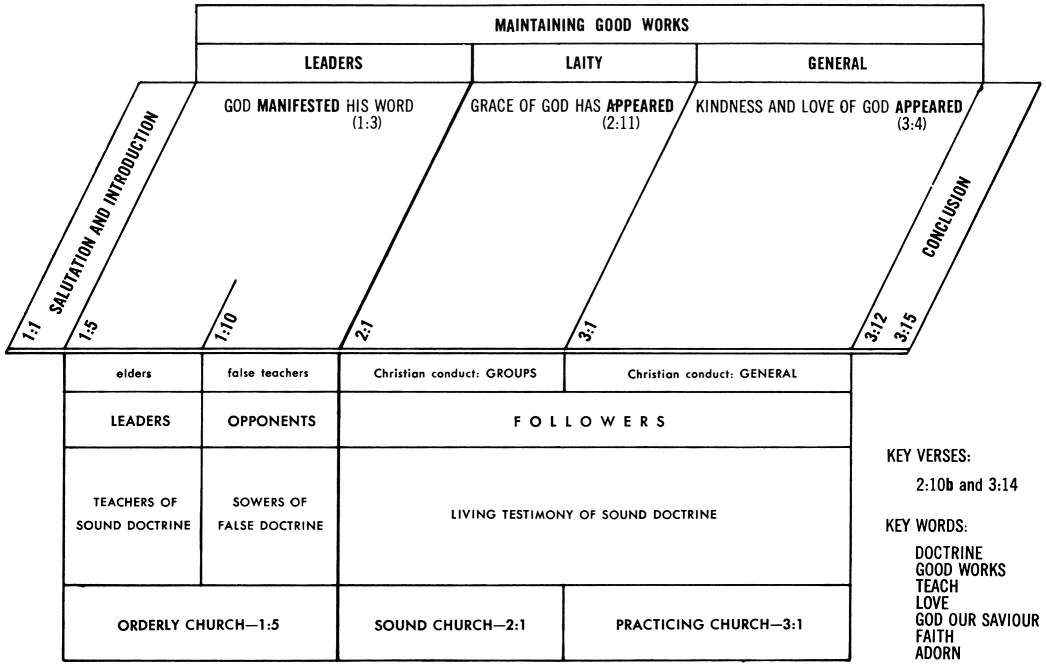
ADORNING THE DOCTRINE OF GOD
Click chart to enlarge
Charts from Jensen's Survey of the NT - used by permission
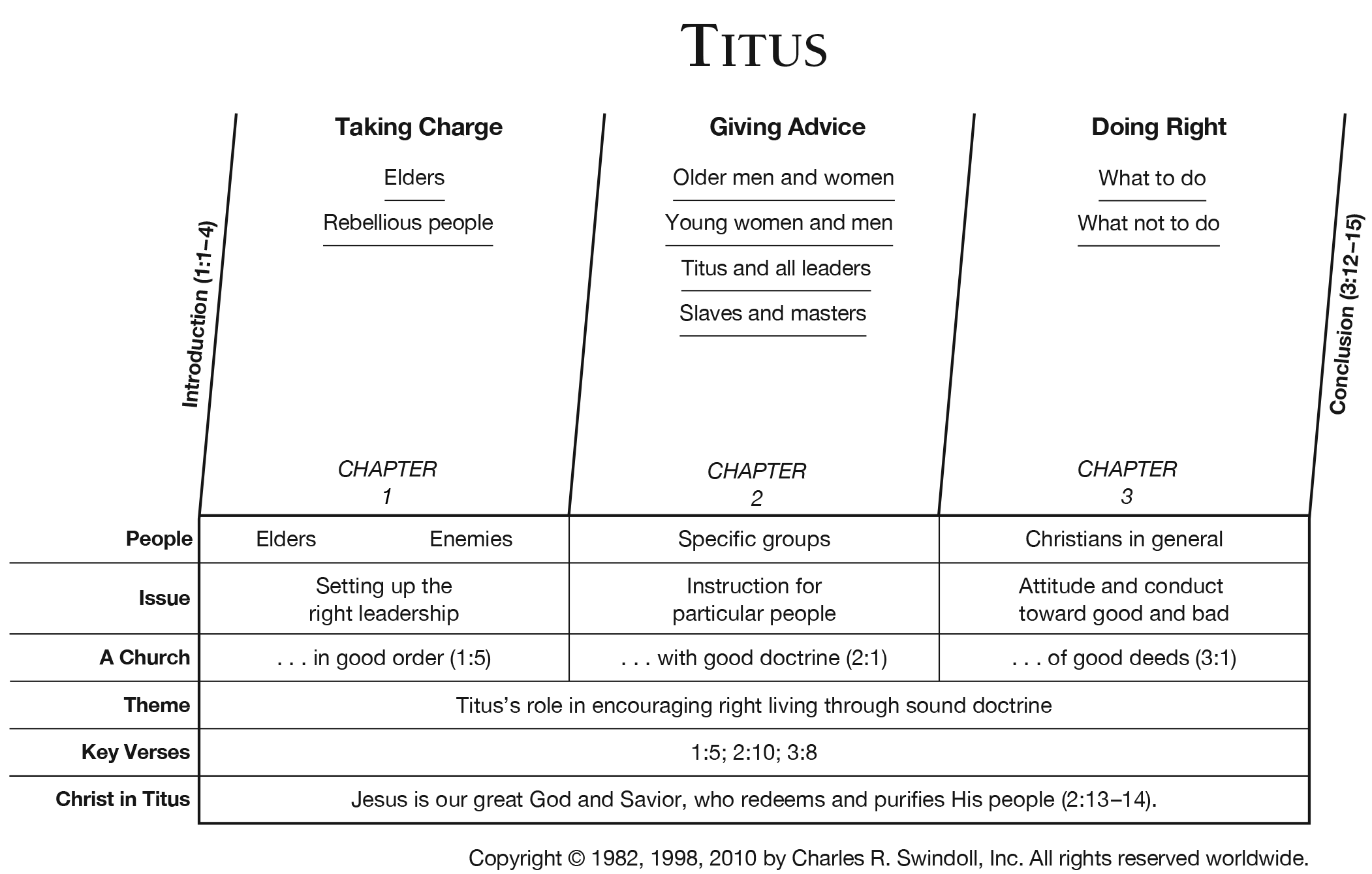
See Summary Chart by Charles Swindoll
Chart below from Michael J. Penfold
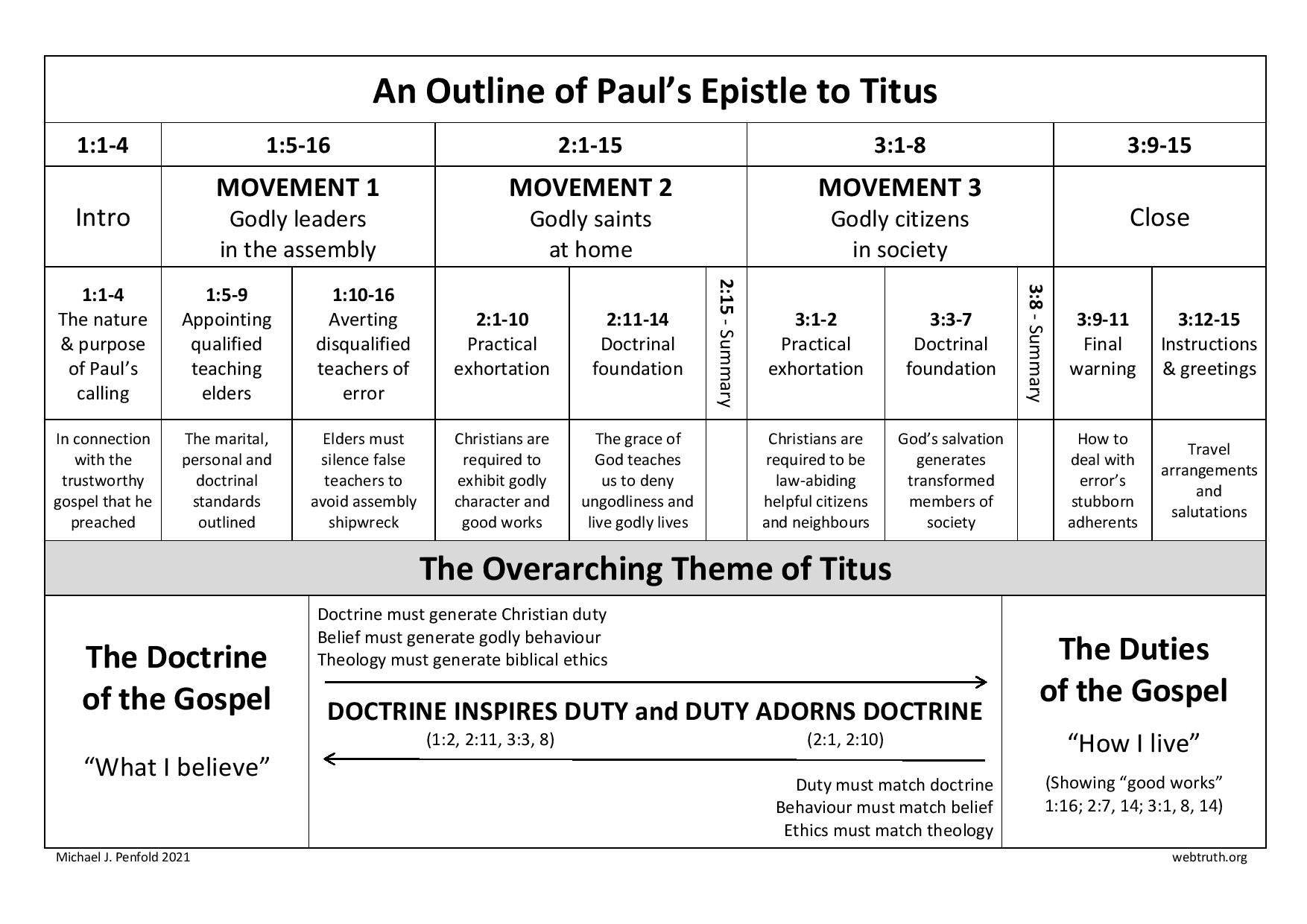
|
Focus |
Appoint Elders |
|||
|
Divisions |
Ordain |
Rebuke |
Maintain |
|
|
Topics |
||||
|
Topics |
Organization |
Offenders |
Operation |
|
|
Place |
Probably Written from either Corinth or Nicopolis (cf. Titus 3:12). |
|||
|
Time |
Circa 63 AD |
|||
|
Modified from Talk Thru the Bible |
||||
Titus 2:11 For the grace of God has appeared (3SAPI) bringing salvation to all men (NASB: Lockman)
Greek: Epephane (3SAPI) gar te charis tou theou soterios pasin anthropois,
Amplified: For the grace of God (His unmerited favor and blessing) has come forward (appeared) for the deliverance from sin and the eternal salvation for all mankind. (Amplified Bible - Lockman)
GWT: After all, God's saving ki-ndness has appeared for the benefit of all people. (GWT)
KJV: For the grace of God that bringeth salvation hath appeared to all men,
Phillips: For the grace of God, which can save every man, has now become known, (Phillips: Touchstone)
Wuest: For the grace of God bringing salvation, appeared to all men
Weymouth: For the grace of God has displayed itself with healing power to all mankind
Young's Literal: For the saving grace of God was manifested to all men,
FOR: gar:
- Titus 2 Resources - Multiple Sermons and Commentaries
THE EXPLANATION
Titus 2:11-14 is a single sentence in Greek and surely is one of the great theological statements in the Bible.
For (1063)(gar) is a term of explanation, and should always be viewed as an invitation and/or opportunity to prayerfully pause and ponder (meditate on) the passage in the power of the Spirit (your constant Teacher - 1Cor 2:10-16, 1Jn 2:20, 27), always asking at least one 5W/H question - "What is the text explaining?" which will force you to examine the preceding passages, which in turn will hone or refine your skill of observation and help you establish thste context, which will lead to a more accurate Interpretation, which is essential for valid Application of the text. Notice how this discipline of pausing to ponder, slows you down so that you do not "speed read" the text, a real and present danger if you are reading through the Bible in a year (which necessitates larger "chunks" of Scripture each day). Pausing causes you to more actively engage the Word of God (and the God of the Word), a benefit and blessing which is minimized when you read too fast and only passively, like a bystander rather than a participant.
Someone has said that the word for (gar) "suggests that here is the theological foundation for what the apostle had just written." I think Paul is explaining how it is possible for saved sinners to "adorn the doctrine" of God (Titus 2:10), rather than dishonor it (Titus 2:5). How? Grace!
In this context the "for" looks back first to Titus 2:10, but as Steven Cole points out, it goes even further back in Paul's preceding exhortation.
Steven Cole writes that "The word “for” (gar) that opens verse 11 links these verses to what he has just said. In Titus 2:1-10, Paul has shown that various groups of believers should beautify their lives with godliness and good deeds so as to attract others to the Savior. Paul’s mention of “God our Savior” (Titus 2:10) causes him to elaborate on the theological basis for our salvation and how understanding that inevitably leads to a life of godliness and good deeds. At the heart of everything is this crucial concept of God’s grace. (Titus 2:11-14 How Grace Works)
Hiebert explains that "For marks Paul's masterly epitome of Christian doctrine as the proper foundation for the ethical demands just made on the various groups. Christian conduct must be grounded in and motivated by Christian truth. The vitality of doctrinal profession must be demonstrated by transformed Christian conduct. Titus 2:11-14 unfold the meaning of "God our Savior" in Titus 2:10. Paul could not think of Christian truth and conduct apart from God's grace. He speaks of the manifestation of God's grace (v. 11), the Christian's present training by grace (v. 12), the expectation of Christ's return (v. 13), and the aim of Christ's redemptive work (v. 14).
A W Pink writes that…
In the immediate context the Apostle had exhorted servants to walk amiably and faithfully, so that they "adorned the doctrine of God our Savior in all things." It is deeply important that we should be sound in doctrine, for error acts upon the soul the same as poison does upon the body. Yes, it is very necessary that we be sound in the Faith, for it is dishonoring to God and injurious to ourselves to believe the Devil's lies, for that is what false doctrine is. Then let us not despise doctrinal preaching, for "All Scripture is given by inspiration of God, and is profitable for doctrine" (2Ti 3:16).
But there is something else which is equally important as being sound in doctrine, namely, that we adorn it by our conduct. The sounder I am in doctrine, the more loudly I advertise my orthodox views, the more do I bring that doctrine into reproach—if my life is worldly, and my walk carnal. How earnestly we need to pray for Divine enablement that we may "adorn the doctrine in all things." We need the doctrine of Scripture written upon our hearts, molding our character, regulating our ways, influencing our conduct. We "adorn" the doctrine when we "walk in newness of life," (Ro 6:4, cp Ro 7:6 for how this is possible = "the Spirit" enables us!) when we live each hour as those who must appear before the final judgment (2Co 5:10). And we are to "adorn the doctrine in all things"—in every sphere we occupy, every relation we sustain, every circle which God's providence brings us into.
The Apostle now enforces what he said in Titus 2:10 by reminding us that "the grace of God that brings salvation has appeared to all men." This is in blessed contrast from the Law, which brings nothing but "condemnation." But the grace of God brings salvation, and that in a twofold way—by what Christ has done for His people, and by what He works in them (cp Three Tenses of Salvation). "He shall save His people from their sins" (Mt. 1:21)—save from the guilt and penalty of sin, and from the love or power of sin. This grace of God "has appeared"—it has broken forth like the light of the morning after a dark night. It has "appeared" both objectively and subjectively—in the Gospel and in our hearts, "when it pleased God … to reveal His Son in me" (Gal 1:15, 16); "God, who commanded the light to shine out of darkness, has shined in our hearts" (2Co 4:6).
The grace of God—His loving-kindness, His goodwill, His free favor—hath appeared "to all men." That expression is used in Scripture in two different senses—sometimes it means all without exception, as in "all have sinned and come short of the glory of God." In other passages it signifies all without distinction, as it does here—to the bondsmen, as well as the free; to the servant as the master, to the Gentiles as well as to the Jews; to all kinds and conditions of men. (Grace Preparing for Glory)
Barclay introduces this section noting that "There are few passages in the New Testament which so vividly set out the moral power (to carry out the ethical demands)… as this does. Its whole stress is the miracle of moral change which Jesus Christ can work. (Ed: Specifically His grace and His Spirit.) (Daily Study Bible)
Hiebert writes that "Titus 2:1-10 give ethical instructions for the different groups in the congregations; Titus 2:11-14 unfold the grace of God as the motivating power for Christian living; and Titus 2:15 summarizes the duty of Titus on Crete. (Titus 2:1-10) Paul here stresses the importance of building up the inner life of believers as the best antidote against error. Sound doctrine must lead to ethical conduct in the lives of all the groups in the congregations. (Borrow Titus and Philemon)
Expositor's Greek Testament explains that…The teaching (didaskalia) though really practical can be plausibly alleged to be mere theory; it must then, by good works, be rendered attractive ("adorn the doctrine" v10) to them that are without (salvation) (cp Mt 5:16,Php 2:15).
Lange explains that the for this way…After mentioning the duties of these different classes, the Apostle enforces his exhortation by referring to that revelation of salvation, which alone gives strength for a godly life, and also, on account of its aim and tendency, lays believers under the most endearing obligations to follow it. (Lange, J. P., Schaff, P., van Oosterzee, J. J., & Day, G. E. A Commentary on the Holy Scriptures: Titus)
The UBS Handbook writes that Titus 2:11ff…give the theological basis for the previous section, that is, they give the reason why Titus should teach Christians to display exemplary behavior. This relation is marked by the word For at the beginning of verse 11. It is as if Paul was saying “The reason why you should teach Christians to behave this way is because … ,” or simply “It is for this reason that …” At the same time this section also explains in some way the content of the last part of verse 10, namely, “the doctrine of God our Savior.” This theological basis is about God’s grace that has been revealed for the purpose of bringing salvation for all humankind. Furthermore, this grace enables Christians to live lives that are acceptable to God as they wait for the return of Jesus Christ. (Arichea, D. C., & Hatton, H. The United Bible Societies' New Testament Handbook Series)
If we go back to the opening verse of chapter 2 we read
But as for you, speak the things which are fitting for sound doctrine. (see note Titus 2:1)
The word "fitting" describes those things which are appropriate, proper, seemly or becoming. Doctrine should be associated with certain behaviors which truly reflect that doctrine and thus are proper, seemly or becoming. In Titus 2:2, 3, 4, 5, 6, 7, 8, 9, 10 Paul describes sound (healthy) doctrine as it applies to several groups of believers (older men, older women, young women, younger men), ending up with a doctrine directed to slaves…
Urge bondslaves to be subject to their own masters in everything, to be well-pleasing, not argumentative, not pilfering, but showing all good faith that they may adorn the doctrine (expounded on in verses 2-10) of God our Savior in every respect. (See notes Titus 2:9; 10)
From this preceding context, we note that what Paul is getting ready to write will explain how all the categories of believers addressed in verses 2-10) are able to adorn the doctrine of God our Savior in every respect or make the teaching about God our Savior attractive (NIV). The
In summary, the word "for" in this verse introduces Paul's explanation of why and how each group of believers just mentioned in Titus 2:1-10 can make the doctrine of God our Savior attractive. The only way to fulfill this lofty goal is by God's all sufficient grace which is His supernatural empowerment of believers to enable them to do what they cannot do naturally. The Christian life is a supernatural life and thus necessitates continual dependence on the source of life giving grace. The isle of Crete certainly needed to see (living out of the Gospel in the the lives of the genuine believers, old, young, male and female) and hear this message (in the proclamation of the Gospel) concerning the true and sound doctrine of God our Savior because most Cretans were doing what was right in their own eyes (Jdg 21:25,cf Titus 1:12). In short, like all unregenerate men and women, they had no inherent power to consistently say "no" to their Slave Master Sin (and the fallen flesh) (cf Ro 6:11, 12, 13-notes Ro 6:11; 12; 13).
Black comments…This ordering of material contrasts with that used in several of Paul’s other letters (Romans, Ephesians, and Colossians), where he first gives the doctrinal basis for conduct then goes on to show how that correct belief leads to practical Christianity. Here the order is reversed. Paul is saying, in effect, “The reason I can speak so emphatically about the way you should behave is because I know what God has done. He has caused His grace … that brings salvation [to appear] to all men” (2:11). (Black, Robert; McClung, Ronald: 1 & 2 Timothy, Titus, Philemon: a commentary for bible students)
THOUGHT - Paul once again reminds us of the axiomatic truth that Christian doctrine (especially the Gospel of salvation) is preached most effectively by a Christian's conduct. As the natural "Cretans" of every age watch the supernatural lives of believers, they are either repelled or attracted to Christ in the believer.
Beloved, what is "the gospel" according to you?
Creed determines conduct.
What creed does your conduct preach to those around you?
Hampton Keathley has an excellent introduction to this great section of Titus 2:11-15…
There is no doubt that Titus 2:11-14 and its companion, Titus 3:4-7 (Titus 3:4, 5, 6, 7), are two of the great theological passages of the New Testament. These texts deal with salvation (past, present, and future), with Christology (the person and work of Christ), and Pneumatology (the person and work of the Spirit), but central to their focus is the practical ramifications of this gracious working of God on behalf of all people. In the process of developing the theme of God’s gracious work on our behalf, these two passages set forth the reasons why believers in Christ can and should live a godly Christian life.
As to Titus 2:11-14, there are few passages in the New Testament which so beautifully and vividly point us to the transforming power of both the f irst and second epiphanies (appearances) of Christ as does this passage. In these verses are truths that cry out to be communicated (cf. Titus 2:15) because of their tremendous implications on human life for both now and in the millennial and eternal futures.
But as we examine this passage (Titus 2:11-15), we dare not overlook its place and purpose in the message of this epistle. The book of Titus strongly stresses the need of good works in the lives of Christians. In fact, this note is sounded over and over again either by way of terms like godliness (two times) good deeds or good works (four times) or by a list of moral qualities that characterize godly leadership and behavior (three times [cf. Titus 1:1, 6, 7, 8, 9, 16; 2:1-10, 14; 3:1, 2, 3, 8, 14]). For a book of three short chapters, this is a strong emphasis. Thus, as the title of this section implies (The Foundation, Means, and Motivation for Godly Behavior), these verses provide the theological foundation, means, and motivation (the “declaration”) for the previous instructions (the “exhortations”) of Titus 1:10-2:10. At the end of the last section, Titus 2:10 (note), the apostle demonstrated his concern that Christians do credit to the teaching of God our Savior before a lost world. With this mention of God our Savior, Paul launched into a declaration of God’s gracious and saving activity which he defined as the appearing of the grace of God that brings salvation for all people, a reference to the first advent of Christ…
In summary, the motivation for good works, so much a theme of the book of Titus, looks both ways—to the past and to the future. We should be motivated to faithful service and good works as we (1) reflect back- on what Christ has done for us and why, and (2) as we wait expectantly for His blessed and glorious appearance for us (ED: I CALL THIS VERTICAL VISION). This glorious coming is one of the prominent themes of the New Testament. (See Keathley's full excellent discussion of Titus 2:11-15 The Foundation, Means, and Motivation for Godly Behavior)
THE GRACE OF GOD: te charis ton theou:
- Ps 84:11; Zech 4:7; 12:10; Jn 1:14,16, Jn 1:17 ; Acts 11:23; 13:43; Acts 20:24; 32 Ro 4:4; 4:5 5:2,15,20 21; 11:5 11:6 2Cor 6:1; Gal 2:21; Eph 1:6, 1:7; 2:5, 2:8; 2Th 2:16; 1Ti 1:14; Heb 2:9; 12:15; 1Pe 1:10, 11, 12, 5:5, 5:6, 5:7, 5:8, 5:9, 5:10, 5:11 5:12
- Titus 3:4, Lk 1:79, 2:30, 2Ti 1:9, 10, 2Co 8:9 Ps 98:2, Isa 49:6, 52:10, Isa 60:1-3
- Titus 2 Resources - Multiple Sermons and Commentaries
Related Passages:
Psalm 84:11 For the LORD God is a sun and shield; The LORD gives grace and glory; No good thing does He withhold from those who walk uprightly.
John 1:14; 16 And the Word became flesh, and dwelt among us, and we saw His glory, glory as of the only begotten from the Father, full of grace and truth. 16 For of His fullness we have all received, and grace upon grace.
1 Corinthians 15:10 But by the grace of God I am what I am, and His grace toward me did not prove vain; but I labored even more than all of them, yet not I, but the grace of God with me.
THE BEAUTIFUL SUFFICIENT
GRACE OF GOD
Grace of God - Most commentaries agree that this phrase is virtually synonymous with the Son of God and thus refers to the first advent of Messiah. A few commentators see this phrase as a reference to "the Gospel" but that is not a striking difference as the gospel is ultimately the good news of Jesus Christ's death, burial and resurrection that occurred in His first appearing. In sum, the first coming of Christ is in essence the Personal manifestation of God’s grace. In the words of Chuck Swindoll "Grace is summed up in the name, person, and work of the Lord Jesus Christ." This is all the more intriguing in view of the fact that Jesus Himself never used the word "grace" (charis). He simply lived it and by so doing left us an example to follow in His steps (1Pe 2:21). Swindoll recalls Jesus' examples of grace demonstrated…
He stood alongside a woman caught in adultery. The Law clearly stated, “Stone her.” The grace killers who set her up demanded the same. Yet Christ said to those self-righteous Pharisees, “He who is without sin, let him cast the first stone.” What grace! Under the Law they had every legal right to bury her beneath the rocks in their hands … and they were ready. There they stood with self-righteous fire in their eyes, but He intervened in grace. When His friend Lazarus died, Martha met Him on the road and Mary later faced Him in the house. Both blamed Him for not coming earlier: “If You had been here, my brother would not have died!” (John 11:21). There is strong accusation in those words. He took them in grace. With the turn of His hand, He could have sent them to eternity; but He refused to answer them back in argument. That is grace. When He told stories, grace was a favorite theme. He employed a gracious style in handling children. He spoke of the prodigal son in grace. As He told stories of people who were caught in helpless situations, grace abounded … as with the good Samaritan. (The Grace Awakening)
A W Pink asks…
how may I know that the grace of God which brings salvation has appeared to me? A vitally important question is that, one which none who really values the eternal interest of his or her soul, will treat lightly or take for granted. There are many who profess to be "saved" but they give no evidence of it in their lives. Now here is the inspired answer.
"Teaching us that, denying ungodliness and worldly lusts." Divine grace teaches its favored recipients subjectively as well as objectively, effectually as well as theoretically. Grace in the heart prevents us from abusing grace in the head—it delivers us from making grace the lackey of sin. Where the grace of God brings salvation to the soul, it works effectually. And what is it that grace teaches? Practical holiness. Grace does not eradicate ungodliness and worldly lusts—but it causes us to deny them. And what but "Divine grace" can? Philosophy cannot, nor ethics, nor any form of human education or culture. But grace does, by the impulsive power of gratitude, by love's desire to please the Savior, by instilling a determination to "walk worthy of the vocation wherewith we are called" (Eph 4:1). (Grace Preparing for Glory)
Amazing Grace in a few different modes of presentation…
- Amazing Grace - Bagpipes
- Amazing Grace - Judy Collins and the choir
- Mahalia Jackson - Amazing Grace
- Declan Galbraith - Amazing Grace
- Chris Tomlin - Amazing Grace (My Chains Are Gone)
John associates grace with our Lord Jesus Christ…
14 And the Word (Jn 1:1,2) became flesh, and dwelt among us, and we beheld His glory, glory as of the only begotten from the Father, full of grace and truth…
16 For of His fulness we have all received, and grace upon grace. 17 For the Law was given through Moses; grace and truth were realized through Jesus Christ. (Jn 1:14, 16 17)
For an excellent Mp3 message on Titus 2:11-15 listen to John Piper - Our Hope: The Appearing of Jesus Christ - Piper says…
Notice first of all from our text in Titus 2 that there are two appearings of Christ—one called an appearing of grace, the other called an appearing of glory.
Verse 11: "For the grace of God has appeared for the salvation of all men." That is the first coming of Christ—the appearance of grace.
Then verse 13: "Awaiting our blessed hope, the appearing of the glory of our great God and Savior Jesus Christ." That is the second coming of Christ—the appearance of glory.
First grace, then glory. (See transcript Our Hope: The Appearing of Jesus Christ)
AMAZING GRACE
(More Discussion of Charis)
Grace (5485) (charis from from chairo = to rejoice. English = charity. Beggars need "charity" even as sinners need grace, for we are all spiritual paupers outside of Christ, but "God gives where he finds empty hands"-Augustine [cp Mt 5:3]) is a word which defies a simple definition but at its core conveys the sense of favor while the specific nuances of charis depend on the context in which it is used. Someone has written that the word grace is probably the greatest word in the Scriptures, even greater even than “love,” because grace is love in action, and therefore includes it. It is hardly too much to say that God has in no word uttered Himself and all that was in His heart more distinctly than in this word grace (charis)!
See 10 page discussion in New International Dictionary of New Testament Theology - Topics covered include χάρις (charis), grace, gracefulness, graciousness, favour, thanks, gratitude; χάρισμα (charisma), gift given out of goodwill; χαρίζομαι (charizomai), show favour or kindness, give as a favour, to be gracious to someone, to pardon; χαριτόω (charitoō), endue with grace.
Adrian Rogers says the best definition of grace that he has ever heard is that God's grace is "both the desire and the ability to do the will of God." It is striking that almost the same words occur in Php 2:13NLT "For (term of explanation - explains how it is possible to Work out our salvation - Php 2:12) God is working in you, giving you the DESIRE and the POWER to do what pleases Him." When you have a godly desire, that desire is from God, because no good thing can come out of our old vile heart! And only God the Spirit in us can give the supernatural power necessary to accomplish that godly desire! So we could paraphrase Php 2:13, in simple words, by saying that God's Spirit is continually giving us the grace (desire and power) to do what pleases Him! This practical definition of grace ought to free many of us who are "trying to clean ourselves up!" It can't be done! We need His grace to give us the desire to "clean up" and the power to "clean up!" Are you resisting His grace? You can either receive it or resist it! The first way leaves us filled, while the second way leaves us empty, dry, and spiritually barren. O beloved, tell God you desperately need and want Him to pour out His grace on the situation you find yourself entwined. Do you have a root of bitterness? Then confess it (even that act is a reflection of His grace) and cry out for His grace to give you the desire and the ability to eradicate that deadly root and its caustic fruit. And keep crying out until He removes the root, for it is in His will that no child of His should ever have a root of bitterness! And when He removes it, celebrate with a praise and worship service!
Spurgeon on grace as a discipline - first of all, grace has a discipline. We generally think of law when we talk about schoolmasters and discipline; but grace itself has a discipline and a wonderful training power too. The manifestation of grace is preparing us for the manifestation of glory. What the law could not do, grace is doing. The free favour of God instills new principles, suggests new thoughts, and by inspiring us with gratitude, creates in us love to God and hatred of that which is opposed to God. Happy are they who go to school to the grace of God! This grace of God entering into us shows us what was evil even more clearly than the commandment does. We receive a vital, testing principle within, whereby we discern between good and evil (cf Heb 5:14). The grace of God provides us with instruction, but also with chastisement, as it is written, “As many as I love I rebuke and chasten.” (Rev 3:19) As soon as we come under the conscious enjoyment of the free grace of God, we find it to be a holy rule, a fatherly government, a heavenly training. We find, not self-indulgence, much less licentiousness; but on the contrary, the grace of God both restrains and constrains us; it makes us free to holiness, and delivers us from the law of sin and death by “the law of the spirit of life in Christ Jesus.” (Ro 8:2) Grace has its discipline, and grace has its chosen disciples, for you cannot help noticing that while the eleventh verse says that, “the grace of God that bringeth salvation hath appeared to all men,” yet it is clear that this grace of God has not exercised its holy discipline upon all men, and therefore the text changes its “all men” into “us.” Usually in Scripture when you get a generality you soon find a particularity near it. (cp 1 Ti 4:10) The text hath it, “teaching us that, denying ungodliness and worldly lusts, we should live soberly, righteously, and godly, in this present world.” Thus you see that grace has its own disciples. Are you a disciple of the grace of God? (NOTE CAREFULLY THAT SPURGEON SEES ALL BELIEVERS AS DISCIPLES, WHO ARE NOT A SPECIAL ELITE GROUP AS IS SO COMMONLY TAUGHT TODAY!) Did you ever come and submit yourself to it? Have you learned to spell that word “faith?” Have you childlike trust in Jesus? Have you learned to wash in the laver of atonement? Have you learned those holy exercises which are taught by the grace of God? Can you say that your salvation is of grace? Do you know the meaning of that text, “By grace are ye saved through faith; and that not of yourselves: it is the gift of God”? (Eph 2:8-9) If so, then you are his disciples, and the grace of God which has appeared so conspicuously has come to discipline you. As the disciples of grace, endeavor to adorn its doctrine. According to the previous verses, even a slave might do this. He might be an ornament to the grace of God. Let grace have such an effect upon your life and character that all may say, “See what grace can do! See how the grace of God produces holiness in believers (AKA "DISCIPLES")!” All along I wish to be driving at the point which the apostle is aiming at: that we are to be holy—holy because grace exercises a purifying discipline, and because we are the disciples of that grace. The discipline of grace, according to the apostle, has three results—denying, living, looking. (The Two Appearings and the Discipline of Grace)
A T Robertson writes that charis has "a variety of applied meanings. They all come from the notion of sweetness, charm, loveliness, joy, delight, like words of grace, Luke 4:22, growing grace, Eph. 4:29, with grace, Col. 4:6. The notion of kindness is in it also, especially of God towards men as here. It is a favorite word for Christianity, the Gospel of the grace of God (Acts 20:24) in contrast with law or works (John 1:16). Gratitude is expressed also (Luke 6:32), especially to God (Ro 6:17)."
See studies on related words -
The English word grace is from the Latin gratia meaning favor, charm or thanks. Gratia in turn is derived from gratus meaning free, ready, quick, willing, prompt. Webster defines grace as the…
unmerited love and favor of God which is the spring and source of all benefits men receive from Him, including especially His assistance given man for his regeneration or sanctification. (Grace is) a virtue from God influencing man, renewing his heart and restraining him from sin. (Compare this more "modern Webster" with Noah Webster's original definition of grace)
Grace in simple terms is God's unmerited favor and supernatural enablement and empowerment for salvation and for daily sanctification. Grace is everything for nothing to those who don't deserve anything. Grace is what every man needs, what none can earn and what God Alone can and does freely give (see Ro 8:32 where "freely give" is charizomai [word study] from charis = a grace gift!). Grace addresses man's sin, while mercy addresses man's misery. The gift of grace makes men fit for salvation, miraculously making separated strangers into God's beloved sons (1Th 1:4, 1Jn 3:1, 1Jn 3:2, 1Jn 3:3).
J H Jowett summarizes grace as God's "holy love on the move" (Another source attributes this quote to H G C Moule). This reminds me of the phrase that God is like the "hound of heaven" chasing after sinners, sinners who before Christ saved them by grace through faith, chased after sin but now because of the transforming power of sanctifying grace, they no longer chase after sin but sin "chases" after them! And so we see the continual need for God's grace!
Eadie in his commentary on Ephesians writes that grace (charis) is…
that goodwill on God's part which not only provides and applies salvation, but blesses, cheers, and assists believers. As a wish expressed for the Ephesian church, it does not denote mercy in its general aspect, but that many-sided favour that comes in the form of hope to saints in despondency, of joy to them in sorrow, of patience to them in suffering, of victory to them under assault, and of final triumph to them in the hour of death. And so the (writer of Hebrews) calls it grace in order to well-timed assistance. (He 4:16) (A Commentary on the Greek text - Page 6)
Charles Allen offers a succinct synopsis of grace noting that…
In the Bible there are three distinctive meanings of grace; it means the mercy and active love of God; it means the winsome attractiveness of God; it means the strength of God to overcome.
The grace of God is described as…
- Glorious (Ep 1:6)
- Abundant (Acts 4:33)
- Rich (Ep 1:7)
- Manifold (many-sided, multi-colored, variegated) (1Pe 4:10)
- Sufficient (sufficing, enough, adequate - there is never a shortage) (2Cor 12:9)
The Grace of God (Read the NT occurrences of this beautiful phrase - Acts 11:23; 13:43; 14:26; 20:24; Ro 5:15; 1Co 1:4; 3:10; 15:10; 2Co 1:12; 6:1; 8:1; 9:14; Gal. 2:21; Col 1:6; Titus 2:11; Heb 2:9; He 12:15; 1Pe 5:12) expresses the Source of the Grace, God Himself, "the God of all grace" (1Pe 5:1) Who reigns as sovereign on "the throne of grace" (He 4:16), and Who Alone "gives grace and glory" (Ps 84:11-Spurgeon's note)
The Expositor's Greek Testament writes that the grace of God…
… is His kindness and love of man (Titus 3:4) (a) as a revelation, in the Incarnation, and also (b) in its visible results; and so it is both heard and recognized (Col 1:6). Accordingly Barnabas could see it at Antioch (Acts 11:23).
Jamieson calls the grace of God…
God’s gratuitous favor in the scheme of redemption.
Wuest quotes Trench who wrote that…
"It is hardly too much to say that the Greek mind has in no word uttered itself and all that was at its heart more distinctly than in this." In other words, all that the Greeks were and loved and exemplified in their art, literature, and thought, lies embedded in this word. We can take Trench’s words, and substituting the word “God” say, “It is hardly too much to say that God has in no word uttered Himself and all that is in His heart more than in this.”
One of the most familiar short definitions of grace is God's unmerited favor. Unfortunately, the practical, everyday, working definition of grace in the lives of many believers goes little beyond this basic simple definition.
Many believers fall woefully short of experiencing the riches of God's grace in their everyday life as C H Spurgeon wrote…
There are many who are barely Christians and have scarcely enough grace to float them into heaven, the keel of their vessel grating on the gravel all the way.
Too many of us (yours truly included far too often!) are like the story of the poor European family who saved for years to buy tickets to sail to America. Once at sea, they carefully rationed the cheese and bread they had brought for the journey. After 3 days, the boy complained to his father, “I hate cheese sandwiches. If I don’t eat anything else before we get to America, I’m going to die.” Giving the boy his last nickel, the father told him to go to the ship’s galley and buy an ice-cream cone. When the boy returned a long time later with a wide smile, his worried dad asked, “Where were you?” “In the galley, eating three ice-cream cones and a steak dinner!” “All that for a nickel?” “Oh, no, the food is free,” the boy replied. “It comes with the ticket.” Indeed, Amazing Grace, not cheap, but free, sufficient to save a wretch like me, the first day, and then every day for the rest (pun intended) of my life!
And so we need to amplify the simple definition of grace as unmerited favor by stating that grace is the unmerited favor of God shown to man primarily in the Person and work of Jesus Christ, Who is now the believer's new life (Via His indwelling, enabling Spirit) and new Source of strength for this supernatural life (cp 2Co 5:17-note). This truth about the "Christ life" (which I think is synonymous with the "grace life") is one many believers do not seem to grasp and so they live a bit like spiritual "yo-yo's", attempting to live the supernatural Christian life in their own natural strength instead of in Christ's rich, boundless supply of grace (cp Jn 1:14, 16, 17, 2Cor 8:9). Christian - take "a" and place it at the beginning of the word = "A Christ in"! Does your life reflect this truth beloved? May the Lord grant us this most precious grace and may we be every one of us led of the Spirit of God to seek Him Who alone can open "the well-stored granaries of grace" [CHS].
Paul writing to young Timothy exhorted him in view of the challenges that lay before him…
You therefore, my son, be strong (present imperative and passive voice = action exerted from outside source = In short, this is a command calling for believers to continually make ourselves "ready receptacles" for the outpouring of God's grace) in the grace that is in Christ Jesus. (2Ti 2:1)
Chuck Swindoll notes that "Understanding what grace means requires our going back to an old Hebrew term that meant “to bend, to stoop.” By and by, it came to include the idea of “condescending favor.” If you have traveled to London, you have perhaps seen royalty. If so, you may have noticed sophistication, aloofness, distance. On occasion, royalty in England will make the news because someone in the ranks of nobility will stop, kneel down, and touch or bless a commoner. That is grace. There is nothing in the commoner that deserves being noticed or touched or blessed by the royal family. But because of grace in the heart of the royal person, there is the desire at that moment to pause, to stoop, to touch, even to bless… To show grace is to extend favor or kindness to one who doesn’t deserve it and can never earn it. Receiving God’s acceptance by grace always stands in sharp contrast to earning it on the basis of works. Every time the thought of grace appears, there is the idea of its being undeserved. In no way is the recipient getting what he or she deserves. Favor is being extended simply out of the goodness of the heart of the giver… One more thing should be emphasized about grace: It is absolutely and totally free (Ed: But not cheap!). You will never be asked to pay it back. You couldn’t even if you tried. Most of us have trouble with that thought, because we work for everything we get. As the old saying goes, “There ain’t no free lunch.” But in this case, grace comes to us free and clear, no strings attached. We should not even try to repay it; to do so is insulting. (The Grace Awakening: Believing in Grace Is One Thing. Living it is Another.)
Where then do we find the source of grace?
Answer: In 2Ti 2:1 Paul clearly states that grace that is able to continually make us strong to fight this good fight of faith (1Ti 6:12, 1:18, 2Ti 4:7) is found in the Person of Christ Jesus, the very One Who is now "our life" (Col 3:4, see In Christ). As discussed above, in Titus 2:11 Paul equates the "grace of God" with Jesus Christ (cp Jn 1:14, 16, 17). So He and He alone is the Source of all "grace upon grace". As mentioned earlier, Chuck Swindoll wrote that "Grace is summed up in the Name, Person, and work of the Lord Jesus Christ."
How do we appropriate God's amazing grace in and through Christ?
Answer: Of course the seminal answer is God's unmerited favor is not earned or deserved but is appropriated by faith in Christ. Paul writing about Abraham's appropriation of God's promise states that "is by faith, that it might be in accordance with grace" (Ro 4:16) Paul amplifies this truth in Ephesians explaining…
For by grace you have been saved through faith; and that not of yourselves, it is the gift of God; not as a result of works, that no one should boast. (Eph 2:8, 9, cp Acts 26:18b)
Grace first inscribed my name
In God's eternal book:
'Twas grace that gave me to the Lamb,
Who all my sorrows took.
-Philip Doddridge
And so we see that we begin this race of salvation by grace through faith (Eph 2:8, 9), we run daily by grace through faith (cp Col 2:6 with 2Co 5:7, Hab 2:4, Ro 1:17, Heb 10:38) and finish by grace through faith (Rev 22:21). Grace is God’s generous favor to both undeserving sinners and needy saints. Therefore, it behooves every Christian runner to understand some of the practical truths about how he or she is enabled to run with endurance the grace race that is set before us (Heb 12:1). One of the primary ways by which we are to run is by keeping our focus on our Source of Grace, the One Who ran and "won" the race, Christ Jesus (Heb 12:2).
To reiterate saving grace is God's provision for the believer's sinful past (see Eph 2:8, 9) while enabling grace His provision for day to day Christian living (See also the comments on Titus 2:12 where the grace of God is depicted as our "instructor" for daily living [= sanctification], cp Heb 13:9 where "strengthened by grace" is in the present tense = indicating that one function of grace is to continually increase our inner strength and resolve to run the grace race with endurance).
QUESTION - Asking the question again - How do we appropriate God's amazing grace in and through Christ?
ANSWER: Weakness and Humility. These truths are in taught in the following passages from James and Paul.
First from the apostle James…
But He gives a greater grace. Therefore it says, "GOD IS OPPOSED TO THE PROUD, BUT GIVES GRACE TO THE HUMBLE." (Jas 4:6- see in depth note), Peter experientially understood this truth (Compare Peter's affirmation in his natural strength in Mt 26:33, 34, 35, 69, 70, 71, 72, 73, 74, 75 with the transforming power of God's grace in Peter's change in 1Pe 5:5, 1Pe 5:6)
Comment: Vincent says “pride calls out God’s armies. No wonder, therefore, that it ‘goeth before destruction’ “
Story of the young Scottish minister who walked proudly into the pulpit to preach his first sermon. He had a brilliant mind and a good education and was confident of himself as he faced his first congregation. But the longer he preached, the more conscious everyone was that “the Lord was not in the wind.” He finished his message quickly and came down from the pulpit with his head bowed, his pride now gone. Afterward, one of the members said to him,
If you had gone into the pulpit the way you came down,
you might have come down from the pulpit the way you went up.
The humble man realizes that all that he has comes from God and must be given back to God. But when we think we're humble--we're not!
The “gravity of grace” works like the earth’s water system, which always flows from the highest to the lowest point. Just as the waters of Niagara roll over the fall and plunge down to make a river below, and just as that river flows ever downward to still more low-lying areas where it brings life and growth, so too it is with God’s river of grace (cp Jn 7:38, 39). Grace’s gravity carries it to the lowly in heart, where it brings life and blessing. Grace goes to the humble.
The gravity of grace will always channel the rivers of divine favor to the lowly—to those (1) who submit to God, (2) whose soul’s momentum is away from the Devil and toward God, (3) who purify their inner and outer lives, (4) who mourn over their sins, and (5) who obey the final summary command, “Humble yourselves before the Lord, and he will lift you up” (Jas 4:10). Notice that all five of these aspects of a lowly heart are themselves dependent on bestowal of God's grace. What a mystery is His grace!
The unbowed soul standing proudly before God receives no benefit from God’s falling grace. It may descend upon him, but it does not penetrate, and drips away like rain from a statue. But the soul lying humbly before God is immersed—and even swims—in a sea of grace. So while there is always “greater grace,” it is reserved for the lowly—the humble in heart.
Andrew Murray, adds that "Humility is the only soil in which the graces root. The lack of humility is the sufficient explanation of every defect and failure.
Andrew Murray is one of the few people who could have written a credible book on the subject of humility. Born in South Africa in 1828, his was a lifelong ministry of prayer, preaching, and writing. In his early fifties, Murray contracted a mysterious throat ailment that left him almost voiceless. For those two years of silence he pondered the subject of humility. He later developed a series of twelve messages on this subject, which were published in 1895 under the title Humility: The Beauty of Holiness. "Jesus found His glory in taking the form of a servant," wrote Murray. "There is nothing so divine and heavenly as being the servant and helper of all. Humility, the place of entire dependence on God, is, from the very nature of things, the first duty and the highest virtue of the creature, and the root of every virtue.... Humility is the only soil in which the graces root; the lack of humility is the sufficient explanation of every defect and failure. Humility is not so much a grace or virtue along with others; it is the root of all, because it alone takes the right attitude before God and allows Him as God to do all."
William MacDonald commenting on James 4:6 writes "Think of it—the mighty God opposed to our pride and determined to break it, contrasted with the mighty God powerless to resist a broken and contrite heart! (Believer's Bible Commentary)
Paul's answer is related to James' call for grace partakers to practice humility…
And He (Christ) has said to me (This is Christ's answer to Paul's prayer, 2Co 12:7, 8 to remove the "thorn"),
"My grace is sufficient for you,
for power is perfected in weakness."
Most gladly, therefore, I will rather boast about my weaknesses, that the power of Christ may dwell in me. Therefore I am well content with weaknesses, with insults, with distresses, with persecutions, with difficulties, for Christ's sake; for when I am weak, then I am strong. (2Cor 12:9-see in depth note, 2Cor 12:10-see note).
Comment: Our weakness is the fertile soil for God's grace to grow richly, beloved! Note that grace is not some abstract concept to be learned but is power (dunamis [word study]) for supernatural living! What keeps us from admitting our weakness (e.g., our inability as husbands to love our wives like Christ loved the church, our inability to love others as we love ourselves, etc)? Is it not our pride, our fallen flesh, which says "I" can do this in my own strength? And so we see James' call to humility is related to Paul's confession of weakness, and that this combination is a powerful catalyst for the pouring out of grace upon grace! In a word God's grace can transform trial into triumph and sorrow into joy.
Man's extremity is God's opportunity.
Man's security is Satan's opportunity.
HE GIVETH MORE GRACE
(Play Hymn)
He giveth more grace when the burdens grow greater;
He sendeth more grace when the labours increase;
To added afflictions He addeth His mercy,
To multiplied trials His multiplied peace.When we have exhausted our store of endurance,
When our strength has failed ere the day is half done:
When we reach the end of our hoarded resources,
Our Father’s full giving is only begun.His love has no limits, His grace has no measure,
His power has no boundary known unto men;
For out of His infinite riches in Jesus,
He giveth, and giveth, and giveth again.
--Annie Johnson Flint
Dearly beloved, this great promise is one every believer can claim. If the grace of God is sufficient to save us (and it is), surely it is sufficient to keep us and strengthen us in our times of suffering and weakness. God permits us to become weak so that we might receive His strength. Grace is the active working of God to reach us at our point of need and supply what we cannot obtain for ourselves and becomes most evident in our lives when we are humble, helpless and things look hopeless.
Man's extremity is God's "opportunity" to demonstrate His amazing grace in our lives
Commenting on 2Corinthians 12 Warren Wiersbe adds that
In the Christian life, we get many of our blessings through transformation, not substitution. When Paul prayed three times for the removal of his pain, he was asking God for a substitution: “Give me health instead of sickness, deliverance instead of pain and weakness.” Sometimes God does meet the need by substitution; but other times He meets the need by transformation. He does not remove the affliction, but He gives us His grace so that the affliction works for us and not against us… When Paul accepted his affliction as the gift of God, this made it possible for God’s grace to go to work in his life. It was then that God spoke to Paul and gave him the assurance of His grace. Whenever you are going through suffering, spend extra time in the Word of God; and you can be sure God will speak to you. He always has a special message for His children when they are afflicted. God did not give Paul any explanations; instead, He gave him a promise: “My grace is sufficient for thee.” We do not live on explanations; we live on promises. Our feelings change, but God’s promises never change. Promises generate faith, and faith strengthens hope." (Wiersbe, W: Bible Exposition Commentary. 1989. Victor)
SOME OTHER AMAZING
ASPECTS OF GOD'S GRACE
Grace and works don't work!
They are diametrically opposed (cp Ro 4:4 where "favor" = charis, Ro 9:30, 31, 32), for works give "glory" to man not God. Whatever begins with God’s grace will always lead to God's glory (Ps 84:11 [Spurgeon's note]; 1Pe 5:10) because we can take no credit for the effects or results.
God’s grace insures that those who have been truly regenerated will in fact persevere until the end of life.
This entire work is called sanctification, a work of God “whereby we are renewed in the whole man and are enabled more and more to die daily unto sin and to live unto righteousness” as stated by the Westminster Shorter Catechism (see notes Romans 12:2; Ephesians 4:23; Colossians 3:10; 2Cor 4:16).
Grace can be seen!
Acts 11:23 Then when he arrived and witnessed the grace of God, he rejoiced and began to encourage them all with resolute heart to remain true to the Lord
Grace is that in which believers now and forever "stand".
Believers now live in freedom of the "land of grace" not in the fetters of the law, not in our "meritorious" works (an oxymoron). We now live in God's grace in Christ Who is in us Paul explaining…
Therefore having been justified by faith, we have peace with God through our Lord Jesus Christ, through Whom also we have obtained our introduction by faith into this grace in which we stand (perfect tense = past completed action with a present and continuing result. Now in Christ we are forever in grace, the permanent, secure position every believer enjoys whether he understands that truth or not! Beloved, let us grow in our understanding, that we might live in the light and power of this grand truth - cp Peter's command in 2Pe 3:18-see note); and we exult in hope of the glory of God. (Ro 5:1, 2)
Peter draws his first epistle to a close with a cry like a commanding general to his troops engaged in a life or death struggle against seemingly overwhelming odds (cp Ep 6:12)…
Through Silvanus, our faithful brother (for so I regard him), I have written to you briefly, exhorting and testifying that this is the true grace of God. Stand firm (aorist imperative = Do this now! Don't delay! It is urgent!) in it! (1Peter 5:12)
Scripture is permeated from beginning to end with God's grace.
Contrary to "popular opinion" the Old Testament is not all law and the New Testament all grace, but both are filled with God's grace. Grace has always been the provision of our holy, loving God for sinful men who do not deserve to be shown such favor and could never earn it.
Compare…
Genesis 6:8 But Noah found favor (Hebrew = chen; Septuagint - LXX = charis) in the eyes of the LORD.
Exodus 3:21 "I will grant this people favor (Septuagint - LXX = charis) in the sight of the Egyptians; and it shall be that when you go, you will not go empty-handed. (cp Ex 11:3, 12:36)
Exodus 33:13 "Now therefore, I pray You, if I have found favor (Septuagint - LXX = charis) in Your sight, let me know Your ways that I may know You, so that I may find favor (Septuagint - LXX = charis) in Your sight. Consider too, that this nation is Your people." (Notice on the basis of God's grace, Moses in essence asks for more of His grace. And notice it wasn't self serving but for God's glory, Ex 33:16, cp Ps 115:1)
Psalm 84:11 For the LORD God is a sun and shield. The LORD gives grace and glory. No good thing does He withhold from those who walk uprightly.
Spurgeon Comments: The Lord will give grace and glory. Both in due time, both as needed, both to the full, both with absolute certainty. The Lord has both grace and glory in infinite abundance; Jesus is the fulness of both, and, as his chosen people, we shall receive both as a free gift from the God of our salvation. What more can the Lord give, or we receive, or desire.
Revelation 22:21 The grace (charis) of the Lord Jesus be with all. Amen. (Note that again our Lord is the wellspring of God's grace!)
No grace, no peace. Know grace, know peace .
Grace and peace are found in the greeting of all of Paul's epistles (Ro 1:7, 1Co 1:3, 2Co 1:2, Gal 1:3, Eph 1:2, Php 1:2, Col 1:2, 1Th 1:1, 2Th 1:2, 1Ti 1:2, 2Ti 1:2, Titus 1:4, Philemon 1:3). It is no accident that grace always precedes peace (eirene [word study]), for grace is the fountain of which peace is the stream. When we know the grace of God, we have peace with God (Ro 5:1) and then can daily experience the peace of God which surpasses all comprehension (Php 4:7)
Grace is the foundation and peace is the result. Grace is God’s free unmerited favor toward man. Peace is the result to those who respond to His grace. Our hearts are kept in peace as we realize that the favor (grace) of God is upon us.
William MacDonald has said that the combination of grace and peace is in one sense "in miniature, the gospel for the whole world" for the essence of the gospel is grace, therefore peace. Through the gospel we are all brought under His grace and therefore have peace with Him and peace within. The gospel is not so much about “not fighting” but about wholeness of life (shalom) as God intended it. The peace flows out of the grace, and both together flow from God our Father and were made effective in human history through the Lord Jesus Christ. (MacDonald, W & Farstad, A. Believer's Bible Commentary: Thomas Nelson)
The greeting of grace and peace bears the poetry of redemption, for the regular Greek greeting was Rejoice! (chaire), and the regular Jewish greeting was Peace (Shalom). Paul combines the two and then replaces rejoice with the similar sounding but far richer charis—“grace.” He in effect combines the greetings of the Eastern and Western worlds, then modifies the Western and gives the whole world the sublime Christian greeting, “Grace and peace.” The two combine naturally and beautifully in cause and effect, because when God’s grace comes upon us, taking away our sins and making us objects of his favor, His peace floods our being.
Hiebert explains that the grace of God is…
the divine love manifesting itself towards guilty sinners in free forgiveness and unmerited blessing. It speaks of our own unworthiness and the spontaneous redeeming act of God in Christ when there was nothing in us to merit it. Peace is the resultant reconciliation (Ed: peace with God) experienced by those who respond to the grace of God. It is the outcome of the restoration of harmony between our soul and God on the basis of the atonement. Our hearts are kept in peace (Ed: peace of God) as we realize that the unmerited favor of God has been bestowed upon us in Christ. (D. Edmond Hiebert: "Titus and Philemon", page 56, Moody Press, 1957).
Dr. Donald Hubbard nicely sums up grace, mercy and peace writing that
Grace is for the worthless. It is God giving me what I don’t deserve.
Mercy is for the helpless. God withholding from me what I do deserve.
Peace is for the restless. The assurance that whatever happens to me will work out for God’s glory (cp Ps 84:11)
Ray Stedman writes that…
The two great heritages of the Christian are grace and peace. These are two things you can always have, no matter what your circumstances. Grace is all God's power, all his love, all his beauty available to you. It is a marvelous term which wraps up all that God is and offers to us. It comes from the same Greek word from which we get our English word charm. Grace is charming, lovely, pleasant. It is something which pleases, which imparts charm and loveliness to a life. Peace is freedom from anxiety, fear, and worry. These are the two characteristics which ought to mark Christians all the time: Grace -- God at work in their life; and peace -- a sense of security, of trust. (Read the entire sermon Ephesians 1:1-14: God At Work)
Guy King commenting on grace and peace writes…
Grace - a quality which is, at once…
(i) an Attitude, which He adopts towards us, as in Eph 2:8 (note);
(ii) an Activity, which He exerts for our help, as in 1Cor 15:10; and
(iii) an Accomplishment, which He works in, and out from, us, as in Acts 4:33.
Paul ardently, and prayerfully, desires for his converts everywhere - for he uses the words in all his church letters - that they may experience to the full this "grace"… Grace is needed for every service, mercy for every failure, and peace for every circumstance. (King, Guy, Joy Way,1952 - online)
GRACE: CHARIS
Distinctive Uses
in the New Testament
(1) Of a favor, good will, lovingkindness, especially from God the Father and God the Son.
A blessing (or prayer) for grace (and peace, and sometimes mercy) was part of the introduction of most of Paul's epistles. (See full note)
Grace is a beneficent disposition toward another person and in the NT describes God's attitude toward human beings and so speaks of God's kindness, grace, favor, helpfulness, gracious care/help, goodwill (Jn 1:16, 17, Ep 2:8)
The gospel is a specific manifestation of divine favor for it is "the gospel of the grace of God." (Acts 20:24)
In the majority of the NT passages, grace is used with this meaning and speaks of the merciful kindness by which God exerting His holy influence upon souls, turning them from self to the Savior and providing them the power that guards, strengthens and grows them in the faith and kindles in them the desire (and power) to manifest Christ-like conduct. Note that there is obviously some overlap with this aspect of grace (#1) with that described below (#5).
This aspect of grace signifies the unmerited operation of God in the heart of man, effected through the agency of the Holy Spirit. Grace is a free expression of God's love and represents an act of God done in or for man without any expectation of a return from men on whom it is exerts its effect.
Aristotle, defining charis, lays the whole stress on the point that it is conferred freely, with no expectation of return or payment, and finding its only motive in the bounty and free-heartedness of the giver. Aristotle's definition sounds quite Biblical, but there is "catch"… in the pagan Greek culture, this favor was only conferred upon a friend, not upon an enemy. When charis is taken over into the terminology of the NT, it takes an infinite leap forward, and acquires an added meaning which it never had in pagan Greece, for the favor God did at Calvary’s Cross, He did, not for a race that loved Him but which hated Him (Ro 5:10 , Ro 8:7, Col 1:21, 2Ti 3:4- note, James 4:4).
Wuest characterizes grace as follows:
In its use among the pagan Greeks it referred to a favor done by one Greek to another out of the pure generosity of his heart, and with no hope of reward. When it is used in the New Testament, it refers to that favor which God did at Calvary when He stepped down from His judgment throne to take upon Himself the guilt and penalty of human sin. In the case of the Greek, the favor was done to a friend, never an enemy. In the case of God it was an enemy, the sinner, bitter in his hatred of God, for whom the favor was done. God has no strings tied to the salvation He procured for man at the Cross. Salvation is given the believing sinner out of the pure generosity of God’s heart. The Greek word (charis) referred to an action that was beyond the ordinary course of what might be expected, and was therefore commendable. What a description of that which took place at the Cross! [Ed note: Grace is the Spirit of Christ indwelling me and enabling me to overcome sin. I cannot overcome it… it will overcome me if I try. All attempts to defeat the flesh in my own power will fail ] (Wuest, K. S. Wuest's Word Studies from the Greek New Testament: Eerdmans)
(2) Grace is used of that which causes attractiveness, joy, pleasure, delight, especially referring to the "grace" of one's speech (remembering that speech most accurately expresses what is on the inside a believer).
Grace is a quality that adds delight or pleasure or a winning quality or attractiveness that invites a favorable reaction = graciousness, attractiveness, charm, winsomeness.
Luke speaking of Jesus writes that…
all were speaking well of (Jesus), and wondering at the gracious (charis) words which were falling from His lips; and they were saying, “Is this not Joseph’s son? (Lk 4:22)
The psalmist speaking of the coming Messiah wrote that
Thou art fairer than the sons of men. Grace (charis) is poured upon Thy lips, therefore God has blessed Thee forever. (Ps 45:2).
Spurgeon comments: "Whoever in personal communion with the Well-beloved has listened to his voice will feel that “never man spake like this man.” Often a sentence from his lips has turned our own midnight into morning, our winter into spring." (Praise the Lord for His so often speaking such gracious words to our soul!)
And so we see that our Lord sets the standard for all believers who are now called to live and speak with similar grace…
Let no unwholesome (sapros = rotten, defiling, foul like spoiled fruit) word proceed (present imperative + negative = command to stop letting this happen! How is it possible for use to be "saved" from so frequently responding with unwholesome words? Answer? The same grace that saved us, daily transforms us and enables us to fulfill God's commands!) from your mouth, but only such a word as is good (suitable, beneficial) for edification (oikodome = building up) according to the need (chreia) of the moment, that it may give grace to those who hear. (Ep 4:29) (Beloved, does your speech tear down or build up your spouse, your children, your fellow believers, unbelievers, etc?)
Writing to the believers at Colossae, Paul exhorted them to
Conduct (present imperative = command to make this your habitual practice. How possible? Only by His provision of enabling grace!) yourselves with wisdom toward outsiders, making the most of (exagorazo = redeeming, "buying up" every) the opportunity (kairos = Once it has passed, that specific opportunity at that moment is forever gone. He may of course give other kairos.). (What does "wise conduct" before unbelievers look like? Paul says our speech is a vital component to our witness!) Let your speech always be with grace (in this context = pleasant, winsome, courteous, wholesome, sensitive, kind, fitting, gentle, loving, thoughtful), seasoned, as it were, with salt (flavors and makes appealing, preserves from corruption - cp Mt 5:13), so that you may know how you should respond to each person. (Col 4:5, 6). (See Ec 10:12 where Hebrew word chen = "gracious" is translated by charis)
A believer's gracious words (such words even being made possible by His grace) reflect the grace of Christ, Who uses our graciousness to draw others to His saving grace! Truly what goes around, comes around!
(3) Of a favorable regard or attitude felt toward someone or something.
Luke uses charis with this meaning in his description of the newly formed church in Jerusalem:
And day by day continuing with one mind in the temple, and breaking bread from house to house, they were taking their meals together with gladness and sincerity of heart, praising God, and having favor (charis) with all the people… " (Acts 2:46, 47)
Another example by Luke is the angel's comforting words to Mary
And the angel said to her, "Do not be afraid, Mary; for you have found favor with God. (Lk 1:30)
(4) Of gratitude or thanks.
Paul uses charis meaning of "thankfulness" writing to the Roman saints
But thanks (charis) be to God that though you were slaves of sin, you became obedient from the heart to that form of teaching to which you were committed (Ro 6:17)
Gratitude is appropriate as a response to the graciousness of God, but never repays it.
Grace is being given
Not what we deserve
But what we need
Here is an illustration of that principle - The two renowned preachers, Charles Spurgeon and Joseph Parker, both occupied pulpits in London during the 19th century. On one occasion, Parker commented about the poor condition of children admitted to Spurgeon’s orphanage. It was reported to Spurgeon, however, that Parker had criticized the orphanage itself. Being a man of fiery temperament, Spurgeon blasted Parker from his pulpit. That attack, printed in the newspaper, became the talk of the town. Londoners flocked to Parker’s church the next Sunday to hear his rebuttal.
“I understand Dr. Spurgeon is not in his pulpit today, and this is the Sunday they use to take an offering for the orphanage,” Parker said.
“I suggest we take a love offering here for the orphanage.”
The crowd was delighted; ushers had to empty the collection plates three times. Later that week, there was a knock at Parker’s study. It was Spurgeon.
“You know, Parker, you have practiced grace on me,” he said.
“You have given me not what I deserved; you have given me what I needed.”
(5) Grace represents the exceptional (supernatural) effects produced by God's favor = ability, power to transform, enabling power (Ro 12:6, 1Cor 15:10)
Paul knew that through the charis of God he has been called to be an apostle, and that he has been fitted with the power and capabilities this office required (Ro 1:5; Ro 12:3; Ro 15:15; 1Cor 3:10; Ro 15:10a, 2Co 12:9; Gal 2:9; Eph 3:2, 7, 8) Notice that in most of the following examples grace is pictured as either that which God gives or which Paul receives, the same pattern by which every believer experiences the amazing grace of God = He gives, we receive.
As prideful humans, we often find it difficult to receive gifts from others, especially when we sense they perceive we are destitute or in a "beggarly" position. Sometimes we feel "embarrassed". But ultimately it is our pride saying "I don't need a handout!". Grace is similar. We are spiritual paupers and in great need of God's grace that we might live a supernatural life (first needing God's grace for initial salvation and then continuing to need His grace for daily salvation from our intractable enemies, the world, the flesh and the devil). Paul understood the vital importance of continually maintaining an attitude of "beggar-like" dependence on Christ for His provision of grace (and power), and so too much we if we are to experience the daily provision of God's amazing, transforming, empowering grace and the result, supernatural life, a Christ-like life. There is no other way to be happy in Jesus but to "trust and obey" and live as a "grace beggar"!
Ro 1:5 = through whom we have received grace and apostleship (Notice that the Grace is from God through His Son Christ) (Grace was received)
Ro 12:3 = "grace given to me" (God's gift of grace to make Paul an apostle, now enables him to speak to the saints about their "grace gifts" [charisma - Ro 12:6]!") (Grace was given)
1Cor 3:10 = "grace of God" (Grace was given)
Ro 15:15 = "because of the grace that was given me from God" (Grace was given)
1Co 15:15 = "by the the grace of God I am what I am (an apostle)"
2Co 12:9 = "My grace is sufficient for you"
Gal 2:9 = "recognizing the grace that had been given to me" (Grace was given) (Notice that grace in/on/through a person can be seen by others! James and Cephas [Peter] and John recognized God's grace in Paul and specifically that Paul had been given apostleship by God [see Gal 2:8]. Beloved, do others recognize the grace of God in you, through your words, actions and deeds?)
F B Meyer: Hudson Taylor told me that on the threshold of his great life work God came to him and said: "My child, I am going to evangelize inland China, and if you like to walk with Me I will do it through you." (The power provided by God's grace is) "Mighty in me." I cannot take that Bible class, but Christ is in me, and HE can. I cannot conduct that mission, but Christ is in me, and HE can. I cannot assume these responsibilities, but hallelujah (HE can)! it does not matter. A copper wire has only to convey the message, it is for the battery to send it; and you may be forever more like the wire which connects you with cities far down its course, the wire along which the fair… passes without fret, without anxiety, without care, a mighty, mighty force (the power of God's grace) meeting in the wire. When it is not self but Christ, it is Christ (the power provided by His grace which is) "mighty in me."
Eph 3:2 "the stewardship of God's grace (to be an apostle) which was given to me" (Grace was given)
Eph 3:7 = "made a minister, according to the gift of God's grace" (Grace was given)
Eph 3:8 = "this grace was given" (Grace was given)
Note the relation of God's provision of supernatural power (dunamis) with His amazing grace (charis)
And Stephen, full of grace and power (dunamis), was performing great wonders and signs among the people. (Acts 6:8)
Comment: Note what the power enabled him to accomplish (great wonders and signs). While grace filled believers today may not perform "great wonders and signs" in the same way as Stephen, nevertheless they too are empowered to carry out "miraculous" acts - e.g., still able to love someone who is not acting very loving toward you, able not retaliate when offended, able to hold our tongue when we would in our natural state rather "give them a piece of our mind", etc. Are not all of these attitudes and actions not "great signs and wonders" giving testimony to the power of grace in the believer's life? I think they are! And not only did grace manifest itself with in a divine glow in and on Stephen but a divine boldness to witness (Acts 7:1, 3-50, 51, 52, 53, 54, 55, 56, 5758 59) and a divine power to die fearlessly and "forgivingly" (Acts 7:60) - Beloved, we too can be assured that God still gives "living grace" and "dying grace" to His children!
And He has said to me, "My grace is sufficient for you, for power (dunamis) is perfected in weakness." Most gladly, therefore, I will rather boast about my weaknesses, that the power (dunamis) of Christ may dwell in me. (2Co 12:9)
(The promise in Christ Jesus through the gospel) of which I was made a minister, according to the gift of God's grace which was given to me according to the working of His power (dunamis). (Eph 3:7)
Comment: Paul was able to serve because he had been given a gift (which he willingly received). Furthermore, God's grace in Paul was was not a "static concept" but an effective, working power., "dynamic" ("dynamite") power, resurrection power of Christ by which (and ONLY by which) he could accomplish God's work. Beloved that same grace is available to us today that we might have supernatural power to live the Christ life and serve in His strength, not our own. While this spiritual aspect of grace as a dynamic force in my life continues to be somewhat a mystery to me, I am firmly convinced it is an absolute necessity and that it is God's desire for it to be a living reality in all of His children.
Someone has devised the following acronym which is not a bad "definition" of grace…
G (God's), R (Riches) A (At) C (Christ's) E (Expense)
Vance Havner once said that someone spelled out "grace" as…
G stands for Gift, the principle of grace.
R [stands] for Redemption, the purpose of grace.
A [stands] for Access, the privilege of grace.
C [stands] for Character, the product of grace.
E [stands] for Eternal Life, the prospect of grace.
As Hampton Keathley says
since grace is at the very heart, indeed, it is the very foundation and fountain of true Christianity, we should have a better grasp of this important word and its truth…
Furthermore, the doctrine of God’s Grace in Christ is multi-sided. As a doctrine of the Word it touches every area of truth or doctrine in one way or another. Every aspect of doctrine is related to grace. It is no wonder grace is an important word and one that Paul desires to be experienced by all. It is a fountain from which we must all drink deeply, but it is one that runs counter to our own natural tendencies. Rather than drink from God’s fountain, we tend to build our own broken cisterns. (Jer 2:13)
A Basic Definition—lexical: The Greek word for grace is charis. Its basic idea is simply “non-meritorious or unearned favor, an unearned gift, a favor or blessings bestowed as a gift, freely and never as merit for work performed.”
Expanded Definition—theological: Grace is “that which God does for mankind through His Son, which mankind cannot earn, does not deserve, and will never merit”
Grace is all that God freely and non-meritoriously does for man and is free to do for man on the basis of Christ’s person and work on the cross. Grace, one might say, is the work of God for man and encompasses everything we receive from God. (From Grace and Peace)
Hendriksen writes that…
God’s grace is his active favor bestowing the greatest gift upon those who have deserved the greatest punishment.
Hiebert explains that the grace of God…
is His unmerited favor towards men, expressing itself in active love in procuring our redemption in Christ Jesus (D. Edmond Hiebert: "Titus and Philemon", page 56, Moody Press, 1957).
Olford writes that…
Grace is God’s goodness and severity converging. Grace is God’s mercy and justice uniting. Grace is God’s love and power redeeming.
Without this grace there is no pardon for the past, no power for the present, and no prospect for the future.
It is the grace of God that chose Mary to be the instrument of bringing Christ into a sin-stricken world. It is likewise the grace of God that makes you and me the channels through whom Christ can live, flow and bless others.
SAVING GRACE
SANCTIFYING GRACE
Thus shall we best proclaim abroad
The honours of our Saviour God,
When his salvation reigns within,
And grace subdues the power of sin.
Grace is central in salvation (justification - declaration of righteousness, past tense salvation) as Paul explains to the saints at Ephesians writing that…
By grace we have been saved through faith (Ep 2:8)
Grace however is not only God's provision for our new birth (past tense salvation [see Three Tenses of Salvation]) but is His present provision for our daily salvation (present tense salvation = progressive sanctification) in which God's Spirit progressively sets believers apart from the world, the flesh and the devil and unto God. In other words if one defines grace by its salvation (soteriological) functions, grace is initially saving grace for a sinner and subsequently is sanctifying grace for a saint. Sanctifying grace provides the power for believers to "walk in a manner worthy of the Lord, to please Him in all respects, bearing fruit in every good work and increasing in the knowledge of God" (Col 1:10)
John MacArthur affirms the multi-faceted effect of charis in all aspects of salvation writing that…
(Charis) is a dynamic force, totally transforming believers’ lives, beginning at salvation (Acts 15:11; 18:27; Ro 3:24; Ep. 1:7; 2:5, 8; 2Ti 1:9; Titus 2:11; Titus 3:7) and continuing through sanctification (2Pe 3:18) to glorification (Ep 2:7). Grace sets the Christian faith apart from all other religions. God is gracious, benevolent, and kind, in contrast to the gods of false religions, who are at best indifferent and need constantly to be cajoled and appeased. (2Corinthians. Page 402. Chicago: Moody Publishers)
John Flavel alludes to the sanctifying aspect of grace in his reminder that…
Grace is to corruption
(cf flesh, 2Pe 1:4)
as water is to fire.
Spurgeon alluded to the power of sanctifying grace writing that…
The sovereign grace of God creates grave distinctions when it begins to operate, and every year makes the differences more apparent.
In Paul's testimony in 1Corinthians 15, we see an illustration of sanctifying grace practical as he explains…
by the grace of God I am what I am, and His grace toward me did not prove vain; but I labored (kopiao = to the point of exhaustion, toiling intensely even unto utter weariness) even more than all of them, yet not I, but the grace of God with me. (1Cor 15:10)
Comment: And so we see the juxtaposition of man's responsibility (Paul labored) and God's sovereignty, (God provided the grace to labor).
David Guzik commenting on Paul's testimony in 1Corinthians 15 has a helpful note (including quotes from C H Spurgeon) writing that…
Paul gave the grace of God all the credit for the change in His life. He was a changed man, forgiven, cleansed, full of love when once he was full of hate. He knew this was not his own accomplishment, but it was the work of the grace of God in him. (Ed: Referring to past tense salvation - "saving" grace)
The grace that saves us also changes us. Grace changed Paul. You can’t receive the grace of God without being changed by it. The changes don’t come all at once, and the changes are not complete until we pass to the next life, but we are indeed changed. (Ed: Referring to present tense salvation - "sanctifying" grace which gives us the power to change!)
You see that the mark of a child of God is that by the grace of God he is what he is; what do you know about the grace of God? ‘Well, I attend a place of worship regularly.’ But what do you know about the grace of God? ‘I have always been an upright, honest, truthful, respectable man.’ I am glad to hear it; but what do you know about the grace of God? (Spurgeon)
By the grace of God we not only are what we are, but we also remain what we are (Ed: This speaks of the keeping, sanctifying power of grace). We should long ago have ruined ourselves, and damned ourselves, if Christ had not kept us by His almighty grace. (Spurgeon)
Here in Titus 2 Paul presents two aspects of salvation (justification and sanctification) and alludes to the third aspect (glorification) in the same context …
For the grace of God has appeared, bringing salvation (speaks of past tense salvation = justification) to all men, instructing (paideuo = teaching, disciplining in the present tense = continual effect throughout our earthly lives - But what is the subject of "instructing"? In context = "grace of God") us to deny (arneomai) ungodliness (asebeia) and worldly (kosmikos) desires (epithumia) and to live sensibly (sophronos), righteously (dikaios) and godly (eusebos) in the present age,13 looking (prosdechomai = looking continually, eagerly) for the blessed hope and the appearing of the glory of our great God and Savior, Christ Jesus (When our "blessed hope" appears, at that moment we shall attain to the consummation of our salvation = glorification). (Titus 2:11, Titus 2:12, Titus 2:13)
Thomas Brooks echoes Paul's words regarding the instructing power of Grace…
Saving grace makes a man as willing to leave his lusts as a slave is willing to leave his galley, or a prisoner his dungeon, or a thief his bolts, or a beggar his rags.
To summarize this great passage, we see that in Titus 2:11 grace saves us, then in Titus 2:12 grace saves us daily (sanctifies us) and leads to our future salvation (glorification) in Titus 2:13. In context, God's sanctifying grace continually provides the power to say "no" (to ungodliness and worldly desires) and "yes" to life (life abundant - sober, righteous, godly). Furthermore, it follows that if grace provides the power to say "no" to evil, it can hardly be fair to accuse those who espouse the teaching of grace as promoting a license to sin. To the contrary, a proper understanding of the grace of God is that it teaches and enables saints to say "no" to evil (world, flesh and devil) and "yes" to good (Jesus)! In other words, grace does not provide the license to do as we please, but the power to do as we ought!
As Bob Deffinbaugh emphasizes…
While sin is an occasion for grace,
grace is never to be an occasion for sin.
Sadly some preachers and teachers have crept into the modern church bringing the distorted (unsound, unhealthy) doctrine that grace gives believers a license to continually live in sin, but clearly Paul is teaching that genuine Biblical grace gives us the power not to continually sin! Things have not changed since the first century for Jude warned that…
certain persons have crept in unnoticed (pareisduno from pará = unto or at the side of + eisdúo = enter in from eis = into + dúo = go down, sink - secretly slinking/slipping in by a side door!), those who were long beforehand marked out for this condemnation (divine judgment), ungodly (asebes - belief devoid of fear and reverence for God leading to similar behavior) that persons who turn the grace of our God into licentiousness (aselgeia - any excess or lack of restraint and then came to be associated primarily with sexual excess) and deny ("say no to") our only Master and Lord, Jesus Christ. (Jude 1:4)
Kenneth Wuest also emphasizes that although grace is free, grace is not license to do as we please for
grace in the form of salvation is so adjusted that the one who receives it, turns from sin to serve the living God (cp 1Th 1:9, 1Th 1:10) and live a holy life (1Pe 1:14, 1Pe 1:15, 16, 1Pe 1:17), for grace includes not only the bestowal of a righteousness (Ro 3:24) [Ed: Justification = Past Tense Salvation]), but the inward transformation consisting of the power of indwelling sin broken (Ro 6:11) and the divine nature implanted (Col 1:27, 2Co 5:17, 2Pe 1:4), which liberates the believer from the compelling power of sin (Jn 8:36) and makes him hate sin, love holiness, and gives him the power to obey the Word of God (Ed: Sanctification = Present Tense Salvation. See related discussions - Three Tenses of Salvation and Obedience of faith). (Wuest, K. S. Wuest's Word Studies from the Greek New Testament: Eerdmans)
The fact that we are saved by grace does not give us an excuse to sin but it does give us a reason to obey. Sin (hamartia [word study]) and Law go together.
The sting of death is sin; and the strength of sin is the Law (1Co 15:56).
Since believers are no longer under the (the power and authority of) Law, but under (the power of) grace (Ro 6:14, cp Ro 7:6) Sin is robbed of its strength and thus now we can obey. The Law says, “The man that does them [the things written in the Law] shall live in them” (Gal 3:12). Grace says “The work is done. Now we need to believe, to obey and to live!”
See further discussion below on Distortions of Grace
The gospel is aptly described by Paul as "the gospel of grace" (Acts 20:24) since salvation is solely by God's grace.
Writing to the Ephesian elders Paul said
and now I commend you to God and to the word of His grace, which is able (has the power) to build you up (edify, promote growth in Christ-likeness) and to give you the inheritance among all those who are sanctified (set apart for God by His "gospel of grace"). (Acts 20:32).
Comment: Clearly the Word of God is our source of truth about grace. Note the effects of the word of His grace - (1) Build up, edify (2) Enable believers to inherit their inheritance. It is important to remember that it is the word of His grace that performs the work of His grace (Acts 14:26).
The word of His grace has inherent transforming power (power to bring about present tense salvation or sanctification) and in fact is the sole source of a believer's growth in grace, a growth which is not optional but which is commanded by Peter…
Grow (present imperative = continual growth is commanded - Believers never outgrow the desperate need for God's behavior-changing, life transforming grace) in the grace and knowledge of our Lord Jesus Christ (2Pe 3:18)
Noah Webster's 1828 dictionary is a veritable cornucopia of definitions for grace…
1. Favor; good will; kindness; disposition to oblige another; as a grant made as an act of grace.
Or each, or all, may win a lady’s grace. Dryden.
2. Appropriately, the free unmerited love and favor of God, the spring and source of all the benefits men receive from him.
But if it is by grace, it is no longer on the basis of works, otherwise grace is no longer grace. (Ro 11:6)
3. Favorable influence of God; divine influence or the influence of the spirit, in renewing the heart and restraining from sin.
And He has said to me, "My grace is sufficient for you, for power is perfected in weakness." Most gladly, therefore, I will rather boast about my weaknesses, that the power of Christ may dwell in me. 2Cor. 12:9 (see note)
4. The application of Christ’s righteousness to the sinner.
And the Law came in that the transgression might increase; but where sin increased, grace abounded all the more, that, as sin reigned in death, even so grace might reign through righteousness to eternal life through Jesus Christ our Lord. (Ro 5:20, 21-notes Ro 5:20; 21)
5. A state of reconciliation to God.
through whom also we have obtained our introduction by faith into this grace in which we stand; and we exult in hope of the glory of God. (Ro 5:2).
6. Virtuous or religious affection or disposition, as a liberal disposition, faith, meekness, humility, patience, etc. proceeding from divine influence.
7. Spiritual instruction, improvement and edification.
Let no unwholesome word proceed from your mouth, but only such a word as is good for edification according to the need of the moment, that it may give grace to those who hear. (Ep 4:29)
8. Apostleship, or the qualifications of an apostle.
To me, the very least of all saints, this grace was given, to preach to the Gentiles the unfathomable riches of Christ, (see note Ephesians 3:8)
9. Eternal life; final salvation.
Therefore, gird your minds for action, keep sober in spirit, fix your hope completely on the grace to be brought to you at the revelation of Jesus Christ. (see note 1 Peter 1:13)
10. Favor; mercy; pardon.
Bow and sue for grace
With suppliant knee. Milton.
11. Favor conferred.
I should therefore esteem it a great favor and grace. Prior.
12. Privilege.
To few great Jupiter imparts this grace. Dryden.
13. That in manner, deportment or language which renders it appropriate and agreeable; suitableness; elegance with appropriate dignity. We say, a speaker delivers his address with grace; a man performs his part with grace.
Grace was in all her steps. Milton.
Her purple habit sits with such a grace
On her smooth shoulders. Dryden.
14. Natural or acquired excellence; any endowment that recommends the possessor to others; as the graces of wit and learning. Hooker.
15. Beauty; embellishment; in general, whatever adorns and recommends to favor; sometimes, a single beauty.
I pass their form and every charming grace. Dryden.
16. Beauty deified; among pagans, a goddess.
The graces were three in number, Aglaia, Thalia, and Euphrosyne, the constant attendants of Venus. Lempriere.
The loves delighted, and the graces played. Prior.
17. Virtue physical; as the grace of plants. [Not used.] Shakespeare
18. The title of a duke or an archbishop, and formerly of the king of England, meaning your goodness or clemency. His Grace the Duke of York.
Your Grace will please to accept my thanks.
19. A short prayer before or after meat; a blessing asked, or thanks rendered.
The godly Puritan writer Thomas Watson has the following explanation of grace…
This word "grace" has various acceptable uses in Scripture: Grace is taken in a genuine and proper sense, as in our text: "May grace be multiplied to you." (2Pe 1:2) It may admit this description: grace is the infusion of a new and holy principle into the heart, whereby it is changed from what it was—and is made after God's own heart. Grace does not make a moral change only—but a sacred one (cp 2Co 5:17); it biases the soul heavenward—and stamps upon it the image and superscription of God.… I shall show you twelve rare excellencies in grace. I shall set this fair virgin of grace before you, hoping that you will be enticed to fall in love with it. (Click the following link to read these "twelve rare excellencies in grace - The Beauty of Grace)
The following is a summary of the general meaning of charis as used in the New Testament. You will undoubtedly encounter some overlap from the preceding discussion. This summary of grace (charis) will at best "only scratch the surface" for as Paul informs us
in the ages to come (God will) show the surpassing riches of His grace in kindness toward us in Christ Jesus (Eph 2:7)
In short, through all eternity God will unveil the rich glory of His infinite grace. Any understanding of grace, even as glorious as it is today, will pale in comparison to God's revelation of grace throughout eternity!
MacDonald adds that the "miracle of transforming grace will be the subject of eternal revelation. Throughout the endless ages God will be unveiling to the heavenly throng what it cost Him to send His Son to this jungle of sin, and what it cost the Lord Jesus to bear our sins at the cross. (MacDonald, W & Farstad, A. Believer's Bible Commentary: Thomas Nelson)
With that said let me encourage you to do your own study of grace. For example you could work through the 155 NT uses of charis below. Make a simple list of what the Spirit teaches you and use it in a time of praise and thanksgiving. You might even use this exercise (exploring what Scripture teaches about grace) as your morning devotional for a few weeks asking God to unveil some of the infinite treasures of grace in His Word. Write down what you learn (if you don't keep a journal of what God has done and shown you in His word and through answered prayer, you are missing out on a special blessing and you will forget what you have observed and what He has done in your life!). Let the Scripture speak for itself. I can promise you that you will be "enriched by grace abounding!"
Charis -NAS renders charis as - blessing(1), concession(1), credit(3), favor(11), gift(1), grace(122), gracious(2), gracious work(3), gratitude(1), thank(3), thankfulness(2), thanks(6). 155x in 147v in the NT - Lk. 1:30; 2:40, 52; 4:22; 6:32, 33, 34; 17:9; Jn. 1:14, 16, 17; Acts 2:47; 4:33; 6:8; 7:10, 46; 11:23; 13:43; 14:3, 26; 15:11, 40; 18:27; 20:24, 32; 24:27; 25:3, 9; Ro 1:5, Ro 1:7; Ro 3:24; Ro 4:4, Ro 4:16; Ro 5:2, Ro 5:15, Ro 5:17, Ro 5:20, Ro 5:21; Ro 6:1, Ro 6:14, Ro 6:15, Ro 6:17; Ro 7:25; Ro 11:5, 6; Ro 12:3, Ro 12:6; Ro 15:15; Ro 16:20; 1Co. 1:3, 4; 3:10; 10:30; 15:10, 57; 16:3, 23; 2Co 1:2, 12, 15; 2:14; 4:15; 6:1; 8:1, 4, 6, 7, 9, 16, 19; 9:8, 14, 15; 2Co12:9; 2Co13:13; Ga 1:3, 6, 15; 2:9, 21; 5:4; 6:18; Ep 1:2, Ep 1:6, Ep 1:7; Ep 2:5, Ep 2:7, Ep 2:8; Ep 3:2, Ep 3:7, Ep 3:8; Ep 4:7, Ep 4:29; Ep 6:24; Php 1:2, Php 1:7; Php 4:23; Col 1:2, Col 1:6; Col 3:16; Col 4:6, Col 4:18; 1Th 1:1; 1Th 5:28; 2Th 1:2, 12; 2:16; 3:18; 1Ti 1:2, 12, 14; 6:21; 2Ti 1:2, 2Ti 1:3, 2Ti 1:9; 2Ti 2:1; 2Ti 4:22; Titus 1:4; Titus 2:11; Titus 3:7, Titus 3:15; Philemon 1:3, 25; He 2:9; He 4:16; He 10:29; He 12:15, He 12:28; He 13:9, He 13:25; Jas 4:6; 1Pe 1:2, 1Pe 1:10, 1Pe 1:13; 1Pe 2:19, 20; 1Pe 3:7; 1Pe 4:10; 1Pe 5:5, 1Pe 5:10, 1Pe 5:12; 2Pe 1:2; 2Pe 3:18; 2Jn 1:3; Jude 1:4; Re 1:4; Re 22:21 (Observe which books have most uses and most uses/number of chapters)
Charis 67x in the Septuagint (LXX) (many times rendered in English by the word "favor" often the Hebrew word chen/hen) (Notice the last OT use!) - Ge 6:8; 18:3; 30:27; 32:5; 33:8, 10, 15; 34:11; 39:4, 21; 43:14; 47:25, 29; 50:4; Ex 3:21; 11:3; 12:36; 33:12, 13, 16, 17; 34:9; Num. 11:11; 32:5; Dt. 24:1; Ru 2:2, 10, 13; 1Sa 1:18; 16:22; 20:3, 29; 25:8; 27:5; 2Sa 14:22; 15:25; 16:4; 1 Ki. 11:19; Esther 2:9, 15, 17; 5:2, 8; 6:3; 7:3; 8:5; Ps 45:2; 84:11; Pr 1:9; 3:3, 22, 34; 4:9; 5:19; 7:5; 10:32; 11:27; 12:2; 13:15; 15:17; 17:8, 17; 18:22; 22:1; 25:10; 26:11; 28:23; 30:7; Eccl 9:11; 10:12; Ezek 12:24; Da 1:9; Zech 4:7; 6:14; 12:10
Another useful resource is Torrey's topic on grace (Click here for the Scriptures on Grace), one of many topics this godly writer compiled in the early 1900's. Take time to read the Scriptural link before you note what Torrey gleaned from the passage.
Grace is charis which is derived from chairo which means to rejoice or to be glad. This is exactly what will begin to happen in our heart, when we begin to truly understand the meaning of God's "grace" -- There is a rejoicing in our heart! And thus as you will see in the many uses of charis in Scripture, to an extent grace can be defined by what it causes, including joy, pleasure, delight, gratification, favor and acceptance -- Amazingly variegated effects of God's grace.
J Vernon McGee explains this promise of grace this way - I have said this again and again: God is overloaded with grace. You and I just don’t know how gracious He is. He has an abundance of grace. Grace has been defined as unmerited favor, but I call it love in action. God didn’t save us by love. He gave His Son, and it is by His grace that we are saved. He has so much of it. You may say, “Oh, I am so wrong on the inside, so sinful.” Go to Him and tell Him you are wrong on the inside, and ask Him for grace to overcome it. He will give you grace. He is the living Christ, interceding at God’s right hand for you. Now some may doubt the surplus of His grace. May I say to you, all the medicine in the world cannot cure the sick; the remedy must be taken. Likewise, God has the grace, my friend; lay hold of it! It is possible for a man to die of thirst with a pure spring of water right before him. He has to drink of it; he has to appropriate it before it can save his life. You don’t blame soap and water for the fact that there are dirty people in the world, do you? There is plenty of soap and water to clean you up, my friend. “God resisteth the proud, but giveth grace unto the humble.” This is the kind of container that the grace of God must be carried in; it must be carried in an humble individual." (McGee, J V: Thru the Bible Commentary: Thomas Nelson) (Or listen to his Mp3 - James 4:5-8.mp3 )
Grace is the ultimate ground of salvation, Paul recording that God "saved us, and called us with a holy calling, not according to our works, but according to His own purpose (God's plan) and grace (The means by which God will bring about the fulfillment of His Plan in each of our lives) which was granted us in Christ Jesus from all eternity (2Ti 1:9)
Here we see a clear distinction between God's grace and man's works. All of this grace was given to us in Jesus Christ. He is the Source of grace upon grace (Jn 1:16, 17). We could not earn it. We did nothing to merit it. That is why it is called the grace of God!
In explaining the gospel as it relates to Israel, Paul writes that he was part of the saved Jewish "remnant chosen (elected) by grace" (Ro 11:5) and that it was "the grace of Christ" (Once again note the Source of God's grace) which called (click study of related word) him (Gal 1:6). The same grace of God which is at work in calling and electing individuals, is also active in justifying them, Paul explaining that we are
justified (declared righteous) as a gift by His grace through the redemption (the price paid to make possible the grace shown to a believing sinner) which is in Christ Jesus. (Ro 3:24).
In each of the aspects of a believer's salvation (calling, election, justification) grace is at work and is clearly manifest apart from any meritorious work by the recipient. Paul reaffirms the truth of grace as God's unmerited favor, reminding the saints at Ephesus that
even when we were dead in our transgressions, (God) made us alive together with Christ (by grace you have been saved)… for by grace (the source of salvation in this context) you have been saved through faith; and that not of yourselves, it is the gift of God; not as a result of works, that no one should boast." (see notes Ephesians 2:5; 2:8; 2:9)
The grace of God is undeserved, unsought, and unbought (except that it is made available by the precious blood of the Lamb of God). The infinitely high price of redemption was paid for by
the grace of our Lord Jesus Christ, that though He was rich, yet for your sake He became poor (His incarnation), that you through His poverty might become rich (spiritual riches that Jesus gives to all who place their trust in Him). (2Cor 8:9)
So the riches of our salvation (calling, election, justification, sanctification) were all made possible by the "impoverishment" of Christ Who became a man, suffered and died a cruel death on the cross so that grace could be manifested in our life. When we realize what it cost God to express grace, it helps us realize the wickedness of our sin and the undeserving state of mankind. What an amazing divine paradox -- grace was immeasurably costly for God to express and yet is unconditionally free to all men. Grace is God’s favor freely offered but expensively expressed!
Don't recklessly waste the infinite riches of God's grace by continuing to yield to temptation to sin. Don't be like the prince of a small, oil-rich Asian nation who was indicted for allegedly squandering $16 billion of his country's wealth. Over a 10-year period, the prince is believed to have lost huge sums through poor judgment and bad investments. His nation's High Court said that he spent $2.7 billion just on aircraft, yachts, cars, and jewelry. Beloved, don't squander the riches of God's grace!
As a result of having been justified by grace through faith, believers now have
eternal comfort and good hope ("good hope" was used by non-Christian writers as reference to life after death!) by grace. (2Th 2:16).
In other words the grace of God is the foundation on which a believer can now possesses eternal encouragement even in the face of temporary distresses and maintain a steadfast hope which motivates us to live in the light of our Savior’s return.
FUTURE GRACE
Peter exhorts his readers who were experiencing various trials, to remember that in view of their great salvation to
gird your minds for action ("pull yourselves together"), keep sober in spirit, fix your hope completely on the grace to be brought to you at the revelation of Jesus Christ. (1Pe 1:13)
Christ’s future ministry of glorifying Christians ("future tense salvation" click here) will be the culmination of the same grace of God which initiated our salvation. The believer's assurance of "future grace" should be a compelling motive for endurance in the midst of life's storms and tribulations, an endurance only possible because of grace.
Grace (charis) is the basis for joy (chara), and it leads to thanksgiving (eucharistia). Certainly when we begin to understand the grace of God there is rejoicing in our heart and thanksgiving on our lips. There is a lift that comes to our spirit. How many of us feel beat down? How many feel like we are in a valley? We look around and nothing seems very appealing or satisfying. But when we come to God’s word of grace and begin to understand His all sufficient grace, this understanding has the power to lift our spirits and rejoice our soul! His grace is the absolutely free expression of His loving kindnesses to mankind.
Marvin Vincent says that grace (charis) "is primarily that which gives joy (chara). Its higher, Christian meaning is based on the emphasis of freeness in a gift or favour. It is the free, spontaneous, absolute loving-kindness of God toward men. (Word Studies in the New Testament: Vol. 4, page 109)
Grace is the merciful kindness by which God, exerting his holy influence upon souls ("saving" grace), turning them to Christ and causing him to seek after His righteousness, keeps, strengthens, increases them in Christian faith, knowledge, affection, and kindles them to the exercise of the Christian virtues ("sanctifying" grace - that work of the Holy Spirit in the life of a yielded believer, enabling him to daily die to sin and live to righteousness).
It is notable that Paul frequently introduces his epistles with grace to recipients who are already saved by grace. Thus grace in these introductions is Paul's desire (even taking the form of a prayer) that his recipients live out their Christianity empowered by sanctifying grace.
Grace is "the gift of God as expressed in his actions of extending mercy, loving-kindness, and salvation to people. Grace is the dimension of divine activity that enables God to confront human indifference and rebellion with an inexhaustible capacity to forgive and to bless. (Tyndale Bible dictionary)
J I Packer writes in his classic work "Knowing God" that "grace, far from being an impersonal force, a sort of celestial electricity received like a battery charge by “plugging in” to the sacraments, is a personal activity—God operating in love toward people… expressing a notion of spontaneous, self–determined kindness which was previously quite unknown to Greco–Roman ethics and theology. It is staple diet in the Sunday school that grace is God’s Riches At Christ’s Expense. And yet, despite these facts, there do not seem to be many in our churches who actually believe in grace." Packer goes on to add that grace "tells how our Judge has become our Savior. Grace and salvation belong together as cause and effect.
My God, how excellent thy grace,
Whence all our hope and comfort spring!
The sons of Adam in distress
Fly to the shadow of thy wing.
-- Isaac Watts
GRACE DISTORTIONS:
LEGALISM &
LICENTIOUSNESS
As alluded to above, there are two common distortions of grace - legalism and licentiousness (see discussion of Jude 1:4). On the legalistic side, we say we are saved by grace and yet willingly place ourselves under the yolk of a set of do's and don't's and in so doing blunt the effect of grace. Grace cannot be earned or merited and the legalist whether knowingly or not is seeking to please God by virtue of their own merit. God's favor is unmerited and cannot be earned only received.
Spurgeon wrote that…
Pharisees (legalists) and self-righteous persons display great enmity towards those who depend upon the grace of God in Christ Jesus. They call them presumptuous, and revile their doctrine as tending to licentiousness.
It is impossible to mix grace and works of the Law, for the one cancels the other. Law means I must do something to please God, while grace means that God has finished the work for me and all I need do is believe on Christ. Salvation is not by faith in Christ plus something: it is by faith in Christ alone. To live by grace means to depend on God’s abundant supply for every need. To live by Law means to depend on my own strength—the flesh—and be left to get by without God’s supply (It doesn't work does it? I know, I've tried!). A supernatural life, the Christ life, calls for God's continual supernatural supply of amazing grace!
On the other side, grace can be turned into licentiousness (see discussion of Jude 1:4), and in this scenario, grace is taught to be a "free pass" to sin with no expectation of consequences or discipline. "Once saved, always saved" is true, but it is not true that a person can say they are saved and then live the rest of their life turning God's rich, costly grace into licentiousness! Beware of such aberrant teaching for Jude warns those who teach this were long beforehand marked out for God's judgment! In short, grace is not permission for "sloppy" Christian living. To the contrary in the present context (Titus 2:11, 12, 13, 14, 15) we observe that grace saves and then instructs (or trains) God's children to live godly lives ("like Father, like son"!), but not by living under a set of rules (legalism) nor by giving a "pass" allowing loose living (licentiousness). Paul alludes to this in Romans 6 writing that…
Sin shall not be master over you, for you are not under (hupo = literally beneath and figuratively here speaking of one who is totally under the power, authority, control of) law, but under (hupo - one who is totally under the power, authority, control of) grace. (see note Romans 6:14)
To reiterate, in Titus 2:11, 12, the grace of God is personified as a living, dynamic force which brings about salvation, which in the context of verse 11 makes possible justification or "past tense salvation" (click here) and then in verse 12 this same grace refers to the process of a believer's sanctification or "present tense salvation".
In Titus 2:12 the grace of God is the believer's ever-present tutor and discipliner "instructing us to deny ungodliness" etc.
As John MacArthur writes Paul culminates his practical teaching in Titus 2:1-10 on how believers are to live by emphasizing where it begins…
with the grace of God. God’s grace is His unmerited favor toward wicked, unworthy sinners, by which He delivers them from condemnation and death. But the grace of God is more than a divine attribute; it is a divine Person, Jesus Christ. Jesus Christ not only was God incarnate but was grace incarnate. He Himself personifies and expresses the grace of God, the sovereign, eternal, and unmerited divine gift of Him who has appeared, bringing salvation to all men.
When did the grace of God appear in the past (aorist tense of "appeared" speaks of completed action in the past)? Without a doubt Paul's reference is a figurative allusion to the incarnation of our Lord Jesus Christ, when "the Word became flesh, and dwelt among us, and we beheld His glory, glory as of the only begotten from the Father, full of grace and truth" (Jn 1:14) and "of His fulness we have all received and grace upon grace, (grace "piled upon" grace, like waves continually lapping ashore, emphasizing the superabundance of grace that has been displayed by God in and through Christ toward mankind, in this context especially referring to believers - in other words there is no "fuel shortage"!) for the Law was given through Moses (God's demand for holiness, demonstrating the unrighteousness of man thus showing him his need for a Savior); grace (heaven's "Best" for earth's worst!) and truth were realized (came into existence) through Jesus Christ." (Jn 1:16,17).
Almighty God, Your grace impart,
Fix deep conviction on each heart;
Nor let us waste on trifling things
The life that Your salvation brings. —Anon.
Spurgeon observes that…
In the person of Christ the grace of God is revealed, as when the sun ariseth and makes glad all lands. It is not a private vision of God to a favored prophet on the lone mountain’s brow; but it is an open declaration of the grace of God to every creature under heaven, — a display of the grace of God to all eyes that are open to behold it. When the Lord Jesus Christ came to Bethlehem, and when He closed a perfect life by death upon Calvary, He manifested the grace of God more gloriously than has been done by creation or Providence. This is the clearest revelation of the everlasting mercy of the living God. In the Redeemer we behold the unveiling of the Father’s face. What if I say the laying bare of the divine heart? To repeat the figure of the text, this is the dayspring from on high which hath visited us: the Sun which has arisen with healing in His wings. The grace of God hath shone forth conspicuously, and made itself visible to men of every rank in the person and work of the Lord Jesus. This was not given us because of any deservings on our part; it is a manifestation of free, rich, undeserved grace, and of that grace in its fullness. The grace of God has been made manifest to the entire universe in the appearing of Jesus Christ our Lord…
We live in an age which is an interval between two appearings of the Lord from heaven. Believers in Jesus are shut off from the old economy by the first coming of our Lord. The times of man’s ignorance God winked at, but now commandeth all men everywhere to repent. We are divided from the past by a wall of light, upon whose forefront we read the words Bethlehem, Gethsemane, Calvary. We date from the birth of the Virgin’s Son: we begin with Anno Domini. All the rest of time is before Christ, and is marked off from the Christian era. Bethlehem’s manger is our beginning. The chief landmark in all time to us is the wondrous life of him who is the light of the world. We look to the appearing of the grace of God in the form of the lowly One of Nazareth, for our trust is there. We confide in him who was made flesh and dwelt among us, so that men beheld his glory, the glory as of the Only Begotten of the Father, full of grace and truth. The dense darkness of the heathen ages begins to be broken when we reach the first appearing, and the dawn of a glorious day begins.
Brethren, we look forward to a second appearing. Our outlook for the close of this present era is another appearing, — an appearing of glory rather than of grace. After our Master rose from the brow of Olivet His disciples remained for a while in mute astonishment; but soon an angelic messenger reminded them of prophecy and promise by saying, “Ye men of Galilee, why stand ye gazing up into heaven? this same Jesus, which is taken up from you into heaven, shall so come in like manner as ye have seen him go into heaven.” We believe that our Lord in the fullness of time will descend from heaven with a shout, with the trump of the archangel, and the voice of God.
“The Lord shall come! the earth shall quake;
The mountains to their center shake;
And, withering from the vault of night,
The stars shall pale their feeble light.”
This is the terminus of the present age. We look from Anno Domini, in which he came the first time, to that greater Anno Domini, or year of our Lord, in which he shall come a second time, in all the splendor of his power, to reign in righteousness, and break the evil powers as with a rod of iron. (Two Appearings & the Discipline of Grace)
Rod Mattoon - Grace and mercy are not to be confused together. They have a close relationship, yet, are different.
• Mercy has to do with pain, misery, distress, and the consequences of sin. Grace deals with the sin itself.
• Mercy deals with the symptoms of sin and grace deals with the cause or root problem.
• Mercy offers relief from punishment. Grace offers pardon from the crime. In a medical sense, mercy eliminates the pain while grace cures the disease.
• Mercy removes the guilt and penalty of sin while grace imputes the righteousness of Christ.
• Mercy saves from the peril of Hell while grace imparts a new nature to us.
• Mercy relates to the negative while grace relates to the positive.
• Mercy rescues from punishment. Grace transforms us into the likeness of Christ.
GREAT GRACE QUOTES
The three watchwords of the Reformation were Sola Fide (Faith alone), Sola Gratia (Grace alone), and Sola Christi (Christ alone).
The Grace of God is so simple, yet so profound that it is beyond the greatest minds to fully understand. It stands in opposition to the ideas that most of us have about earning our way in the world, about people getting what they deserve, about “fairness,” and about the independence of human beings… The meaning of Grace behind that simple explanation is one of the most hated teachings in the world because it so totally undermines and removes all traces of human pride. The Doctrine of Grace teaches that we are totally unable to save ourselves, to help in our salvation, to do anything to merit all or any part of our salvation, or to keep our salvation. We are saved totally as an act of God’s will, and we do not deserve it in any way. Indeed, those that are saved are equally (if not more) deserving of Hell as those who actually go there! This is the most important first principle in understanding Grace--no one in the entire human race deserves any consideration from God, we are all rebels and sinners, and we all deserve Hell. Except for His own redemption plan, God could rightfully have sent the entire human race to eternal punishment long ago! (see full article Saved by Grace)
Sin and grace are like two buckets at a well; when one is up the other is down… Grace… turns lions into lambs, wolves into sheep, monsters into men and men into angels… Grace… turns counters into gold, pebbles into pearls, sickness into health, weakness into strength and wants into abundance. -- Thomas Brooks
Grace is God’s generous favor to undeserving sinners and needy saints. The grace of God is undeserved, unsought, and unbought (except that it is made available by the precious blood of the Lamb of God). Grace is not license to do as we please, but power to do as we should. God’s grace insures that those who have been truly regenerated will persevere until the end of life. Saving grace is God's provision for the believer's sinful past and enabling grace His portion for daily Christian living.
Someone asked me once, “Why do you. say free grace? Of course, if it is grace, it’s free.” “Oh, well!” I replied, “I do so to make assurance doubly sure.” We will always call it, not only grace, but free grace, to make it clear that God gives his grace freely to sinners,—the undeserving and ungodly. He gives it without any condition. If, in one place, he says that he requires repentance, in another place he promises it; if he demands faith at one moment, he bestows it at another. So grace is always God’s free gift, and that suits a man who has not a penny in his pocket. -- C H Spurgeon
There is no other present salvation except that which begins and ends with grace… Those who have lived the most holy and useful lives invariably look to free grace in their final moments… If a man be completely saved in this present time of warfare, how can it be except by grace. While he has to mourn over sin that dwelleth in him, while he has to confess innumerable shortcomings and transgressions, while sin is mixed with all he does, how can he believe that he is completely saved except it be by the free favor of God? (Excerpted from Spurgeon's sermon on Ephesians 2:8 [note] All of Grace; see also his booklet by the same title All of Grace)
Grace in the soul is heaven in that soul. - Matthew Henry
With God's grace, you can do everything you ought to do.
Anything this side of hell is pure grace. - Unknown
Grace finds us beggars but leaves us debtors. - Augustus Toplady
He who is graceless in the day of grace will be speechless in the Day of Judgment. - Unknown
The life of grace is the death of sin, and the growth of grace the decay of sin. - Thomas Brooks
Sin and grace are like two buckets at a well; when one is up the other is down. - Thomas Brooks
In the Bible there are three distinctive meanings of grace; it means the mercy and active love of God; it means the winsome attractiveness of God; it means the strength of God to overcome. - Charles L. Allen
God's grace is sufficient for us anywhere his providence places us.
Grace is especially associated with men in their sins: mercy is usually associated with men in their misery. - Unknown
The law tells me how crooked I am. Grace comes along and straightens me out. -D L Moody
Grace is free but it is not cheap for as Martyn Lloyd-Jones reminds us
If the race you have received does not help you to keep the law, you have not received grace!
The will of God will never lead to where the grace of God cannot keep you.
Grace does not offer freedom to sin; it offers freedom from sin.
Law sentences a living man to death; grace brings a dead man to life.
Grace always leads to peace.
The doctrines of grace humble a man without degrading him, and exalt him without inflating him. - Charles Hodge
The sanctifying grace of God is appropriated by the obedient and unrelenting activity of the regenerate man. - J. A. Motyer
Death shortens our way to heaven, but grace sweetens our way to heaven.
Grace is the first and last word of the Gospel; and peace—perfect spiritual soundness—is the finished work of grace. - James Denney
Self-consciousness is a sure sign that there is not much depth of grace. - Spurgeon
God's grace is not only amazing grace, it is abounding grace. - Vance Havner
The grace of God transcends all our feeble efforts to describe it. It cannot be poured into any of our mental receptacles without running over.— Vance Havner
A supply of grace is in store for believers against all exigencies; but they are only supplied with it as the need arises. - A. R. Fausset
If the 'grace' you have received does not help you to keep the law, you have not received grace. - D. Martyn Lloyd-Jones
A man may find out many ways to hide his sin, but he will never find out any way to subdue his sin, but by the exercise of grace. - Thomas Brooks
The less we have of self the more room there is for His divine grace. -Spurgeon
New trials will bring new grace and prove the value of old promises. - Spurgeon
Your adversity may prove your advantage by offering occasion and opportunity for the display of divine grace. - Spurgeon
God's grace is immeasurable; his mercy inexhaustible; his peace inexpressible.
We have a constant dependence upon God. All our natural actions depend upon his providence, all our spiritual actions upon his grace. - Matthew Henry
Accept God's grace through faith, then prove his grace through works.
God would never save us by grace so we could live in disgrace.
Self-denial is the finest lesson in the school of grace.
Always distinguish between the words 'attain' and 'obtain'. We can never attain or earn God's gracious help by prayer or service, but we can obtain, appropriate and take it. - F. B. Meyer
God who is love allows Himself to love sinful people. That is grace - Charles Ryrie
I am not what I might be, I am not what I ought to be, I am not what I wish to be, I am not what I hope to be; but I thank God I am not what I once was, and I can say with the great apostle, 'By the grace of God I am what I am.' - John Newton
We hear these days about "cheap grace." It doesn't mean much to be a Christian. But salvation is the costliest item on earth. It cost our Lord everything to provide it and it costs us everything to possess it.— Vance Havner
Law condemns the best man; grace saves the worst man.
A man can no more take in a supply of grace for the future than he can eat enough for the next six months or take sufficient air into his lungs at one time to sustain life for a week. We must draw upon God's boundless store of grace from day to day, as we need it. - D. L. Moody
Christians need to pray two prayers: "Lord, give me light," and, "Give me grace to walk in the light."
Too many apply the principles of "saving grace" to their pocketbooks rather than their souls.
Love that gives upward is worship, love that goes outward is affection; love that stoops is grace -- Donald Grey Barnhouse
It is possible to grow in Bible knowledge and yet not grow in grace or in one’s personal relationship with God.
The will of God will never lead you where the grace of God cannot keep you. -- Unknown
When the mask of self-righteousness has been torn from us and we stand stripped of all our accustomed defenses, we are candidates for God’s generous grace. - Erwin W. Lutzer
The law detects, grace alone conquers sin. - Augustine
Grace is but glory begun, and glory is but grace perfected -- Jonathan Edwards
The man who has been quiet enough to get a message from God will find in the same quiet hour the grace to give it.— Vance Havner
Grace is the only thing that can make us like God. I might be dragged through heaven, earth, and hell and I would still be the same sinful, polluted wretch unless God Himself should cleanse me by His grace. - Dying words of one ancient saint
Note: Many of the preceding quotes are from John Blanchard's highly recommended book, the single best compendium of Biblically sound quotations available in print = The Complete Gathered Gold: A Treasury of Quotations
GRACE
GIVING
In 2 Corinthians 8–9 (commentary) charis is used 10 times as a synonym for Christian giving, which is simply the outflow of the grace of God in and through our lives and not the result of someone's hype, promotion or pressure. If we genuinely understand and appreciate the grace of God extended to sinners such as us, we will want to express that grace by sharing with others. It is a wonderful thing when Christians enter into grace of giving and really believe that giving is more blessed than receiving. Grace giving is an evidence of love—love for Christ, love for God’s servants who have ministered to us, and love for those who have special needs that we are able to help meet. Grace not only frees us from our sins, but it frees us from ourselves. The grace of God will open your heart and your hand, because an open heart cannot maintain a closed hand. God sees, not the portion, but the proportion. If we could have given more, and did not, God notes it. If we wanted to give more, and could not, God also notes that. When we give willingly, according to what we have, we are practicing grace giving. Grace giving is a matter of faith: we obey God and believe that He will meet our needs as we help to meet the needs of others. In both nature and grace, God is a generous Giver; and he who would be godly must follow the divine example. Your giving will not be the result of cold calculation, but of warmhearted jubilation! Grace giving does not bring credit to us but brings thanksgiving to God for believers are but channels through whom God's grace can flow to meet the needs of others. When a Christian starts to think of excuses for not giving, he automatically moves out of the sphere of grace giving. Grace never looks for a reason; it only looks for an opportunity. If there is a need to be met, the grace-controlled Christian will do what he can to meet it. When he practices grace giving, his money is not a substitute for either his concern or his service. He first gives himself to the Lord (2Co 8:5) and then he gives what he has. His gift is a symbol, as it were, of the surrender of his heart. You cannot separate the gift and the giver when your giving is motivated by God’s grace. The preceding is adapted and condensed from the teaching of Warren Wiersbe. (Wiersbe, W: Bible Exposition Commentary. 1989. Victor)
Paul writes
Now, brethren, we wish to make known to you the grace of God which has been given in the churches of Macedonia, that in a great ordeal of affliction their abundance of joy and their deep poverty overflowed in the wealth of their liberality. (2Cor 8:1, 2)
This verse gives us the paradoxical formula illustrating the power of amazing grace:
Great affliction
+
Deep poverty
+
Grace
=
Abundant joy
+
Abounding liberality!
Wiersbe writes that…
Grace was not an addition to God’s plan; grace was a part of God’s plan from the very beginning. God dealt with Adam and Eve in grace; He dealt with the patriarchs in grace; and He dealt with the nation of Israel in grace. He gave the Law through Moses, not to replace His grace, but to reveal man’s need for grace. Law was temporary, but grace is eternal. But as the Law made man’s sins increase, God’s grace abounded even more. God’s grace was more than adequate to deal with man’s sins. Even though sin and death still reign in this world, God’s grace is also reigning through the righteousness of Christ. (Wiersbe, W: Bible Exposition Commentary. 1989. Victor)
It is impossible to mix grace and works of the Law, for the one cancels the other. Law means I must do something to please God, while grace means that God has finished the work for me and all I need do is believe on Christ. Salvation is not by faith in Christ plus something: it is by faith in Christ alone. To live by grace means to depend on God’s abundant supply of every need. To live by Law means to depend on my own strength—the flesh—and be left to get by without God’s supply.
In summary, it is hardly too much to say that the mind of God has in no word uttered itself and all that was in His heart more distinctly than in the word charis. Thus, in the NT, charis refers to an act that is beyond the ordinary course of what might be expected and is therefore commendable. It was a favor done out of the spontaneous generosity of God’s heart of love with no expectation of return. There are no strings attached to grace. All the human race could rightfully expect was punishment for its sins. But instead all mankind is offered mercy from the Judge who stepped down from His judgment throne in the Glory, to take upon Himself the guilt and penalty of human sin, thus satisfying His justice (propitiation) and making it possible to bestow mercy (justification) on the basis of justice satisfied upon every hell-deserving sinner who puts his faith in Christ's death in his place. This grace then is offered to all men as a free gift to be accepted by the outstretched hand of faith. Paul teaches that God's grace is unlimited, writing that "where sin increased, grace abounded all the more" (Ro 5:20). The Greek word for here “abounded” is a compound word which could be translated as “grace existed in superabundance and then more grace added to this superabundance.” What else can we sing except "Amazing Grace"?
May the Spirit of God give each of us hearts to receive His grace so that our life may echo Paul's testimony…
By the grace of God I am what I am (1Cor 15:10)
And may our rule of life be
I do not frustrate the grace of God (Gal 2:21KJV).
The Amplified Version phrases Gal 2:21 this way "[Therefore, I do not treat God’s gracious gift as something of minor importance and defeat its very purpose]; I do not set aside and invalidate and frustrate and nullify the grace (unmerited favor) of God."
And finally, may we too be grace saturated saints like
Stephen, full of grace and power (Acts 6:8)
(No grace, no power. Know grace, know power!)
Puritan Thomas Watson from A Divine Cordial
Grace is the spiritual enamel and embroidery of the soul;
it is the very signature and engraving of the Holy Ghost.
Meditate upon the excellency of grace. Grace is,
1. Precious in itself, 2 Pet. 1:1. precious faith. Grace is precious in its original; it comes from above, James 3:17. and in its nature; it is the seed of God, 1 John 3:9.
Grace is the spiritual enamel and embroidery of the soul; it is the very signature and engraving of the Holy Ghost. Grace doth not lose its colour: it is such a commodity, that the longer we keep it, the better it is, it changeth into glory.
2 As grace is precious in itself, so it makes us precious to God, as a rich diamond adorns them that wear it: “Since thou wert precious in my sight, thou hast been honourable,” Isa. 43:4. The saints who are invested with grace are God’s jewels, Mal. 3:17. though sullied with reproach, though besmeared with blood, yet jewels; all the world besides is but lumber. These are the jewels, and heaven is the golden cabinet where they shall be locked up safe. A gracious man is the glory of the age he lives in, like Melancthon, who was called the phœnix of Germany. So illustrious in God’s eye is a soul bespangled with grace, that he doth not think the world worthy of him: “Of whom the world was not worthy,” Heb. 11:38. Therefore God calls for his people home so fast, because they are too good to live in the world: “The righteous is more excellent than his neighbour,” Prov. 12:26.
Grace is the best blessing; it hath a transcendency above all things else; there are two things sparkle much in our eyes; but grace infinitely outshines both;
1. Gold. The sun doth not shine so bright in our eyes as gold; it is the mirror of beauty; “money answers all things,” Eccl. 10:19. but grace weighs heavier than gold, gold draws the heart from God; grace draws the heart to God. Gold doth but enrich the mortal part; grace the angelical. Gold perisheth, 1 Pet. 1:7. grace perseveres. The rose, the fuller it is blown, the sooner it sheds; an emblem of all things besides grace.
2. Gifts. These are nature’s pride. Gifts and parts, like Rachel, are fair to look upon, but grace excels. I had rather be holy than eloquent. A heart full of grace is better than a head full of notions. Gifts commend no man to God. It is not the paring of the apple we esteem, though of a vermilion colour, but the fruit. We judge not the better of a horse for his trappings and ornaments, unless he have good mettle. What are the most glorious parts, if there be not the metal of grace in the heart? Gifts may be bestowed upon one for the good of others; but grace is bestowed for a man’s own eternal advantage. God may send away reprobates with gifts, as Abraham did the sons of the concubines, Gen. 25:6. but he entails the inheritance only upon grace. Oh often meditate upon the excellency of grace!
The musing on the beauty of grace would,
1. Make us fall in love with it. He that meditates on the worth of a diamond, grows in love with it. Damascen calls the graces of the spirit the very characters and impressions of the divine nature. Grace is that flower of delight, which, like the vine in the parable, “cheers the heart of God and man,” Judg. 9:13.
2. The meditation of the excellency of grace would make us earnest in the pursuit after it. We dig for gold in the mine, we labour for it in the furnace: did we meditate on the worth of grace, we would dig in the mine of ordinances for it; what labour and wrestling in prayer! we should put on a modest boldness, and not take a denial. “What wilt thou give me? saith Abraham, “seeing I go childless?” Gen. 15:2. So would the soul say, Lord, what wilt thou give me, seeing I go graceless; who will give me to drink of the “water of the well of life!”
III. The meditation of the excellency of grace would make us endeavour to be instrumental to convey grace to others. Is grace so transcendently precious, and have I a child who wants grace? O that I might be a means to convey this treasure into his soul! I have read of a rich Florentine, who being about to die, called all his sons together, and used these words to them, “It much rejoiceth me, now upon my death-bed, that I shall leave you all wealthy;” but a parent’s ambition should be rather to convey sanctity, that he may say, O my children, it rejoiceth me that I shall leave you gracious; it comforts me that, before I die, I shall see Jesus Christ live in you.
Articles
- Grace: Why It’s So Amazing and Awesome by J. Hampton Keathley, III
- Grace - Baker's Evangelical Dictionary of Biblical Theology
- Grace in Easton's, ISBE
- The God of All Grace by Richard L. Strauss
- The Grace of God Pt 1- Bob Deffinbaugh - includes discussion of subdivision of grace into common grace, saving grace, securing grace, sanctifying grace, serving grace, sustaining grace
- The Grace of God Pt 3 - Bob Deffinbaugh - a practical article on what grace means in the daily walk of the believer
Spurgeon sermons related to grace…
- Luke 23:42-43 The Believing Thief
- 1 Corinthians 4:7 Distinguishing Grace
- Ezekiel 36:32 Free Grace
- Isaiah 19:18-25 Fruits Of Grace
- Hosea 14:4 Grace Abounding
- Romans 5:20 Grace Abounding Over Abounding Sin
Devotionals from Puritan writings in Valley of Vision -
HAS APPEARED: epephane (2API):
- Titus 2 Resources - Multiple Sermons and Commentaries
GRACE OF GOD HAS APPEARED:
"VISIBLE GRACE"
As discussed below (see phrase to all men) the following translations are not entirely accurate…
(NIV) For the grace of God that brings salvation has appeared to all men.
(KJV) For the grace of God that bringeth salvation hath appeared to all men
Has appeared - "Did appear". It (Better "He," the one full of grace and truth, in Whom there was grace upon grace - Jn 1:14, Jn 1:16, Jn 1:17) has shined forth. It has brought to light or shown. This is the first epiphany or the incarnation. This grace has penetrated our moral and spiritual darkness.
Clarke writes "There is a beauty and energy in the word epiphaino, hath shined out, that is rarely noted; it seems to be a metaphor taken from the sun. As by his rising in the east and shining out, he enlightens, successively, the whole world; so the Lord Jesus, who is called the Sun of righteousness, Malachi 4:2, arises on the whole human race with healing in his wings.
Isaiah had prophesied of this appearance centuries earlier writing that…
The people who walk in darkness will see a great light. Those who live in a dark land, the light will shine on them. (Isaiah 9:2)
As Jamieson rightly observes that the grace of God has appeared…"after having been long hidden in the loving counsels of God (Col 1:26; 2Ti 1:9; 2Ti 1:10). The image is illustrated in Acts 27:20 ("since neither sun nor stars appeared [epiphaino] for many days"). The grace of God hath now been embodied in Jesus, the brightness of the Father’s glory,” manifested as the “Sun of righteousness,” “the Word made flesh.” The Gospel dispensation is hence termed “the day” (1Th 5:5, 8-see notes 1Th 5:5; 5:8; there is a double “appearing,” that of “grace” here, that of “glory,” Tit 2:13; compare Ro 13:12).
Grace of God has appeared - When did it appear in history? In the first century, the time of the New Testament. However the Tyndale Bible Dictionary makes the excellent point that…
The doctrine of divine grace underlies the thought of both the OT and NT. However, the OT merely anticipates and prepares for the full expression of grace that becomes manifest in the NT… Divine grace was already operative in the Garden of Eden when God responded to the debacle of the fall with the promise of redemption (Ge 3:15) and solicitous care rather than with abandonment or retributive annihilation… Divine grace becomes embodied in the person of Jesus Christ, who demonstrates visibly the dynamic nature of God’s grace and fulfills in his ministry of redemption the old covenant promises relative to God’s gracious dealings with humanity (Jn 1:14, 17).
BEHIND US IS OUR TRUST
BEFORE US IS OUR HOPE
Charles Spurgeon comments on the two appearings of Christ....
Behind us is our trust; before us is our hope. Behind us is the Son of God in humiliation; before us is the great God our Saviour in his glory (Titus 2:13). To use an ecclesiastical term, we stand between two Epiphanies: the first is the manifestation of the Son of God in human flesh in dishonor and weakness; the second is the manifestation of the same Son of God in all his power and glory. In what a position, then, do the saints stand! They have an era all to themselves which begins and ends with the Lord’s appearing....
We are living in the age which lies between the two blazing beacons of the divine appearings; and we are called to hasten from one to the other....
We have everything to hope for in the last appearing, as we have everything to trust to in the first appearing; and we have now to wait with patient hope throughout that weary interval which intervenes....
Already I have given to you, in this description of our position, the very best argument for a holy life. If it be so, my brethren, ye are not of the world even as Jesus is not of the world (John 17:14). If this be so, that before you blazes the supernatural splendour of the Second Advent, and behind you burns the everlasting light of the Redeemer’s first appearing, what manner of people ought ye to be! If, indeed, you be but journeying through this present world, suffer not your hearts to be defiled with its sins; learn not the manner of speech of these aliens through whose country you are passing. Is it not written, “The people shall dwell alone, and shall not be reckoned among the nations”? (Nu 23:9KJV) “Come out (ED: aorist imperative - speaks of urgency. To obey we must rely on the enabling power of the Spirit, not our natural, fleshly power!) from among them, and be ye separate, touch not the unclean thing,” (2 Cor 6:17) for the Lord hath said, “I will be a Father unto you, and ye shall be my sons and daughters.” (2 Cor 6:18, cf PAUL'S EXHORTATION IN 2 Cor 7:1)
They that lived before the coming of Christ had responsibilities upon them, but not such as those which rest upon you who have seen the face of God in Jesus Christ (2 Cor 4:6), and who expect to see that face again (1 Jn 3:2). You live in light which renders their brightest knowledge a comparative darkness: walk (ED: present imperative = only possible as we rely on the Spirit!) as children of light (Eph 5:8). You stand between two mornings (see 1 Pe 1:11), between which there is no evening. The glory of the Lord has risen upon you once in the incarnation and atonement of your Lord: that light is shining more and more, and soon there will come the perfect day, which shall be ushered in by the second advent. The sun shall no more go down, but it shall unveil itself, and shed an indescribable splendour upon all hearts that look for it. “Put on therefore the armour of light.” What a grand expression! Helmet of light, breastplate of light, shoes of light—everything of light. What a knight must he be who is clad, not in steel, but in light, light which shall flash confusion on his foes! There ought to be a holy light about you, O believer in Jesus, for there is the appearing of grace behind you, and the appearing of glory before you. Two manifestations of God shine upon you. Like a wall of fire the Lord’s appearings are round about you: there ought to be a special glory of holiness in the midst. “Let your light so shine before men, that they may see your good works, and glorify your Father which is in heaven.” (Mt 5:16) That is the position of the righteous according to my text (Titus 2:11), and it furnishes a loud call to holiness. (Titus 2:11-14 The Two Appearings and the Discipline of Grace)
They that lived before the coming of Christ had responsibilities upon them, but not such as those which rest upon you who have seen the face of God in Jesus Christ, and who expect to see that face again. You live in light which renders their brightest knowledge a comparative darkness: walk (ED: present imperative = only possible as we rely on the Spirit!) as children of light (Eph 5:8). You stand between two mornings (see 1 Pe 1:11), between which there is no evening. The glory of the Lord has risen upon you once in the incarnation and atonement of your Lord (Isa 60:1-2): that light is shining more and more, and soon there will come the perfect day (Pr 4:18KJV), which shall be ushered in by the Second Advent. The sun shall no more go down (Isa 60:20), but it shall unveil itself, and shed an indescribable splendour upon all hearts that look for it. “Put on therefore the armour of light.” (Ro 13:12) What a grand expression! Helmet of light, breastplate of light, shoes of light—everything of light. What a knight must he be who is clad, not in steel, but in light, light which shall flash confusion on his foes! There ought to be a holy light about you, O believer in Jesus, for there is the appearing of grace behind you, and the appearing of glory before you. Two manifestations of God shine upon you. Like a wall of fire the Lord’s appearings are round about you: there ought to be a special glory of holiness in the midst. “Let your light so shine before men, that they may see your good works, and glorify your Father which is in heaven.” (Mt 5:16) That is the position of the righteous according to my text (Titus 2:11), and it furnishes a loud call to holiness. (Titus 2:11-14 The Two Appearings and the Discipline of Grace)
Appeared (2014) (epiphaino from epí = upon + phaíno = to shine, English = epiphany, which some churches observe in commemoration of coming of Magi as first manifestation of Christ to the Gentiles) (Click for more detailed definition) means literally to shine upon and so to become visible and to be made clear or manifest (passive voice).
Note that epiphaino is the first word in the Greek sentence for emphasis.
Epiphaino - 4 uses in the NT - Lk. 1:79; Acts 27:20; Titus 2:11; 3:4
Epiphaino means to cause light to shine upon some object in the sense of illuminating it and was used of the dawning of light upon darkness.
Epiphaino is used particularly of divine interposition, especially to aid, and of the dawning of light upon darkness.
The Septuagint uses epiphaino in the famous Aaronic blessing…
Numbers 6:25 The LORD make His face shine on (epiphaino) you, And be gracious to you;
Zacharias (John the Baptist's father) filled with the Holy Spirit prophetically declared…
And you, child (John the Baptist), will be called the prophet of the Most High; For you will go on BEFORE THE LORD TO PREPARE HIS WAYS; To give to His people the knowledge of salvation by the forgiveness of their sins, because of the tender mercy of our God, with which the Sunrise from on high (Speaks of the Messiah) shall visit us, TO SHINE UPON (epiphaino) THOSE WHO SIT IN DARKNESS (Messiah's coming would be like the coming of dawn, light driving away darkness) AND THE SHADOW OF DEATH, To guide our feet into the way of peace." (Luke 1:75-79)
Comment: The coming of Jesus Christ was the light of the grace of God’s salvation dawning upon this sin-darkened world.(See Table comparing Rapture vs Second Coming)
In Titus 3 Paul uses epiphaino again writing that
when the kindness of God our Savior and His love for mankind appeared, He saved us, not on the basis of deeds which we have done in righteousness, but according to His mercy, by the washing of regeneration and renewing by the Holy Spirit (see notes Titus 3:4; 3:5)
Epiphaino describes the sudden appearance upon the scene and was used in ancient Greece as a religious term to describe a visible manifestation of a hidden deity (especially to provide aid), either in person or by some great act through which his presence is revealed.
Hughes writes that "In Greek literature this word can function as a technical term to describe a hero (or a god) breaking into a helpless situation to rescue someone from danger. Paul typically uses this terminology to refer to the past or future coming of Christ to rescue his people (cf. Titus 2:13). When the apostle uses the same word to describe the coming of grace, he so intertwines who Christ is with what Christ provides that the two become inseparable in our consideration. Grace is not some abstract doctrine or theological construct. Grace comes as Christ does. Grace is as personal as he is. In fact, Christ is grace. The unmerited favor of God is what Jesus is about, but it is also who he is. We should thus see grace as a personal action by a personal God who saved us from our helpless condition out of pure love. (1–2 Timothy and Titus: To Guard the Deposit )
And so the image conveyed by epiphaino is that of grace suddenly breaking in on our moral darkness, like the rising sun or as Malachi puts it "the Sun (Son) of righteousness " rising "with healing in (His) wings" so that we those so enlightened might be empowered to "go forth and skip about like calves from the stall." (Mal 4:2)
In the Greek text, the verb epiphaino, "has appeared" is placed at the beginning of the passage to stress that the manifestation of grace is a historical reality, a fact also emphasized by use of the aorist tense which pictures a past completed action (a historical event).
Howard Zabriskie comments that epiphaino…
is an aorist indicative, and since all aorists express punctiliar action, one learns that the appearance of God’s grace here spoken of, is not a process. It may be noticed also that this aorist is ingressive. There are three kinds of aorist tenses in Greek; ingressive, constative, and effective. The ingressive aorist places the emphasis on the beginning of the action. This verb, therefore, throws light on a difficult problem. This age is called the Age of Grace and yet many see little difference between God’s dealings with man now and His dealings with man before the inception of the law. Many reason that God dealt in grace then and saved those who looked in faith to Him, just as He saves those who now believe in His Son. Faith was then the necessary prerogative to please God just as it is now. Wherein lies the difference?
The verb helps answer the question. Since it stresses point action it implies that God did something at a definite time which serves to display His grace in a manner superior to any revelation of it that had been previously given. Clearly, then, this points to the cross of Christ, for it was there that God’s grace found a display superior to that seen in all other ages. Therefore, because Christ has died and because we are living in an age this side of the cross, God can deal with us in a different manner from that in which He dealt with those living before the cross. Never before has God concluded all under sin, because of which action all who are unsaved, Jews or Gentiles, bond or free, stand on the same plane before Him. There never has been an age, before our present one, nor will one ever come again, in which God will be selecting a group from every kindred, tongue, and nation to make a people for His name. This group is being selected during this present age, and the selection is being made, not on the basis of individual merit, but purely on the basis of grace. Lastly, this age shows men that God in grace is doing for man what man in other ages has never been able to do for himself. Therefore, this is rightly called the Age of Grace. Grace is the outstanding thing that characterizes all of God’s dealings with man today. (The Discipline of Grace in Bibliotheca Sacra 93:370. April, 1936. Page 168) (Theological Journal Subscription info) (List of 33 journals - 500+ yrs of articles searchable by topic or verse! Incredible Online Resource!) (Ed: Don't misunderstand -- all of God's dealings in the OT were also by grace for men are ever and only saved by grace through faith, cp Abram in Genesis 15:6)
Hiebert comments that "The reference is to Christ’s entire earthly life—his birth, life, death, and resurrection. The verb epephane, from which we derive our word ‘epiphany,’ means ‘to become visible, make an appearance,’ and conveys the image of grace suddenly breaking in on our moral darkness, like the rising sun. (It is used of the sun in Acts 27:20.) Men could never have formed an adequate conception of that grace apart from its personal manifestation in Christ, in his incarnation and atonement.
Who appeared? Not simply the attribute of God's grace, but Jesus Christ Himself, grace incarnate, God’s supremely gracious gift to fallen mankind. Isaac Watts has an apropos hymn…
BEHOLD, THE GRACE APPEARS!
Play hymn
Behold, the grace appears!
The promise is fulfilled;
Mary, the wondrous virgin, bears,
And Jesus is the Child.
Don't Waste It - The prince of a small, oil-rich Asian nation was indicted for allegedly squandering $16 billion of his country's wealth. Over a 10-year period, the prince is believed to have lost huge sums through poor judgment and bad investments. His nation's High Court said that he spent $2.7 billion just on aircraft, yachts, cars, and jewelry.
While shaking my head in disbelief, I had to ask myself if I too am guilty of recklessly wasting riches—the riches of God's grace. If I have received His mercy and forgiveness yet continue to yield to sin, I am squandering His grace.
After Jesus healed a man who had been an invalid for 38 years, the Lord said to him, "See, you have been made well. Sin no more, lest a worse thing come upon you" (John 5:14). It seems that Jesus was warning him not to waste God's healing touch on his life. Paul too pleaded with the Christians in Corinth "not to receive the grace of God in vain" (2 Corinthians 6:1). Indeed, God's grace should result in changed lives (Titus 2:11-12).
As God freely forgives us, His grace opens the door for us to change. How tragic it would be to fritter away a spiritual fortune instead of allowing "the riches of His grace" to transform our lives! (Ephesians 1:7). — David C. McCasland (Our Daily Bread, Copyright RBC Ministries, Grand Rapids, MI. — Reprinted by permission. All rights reserved)
Almighty God, Your grace impart,
Fix deep conviction on each heart;
Nor let us waste on trifling things
The life that Your salvation brings.
—Anon.
To avoid disgrace,
Grow in grace.
BRINGING SALVATION TO ALL MEN: sôtêrios pasin anthropois:
- Ps 67:2, Lk 3:6,Jn 1:9, 1Ti 2:4, 5, 6, Ro 10:18,2Pe 3:9
- Ps 96:1, 2, 3; Ps 96:10, Ps 98:1, 2, 3; Ps 117:1, 2; Isa 2:2;2:3, 45:22; 49:6; 52:10; 60:1, 2, 3; Mt 28:19; Mk 16:15; Lk 3:6; 24:47; Acts 13:47; Jn 1:9; Ro 10:18; Ro 15:9, 10, 11, 12, 13, 14, 15, 16, 17, 18, 19; Eph 3:6, 7, 8-; Col 1:6; Col 1:23 1Ti 2:4; 2Ti 4:17
- Titus 2 Resources - Multiple Sermons and Commentaries
GRACE
BRINGS SALVATION
The following version if taken out of context could be misinterpreted as "universalism" (all mankind will be saved)
For the grace of God has appeared, saving all (New American Bible).
But even the NAS rendering is one of which the Universalist is fond, craftily misinterpreting and misusing this verse to give pseudo-Scriptural support to his false doctrine that all men will be saved irrespective of their deeds. Paul's point is not that the entire world will be saved but that the message of God's grace has been made available to all people. He is showing the universal scope of salvation while the saving effect is dependent on a personal response of faith on hearing the Gospel.
Here are some other translations:
"that brings salvation has appeared to all men" (NIV)
"God's saving kindness has appeared for the benefit of all people" (GWT)
"For the free gift of eternal salvation is now being offered to everyone" (TLB)
Bringing salvation - The verb bringing is not present in the original Greek but is added to smooth out the English translation.
To all men- The phrase to all men may be connected either with appeared (NIV "the grace of God that brings salvation has appeared to all men") or with salvation (NAS) and grammatically either would be possible.
A D Litfin however argues that the NIV rendering…
introduces an idea foreign to the New Testament and to common sense, since the gospel itself has patently not “appeared” to all men (unless “all men” means all kinds of people and not every single person). (Walvoord, J. F., Zuck, R. B., et al: The Bible Knowledge Commentary. 1985. Victor)
Salvation (4992) (soterios from soter = savior) is an adjective which refers to that which is pertains to the means of salvation = bringing salvation, delivering, rescuing. Soterion/soterios is used 5x: Lk. 2:30; 3:6; Acts 28:28; Eph. 6:17; Titus 2:11
Soterios describes the act of delivering or saving from great danger or peril and of healing, protecting and preserving. In the original Greek text here in Titus 2:11 "soterios" is an adjective meaning "saving, bringing salvation" and describes the effect of this grace as being beneficent and redemptive.
Grace brings salvation (Ro 3:24, Eph 2:8, 2:9, 2Ti 1:9) but it doesn't stop there, for then grace empowers the believer for daily sanctification (See discussion of sanctification at the three tenses of salvation)
Grace as used here by Paul refers both to grace to the guilty sinner (in Titus 2:11) and the gracious favor of God in its enabling power and effect, which is to be found alone in Christ (see note on this meaning of grace in 2Ti 2:1).
Vine writes that it is
Only as we live in the enjoyment of the power of this grace can we devotedly and faithfully discharge the service committed to us (in Titus 2:12). There is adequate grace to meet our every need. (cf "manifold [poikilos - variegated] grace" (1Pe 4:10] for "various [poikilos - variegated, multi-colored - same word in Lxx describing Joseph's coat of "many colors"] trials" (1Pe 1:6) (Vine)
God in His mercy does not give us what we do deserve but God in His grace gives us what we don’t deserve and could never obtain without Him, so that now believers are empowered to do good works which we could not have done unless grace had appeared.
All the other NT uses of soterios/soterion are recorded below
(1) Luke 2:30 - Luke uses this word in his description of the encounter of Simeon and the infant Jesus, writing that
"there was a man in Jerusalem whose name was Simeon; and this man was righteous and devout, looking for the consolation of Israel; and the Holy Spirit was upon him. And it had been revealed to him by the Holy Spirit that he would not see death before he had seen the Lord's Messiah. And he came in the Spirit into the temple; and when the parents brought in the child Jesus, to carry out for Him the custom of the Law, then he took Him into his arms, and blessed God, and said, "Now Lord, Thou dost let Thy bond-servant depart In peace, according to Thy word for my eyes have seen Thy salvation (soterios) which Thou hast prepared in the presence of all peoples, a LIGHT OF REVELATION TO THE GENTILES, And the glory of Thy people Israel." (Lk 2:25-32)
It is interesting that in the Bible's first mention of "salvation," Jacob also stated that he was waiting "for Thy salvation (Hebrew = Yeshua from which is derived the name Jesus) I wait, O LORD." (Ge 49:18). Simeon, the namesake of Jacob's second son actually saw "Thy Salvation" in the Spirit (speaking of Simeon) in the Person of the baby Jesus.
(2) Luke 3: - Luke again uses soterios in his description of John the Baptist's prophesy of the coming Messiah in which he declared that
"ALL FLESH SHALL SEE THE SALVATION OF GOD." (Lk 3:6)
In both of these verses, Luke uses "salvation" as virtually synonymous with the Savior, a figure of speech known as a metonymy in which one uses the name of one thing ("salvation") for another thing (in this case "Jesus" or "Savior") of which it ("salvation") is an attribute.
(3) Acts 28:28 - Paul speaking to the Jews during his house arrest in Rome declared to them that since they had rejected the offer of salvation, it would go to the Gentiles saying "Let it be known to you therefore, that this salvation (soterios) of God has been sent to the Gentiles; they will also listen." (Acts 28:29)
(4) Ephesians 6:17 - The last use by Paul is in describing the Christian's spiritual wardrobe…
And take THE HELMET OF SALVATION, and the sword of the Spirit, which is the word of God.
Comment: The "helmet of salvation" speaks of the believer's assurance of salvation) (Ephesians 6:17)
To all men - The Greek word for "all" (pas) means all without exception. The point is that Salvation is available to all but not all will receive (believe in) Jesus as Savior. In fact Scripture teaches that most will not. There is no suggestion here or anywhere else in the Bible that everyone will eventually be saved. Universal salvation is a lie. The heart of "God our Savior… desires all men to be saved and to come to the knowledge of the truth." (1Ti 2:3, 4). Later in that same epistle Paul qualifies salvation writing that "the living God… is the Savior of all men, especially of believers." (1Ti 4:10) So of the "all", it is only believers who will be saved.
Howard Zabriskie explains that…
Although salvation has been bought for all men, all have not accepted it for themselves. By the death of Christ, God has provided salvation for all men and has made such provision as is necessary for the salvation of “whosoever will.” Christ’s death is a finished work in the matter of salvation, having procured redemption towards sin, reconciliation with respect to man, and propitiation towards God. Every barrier has been removed that has hindered this marvelous display of God’s grace. Thus, humanly speaking, man himself is the only hindrance to his salvation. By this explanation, the text of the American Revised Version, which is to be preferred, can be accepted and the position of the Universalist can be refuted. (The Discipline of Grace in Bibliotheca Sacra 93:370. April 36. p. 163)
Hiebert adds that this phrase ("to all men") is
descriptive of the universality of the salvation provided in Christ; it is adapted to and freely available to all men. No nation, tongue, class, or group was excluded. The atonement rendered all men saveable. This does not mean that all men will be saved, since its power actually to save is dependent upon personal faith. (Titus and Philemon, p57, Moody Press, 1957).
What does genuine salvation look like? See the clear description in the next verse. How deceptive is it to say one is saved by "believing" and then fail to show no denial of ungodliness or worldly desires and no heart for godly living. Jesus warned that many would be deceived (Study carefully the sobering warning of Jesus in Mt 7:21,22,23-notes Mt 7:21; 22; 23). How dangerous is the cloak and garb of "religion". There are many "religious" men and women in hell today who "believed" and yet by their continual (this is the key word - believers still sin but not as a lifestyle) lawless behavior (cf 1Jn 3:9,10) they clearly demonstrated that there had never been a supernatural "circumcision" of their hearts (Col 2:11).
The Grace of God in the form of salvation is so ordained that the one who receives it (better "Him", i.e., Jesus the manifestation of grace), turns from sin to serve the living God and seeks to live holy (cp 1Th 1:9), for grace includes not only the bestowal of righteousness (of Christ), but also a new heart, an inward transformation consisting of the breaking of the power of indwelling sin and the implantation of the enabling presence and power of the Spirit of Christ, Who liberates the believer (who learns to yield or surrender to the Spirit, cf being filled with the Spirit Eph 5:18; Walking by the Spirit - Gal 5:16) from the compelling power of Sin and provides the supernatural power to obey, to work out one's salvation.
Kenneth Wuest comments on grace and law writing that
To be under law (Ro 6:14, Ro 6:15, Gal 5:18) refers to an unsaved person who attempts to live in obedience to the law of God. To be under grace is to be a saved person who has been the subject of the surgical operation in which the power of the sinful nature has been broken and the divine nature implanted. The poet says
Do this and live, the law commands,
but gives me neither feet nor hands.
A better word the gospel brings.
It bids me fly and gives me wings.
Wings in Scripture, speak of supernatural power. (Wuest, K. S. Wuest's Word Studies from the Greek New Testament: Eerdmans)
Paul sets grace against works directly in opposition to one another so far as the means of salvation is concerned (Ro 11:6). But Paul is very careful to make plain that good deeds naturally issue from and are required by grace (Titus 2:11, 12).
Grace! ’tis a charming sound,
Harmonious to the ear;
Heav’n with the echo shall resound,
And all the earth shall hear.
Saved by grace alone!
This is all my plea:
Jesus died for all mankind,
And Jesus died for me.”
--Poet unknown
Titus 2:11 What's Ahead? - American theologian Carl Henry gave a thought-provoking lecture with these three major points:
1. "The barbarians have come."
Evil forces have entered the gates and are tearing down the values Christians embrace as true and good. Many thoughtful people believe that we are witnessing the moral collapse of Western civilization, and they are afraid.
2. "Jesus is coming."
Christians have lived for 20 centuries with the hope that they will witness the glorious appearing of our great God and Savior, Jesus Christ. The darker the night, the brighter shines that hope. The barbarians may have won a battle, but they will not win the war.
3. "The church doesn't know whether it is coming or going."
Many of those who claim to know God deny Him by their words and actions. A great number of Christians believe that the hands on the clock of history are nearing the midnight hour, but they don't know just how close. Whether our Lord comes today or in a thousand years, Christians must say no to ungodliness and worldly passions and live self-controlled, upright, and godly lives in this present evil age (Titus 2:11).
Let's get our eyes off the barbarians, keep looking for the coming of our Lord, and live for Him today.-- Haddon W. Robinson (Our Daily Bread, Copyright RBC Ministries, Grand Rapids, MI. Reprinted by permission. All rights reserved)
Faithful and true would He find us here
If He should come today?
Watching in gladness and not in fear,
If He should come today?
- Morris
What we believe about the world to come
shapes how we live in the world today.