Titus 2:2
Titus 2:3
Titus 2:4
Titus 2:5
Titus 2:6
Titus 2:7
Titus 2:8
Titus 2:9
Titus 2:10
Titus 2:11
Titus 2:12
Titus 2:13
Titus 2:14
Titus 2:15
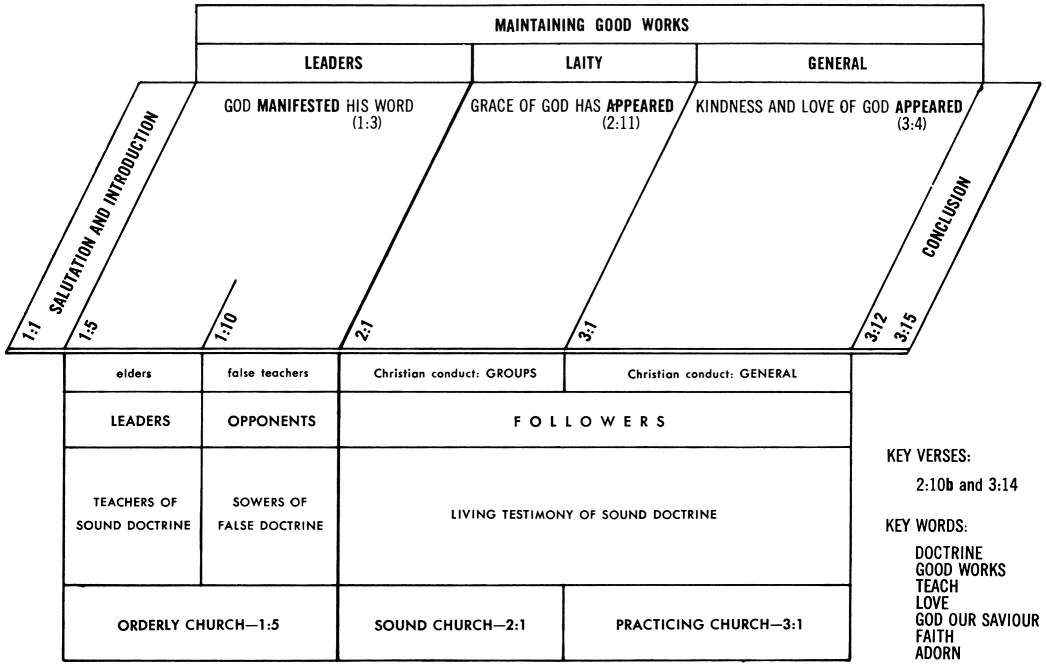
ADORNING THE DOCTRINE OF GOD
Click chart to enlarge
Charts from Jensen's Survey of the NT - used by permission
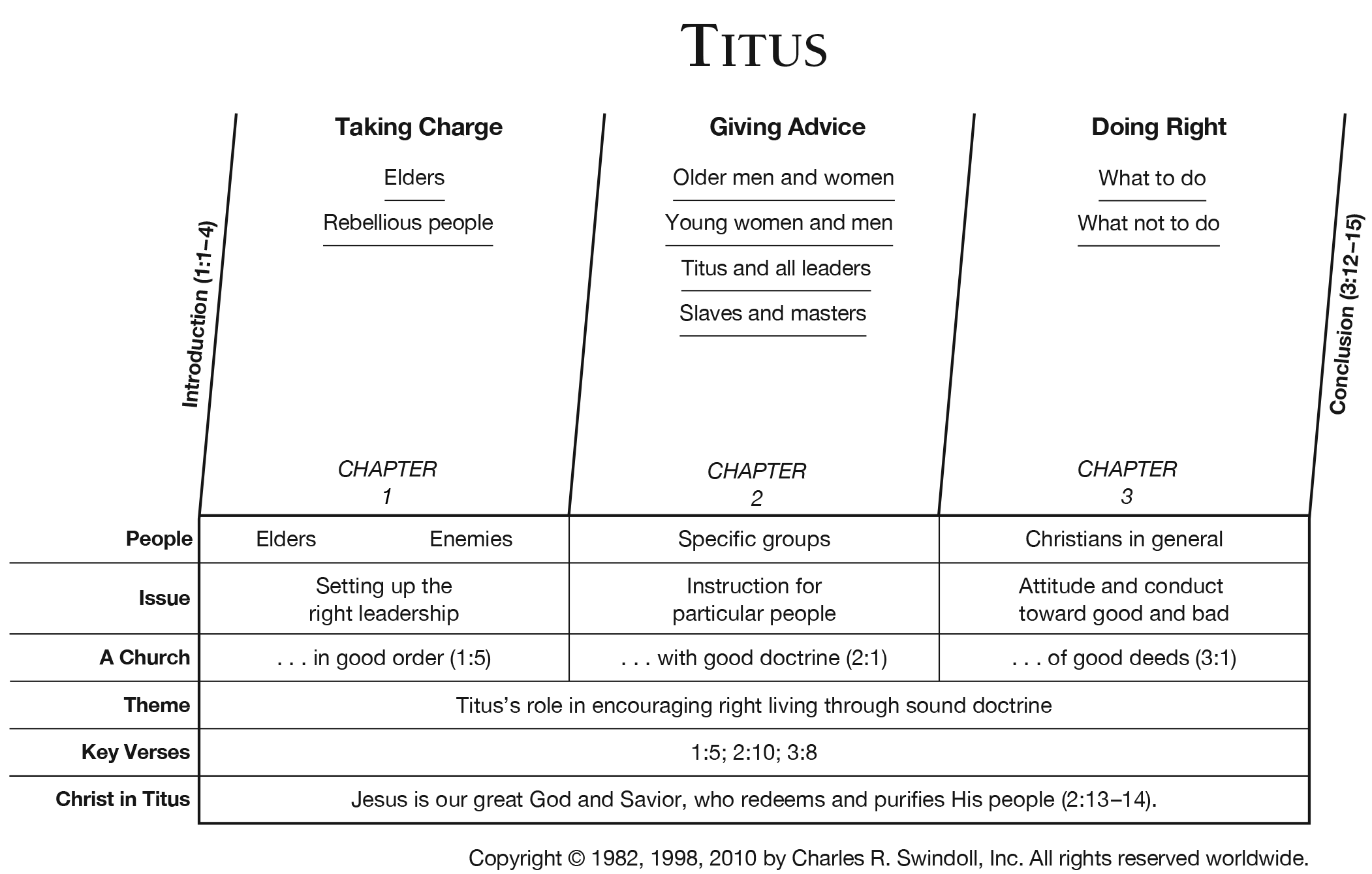
See Summary Chart by Charles Swindoll
Chart below from Michael J. Penfold
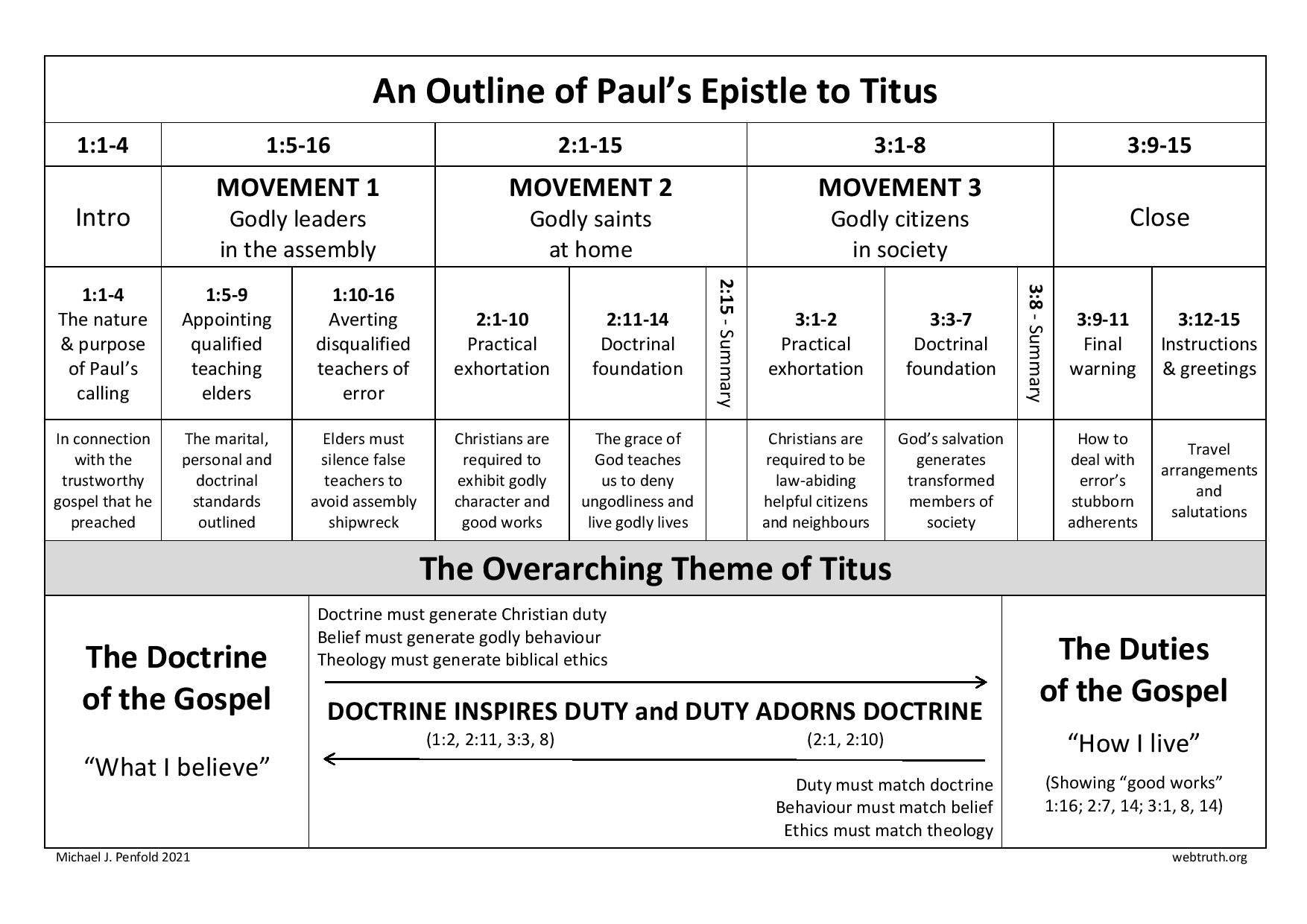
|
Focus |
Appoint Elders |
|||
|
Divisions |
Rebuke |
Maintain |
||
|
Topics |
||||
|
Topics |
Organization |
Offenders |
Operation |
|
|
Place |
Probably Written from either Corinth or Nicopolis (cf. Titus 3:12). |
|||
|
Time |
Circa 63 AD |
|||
|
Modified from Talk Thru the Bible |
||||
Titus 2:13 Looking for (PMPMPN) the blessed hope and the appearing of the glory of our great God and Savior, Christ Jesus, (NASB: Lockman)
Greek: prosdechomenoi (PMPMPN) ten makarian elpida kai epiphaneian tes doxes tou megalou theou kai soteros hemon Iesou Christou,
Amplified: Awaiting and looking for the [fulfillment, the realization of our] blessed hope, even the glorious appearing of our great God and Savior Christ Jesus (the Messiah, the Anointed One), (Amplified Bible - Lockman)
Barclay: because we expectantly await the realization of our blessed hope—I mean the glorious appearing of our great God and Saviour Jesus Christ,, (Westminster Press)
CSB while we wait for the blessed hope and appearing of the glory of our great God and Savior, Jesus Christ
ESV waiting for our blessed hope, the appearing of the glory of our great God and Savior Jesus Christ,
GWN At the same time we can expect what we hope for-the appearance of the glory of our great God and Savior, Jesus Christ.
KJV: Looking for that blessed hope, and the glorious appearing of the great God and our Saviour Jesus Christ;
NET: as we wait for the happy fulfillment of our hope in the glorious appearing of our great God and Savior, Jesus Christ.
NIV while we wait for the blessed hope--the glorious appearing of our great God and Savior, Jesus Christ,
NAB as we await the blessed hope, the appearance of the glory of the great God and of our savior Jesus Christ,
NJB waiting in hope for the blessing which will come with the appearing of the glory of our great God and Saviour Christ Jesus.
Phillips: And while we live this life we hope and wait for the glorious dénouement of the Great God and of Jesus Christ our saviour. (Phillips: Touchstone)
Wuest: expectantly looking for the prosperous expectation, even the appearing of the glory of our great God and Saviour, Jesus Christ,
Young's Literal: waiting for the blessed hope and manifestation of the glory of our great God and Saviour Jesus Christ, (Tit 2:13 YLT)
LOOKING (continuously = one's lifestyle as manifest by his or her choices) FOR: prosdechomenoi (PMPMPN):
- Lk 2:25, 38 Lk 12:35, Mk 15:43, Acts 24:15 , 1Cor 1:7 Php 3:20,21,1Th 1:10, 2Ti 4:8, Heb 9:28,2Pet 3:12,13, 14, Jude 1:21, 1Jn 3:3
- Titus 2 Resources - Multiple Sermons and Commentaries
- Titus 2:11-14 How Grace Works - Steven Cole
- Titus 2:11-14 Saving Grace, Pt. 3 - John MacArthur
- Titus 2:11-14 Saving Grace, Pt. 4 - John MacArthur

Buster Keaton looking expectantly
"The Navigator" 1924
WAITING EXPECTANTLY
FOR OUR BLESSED HOPE
Looking - This is the key verb of this verse and is translated "waiting" or "expectantly waiting" and is in the present tense (discussed more below) which depicts what is to be the believer's continual attitude in this present age (Titus 2:12-note). Remember that our attitudes always influence our actions, thus this attitude of expectant waiting will or should have profound effect on the way we are living, working its way out in our daily practical choices, motivating (for example) our moment by moment choices to mortify sin (Ro 6:11-note, Ro 8:13-note, Col 3:5-note, etc) and to intentionally, radically pursue righteousness and godliness and holiness (Lev 11:44, Is 51:1, Lk 1:74, 75, 1Pe 1:14-note, 1Pe 1:15, 16-note, He 12:14KJV-note, Ro 6:22KJV-note, 2Co 6:17, 18, 2Co 7:1-note, Php 3:12-note, 1Th 3:13-note, 1Th 4:3-note, 1Th 4:7-note 2Pe 3:11-note, 3Jn 1:11, 1Ti 4:7, 8-note, 1Ti 4:9-note 1Ti 6:11 2Ti 2:22-note)
Beloved, the only way you can maintain this expectant attitude is by depending daily on the filling of the Spirit Who Jesus said "He shall glorify (give a proper opinion of) Me; for He shall take of Mine, and shall disclose it to you." (Jn 16:14) So the Spirit Who fills and controls us (Eph 5:18-note) will give us a proper opinion of Jesus by daily directing our hearts toward heaven (cf Col 3:1-2-note) and His soon Second Coming!
Read the English dictionary definitions of "wait" (some repetition) and try to apply them to your own life in view of what Paul is describing in Titus 2:13 -- "to stay in place in expectation of", "to remain stationary in readiness or expectation" (I like this picture - it reminds us that we are soldiers and as soldiers we are always "on duty" and are are not to leave our "station" and are never to take a "furlough" for the spiritual war is incessant and our ever prowling crafty enemy is invisible!), "to be ready and available", "to stay or rest in expectation...till the arrival of some person" (!), "to rest in expectation and patience", "to hold oneself in readiness", "to remain in readiness or expectation."
Nelson's New Illustrated Bible Dictionary adds that...
In Scripture, the word “wait” normally suggests the anxious, yet confident, expectation by God’s people that the Lord will intervene on their behalf. Such waiting may be for answers to prayer (Ps 25:5-note), for the coming of the Holy Spirit (Acts 1:4), for salvation (Ge 49:18), or especially for the coming of the Messiah to bring salvation to His people and to establish His kingdom on earth (Ps 37:34-note; Lk 12:36; Ro 8:23-note; 1Th 1:10-note). Waiting, therefore, is the working out of hope. (Youngblood, R. F., Bruce, F. F., Harrison, R. K., & Thomas Nelson Publishers. Nelson's New Illustrated Bible Dictionary)
Jesus is our Bridegroom (Lk 5:34, 35) and we are His bride (2Co 11:2) and just as a young bride whose husband is serving in military in a foreign country eagerly looks forward to his return, so we who have tasted the sweetness of God’s grace should look forward to the coming of our Bridegroom and seek to put on our "best dress", clothing ourselves in "fine linen, bright and clean, for the fine linen is the righteous acts of the saints." (Re 19:7-note)
Octavius Winslow exclaims "This subject is eminently PRACTICAL. It makes Jesus more precious. How quicker beats the pulse and warmer throbs the heart of the bride anticipating the speedy return of her long absent lord! Blessed Jesus! You are the Bridegroom of Your Church, and the Beloved of my soul, and the thought of soon and forever beholding You makes my soul as the wings of Amminadab--unclasped, uplifted, and ready to fly! (Consider Jesus)
When we maintain an attitude of expectant looking, it will radically impact our life and our usefulness to the Lord. There is little doubt that this future thinking mentality was a major motivating force in the lives of men who have been greatly used of God, men like Dwight L. Moody who once said "I never preach a sermon without thinking that possibly the Lord may come before I preach another."
Spurgeon said it this way...
If I knew that our Lord would come this evening, I should preach just as I mean to preach; and if I knew he would come during this sermon, I would go on preaching until he did...The fact that Jesus Christ is to come again is not a reason for star-gazing, but for working in the power of the Holy Ghost.
J Hampton Keathley introduces Titus 2:13 commenting that...
Having mentioned this present and temporary age (Titus 2:12b-note), the apostle quickly moved to the age to come that will be ushered in with the glorious appearing of the Savior. This is to be another strong motivation to godly living, a fact that is even more obvious in the Greek text. “As we wait” represents the translation of another adverbial participle that is dependent on the previous verb, “that we should live.” We could easily translate it,
we should live... by waiting expectantly for the happy fulfillment of our hope (literally, the blessed hope)...
The participle points us to one of the means by which we are to live in this present age, by living with a view to the return of Christ. Waiting for the blessed hope provides added incentives that enable us to live godly lives in this present age. (Titus 2:11-15 The Foundation, Means, and Motivation for Godly Behavior)
Looking for the blessed hope - As someone has well said when it comes to belief in the Lord's return there are two kinds of Christians—gazers and goers. Paul is charging Titus to be a gazing goer, motivated to live in the light of the One Whom he is continually looking for.
J Vernon McGee - The word for “looking” (prosdechomai) has the root meaning of entertaining. This is the hope that occupied the guest chamber in the heart of Paul during all of his life, beginning at the Damascus Road and going on to the Appian Way.
Alexander Maclaren - The primitive church thought a great deal more about the coming of Christ than about death, and thought a great deal more about his coming than about heaven.
Lehman Strauss rightly observes that "The upward look for the coming again of the Lord Jesus is an effective counteraction for an unbalanced mind."
John Blanchard - The certainty of the Second Coming of Christ should touch and tincture every part of our daily behavior.
William Gurnall - Christ hath told us he will come, but not when, that we might never put off our clothes, or put out the candle.
H A Ironside - It is the return of the Lord which is thus put before us to influence our daily lives. It is one thing to hold the doctrine of the Lord's return, but quite another to be held by that blessed hope. (Ed: Paraphrased - Hold to the Word of Truth, so that it may hold you firm when the winds of adversity blow unexpectedly into your life.)
Jamieson writes that looking expectantly for Jesus "will prove the antidote (a remedy to counteract the effects of poison) to worldly lusts, and the stimulus to "live in this present world (age)" (Titus 2:12-note) conformably to this expectation."
A W Pink makes a good point for all relish the study of prophecy - My head may be filled with prophecy, I maybe an ardent pre-millennarian, I may think and say that I am “looking for that blessed Hope” but, unless Divine grace is teaching me to deny “ungodliness and worldly lusts” and to “live soberly, righteously, and godly, in this present world,” then I am deceiving myself Make no mistake upon that point. To be truly “looking for that blessed hope” is a spiritual attitude: it is the longing of those whose hearts are right with God. Thus, our text may be summed up in three words: grace, godliness, glory. (Grace Preparing for Glory)
Related Resources:
- Second Coming of Christ-Quotes, Devotionals & Illustrations
- What is the Second Coming of Jesus Christ?
- What is the difference between the Rapture and the Second Coming?
- John Piper - Our Hope: The Appearing of Jesus Christ
- Why is Jesus going to return on a white horse?
- What is the blessed hope?
- Is Jesus coming soon?
- Can the return of Christ truly be said to be imminent?
- Is Zechariah 14:4 a prophecy about the second coming of Christ?
- Is it possible to know when Jesus is coming back?
- Does the Old Testament truly predict a second advent of the Messiah?
- What does it mean that Jesus will come in the clouds (Revelation 1:7)?
- What does it mean that Jesus will return like a thief in the night?
- Song by Third Day - The Blessed Hope
Looking for (4327) (prosdechomai from pros = in compound Greek words implies motion or direction toward + dechomai [word study] = a deliberate and ready reception) means to accept favorably, to receive one into intercourse/companionship, to give access to oneself or receive to oneself. Prosdechomai means to receive one coming from some place and so to welcome with friendliness (Ro 16:2-note, Phil 2:29).
This great Greek verb describes one who is waiting for something (in context Someone) with a sense of expectancy (Mk 15:43, Luke 2:25, 38, 12:36, 23:51, Acts 23:21, Titus 2:13, Jude 1:21). Does this verb typify your life beloved? If not what "earthly cargo" do you need to jettison in order to assure a safe voyage and an "abundant" arrival at port (see 2Pe 1:10, 11-see notes, He 6:19, 20-see notes)?
The root verb dechomai means to accept deliberately and readily, receive kindly and so to take to oneself what is presented or brought by another. It means to welcome as a teacher, a friend, or a guest into one's house. The word describes accepting persons with open arms, minds, and hearts, even going beyond normally expected gracious hospitality. The term was often used of welcoming honored guests and meeting their needs with special attention and kindness.
Prosdechomai is used of things future, in the sense of expecting and with the meaning of accepting. This verb is virtually always is found in the middle voice conveying reflexive action (action directed or turned back on self) which means that one receives to one’s self or gives another access to one’s self.
As alluded to in the introductory comments on this passage, prosdechomai is in the present tense which calls for our looking to be our lifestyle! Are you looking for Him? If you are looking at the visible things, the temporal things (2Co 4:18-note) of this passing world (1Jn 2:17-note), you can be sure that your looking (for Him = Second Coming) will be a bit lacking! As an aside the only way we can be continually looking for Jesus is by relying on the filling and empowering of the Spirit of Jesus Whose role is to glorify the Son (John 16:14)!
We need more men like G Campbell Morgan who said "I never begin my work in the morning without thinking that perhaps he may interrupt my work and begin his own. I am not looking for death, I am looking for Him." (Amen!) How would my daily choices change if I lived with what I like to call "vertical vision" (in contrast to "horizontal vision" -- looking at the things of the world [horizontal] rather than the things above [vertical])?
- Discussion of Vertical Vision Empowers Horizontal Living
- See also Redeem the Time
- 80+ Minute Video of Talk I Gave to Men's Group on Redeeming the Time
Adoniram Judson alluded to living expectantly in light of His imminent return when he wrote that...
A life once spent is irrevocable. It will remain to be contemplated through eternity. The same may be said of each day. When it is once past, it is gone forever. All the marks which we put upon it, it will exhibit forever. Each day will not only be a witness of our conduct, but will affect our everlasting destiny. How shall we then wish to see each day marked with usefulness?! It is too late to mend the days that are past. The future is in our power.
Let us, then, each morning,
resolve to send the day into eternity
in such a garb as we shall wish it to wear forever.
Beloved, if you are struggling with the cost you might have to pay to be one of God's winning runners, or simply struggling with God's will for your life, struggling with what to do with your time, struggling with how you should live in these last days, struggling with whether you are really looking forward to that moment in eternity when you will stand fully revealed before your Lord, then you cannot afford not to watch the following video by John Piper (click title to watch Dr Piper's 46 minute video = Don't Waste Your Life. You can also download a free copy of John Piper's book Don’t Waste Your Life (also has a study guide)
Moulton-Milligan have this secular use of prosdechomai...
“I am waiting for the 450 drachma you have given to Radanus.” (Comment: We can probably all identify with this person's anticipation of being repaid!)
Prosdechomai - 14x in 14v - NAS = accepted(1), accepting(1), cherish(1), looking(3), receive(2), receives(1), waiting(5), waiting anxiously(1).
Mark 15:43 Joseph of Arimathea came, a prominent member of the Council, who himself was waiting for the kingdom of God; and he gathered up courage and went in before Pilate, and asked for the body of Jesus.
Luke 2:25 And behold, there was a man in Jerusalem whose name was Simeon; and this man was righteous and devout, looking for the consolation of Israel; and the Holy Spirit was upon him.
See wonderful sermon on these passages by Brian Bill entitled "Waiting for Christmas" -- the illustration at the end of the sermon is exceptional.
Luke 2:38 And at that very moment she came up and began giving thanks to God, and continued to speak of Him to all those who were looking for the redemption of Jerusalem.
See wonderful sermon by Brian Bill entitled "Waiting for Christmas" -- the illustration at the end of the sermon is exceptional.
Luke 12:36 "And be like men who are waiting for their master when he returns from the wedding feast, so that they may immediately open the door to him when he comes and knocks.
Luke 15:2 And both the Pharisees and the scribes began to grumble, saying, "This man receives sinners and eats with them."
Luke 23:51 (he had not consented to their plan and action), a man from Arimathea, a city of the Jews, who was waiting for the kingdom of God;
Acts 23:21 "So do not listen to them, for more than forty of them are lying in wait for him who have bound themselves under a curse not to eat or drink until they slay him; and now they are ready and waiting for the promise from you."
Acts 24:15 having a hope in God, which these men cherish themselves, that there shall certainly be a resurrection of both the righteous and the wicked.
Romans 16:2 (note) that you receive her in the Lord in a manner worthy of the saints, and that you help her in whatever matter she may have need of you; for she herself has also been a helper of many, and of myself as well.
Philippians 2:29 (note) Therefore receive him in the Lord with all joy, and hold men like him in high regard;
Titus 2:13 (note) looking for the blessed hope and the appearing of the glory of our great God and Savior, Christ Jesus;
Hebrews 10:34 (note) For you showed sympathy to the prisoners, and accepted joyfully the seizure of your property, knowing that you have for yourselves a better possession and an abiding one.
Hebrews 11:35 (note) Women received back their dead by resurrection; and others were tortured, not accepting their release, in order that they might obtain a better resurrection;
Jude 1:21 keep yourselves in the love of God, waiting anxiously for the mercy of our Lord Jesus Christ to eternal life.
Thayer writes that prosdechomai..."as in Greek writings from Aeschylus and Herodotus down (meant) "to receive to oneself, to admit, to give access to oneself'... to admit one, receive into contact and companionship, Luke 15:2; to receive one (coming from some place), Romans 16:2; Philippians 2:29 (1 Chr. 12:18); to accept (not to reject) a thing offered: To reject, Heb 11:35-note; to admit (accept) hope, i.e., not to repudiate but to entertain, embrace, its substance, Acts 24:15... not to shun, to bear, an impending evil Hebrews 10:34.
(And) from Homer down (prosdechomai meant), to expect (look for, wait for): Luke 12:36; Mark 15:43; Luke 2:25,38; 23:51 (Acts 23:21); Titus 2:13; Jude 1:21
If we are to be looking for Christ to return at any time, living in light of its imminency, such an "uplook outlook" should be a powerful incentive to spur us on to fight the good fight necessary for godly living and bold witnessing. Note the emphasis is that we are to be looking for the Christ and not for the Antichrist, for a one world government or for any other supernatural sign. Beloved, our Bridegroom's coming is imminent, and no prophetic event is required to precede His sure return (See related topics Imminency; Another discussion on imminency). Maranatha (Our Lord, come! 1Cor 16:22).
Is that my mindset? Do my day to day choices
reflect the reality of an expectant attitude?
Expectant Looking
Is the "Antidote" for
Apathetic Living
Hudson Taylor put it this way "Since he may come any day, it is well to be ready every day."
The watchers on the mountain
Proclaim the Bridegroom near,
Go, meet Him as He comes,
With Hallelujahs clear!The marriage feast is waiting,
The gates wide open stand
Up, up! ye heirs of glory,
The Bridegroom is at hand!"
May we be like the Psalmist who cried...
My soul waits for the Lord More than the watchmen for the morning; Indeed, more than the watchmen for the morning. (Ps 130:6-note)
Prosdechomai aptly describes the lifestyle and habitual attitude of the godly Jewish man named Simeon (who undoubtedly was a member of the Jewish remnant who had placed his faith in the Messiah):
And behold, there was a man in Jerusalem whose name was Simeon; (one of the believing Jewish remnant) and this man was righteous and devout, looking (prosdechomai present tense) for the consolation of Israel (a synonym for the Redeemer Christ Jesus Who Himself would be the ultimate "consolation" of Israel); and the Holy Spirit was upon him. And it had been revealed to him by the Holy Spirit that he would not see death before he had seen the Lord's Christ.". (Luke 2:25,26)
Luke also uses prosdechomai in his description of godly Anna writing
And there was a prophetess, Anna (one of the believing Jewish remnant) the daughter of Phanuel, of the tribe of Asher. She was advanced in years, having lived with a husband seven years after her marriage, and then as a widow to the age of eighty-four. And she never left the temple, serving night and day with fastings and prayers. And at that very moment she came up and began giving thanks to God, and continued to speak of Him to all those who were looking for (present tense - the pattern or direction of one's life, this was their lifestyle in this present age ["church age" - the next "age" is the Messianic age = Millennium] which continually motivated them and pointed them toward this glorious future age [cp Jesus' disciples' question in Mt 24:3 noting especially the phrase "the end of the age"]) the redemption of Jerusalem (synonymous with the Redeemer Himself - e.g., see Zech 14:1, 2, 3, 4, 5, 6, 7, 8, esp Zech 14:9!). (Luke 2:36, 37, 38)
Fanny Crosby (who was physically blind but had spiritual eyes of faith) caught the idea of expectant living in this line from Blessed Assurance (play hymn). Lord open the eyes of our heart to see the hope of our calling as did Miss Fanny Crosby. In Jesus' mighty Name. Amen.
Perfect submission, all is at rest;
I in my Savior am happy and blest,
Watching and waiting, looking above,
Filled with His goodness, lost in His love.
Mark describes another Jew who was undoubtedly part of the saved Jewish remnant writing that
Joseph of Arimathea came, a prominent member of the Council, who himself was waiting for (prosdechomai present tense - expectant waiting was his lifestyle which undoubtedly prompted godly living!) the kingdom of God and he gathered up courage and went in before Pilate, and asked for the body of Jesus. (Mark 15:43, cp Mt 27:57 Lk 23:50, 51 Jn 19:38)
Comment: Notice how his future focused perspective emboldened his present actions, which is exactly what should happen in every believer's life...to the glory of God!
As mentioned above, prosdechomai was used of receiving to one's self with a welcoming attitude:
And both the Pharisees and the scribes began to grumble, saying, "This man receives (to Himself with a welcoming attitude) sinners and eats with them." (Luke 15:2)
I commend to you our sister Phoebe, who is a servant of the church which is at Cenchrea that you receive (prosdechomai) her in the Lord in a manner worthy of the saints, and that you help her in whatever matter she may have need of you; for she herself has also been a helper of many, and of myself as well. (Ro 16:1, 2-notes)
Paul, writing to the saints at Philippi concerning his sending them Epaphroditus, his brother and fellow worker and fellow soldier, who was also their messenger and minister to Paul's need, encouraged the Philippians...
Therefore receive (prosdechomai - conveys the picture of someone who is filled with the Spirit welcoming another person with open arms and heart!) him in the Lord with all joy, and hold men like him in high regard (Php 2:29-note)
Prosdechomai is used in a negative sense in Acts, where we read
So do not listen to them, for more than forty of them are lying in wait for him (to kill Paul) who have bound themselves under a curse not to eat or drink until they slay him; and now they are ready and waiting for the promise from you. (Acts 23:21)
In a positive use Luke records Paul's testimony of...
having a hope (click discussion of Biblical hope) in God, which these men cherish (prosdechomai present tense) themselves, that there shall certainly be a resurrection of both the righteous and the wicked. (Acts 24:15)
The writer of Hebrews explains that those having a sure future with God can even "welcome" present affliction encouraging his readers
For you showed sympathy to the prisoners, and accepted (prosdechomai) joyfully the seizure of your property, knowing that you have for yourselves a better possession and an abiding one. (10:34-note)
Comment: Notice how their "firm grip" on their future possession, prompted a "loose grip" on the temporal possessions of this present age which is passing away and along with its lusts).
Jude also associates this expectant attitude with living for God writing
keep (aorist imperative - command to guard, practice watchful care of - the only way you can possibly obey is by rejecting self-reliance and relying wholly on the Holy Spirit's supernatural enabling power) yourselves (take care of your business, not everyone else's! And do so by means of the two things just mentioned in context, building themselves up in their Christian lives and by praying in the Holy Spirit) in (in the sphere of His love - see to it that they stay within "the circle" of His love) the love of God, waiting anxiously (prosdechomai present tense - this was to be their continual mindset) for the mercy of our Lord Jesus Christ to eternal life (which Wuest feels seems to point to that part of eternal life which will be given the saint at the Rapture = glorification)." (Jude 1:21)
Jesus used this verb in His exhortation to His disciples live life with an expectant attitude and to...
be like men who are waiting (prosdechomai present tense) for their master when he returns from the wedding feast, so that they may immediately open the door to him when he comes and knocks. (Luke 12:36)
Prosdechomai is used 46 times in the Septuagint (LXX) (Ge 32:20; Ex 10:17; 22:11; 36:3; Lev. 26:43; Ruth 1:13; 1 Chr. 12:18; 2 Chr. 36:21; Esther 9:23, 27; Job 2:9; 29:23; 33:20; Ps. 6:9; 55:8; 104:11; Prov. 15:15; Isa. 28:10; 42:1; 45:4; 55:12; Ezek. 20:40f; 32:10; 43:27; Dan. 7:25; Hos. 8:13; Amos 5:22; Mic. 6:7; Mal. 1:8, 10, 13) with meanings generally similar to the NT uses. Here are a few examples: Isa 42:1 "My soul delights." Amos 5:22 God "will not accept" their offerings. "nor will I accept an offering from you." (Mal 1:10). "Should I receive that from your hand?" (Mal 1:13)
Here is one use from Psalms...
The LORD has heard my supplication. The LORD receives (prosdechomai) my prayer." (Psalm 6:9)
Comment: In other words the Lord welcomes our prayers! In a sense He even looks expectantly for them! Are you as convicted as I am?
Spurgeon's note - Here is past experience used for future encouragement.
John explains that daily looking for Christ's appearing will affect daily living, writing...
See how great a love the Father has bestowed upon us, that we should be called children of God; and such we are. For this reason the world does not know us, because it did not know Him. Beloved, now we are children of God, and it has not appeared as yet what we shall be. We know that, when He appears, we shall be like Him, because we shall see Him just as He is. Everyone who has this hope fixed on Him purifies himself (motivated by love not fear...perfect love casts out all fear...perfect love would connote "perfect" as far as humanly possible, obedience.) just as He is pure." (1John 3:1-note, 1John 3:2-note, 1John 3:3-note)
I AM
COMING
QUICKLY
In a similar vein, Jesus' promise in the last chapter of the last book of the Bible should be words believers frequently ponder (Suggestion: Recall this verse to mind every morning when you present yourself to Him as a living and holy sacrifice - Ro 12:1-note) so that motivated by this truth we would continually, expectantly look for Him and continually live for Him (1Cor 6:20)...
Behold, I am coming quickly, and My reward is with Me, to render to every man according to what he has done. (Revelation 22:12-note)
J. C. Ryle correctly concludes that the...
Uncertainty about the date of the Lord's return is calculated to keep believers in an attitude of constant expectation and to preserve them from despondency.
Spurgeon adds that...
The fact that Jesus Christ is to come again is not a reason for star-gazing, but for working in the power of the Holy Ghost.
Even an ancient sage such as Augustine understood the motivating power of looking for Jesus' return writing...
He who loves the coming of the Lord is not he who affirms it is far off, nor is it he who says it is near. It is he who, whether it be far or near, awaits it with sincere faith, stead-fast hope and fervent love.
John Blanchard has several pithy comments on the Second Coming...
It is a bad sign when people start discussing eschatology instead of preparing for the coming of Christ...When Christ returns, the second advent will no longer be a subject for discussion....The certainty of the Second Coming of Christ should touch and tincture every part of our daily behavior....Many people will be surprised when Jesus comes again—but nobody will be mistaken. (highly recommended resource useful in teaching and preaching - the best of its kind I have encountered - The Complete Gathered Gold A Treasury of Quotations for Christians by John Blanchard or Wordsearch Computer Version)
Looking at Titus 2:11-13 from another perspective, it is interesting to see how Paul uses this short but powerful section of Scripture to summarize the truth inherent in the Three Tenses of Salvation:
|
Three Tenses of Salvation |
|||
| Titus 2:11 note |
Past Tense |
“the grace of God has appeared, bringing salvation” (aorist tense) |
Justification: One time event |
| Titus 2:12 note |
Present Tense |
“instructing us” (present tense) |
Sanctification: A lifelong process |
| Titus 2:13 note |
Future Tense |
“looking for the Blessed Hope”** | Glorification: One time event |
** Note that the tense for looking is present not future but the effect of this habitual practice of looking is to produce a life lived with a future focus! What you aim at in life will usually determine your course through this wilderness journey. Aim at the passing pleasures of sin (He 11:25-note) of this passing present world (1Jn 2:17-note) and you will miss the joy of heaven now (cp Ps 90:12-note). I am not saying your "aiming" earns or merits heaven but when a believer is entangled by the affairs of everyday life (2Ti 2:4-note), their anticipation of heaven's joys (which also invigorate and engender present joy) will surely be dampened. Don't let the world, the flesh and the devil continue to steal your joy dear pilgrim (1Pe 1:1-note, 1Pe 2:11KJV-note), citizen of a heavenly land (Php 3:20, 21-note, see a better country, a better city - He 11:16-note, He 12:22-note, He 13:14-note)!
AMAZING
GRACE!
In short, God’s grace redeems us (cp justifies us), reforms us (cp sanctifies us) and rewards us (cp glorifies us)! Amazing grace! How sweet the sound that has saved, is saving and will save a wretch like me! (cp Ro 7:24, 25-note)
Reuben A. Torrey wrote that...
The imminent return of our Lord is the great Bible argument for a pure, unselfish, devoted, unworldly, active life of service.
Spurgeon writes that...
One work of the grace of God is to cause us to be “looking for that blessed hope of the glorious appearing of the great God and our Savior Jesus Christ.”
What is that “blessed hope?” Why, first, that when He comes we shall rise from the dead, if we have fallen asleep; and that, if we are alive and remain, we shall be changed at His appearing. (1Th 4:13, 14, 115, 16, 17, 18-see notes beginning 1Th 4:13)
Our hope is that we shall be approved of Him and shall hear him say, “Well done, good and faithful servant.” (Mt 25:21, 23, Lk 19:17) This hope is not of debt, but of grace: though our Lord will give us a reward, it will not be according to the law of works.
We expect to be like Jesus when we shall see him as he is. When Jesus shines forth as the sun, “then shall the righteous shine forth as the sun in the kingdom of our Father.”
Our gain by godliness cannot be counted down into the palm of our hand. It lies in the glorious future (1Ti 4:8-note); and yet to faith it is so near that at this moment I almost hear the chariot of the Coming One. The Lord cometh, and in the coming of the Lord lies the great hope of the believer, his great stimulus to overcome evil, his incentive to perfect holiness in the fear of the Lord. Oh to be found blameless in the day of the manifestation of our Lord! God grant us this! Do you not see, brethren, how the discipline of the doctrine of grace runs towards the separating of us from sin, and the making us to live unto God? (From Spurgeon's sermon The Two Appearings and the Discipline of Grace)
Billy Graham was right when he said that...
The subject of the second coming of Christ has never been popular to any but the true believer.
After World War II there was a sign on the shore of New York harbor facing all incoming troop ships, which read:
WELCOME HOME.
WELL DONE.
When the Lord Jesus Christ appears in the air, He is going to “WELCOME HOME” every saint, for at that time He shall come to take us home to heaven. Our entrance into heaven is solely on the basis of our faith in His shed blood and death on the cross, and every believer shall receive the same “WELCOME HOME.” But, how many of us will receive His “WELL DONE,” and the “crown of righteousness”? (2Ti 4:8-note, Mt 25:21, 23, Lk 19:17)
THE EARLY EDITION - THERE was a show I used to watch a couple of years ago called Early Edition. The host of the show would get the next day's newspaper, read it, and then do a show about the upcoming news. He'd read a newspaper about the morrow and related it to his viewers today. Because he had tomorrow's newspaper today, he had information nobody else did. Most of our coworkers don't have the information. Most of our neighbors don't have the information. But as Christians, we've got an Early Edition. God has given us the Early Edition. We can function today in light of what we know about God's plan for the future. (Tony Evans' Book of Illustrations)
O Son of God, We Wait for Thee
Philipp Hiller (1699-1769)
O Son of God, we wait for Thee,
In love for Thine appearing;
We know Thou sittest on the throne,
And we Thy Name are bearing,
Who trusts in Thee, may joyful be,
And see Thee, Lord, descending,
To bring us bliss unending.
We wait for Thee ’mid toil and pain,
In weariness and sighing;
But glad that Thou our guilt hast borne,
And canceled it by dying;
Hence cheerfully may we with Thee
Take up our cross and bear it,
Till we relief inherit.
We wait for Thee; sure Thou wilt come;
The time is swiftly nearing;
In this we also now rejoice,
And long for Thine appearing.
Oh, bliss ’twill be when Thee we see,
Homeward Thy people bringing,
With transport and with singing!
Thomas Watson comments on Titus 2:13...
A Christian's chief happiness is in in the future. A saint in this life, is an expectant of heaven; he has little in hand—but much in hope. So says the text, "looking for that blessed hope." There is enough to make us breathe after that hope, if we look either internally or externally.
Internally, if we turn our eyes inward and behold our sins. This made Paul himself cry out, "O wretched man that I am!" Ro 7:24. A Christian has two men within him—flesh and spirit. This may make him look for that blessed hope—when he shall be disentangled of his sins, and shall be as the angels of God.
If we look externally, if we cast our eyes abroad, the world is but our sojourning-house. It is a stage whereon vanity and vexation act their part, and the scene seldom alters. "Arise and depart; for this is not your rest: because it is polluted!" Micah 2:10. All which considered, may make us look for "that blessed hope, and the glorious appearing of the great God, and our Savior Jesus Christ."
In which words there is the act, "looking," and the object, which is set down emphatically, "that blessed hope" and, specifically, "the glorious appearing of the great God."
I begin with the first, the act, "looking." There is a threefold looking:
1. There is a looking with DESIRE—as the servant looked for the year of jubilee and release, Leviticus 25:40, or as the bride looks for the marriage day. Now is a time of absence from our husband Christ; therefore, we are dressed in mourning and hang our harps upon the willows. But how the spouse desires the marriage day when the nuptials shall be solemnized! At that wedding, "the water shall be turned into wine." How the pious soul cries out in a holy pang of desire, "How long Lord! Why is Your chariot so long a-coming? Why o do the wheels of Your chariot tarry?" It is the desire of the whole church, "Come Lord Jesus, come quickly." Re 22:17.
2. There is a looking with JOY. Ro 5:2, "We rejoice in hope of the glory of God." There is terror in a sinner's looking; it is called a fearful looking for of judgment, He 10:27. A man in debt looks every hour when the sergeant shall arrest him—but the saint's looking is a joyful looking, as a man looks for a friend, or for one that is to pay him a great sum of money. So Moses looked with joy "to the recompense of reward," He 11:26.
3. There is a looking with PATIENCE—as a man casts his seed into the earth, and looks with patience until the crop springs up. Jas 5:7, "Consider the farmers who eagerly look for the rains in the fall and in the spring. They patiently wait for the precious harvest to ripen. You, too, must be patient. And take courage, for the coming of the Lord is near." So much for the act, looking.
The second is the object, "that blessed hope", where we are to consider what hope is—and what a Christian hopes for.
What is hope?
I answer, hope is a supernatural grace planted in the heart by the Spirit of God, whereby a Christian is quickened to the expectation of those things which are held forth in the promise. Ro 8:25, "If we hope for what we do not see, we eagerly wait for it with patience." Aquinas describes hope thus, "Hope is concerned with a good that is hard to reach, located in the future, and open to be gained."
Hope is concerned with a good. It looks at some good, so it differs from fear. Fear looks at evil, hope at good.
Hope is concerned with a future good. It looks at some good to come; so it differs from joy. Joy is exercised about something present, hope about something future.
Hope is concerned with a good that is hard to reach. It looks at some good which is difficult to attain; so hope differs from desire. Desire is weak and transient; it is soon over. Hope is resolute and fixed, it wrestles with difficulties and will not give up, until it has the thing hoped for.
Hope is concerned with a good that is open to be gained. It looks at some good which is feasible, and which there is possibility of obtaining; so hope differs from despair. Despair looks on things with black spectacles and gives all up as lost. Hope is like cork to the net, which keeps the heart from sinking in despair. Thus you have seen what hope is. (Click for the rest of Watson's discussion - The Sacred Anchor)
THE BLESSED HOPE: ten makarian elpida:
- Titus 1:2; 3:7; Acts 24:15; Ro 5:5; 8:24,25; 15:13; Col 1:5,23,27; 2Th 2:16; He 6:18,19; 1Pe 1:3; 1Jn 3:3
- Titus 2 Resources - Multiple Sermons and Commentaries
- Titus 2:11-14 How Grace Works - Steven Cole
- Titus 2:11-14 Saving Grace, Pt. 3 - John MacArthur
- Titus 2:11-14 Saving Grace, Pt. 4 - John MacArthur
- Our Blessed Hope - 2 part study - in depth
- Quotes by C H Spurgeon on The Blessed Hope
- Our Daily Bread Devotionals on the Blessed Hope
- Devotionals on the Blessed Hope by F B Meyer
- Quotes, Devotionals & Illustrations - Second Coming of Christ
THE BELIEVER'S
BLESSED HOPE
Paul had earlier alluded to one aspect of the believer's hope writing that we are to live godly...
in (in the sphere of, circle of or atmosphere of) the hope (not a "hope so," but a "hope sure," not a "hope I make it" mentality but absolute assurance that God will do good to me in the future) of eternal life, which God, who cannot lie, promised long ages ago (Titus 1:2-note)
He reiterates this truth in Titus 3 explaining that by grace through faith, believers are now...
justified (declared righteous, in right standing before God) by His grace (and) we might be made heirs according to the hope (absolute certainty) of eternal life. (Titus 3:7-note)
Titus 3:7 (NET) And so, since we have been justified by his grace, we become heirs with the confident expectation of eternal life."
NET Note - This is the conclusion of a single, skillfully composed sentence in Greek encompassing Titus 3:4-7 Showing the goal of God's merciful salvation, v. 7 begins literally, "in order that, being justified…we might become heirs…"
The blessed hope - "the prosperous expectation" (Wuest)
Blessed (3107) (makarios [word study]) means spiritually “prosperous”, fully satisfied independent of the circumstances because of the amazing enabling grace in which we stand and the supernatural ministry of the indwelling Holy Spirit (Mt 5:6-note). The sure hope we have of the return of our Bridegroom, the Lord Jesus, to catch up (and out of this present evil age) His Bride, the Church (see Rapture), is one that is "prosperous," filled with richness. It is a hope that stabilizes our souls in this present world in which we live as aliens and strangers (we're just "passing through").
Makarios - 50x in 49v in NAS -blessed(1), blessed(46), fortunate(1), happier(1), happy(1).
Matt. 5:3, 4, 5; 11:6; 13:16; 16:17; 24:46; Lk. 1:45; 6:20ff; 7:23; 10:23; 11:27f; 12:37f, 43; 14:14f; 23:29; Jn. 13:17; 20:29; Acts 20:35; 26:2; Rom. 4:7f; 14:22; 1 Co. 7:40; 1 Tim. 1:11; 6:15; Titus 2:13; Jas. 1:12, 25; 1 Pet. 3:14; 4:14; Rev. 1:3; 14:13; 16:15; 19:9; 20:6; 22:7, 14. =
The second coming of Christ, including the first phrase or stage of that coming, the resurrection of those who died in Christ and the catching up (Rapture) (See Table comparing Rapture vs Second Coming) of those believers still living when He comes, is the "blessed hope" of the Christian. The forgiveness of sins coupled with living a godly life eliminates all dread over the return of Christ and transforms the prospect into a blessed hope.
It is important to note that the KJV translates “blessed hope” and “appearing of the glory” as if they were two different entities, whereas the Greek construction requires that they be construed as one.
Looking for that blessed hope, and the glorious appearing of the great God and our Saviour Jesus Christ (KJV)
Granville Sharp's rule says that when there are two nouns in the same case connected by and (kai), the first noun has the definite article (the = Greek word ten), and the second noun lacks the definite article, then the second noun refers to the same thing as the first noun and serves as a further description. Thus, the blessed hope is the appearing of the glory of our Lord.
The blessed hope - Not "hope so". Not a wish. Not a possibility. But...a sure and certain hope that Jesus will return in glory.
C S Lewis in a discussion of the Second Coming said...
If this is not an integral part of the faith once given to the saints, I do not know what is.
As Puritan William Gurnall phrased it...
Christ hath told us He will come, but not when, that we might never put off our clothes, or put out the candle.
The Hope of the Coming of the Lord
By Daniel WhittleA lamp in the night, a song in time of sorrow;
A great glad hope which faith can ever borrow
To gild the passing day, with the glory of the morrow,
Is the hope of the coming of the Lord.Refrain
Blessèd hope, blessèd hope,
Blessèd hope of the coming of the Lord;
How the aching heart it cheers,
How it glistens through our tears,
Blessèd hope of the coming of the Lord.A star in the sky, a beacon bright to guide us;
An anchor sure to hold when storms betide us;
A refuge for the soul, where in quiet we may hide us,
Is the hope of the coming of the Lord.
RefrainA call of command, like trumpet clearly sounding,
To make us bold when evil is surrounding;
To stir the sluggish heart and to keep in good abounding,
Is the hope of the coming of the Lord.
RefrainA word from the One to all our hearts the dearest,
A parting word to make Him aye the nearest;
Of all His precious words, the sweetest, brightest, clearest,
Is the hope of the coming of the Lord.
Refrain
Hope (1680) (elpis [word study]) is expectation or confidence and in the New Testament describes the believer's absolute certainty of future good. Hope is full assurance ("the full assurance of hope" Hebrews 6:11-note) and ultimately is found in the Person of Christ for as Paul wrote to Timothy "Christ Jesus (is) our hope" (1Timothy 1:1)
Butler describes this sure hope as
like being at the airport and looking forward to the arrival on the plane of a loved one. You are not uncertain about the arrival, but you are confidently anticipating with great delight the arrival of your loved one. That is the idea of the use of the word "hope" in our text. The matter is settled. The return of the Lord is not some imagination of some oppressed saint wishing for better days, but it is an established fact that provides much inspiration for the saints regardless of their circumstances. (Studies of the Savior - His Return)
Elpis - 53x in 48v in NAS - THIS MAKES AN EDIFYING, ENCOURAGING DEVOTIONAL STUDY - READ THROUGH THESE SCRIPTURES (check context) AND INTERROGATE THEM WITH THE 5W's/H QUESTIONS (see 5W'S & H) - KEEP A LIST - ADD A DASH OF PRAYER AND THANKSGIVING (Once you've done your own study check the notes below on "The Blessed Hope") - Acts 2:26; 16:19; 23:6; 24:15; 26:6, 7; 27:20; 28:20; Ro 4:18; Ro 5:2, Ro 5:4, 5; Ro 8:20, Ro 8:24; Ro 12:12; Ro 15:4, Ro 15:13; 1Co 9:10; 13:13; 2Co 1:7; 3:12; 10:15; Gal 5:5; Ep 1:18; Ep 2:12; Ep 4:4; Php 1:20; Col 1:5, Col 1:23, Col 1:27; 1Th 1:3; 1Th 2:19; 1Th 4:13; 1Th 5:8; 2Th 2:16; 1Ti 1:1; Titus 1:2; Titus 2:13; Titus 3:7; He 3:6; He 6:11, He 6:18; He 7:19; He 10:23; 1Pe 1:3, 1Pe 1:21; 1Pe 3:15; 1Jn. 3:3
Related Resources:
- The Blessed Hope: Part 1
- The Blessed Hope: Definition
- The Blessed Hope: Source of
- The Blessed Hope: Part 2
- The Blessed Hope: Stabilizing Effect
- The Blessed Hope: Sanctifying Effect
- Other resources on the Blessed Hope
W. H. G. Thomas eloquently described the interrelationship of the great Christian triumphurate of faith, hope and love...
Faith rests on the past, love works in the present, and hope presses toward the future; or, faith looks backward and upward, love looks outward, and hope looks forward. These three constitute the true, complete Christian life and not one of them should be omitted or slighted.
We are only too apt to emphasize faith and love and forget hope but, inasmuch as hope is invariably connected with the coming of the Lord, that blessed hope (Titus 2:13), it is a vital part of our Christian life.
Faith accepts, hope expects; faith appropriates, hope anticipates; faith receives, hope realizes; faith is always and only concerned with the past and present, hope is always and only concerned with the future. We know that faith comes by hearing; we shall find that hope comes by experience. Faith is concerned with a person who promises, hope with the thing promised; and faith is the root of which hope is a fruit.
Zabriskie has an interesting thought writing that...
perhaps the reason why so few today look with favor upon the Blessed Hope is that perhaps they have rebelled at God’s lessons in grace and have reversed the determination of Moses: “Choosing rather to suffer affliction with the people of God, than to enjoy the pleasures of sin for a season” (He 11:25-note). Although ...God will not allow a child of His to sin lawlessly, yet often, after continual rebellion against His will, He will let the child have his own way for a season to prove to Him that God’s way is best. This action on God’s part may be seen in the case of the children of Israel. On one occasion, after they had rebelled continuously against God’s will for them, He sent to them the desires of their hearts but sent leanness to their souls. (KJV of Ps 106:15 And he gave them their request; but sent leanness into their soul.- Spurgeon's note) What a pathetic picture and yet how adequately this describes the spiritual lives of many Christians. (The Discipline of Grace, Bibliotheca Sacra 93:370. April, 1936. Page 178 - $ to view entire article but will give you access to literally 1000's of excellent theological journal articles. Click here)
Perhaps today! Then, much-tried saint,
Look up, nor let thy spirit faint;
The stretching road thine eyes may see
May never be traversed by thee—
One moment's space, and then above,
To find thyself in cloudless love!Perhaps today, afflicted life,
Thou shalt be taken from the strife;
From all that hatred to thy word
Which comes as thou dost please thy Lord!
And then, ah then, how small the pain
Compared with all thou then shalt gain.
—J. Danson Smith
Daily Light on the Path has this devotional (composed on only Scripture) from April 29 ...
The blessed hope and the appearing of the glory of our great God and Savior, Christ Jesus. This hope we have as an anchor of the soul, a hope both sure and steadfast and one which enters within the veil, where Jesus has entered as a forerunner for us, having become a high priest forever according to the order of Melchizedek. -- Whom heaven must receive until the period of restoration of all things.--When He comes to be glorified in His saints on that day, and to be marveled at among all who have believed. The the whole creation groans and suffers the pains of childbirth together until now. And not only this, but also we ourselves... even we ourselves groan within ourselves, waiting eagerly for our adoption as sons, the redemption of our body. Beloved, now we are children of God, and it has not appeared as yet what we shall be. We know that, when He appears, we shall be like Him, because we shall see Him just as He is. When Christ, who is our life, is revealed, then you also will be revealed with Him in glory. Yes, I am coming quickly." Amen. Come, Lord Jesus. (Titus 2.13. He 6.19, 20. Ac 3.21. 2Th 1.10. Ro 8.22, 23. 1Jn 3.2. Col 3.4. Rev 22.20) (Daily Light on the Daily Path - April)
A W Pink writes...
Now our "hope" is something more than a future event, concerning the details of which there may be room for considerable difference of opinion. Our hope is something more than the next item on God’s prophetic program. It is something more than a place in which we are going to spend eternity (Ed: eg see Col 1:5-note where hope is actually in heaven, so that heaven there is hardly our "hope").
The Christian’s hope is a person.
Have you noticed how prominently and emphatically that fact is presented in the Scriptures? "I will come again, and receive you unto myself (John 14:3); "This same Jesus which is taken up from you into heaven shall so come in like manner" (Acts 1:11); "We look for the Saviour" (Phil 3:20-note); "The coming of the Lord draweth nigh" (Jas 5:8)— not even the Great Tribulation draweth nigh, not the Millennium draweth nigh, nor even the Rapture draweth nigh, but the coming of the Lord. It is with his own blessed person that our poor hearts need to be occupied.
Here is a poor wife whose husband has been away for many months in distant lands, whose duty required him to go there. News arrives that he is coming back home: the devoted wife is filled with joy at the prospect of the return of her husband. Is she puzzling her brains as to what will be his program of action after he arrives? No, the all-absorbing thing for her is himself—her beloved is soon to appear before her.
Now do not misunderstand me: I am not saying that the plan of prophecy holds little of interest, or that it matters nothing to us what course Christ will follow; but that which I am seeking to emphasize is that the primary and grand point of the whole subject is having our prepared hearts fixed upon Christ himself. God would have us occupied not so much with prophetic details, as with the blessed person of his dear Son.
That "blessed hope", then, which the Christian is "looking for" is not an event, but a Person: Christ himself. "And this is his name whereby he shall be called, the Lord of righteousness" (Jer 23:6)—the Lord is our righteousness. "For he is our peace" (Ep 2:13-note)—the Lord is our peace. "When Christ, who is our life, shall appear" (Col 3:4-note)—the Lord is our life. "By the commandment of God our Saviour, and Lord Jesus Christ, who is our hope" (1Ti 1:1)—the Lord is our hope.
To me "that blessed hope" is summed up in three things. First, that Christ is coming to receive me unto himself. Second, that Christ will then make me like himself—for nothing less than that will satisfy him or the renewed heart. Third, that Christ is going to have me forever with himself an eternity of bliss spent in his own immediate presence. Then will be answered his prayer " Father, I will that they also, whom thou hast given me, be with me where I am; that they may behold my glory" (John 17:24).
Now "looking for that blessed Hope", for Christ himself, is an attitude of heart. The Christian "looks" with the eyes of faith (cp 2Co 4:18-note), and faith always rests alone upon God and his Word. Faith is not influenced by sensational items from the newspapers about the latest doings of Hitler and Mussolini etc. Scripture says, "The coming of the Lord draweth nigh", and faith believes it. The Christian "looks" with the eyes of hope, joyously anticipating perfect fellowship with its Beloved. The Christian "looks" with the eyes of love, for nothing but his personal presence can satisfy him. It is an attitude of anticipation: Christ has given his sure promise that He is coming, but the exact time is withheld—that we may be in constant readiness. It is an attitude of expectation, for we do not "look for" something we know will never happen. It is an attitude of supplication, the heart’s response is,
Even so, come, Lord Jesus
A final word upon Christ’s title here: "The glorious appearing of the great God and our Saviour Jesus Christ", or as Bagster’s Interlinear more correctly renders it, "And appearing of the glory, the great God and Saviour, of our Lord Jesus Christ". Three things are suggested to us by Christ’s being here called "the great God". First, it points a contrast from his first advent, when he appeared in humiliation and lowliness as the "servant". Second, it shows us he is called "God" not by way of courtesy, but by right of his Divine nature. Third, it evidences the fact that the Saviour is in no wise inferior to the Father, but his coequal, "the great God". (Grace Preparing for Glory)
The following excerpt (read entire chapter) is from another discussion by A W Pink of the believer's blessed hope...
Our Hope is the Personal Return
of Our Redeemer
“Jesus Christ our hope” (1Ti 1:1). Jesus Christ is the believer’s “all in all” (Col 3:11-note). He is “our peace” (Ep 2:14-note) He is “our life” (Col 3:4-note). He is “made unto us wisdom, and righteousness, and sanctification, and redemption” (1Cor. 1:30). And, we repeat, He is “our Hope.” But hope always looks forward. Hope has to do with the future. “We are saved in hope: but hope that is seen is not hope: for what a man seeth, why doth he yet hope for? But if we hope for that we see not, then do we with patience wait for it” (Ro 8:24, 25-note). This means that what we hope for is that which we do not yet possess. In Scripture, “hope” is something more than desire or longing: it is a joyous expectation, a definite assurance.
Faith is that which lays holds of God’s promises;
hope is that spiritual grace which sustains the heart
until the promise is “received.”
As another has said
Man was not made for the present, and the present was not intended to satisfy man. It is for the future, not the present, that man exists (W. Trotter).
The Hope of the believer is clearly set forth in Titus 2:13...Our Hope is the personal Return of Christ when He shall come back again to receive us unto Himself. Our Hope is to be taken out of this scene of sin and suffering and sorrow to be where Christ is (John 14:1-13). Our Hope is to be caught up to meet the Lord in the air and be for ever “with the Lord” (1Th 4:16-note, 1Th 4:17-note). Our Hope is to be “made like” Him, and this hope will be realized when “we shall see Him as He is” (1Jn 3:2-note). This is the “one hope” of our calling” (Ep 4:4-note). This is the only Hope for everything else has failed. (A W Pink - The Hope of the Redeemer's Return)
AND THE APPEARING OF THE GLORY: kai epiphaneian tes doxes:
- Job 19:25, 26, 27; Isa 25:9; Mt 16:27; 25:31; 26:64; Mk 8:38; 14:62; 1Ti 6:13,14; He 9:28; 2Co 4:4,6; Col 3:4; 1Pe 1:7; 1Jn 3:2; Rev 1:7
- Titus 2 Resources - Multiple Sermons and Commentaries
- Titus 2:11-14 How Grace Works - Steven Cole
- Titus 2:11-14 Saving Grace, Pt. 3 - John MacArthur
- Titus 2:11-14 Saving Grace, Pt. 4 - John MacArthur
THE CONSUMMATION
OF HISTORY
Oh, the joy to see thee reigning,
Thee, my own beloved Lord!
Every tongue thy name confessing,
Worship, honour, glory, blessing,
Brought to thee with glad accord—
Thee, my Master and my Friend, Vindicated and enthroned,
Unto earth's remotest end Glorified, adored and owned!
—Frances Ridley Havergal
Chrysostom rightly said that...
In the first advent God veiled his divinity to prove the faithful; in the second advent he will manifest his glory to reward their faith....nothing is more blessed and more desirable than that appearing. Words are not able to represent it, the blessings thereof surpass our understanding.
The writer of Hebrews also refers to the two advents of Christ writing...
And inasmuch as it is appointed for men to die once and after this comes judgment so Christ also, having been offered once to bear the sins of many (referring to Christ's first coming and His necessity to die as a man, the Lamb of God), shall appear a second time for salvation without reference to sin, to those who eagerly await (present tense ~ their "lifestyle") Him. (He 9:27, 28-note)
Billy Graham was correct when he said "The subject of the second coming of Christ has never been popular to any but the true believer."
|
PARALLEL |
|||
| Titus 2:11 | God's Grace | Has Appeared | Incarnation |
| Titus 2:13 | God's Glory | Will Appear | Second Coming |
Appearing (2015) (epiphaneia [word study] from the verb epiphaino [word study] [used in Titus 2:11, 3:4 click word study on epiphaino] in turn from epí = over, upon or to + phaíno = to shine) is literally "a shining upon" and from its secular used conveys the thought of an event which is sudden and unexpected. Secular Greek writings used this word group to describe the appearance of pagan "gods" but in this verse Paul is saying there is a glorious second coming of of the one living and true God, Jesus Christ.
Epiphaneia - 6x in 6v in NAS - 2Th. 2:8; 1Ti 6:14; 2Ti 1:10; 4:1, 8; Titus 2:13. Three of the uses are in Paul's very last letter! The appearing of His Lord was ever on his mind right up to the very end of his life (2Ti 4:6-note - relate this to Paul's present imperative commands in 1Co 4:16, 11:1, Php 3:17-note)
Epiphany - A Christian festival celebrated on the sixth day of January, the twelfth day after Christmas, in commemoration of the appearance of our Savior to the magians or philosophers of the East, who came to adore him with presents; or as others maintain, to commemorate the appearance of the star to the magians, or the manifestation of Christ to the Gentiles. (Webster's 1828 Dictionary)
Epiphaneia is a solely used by Paul, first to describe the counterfeit appearance of the Antichrist ("the cursed hope", "the false hope") Paul informing the Thessalonian saints that the
lawless one (the Antichrist) will be revealed whom the Lord will slay with the breath of His mouth and bring to an end by the appearance of His coming. (2Th 2:8).
The following uses refer to the coming of the Christ, Paul charging Timothy to
keep the commandment without stain or reproach until the appearing of our Lord Jesus Christ (1Ti 6:14)
Again Paul draws on the truth of the second coming of Christ to impress Timothy writing
I solemnly charge you in the presence of God and of Christ Jesus, who is to judge the living and the dead, and by His appearing and His kingdom. (2 Ti 4:1-note)
Again Paul appeals not just to Timothy but to all believers reminding us that
in the future there is laid up for me (Paul) the crown of righteousness, which the Lord, the righteous Judge, will award to me on that day; and not only to me, but also to all who have loved His appearing. (2Ti 4:8-note)
Finally Paul used epiphaneia in reference to the incarnation writing that God's purpose and grace have
been revealed by the appearing of our Savior Christ Jesus, who abolished death, and brought life and immortality to light through the gospel. (2 Ti 1:10-note)
Appearing of the glory (cp Mt 24:30-note) - What a striking contrast His Second Coming in glory will be with His first coming in humility. The first appearing of Christ was concealed to most, for . That few knew of His coming. For example, when He was born in Bethlehem, only the shepherds came to visit Him and even they came only because of Divine enlightenment. Later the magi from the east came to visit Him, because like the angels they had received Divine illumination. And only a "remnant" of Jews recognized him, among whom were Simeon and Anna (Lk 2:25, 38). Isaiah describes Christ's appearing in humility...
For He grew up before Him like a tender shoot, And like a root out of parched ground; He has no stately form or majesty That we should look upon Him, Nor appearance that we should be attracted to Him. (Is 53:2)
But His Second Coming will be vastly different John recording...
BEHOLD, HE IS COMING WITH THE CLOUDS, and every eye will see Him, even those who pierced Him; and all the tribes of the earth will mourn over Him. Even so. Amen. (Rev 1:7-note)
Steven Cole has an intriguing illustration regarding the practical impact that the imminency of Christ's appearing should have in our lives...
If your focus is set on the hope of Christ’s return, you will purify your life from every known sin (1Jn 3:2-note, 1Jn 3:3-note). During his time in the White House, President Carter did something that no other President (that I know of) has done: on several occasions, he stayed in the homes of common Americans. I don’t know how he picked them, but he wanted to convey that he was in tune with the needs of average Americans. If you got a call this week from the White House, announcing that the President would like to stay in your home sometime next month (meaning that your living room and kitchen would be on national television), I predict that you would do some housecleaning! Your home would sparkle because you knew that the President was coming. Someone far greater than the President is coming! Paul calls Him, “our great God and Savior, Christ Jesus.” (How Grace Works)
Glory (1391)(doxa from dokeo = to think) in simple terms means to give a proper opinion or estimate of something and thus the glory of God expresses all that He is in His Being and in His nature, character, power and acts. He is glorified when He is allowed to be seen as He really is. To be where God is will be glory. To be what God intended will be glory. To do what God purposed will be glory. Play Paul Baloche's Glorious.
The glory of God is used of the aggregate of the divine attributes and coincides with His self-revelation (Ex 33:22)
G B Wilson alludes to the glory of our soon coming King of kings...
The brightness of Christ's advent will reveal the true character of those things which were previously hidden by darkness.
See discussion of the common OT manifestation of God in the Shekinah glory cloud
Phil Newton writes that "Paul's use of "glory" borrows language from the Old Testament to describe the brilliant, radiant outshining of the divine being. It refers to the weightiness or heaviness of the combined attributes of God (Ed: Hebrew word for "glory" = kabod = root means to be heavy or weighty but only rarely used literally), immeasurable and unexplainable and unfathomable by our finite minds. Yet the day will come when that glory will be undeniably explained and revealed. It will not be secret so that only a few will know of Christ's coming but open for all the world to see: for believers to be filled with wonder at the outshining majesty of our Savior and for unbelievers to cringe in terror at the dreadful appearance of one so holy and just. Paul does not use "great" to infer that He is greater than the Greek pantheon of gods. That goes without saying! As the only God, He alone has greatness. Chrysostom explained that our God is great, and "after whom no one is great" [quoted by Mounce, 426]. So, since Jesus Christ is the "great God," what will you do with Him? Will you believe the good news concerning Him? (All of Grace, Part 2 Titus 2:11-14 Feb 19, 2006) (Bolding added)
Glorious One
Light of the world
You outshine the sun
King of all kings
Eternity sings
Glorious One
Play Steve Fee's Glorious One
Charles Ryrie says that the glory of God...
is the manifestation of any or all of His attributes. In other words, it is the displaying of God to the world. Thus, things which glorify God are things which show the characteristics of His being to the world.
I like the way Puritan writer Thomas Watson described God's glory...
Glory is the sparkling of the Deity... We may see God's glory blazing in the sun and twinkling in the stars (Ps 19:1)...A sight of God's glory humbles. The stars vanish when the sun appears.
John G. Butler adds that ...
The word translated "glorious" (doxa) in our text is the word that gives us the English word "doxology." That word is the name of the chorus (based on Psalm 100) which churches often sing in their services. It signifies praise and adoration. And that is what Christ will experience when He returns. His first coming was for the cross; His second coming is with the crown. His first coming was in scorn; His second coming will be in splendor. His first coming was in humility; His second coming will be in honor. (Studies of the Savior - His Return)
Looking for the return of our Lord Jesus brings great joy and hope to our hearts. It also leads to a numbering of our days to that we might present to Him a heart of wisdom as illustrated by the following story:
A tourist who visited an exquisite garden on a lovely estate in Italy spoke to the caretaker:
“How long have you been here?” he asked.
“Twenty-five years.”
“And how often has the owner been to see the estate?”
“Four times.”
“When did he come last?”
“Twelve years ago.”
“Who comes then to look after things?”
“I am left pretty much alone.”
“Yet you keep the garden so spic-and-span that one would think you were expecting the owner tomorrow.”
“Today, sir, today! replied the caretaker. ”Perhaps today!"
A Rich Poor Man
One windy afternoon I went with a friend into a country almshouse. There was sitting before a feeble fire a very aged man, who was deaf, and so shaken with the palsy that one wooden shoe constantly pattered on the brick floor. But deaf, sick, and helpless, it turned out that he was happy.
"What are you doing, Wisby?" said my friend.
"Waiting, sir."
"And for what?"
"For the appearing of my Lord."
"And what makes you wish for his appearing?"
"Because, sir, I expect great things then. He has promised a crown of righteousness to all that love his appearing."
And to see whether it was a right foundation on which he rested that glorious hope, we asked old Wisby what it was. By degrees he got on his spectacles, and opening the great Bible beside him, pointed to the text, "Therefore, being justified by faith, we have peace with God through our Lord Jesus Christ; by whom also we have access by faith into this grace wherein we stand, and rejoice in the hope of the glory of God."
Though you possess untold wealth, if you have not old Wisby's faith, you are a poor man; if you have that faith, and are "rich toward God," count it all joy if you are as poor as Lazarus or Wisby in worldly goods. Your inheritance is as sure as God's promise, and as glorious as a throne and a crown can make it. Better have Wisby's hope than Victoria's scepter, Lazarus' rags than Dives' purple. Better is poverty with piety than riches with perdition.—Bishop Heber.
OF OUR GREAT GOD AND SAVIOR CHRIST JESUS: tou megalou theou kai soteros hemon iesou christou:
- Titus 3:4,6; 2Peter 3:18; 1John 4:14
- Titus 2 Resources - Multiple Sermons and Commentaries
- Titus 2:11-14 How Grace Works - Steven Cole
- Titus 2:11-14 Saving Grace, Pt. 3 - John MacArthur
- Titus 2:11-14 Saving Grace, Pt. 4 - John MacArthur
OUR GREAT GOD AND SAVIOR
CHRIST JESUS
The King is Coming!
by Ira Sankey
Rejoice! Rejoice! our King is coming!
And the time will not be long,
Until we hail the radiant dawning,
And lift up the glad new song.
Refrain
Oh, wondrous day! oh, glorious morning,
When the Son of Man shall come!
May we with lamps all trimmed and burning
Gladly welcome His return!
Rejoice! Rejoice! our King is coming!
And the time will not be long,
Until we hail the radiant dawning,
And lift up the glad new song.
With joy we wait our King’s returning
From His heavenly mansions fair;
And with ten thousand saints appearing
We shall meet Him in the air.
Refrain
Oh, may we never weary, watching,
Never lay our armor down
Until He come, and with rejoicing
Give to each the promised crown.
Refrain
The same rule as discussed above under "Blessed hope" applies to the phrase: “our great God and Saviour Jesus Christ.” Both expressions refer to the same individual. The deity of the Lord Jesus is brought out here by a rule of Greek syntax. Note that I have greatly simplified this discussion and you will find more technical comments and some alternative suggestions as to the interpretation in many of the commentaries. For a lucid, succinct explanation of the technical nuances on this passage I would recommend Hampton Keathley's discussion Titus 2:11-15 Godly Behavior.
The pronoun "our" in this context is polemic, polemic being an adjective which describes an argument or controversy, especially over a doctrine, belief, etc. Here Paul presents the One Who is to be the believer's true God and Savior a truth which direct countered the prevalent secular belief in the Roman Empire. In other words, in Paul's day, the god and savior of the Roman empire was considered to be the Emperor himself, who was looked upon as a god and savior of the world in that he by his government brought peace and prosperity to the people. He was actually worshipped as a god as part of the state religion of the Roman Empire (so called Emperor Worship). And so with this short but pithy phrase Paul offers a subtle protest against emperor worship.
Great (3173) (megas) means remarkable in magnitude, degree, or effectiveness, chief or preeminent over others. "Great God" is found four other times in the NAS - Ezra 5:8, Neh 8:6, Ps 95:3, Da 2:45. Thus we read...
For the LORD is a great God, And a great King above all gods (Ps 95:3)
Spurgeon comments: No doubt the surrounding nations imagined Jehovah to be a merely local deity, the god of a small nation, and therefore one of the inferior deities; the psalmist utterly repudiates such an idea. Idolaters tolerated gods many and lords many, giving to each a certain measure of respect; the monotheism of the Jews was not content with this concession, it rightly claimed for Jehovah the chief place, and the supreme power. He is great, for he is all in all; he is a great King above all other powers and dignitaries, whether angels or princes, for they owe their existence to him; as for the idol gods, they are not worthy to be mentioned. This verse and the following supply some of the reasons for worship, drawn from the being, greatness, and sovereign dominion of the Lord.
(Daniel to Nebuchadnezzar the "great" earthly king) "Inasmuch as you saw that a stone was cut out of the mountain without hands and that it crushed the iron, the bronze, the clay, the silver, and the gold, the great God has made known to the king what will take place in the future; so the dream is true, and its interpretation is trustworthy." (Da 2:45-note)
Our great God and Savior - The meaning of the one article (with theou and soteros) identifies our Savior as Divine. (See discussion of a similar phrase "God and Savior Jesus Christ" in 2Pe 1:1-see note) So despite the arguments of skeptics that Jesus was not God, this passage gives clear and unmistakable testimony in the Scriptures that Jesus Christ is very God.
NET Note - The terms "God and Savior" both refer to the same person, Jesus Christ. This is one of the clearest statements in the NT concerning the deity of Christ. The construction in Greek is known as the Granville Sharp rule, named after the English philanthropist-linguist who first clearly articulated the rule in 1798. Sharp pointed out that in the construction article-noun-kai,-noun (where kai, [kai] = "and"), when two nouns are singular, personal, and common (i.e., not proper names), they always had the same referent. Illustrations such as "the friend and brother," "the God and Father," etc. abound in the NT to prove Sharp's point. The only issue is whether terms such as "God" and "Savior" could be considered common nouns as opposed to proper names. Sharp and others who followed (such as T. F. Middleton in his masterful The Doctrine of the Greek Article) demonstrated that a proper name in Greek was one that could not be pluralized. Since both "God" (qeo,j, theos) and "savior" (swth,r, soÒteÒr) were occasionally found in the plural, they did not constitute proper names, and hence, do fit Sharp's rule. Although there have been 200 years of attempts to dislodge Sharp's rule, all attempts have been futile. Sharp's rule stands vindicated after all the dust has settled. For more information on Sharp's rule see ExSyn 270–78, esp. 276. See also 2 Pet 1:1 and Jude 4.
Savior (4990)(soter from sozo = rescue from peril > from saos = safe; delivered) refers to the agent of salvation or deliverance, the one who rescues, delivers, saves and preserves, an apropos title of our Lord Jesus Christ.
Newton makes the excellent point that...
We do not know that we need a Savior until we come to terms with the human predicament of bondage to sin. This is pictured for us in the story of Israel in Egypt. The Egyptians held the Jewish nation in bondage. They applied the whip to their backs and demanded more of them than they could deliver. They were powerless to do anything to change their situation. But God sent a deliverer by the name of Moses who was the human instrument God used to rescue Israel from bondage and a type of savior. Yet Moses was powerless apart from the Lord who met him in the wilderness and set him apart as an instrument in the hand of God. That's why the preface to the Ten Commandments begins with the declaration of God as Savior: "I am the Lord your God, who brought you out of the land of Egypt, out of the house of slavery" (Ex. 20:2). Do you need a Savior? If you have come face to face with your own inescapable bondage to sin and the weight of judgment against you, there's only One to deliver you, Christ Jesus, our great God and Savior. (All of Grace) (Bolding added)
Anyone who saves or delivers can be called a deliverer or rescuer (a soter). Greeks used soter as a title of divinities such as Asclepius, the god of healing. Soter was used by the mystery religions to refer to their divinities. At an early date soter was used as a title of honor for deserving men, e.g., Epicurus (300BC) was called "soter" by his followers. As discussed below, soter was used as a designation of the "deified" ruler, e.g., Ptolemy I Soter (323-285BC).
Soter - 24x NAS -
Lk 1:47; 2:11; Jn. 4:42; Acts 5:31; 13:23; Ep 5:23; Php 3:20; 1Ti 1:1; 2:3; 4:10; 2Ti 1:10; Titus 1:3, 4; 2:10, 13; 3:4, 6; 2Pe 1:1, 11; 2:20; 3:2, 18; 1Jn. 4:14; Jude 1:25
Soter was used of God as the source of salvation - the Deliverer, the Preserver, the Protector, the Healer, the One Who rescues man from danger or peril and unto a state of prosperity and happiness. Soter was used of Jesus Christ as the agent sent by God to bring deliverance to sinful mankind.
Jesus (2424) (Iesous from the Hebrew Yeshu'a = Jehovah will save or Yahweh is salvation) is the Hellenized as Jesus. Jesus is His human name, received before His birth as an indication of His saving work through the incarnation (Mt 1:21) and is the Greek form of the Hebrew name Joshua (He 4:8-note which means "Jehovah is Salvation".
Christ (5547) (Christos from chrio = to rub or anoint, consecrate to an office) is the Greek rendering of the Hebrew title Messiah and means "the anointed one" (cf Ps 2:2, Acts 4:26) a title of the Messiah, the divine One (fully God) the Jews were looking for and of Whom the OT bore prophetic witness.
In the Gospels the Christ is not a personal name but an official designation for the expected Messiah (see Matthew 2:4, Luke 3:15). As by faith the human Jesus was recognized and accepted as the personal Messiah, the definite article ("the") was dropped and the designation "Christ" came to be used as a personal name. The name "Christ" speaks of His Messianic dignity and emphasizes that He is the fulfillment of the Old Testament promises concerning the coming Messiah and "King of Israel" (Mk 15:32).
Using this combined title, Jesus Christ, Paul affirms his full conviction that the human Jesus was also the Christ, the One about Whom the Scriptures foretold, the anointed Messiah, the Bringer of messianic redemption (cf Acts 3:20)
Jesus the God Man was indeed the promised Christ or Messiah. Peter's belief in this simple but profound truth arose from his association with Him on earth (cf. Andrew's proclamation to his brother Peter that "We have found the Messiah which translated means Christ" Jn 1:41, "Simon Peter answered "You are the Christ, (the Messiah) the Son of the living God" Mt 16:16) and received unshakable confirmation as witnesses of His resurrection and ascension ("This Jesus God raised up again to which we are all witnesses...God has made Him both Lord and Christ --this Jesus Whom you crucified." Acts 2:32, 33, 34, 35, 36).
JESUS CHRIST OUR HOPE
FULLY GOD
FULLY MAN
Pastor Phil Newton has a lucid explanation of the importance of the truth in Titus 2:13 in undergirding the fact that Jesus Christ was truly God...
Is Jesus Christ God or not? That question has been asked for centuries. The early church faced confrontations by those refusing to accept the deity of Jesus Christ. Some were Jews whose high view of God would not allow them to consider that He came among men. Others were Gnostics (Gnosticism) who denied that the spirit could have anything to do with the flesh. Certainly, the Jewish influence would have been strong on the island of Crete (Titus 1:5-note), as well as the Greek influence that allowed for multiple gods to be worshiped simultaneously. So Paul strikes at the heart of this dispute by clarifying Jesus Christ as the great God;
looking for the blessed hope and the appearing of the glory of our great God and Savior, Christ Jesus.
Paul explains what he means by the grace of God, first, in Titus 2:11 (note) by explaining that the grace of God "appeared, bringing salvation to all men." Then in Titus 2:13 he speaks of yet another appearing, "looking for the blessed hope and the appearing of the glory of our great God and Savior, Christ Jesus."
The first appearing brought salvation. Here he points to the First Advent, the Incarnation, as God became a man in order to secure the salvation of God's people.
But now he considers the Second Advent, the Second Coming of Christ, as He returns in triumph bringing to grand fruition what He secured in His death on the cross. Grace calls for us to look in two directions. We are to look to Christ in the first advent as He came to die in our place at the cross, securing our eternal pardon and satisfying eternal justice on our behalf. But we're also to look to the Second Advent so that we keep in mind how temporal this life really is, and how one day, all that Christ has done for us in His death and resurrection will be fully realized in the sinless presence of God forever.
But was Jesus simply an agent of God and less than God? That's what the Gnostics would have believed; it's what modern Jehovah's Witnesses, Mormons, and New Age adherents believe. However, Paul calls Jesus Christ "the great God." We know this due to several details in the language.
First, one article (the) governs both "great God and Savior." Since Paul understood the seriousness of what he stated, if he had wanted to make a distinction to identify two different persons he would have used an article for God, referring to the Father, and another article (the) for Jesus Christ, the Savior. The apostle is not identifying two different Gods or two different modes to the same God (Ed: See Modalism). He's stating clearly that the one called "Savior," whom he identifies as Jesus Christ, is "the great God."
Second, since Paul is explaining the action of God in bringing salvation to all men, and further describing the blessed hope found in this God, the aim of his explanation goes immediately to "Christ Jesus," as the one that brings salvation and as the focus of our hope. In 1Ti 1:1, Paul personifies Jesus Christ as "our hope." Hope has no meaning outside of the person of Christ. The confidence that the believer has rests securely in the Person who has redeemed him, Jesus Christ [see William Mounce, WBC: Pastoral Epistles, 425 or on computer - Logos]. "The blessed hope" is explained to be "the appearing of the glory of our great God and Savior, Christ Jesus." ("And" or kai in the Greek is epexegetical [Ed: the addition of a phrase, clause, or sentence to a text to provide further explanation], translated as "that is," so it is an explanation of what Paul means by "blessed hope").
Third, the phrase that Paul used, "great God and Savior," was borrowed from the common Hellenistic language that always referred to one person. It was a title used of ancient emperors as they flaunted themselves as gods and saviors. But the Christian could not accept such mockery of the one true God. Mounce explains,
Paul is using language that places his gospel in direct confrontation with emperor worship and Ephesian religion, the phrase most likely refers to one person in this context, not two. This is how it would have been understood in Cretan society [428].
Finally, Paul uses "appearing" to explain what "our great God" would be doing. He always uses this term in reference "to Jesus' Second Coming and never to God" the Father [Mounce, 429]. So, God's appearance refers to the appearance of Jesus Christ. (All of Grace, Part 2 Titus 2:11-14 Feb 19, 2006) (Bolding, hyperlinks and notes added)
Titus 2:11-14 tells the story of two appearings of Christ.
|
TWO APPEARINGS OF |
|
|
FIRST |
SECOND |
|
Past |
Future |
|
Associated |
Associated |
|
Saved man |
Will save man |
| See also a detailed discussion of Table comparing Rapture vs Second Coming | |
The first appearing is past and is associated with grace and the second appearing is future and is associated with glory. The first appearance was the commencement of that salvation; the second appearing will be its consummation. The first appearing saved man from the penalty of sin, while the second appearing will save him from the presence and possibility of sin.
The potential for the abundant, victorious Christian life lies between Christ's two appearings. And for this meantime living God provides His grace as our "teacher" (Titus 2:11, 12-see notes Titus 2:11; 12) and His indwelling Spirit to impart His purifying influence. When the believing sinner accepts the work of divine grace which sent Christ to Calvary to procure the sinner's redemption, he enrolls in the school of grace. Grace is now our teacher who trains, educates, and instructs us in this supernatural endeavor called the Christian life.
Are you submitting from the heart to your "teacher" name "Grace" and allowing the Spirit to grow you "in the grace and knowledge of our Lord and Savior Jesus Christ"? (2Pe 3:14, 15, 16, 17, 18-see notes 2Pe 3:14; 15; 16; 17; 18)
WHAT IS THE
BLESSED HOPE?
What eschatological (future end time) event is Paul referring to in this section of Titus? In general terms, he is describing the Second Coming of Christ, which many evangelical scholars interpret as a two stage coming, Christ coming first to catch up His church prior to the Tribulation and then coming back to earth to put an end to the Great Tribulation by defeating His enemies and then establishing His millennial kingdom on earth. Both of these glorious events are certainly the believer's blessed hope and both aspects of the Second Coming should motivate every believer to discipline themselves for godliness (1 Timothy 4:7-8-note) in this present evil age (Gal 1:4-note). It is interesting that this term "Second Coming" in commentaries (including the one you are now reading) can sometimes be confusing if no qualifying statement is given. For a discussion of the distinguishing aspects of the first and second stages of Christ's Second Coming see the topic The Second Coming of Christ. (See also Comparison of the Rapture vs the Second Coming)
In the discussion on The Second Coming of Christ there are a number of comments which demonstrate how it might be possible to become confused as to what "event" Paul is referring to by the phrase the blessed hope
Jonathan Edwards, a man used greatly by God, lived in the light of the truth of Titus 2:13 and even before age 20 wrote a series of profound resolutions some of which are noted below...
Being sensible that I am unable to do anything without God’s help, I do humbly entreat Him, by His grace, to enable me to keep these Resolutions, so far as they are agreeable to His will.’
1 - Resolved, that I will do whatsoever I think to be most to the glory of God, and my own good, profit, and pleasure... To do whatever I think to be my duty... for the good and advantage of mankind in general. "
4 - Resolved, Never to do any manner of thing, whether in soul or body less or more, but what tends to the glory of God...’
5 - Resolved, Never to lose one moment of time, but to improve it in the most profitable way I possibly can.
6 - Resolved, To live with all my might, while I do live.
7 - Resolved, Never to do anything, which I should be afraid to do if it were the last hour of my life.
28 - Resolved, To study the Scriptures so steadily, constantly, and frequently, as that I may find, and plainly perceive, myself to grow in the knowledge of the same.
43 - Resolved, Never, henceforward, till I die, to act as if I were any way my own, but entirely and altogether God’s.
46 - Resolved, Never to allow the least measure of any fretting or uneasiness at my father or mother.
70 - Resolved, (That) there be something of benevolence in all I speak. - (Edwards resolved to read these resolutions over once a week!).
Alexander Maclaren on Titus 2:13 - We have here for our consideration three points embodied in these words. The grace of God has appeared, the glory of God is to appear; the appearance of the glory is a blessed hope; the disciplining of the grace prepares us for the expectation of the glory.
I. First, then, take that thought, The appearance of the grace leads to the appearance of the glory. The identity of the form of expression in the two clauses is intended to suggest the likeness of and the connection between the two appearances. In both there is a visible manifestation of God, and the latter rests upon the former and completes and crowns it. But the difference between the two is as strongly marked as the analogy; and it is not difficult to grasp distinctly the differences which the Apostle intends. While both are manifestations of the Divine character in exercise, the specific phase (so to speak) of that character which appears is in one case "grace," and in the other "glory." If one might venture on any illustration in regard to such a subject, it is as when the pure white light is sent through glass of different colours, and at one moment beams mild through refreshing green, and in the next flames in fiery red that warns of danger.
II. The second thought which is involved in these words is that the appearing of the glory is a blessed hope. The hope is blessed; or, as we have already remarked, the word "happy" may, perhaps, be substituted with advantage because it will be full of blessedness when it is a reality, therefore it is full of joy while it is but a hope.
III. Finally one word about the last consideration here, viz., the grace disciplines us to hope for the glory. The very idea of discipline involves the notion that it is a preparatory stage, a transient process for a permanent result. It carries with it the idea of immaturity, of apprenticeship, so to speak. If it is discipline, it is discipline for some condition which is not yet reached. And so if the grace of God comes "disciplining" then there must be something beyond the epoch and era within which the discipline is confined. Yield to the discipline and the hope will be strengthened.
In the following excerpt (click for full sermon) C H Spurgeon appeals to the certainty of the Second Coming as a strong motive for godly living in this present age...
Brethren, we look forward to a second appearing. Our outlook for the close of this present era is another appearing,—an appearing of glory rather than of grace. After our Master rose from the brow of Olivet his disciples remained for a while in mute astonishment; but soon an angelic messenger reminded them of prophecy and promise by saying, "Ye men of Galilee, why stand ye gazing up into heaven? this same Jesus, which is taken up from you into heaven, shall so come in like manner as ye have seen him go into heaven." We believe that our Lord in the fullness of time will descend from heaven with a shout, with the trump of the archangel, and the voice of God.
The Lord shall come! the earth shall quake;
The mountains to their center shake;
And, withering from the vault of night,
The stars shall pale their feeble light.
This is the terminus of the present age. We look from Anno Domini, in which he came the first time, to that greater Anno Domini, or year of our Lord, in which he shall come a second time, in all the splendor of his power, to reign in righteousness, and break the evil powers as with a rod of iron.
See, then, where we are: we are compassed about, behind and before, with the appearings of our Lord. Behind us is our trust; before us is our hope. Behind us is the Son of God in humiliation; before us is the great God our Savior in his glory. To use an ecclesiastical term, we stand between two Epiphanies: the first is the manifestation of the Son of God in human flesh in dishonor and weakness; the second is the manifestation of the same Son of God in all his power and glory. In what a position, then, do the saints stand! They have an era all to themselves which begins and ends with the Lord's appearing.
Our position is further described in the text, if you look at it, as being in this present world, or age. We are living in the age which lies between the two blazing beacons of the divine appearings; and we are called to hasten from one to the other. The sacramental host of God's elect is marching on from the one appearing to the other with hasty foot. We have everything to hope for in the last appearing, as we have everything to trust to in the first appearing; and we have now to wait with patient hope throughout that weary interval which intervenes. Paul calls it "this present world." This marks its fleeting nature. It is present, but it is scarcely future; for the Lord may come so soon, and thus end it all. It is present now, but it will not be present long. It is but a little time, and he that will come shall come, and will not tarry. Now it is this "present world:" oh, how present it is! How sadly it surrounds us! Yet by faith we count these present things to be unsubstantial as a dream; and we look to the things which are not seen, and not present, as being real and eternal. We pass through this world as men on pilgrimage. We traverse an enemy's country. Going from one manifestation to another, we are as birds migrating on the wing from one region to another: there is no rest for us by the way. We are to keep ourselves as loose as we can from this country through which we make our pilgrim-way; for we are strangers and foreigners, and here we have no continuing city. We hurry through this Vanity Fair: before us lies the Celestial city and the coming of the Lord who is the King thereof. As voyagers cross the Atlantic, and so pass from shore to shore, so do we speed over the waves of this ever-changing world to the glory-land of the bright appearing of our Lord and Savior Jesus Christ.
Already I have given to you, in this description of our position, the very best argument for a holy life. If it be so, my brethren, ye are not of the world even as Jesus is not of the world. If this be so, that before you blazes the supernatural splendor of the second advent, and behind you burns the everlasting light of the Redeemer's first appearing, what manner of people ought ye to be! If, indeed, you be but journeying through this present world, suffer not your hearts to be defiled with its sins; learn not the manner of speech of these aliens through whose country you are passing. Is it not written, "The people shall dwell alone, and shall not be reckoned among the nations?" "Come ye out from among them, and be ye separate, touch not the unclean thing," for the Lord hath said, "I will be a Father unto you, and ye shall be my sons and daughters." They that lived before the coming of Christ had responsibilities upon them, but not such as those which rest upon you who have seen the face of God in Jesus Christ, and who expect to see that face again. You live in light which renders their brightest know ledge a comparative darkness: walk as children of light. You stand between two mornings, between which there is no evening. The glory of the Lord has risen upon you once in the incarnation and atonement of your Lord: that light is shining more and more, and soon there will come the perfect day, which shall be ushered in by the second advent. The sun shall no more go down, but it shall unveil itself, and shed an indescribable splendor upon all hearts that look for it. "Put on therefore the armor of light." What a grand expression! Helmet of light, breastplate of light, shoes of light—everything of light. What a knight must he be who is clad, not in steel, but in light, light which shall flash confusion on his foes! There ought to be a holy light about you, O believer in Jesus, for there is the appearing of grace behind you, and the appearing of glory before you. Two manifestations of God shine upon you. Like a wall of fire the Lord's appearings are round about you: there ought to be a special glory of holiness in the midst. "Let your light so shine before men, that they may see your good works, and glorify your Father which is in heaven." That is the position of the righteous according to my text, and it furnishes a loud call to holiness. (The Two Appearings and the Discipline of Grace)
A G Brown - The Return of our Lord.
I. Note first the hope mentioned in our text.
It is the manifestation of Christ in glory. It is the pre-eminent hope of Scripture. Just as, during the old dispensation, the coming of our Lord in the flesh was the hope of the faithful, so in the new dispensation, the coming again of the Lord occupies the same position from the time of Adam, and especially from the days of Abraham, right down to the incarnation of our Lord, what was the action of the faithful? Waiting and looking for the fulfilment of the promise.
Over and over again, we find the Messiah spoken of as the Hope of Israel, and all the faithful were waiting for the redemption. As the days predicted by Daniel drew on, there came a general feeling abroad that the time was coming near when the hope of Israel should appear; and at last it was consummated when old Simeon took the infant Christ in his arms and said,
"Lord, now lettest Thou Thy servant depart in peace; for mine eyes have seen Thy salvation."
The coming of Christ in the flesh was the consummation of the hope of the old dispensation. The first dispensation waited for a Christ who should bring redemption for the soul; we wait for a Christ who shall bring redemption for the body (see note Romans 8:23). Notice one or two particulars of the hope. What is included?
(1) The hope of seeing Him. Where real love is, there is a desire to see the face of the loved one.
(2) We shall see Him in His beauty. The gabardine of Nazareth effectually hid the glory of Deity from the eyes of men, for the eyes of the people were blind with prejudice; but when He comes the second time there will be glory in His person.
II. This hope is a blessed one.
The Lord Jesus is the Hope and we know that He is blessed. It is a blessed hope (1) because of its influence and (2) because of its surroundings. It is blessed because of the blessings that come with it. (3) It is blessed to those of us who have precious dust sleeping in the sepulchre. (4) It is most blessed because it is the consummation of Christ's glory. His glory is not complete until that day. He is waiting until His enemies are made His footstool (see note Hebrews 1:13). Where Christ is surrounded with glorified bodies as well as with glorified spirits, there will His glory be complete.
III. What is the looking for this blessed hope?
It is the attitude of the believer, the quiet expectancy of his heart towards this appearing. "Of that day and that hour knoweth no man—no, not the angels of God." But it is possible for God's children, and it is incumbent upon them to be on the lookout for the signs of His coming. And what are to be the signs of the last days? A general profession of godliness without any power. We have only to read the Second Epistle to Timothy, to find almost the photograph of the present days. Let us seek to combine the watching and the doing—never to get into a mere visionary gazing-up into heaven and doing nothing for God; and on the other hand, never to be a hard, practical, machine-like Christian, knowing nothing of fellowship with the risen, and the living, and the returning Christ. Blessed are they who watch and work. Blessed are they who watch as they work. (A. G. Brown, Penny Pulpit)
Is Your Vision Hampered by the Fog? - In 1952 there was a young girl named Florence Chadwick who stepped into the waters of the Pacific Ocean off Catalina Island determined to swim from it to the shore of the state of California. She had already been the first woman to swim the English Channel both ways, and on that day she decided to swim from California to that Catalina Island the weather was very foggy, it was freezing cold, she could hardly see even the boats that were around her accompanying her on that journey. She swam and she swam and she swam for 15 hours, and eventually she had had enough, she couldn't take it any more and she begged to be taken out of the water along the way. Her mother was in the boat right beside her, and she said: 'Mother, get me out!', and her mother told her that she was very, very close to the shore, and that she could make it if she just kept going. Finally she was physically, mentally, and emotionally exhausted, and she stopped swimming, and she had to be winched out of the water. It wasn't until she got onto that boat that she discovered that the shore was less than half a mile away. At the news conference the next day, this is what she said:
'All I could see was the fog, I think if I could have seen the shore I would have made it'.
Beloved, His return is imminent when we will all see His glory unhindered. But now we are to be looking for the appearing of His glory through His Word of Truth (Ps 119:43-note, 2Co 6:7, Col 1:5-note, 2Ti 2:15-note, Jas 1:18-note). Are you looking for Him? Are you living for Him? A glimpse of Him in His Word will get you through the fog and will carry you home to the shores of heaven. Remember, beloved, that just one glimpse of Him in Glory will repay and banish all the afflictions, the toils and the sorrows of this life (cp 2Co 4:17-note, 2Co 4:18-note). So let the Sun of Righteousness arise today with healing in His wings (Mal 4:2). Fix your eyes on Jesus (Heb 12:2-note) (see Fix Your Eyes On Jesus - 44 excellent meditations by Anne Ortlund) so that you might be motivated and enabled to run with endurance the race that is set before you (He 12:1-note). Keep setting your mind on the things above where Christ is seated at the right hand of His Father (Col 3:1-note, Col 3:2-note).
Are You Looking Up? - Are you so eager for Christ's return that you hope it will take place today? I wouldn't be honest if I answered an unqualified yes to this question. You see, I'm enjoying life right now. I love what I'm doing. My wife and I are having fun watching our grandsons grow toward manhood. There are still people and places we would like to visit during our retirement years.
Does this mean that I'm not "looking for the blessed hope and glorious appearing" of Jesus Christ? (Titus 2:13). No, it doesn't. I believe that His return is indeed "the blessed hope." Earthly pleasures are only temporary and cannot compare with the joys of heaven. Besides, I am troubled by the sin, sorrow, and suffering all around me.
All Christians are thankful for Jesus' promise, "I will come again and receive you to Myself" (Jn. 14:3). But our own circumstances affect how eagerly we anticipate His return. Whether life for us today is a joy or a struggle, we are to deny "ungodliness and worldly lusts" and to "live soberly, righteously, and godly" (Titus 2:12-note).
God wants us to enjoy life. But He also wants us to live each day as if it may be the one in which He will return. Are you looking up? — Herbert Vander Lugt (Our Daily Bread, Copyright RBC Ministries, Grand Rapids, MI. Reprinted by permission. All rights reserved)
Take the world but give me Jesus--
In His cross my trust shall be;
Till, with clearer, brighter vision,
Face to face my Lord I see. --Crosby
Enjoy life, but anticipate heaven
It's Late! - A young boy was playing in his grandmother's house near a large grandfather clock. Noontime was approaching, and when both hands of the old timepiece reached 12, the chimes began to ring.
As he always liked to do, the boy counted each gong as it sounded. This time, however, something went wrong with the clock's inner mechanism. Instead of stopping at 12, it kept right on chiming--13, 14, 15, 16 times.
The boy couldn't believe his ears! He jumped to his feet and ran into the kitchen, shouting, "Grandma! Grandma! It's later than it's ever been before!" In his excitement, the youngster expressed a truth we all would do well to consider.
It is later than it's ever been before--in the history of the world, in the days allotted to man, and on God's calendar of events. With each passing hour, the words of James 5:8 take on added significance: "The coming of the Lord is at hand."
This fact is both comforting and sobering. It is reassuring to know that the day our Savior will come for us may be near. But at the same time, we must honestly ask ourselves, "Am I living in a way that will bring His commendation?" Think about it!
Remember, "It's later than it's ever been before!" — Richard De Haan (Our Daily Bread, Copyright RBC Ministries, Grand Rapids, MI. Reprinted by permission. All rights reserved)
May I live so that I will be ready
With joy my Savior to meet,
And feel no alarm at His coming
But hasten His heralds to greet. --Anon.
Be ready for the last moment
by being ready at every moment.
Hope For The World- PEACE TALKS FALL APART AGAIN. UNEMPLOYMENT RATE RISES. TORNADO RIPS THROUGH TOWN.
These newspaper headlines selected at random tend to lead us to despair. There just doesn't seem to be any hope for this world. And yet, according to the Scriptures, the dream of abolishing war is not merely wishful thinking. The idea of prosperity for all is more than a political gimmick. The Bible tells us that the eventual taming of nature is a certainty.
The hope for this world, however, is not to be found in human efforts but in the return of Jesus Christ. He alone can solve the problems that are baffling mankind.
The prophet Isaiah said that someday "nation shall not lift up sword against nation, neither shall they learn war anymore" (Isaiah 2:4). This glorious prospect will become a reality when the Lord Jesus Himself returns as "King of kings and Lord of lords" (1Ti 6:15) to set up His kingdom of peace and righteousness. We are to be "looking for the blessed hope and glorious appearing of our great God and Savior Jesus Christ" (Titus 2:13). Because we have this hope, we can be optimistic even in the deepening gloom of this age. Keep looking up! —Richard De Haan (Our Daily Bread, Copyright RBC Ministries, Grand Rapids, MI. Reprinted by permission. All rights reserved)
The only hope for world peace is
the coming of the Prince of Peace.
Alpha And Omega - The meaning of the words Alpha and Omega —terms that refer to the first and last letters of the Greek alphabet—is fairly easy to understand. Like A and Z, they simply mean "the beginning" and "the end."
In life, we understand these concepts. Things begin . . . things end. Jobs start . . . jobs stop. Decades come . . . decades go. Birth . . . death.
But there is something special and unique about the words Alpha and Omega as they appear in Revelation (Re 1:8-note; Re 1:11-note; Re 21:6-note; Re 22:13-note). Jesus Christ used those terms to describe Himself—terms that refer to His deity.
When used in Scripture, the words have an almost unfathomable meaning. Jesus, the Alpha, had no beginning. He existed before time, before the creation of the universe (John 1:1). As the first cause of all that exists (Jn 1:2, 3), Jesus cannot be limited by the word Alpha. And as the Omega, He is not the "end" as we know it. He will continue to exist into the everlasting, never-ending future.
It's mind-boggling and awe-inspiring—this view of our Lord. He's the one "who is and who was and who is to come" (Re 1:8-note). He's the Alpha and the Omega, the Almighty God. Not only that, He's our Savior (Titus 2:13). As such, He deserves our praise, our lives, our all! — Dave Branon (Our Daily Bread, Copyright RBC Ministries, Grand Rapids, MI. Reprinted by permission. All rights reserved)
Alpha, Omega—our God we proclaim,
Eternal, unchanging, always the same;
He's the beginning and He is the end,
He is our Savior, our Lord, and our Friend. —Fitzhugh
For time and for eternity,
Jesus is all we need.
Barnyard Ducks - Does the following anonymous poem describe how you feel?
My soul is like a barnyard duck
Muddling in the barnyard muck,
Fat and lazy with useless wings;
But sometimes, when the northwind sings
And wild ducks fly overhead,
It ponders something lost and dead,
Then cocks a wary, bewildered eye
And makes a feeble attempt to fly.
It’s quite content with the state it’s in,
But it’s not the duck it might have been.
Are you haunted by the fear that you’ll never be what God meant you to be? That you’re preoccupied with the trinkets of this passing world? Are you “living in the barnyard” when you could be soaring?
Do you really want to fly? Do you long to soar above the pettiness and insignificance of the barnyard muck?
You can! Put aside the sin and worldly weights that are holding you down (He 12:1-note) and get busy with the tasks the Lord has for you. Only in Christ do we find the fulfillment He longs for each of us to enjoy.
Remember that Jesus came to set you free and let you soar as you look for His coming (Titus 2:11-13). Isn’t it time you got out of the mud and did some flying? — by Haddon W. Robinson (Our Daily Bread, Copyright RBC Ministries, Grand Rapids, MI. Reprinted by permission. All rights reserved)
In this world but never of it,
Help me, Lord, to live this day
Free from all that would entangle,
Of the dazzle and array. —Graves
If your Christian life is a drag,
worldly weights are probably to blame.
What’s Ahead? - American theologian Carl Henry gave a thought-provoking lecture with these three major points:
1. The barbarians have come. Evil forces have entered the gates and are tearing down the values Christians embrace as true and good. Many thoughtful people believe that we are witnessing the moral collapse of Western civilization, and they are afraid.
2. Jesus is coming. Christians have lived for 20 centuries with the hope that they will witness the glorious appearing of our great God and Savior, Jesus Christ. The darker the night, the brighter shines that hope. The barbarians may have won a battle, but they will not win the war.
3. The church doesn’t know whether it is coming or going. Many of those who claim to know God deny Him by their words and actions. A great number of Christians believe that the hands on the clock of history are nearing the midnight hour, but they don’t know just how close. Whether our Lord comes today or in a thousand years, Christians must say no to ungodliness and worldly passions and live self-controlled, upright, and godly lives in this present evil age (Titus 2:12).
Let’s get our eyes off the barbarians, keep looking for the coming of our Lord, and live for Him today.
Faithful and true would He find us here
If He should come today?
Watching in gladness and not in fear,
If He should come today? —Morris
What we believe about the world to come
shapes how we live in the world today.
Waiting - Our citizenship is in heaven, from which we also eagerly wait for the Savior, the Lord Jesus Christ. --Php 3:20-note
In the 1940s, Samuel Beckett wrote a play called Waiting for Godot which is now regarded as a classic. Two men stand on an empty stage, hands in their pockets, staring at each other. All they do is stand and stare. There is no action, no plot, they just stand there waiting for Godot to come.
But who is Godot? Is he a person? Does he represent God? Christian ethicist Lewis Smedes suggests, Godot "stands for the pipe dreams that a lot of people hang on to as an escape." As the play ends, those men are still standing on the stage doing nothing, just waiting.
When the 50th anniversary of that play was celebrated, someone asked Beckett, "Now will you tell us who Godot is?" He answered, "How should I know?"
Waiting for Godot is a parable of many people's lives--empty and meaningless, a pointless matter of waiting. And if there's no God of love, grace, and wisdom, then life really is a hopeless waiting for empty time to pass.
How totally different, though, is Christian hope! We're waiting and "looking for the blessed hope and glorious appearing of our great God and Savior Jesus Christ" (Titus 2:13). That hope sustains us--a hope that beyond this world lies a life of indescribable blessing. —Vernon C Grounds (Our Daily Bread, Copyright RBC Ministries, Grand Rapids, MI. Reprinted by permission. All rights reserved)
We're waiting for You, Lord, to come
And take us home to be with You;
Your promise to return for us
Gives hope because we know it's true. --Sper
The greatest joy on earth is
to the sure hope of heaven
Our Only Hope - An unknown author wrote, “When I was first converted, and for some years afterward, the second coming of Christ was a thrilling idea, a blessed hope, a glorious promise, the theme of some of the most inspiring songs of the church.
Later it became an accepted tenet of faith, a cardinal doctrine, a kind of invisible trademark of my ministry. It was the favorite arena of my theological discussions, in the pulpit and in print. Now suddenly the second coming means something more to me. Paul called it ‘the blessed hope.’ But today it appears as the only hope of the world.
From the human standpoint, there is no solution for the problems of the world. Leaders seem to be completely frustrated in trying to deal with the unrest and increasing violence in society. The only complete and permanent solution is found in the return of Christ. When He comes, He will set up His kingdom. He will rule the nations in righteousness, and “the earth will be filled with the knowledge of the glory of the Lord, as the waters cover the sea” (Hab. 2:14).
As we await our Savior’s return, let us keep on praying, working, and watching, while “looking for the blessed hope”—our only hope for this world.— by Richard De Haan (Our Daily Bread, Copyright RBC Ministries, Grand Rapids, MI. Reprinted by permission. All rights reserved)
And for the hope of His return,
Dear Lord, Your name we praise;
With longing hearts we watch and wait
For that great day of days! —Sherwood
As this world grows darker,
the promised return of the Son grows brighter.
Looking for that blessed hope, and the glorious appearing of the great God and our Saviour Jesus Christ; Titus 2:13
while we wait for the blessed hope--the glorious appearing of our great God and Savior, Jesus Christ, Titus 2:13
while we look forward to that wonderful event when the glory of our great God and Savior, Jesus Christ, will be revealed. Titus 2:13
If it were true, that the abuse or the perversion of a good thing formed a valid argument against its truth, or were a proper objection to its utility, then how soon should we be compelled to abandon all our strongholds of truth, tamely relinquishing into the hands of the sceptic and the caviler the power of controlling our opinions, and legislating for our consciences! If the advocates of Christianity were responsible for all the flaws, mistakes, and inconsistencies, with which its professed disciples were chargeable; and if it were demanded from them to concede a doctrine or an institution, because that doctrine or that institution had been made the instrument of unrighteousness, then how little would be left to us of the "glorious Gospel of the blessed God!" To what a mere skeleton of truth would this sublime, life-inspiring system be reduced! Take, for example, the Scripture doctrine of justification by faith in Christ. To the urgent and faithful expositor of this cardinal truth, laid deeply and pressed home upon the conscience with earnestness and power, how ready is the opponent of this truth with the remonstrance, "You are teaching a doctrine which has proved most injurious to the best interests of the Christian Church- a doctrine which undermines the foundations of morality, and which weakens the obligation to practical holiness!" Suppose that the believer, admitting the truth of this allegation, were in consequence to abandon the doctrine altogether- what would he be relinquishing? One of the essential corner-stones of the great fabric of the Gospel; one of the main pillars of Christianity; one of the most sanctifying, God-glorifying truths of the Bible; yes, a truth which has well been denominated the doctrine of a standing or a falling Church.
Now the subject of this closing chapter is one of those Scripture doctrines against which the prejudices of many Christian minds have been formed, in consequence of the speculative and fanciful views with which it has been associated by many of its advocates. The same mode of reasoning which we have applied in the vindication of the great doctrine of justification, will with equal force apply here. Is the doctrine of Christ's second appearing less a doctrine of Divine revelation- is it less glorious in its nature and holy in its tendency, because some have abused it? Assuredly not. But separated from human speculation, disentangled from the errors with which men have interwoven it, and made to stand out dressed in its own native sweetness and sublimity, it will be found to be one of the most precious, holy, and influential truths revealed in God's holy word.
The doctrine of a coming Savior was to the early Church a fully received, most endearing, and practical truth. They are represented as "waiting for His Son from heaven;" as "loving His appearing;" as "looking for the blessed hope and the glorious appearing of the great God even our Savior Jesus Christ." The great apostasy, however, dimmed this star of hope on which the eye was accustomed to gaze so intently and so fondly. And as it waned, with it waned her true spirituality. The Church of Rome, 'the mother of abominations,' the great extinguisher of all evangelical light, by the introduction of doctrines more palatable to the taste of a declining Church, drew off its mind from the great truth, and the expectation of the Lord's coming became, almost entirely extinct. A purgatory after death, which might allow a longer period and an easier atonement to cleanse the souls of the wicked, was far more agreeable to such a system, than the sure and near approach of the Almighty King, "coming to take vengeance on those who knew not God, and that obeyed not the Gospel of His Son." To the Reformation we are indebted for the recovery of this, as of many other glorious truths of the Bible, so long buried beneath the rubbish of the great apostasy. The reformers, returning to the principles of the early Christians, returned to the 'blessed hope' of the Church, and once more pointed her eye to this bright constellation, which, though darkened and lost to view for a while, now shone forth as if robed with new and richer effulgence; and again the Bride was brought into the holy posture of an anxious expectant of her Lord.
The great subject which has for some time occupied our attention, I trust to the endearing of His name to our hearts, has been the glory of Jesus. Imperfectly as it has been discussed, I am reluctant to conduct it to a close without directing the eye of my reader to one more view of the Redeemer's glory- the last, the crowning one of all- the glory of His second appearing. Let it be premised, however, that with the spiritual and practical bearing of the doctrine as it is laid down in God's word, we have alone to do. It comes not within our scope or design to meet the objections which have been alleged against it, or to touch upon those controverted prophetic points with which, in the minds and in the writings of many, it has been connected. This would divert our attention from the grand topic before us. May the Holy Spirit descend upon us while investigating this great truth! May He unfold it deeply to our minds, and lay it closely upon our hearts, that we may awake out of sleep, gird up afresh the loins of our minds, trim anew our lamps, and be found waiting, watching, and looking for the coming of the Bridegroom, that thus we may be prepared to go forth and meet Him, when He shall "appear the second time without sin unto salvation."
We shall first endeavor to place the doctrine of the second coming of the Redeemer upon a scriptural basis; and then proceed to unfold His glory in connection with the grand event. If it be found to be a truth revealed by God the Holy Spirit, then it becomes us with all teachableness, humility, and joy, to receive it- all prejudices and objections yielding before- "Thus says the Lord."
We commence the SCRIPTURE PROOF with adducing a few of the more prominent predictions of the Old Testament, quoting an observation of Sir Isaac Newton, that "there is scarcely a prophecy in the Old Testament which does not in something or other relate to the second coming of Christ." The first promise of mercy to fallen man must be regarded as containing an intimation of the second advent of our Lord, for the events of the first advent did not fulfil all that is contained in this prediction. "And I will put enmity between You and the woman, and between Your seed and her seed: he shall bruise Your head, and You shall bruise his heel." Now, the incarnation of our adorable Lord has taught us who is the "woman's Seed;" His death has fully explained the prophecy of the "bruising of his heel;" but that part which relates to the bruising of the serpent's head must be considered as yet an unfulfilled prophecy. Christ did indeed defeat and overcome Satan upon the cross; chaining Him to His car, thus "leading captivity captive." But the fatal blow aimed at the head, cannot be said to have been inflicted until Christ tames the second time to take full possession of His kingdom, to raise His saints, and chain down Satan, so that he shall never go forth again to deceive the nations that are upon the earth. The head, or the power of the serpent, is not yet fully bruised nor destroyed; but it will be when the descending Redeemer shall place His foot upon him, trampling him to the earth in complete and glorious triumph.
Restored to its chronological order, the remarkable prophecy of Enoch, the seventh generation from Adam, as preserved by the Apostle Jude, is worthy of our next consideration. "And Enoch also, the seventh from Adam, prophesied of these, saying, Behold, the Lord comes with ten thousand of His saints to execute judgment upon all." That this refers not to the first, but to the second coming of Christ, is unquestionable, from the fact that the former was an errand of mercy, whereas the latter is here represented as one of judgment.
We must be content to present in a single group, and without comment, the remaining prophetic testimonies. Thus the patriarch Job, in the strength of a far-reaching faith, testifies, "I know that my Redeemer lives, and that He shall stand at the latter day upon the earth: and though after my skin worms destroy this body, yet in my flesh shall I see God." Thus the prophet Daniel: "I watched as thrones were put in place and the Ancient One sat down to judge. His clothing was as white as snow, his hair like whitest wool. He sat on a fiery throne with wheels of blazing fire, and a river of fire flowed from his presence. Millions of angels ministered to him, and a hundred million stood to attend him. Then the court began its session, and the books were opened." Thus, too, speaks the prophet Haggai: "Thus says the Lord of hosts; Yet once, it is a little while, and I will shake the heavens, and the earth, and the sea, and the dry land; and I will shake all nations, and the Desire of all nations shall come." Malachi, in a similar strain, closes the prophetic testimony: "The Lord, whom you seek, shall suddenly come to His temple, even the Messenger of the covenant, whom you delight in: behold, He shall come, says the Lord of hosts. But who may abide the day of His coming? and who shall stand when He appears? for He is like a refiner's fire, and like fuller's soap." Thus clearly, as a golden thread, does the great truth run through the prophecies of the Old Testament. We pass to the proof afforded by the New Testament writings.
Intimations of a second appearing are clearly discoverable in the angel's annunciation to Mary. "Behold, you shall conceive in your womb, and bring forth a Son, and shall call His name Jesus. And He shall be great, and shall be called the Son of the Highest: and the Lord God shall give unto Him the throne of His father David: and He shall reign over the house of Jacob forever; and of His kingdom there shall be no end." Surely the subsequent history of our suffering Lord forbids the application of this angelic prediction to the era of His humiliation in the flesh. The Son of David at that time found no throne; the scene of His humiliation was the ignominious cross; thorns the only crown which He wore; and a reed, mocking in His dying, agonies the claims of His majesty, the only scepter which He swayed. But we look for its full accomplishment at a period of far greater visible glory, when He shall part the heavens asunder, and appear in great and acknowledged majesty.
While upon the testimony of the angels, we may refer to the period of His ascension, when, for anything that we know, the same 'ministering spirits' thus proclaimed His second coming: "And while they looked steadfastly toward heaven as He went up, behold, two men stood by them in white apparel; who also said, You men of Galilee, why stand you gazing up into heaven? this same Jesus, which is taken up from you into heaven, shall so come in like manner as you have seen Him go into heaven."
We pass on to our Lord's own testimony to the doctrine. Comprehending two distinct predictions, the one the destruction of His temple, and the other His coming again, when the nation now rejecting Him should gladly welcome and acknowledge Him their Redeemer and their King, He thus addresses the Jews- Behold, your house is left unto you desolate. For I say unto you, You shall not see me henceforth, until you shall say, Blessed is He that comes in the name of the Lord." Again, intimating that the time of His appearing would be a season for which His Church would long have to wait, thus rebuking the received opinion that it was then near at hand: "He said unto the disciples, The days will come, when you shall desire to see one of the days of the Son of man, and you shall not see it." He then presents an emblem of His manifestation: "As the lightning, that lights out of the one part under heaven, shines into the other part under heaven, so shall also the Son of man be in His day." He then proceeds in the following verses to describe the unexpected manner in which the day of His appearing will burst upon an ungodly and unprepared world; illustrates it by the sudden surprisal of Sodom and Gomorrah by the Divine judgments, leaving not a moment to loiter upon worldly possessions; and then, to rebuke a hankering spirit after earthly glory, now fading upon the view, pointed to the case of Lot's wife, who, casting a lingering look upon the doomed city she had left, became instantly a monument of God's indignation.
It only remains that we adduce the proof found to exist in the writings of the apostles. Here the doctrine of the second coming is inscribed as with a sun beam. How solemnly and emphatically are we reminded of this great and grand event, on each return of the ordinance of the Lord's Supper! "As often as you eat this bread, and drink this cup, you do show
the Lord's death until He come." Thus fitly is this precious truth entwined with our most solemn rites, and blended with our most hallowed scenes. Well is it that we keep in mind, when partaking of the sacred emblems, the speedy return of Him, the elements of whose dying love are at that moment melting upon our lips, and the splendor of whose personal appearing will soon burst upon our view.
With this same truth the apostle seeks to soothe the sorrow of those who were mourning over the pious dead. "I would not have you to be ignorant, brethren, concerning those who are asleep, that you sorrow not, even as others which have no hope. For if we believe that Jesus died and rose again, even so them also which sleep in Jesus will God bring with Him. For this we say unto you by the word of the Lord, that we which are alive and remain unto the coming of the Lord, shall not prevent (or rise before) those who are asleep." Mark the certainty which He attaches to the second coming: "If we believe that Jesus died and rose again." As surely as Christ has atoned for our sins, and has risen again for our justification, so surely will He come again for our glorification. The three great facts form so many links in one golden, indissoluble chain.
Yet again. "Our conversation is in heaven, from where also we look for the Savior, the Lord Jesus Christ." "When Christ who is our life shall appear, then shall we also appear with Him in glory." "It does not yet appear what we shall be, but we know that when He shall appear we shall be like Him, for we shall see Him as He is." "Waiting for the coming of our Lord Jesus Christ." "Christ the first-fruits, afterward those who are Christ's at His coming." "To the end He may establish your hearts unblameable in holiness before God, even our Father, at the coming of our Lord Jesus Christ with all His saints." "We beseech you, brethren, by the coming of our Lord Jesus Christ, and by our gathering together unto Him." "The coming of the Lord draws near."
What further testimony need we? The doctrine stands upon the impregnable basis of Divine revelation, and happy and holy is he that receives and embraces it as the "blessed hope" of the Church.
Let us now contemplate THE GLORY OF THE REDEEMER AS CONNECTED WITH THIS GREAT EVENT. It is called the "glorious appearing of the great God our Savior." Surpassing in glory all that the eye has ever seen, or the imagination has ever conceived, will be the second personal appearing of the Son of God. A perfect contrast will it present to His first advent. Then He appeared a king, but disguised in the form of a servant, without a retinue, without the insignia of royalty, without visible glory, His throne a cross, His crown the thorns, His scepter a reed. But His second coming will be in perfect contrast with this. He will now have thrown off the garment of humiliation, and will appear clad with the robe of majesty, the King acknowledged and adored.
In the first place, He will appear in the glory of His Father. "The Son of man shall come in the glory of His Father." As the representative of the Father, He appeared in the flesh: "He that has seen me has seen the Father." But when He appears the second time, it will be with a clearer, brighter manifestation of the Father's glory. He will come as the Father's equal- as His own beloved Son, and with all the glory which the Father gave Him as the Mediator of His Church. This will contribute immensely to the splendor of the scene. The Father's glory and the Son's glory will now be seen to be one glory. All His former claims to a oneness with the Father, to a perfect equality with Him in essential dignity, will now be made good. How gloriously will shine out the Father's love, the Father's grace, the Father's wisdom, when the Son of God appears in the clouds of heaven with great glory and majesty! Exalted and precious as had been our previous views of the Father, methinks they will appear as nothing compared with the revelations which at that moment will burst in overwhelming power on the soul.
But more especially will He appear in His own personal glory. "The Son of man shall come in His glory." He will come in the glory of His Divine nature. His Deity will now be unveiled, unclouded, and undenied, the "God over all, blessed forever more." He will appear as the" Great God, even our Savior." The question of His Deity will be set at rest forever. Will men deny it now? Will they refuse Him Divine honor? Will they withhold from Him Divine worship? Will they now lift their puny hands and pluck the crown of Godhead from His brow? No! "At the name of Jesus every knee shall bow, and every tongue shall confess that Jesus Christ is Lord, to the glory of God the Father." Angels will laud Him, saints will crown Him, devils will fear Him, His enemies will bow to Him. Every tongue will confess His Deity. His own glory will shine out to the confusion of His foes, to the admiration of His friends.
But He will also appear in the glory of His human nature. This was concealed beneath the cloud of sin and sorrow when He was on earth. Although it was holy, spotless, flawless, yet it was humbled, bruised, and trodden under foot. But He will "appear the second time without sin unto salvation," that same humanity now robed in glory and exalted in dignity. Especially will the glory of His priestly character now burst forth; and like the Jewish high priest, who, after He had offered the sacrifice, entered the holy of holies, taking in His hands the blood of the atonement; then when He had sprinkled the blood upon the mercy-seat, put on His gorgeous robes, and appeared again to bless the congregation; so Jesus, our great High Priest, having offered Himself a sacrifice, and having entered within the veil with His own blood, will appear the second time, robed in majesty and glory, to bless His people, and to take them to Himself forever.
Angels and saints will contribute to the glory of the scene. The celestial beings who sang His nativity song, and who escorted Him back to heaven with ten thousand times ten thousand, and thousands of thousands more, will now throng His descending way. Clustering around still nearer to His person will be the ransomed Church, the "holy city, new Jerusalem, coming down from God out of heaven, prepared as a bride adorned for her husband." And as she nears the new earth, the future scene of her rest and her glory, a "great voice out of heaven" will be heard, saying, "Behold, the tabernacle of God is with men, and He will dwell with them, and God Himself shall be with them, and be their God. And God shall wipe away all tears from their eyes; and there shall be no more death, nor sorrow, nor crying, nor shall there be any more pain: for the former things are passed away." Oh, blessed hope and glorious appearing of the great God our Savior, "when He shall come to be glorified in His saints, and to be admired in all those who believe!"
But let us briefly trace SOME OF THE IMPORTANT EVENTS suspended upon the coming of the Lord, which will contribute greatly to the glory of the Redeemer, and to the grandeur of the scene.
The first that will then transpire will be the resurrection of the righteous. This is termed in the Apocalypse the "first resurrection." After a glowing description of the thrones, and of the happy saints who filled them, the apostle proceeds to say, "This is the first resurrection. Blessed and holy is He that has part in the first resurrection: on such the second death has no power, but they shall be priests of God and of Christ, and shall reign with Him a thousand years." Now this first resurrection, which will transpire a thousand years before the second, will be exclusively the resurrection of the saints. They shall take precedence of the ungodly world. How distinctly is this truth thus affirmed! "The Lord Himself shall descend from heaven with a shout, with the voice of the archangel, and with the trump of God: and the dead in Christ shall rise first: then we which are alive and remain shall be caught up together with them in the clouds, to meet the Lord in the air: and so shall we ever be with the Lord." Then the upright shall have dominion over the wicked in the morning of the resurrection; and in the evening of the thousand years- for with the Lord a thousand years are but as one day- the rest of the dead shall come forth. Blessed hope! transporting prospect! The Lord descends! the trumpet sounds! the earth trembles! the graves open! And who emerge?
None but those who slept in Jesus. All the rest of mankind remain locked in the iron dominion of death until the thousand years shall have expired. Not an enemy of God, not a despiser of Christ, not a foe of the Christian, now rears his dark brow! None but holy and happy forms are seen throwing back the clods, and coming forth, gilded with the light, breathing the air, and drinking the dew of that orient and blessed morning. What calmness reigns! All sounds of sin and of suffering are now hushed, and no voice breaks the holy stillness of that hour, save the joyous challenge, as each mounts in triumph from the tomb, "O grave! where is your victory?" Saints of God! this will be your resurrection! Oh to have a part in it! Then will God's electing love shine forth in all its magnificence. Then will sovereign grace appear truly glorious. And then will the crown be laid at Jesus' feet, and every tongue will confess, "Salvation is from the Lord."
The perfect glorification of His saints will then follow. In what will it consist? The reunion of the soul and the body, and both made like Christ. "Our citizenship is in heaven; from where we look for the Savior, the Lord Jesus Christ, who shall change our vile body, that it may be fashioned like unto His glorious body." "It does not yet appear what we shall be, but we know that when He shall appear, we shall be like Him, for we shall see Him as He is." "As we have borne the image of the earthly, we shall also bear the image of the heavenly." This will constitute the perfect glory of the risen saints- they shall be like Christ in body and in soul. The body spiritual, immortal, glorified: the soul resembling a sea of glass, transparent, pure, serene, reflecting every perfection and lineament of the Divine image: "We shall be like Him." Then we will not speculate as fo the details of that happy and holy existence- it is enough that we shall be like Jesus: this, we know, will comprehend perfect holiness and consummate bliss. "Then shall the righteous shine forth as the sun in the kingdom of their Father."
The mutual recognition and reunion of the saints, will form another element in the glory which is to be revealed at the first resurrection, and at the second coming of the Redeemer. This truth is not one of vain speculation or idle theory, and conducting to no important practical result. It is one, if not of express, yet of clear, revelation in God's word, is comforting in its influence, and is associated with the most sublime prospect of the believer's faith. We shall meet and know each other at the appearing of the Lord. That the saints will recognize and have communion with each other immediately on their entrance into glory, is, we think, clear from the apostle's words, when enumerating the privileges of the released believers: "We are come . . . . to the spirits of just men made perfect." We indulge, therefore, the fond hope that, should death remove us before the coming of the Lord, we shall meet, know, and have delightful communion with our friends, who departed this life in Jesus. But the recognition and the communion must necessarily be not so perfect and full as when Christ shall appear, and the risen saints shall cluster together around the person and in the kingdom of their Lord; since neither we nor they have attained our state of full knowledge and capacity, until that great event take place, and the "blessed hope" is realized.
How clearly is this truth stated by the apostle! Attempting to console the minds of those who were mourning for their departed kindred, he uses these animating words: "But I would not have you to be ignorant, brethren, concerning them who are asleep, that you sorrow not even as others who have no hope. For if we believe that Jesus died and rose again, even so them also which sleep in Jesus will God bring with Him." These members of the Church in Thessalonica were bereaved: the apostle seeks to soothe their grief by assuring those who, at the coming of Jesus, they would meet their departed relatives again. But what real consolation could this hope inspire if, when they met them again, they should not know them?
But we argue the recognition of the saints from the fact of the perfection of knowledge to which the coming glory will advance us. Our dear Lord reminds His saints that they shall be equal to the angels. They know each other. It would seem impossible, living together for so many years, that they should not. If, then, the saints are equal to them at all, they must be in this sweet privilege. And is it reasonable to suppose, that in all other respects our knowledge will be perfected, save in this one particular only? Shall we possess an element of mental power here, which we shall lose in a gradation towards perfection, and consequently, shall not possess in a higher degree hereafter? Assuredly not. When, therefore, the dead in Christ shall rise at His coming, every intellectual faculty will be enlarged, and not only retaining all our former, but increasing the amount by a larger degree of additional knowledge, we shall "know even as we are known."
The perfection of happiness, which glorification implies, involves this blessing. What a rich source of high and holy delight does the communion of saints supply even in our present state! How it elevates, chastens, expands, and soothes the mind and heart, so much beclouded by care and chafed by sorrow! A look beaming with love, an expression of the countenance speaking of sympathy, a word unfolding counsel or uttering a promise, oh, it has been like the sudden gleam of the sun bursting through the dark clouds of a storm-wreathed sky!
Above all price is Christian friendship! How sweet the communion of holy minds! To rush into the warm embrace of fond ones, from whom oceans had divided or years had long separated us; to recognize their well-remembered features, too deeply engraven on memory's tablet to have faded- to know again the speaking eye, the familiar countenance, the gentle voice- oh, who has not felt the joyous thrill of that moment?
But heaven will perfect this bliss. Does it not heighten the beauty of the prospect, and strengthen the expectation of the scene? Will it add nothing to the glory of that event, and to the happiness of that moment, when the Son of God descends, and, dissolving the soft slumbers of the holy dead, will re-animate each with its former occupant, that then we shall perfectly recognize those we once knew and loved, and renew the sweet communion before imperfect and limited, but now complete and eternal? Dry, then, your tears, and cease to mourn, you saints of God. They are 'not lost, but gone before.' Their spirits live with Jesus. And when He comes, He will bring them with Him, and you shall see and know them with a cloudless sight and a perfect knowledge. The very eyes which once smiled upon you so kindly- the very tongue which spoke to you so comfortingly- the very hands which administered to you so skillfully- the very feet which traveled by your side so faithfully- the very bosom which pillowed you so tenderly- you shall meet again. "The coming of the Lord draws near," and those who "sleep in Jesus will God bring with Him." Let us "comfort one another with these words."
And will it be no additional joy to meet and to know those eminent servants of the Lord whose histories and whose writings stimulated, instructed, and cheered us, shedding light and gladness on our way? Abraham, whose faith had animated us; David, whose experimental psalms had comforted us; Isaiah, whose vision of Jesus had gladdened us; Paul, whose doctrinal epistles had instructed us; John, whose letters of love had subdued us; to gaze upon 'Magdalene' sitting at Jesus' feet- upon the 'beggar' reposing in Abraham's bosom- upon the 'thief' with Christ in paradise- oh! will not this add to the happiness of heaven? Will this be no joy, no bliss, no glory? Assuredly it will!
At Christ's coming, will not His ministers, too, and those to whom their labors had been useful, meet, know, and rejoice in each other? The pastor and the flock, will there be no certain and permanent reunion? no sweet, and fond, and holy recognition? Shall their union in the Church below exceed, in its beauty and sweetness, their reunion in the Church above? Here it is necessarily mingled with much that is imperfect. Much concealment is connected with their united labors in the vineyard of Christ. They go forth weeping, bearing precious seed, and often are called to their rest before the fruit of their prayers, and tears, and toil appears. Here, too, seasons of sickness and of separation frequently transpire, enshrouding the spirit with gloom, and wringing the heart with anguish. And then, at last, death itself rudely breaks the tender bond, lays the Standard-bearer low, leaving the affectionate flock to gaze with streaming eye upon the lessening spirit of their pastor as it ascends and towers away to glory. But the coming of Jesus, with all His saints, will restore this happy union, invest it with new and richer glory, and place it upon a permanent, yes, everlasting basis. "For what is our hope, or joy, or crown of rejoicing? Are not even you in the presence of our Lord Jesus Christ at His coming? For you are our glory and joy." It was this hope which animated the apostle so fully and constantly to preach Jesus: "Whom we preach, warning every man, and teaching every man, in all wisdom, that we may present every man perfect in Christ Jesus." Do we not see here an argument for the mutual recognition of the saints at the coming of the Lord? For how could the apostle present those believers in that day, unless he had a knowledge of their persons? or how, without this recognition, could he call them his "crown of rejoicing?" Yes, beloved, we shall know one another again, altered and glorified though we may be. Our Lord's appearing, if it change our vile body, fashioning it like unto His glorious body, will also enlarge our mental capacity of knowing even as also we shall be known. You bereaved flocks! you mourning churches! has the Lord taken from you the faithful minister, the tender pastor, the watchful shepherd? Has he who first led you to Jesus, who preached to you Jesus, who built you up in Jesus, gone now to be with Jesus? Oh think, as you gaze upon the vacant and mourning-clad pulpit, that soon Jesus will come in the clouds of heaven, attended by your pastor; and you shall meet him again, and he will present you, even you, his children begotten in the faith, before God perfect in Christ Jesus.
The restoration of the Jewish nation to their own land, and their national conversion to God, will be an event greatly contributing to the glory of the Redeemer at His coming. Into the full investigation of this deeply interesting subject- deepening in interest as the "day draws near" our few remaining pages will not allow us to enter. We must content ourselves with a rapid glance at the Scripture testimony on which we ground our belief of the gathering together of Israel and Judah to the land of their fathers, and the reunion of the two kingdoms subsequently to, and yet closely connected with, the second advent of Him whom they pierced. We need not spend any time in proving that the descendants of Abraham are not only not in possession of Palestine, but are at this moment a people 'scattered and torn,' the dispersed over all the lands. This fact is too evident to need proof. Where is there scarcely a spot on the earth, trodden by the foot of civilized man, where the Jews have not, in their wanderings, found their way? Separate and distinct from all, they yet have existed among all nations, a living monument of the truth of God's word, and a mournful witness to the sin of their fathers. In almost every part of Europe, Asia, Africa, and America, they have been alike found. No mountains nor rivers, no deserts nor oceans, have terminated their wanderings. They have penetrated into the very heart of countries, where the traveler hears of their existence, but can not reach them. Thus are fulfilled to the letter the predictions which foretold their ostracism and dispersion among all countries, their total separation from all people, and the severe persecution of which they should everywhere be the subjects: "I will scatter you among the heathen, and will draw out a sword after you, and your land shall be desolate, and your cities waste." "And the Lord shall scatter you among all people, from the one end of the earth even unto the other. . . And among these nations shall you find no ease, nor shall the sole of your foot have rest: but the Lord shall give you there a trembling heart, and failing of eyes, and sorrow of mind." "And I will deliver them to be removed into all the kingdoms of the earth for their hurt, to be a reproach and a proverb, a taunt and a curse, in all places where I shall drive them." "So the people shall dwell alone, and shall not be reckoned among the nations." How literally have these prophecies been accomplished! From the moment of their banishment from their own land they have roamed the world in quest of rest, finding it not, a "proverb and a byword," the objects of individual hate, of national scorn, proscription, and violence. Oh what an overwhelming evidence to the truth of revelation does their thrilling history afford! Let the infidel honestly study it with God's word in his hand, and he must bend his judgment to the irresistible conviction that that word is truth. Their preservation is a standing miracle, and that miracle is a standing proof of the divinity of the Bible. But exceedingly great and precious promises are theirs. Bright and glowing prospects are placed before them.
Their own land, now occupied by Turks, Greeks, Christians, Arabians, and Moors, while very few Jews are permitted to remain in it- let it be distinctly borne in mind- God gave to them unconditionally, and as theirs forever. Thus He spoke to Abraham, "Unto your seed will I give this land." "All the land which you see, to you will I give it, and to your seed forever." "I will give unto you, and to your seed after you, the land wherein you are a stranger, all the land of Canaan for an ever lasting possession; and I sill be their God." Now this gift God has never revoked, in any subsequent period of their history, painful and chequered as that history has been. The unconditional promise of their perpetual possession of the land of Palestine remains to this day as God gave it to Abraham, and will ever so remain.
Let us now turn our attention to some of the promises which distinctly point to their certain restoration to this their own land. "And it shall come to pass in that day, that the Lord shall set His hand again the second time to recover the remnant of His people, which shall be left." How striking and conclusive is this passage! It refers to a second recovery of the Jews. Hitherto there has been but one restoration of the whole nation, which was when God delivered them out of Egypt, for their partial recovery from Babylon does not correspond with the fulness of the language of this prophecy. Again, the prophet declares that the Lord shall set up an ensign for the nations, and shall assemble the outcasts of Israel, and gather together the dispersed of Judah from the four corners of the earth." "In those days the house of Judah shall walk with the house of Israel, and they shall come together out of the land of the north to the land that I have given for an inheritance unto your fathers." "The days come, says the Lord, that I will bring again the captivity of my people Israel and Judah, and I will cause them to return to the land that I gave to their fathers, and they shall possess it." "Thus says the Lord of hosts, Behold, I will save my people from the east country, and from the west country; and I will bring them, and they shall dwell in the midst of Jerusalem; and they shall be my people, and I will be their God, in truth and in righteousness.... Thus says the Lord of hosts, In those days it shall come to pass, that ten men shall take hold out of all languages of the nations, even shall take hold of the skirt of him that is a Jew, saying, We will go with you: for we have heard that God is with you." What a bright and radiant landscape stretches out before the view of God's ancient people! What hues of beauty tint and adorn their sky! What blessings, what bliss, what honor, what distinction await them!
The conversion of the Jews to the faith of Jesus- perhaps the first in order of time- is a subject as distinctly and clearly specified in God's word as is their literal restoration to their own land. A few passages only, affirming the certainty of this blessed event, must suffice for our present proof. "I will take you from among the heathen, and gather you out of all countries, and I will bring you into your own land. Then will I sprinkle clean water upon you, and you shall be clean: from all your filthiness, and from all your idols, will I cleanse you. A new heart also will I give you, and anew spirit will I put within you: and I will take away the stony heart out of your flesh, and I will give you a heart of flesh. And I will put my Spirit within you, and cause you to walk in my statutes, and you shall keep my judgments, and do them. And you shall dwell in the land that I gave to your fathers; and you shall be my people, and I will be your God." "Behold, I will bring them from the north country, and gather them from the coasts of the earth .... They shall come with weeping, and with supplications will I lead them." "They shall look upon me whom they have pierced, and they shall mourn for Him, as one mourns for his only son."
Passing on to the New Testament, we find the conversion of Israel as unequivocally and explicitly declared. "I say then, Has God cast away His people? God forbid. For I also am an Israelite, of the seed of Abraham, of the tribe of Benjamin. God has not cast away His people whom He foreknew. Know you not what the Scripture says of Elias, how he makes intercession to God against Israel, saying, Lord, they have killed Your prophets, and dug down Your altars: and I am left alone, and they seek my life? But what says the answer of God unto him? I have reserved to myself seven thousand men, who have not bowed the knee to the image of Baal. Even so then at this present time also there is a remnant according to the election of grace." The apostle then goes on to show, that the accession of Jacob's posterity to the Church of God will involve on a large and national scale the conversion of the Gentiles. "Now if the full of them be the riches of the world, and the diminishing of them the riches of the Gentiles; how much more their fulness! ... If the casting away of them be the reconciling of the world, what shall the receiving of them be but life from the dead?" "God has concluded them all in unbelief, that He might have mercy upon all. Oh the depth of, the riches both of the wisdom and knowledge of God! how unsearchable are His judgments, and His ways past finding out!"
But the glory which these events- the complete recovery of the lost sheep of the house of Israel, and their gathering together within one fold, and under the one Shepherd- will enkindle around the descending form of the Redeemer, what imagination can fully conceive, or pen describe? Then how glorious will appear His word, magnified above all His name! How manifest His faithfulness in fulfilling to the letter all His promises to His ancient people! How stupendous His love, how rich His grace, how precious His blood, how mighty His power, how illustrious His wisdom, yes, how transcendent His whole moral government, as from the valley of dry bones a mighty army is seen to arise, of living, joyous, holy beings as from every part under heaven, His long lost, long afflicted, long rebellious people are seen to come clustering in adoring crowds around Him whom their fathers slew and hanged upon a tree! Methinks it will be the crowning act of redeeming, pardoning, quickening grace- the brightest, the sweetest, the richest of all. The cry of wondrous joy will be raised, "Who are these that fly as a cloud, and as doves to the windows of their dove-cote?" Ten thousand voices will be heard replying- "These are they who have come out of great tribulation, and have washed their robes, and made them white in the blood of the Lamb;" while from their lips, once muttering imprecations upon their Messiah, the song will now float, filling the air with its melody, "I will greatly rejoice in the Lord, my soul shall be joyful in my God; for He has clothed me with the garments of salvation, He has covered me with the robe of righteousness." Oh, who does not love and long for His appearing in the clouds of heaven, whose coming will be the signal of such blessings to the Church as these?
Other events dependent upon the coming of the Redeemer will augment the glory of His person and the splendor of the scene. Then will take place the full revelation, and the final overthrow of the "Man of sin," and all anti-christian confederates- the creation of a new heaven and a new earth, in which will dwell righteousness- the setting up of the throne of David, and the millennial reign of the saints with Christ over a holy and happy creation. "Then will He sit upon the throne of His glory." "He will judge among the nations." He "shall reign in Mount Zion and in Jerusalem, and before His ancients gloriously." "All things shall be put under His feet." He shall wear the "many crowns," and the "kingdoms of this world shall become the kingdoms of our Lord and of His Christ, and He shall reign forever and ever." "Even so, come, Lord Jesus! Come quickly!"
Let us now briefly contemplate THE APPROPRIATE AND SPIRITUAL POSTURE IN WHICH IT BEHOOVES ALL, AND ESPECIALLY CHRIST'S CHURCH, TO BE FOUND IN VIEW OF SO GLORIOUS AND NEAR AN EVENT AS THE SECOND COMING OF JESUS. For "behold the Lord comes with ten thousand of His saints." The becoming attitude is in general terms thus expressed- "Looking for that blessed hope and the glorious appearing of the great God even our Savior Jesus Christ." It involves among other particulars, Faith in the doctrine of the coming Savior, as the basis of a holy posture of expectation. Without a belief of this truth, there can be no looking for this blessed hope. "When the Son of man comes, will He find faith" -in this doctrine- "on the earth?" No: it is to be feared that many in the Church will be found sadly lacking here. They had believed in the coming of death, but they had not believed in the coming of Him who has 'abolished death.' They had expected with trembling the "king of terror," but had not expected with joy the "King of glory." They had hoped to go to Christ, but they had not hoped that Christ would come to them. But the "glorious appearing" of Jesus, and not the death of the saints, is the "blessed hope" of the Church of God. On this one grand event the eye of faith is bade to rest, as the pole-star of the soul: "Until the day-star arise in your hearts." And how much more soothing to the believing mind is such an object of faith, than the terrific monster- Death! To look up to the "bright and morning Star," and not down into the misty vault of the grave- to anticipate the glorious coming of the great Captain of my salvation, and not the gloomy and subtle approach- perhaps by slow and lingering steps- of the "last enemy" of my being- to hope for the coming of the Conqueror, and not to live in dread expectation of the foe, surely is more strengthening to faith, animating to hope, and stimulating to love!
Faith thus firmly grasping the doctrine that reveals, will inspire the hope that expects, the event. The child of God first believing it, will then be found looking for it. Resembling the faithful and affectionate wife, who frequently retires to read over the letters of her long-absent and far-distant husband, lingering with especial interest and delight over the assurances of his certain and speedy return to her again, love will constrain you to dwell upon the promise- "Let not your heart be troubled: you believe in God, believe also in me. In my Father's house are many mansions; if it were not so, I would have told you. I go to prepare a place for you. And if I go to prepare a place for you, I will come again and receive you unto myself; that where I am, you may be also." "I will not leave you comfortless (orphans), I will come to you." Thus, a quickening power and holy exercise are given to these sister graces of the Spirit, faith, hope, and love. Faith believes it; hope expects it; love desires it.
Thus, with this firm belief in the doctrine of the Lord's coming, the truth itself will be found an eminently influential one. Is it asked, Of what PRACTICAL USE is this blessed hope to the Church of God? We answer, 'Much every way.' Chiefly in the emptiness and nothingness to which it reduces all worldly glory, and in the holy elevation which it gives the believer above all sublunary enjoyments. And is this no great attainment in holiness? The grand duty of the believer is to live above the world. He is not of the world, even as Christ was not of it. The very name of a Christian implies his crucifixion to the world. In his profession, his joys, his pursuits, his hopes, he seems to say, with the soaring eagle, "I was born on the earth, but I live in the sky." But we require powerful motives to influence us to this. We are moved by motive, and the religion of Jesus is pre-eminently a religion of motive. The certain and speedy coming of Christ to glorify His Church, oh, what a motive is here! Were you to rise in the morning impressed with this truth, how sweetly would it carry you through your day! How effectually would it dim the luster of the world's pomp, deaden its joys, soothe your sorrows, dry your tears, lighten your burdens, reconcile you to poverty, to crosses, to losses, yes, to whatever your Lord ordains! You would feel, "What have I to do with the world's vanities, its smiles, and its glories? I am waiting, expecting, looking, hoping, praying, for that blessed hope, the appearing of my Redeemer." Oh what an eminent Christian would you be! What a burning and shining light! What vigorous faith, what lively hope, what fervent love, what a holy living for God, for Christ, and for eternity, would henceforth distinguish you!
It stimulates to the exercise of watchfulness and prayer. How closely and beautifully has our dear Lord connected together these two important Christian duties, "Watch and pray!" The one as necessary as the other is sublime. Watchfulness implying uncertainty as to time; prayer expressive of an earnest desire to be found in an appropriate attitude for the event. "Watch therefore and pray always, that you may be accounted worthy to escape all these things that shall come to pass, and to stand before the Son of man." "Watch therefore, for you know not what hour your Lord does come." "Therefore, be you ready also, for in such an hour as you do not think, the Son of man comes." "Behold, I come as a thief. Blessed is he that watches and keeps his garments." Surely, if our affections were supremely fixed on Jesus- were He to us the "chief among ten thousand," and did we really feel in our hearts the sentiment which our lips so often utter, "Whom have I in heaven but You? and there is none upon earth that I desire besides You," the return of our Lord would be to us a matter of most delightsome expectation and joyous desire. Our earnest prayer would oftener be, "Why are Your chariot-wheels so long in coming? Come, Lord Jesus, come quickly!"
Yet again: we are the expectants of a "new heaven and a new earth," from which will be excluded all that is sinful and sorrowful, and in which will dwell all that is holy and blissful. This world of pollution and of woe, and yonder skies of storm and of tempest, soon will pass away. "The heavens and the earth which are now, by the same word are kept in store, reserved unto fire against the day of judgment and of perdition of ungodly men." "The day of the Lord will come as a thief in the night; in the which the heavens shall pass away with a great noise, and the elements shall melt with fervent heat; the earth also, and the works that are therein, shall be burned up. Nevertheless we, according to His promise, look for new heavens and a new earth, wherein dwells righteousness." As to the precise period at which
God will thus create all things new, the students of prophecy are divided in opinion. Some place it at the commencement of the thousand years of millennial blessedness, believing that on this renovated earth Christ will reign in glory with His saints, and that at its expiration, the second or general resurrection will take place, the judgment will be set, and the books be opened. But differing from this view as to the time of the new creation, we are constrained to place it after the first resurrection, at the close of the thousand years, and immediately following the judicial process of the judgment day. In support of this opinion we again quote the words of Peter, "The heavens and the earth which are now, by the same word are kept in store, reserved unto fire against the day of judgment and of perdition of ungodly men." And it will be recollected that immediately after John describes the process of the last judgment, he says, "And I saw a new heaven and a new earth: for the first heaven and the first earth were passed away; and there was no more sea."
The heavens and the earth, thus renovated and formed anew, will constitute the home and the abode of the glorified, palm-bearing saints. All the physical evils, all the ravages of sin, all the emblems of the curse, will have passed away; and from the conflagration of the old, a new creation will spring, like the fabled phoenix from its ashes, robed in beauty, order, and loveliness. "For behold," says God, "I create new heavens and a new earth; and the former shall not be remembered, nor come into mind. But be you glad and rejoice forever in that which I create." That this view of a renovated earth may disturb the conceptions of many pious minds, we are prepared to believe. To the believer the present material world has so long been the scene of moral degradation and of sin, a valley of bereavement and of tears, that he has labored to detach his best sympathies and affections from its locality, and fix them upon some distant though undefined abode of glory and of bliss. Throwing his eye around, and resting it on nothing but spots blighted with the mildew of the curse; forms of pollution each moment crowding around his path, and spectacles of suffering meeting him at every glance; his ears assailed with the plaintive sighs of grief, or the harsh sounds of blasphemy, he has longed for the wings of a dove, with which he might soar to another and a holier dwelling-place, far removed from all the sorrows of earth and the grossness of materialism. But of such would I inquire, May not your views and anticipations of heaven be less spiritual than you have supposed? Are not your conceptions of its nature derived less from anticipations of the Divine glory, than they are intertwined with cherished expectations of your own happiness? What is it to me, whether I float in ether, or whether I dwell in a material heaven- a world re-created, restored, made holy, if God is but glorified, and His will is done on earth, even as it is done in heaven? And this is heaven!
To come back, wearing my same material but glorified body, to the same material but glorified earth, both springing from their ruin, lovely, pure, beauteous, immortal- "to be with Christ"- to be like Christ- to behold the glory of Christ- to mark His triumphs- to witness the golden harvest of Redemption waving in a world once accursed through rebellion, and barren through sin- to behold the contrast between revolt and allegiance, hatred and love, sorrow and bliss, death and immortality- to go and trace the spot where this picture of incarnate love was displayed- to see the crown upon His head, who singlehanded fought the battle and won the victory- to reign with Him, and to unite in the accordant song of praise in the presence of Him to whom it refers, "Unto Him that loved us, and washed us from our sins in His own blood, and has made us kings and priests unto God and His Father; to Him be glory and dominion forever and ever. Amen," -oh, can we form a loftier conception of heaven, or cherish a fonder desire for its happiness and joy, than this? Where is rest, where is peace, where is joy, where is purity, if not found in the presence of the crowned Lamb, associated with the reigning Church, and on the actual theater of His glorious triumph? "Seeing then that all these things shall be dissolved, what manner of people ought you to be in all holy conversation and godliness, looking for and basting unto the coming of the day of God!"
But the appearing of the Lord, while it will be "the year of His redeemed," will also be the "day of vengeance" to His enemies. He comes to judgment! "Look, the Lord is coming with thousands of his holy ones. He will bring the people of the world to judgment. He will convict the ungodly of all the evil things they have done in rebellion and of all the insults that godless sinners have spoken against him." You may think lightly of Christ now- you may despise and reject Him now- you may scoff at the doctrine, and say, "Where is the promise of His coming? " but, He will come to judgment, and every eye shall see Him, and you shall see Him. That same Jesus whose Deity, perhaps, you have denied, whose atonement you have rejected, whose saints you have ridiculed, that same "Lord Jesus shall be revealed from heaven, with His mighty angels, in flaming fire, taking vengeance on those who know not God, and obey not the Gospel of our Lord Jesus Christ: who shall be punished with everlasting destruction from the presence of the Lord and from the glory of His power." Then will "all the kindreds of the earth wail because of Him." "I beheld," says the apostle, "and the kings of the earth, and the great men, and the rich men, and the chief captains, and the mighty men, and every bondman, and every free man, hid themselves in the dens, and in the rocks of the mountains; and said to the mountains and rocks, Fall on us, and hide us from the face of Him that sits on the throne, and from the wrath of the Lamb; for the great day of His wrath is come; and who shall be able to stand?"
You enemies of God! You despisers of Christ! You lovers of the world, dazzled with its pomp, and fascinated with its pleasures, pause for a moment, and contemplate this tremendous scene. "Look at that point, far away in the ethereal regions, where the gradually lessening form of our Savior disappeared from the gaze of His disciples, when He ascended to heaven. In that point see an uncommon, but faint and undefined, brightness, just beginning to appear. It has caught the roving eye of yon careless gazer, and excited his curiosity. He points it out to a second and a third. A little circle now collects, and various are the conjectures which they form respecting it. Similar circles are formed, and similar conjectures made, in a thousand different parts of the world. But conjecture is soon to give place to certainty- awful, appalling, overwhelming certainty. While they gaze, the appearance which has excited their curiosity rapidly approaches, and still more rapidly brightens. Some begin to suspect what it may prove; but no one dares to give utterance to his suspicions. Meanwhile the light of the sun begins to fade before a brightness superior to its own. Thousands see their shadows cast in a new direction, and thousands of hitherto careless eyes look up at once, to discover the cause. Full clearly they see it; and now new hopes and fears begin to agitate their breasts. The afflicted and persecuted servants of Christ begin to hope that the predicted, long-expected day of their deliverance is arrived. The wicked, the careless, the unbelieving, begin to fear that the Bible is about to prove no idle tale. And fiery shapes, moving like streams of lightning, begin to appear indistinctly amid the bright dazzling cloud which comes rushing down as on the wings of a whirlwind. At length it reaches its destined place. It pauses; then, suddenly unfolding, discloses at once a great white throne, where sits, starry resplendent, in all the glories of the Godhead, the Man Christ Jesus! Every eye sees Him, every heart knows Him. Too well do the wretched unprepared inhabitants of the earth now know what to expect; and one universal shriek of anguish and despair rises to heaven, and is echoed back to earth. But louder, far louder than the universal cry, now sounds the last trumpet; and, far above all, is heard the voice of the Omnipotent, summoning the dead to arise, and come to judgment. New terrors now assail the living. On every side, no, under their very feet, the earth heaves, as in convulsions; the graves open, and the dead come forth, while, at the same moment, a change, equivalent to that occasioned by death, is effected by Almighty power on the bodies of the living. Their mortal bodies put on immortality, and are thus prepared to sustain a weight of glory, or of wretchedness, which flesh and blood could not endure. Meanwhile legions of angels are seen darting from pole to pole, gathering together the faithful servants of Christ from the four winds of heaven, and bearing them aloft to meet the Lord in the air, where He causes them to be placed at His own right hand, preparatory to the sentence which is to award to them everlasting life." But another and a different scene presents itself. Consternation now seizes the myriads whom this event has surprised amid their worldliness, their gaiety, their voluptuousness, their employment, their marrying, and their being given in marriage. As a thief in the night, the Bridegroom has startled them from their sleep! And now the graceless professor seizes his lamp, and finds it destitute of oil. The pharisee hastens to wrap his righteousness around him, but discovers that it is too narrow to conceal his deformity. The scoffer, the sceptic, the careless, the procrastinator, are seen fleeing from refuge to refuge, from mountain to mountain, from rock to rock, but none afford a shelter from the darkening storm. The great day of His wrath is come, and who is able to stand? The judgment is set! the books are opened! the wicked are arraigned! the trial proceeds! the verdict is given! the sentence is pronounced! the doom is fixed! and the undying worm and the quenchless flame are their portion forever! "The wicked shall be turned into hell, and all the nations that forget God." "Upon the wicked He will rain snares, fire and brimstone, and a horrible tempest: this shall be the portion of their cup." Reader! are you prepared for the coming of the Lord? Are you ready to enter in with Him to the marriage supper? Are you a professor? Have you grace- renewing, humbling, sanctifying, Christ-exalting grace in your heart? Is your preparation one of principle, one of habit? Will it abide the searching scrutiny of that day? Examine and see. Take nothing for granted, in deciding a matter so solemn, and involving interests so momentous. Christ must be all in all to you- the entire groundwork and fabric of your salvation. Mere notions of truth- external membership with the Church- sacraments- regular attendance upon means- punctilious observance of days, and forms, and ceremonies, in themselves, are no fit preparation for this awful event. As the fruit of a living faith in Jesus, they are valuable; but standing alone, without repentance towards God and faith in the Lord Jesus Christ, they are the wood, the hay, the stubble which the last fire will consume.
Believer in Jesus, the day of your redemption draws near! The Lord is at hand. Behold, the Judge stands at the door. The days we live in are eventful. The times are perilous. The signs, thickening and darkening around us, are deeply and fearfully significant. We are standing on the eve of events perhaps more awful than the world has ever seen. A period of glory for the Church brighter than has yet shone upon her, and a period of woe to the world more dark than has yet cast its shadows upon it, seems rapidly approaching. Then, "let us not sleep as do others, but let us watch and be sober." "And that, knowing the time, that now it is high time to awake out of sleep, for now is our salvation nearer than when we believed. The night is far spent, the day is at hand." "Watch you therefore for you know not when the master of the house comes, at even, or at midnight, or at the cock-crowing, or in the morning: lest coming suddenly He find you sleeping." Oh, to blend the steady thought of our Redeemer's coming with every present duty, privilege, and effort: how would it hallow, cheer, and dignify us, consecrating by one of the most solemn motives, the lowliest work of faith, and the feeblest labor of love!
Thus, too, would there be a growing preparedness of mind for the judgments which are yet to come upon the earth. "For there shall be great tribulation, such as was not since the beginning of the world to this time, no, nor ever shall be." "Men's hearts failing them for fear, and for looking after those things which are coming on the earth; for the powers of heaven shall be shaken. And then shall they see the Son of man coming in a cloud with power and great glory. And when these things begin to come to pass, then look up, and lift up your heads; for your redemption draws near."
"A child of God! and can this earth's vain pleasures
Be anything to you for whom the Savior died?
Rise, rise above them all! its worthless treasures,
Its soul-destroying joys, its pomp and pride.
Be His in all, your soul and eye be single,
Fixed as the glory that surrounds the throne;
Seek not Christ's service with the world to mingle;
Remember God has sealed you for His own.
O child of God! do not be this earth your dwelling,
But stand in spirit on that glassy sea,
Where the rich harmonies forever swelling,
Sound forth the slain Lamb's love, so full, so free.
Stand forth in peace, far above all the madness
Of sinful man, weighing with even scale
The worth of all things- feeling the deep gladness
Of one who follows Christ within the veil.
Child of the living God! what boundless blessing!
His Spirit yours, to comfort and refine;
The heir of God! joint-heir with Christ, possessing
All things in Him, and He Himself too thine.
Hold fast your crown, go forth with joy, meet Him
Soon will He come, and take you for His own.
With girded loins and burning lamps then greet Him,
The Bridegroom's triumph yours; yours too His throne!"
Precious Jesus! we have been contemplating Your glory as through a glass darkly. And yet we thank and adore You even for this glimpse. Dim and imperfect though it is, it has endeared You, unutterably endeared You, to our hearts. Oh! if this is Your glory beheld through a clouded medium, what will it be when seen face to face! Soon, soon shall we gaze upon it. Then, glorious King, we will exclaim, "It was a true report that I heard of Your acts and of Your wisdom, and behold, the half was not told me." "Seeing that we look for such things, grant us grace, that being diligent, we may be found of You in peace, without spot and blameless. Send to us what You will, withhold from us what You will; only vouchsafe to us a "part in the first resurrection," and a seat at Your right hand when You come to Your kingdom. Low at Your feet we fall! Here may Your Spirit reveal to us more of Your glory! Oh irradiate, sanctify, and cheer us with its beams! Behold, we cling to You! You are our Emmanuel, our portion, and our all. In darkness, we repair to the fountain of Your light. In sorrow, we flee to the asylum of Your bosom. Oppressed, we come to the shelter of Your cross. Oh take our hearts, and bind them closer and still closer to Yourself! Won by Your beauty, and drawn by Your love, let there be a renewed surrender of our whole spirit, and soul, and body. Claim and take a fresh possession. "Your statutes have been our songs in the house of out pilgrimage;" "You shall guide us with Your counsel, and afterward receive us to glory." Then, oh then shall we unite with the Hallelujah Chorus, and sing in strains of surpassing sweetness, gratitude, and love
"Thanks be unto God for his unspeakable gift!"