Titus 3:2
Titus 3:3
Titus 3:4
Titus 3:5
Titus 3:6
Titus 3:7
Titus 3:8
Titus 3:9
Titus 3:10
Titus 3:11
Titus 3:12
Titus 3:13
Titus 3:14
Titus 3:15
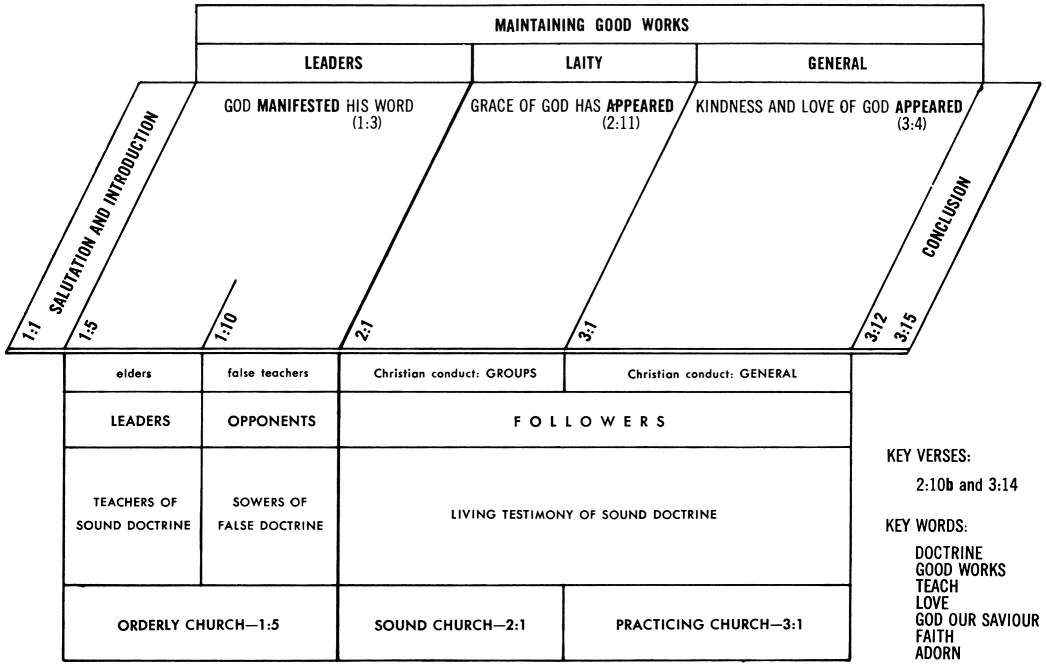
ADORNING THE DOCTRINE OF GOD
Click chart to enlarge
Charts from Jensen's Survey of the NT - used by permission
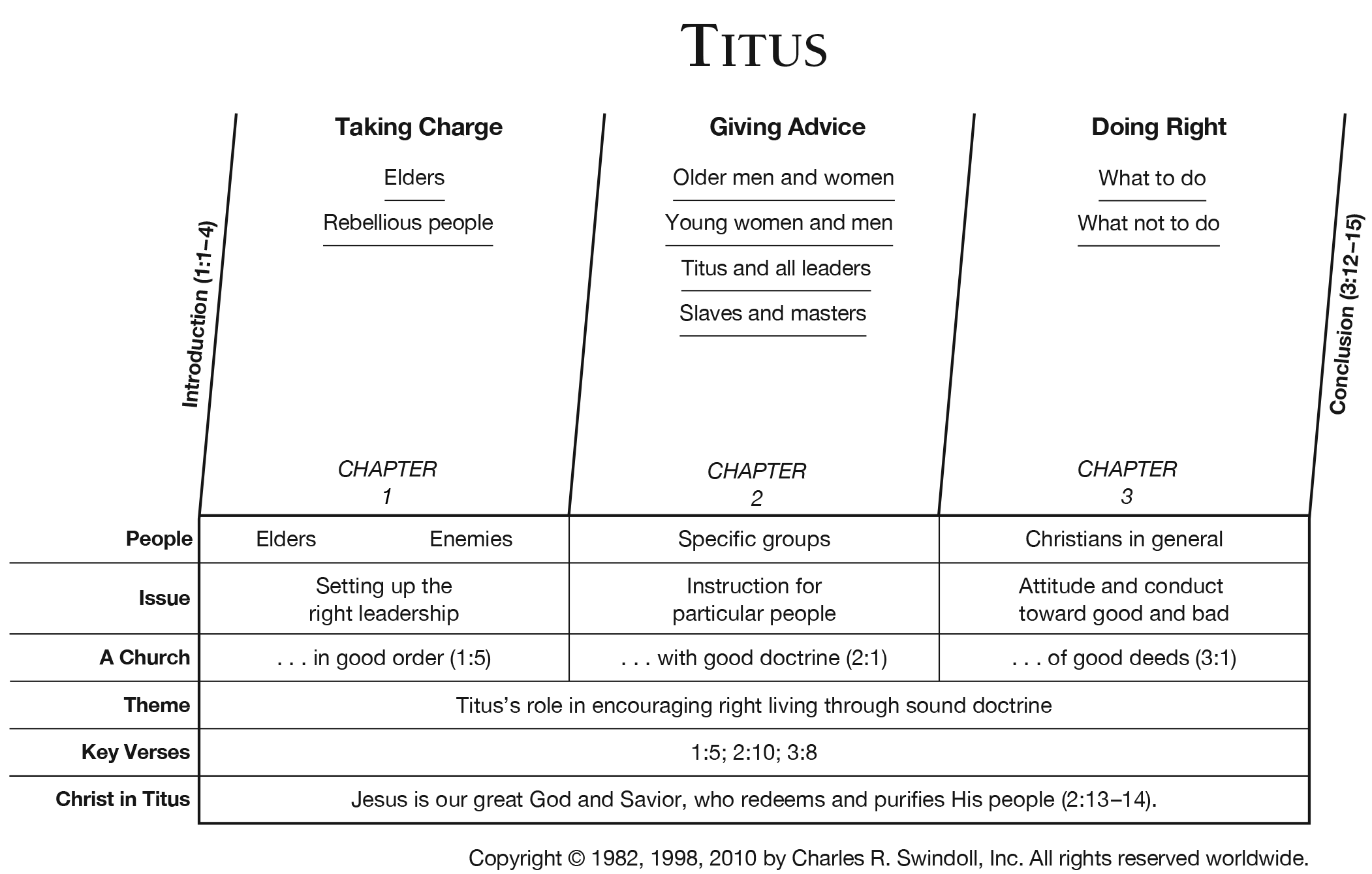
See Summary Chart by Charles Swindoll
Chart below from Michael J. Penfold
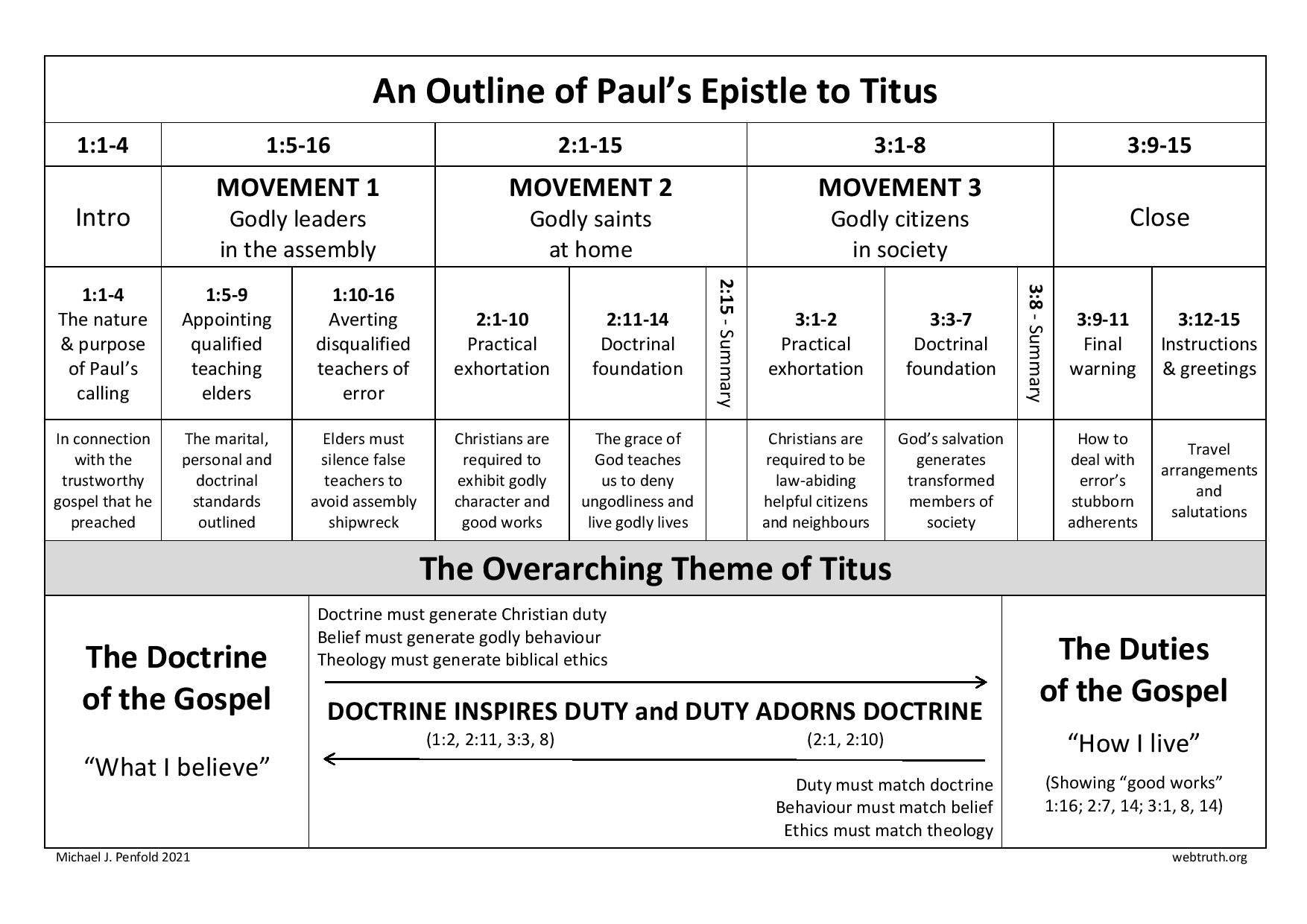
|
Focus |
Appoint Elders |
|||
|
Divisions |
Rebuke |
Maintain |
||
|
Topics |
||||
|
Topics |
Organization |
Offenders |
Operation |
|
|
Place |
Probably Written from either Corinth or Nicopolis (cf. Titus 3:12). |
|||
|
Time |
Circa 63 AD |
|||
|
Modified from Talk Thru the Bible |
||||
Titus 3:3 , disobedient, deceived, enslaved to various lusts and pleasures, spending our life in malice and envy, hateful, hating one another (NASB: Lockman)
Greek: Emen (1PIAI) gar pote kai hemeivs anoetoi, apeitheis, planomenoi, (PPPMPN) douleuontes (PAPMPN) epithumiais kai hedonais poikilais, en kakia kai phthono diagontes, (PAPMPN) stugetoi, misountes (PAPMPN) allelous
Amplified: For we also were once thoughtless and senseless, obstinate and disobedient, deluded and misled; [we too were once] slaves to all sorts of cravings and pleasures, wasting our days in malice and jealousy and envy, hateful (hated, detestable) and hating one another. (Amplified Bible - Lockman)
KJV: For we ourselves also were sometimes foolish, disobedient, deceived, serving divers lusts and pleasures, living in malice and envy, hateful, and hating one another.
NLT: Once we, too, were foolish and disobedient. We were misled by others and became slaves to many wicked desires and evil pleasures. Our lives were full of evil and envy. We hated others, and they hated us. (NLT - Tyndale House)
Phillips: For we ourselves have known what it is to be ignorant, disobedient and deceived, the slaves of various desires and pleasant feelings, while our lives were spent in malice and jealousy - we were hateful and we hated each other. (Phillips: Touchstone)
Wuest :For we were at one time also foolish, nonpersuasible, deceived, rendering a slave’s obedience to variegated passionate cravings and pleasures, in malice and envy passing the time, detestable, hating one another. (Eerdmans Publishing)
Young's Literal: for we were once -- also we -- thoughtless, disobedient, led astray, serving desires and pleasures manifold, in malice and envy living, odious -- hating one another;
FOR WE ALSO ONCE WERE FOOLISH OURSELVES: Emeni (1PIAI) gar pote kai kai hemeis anoetoi:
- Ro 3:9+, Ro 3:10+, Ro 3:11+, Ro 3:12+, Ro 3:13+, Ro 3:14+, Ro 3:15+, Ro 3:16+, Ro 3:17+, Ro 3:18+, Ro 3:19+; Ro 3:20+; Col 1:21+; Col 3:7+; 1Pet 4:1, 2, 3+
- Pr 1:22,23; 8:5; 9:6
- Titus 3 Resources - Multiple Sermons and Commentaries
OUR LOST
CONDITION
For - Term of explanation. What is Paul explaining? Always check the preceding context which will usually give you the answer. In this case “for” looks backward and gives the reason for humility, gentleness, and patience toward others and it is because we ourselves were once just as sinful and lost. Paul reminds believers who they once were IN ADAM, so any moral superiority is excluded. In other words Paul grounds Christian ethics in remembered grace, so that we treat others with mercy because we once needed the same mercy (cf. Titus 3:4–7).
We also once were foolish ourselves - Notice how Paul is careful to include himself in this "BC" or "Before Christ" description, the condition we were all in because we all have been born IN ADAM (cf Ro 5:12+, Ps 51:5).
🙏 THOUGHT - The truth of Paul's words (We also once were) should have real practical import! Remembering who we once were should serve to motivate how we live now. Awareness of our former life in Adam and what grace has rescued us from (Col 1:13+) should fuel our pursuit of progressive sancitification as those who are now in Christ. We do so by learning daily to lean on the Holy Spirit to give us the DESIRE to live like Christ and the POWER to live like Christ (see Php 2:13NLT+), so that we are supernaturally enabled to walk in a manner worthy of the Lord, to please our Father in all respects. (Col 1:10+). At the same time, remembering the past does not mean living in it. Paul himself strikes the balance in Philippians 3:13–14+ acknowledging what lies behind, but refusing to be defined by it, choosing instead to forget what is past and "press on toward the goal for the prize of the upward call of God in Christ Jesus." The past instructs us but it must not imprison us. In summary, we look back briefly to remember what grace has rescued us from, and then we look forward resolutely, pursuing Christ with Spirit energized, Word centered holy focus. Gratitude for having been delivered from who we once were becomes fuel, not baggage, as we press on to live out who we now are in Christ, continually "looking for the blessed hope and the appearing of the glory of our great God and Savior, Christ Jesus." (Titus 2:13+).
We were - Is in the imperfect tense, indicating over and over, again and again we were foolish. Believers need to continually remember wherefrom they have come by virtue of the supernatural grace of God. As Spurgeon once put it…
No man here has any idea of how bad he really is. You do not know how good the grace of God can make you, nor how bad you are by nature, nor how bad you might become if that nature were left to itself.
The first words of this verse are "we were" placed emphatically at the beginning of this description of unregenerate man to emphasize that this was the state of every believer (including Paul himself) before Christ came into their life. The foot of the Cross is level footing for everyone. As Spurgeon puts it…
Well, then, if other people are foolish, we ought to bear with them.
For (whenever you see a "for" always ask "What's it there for?") is the Greek conjunction gar (which usually introduces an explanation or the reason for a statement which precedes) and in this case explains the reason for the right conduct Paul has just prescribed in the preceding section.
Expositor's Bible Commentary summarizes this section noting that Paul
now "advances three supporting motives: their own pre-Christian past (v3), the saving work of God in believers (v4-8a), and the necessary connection between Christian truth and conduct (v8b). (Gaebelein, F, Editor: Expositor's Bible Commentary 6-Volume New Testament. Zondervan Publishing)
Note that the NIV omits the conjunction "for" and is another reason a more literal version like NAS or NKJV is preferable for serious Bible study.
W E Vine comments that "the remembrance of the fact that we once manifested some of these characteristics of our unregenerate nature, should in itself be an incentive to us to fulfill the exhortations just given. We ourselves stood in need of kindness, gentleness, meekness, on the part of others, and were so treated by God in His long-suffering. How then can we refuse kindness to those who stand in need of it?" Vine goes on to write that "Foolishness is evidence of a blunted mind; disobedience is evidence of a hardened heart; deception is evidence of a perverted will; bondage to lusts and pleasures is evidence of a carnal mind; malice and envy and hate are proofs of selfishness, pride and grasping ambition. And all are the effects of sin." (Vine, W. Collected writings of W. E. Vine. Nashville: Thomas Nelson ) (Bolding added)
Thomas Constable writes that "to motivate his readers to obey these commands (Ed note: those instructions in the preceding verses) Paul encouraged them by reminding them of the way they used to be. They had already come a long way. Each characteristic he mentioned in this verse contrasts with one he had urged his readers to adopt earlier in this epistle. They—Paul included himself—had been foolish, not sensible; disobedient, not submissive; deceived, not enlightened; and enslaved, not free and self-disciplined. Moreover they had been malicious, not peaceable; envious, not considerate; and hateful, not loving."
EBC writes that…"The remembrance of our own past should be a powerful motive for gentleness and consideration toward the unsaved… It is salutary to remember our own past moral condition when dealing with the unsaved in their degradation. The picture of our past is vividly and concisely drawn." (Gaebelein, F, Editor: Expositor's Bible Commentary 6-Volume New Testament. Zondervan Publishing)
Keathley adds that "In these verses we see the truth that, as George Whitefield so accurately put it when he saw a criminal going to the gallows, “there but for the grace of God go I.”… The tendency is to become pharisaic and look down on those whose lifestyle is not like ours. There should be a moral difference, but the issue is not the moral difference, rather the cross is what made the difference. To stress this, Paul uses terms to stress the change. The “for we too were once” of verse 3 must be seen in the light of “but when the kindness of God appeared.” But for the grace work of God, we would still be in the same predicament as the unbelieving world, a predicament graphically described by the apostle."
Paul has a similar commentary on humanity's state outside of Christ writing that…
We also once "were (spiritually) dead (and destined for eternal death or separated "away from the presence of the Lord and from the glory of His power" 2 Th 1:9) in (our) trespasses and sins, in which (we) formerly walked (lived, conducted our life) according to the course of this world (under the sway of the tendency of this present evil age), according to the prince of the power of the air (Satan, the old Serpent, the master deceiver!), of the spirit that is now working (continually energizing) in the sons of disobedience (unwilling to be persuaded, obstinate, rebellious, unbelieving, striving continually against the purposes of God) Among them we too all formerly lived in the (the environment, the "atmosphere", the "air" we breathed, so to speak) lusts of our flesh (our behavior governed by our corrupt and sensual nature), indulging (give free rein to, yielding to or gratifying the whims or) the desires of the flesh and of the mind, and were by nature children (born with a sinful nature inherited from Adam Ro 5:12+) of wrath (objects of God's holy hatred of sin representing His attribute of necessary antagonism to everything evil), even as the rest." (Eph 2:1-3+)
Writing to the Corinthians, Paul reminded the saints (and all of us) of their former despicable, degraded, debased, despairing condition --
"Or do you not know that the unrighteous shall not inherit the kingdom of God (This equates with salvation, for only the born again will enter this Kingdom. Notice here this Kingdom offers not just an entry but an "inheritance!" Ponder that thought! - see comments on Lk 17:20+)? (Paul is addressing believers who have to power to not continually be deceived - Gal 5:16+) Do not be deceived (present imperative with negative = Stop being deceived! Passive Voice - the urge comes not from our regenerate heart but our old nature and/or the devil and the godless world); neither fornicators, nor idolaters, nor adulterers, nor effeminate, nor homosexuals, nor thieves, nor the covetous, nor drunkards, nor revilers, nor swindlers, shall inherit the kingdom of God. And such were some of you; but you were washed (purified by a complete atonement for sin and made free from the guilt of sin), but you were sanctified (set apart from the world unto God), but you were justified (declared righteous on the basis of your faith in the gospel) in the name of the Lord Jesus Christ, and in the Spirit of our God." (1Cor 6:9-11+)
THOUGHT- Now ponder this list for a moment -- what is your reaction? Are we not benefactors of infinite mercy? Are we not recipients of so great a salvation? Are we not under obligation out of love and gratitude to serve our Master and not ourselves? Let your heart be renewed by thoughts of the fire from which you were snatched and purpose today to seek first His kingdom and His righteousness all the remaining days of your life on earth. Live for eternity and for His glory!
Remember that we also once were "alienated (estranged from, strangers to and withdrawn from God) and hostile (active enemies of God, antagonistic toward Him) in mind (actively) engaged in evil deeds (alienation of mind showing itself in wicked works)" (see + Colossians 1:21)
Peter adds that "the time already past is sufficient for you to have carried out the desire of the Gentiles, having pursued a course of sensuality, lusts, drunkenness, carousals, drinking parties and abominable idolatries." (see + 1 Peter 4 :3)
We also once were just like them and would still be like them if it were not for "the word of the cross… (which) is the power of God" (1Cor 1:18+) which "delivered us from the domain of darkness and transferred us to the kingdom of His beloved Son, in Whom we have redemption, the forgiveness of sins" and daily provides the power to "walk in newness of life" (Ro 6:4+) "no longer… slaves to (the power, rule and reign of) sin" (Ro 6:6+). Hallelujah!
Spurgeon writes that "A threefold set of evils is here described. The first set consists of the evils of the mind: “We were sometimes foolish, disobedient, deceived.” We were foolish. We thought we knew, and therefore we did not learn. Every lover of vice is a fool writ large. In addition to being foolish, we are said to have been disobedient; and so we were, for we forsook the commands of God. We wanted our own will and way. We were unwilling to yield God His due place either in providence, law, or gospel. Paul adds that we were deceived, or led astray. We were the dupes of custom and of company. We were here, there, and everywhere in our actions: no more to be relied upon than lost sheep.
Foolish (453) (anoetos from a = alpha-negative = makes following word exact opposite + noéo = comprehend from nous = mind, intellect, understanding, thought) means literally “not having a mind” or not thought of (not within the province of thought) and thus describes a person without understanding, dull-witted. Anoetos describes one with a unwillingness to use one's mental faculties to understand. It is not a lack of intelligence as much as it is a mental laziness and carelessness. Anoetos frequently conveyed the idea of a wrong attitude of heart, a lack of faith that clouds one's judgment. For example, Paul used anoetos to describe greedy people who think that a lot of money will enhance their lives and bring happiness and fulfillment -- that is foolish thinking!
Wuest adds that the word anoetos "denotes the stupidity that arises from deadness and impotence of intellect. It means “lacking in the power of perception, unwise.” It refers to one who does not reflect. The word speaks of failure to use one’s powers of perception. The Galatians (Wuest's comment on Gal 3:1+), Paul says, were certainly not using their heads. The word is used with an ethical reference as the faculty of moral judgment. Thus the word indicates a failure to use one’s powers of perception, that failure being due to a moral defect. It is always true, as it was with the Galatians, that the act of a Christian who embraces false doctrine, is due to sin in his life. (Galatians Commentary - Verse by Verse)
Jesus used anoetos to describe men as foolish who did not believe all the prophets had written about Him.
Trench - in the anoetos there is always a moral fault lying behind the intellectual; the nous, the highest knowing power in man, the organ by which divine things are apprehended and known, being the ultimate seat of the error (Luke 24:25, Gal. 3:1, 3; 1 Tim. 6:9; Titus 3:3).
Anoetos - 6x in 6v - foolish(5), foolish men(1).
Luke 24:25 And He said to them, "O foolish men and slow of heart to believe in all that the prophets have spoken!
Romans 1:14+ I am under obligation both to Greeks and to barbarians, both to the wise and to the foolish.
Comment - Paul is using "wise and foolish" to describe the difference between the cultured and uncultured.
Galatians 3:1+ You foolish Galatians, who has bewitched you, before whose eyes Jesus Christ was publicly portrayed as crucified?
Galatians 3: 3+ Are you so foolish? Having begun by the Spirit, are you now being perfected by the flesh?
1 Timothy 6:9 But those who want to get rich fall into temptation and a snare and many foolish and harmful desires which plunge men into ruin and destruction.
Comment - Anoetos (as with other uses) in this context has more to do with morality than intellect. To put it another way, a craving for material things is morally unwise.
Titus 3:3 For we also once were foolish ourselves, disobedient, deceived, enslaved to various lusts and pleasures, spending our life in malice and envy, hateful, hating one another.
Anoetos - 5x in the Septuagint - Deut. 32:31; Ps. 49:12, 20; Prov. 15:21; 17:28
Anoetos pictures the unsaved as without spiritual understanding, ignorant of God and continually manifesting an unwillingness to use their mental faculties to understand the truth about God. They clearly did not lack intelligence but did lack godly wisdom. They lacked discernment of spiritual realities, having become "darkened in their understanding, excluded from the life of God, because of the ignorance that is in them, because of the hardness of their heart. (see note Ephesians 4:18).
Elsewhere Paul describes says "a natural man does not accept the things of the Spirit of God; for they are foolishness to him, and he cannot understand them, because they are spiritually appraised." (1Cor 2:14+) What a play on words -- "foolishness" to him who is the real "fool".
By using the word foolish, Paul is saying that, no matter how advanced one might be in education and intellectual accomplishments, if he or she refuses to recognize God and trust in Him for deliverance from the penalty of sin which is death, they are foolish concerning the most important truth in all eternity. God's attitude towards the foolish is expressed in Proverbs, Solomon asking the question "How long, O naive ones, will you love simplicity? And scoffers delight themselves in scoffing, and fools hate knowledge? (note now the riches of God's kindness and forbearance and patience in beckoning to all men to) Turn to My reproof, behold, I will pour out My Spirit on you. I will make My Words known to you." (Pr 1:22,23)
Paul adds that "since in the wisdom of God the world through its wisdom did not come to know God, God was well-pleased through the foolishness of the message preached (Christ crucified… the power of God and the wisdom of God) to save those who believe."(1Cor 1:21-24)
Paul Johnson in his book Intellectuals documents the morass of unspeakable moral filth and ungodliness that has characterized most of the leading intellectual architects of modern Western culture. Their astounding mental capacities and their profound impact on modern society are indisputable and yet they are the very ones Paul is describing in this section for they “did not see fit to acknowledge God (or even to consider Him worth knowing!)" and therefore they were judicially given over by God "to a depraved mind (literally one that is worthless and rejected by God for it is base, perverted, corrupted, debauched, warped, twisted, degenerate) to do things not proper or decent but loathsome" (see + Romans 1:28).
To study the biographies of the great "movers and shakers" of history is to study the height and depth of despicable degradation and depravity of which men originally made in God's image are capable! A brilliant mind is imminently capable of even the most heinous evil. Witness the appalling, unspeakable atrocities of Nazi Germany, which were conceived and perpetrated by brilliant men in arguably the most intellectually, scientifically and culturally advanced nation of modern times.
Disobedient, deceived, enslaved - Spurgeon comments "That is what we were once; and if the grace of God has made a change in us, we must not boast, we must not censure others, we must not set up as self-righteous judges of others. Oh, no! our action must be the very reverse of all this.
DISOBEDIENT: apeitheis:
- Mt 21:29; Acts 9:1, 2, 3, 4, 5, 6; 26:19,20; Eph 2:2; 1Pet 1:14
- Titus 3 Resources - Multiple Sermons and Commentaries
WE DID NOT
OBEY GOD
Disobedient (545) (apeithes from a = without + peítho = persuade) (See studies on related words apeitheia; apeitheo) literally describes one who refuses to be persuaded (unpersuadable), thus picturing one who willfully disregards authority. Impersuasible, incompliant, contumacious.
In studying apeithes it is important to understand that the stem peith- (pith-, poith-) has the basic meaning of trust (cf. Latin = fido, fides; English = fidelity). Trust can refer to a statement, so that it has the meaning to put faith in, to let oneself be convinced, or to a demand, so that it gets the meaning of obey, be persuaded. The active meaning of the verb stem peith- then is to convince and persuade and is especially characteristic of Greek thought. In secular Greek it interesting to note that "Peitho" (art of persuading) was even regarded as a goddess! (see Brown, Colin, Editor. New International Dictionary of NT Theology. 1986. Zondervan)
Apeithes pictures a stubborn, stiff-necked attitude and speaks of disbelief manifesting itself in disobedience. Apeithes is opposed to pistis or belief (trust).
TDNT says apeithes "means “unworthy of belief,” then “disobedient.”
Marvin Vincent in discussing apeitheo in John 3:36 writes that "Disbelief is regarded in its active manifestation, disobedience. The verb peitho means to persuade, to cause belief, to induce one to do something by persuading, and so runs into the meaning of to obey, properly as the result of persuasion… Obedience, however, includes faith. (Ed Note: See discussion of phrase obedience of faith in notes on Romans 1:5)." (Vincent, M. R. Word studies in the New Testament Vol. 2, Page 1-109)
From these comments, it should not surprise you to discover that in the New Testament the Greek words translated disobey, disobedience, disobedient (apeitheo apeitheia; apeithes) do not stand in contrast with obedience but in contrast with faith!
In the present context apeithes describes the person who refuses obedience to God, resisting His Word and remains steadfastly rebellious against God's natural laws and those which human society requires.
Paul describes a progression is from an unwillingness to use one's mental faculties (foolish) in order to understand the truth about God and His glorious gospel, in turn and inevitably leading to an unwillingness to be persuaded by the truth. Men do not avoid the gospel of Christ because of insufficient facts but because of proud and unrepentant hearts. Such is the natural character of the human heart, Jeremiah recording that the
heart is more deceitful than all else and is desperately sick. (Jer 17:9)
Solomon wrote that "the hearts of the sons of men are full of evil, and insanity is in their hearts throughout their lives (Eccl 9:3).
Apeithes is found 6 times in the NT…
Luke 1:17 "And it is he who will go as a forerunner before Him in the spirit and power of Elijah, to turn the hearts of the fathers back to the children, and the disobedient to the attitude of the righteous; so as to make ready a people prepared for the Lord."
Acts 26:19 "Consequently, King Agrippa, I did not prove disobedient to the heavenly vision,
Romans 1:30 (note) slanderers, haters of God, insolent, arrogant, boastful, inventors of evil, disobedient to parents,
2 Timothy 3:2 (note) For men will be lovers of self, lovers of money, boastful, arrogant, revilers, disobedient to parents, ungrateful, unholy,
Titus 1:16 (note) They profess to know God, but by their deeds they deny Him, being (continually = their "lifestyle") detestable and disobedient, and worthless for any good deed.
Titus 3:3 (note) For we also once were foolish ourselves, disobedient, deceived, enslaved to various lusts and pleasures, spending our life in malice and envy, hateful, hating one another.
Apeithes is used 5 times in the non-apocryphal Septuagint (LXX) …
Numbers 20:10 and Moses and Aaron gathered the assembly before the rock. And he said to them, "Listen now, you rebels (Hebrew = marah [04784] = be contentious or rebellious; Lxx = apeithes) ; shall we bring forth water for you out of this rock?"
Deuteronomy 21:18 "If any man has a stubborn and rebellious son who will not obey his father or his mother, and when they chastise him, he will not even listen to them,
Isaiah 30:9 For this is a rebellious (Lxx = apeithes) people, false sons, Sons who refuse to listen To the instruction of the LORD;
Jeremiah 5:23 'But this people has a stubborn and rebellious heart; They have turned aside and departed.
Zechariah 7:12 "And they made their hearts like flint (Lxx = apeithes = disobedient! Flint is a good metaphor for such a hard heart!) so that they could not hear the law and the words which the LORD of hosts had sent by His Spirit through the former prophets; therefore great wrath came from the LORD of hosts.
Jesus taught that
from within, out of the heart of men, proceed the evil thoughts, fornications, thefts, murders, adulteries, deeds of coveting and wickedness, as well as deceit, sensuality, envy, slander, pride and foolishness. (see note Matthew 7:21; 7:22)
This is who we once were outside of Christ. Paul is saying that this truth should motivate believers to treat others the way God in His grace treated us when we were involved in ungodly activities
"for while we were still helpless, at the right time Christ died for the ungodly", God demonstrating "His own love toward us, in that while we were yet sinners, Christ died for us." (see notes Romans 5:6; Romans 5:8)
DECEIVED: planomenoi (PPPMPN):
- Is 44:20; Ob 1:3; Luke 21:8; Gal 6:3; James 1:26; Rev 12:9; 13:14
- Titus 3 Resources - Multiple Sermons and Commentaries
WE WERE CONTINUALLY
LED ASTRAY BY SIN
Deceived (4105) (planao from plane which describes "a wandering" and gives us our English word "planet") means literally made to wander and so to go (active sense) or be led (passive sense as of sheep in Mt 18:12-13) astray.
Note that in this passage planao is in the passive voice which indicates an outside force or influence (e.g., the unregenerate heart in unbelievers in this context, but in other contexts referring to the power of sin rendered ineffective but unfortunately still latent in believers) is causing the deception that leads one down the wrong path. The present tense indicates the sad truth that unsaved men and women are continually being led astray from God, even to the point that they refuse to believe that in the end they will be judged by Him (cf notes Re 20:11; 12; 13; 14; 15). notes Re 20:11; 12; 13; 14; 15).
Literal wandering is described in Hebrews 11:38+. Spiritual wandering is described in (1 Peter 2:25+) In spiritual terms, planao means to be made to err from the right way, the highway of truth and holiness. Straying in the spiritual sense occurs when one does not adhere to the truth (James 5:19+) and/or forsakes the right way (see 2 Peter 2:15+)
Scripture teaches us that various things or classes of people can deceive a person including the following…
- Signs, sorcery, pretenders coming in Jesus' name (Mt 24:4, 5+, Mark 13:5, 6+, Luke 21:8+),
- False teachers (1Co 15:33+, 1 Jn 2:26+, 1 Jn 3:7+),
- False Christs and false prophets (Mt 24:11+, Mt 24:24+, see note on Jezebel the false prophetess Re 2:20+),
- Not understanding the Scriptures or the power of God (Mt 22:29, Mark 12:24+),
- One's own self (evil flesh) ("self deception" 1Co 6:9+, Gal 6:7+, Titus 3:3+, 1 John 1:8+)
- One's heart (synonymous with evil flesh - Hebrews 3:10+)
- Evil men and imposters (2Ti 3:13+),
- The devil (Rev 12:9+, Rev 20:3+; Re 20:8+;Re 20:10+)
- Babylon (Revelation 18:23+)
- The Antichrist's false prophet (Rev 13:14+, Re 19:20+)
Jesus uses planao several times to describe one who is mistaken (Matthew 22:29, Mark 12:24, 12:27)
Matthew Henry writes that
Man in this his degenerate state is of a straying nature, thence compared to a lost sheep; this must be sought and brought back, and guided in the right way, Ps 119:176. (See Spurgeon's Note) He is weak, and ready to be imposed upon by the wiles and subtleties of Satan, and of men lying in wait to seduce and mislead.
Clarke writes that deceived is
erring - wandering from the right way in consequence of our ignorance, not knowing the right way; and, in consequence of our unbelief and obstinacy, not choosing to know it.
Basically deception refers to a deliberate misrepresentation of the truth, especially in moral and spiritual matters, in order to purposely mislead another person. In this sense, the truth can be misrepresented first of all by our own sinful heart (which is the control center of our character and our moral and spiritual life) (Jer 17:9, Hebrews 3:10 [note], Js 5:19, 1Jn 1:8), by false prophets (Jer 29:8, Mt 24:4-5, Revelation 13:14 [note]), by false teachers (Eph 5:6 [note], 2Pe 2:14 [note], 1Jn 2:26, 1Jn 3:7, 2Jn 1:7, Jezebel Re 2:20[note]) and of course especially by the ultimate "Deceiver", our old Adversary, the consummate Liar (Jn 8:44), Satan himself (see Re 12:9, 20:3, 8, 10 see notes Re 12:9, 3, 8, 10). Satan’s objective is to deceive sinners into ever greater sin and ungodliness.
Deceivers are very good as these illustrations from Today in the Word emphasizes…
Despite the mind-numbing brutality of the Joseph Stalin regime in the Soviet Union, his propaganda machine did its job well. Many Russians hailed him as a hero and a savior, including a young school girl who was chosen to greet Stalin on one occasion. Years later, this woman recalled Stalin taking her onto his lap, smiling like a loving father. She was starry-eyed, and she cherished the moment for many years. Only later did she learn that during this period, Stalin had her parents arrested and sent to the labor camps, never to be seen again.
><>><>><>
In late September 1864 Confederate General Nathan Bedford Forrest was leading his troops north from Decatur, Alabama, toward Nashville. But to make it to Nashville, Forrest would have to defeat the Union army at Athens, Alabama. When the Union commander, Colonel Wallace Campbell, refused to surrender, Forrest asked for a personal meeting, and took Campbell on an inspection of his troops. But each time they left a detachment, the Confederate soldiers simply packed up and moved to another position, artillery and all. Forrest and Campbell would then arrive at the new encampment and continue to tally up the impressive number of Confederate soldiers and weaponry. By the time they returned to the fort, Campbell was convinced he couldn't win and surrendered unconditionally!
><>><>><>
“Marathoner Loses by a Mustache.” So read the headline of a recent Associated Press story. It appeared that Abbes Tehami of Algeria was an easy winner of the Brussels Marathon—until someone wondered where his mustache had gone! Checking eyewitness accounts, it quickly became evident that the mustache belonged to Tehami’s coach, Bensalem Hamiani. Hamiani had run the first seven-and-a-half miles of the race for Tehami, then dropped out of the pack and disappeared into the woods to pass race number 62 on to his pupil. “They looked about the same,” race organizers said. “Only one had a mustache.” It’s expected that the two will never again be allowed to run in Belgium.
><>><>><>
Deception has been a part of warfare since the Trojan horse. During WWII, it became high art. Members of the 23rd Headquarters Special Troops used special “weapons” like dummy planes, tanks, antiaircraft guns, and amplified recordings that created war sounds to fool the German high command. To enable a combat unit to change positions or even attack when the Germans thought it had not moved at all, the 1800 men of the 23rd impersonated entire divisions. They would move in at night, change insignias, and inflate their rubber decoys. Meanwhile, the troops they were replacing sneaked away. Such deception was a major factor in the success of the Allies’ D-Day invasion, as the German 15th Army waited elsewhere for an assault that never came.
How dangerous is deception? Dennis Heatherington explains that it could be deadly…
A person on railroad tracks hear a train approaching, looks behind him, sees the train and then freezes on the tracks in fear. The train “outruns” its sound—which means that by the time you hear it, it is virtually on top on you. If a train engineer sees you on a track, he or she will blow the whistle. Often it takes more than one blast to get the average person’s attention, say train engineers. But trains can’t stop the way motor vehicles can. A freight train has about 100 cars, weights 12 million pounds, and takes a full mile to stop. An optical illusion happens with tracks. When you see a train coming, it looks as if it is traveling half as fast, and is two times farther away from you than it really is. For example, if it is going 60 miles per hour and is half a mile away, it looks as if it is traveling 30 mph and is one mile away. (Operation Lifesaver)
Abraham Lincoln said…
You can fool some of the people all of the time, and all of the people some of the time, but you cannot fool all of the people all of the time.
Walter Scott
Oh! what a tangled web we weave When first we practise to deceive!
William S. Plumer
No wickedness on earth is more common than the various forms of deceit.
Expositor's Bible Commentary writes that…
Those who deceive others impair, in so doing, their sense of the distinction between truth and falsehood, and thus weaken their power of resistance to self-deceit and to imposition by others. (Gaebelein, F, Editor: Expositor's Bible Commentary 6-Volume New Testament. Zondervan Publishing)
Peter writes that prior to salvation we
were continually straying (planao - being led astray) like sheep, but now (we) have returned to the Shepherd and Guardian of (our) souls." (see + 1 Peter 2:25)
This miraculous transition from walking in darkness to walking in the light, should motivate every believer to conduct themselves in a manner worthy of the gospel (submit to and obey the government, do good deeds, don't malign, don't quarrel, be gentle and show meekness to all men, including the foolish, deceived, disobedient, etc!)
Clarke adds that
It is a true saying, “There are none so blind as those who will not see.” Such persons are proof against conviction, they will not be convinced either by God or man.
Although deceived in context describes who we once were (unbelievers), do not be deceived for believers can still fall prey to the wiles of deception! So beware! James writes
Do not be deceived (planao - present imperative + a negative = literally stop being deceived - indicating that deception was already a fact), my beloved brethren. (James 1:16)
Paul warns the Galatians that when dealing with one caught in any trespass, they must be careful for
if anyone thinks he is something when he is nothing, he deceives (not planao but phrenapato) himself. (Gal 6:3).
James writes that
If anyone thinks himself to be religious, and yet does not bridle his tongue but deceives (not planao but apatao) his own heart, this man's religion is worthless. (Ja 1:26)
Clearly, the tragic truth is that the one who is deceived does not even know he or she is deceived! Given the "deceptive nature" of deception, it is not surprising that the writer of Hebrews exhorts us to
encourage one another day after day, as long as it is still called "Today," lest any one of you be hardened by the deceitfulness (not planao but apate) of sin. (see note Hebrews 3:13)
Sin will deceive you. You are not getting away with that "little sin"… in fact your heart is being gradually hardened by it (and you don't even realize it!) Kill sin or it will kill you.
Paul goes on to warn the Corinthians of the danger of deception writing
Or do you not know that the unrighteous shall not inherit the kingdom of God (the spiritual sphere of salvation where God rules as King over all who belong to Him by faith)? Do not be deceived (planao - stop being deceived) neither fornicators, nor idolaters, nor adulterers, nor effeminate, nor homosexuals, nor thieves, nor the covetous, nor drunkards, nor revilers, nor swindlers, shall inherit the kingdom of God. (1Cor 6:9-10)
This list convicts us all… who among us does not covet from time to time? Occasional sins is not what Paul is referring to. Don't be deceived. If an individual habitually and as manner of their lifestyle commits these sins, Paul says they are not saved.
Ryrie agrees writing that
People whose lifestyles exhibit wickedness, not fruit, show they are unsaved and will, therefore, not inherit the kingdom of God. (The Ryrie Study Bible: New American Standard Translation: 1995. Moody Publishers)
In a similar warning to the Galatians Paul writes
Do not be deceived (present imperative + a negative = literally stop being deceived) God is not mocked; for whatever a man sows, this he will also reap. For the one who sows to his own flesh shall from the flesh reap corruption, but the one who sows to the Spirit shall from the Spirit reap eternal life. (Gal 6:7-8)
Here are the 39 uses of planao in the NT…
Matthew 18:12 "What do you think? If any man has a hundred sheep, and one of them has gone astray (passive voice), does he not leave the ninety-nine on the mountains and go and search for the one that is straying? 18:13 "And if it turns out that he finds it, truly I say to you, he rejoices over it more than over the ninety-nine which have not gone astray.
Matthew 22:29 But Jesus answered and said to them, "You are mistaken (you err, you go astray) not understanding the Scriptures, or the power of God.
Matthew 24:4 And Jesus answered and said to them, "See to it that no one misleads you. 5 "For many will come in My name, saying, 'I am the Christ,' and will mislead many.
Matthew 24:11 "And many false prophets will arise, and will mislead many.
Matthew 24:24 "For false Christs and false prophets will arise and will show great signs and wonders, so as to mislead, if possible, even the elect.
Mark 12:24 Jesus said to them, "Is this not the reason you are mistaken, that you do not understand the Scriptures, or the power of God?
Mark 12:27 "He is not the God of the dead, but of the living; you are greatly mistaken."
Mark 13:5 And Jesus began to say to them, "See to it that no one misleads you. 6 "Many will come in My name, saying, 'I am He!' and will mislead many.
Luke 21:8 And He said, "See to it that you be not misled; for many will come in My name, saying, 'I am He,' and, 'The time is at hand'; do not go after them.
John 7:12 And there was much grumbling among the multitudes concerning Him; some were saying, "He is a good man"; others were saying, "No, on the contrary, He leads the multitude astray."
John 7:47 The Pharisees therefore answered them, "You have not also been led astray, have you?
1 Corinthians 6:9 Or do you not know that the unrighteous shall not inherit the kingdom of God? Do not be deceived; (present imperative + a negative = stop something that is in process) neither fornicators, nor idolaters, nor adulterers, nor effeminate, nor homosexuals,
1 Corinthians 15:33 Do not be deceived; (present imperative + a negative = stop something that is in process): "Bad company corrupts good morals."
Galatians 6:7 Do not be deceived; (present imperative + a negative = stop something that is in process), God is not mocked; for whatever a man sows, this he will also reap.
2 Timothy 3:13 (note) But evil men and impostors will proceed from bad to worse, deceiving and being deceived.
Titus 3:3 (note) For we also once were foolish ourselves, disobedient, deceived, enslaved to various lusts and pleasures, spending our life in malice and envy, hateful, hating one another.
Hebrews 3:10 (note) "THEREFORE I WAS ANGRY WITH THIS GENERATION, AND SAID, 'THEY ALWAYS GO ASTRAY IN THEIR HEART; AND THEY DID NOT KNOW MY WAYS';
Hebrews 5:2 (note) he can deal gently with the ignorant and misguided, since he himself also is beset with weakness;
Hebrews 11:38 (note) (men of whom the world was not worthy), wandering in deserts and mountains and caves and holes in the ground.
James 1:16 Do not be deceived; (present imperative + a negative = stop something that is in process), my beloved brethren.
James 5:19 My brethren, if any among you strays from the truth, and one turns him back
1 Peter 2:25 (note) For you were continually straying like sheep, but now you have returned to the Shepherd and Guardian of your souls.
2 Peter 2:15 (note) forsaking the right way they have gone astray, having followed the way of Balaam, the son of Beor, who loved the wages of unrighteousness,
1 John 1:8 If we say that we have no sin, we are deceiving ourselves, and the truth is not in us.
1 John 2:26 These things I have written to you concerning those who are trying to deceive you.
1 John 3:7 Little children, let no one deceive (present imperative + a negative = stop something that is in process) you; the one who practices righteousness is righteous, just as He is righteous;
Revelation 2:20 (note) 'But I have this against you, that you tolerate the woman Jezebel, who calls herself a prophetess, and she teaches and leads My bond-servants astray, so that they commit acts of immorality and eat things sacrificed to idols.
Revelation 12:9 (note) And the great dragon was thrown down, the serpent of old who is called the devil and Satan, who deceives the whole world; he was thrown down to the earth, and his angels were thrown down with him.
Revelation 13:14 (note) And he (false prophet) deceives those who dwell on the earth because of the signs which it was given him to perform in the presence of the beast, telling those who dwell on the earth to make an image to the beast who had the wound of the sword and has come to life.
Revelation 18:23 (note) and the light of a lamp will not shine in you any longer; and the voice of the bridegroom and bride will not be heard in you any longer; for your merchants were the great men of the earth, because all the nations were deceived by your (Babylon's) sorcery.
Revelation 19:20 (note) And the beast was seized, and with him the false prophet who performed the signs in his presence, by which he deceived those who had received the mark of the beast and those who worshiped his image; these two were thrown alive into the lake of fire which burns with brimstone.
Revelation 20:3 (note) and threw him into the abyss, and shut it and sealed it over him, so that he should not deceive the nations any longer, until the thousand years were completed; after these things he must be released for a short time.
Revelation 20:8 (note) and will come out to deceive the nations which are in the four corners of the earth, Gog and Magog, to gather them together for the war; the number of them is like the sand of the seashore.
Revelation 20:10 (note) And the devil who deceived them was thrown into the lake of fire and brimstone, where the beast and the false prophet are also; and they will be tormented day and night forever and ever.
There are 81 uses of planao in the non-apocryphal Septuagint (LXX)
Ge 21:14; 37:15; Ex 14:3; 23:4; Deut. 4:19; 11:28; 13:5; 22:1; 27:18; 30:17; Jdg. 16:10, 13, 15; 2Ki 4:28; 21:9; 2Chr. 33:9; Job 5:2; 6:24; 12:23, Job 12:24, 25; 19:4; 38:41; Ps. 58:3; 95:10; 107:4, 40; 119:110, 176; Pr 1:10; 9:12; 10:17; 12:26; 13:9; 14:22; 16:10; 21:16; 28:10; 29:15; Is 3:12; 9:16; 13:14; 16:8; 17:11; 19:13, 14; 21:4, 15; 22:5; 28:7; 29:24; 30:20, 21; 35:8; 41:10, 29; 44:20; 46:5, 8; 47:15; 53:6; 63:17; 64:5; Jer. 23:13, 32; 31:9; 50:17; Ezek. 13:10; 14:9, 11; 33:12; 34:4, 16; 44:10, 13, 15; 48:11; Dan. 6:22; Hos. 2:14; 4:12; 8:6; Amos 2:4; Mic. 3:5
Below are some uses of planao in the Lxx…
Psalm 119:110 The wicked have laid a snare for me, Yet I have not gone astray (planao) from Thy precepts.
Spurgeon comments: He was not snared, for he kept his eyes open, and kept near his God. He was not entrapped and robbed, for he followed the King's highway of holiness, where God secures safety to every traveller. He did not err from the right, and he was not deterred from following it, because he referred to the Lord for guidance, and obtained it. If we err from the precepts, we part with the promises; if we get away from God's presence, we wander into the wilds where the fowlers freely spread their nets. From this verse let us learn to be on our guard, for we, too, have enemies both crafty and wicked. Hunters set their traps in the animal's usual runs, and our worst snares are laid in our own ways. By keeping to the ways of the Lord we shall escape the snares of our adversaries, for His ways are safe and free from treachery.
Proverbs 10:17 He is on the path of life who heeds instruction, but he who forsakes reproof goes astray (Hebrew = taah = to err; Lxx = planao).
Proverbs 12:26 The righteous is a guide to his neighbor, but the way of the wicked leads them astray (Hebrew = taah = to err; Lxx = planao).
Proverbs 21:16 A man who wanders (Hebrew = taah = to err; Lxx = planao - present tense = habitually) from the way of understanding will rest in the assembly of the dead.
Proverbs 28:10 He who leads the upright astray (Hebrew = shagah = to go astray, to err; Lxx = planao) in an evil way Will himself fall into his own pit, but the blameless will inherit good.
Jeremiah 23:13 "Moreover, among the prophets of Samaria I saw an offensive thing: They prophesied by Baal and led My people Israel astray.
ENSLAVED: douleuontes (PAPMPN):
- Ro 6:17; Ro 6:22
- Titus 3 Resources - Multiple Sermons and Commentaries
Related Passages:
Romans 6:17+ But thanks be to God that though you were slaves of sin, you became obedient from the heart to that form of teaching to which you were committed,
Romans 6:22+ But now having been freed from sin and enslaved to God, you derive your benefit, resulting in sanctification, and the outcome, eternal life.
THE PAST IS PAST
SLAVES TO SIN & LUSTS
Enslaved is in the present tense signifying this was our former lifestyle (continually slaves of Sin) and in the active voice indicates that we made the willful choice to submit ourselves to the strong, corrupt desires that originate from our fallen nature (see discussion of Sin) inherited from Adam. Every person born in the flesh becomes a slave to the rule and reign of Sin, Paul teaching that "just as through one man (Adam) Sin entered into the world and death through Sin and so death spread to all men because all sinned" (Ro 5:12+).
In other words all men commit sins because all men have inherited the "Sin" gene (the propensity to sin) from Adam, our first father. Our very constitution "in Adam" is sinful and we have neither the desire nor the power to do anything but commit sins. We are sinners by nature (by birth). All men are therefore both willingly and inevitably enslaved to sin in its many and various forms. Therefore, although we as believers cannot help being dismayed when we see evil flourishing, we should not be surprised (cf Ps 73:3, 4, 5 [Spurgeon's note], Hab 1:3), for apart from being born again (in the spirit) by grace through faith in Christ, a person has no alternative but to habitually commit sins.
Jesus taught this same truth declaring "Truly, truly, I say to you, everyone who (continually, habitually) commits sin is the slave of sin." (Jn 8:34)
In describing false teachers, Peter writes that "by what a man is overcome, by this he is enslaved." (see note 2 Peter 2:19) The NLT paraphrases it "They (the false teachers) promise freedom, but they themselves are slaves to sin and corruption. For you are a slave to whatever controls you."
Paul adds that "Do you not know that when you (continually) present yourselves to someone as slaves for obedience (to do his will), you are slaves of the one whom you obey, either of (the power of Sin) resulting in death or of obedience resulting in righteousness (right doing and right standing with God)? (see + Romans 6:16)
Servitude in the ancient world, whether voluntary or involuntary, was rigid and gave the master an absolute right over his slave.
Clarke adds that the unsaved are "in a state of continual thraldom (enslavement); not served or gratified by our lusts and pleasures, but living, as their slaves, a life of misery and wretchedness.
Matthew Henry ties this trait with "deceived" observing that "Men deceived are easily entangled and ensnared; they would not serve divers lusts and pleasures as they do, were they not blinded and beguiled into them."
All (no exceptions) unregenerate men and women are enslaved to Sin by the "chains" of their passions and pleasures and are completely under Sin's control. In Romans Paul writes "that both Jews and Greeks are all under (the power of) Sin." (Ro 3:9+)
Writing to the Galatians Paul taught that "the Scripture has shut up all men under SIN" (Gal 3:22a+). The NLT paraphrases it this way "the Scriptures have declared that we are all prisoners of sin".
Jesus came to set men free from slavery to SIN, at the inauguration of His ministry quoting from Isaiah in the synagogue, declaring "The Spirit of the LORD is upon Me, because He has anointed Me to preach the gospel to the poor; He has sent Me to proclaim release to the captives and recovery of sight to the blind, to set free those who are downtrodden." (Lk 4:18+)
Where is the freedom from slavery to SIN revealed? In the Gospel for through the Gospel Jesus "delivered (rescued) us from the domain (right and the might) of darkness (SATAN'S DOMAIN - cf Acts 26:18+), and transferred us to the kingdom of His beloved Son." (see + Colossians 1:13)
Even in the Old Testament, Isaiah had prophesied that Jesus would come "to open blind eyes, to bring out prisoners from the dungeon, and those who dwell in darkness from the prison." (Isaiah 42:6)
In Romans 6 Paul elaborates on the great truth that when we are taken from our state of slavery to Sin (personified as a master) "in Adam" and placed "in Christ", the power of Sin in our life is irrevocably broken. Yes, we all continue to commit sins but for the first time we have the power within us to say "No" to the reign of Sin.
Paul writes that when "our old self (i.e., who we were were in Adam = spiritually dead) was crucified with (Christ), our body of Sin (became ineffective, inoperative, inactive, powerless and) that we should no longer be slaves to SIN (i.e., to the power which Sin exerted over us to control us and force us to commit sins) for he who has died is freed from (the control of) SIN." (see notes Romans 6:6; 6:7)
Sin formerly had dominion over us, but now believers can consider themselves truly "dead to sin, but alive to God in Christ Jesus." (Romans 6:11+)
Paul goes on to teach that because of our death ("co-crucifixion" with Christ) to Sin, now we are not to permit
"Sin (to) reign in your mortal body that you should obey its lusts, and do not go on presenting the members of your body to Sin as instruments of unrighteousness; but present yourselves to God as those alive from the dead, and your members as instruments of righteousness to God. For Sin shall not be master over you, for you are not under law, but under grace." (Ro 6:12-14+)
Here in Titus 3, Paul is reminding the Cretan believers that "we also once were" slaves of Sin.
Spurgeon comments "we were “serving divers lusts and pleasures.” The word for “serving” means being under servitude. We were once the slaves of divers lusts and pleasures. By lusts we understand desires, longings, ambitions, passions. Many are these masters, and they are all tyrants. Some are ruled by greed for money; others crave for fame; some are enslaved by lust for power; others by the lust of the eye; and many by the lusts of the flesh.
Enslaved (1398) (douleuo from doulos = slave or one who is in bondage or bound to another, in the state of being completely controlled by someone or something) means to be in bondage or in the position of servant and to act accordingly, dutifully obeying the master's commands. Douleuo means to be a slave, be subjected lit. Jn 8:33; Acts 7:7; Gal 4:25; fig. Ro 7:6. W. dative serve someone as a slave, serve Mt 6:24; Lk 15:29; 16:13; Ro 14:18; Gal 5:13; Eph 6:7; be a slave fig. Ro 6:6; 7:25. The first two uses by Jesus are notable - "No one can serve two masters; for either he will hate the one and love the other, or he will be devoted to one and despise the other. You cannot serve God and wealth" (Mt 6:24+)
Friberg adds 1) of relationship be a slave, be subjected (Jn 8.33); (2) of action or behavior perform the duties of a slave, serve, obey (Mt 6.24); (3) figuratively, of spiritual service to God serve, obey (Acts 20.19); of spiritual or moral enslavement to sin, appetites, etc. be a slave to, be controlled by (Ro 6.6) (Borrow Analytical Lexicon of the Greek New Testament )
Gilbrant - The ordinary meaning of douleuō in the ancient world is “be a slave” (to someone) or “perform the duties of a slave.” Moulton-Milligan records no use of douleuō in a religious sense. It does, however, point out the reading of “temple slaves” (heirodouloi) in some of the cults. The Septuagint attests to extensive use of douleuō, usually as an equivalent of the Hebrew ‛āvadh (“serve”) or one of its derivatives. Douleuō speaks of Jacob’s service to Laban for Rachel (Genesis 29:18,20,25,30). In a religious connection 2 Chronicles describes Israel’s idolatrous worship of Asherah poles: edouleuon tais Astartais (24:18; cf. Judges 10:6,10,13). Allegiance to Yahweh is also described in terms of servitude (Judges 10:16; Nehemiah 9:35; Ezekiel 20:40). Douleuō occurs in the Synoptic Gospels in the material common to Matthew and Luke (Matthew 6:24; Luke 16:13) and in the Lucan Parable of the Prodigal Son (Luke 15:29). The tradition shared by Matthew and Luke fluctuates between a literal statement of the inability of man to serve two masters and the religious implication that it is equally impossible for man to serve both God and the material mind-set of the world. John’s Gospel uses douleuō only once, but the idea permeates his story. The opposing Jewish leaders claimed to have served no one (John 8:33). Jesus declared they were actually slaves (douloi [see 1395]) to sin (8:34) and not free at all. Only the truth makes one free (John 8:32). Paul is famous for his portrayal of the enslaving effect of the Law. He contrasted this with the freedom that the slave of Christ experiences (Romans 7:6,25; cf. 2 Corinthians 3:17; Galatians 5:1). Such freedom calls for service to one another (douleuete allēlois, Galatians 5:13) as well as service to God (Romans 12:11; Colossians 3:23,24; 1 Thessalonians 1:9). (Complete Biblical Library)
Zodhiates on douleuo - To be in the position of a servant and act accordingly; to be subject and serve in subjection or bondage. Used of actions which are directed by others in contrast to douloo which means to make someone a slave or to be held in bondage without necessarily the idea of serving. Subjugated, reduced to bondage under someone (John 8:33; Acts 7:7; Rom. 9:12). Used in the absolute sense, it means to be deprived of freedom (Gal. 4:25); to be under the law (see Gal. 4:21); serve in bondage, put one's dependence into effect, i.e., to obey (Matt. 6:24; Luke 15:29; 16:13; Eph. 6:7; 1 Tim. 6:2); metaphorically, to be a slave to things such as pleasures (Titus 3:3).
(I) Spoken of involuntary service (Matt. 6:24; Luke 16:13; Eph. 6:7; 1 Tim. 6:2; Sept.: Lev. 25:39; Deut. 15:12); of a people meaning to be subject to (John 8:33; Acts 7:7; Rom. 9:12, see Gen. 25:23; 27:40; Sept.: Gen. 14:4; Judg. 3:8, 14). Metaphorically, of those subject to the Mosaic Law (Gal. 4:25).
(II) Metaphorically spoken of voluntary service, to obey, be devoted to (Luke 15:29; Rom. 12:11, doing what the occasion demands; Gal. 5:13; Phil. 2:22; Sept.: Gen. 29:15, 18, 20, 25, 30). In a moral sense, to obey or be devoted to God or Christ, (Matt. 6:24; Luke 16:13; Acts 20:19; Rom. 7:6; 1 Thess. 1:9); to Christ (Rom. 14:18; 16:18; Col. 3:24); to the law of God (Rom. 7:25; Sept.: Deut. 13:4; Judg. 2:7; Mal. 3:18). Spoken of false gods (Gal. 4:8; Sept.: Ex. 23:33); of things, to obey, follow, indulge in, e.g., mammon (Matt. 6:24; Luke 16:13); sin (Rom. 6:6); the belly, i.e., one's appetite (Rom. 16:18); the elements (Gal. 4:9). To indulge in one's lusts (Titus 3:3). (Borrow The Complete Word Study Dictionary: New Testament)
W E Vine on douleuo - "to serve as a doulos", is used (a) of serving God (and the impossibility of serving mammon also), Matt. 6:24 and Luke 16:13; Rom. 7:6; in the gospel, Phil. 2:22; (b) Christ, Acts 20:19; Rom. 12:11; Rom. 14:18; Rom. 16:18; Eph. 6:7; Col. 3:24; (c) the law of God, Rom. 7:25; (d) one another, Gal. 5:13, RV, "be servants to" (AV, "serve"); (e) a father, Luke 15:29 (with a suggestion of acting as a slave); (f) earthly masters, Matt. 6:24; Luke 16:13; 1 Tim. 6:2, RV, "serve;" (g) the younger by the elder, Rom. 9:12; (h) of being in bondage to a nation, Acts 7:7; Gal. 4:25, to the Romans, actually, though also spiritually to Judaizers; (i) to idols, Gal. 4:8, RV, "were in bondage" (AV, "did service"); (j) to "the weak and beggarly rudiments," Gal. 4:9 (RV), "to be in bondage" (aorist tense in the best texts, suggesting "to enter into bondage"), i.e., to the religion of the Gentiles ("rudiments" being used in ver. 3 of the religion of the Jews); (k) sin, Rom. 6:6, RV, "be in bondage" (AV, "serve"); (1) "divers lusts and pleasures," Titus 3:3; (m) negatively, to any man -- a proud and thoughtless denial by the Jews, John 8:33. (Vine's Expository Dictionary of Old Testament and New Testament Words)
Douleuo - 25x/23v - bondage(1), enslaved(3), render service(1), serve(10), served(1), serves(1), serving(4), slavery(1), slaves(3). Matt. 6:24; Lk. 15:29; Lk. 16:13; Jn. 8:33; Acts 7:7; Acts 20:19; Rom. 6:6; Rom. 7:6; Rom. 7:25; Rom. 9:12; Rom. 12:11; Rom. 14:18; Rom. 16:18; Gal. 4:8; Gal. 4:9; Gal. 4:25; Gal. 5:13; Eph. 6:7; Phil. 2:22; Col. 3:24; 1 Thess. 1:9; 1 Tim. 6:2; Tit. 3:3
Septuagint - Gen. 14:4; Gen. 15:14; Gen. 25:23; Gen. 27:29; Gen. 27:40; Gen. 29:15; Gen. 29:18; Gen. 29:20; Gen. 29:25; Gen. 29:30; Gen. 30:26; Gen. 30:29; Gen. 31:6; Gen. 31:41; Exod. 14:5; Exod. 14:12; Exod. 21:2; Exod. 21:6; Exod. 23:33; Lev. 25:39; Deut. 15:12; Deut. 15:18; Deut. 28:64; Jdg. 2:7; Jdg. 3:8; Jdg. 3:14; Jdg. 9:28; Jdg. 9:38; Jdg. 10:6; Jdg. 10:10; Jdg. 10:13; Jdg. 10:16; 1 Sam. 2:24; 1 Sam. 4:9; 1 Sam. 7:3; 1 Sam. 7:4; 1 Sam. 8:8; 1 Sam. 11:1; 1 Sam. 12:10; 1 Sam. 12:14; 1 Sam. 12:20; 1 Sam. 12:23; 1 Sam. 12:24; 1 Sam. 17:9; 1 Sam. 26:19; 2 Sam. 10:19; 2 Sam. 16:19; 2 Sam. 22:44; 1 Ki. 4:20; 1 Ki. 9:6; 1 Ki. 9:9; 1 Ki. 12:4; 1 Ki. 12:7; 1 Ki. 12:24; 1 Ki. 16:31; 1 Ki. 22:53; 2 Ki. 10:18; 2 Ki. 17:41; 2 Ki. 18:7; 2 Ki. 21:3; 2 Ki. 25:24; 1 Chr. 19:19; 1 Chr. 28:9; 2 Chr. 7:22; 2 Chr. 10:4; 2 Chr. 24:18; 2 Chr. 30:8; 2 Chr. 33:3; 2 Chr. 33:16; 2 Chr. 33:22; 2 Chr. 34:33; 2 Chr. 36:5; Neh. 9:35; Job 21:15; Job 36:11; Job 39:9; Ps. 2:11; Ps. 18:43; Ps. 22:30; Ps. 72:11; Ps. 81:6; Ps. 100:2; Ps. 102:22; Ps. 106:36; Prov. 11:29; Prov. 12:9; Isa. 14:3; Isa. 19:23; Isa. 53:11; Isa. 56:6; Isa. 60:12; Isa. 65:8; Isa. 65:13; Isa. 65:14; Isa. 65:15; Jer. 2:20; Jer. 5:19; Jer. 8:2; Jer. 11:10; Jer. 13:10; Jer. 16:11; Jer. 16:13; Jer. 22:9; Jer. 25:6; Jer. 25:11; Jer. 27:6; Jer. 34:9; Jer. 35:15; Ezek. 20:40; Ezek. 29:18; Ezek. 29:20; Dan. 4:21; Dan. 4:34; Dan. 6:27; Hos. 12:12; Zeph. 3:9; Zech. 2:9; Mal. 3:14; Mal. 3:17; Mal. 3:18;
TO VARIOUS LUSTS AND PLEASURES: epithumiais kai hedonais poikilais:
- Titus 3 Resources - Multiple Sermons and Commentaries
slaves to all sorts of cravings and pleasures (Amp)
Various (4164) (poikilos) indicates a diversity of many kinds of "lusts and pleasures". We all know too well the various shades and hues of these strong desires. Synonyms include manifold, variegated, multi-hued, many-colored, multi-colored, polychromatic, kaleidoscopic.
Lusts (1939) (epithumia from epi = at, toward {the preposition "epi-" in the compound is directive conveying the picture of "having one’s passion toward"} + thumos = passion. The root verb epithumeo = set heart upon) is a neutral term denoting the presence of strong desires or impulses, longings or passionate craving (whether it is good or evil is determined by the context) directed toward an object. (Click article in ISBE)
Epithumia is used 38 times in the NAS - coveting, 2; desire, 4; desires, 8; earnestly, 1; impulses, 1; long, 1; lust, 5; lustful, 1; lusts, 15
Mk. 4:19; Lk. 22:15; Jn. 8:44; Rom. 1:24; 6:12; 7:7, 8; 13:14; Gal. 5:16, 24; Eph. 2:3; 4:22; Phil. 1:23; Col. 3:5; 1 Thess. 2:17; 4:5; 1 Tim. 6:9; 2 Tim. 2:22; 3:6; 4:3; Titus 2:12; 3:3; James. 1:14, 15; 1 Pet. 1:14; 2:11; 4:2, 3; 2 Pet. 1:4; 2:10, 18; 3:3; 1 Jn. 2:16, 17; Jude 1:16, 18; Rev. 18:14
Other versions translate epithumia as strong impulses or desires, yearnings, longings after.
In the NT epithumia is occasionally used in a good sense. For example Jesus uses the verb form epithumeo, speaking to His disciples that
I have earnestly desired to eat this Passover with you before I suffer. (Lk 22:15)
Paul writes
I am hard-pressed from both directions (to live or die), having the desire (epithumia) to depart and be with Christ, for that is very much better. (see + Philippians 1:23)
Paul writes to the Thessalonians that
"we (Paul, Silas, Timothy), brethren, having been bereft of you for a short while-- in person, not in spirit-- were all the more eager with great desire (epithumia) to see your face." (see note 1Thessalonians 2:17)
Epithumia is used in a good sense referring to the natural, legitimate and necessary God given desires (eg, hunger, thirst, sex, etc) which are fulfilled in a God honoring way.
Most often epithumia in the NT describes strong desires which are perverted and unrestrained and which originate from our SIN (flesh) nature, which is corrupt and fallen.
Hiebert has an interesting note that the
"degeneration in the meaning of the term (epithumia from God given desires to perverted desires) is a revealing commentary on human nature. Left to himself, instead of gaining mastery over his base desires and steadfastly adhering to the good, the individual is characteristically overcome by his evil cravings, so that they become the dominating force of his life." (Hiebert, D. Edmond: 1 Peter. Page 94. Moody)
W. E. Vine summarizes epithumia as follows:
epithumia denotes "strong desire" of any kind, the various kinds being frequently specified by some adjective (see below). The word is used of a good desire only in Lk 22:15; Phil 1:23 [note]; 1Thes 2:17 [note]. Everywhere else it has a bad sense. In Ro 6:12 [note] the injunction against letting sin reign in our mortal body to obey the "lust" thereof, refers to those evil desires which are ready to express themselves in bodily activity. They are equally the "lusts" of the flesh, Ro 13:14 [note]; Gal 5:16 [+], Gal 5:24 [+]; Eph 2:3 [note]; 2Pe 2:18 [note]; 1Jn 2:16, a phrase which describes the emotions of the soul, the natural tendency towards things evil. Such "lusts" are not necessarily base and immoral, they may be refined in character, but are evil if inconsistent with the will of God.
Other descriptions besides those already mentioned are:
- "of the mind," Ephesians 2:3 [note];
- "evil (desire)," Colossians 3:5 [note];
- "the passion of," 1Thessalonians 4:5 [note], RV;
- "foolish and hurtful," 1Ti 6:9;
- "youthful," 2Ti 2:22 [note];
- "divers," 2Ti 3:6 [note]; Titus 3:3 [note];
- "their own," 2Ti 4:3 [note]; 2Pe 3:3 [note]; Jude 1:16;
- "worldly," Titus 2:12 [+];
- "his own," Jas 1:14 [+];
- "your former," 1P 1:14 [note], RV;
- "fleshly," 1Pe 2:11 [note];
- "of men," 1Pe 4:2 [note];
- "of defilement," 2Pe 2:10 [note];
- "of the eyes," 1Jn 2:16; [+]
- of the world ("thereof"), 1Jn 2:17 [+];
- "their own ungodly," Jude 1:18. [+]
- In Re 18:14 [note] "(the fruits) which thy soul lusted after" is, lit., "of thy soul's lust."
(Vine, W E: Vine's Complete Expository Dictionary of Old and New Testament Words. 1996. Nelson)
Epithumia (and the verb epithumeo) are used to describe a variety of subjects in the NT…
- of the mind, Ephesians 2:3 [note]
- evil (desire), Colossians 3:5 [note]
- the passion of, 1Thessalonians 4:5 [note]
- foolish and hurtful, 1Ti 6:9
- youthful 2 Timothy 2:22 [note]
- various 2 Timothy 3:6 [note]; Titus 3:3 [note]
- their own, 2 Timothy 4:3 [note]; 2 Peter 3:3 [note]; Jude 1:16
- worldly, Titus 2:12 [note]
- his own, James 1:14 - +
- your former, 1 Peter 1:14 [note]
- fleshly, 1 Peter 2:11 [note]
- of men, 1 Peter 4:2 [note]
- of defilement, 2 Peter 2:10 [note]
- of the eyes, 1Jn 2:16
- of the world (thereof), 1Jn 2:17
- their own ungodly, Jude 1:18
Sin within fallen man is often personified in Paul's writings and is portrayed as an organized power [think of SIN as an evil "king" for example] which ever seeks to rule our will and act out through the members of the body. Thus we see Paul explain that
SIN (the source of the desires)… produced in (him) coveting (epithumia) of every kind. (see + Romans 7:8)
Lusts occur in our mind and are not physical actions per se although they may (and frequently do) lead to physical actions. Thus James warns us of the evil character of "lusts" writing that
each one is tempted when he is carried away and enticed by his own lust. Then when lust has conceived, it gives birth to sin and when sin is accomplished, it brings forth death. (James 1:14-15+)
Lusts denote the varied cravings of fallen human nature pursued in the interest of self in self-sufficient independence of God. Oswald Chambers wrote that "Love can wait and worship endlessly; lust says, "I must have it at once.""
In his sermon entitled Battling the Unbelief of Lust John Piper defines lust as
a sexual desire that dishonors its object and disregards God. It's the corruption of a good thing by the absence of honorable commitment and by the absence of a supreme regard for God. If your sexual desire is not guided by respect for the honor of others and regard for the holiness of God, it is lust." (As an aside if you are in the grips of "lusts", click here to read John Piper's sobering words on a subject that is too easily avoided from the pulpit lest the "comfortable be afflicted"!)
Lust is like rot in the bones. - Jewish proverb
A little will satisfy nature; less will satisfy grace; nothing will satisfy men's lusts. - Thomas Brooks
Our eyes, when gazing on sinful objects, are out of their calling and God's keeping. - Thomas Fuller
A man may be said to be given to covetousness when he takes more pains for getting earth than for getting heaven. - Thomas Watson
Covetous men, though they have enough to sink them yet have they never enough to satisfy them. - John Trapp
What lust is so sweet or profitable that is worth burning in hell for? - William Gurnall
Love can wait and worship endlessly; lust says, “I must have it at once.” - Oswald Chambers
Beware… of the beginnings of covetousness, for you know not where it will end. - Thomas Manton
Lust is appetite run wild. - F. B. Meyer
Covetousness is not only in getting riches unjustly, but in loving them inordinately, which is a key that opens the door to all sin. - Thomas Watson
Natural desires are at rest when that which is desired is obtained, but corrupt desires are insatiable. Nature is content with little, grace with less, but lust with nothing. - Matthew Henry
Covetousness is commonly a master-sin and has the command of other lusts. - Matthew Henry
There is no better antidote against coveting that which is another's than being content with that which is our own. - Thomas Watson
One can be covetous when he has little, much, or anything between, for covetousness comes from the heart, not from the circumstances of life. - C H Ryrie
Covetousness is spiritual idolatry; it is the giving of that love and regard to worldly wealth which are due to God only. - Matthew Henry (see note Colossians 3:5)
Vine adds that lust
describes the inner motions of the soul, the natural tendency of men in their fallen estate toward things evil and toward things forbidden."
Vine adds that the phrase
"The lust of the flesh” stands, therefore, for the temptation which proceeds from our corrupt nature, a nature which, owing to sin, stands opposed to the will and commandments of God. (Vine, W. Collected writings of W. E. Vine. Nashville: Thomas Nelson )
Warren Wiersbe writes that
these fundamental desires of life are the steam in the boiler that makes the machinery go. Turn off the steam and you have no power. Let the steam go its own way and you have destruction. The secret is in constant control. These desires must be our servants and not our masters; and this we can do through Jesus Christ. (Wiersbe, W: Bible Exposition Commentary. 1989. Victor)
Paul instructs the Ephesians that
in reference to (their) former manner of life (as unbelievers), (they were to) lay aside the old self, which (was) being corrupted in accordance with the lusts of deceit. (see + Ephesians 4:22)
In other words, lusts deceive us and lead us astray, promising more than they deliver and producing (spiritual, soul) rottenness when "conceived".
Peter reiterates the detrimental effect of lust, writing about
"the corruption (moral decay - corruption is much deeper than defilement on the outside - it is decay on the inside) that is in the world by lust." (see + 2 Peter 1:4)
John adds that
"all that is in the world, the lust of the flesh (temptations originating from our corrupt SIN nature which is opposed to the Will and Word of God) and the lust of the eyes (lusts that arise from what we see in the world system ruled by Satan) and the boastful pride of life, is not from the Father, but is from the world (defined as society apart from God!). And the world is passing away, and also its lusts… " (1Jn 2:16-17)
John says lusts are temporary, in a continual process of disintegration and ultimately headed for destruction.
Matthew Henry remarks that
Carnal people think they enjoy their pleasures; the Word (of God) calls it servitude and vassalage: they are very drudges (those who labor hard in servile employment) and bond slaves under them; so far are they from freedom and felicity (happiness, blissfulness, blessedness) in them that they are captivated by them, and serve them as taskmasters and tyrants. Observe further, It is the misery of the servants of sin that they have many masters, one lust hurrying them one way, and another; pride commands one thing, covetousness another, and often a contrary. What vile slaves are sinners, while they conceit themselves free! the lusts that tempt them promise them liberty, but in yielding they become the servants of corruption; for of whom a man is overcome of the same is he brought into bondage.
Believers unfortunately are still continually assailed by lusts.
Paul exhorts believers not to
let Sin (continually) reign in your mortal body that you should obey its lusts (see + Romans 6:12)
He is implying that SIN will try to take over the "throne" of our body by lobbing fiery missiles of lustful thoughts (which are not restricted to sexual lusts -- they are variegated or multi-colored!)
In a similar warning, Peter urges us
as aliens and strangers to abstain from (continually hold yourself away from) fleshly lusts, which (continually) wage war (describing not just a battle but a veritable military campaign) against the soul. (see + 1 Peter 2:11)
Believers are called to
flee from youthful lusts (a warning against contamination from one’s own evil propensities -- It is not sufficient to guard against evil in others, we must be watchful against evil within) and pursue righteousness, faith, love and peace, with those who call on the Lord from a pure heart. (see + 2 Timothy 2:22)
In this letter Paul writes the wonderful truth that the
grace of God has appeared (one important effect of this grace is that believers need not try to "fight" lusts in their own strength but in dependence of God's grace or enabling power)" and is continually "instructing us to deny (once and for all refuse to follow or agree with evil strong desires coming from the evil world system ruled by Satan and opposed to God) ungodliness and worldly desires (lusts) and to live sensibly, righteously and godly in the present age. (see + Titus 2:12)
In Romans Paul commands believers to
Put on (urgent command to do this now and first) the Lord Jesus Christ and make no provision (act of making prior preparation) for the flesh (here it means the seat of SIN in man) in regard to its lusts. (see + Romans 13:14)
The Jewish historian Josephus, speaking of Cleopatra, says
She was an expensive woman, enslaved to lusts.
Lusts acted upon are indeed costly!
Barclay has an illustrative note on epithumia as it related to the downfall of one of the great minds of the nineteenth century writing that "The word for desire is epithumia which characteristically means desire for the wrong and the forbidden thing. To succumb to that is inevitably to come to disaster. One of the tragedies of the nineteenth century was the career of Oscar Wilde. He had a brilliant mind, and won the highest academic honours; he was a scintillating writer, and won the highest rewards in literature; he had all the charm in the world and was a man whose instinct it was to be kind; yet he fell to temptation and came to prison and disgrace. When he was suffering for his fall, he wrote his book De Profundis and in it he said: “The gods had given me almost everything. But I let myself be lured into long spells of senseless and sensual ease. … Tired of being on the heights I deliberately went to the depths in search for new sensation. What the paradox was to me in the sphere of thought, perversity became to me in the sphere of passion. I grew careless of the lives of others. I took pleasure where it pleased me, and passed on. I forgot that every little action of the common day makes or unmakes character, and that therefore what one has done in the secret chamber, one has some day to cry aloud from the house-top. I ceased to be lord over myself. I was no longer the captain of my soul, and did not know it (Ed note: he was deceived for the only man who is truly captain of his soul is the man who has surrendered his will to Christ). I allowed pleasure to dominate me. I ended in horrible disgrace.” (Barclay concludes that ) Desire is a bad master, and to be at the mercy of desire is to be a slave. And desire is not simply a fleshly thing; it is the craving for any forbidden thing. (Bolding added) (Barclay, W: The Daily Study Bible Series. The Westminster Press)
Illustration - There is no slave like the man free to do as he pleases because what he pleases is self-destructive. A California psychiatrist recently complained that four out of every ten teenagers and young adults who visited his medical center have a psychological sickness he can do nothing about. According to the Los Angeles Times it is simply this
Each of them demands that his world conform to his uncontrolled desires. Society has provided him with so many escape routes that he never has to stand his ground against disappointment, postponement of pleasure and the weight of responsibility—all forces which shape character. If the personality disorder persists far into adulthood there will be a society of pleasure-driven people hopelessly insecure and dependent
Pleasures (2237) (hedone from hedos = delight, enjoyment > hedomai = have sensual pleasure) describes the state or condition of experiencing pleasure for any reason and thus speaks of gratification and enjoyment. Hedone is the root of our English hedonism, which is the doctrine that pleasure or happiness is the sole or chief good in life, and is manifest as an insatiable pursuit of self-satisfaction that so characterizes our modern society.
Hedone is used 5 times in the NT - Lk. 8:14+; Titus 3:3; James. 4:1+, James 4:3+; 2Pet 2:13+). There are two uses in the Septuagint - Nu 11:8; Pr. 17:1
Ancient hedonism (Wikipedia) expressed itself in two ways: the cruder form was that proposed by Aristippus and the early Cyrenaics, who believed that pleasure was achieved by the complete gratification of all one’s sensual desires. In contrast, Epicurus' school, though accepting the primacy of pleasure, tended to equate it with the absence of pain and taught that it could best be attained through the rational control of one’s desires. In either case it was focused on self.
In the NT hedone is used only in a bad sense, referring to indulgence and lack of control of natural appetites (sensual) pleasure. James asks
"What is the source of quarrels and conflicts among you? Is not the source your pleasures that wage war in your members?" (Jas 4:1+)
He goes on to explain
"You ask and do not receive, because you ask with wrong motives, so that you may spend it on your pleasures." (Jas 4:3+)
Jesus describing nominal, non-saving belief teaches that hedone can contribute to a fruitless life --
"the seed which fell among the thorns, these are the ones who have heard, and as they go on their way they are choked (throttled so as to suffocate) with worries and riches and pleasures of this life, and bring no fruit to maturity." (Lk 8:14+)
Peter uses hedone to describe false teachers as those who
"count it a pleasure to revel in the daytime. They are stains and blemishes, reveling in their deceptions… (see + 2 Peter 2:13)
Mark it well that if we give ourselves up to the endeavor to satisfy ourselves merely by natural gratification, we are sure to meet with disappointment and disaster. And this applies to all men, sinners and saints.
Regarding pleasures Hiebert quotes Brown who writes "With a sort of grim humor St Paul here flashes a sudden light on what is called a 'life of pleasure,' and shows what a slavery it really is."
Clarke remarks that in regard to sensual pleasures the unsaved persons are "intent only on the gratification of sense, living like the brutes, having no rational or spiritual object worthy the pursuit of an immortal being."
Whether the particular lusts and pleasures involve misuse of good things that the Lord provides or are intrinsically evil, the natural man desires and enjoys them for purely selfish and sinful reasons.
Spurgeon writes that…We were also the bond slaves of pleasure. Alas! alas! that we were so far infatuated as to call it pleasure! Looking back at our former lives, we may well be amazed that we could once take pleasure in things whereof we are now ashamed. The Lord has taken the very name of our former idols out of our mouths. A holy man was wont to carry with him a book which had three leaves in it, but never a word. The first leaf was black, and this showed his sin; the second was red, and this reminded him of the way of cleansing by blood; while the third was white, to show how clean the Lord can make us. I beg you just now to study that first black page. It is all black; and as you look at it it shows blacker and blacker. What seemed at one time to be a little white darkens down as it is gazed upon, till it wears the deepest shade of all. Ye were sometimes erring in your minds and in your pursuits. Is not this enough to bring the water into your eyes, O ye that now follow the Lamb whithersoever He goeth?
Related Resources:
- SEE ONLINE 252 PAGE BOOK FREELY AVAILABLE At The Altar of Sexual Idolatry BY Steve Gallagher
- Lovers of pleasure - Edward Payson
- This pleasure-loving, pleasure-seeking,and pleasure-inventing age - John Angell James - Excerpt: A taste for worldly amusements will inevitably prove,wherever it is indulged--a powerful obstacle to growth in grace.
- Is God opposed to pleasure?
- What does the Bible say about self-gratification / self-pleasure?
- Is God a cosmic killjoy?
- Live in Luxury And Pleasure - Trench's Synonyms of the NT
- What is Christian hedonism?
- What is Christian hedonism? - John Piper (Another Article)
- Charles Buck Dictionary Pleasure
- Hastings' Dictionary of the NT Pleasure
- 1911 Encyclopedia Britannica Pleasure
- International Standard Bible Encyclopedia Pleasure
- McClintock and Strong's Bible Encyclopedia Pleasure
- King James Dictionary Pleasure - The gratification of the senses or of the mind agreeable sensations or emotions the excitement, relish or happiness produced by enjoyment or the expectation of good opposed to pain. We receive pleasure from the indulgence of appetite from the view of a beautiful landscape from the harmony of sounds from agreeable society from the expectation of seeing an absent friend from the prospect of gain or success of any kind. Pleasure, bodily and mental, carnal and spiritual, constitutes the whole of positive happiness, as pain constitutes the whole of misery. Pleasure is properly positive excitement of the passions or the mind but we give the name also to the absence of excitement, when that excitement is painful as when we cease to labor, or repose after fatigue, or when the mind is tranquilized after anxiety or agitation. Pleasure is susceptible of increase to any degree but the word when unqualified, expresses less excitement or happiness than delight or joy.
- Vines' Expository Dictionary Pleasure
- Webster's 1829 Dictionary - Pleasure
(1):(n.) Amusement; sport; diversion; self-indulgence; frivolous or dissipating enjoyment; hence, sensual gratification; - opposed to labor, service, duty, self-denial, etc.
(2):(n.) What the will dictates or prefers as gratifying or satisfying; hence, will; choice; wish; purpose.
(3):(n.) That which pleases; a favor; a gratification.
(4):(v. t.) To give or afford pleasure to; to please; to gratify.
(5):(v. i.) To take pleasure; to seek pursue pleasure; as, to go pleasuring.
(6):(n.) The gratification of the senses or of the mind; agreeable sensations or emotions; the excitement, relish, or happiness produced by the expectation or the enjoyment of something good, delightful, or satisfying; - opposed to pain, sorrow, etc.
Fishing with Lures
Some of you fish with lures. A lure is designed to look like the real thing. You throw out the lure and you wiggle it. You want it to move like it's the real thing. Once the fish takes it, he will find that it is a substitute for the real thing, but it will be too late because he will find a hook. Temptation is the same way. It's a lure that Satan throws out. He jiggles it to see if he can get you to hit. He won't make it so obvious that you'll look and say, "That isn't anything." He knows you won't bother it if you know there's nothing to it. He'll make it look real. See: Proverbs 5:6-21; 6:28; Matthew 18:8; Romans 7:5
A Definition of Lust
Lust, I read somewhere, is the craving for salt by a man who is dying of thirst. —Name Withheld, "The War Within," Leadership, Vol. 13, no. 4. See: Proverbs 6:26-28; Mark 4:19; 1 Corinthians 10:8.
Ever-Growing Lust
Lust always points in only one direction. Always you want more. —Name Withheld, "The War Within," Leadership, Vol. 13, no. 4. See: Proverbs 6:24; Matthew 5:28; James 1:14.
The Unforgiving End
Lust in final form spends everything
To purchase headstones.
All passions die in graveyards. —Calvin Miller in A Symphony in Sand. Christianity Today, Vol. 34, no. 13.
See: Job 31:9-12; Proverbs 6:26; 1 Corinthians 10:8.
Lust Kills
The Illinois Department of Natural Resources reports that more than 17,000 deer die each year after being struck by motorists on state highways. According to Paul Shelton, state wildlife director, the peak season for road kills is in late fall.
Why? The bucks are in rut in November. "They're concentrating almost exclusively on reproductive activities," he said, "and are a lot less wary than they normally would be."
Deer aren't the only ones destroyed by preoccupation with sex. —Greg Asimakoupoulos, Naperville, Illinois, Leadership, Vol. 17, no. 1. See: Mark 4:19; James 1:14; 1 John 2:16
Lust Is the Ape
Lust is the ape that gibbers in our loins. Tame him as we will by day, he rages all the wilder in our dreams by night. Just when we think we're safe from him, he raises up his ugly head and smirks, and there's no river in the world flows cold and strong enough to strike him down. Almighty God, why dost thou deck men with such a loathsome toy? —Frederick Buechner, Godric. Leadership, Vol. 3, no. 4. See: Proverbs 6:25; Matthew 5:28; Galatians 5:16-17
Marriage Doesn't Remedy Lust
Marriage does not remedy lust. If anything, it complicates the problem by introducing a new set of difficulties. —Name Withheld, "The War Within," Leadership, Vol. 13, no. 4. See: Exodus 20:17; Job 31:9; Matthew 5:28.
Lust Is Self-Destruction
Unbridled lust:
A cannibal committing suicide
By nibbling on himself.
—Calvin Miller in A Requiem for Love. Christianity Today, Vol. 34, no. 2. See: Proverbs 6:25-26; Matthew 5:28; James 1:15; 1 Peter 2:11.
The True Meaning of Lust
There is a story of two Buddhist monks walking in a drenching thunderstorm. They came to a stream, and it was swollen out of its banks. A beautiful young Japanese woman in a kimono stood there wanting to get to the other side but was afraid of the currents. In characteristic Buddhist compassion, one of the monks said, "Can I help you?"
The woman said, "I need to cross this stream."
The monk picked her up, put her on his shoulder, carried her through the water, and put her down on the other side. He and his companion went on to the monastery.
That night his companion said to him, "I have a bone to pick with you. As Buddhist monks, we have taken vows not to look on a woman, much less touch her body. Back there by the river you did both."
The first monk said, "My brother, I put that woman down on the other side of the river. You're still carrying her in your mind." —John Claypool, "The Future and Forgetting," Preaching Today, Tape No. 109. See: Exodus 20:17; Matthew 5:28; 1 Corinthians 9:27; 1 Peter 2:11.
Destroyed by Lust
The Illinois Department of Natural Resources reports that more than 17,000 deer die each year after being struck by motorists on state highways. According to Paul Shelton, state wildlife director, the peak season for road kills is in late fall.
Why? The bucks are in rut in November. "They're concentrating almost exclusively on reproductive activities," he said, "and are a lot less wary than they normally would be."
Deer aren't the only ones destroyed by preoccupation with sex. —Greg Asimakoupoulos in Fresh Illustrations for Preaching & Teaching (Baker), from the editors of Leadership. See: Proverbs 6:25-26; Matthew 5:28; Colossians 3:5-6.
Humor: Education in the Swedish Tradition
My dad grew up in a Swedish household. Swedish families are not famous for having open, frank discussions in the area of sex. His sexual education from his parents consisted of a single statement from his mom before he went to college. His mom said, "John, there will be some bad girls at college." He said, "Where?" —John Ortberg, "What Did Jesus Say about Sex?" Preaching Today, Tape 180. See: Exodus 20:14; Proverbs 5:3-20; Proverbs 22:6; 1 Corinthians 7:1.
Easier to Stay Out
It is easier to stay out than to get out. See: Genesis 3:1-19; 39:7-12; Matthew 6:13; Luke 21:34
Distractions
If a child is playing with a toy you don't want him to have, how can you get it away from him? Take it by force, and he'll bawl for hours. The better way is to distract his attention by interesting him in something else. Then while his attention is diverted, you can take away the toy. Oddly enough, that's exactly how the devil tempts us. The lure of wealth or fame or pleasure distracts us and lets him take from our hearts our trust in God.See: James 1:13-16
The Temptations of Lust
As far back as sixteen hundred years ago, Jerome wrote:
In the remotest part of a wild and stony desert burnt up with the heat of the scorching sun so that it frightens even the monks that inhabit it, I seemed myself to be in the midst of the delights and crowds of Rome. Many times I imagined myself witnessing the dancing of the Roman maidens as if I had been in the midst of them. I tamed my flesh by fasting whole weeks. I am not ashamed to disclose my temptations. See: Proverbs 6:23-28; Galatians 5:16; Colossians 3:5; 2 Timothy 2:22
Yielding To
Most people want to be delivered from temptation but would like to keep in touch. See: Matthew 6:13
And the Devil Said...."
A woman was married to a miserly man. She had to fight for everything she got. One day, she told him she was going window shopping. He said, "Look, but don't buy."
A few hours later she came home with a new dress. "What is this?" her husband fumed. "I thought I told you to look but not buy."
"Well," she explained, "I saw this lovely dress and thought I'd try it on, and when I did the devil said, 'It sure looks good on you.'"
"Right then you should have told him, 'Get thee behind me, Satan,'" her husband exclaimed.
"I did," she answered, "but when he got behind me he said, 'It sure looks good from the back, too.'" See: Matthew 16:23; Mark 8:33; 1 John 2:16
The Power of Internet Porn
No stimulus like this
ever existed before.
What makes sex online far more compelling than any shrink-wrapped smut [is] instant gratification in endless variety—you never get to the end of the magazine and have to start looking at the same pictures again. With old porn, once you view it, you've consumed it. You've chewed the flavor out of the gum. This can't be done on the Net. The gum never runs out of flavor. A new piece of flesh waits behind every old one, and expectation bids you to go further. Much further. Because as long as there's more to come, you'll keep looking. This is all so new. No stimulus like this ever existed before. —Greg Gutfield, "The Sex Drive," Men's Health (Oct 1999), Leadership, Vol. 21, no. 3. See: Matthew 5:27-30; Romans 1:24-32; 1 Thessalonians 4:3-8
Computerized Child Porn
Federal agents raided 40 locations, including one in Columbus, in the first crackdown on a worldwide computerized child porn ring, the U.S. Customs Service said.
The raids in 15 states from Florida to Washington might also lead to discovery of domestic pornographic "bulletin boards," said William Rosenblatt, chief of the Customs Service in Miami.
"It's not only the largest operation in U.S. history, I want you to know it's the first," he said. "It involves the high-tech exchange of child pornography—basically what we have here is a bunch of computer perverts." That uncovered the existence of a members-only, Denmark-based computer bulletin boards named Bamse, Screwdriver and Vestbjerg. They charge about $80 a year to transmit photos by phone, Rosenblatt said.
The photos "range anywhere from what we call child erotica to explicit sexual activity involving the exploitation of minor children," Rosenblatt said. "Generally pedophiles want children—age of 5 to 12."
"Fifteen to 25 percent of the recipients of pedophile information are also convicted child molesters," Rosenblatt said. "These are human time bombs, ticking, waiting to go off." See: 1 Corinthians 6:18; Colossians 3:5-7; 1 Thessalonians 4:3-4; 1 Peter 2:11
Easier to Stay Out
It is easier to stay out than to get out. See: Genesis 3:1-19; 39:7-12; Matthew 6:13; Luke 21:34
SPENDING OUR LIFE IN MALICE AND ENVY: en kakia kai phthono diagontes (PAPMPN):
- Ro 1:29, 30, 31; 2Cor 12:20; 2Ti 3:2,3
- Titus 3 Resources - Multiple Sermons and Commentaries
Spending our life (1236) (diago from diá = through + ágo = lead) means literally to lead through, to lead across or to send across. Figuratively, as used in the NT, it means to pass the time, to go through life or simply live daily. The present tense means continually or habitually and thus conveys further the idea of a normal, typical manner of life.
Diago is used twice in the NT (1Ti 2:2; Titus 3:3) and 15 times in the non-apocryphal Septuagint (LXX) (2 Sam 12:31; 2 Ki 16:3; 17:17; 21:6; 23:10; 2 Chr 28:3; 33:6; Job 12:17; Ps 78:13; 136:14, 16; Ezek 16:25; 20:37; 23:37; Zech 13:9)
The only other NT uses is also by Paul who urges entreaties and prayers, petitions and thanksgivings on behalf of all men and ..
1Ti 2:2 for kings and all who are in authority, in order that we may lead a tranquil and quiet life in all godliness and dignity.
Malice (2549) (kakia) refers to the quality of wickedness and thus in a moral sense means depravity, vice or baseness (James 1:21, 1Peter 2:16, Acts 8:22). It is the opposite of arete (+) and all virtue and therefore lacks social value. It denotes a vicious disposition, evilness, ill-will, spitefulness.
John Eadie writes that kakia is a generic term that seems to signify "badhardiness" and is the root of all the previous vices.
In reference to behavior kakia conveys the idea of a mean-spirited or vicious attitude or disposition as indicated by words such as malice, ill-will, hatefulness, and dislike. It is an attitude of wickedness as an evil habit of one's mind. Kakia is used in NT to describe the wickedness which comes from within a person. Malice describes a vicious intention and expresses the desire to hurt another and rejoices in it!
Kakia is used 100 times in the Septuagint (LXX) (Ge 6:5; 31:52; Ex. 22:23; 23:2; 32:12, 14; Deut. 31:18; Jdg. 20:34; 1Sa 6:9; 12:17, 19, 20, 25; 20:7, 9, 33; 23:9; 24:11; 25:17, 28, 39; 29:6, 7; 2Sa 3:25, 39; 13:16; 15:14; 16:8; 24:16; 1Ki 1:52; 2:44; 9:9; 11:25; 13:33; 16:7; 20:7; 21:29; 2Ki 6:33; 14:10; 1Chr 21:8, 15; 2Chr 7:22; 25:19; Esther 8:3; Job 17:5; 20:12; 22:5; Ps. 36:4; 50:19; 52:1, 3; 107:34; Prov. 1:16; 13:16; 14:18, 32; 16:30; 19:7, 9; 26:11; Eccl. 5:13; 7:3, 14, 15; 12:1; Is 29:20; Je 1:16; 2:19; 3:2; 4:14, 18; 6:7; 7:12; 8:6; 11:15, 17; 12:4; 15:7; 51:24; Lam. 1:22; Ezek 16:23, 37, 57; 20:43; 22:12; Ho 7:1, 2, 3; 9:15; 10:15; Joel 2:13; Amos 3:6; Jonah 1:2, 7, 8; 3:10; 4:2; Nahum 3:19; Zech. 7:10; 8:17) and 11 times in the NT (see below) and is translated: evil(3), malice(5), trouble(1), wickedness(2). Here are the NT uses of kakia…
Matthew 6:34 (note) "Therefore do not be anxious for tomorrow; for tomorrow will care for itself. Each day has enough trouble of its own.
Acts 8:22+ "Therefore repent of this wickedness of yours, and pray the Lord that if possible, the intention of your heart may be forgiven you.
Romans 1:29 (note) being filled with all unrighteousness, wickedness, greed, evil; full of envy, murder, strife, deceit, malice; they are gossips,
1 Corinthians 5:8 Let us therefore celebrate the feast, not with old leaven, nor with the leaven of malice and wickedness, but with the unleavened bread of sincerity and truth.
1 Corinthians 14:20 Brethren, do not be children in your thinking; yet in evil be babes, but in your thinking be mature.
Ephesians 4:31 (note) Let all bitterness and wrath and anger and clamor and slander be put away from you, along with all malice.
Colossians 3:8 (note) But now you also, put them all aside: anger, wrath, malice, slander, and abusive speech from your mouth.
Titus 3:3 (note) For we also once were foolish ourselves, disobedient, deceived, enslaved to various lusts and pleasures, spending our life in malice and envy, hateful, hating one another.
James 1:21+ Therefore putting aside all filthiness and all that remains of wickedness, in humility receive the word implanted, which is able to save your souls.
1 Peter 2:1 (note) Therefore, putting aside all malice and all guile and hypocrisy and envy and all slander… 2:16 (note) Act as free men, and do not use your freedom as a covering for evil, but use it as bondslaves of God.
Aristotle defines malice as “taking all things in the evil part”
Trench says that kakia is "that peculiar form of evil which manifests itself in a malignant interpretation of the actions of others, an attributing of them all to the worst motive."
Webster says that "malice" is a desire to cause pain, injury, or distress to another and implies a deep-seated often unexplainable desire to see another suffer or experience pain, injury, or distress!
One Greek scholar terms malice “the vicious character generally.”
Vincent writes that kakia "In NT is a special form of vice, not viciousness in general, as Cicero, Tusc. iv. 15, who explains by “vitiositas, a viciousness which includes all vices.” Calvin, on Ephesians 4:32 (see note), defines as “a viciousness of mind opposed to humanity and fairness, and commonly styled malignity.” The homily ascribed to Clement of Rome, describes kakia as the forerunner of our sins (x)… (Kakia) is the word denoting a malevolent disposition toward one’s neighbor. Hence it is not a general term for moral evil, but a special form of vice.
Malice is not only a moral deficiency but destroys fellowship. To varying degrees, the unsaved spend their life maliciously.
In Romans Paul describes those who have refused to acknowledge God and are given over by God to a depraved mind as
being filled with all unrighteousness, wickedness, greed, evil; full of envy, murder, strife, deceit, malice; they are gossips. (see + Romans 1:29).
Related Resources:
- Bridgeway Bible Dictionary Malice
- Charles Buck Dictionary Malice
- Holman Bible Dictionary Malice
- Hastings' Dictionary of the Bible Malice
- Hastings' Dictionary of the NT Malice
- McClintock and Strong's Bible Encyclopedia Malice
- The Jewish Encyclopedia Malice
- King James Dictionary Malice - MAL'ICE, n. L.malitia, from malus, evil. Extreme enmity of heart, or malevolence a disposition to injure others without cause, from mere personal gratification or from a spirit of revenge unprovoked malignity or spite.
- 1828 Webster Dictionary Malice
(1) (n.) Any wicked or mischievous intention of the mind; a depraved inclination to mischief; an intention to vex, annoy, or injure another person, or to do a wrongful act without just cause or cause or excuse; a wanton disregard of the rights or safety of others; willfulness.
(2): (n.) Enmity of heart; malevolence; ill will; a spirit delighting in harm or misfortune to another; a disposition to injure another; a malignant design of evil.
(3): (v. t.) To regard with extreme ill will.
- Springs from an evil heart Matthew 15:19,20 ; Galatians 5:19
- Forbidden 1 Corinthians 14:20 ; Colossians 3:8 ; Ephesians 4:26,27
- A hindrance to growth in grace 1 Peter 2:1,2
- Incompatible with the worship of God 1 Corinthians 5:7,8
- Christian liberty not to be a cloak for 1 Peter 2:16
- Saints avoid Job 31:29,30 ; Psalm 35:12-14
- THE WICKED
- Speak with 3 John 1:10
- Live in Titus 3:3
- Conceive Psalm 7:14
- Filled with Romans 1:29
- Visit saints with Psalm 83:3 ; Matthew 22:6
- Pray for those who injure you through Matthew 5:44
- Brings its own punishment Psalm 7:15,16
- God requites Psalm 10:14 ; Ezekiel 36:5
- Punishment of Amos 1:11,12 ; Obadiah 1:10-15
- Exemplified
- Cain Genesis 4:5
- Esau Genesis 27:41
- Joseph's brethren Genesis 37:19,20
- Saul 1 Samuel 18:9-11
- Shimei 2 Samuel 16:5 ; 1 Kings 2:8,9
- Joab 2 Samuel 3:27 ; 1 Kings 2:5,28-33
- Sanballat Nehemiah 2:10
- Haman Esther 3:5,6
- Edomites Ezekiel 35:5
- Presidents, &c Daniel 6:4-9
- Herodias Mark 6:19
- Scribes &c Mark 11:18 ; Luke 11:54
- Diotrephes 3 John 1:10
Envy (5355) (phthonos) describes pain felt and malignity conceived at the sight of excellence or happiness. It means not just wanting what another person has, but also resenting that person for having it. It is an attitude of ill-will that leads to division and strife and even murder. When we envy, we cannot bear to see the prosperity of others, because we ourselves feel continually wretched. The English word envy is interesting as it is derived from the Latin in = against and video = to look, “to look with ill-will,” etc., toward another, and obviously is an evil strongly condemned in both the Old Testament and the New Testament.
To envy is to feel a grudging discontent aroused by the possessions, achievements, or qualities of another along with the desire to have for oneself something possessed by another. To envy another is to show spiteful malice and resentment over another’s advantage. To envy is to possess a discontented feeling that arises in one's selfish heart in view of the superiority of another, and being nearly tantamount to the expression of jealousy. The one who envies possesses a malignant passion that sees in another qualities that it covets, and can even degenerate into hatred for their possessor. When we feel envy towards others our basic desire is to degrade them, not so much because we aspires after elevation as because we delight in obscuring those who are more deserving. It follows that envying while seemingly just an "innocent" sin is in fact one of the most odious and detestable of all vices.
Jealousy and envy are close in meaning, but nevertheless are expressive of distinct attitudes, for jealousy makes us fear to lose what we possess, while envy creates sorrow that others have what we do not have. In other words, we are jealous of our own possessions, but we are envious of another man’s possessions. Jealousy fears to lose what it has, while envy is pained at seeing another have it!
Vine says that "envy differs from jealousy in that the former desires merely to deprive another of what he has, whereas the latter desires as well to have the same, or a similar, thing for itself." On this account envy is said to be “as the rottenness of the bones (Pr 14:30).
Thus Trench calls envy “the meaner sin” of the two.
Although Paul is characterizing those without Christ, believers are not immune to this sin which especially sad in the body of Christ, where the envying party is resentful of the spiritual accomplishments freely and graciously bestowed upon another brother or sister in Christ. Instead we should rejoice with them, but ultimately we can only do this when we are walking by the Spirit.
Spurgeon observes…
How often, if one Christian brother does a little more than his fellow-workers, they begin to find fault with him; and if one is blessed with greater success than others are, how frequently that success is disparaged and spoken of slightingly!
This spirit of envy is, more or less, in us all and though, perhaps we are not exhibiting it just now, it only needs a suitable opportunity for its display, and it would be manifested. No man here has any idea of how bad he really is. You do not know how good the grace of God can make you, nor how bad you are by nature, nor how bad you might become if that nature were left to itself.
The writer of Proverbs warns of the powerful and corrupting aspects on the one who envies…
A sound heart is the life of the flesh: but envy (Hebrew = qin'ah = expresses a very strong emotion whereby some quality or possession of the object is desired by the subject) the rottenness (pictures decay) of the bones. (Pr 14:30KJV).
Comment: Matthew Henry writes "A fretful, envious, discontented spirit, is its own punishment; it consumes the flesh, preys upon the animal spirits, makes the countenance pale, and is the rottenness of the bones. Those that see the prosperity of others and are grieved, let them gnash with their teeth and melt away, Ps. 112:10. Rumpatur, quisquis rumpitur invidia. Whoever bursts for envy, let him burst.)
Wrath is cruel, and anger is outrageous; but who is able to stand before envy? (Pr 27:4KJV)
Comment: We probably all need to read this verse again. What is the implication? What is even worse than wrath and anger? Envy!
Matthew Henry comments on the second part of Proverbs 27:4 noting that "rooted malice, which is as much worse than the former as coals of juniper are worse than a fire of thorns. Wrath (it is true) is cruel, and does many a barbarous thing, and anger is outrageous; but a secret enmity at the person of another, an envy at his prosperity, and a desire of revenge for some injury or affront, are much more mischievous. One may avoid a sudden heat, as David escaped Saul's javelin, but when it grows, as Saul's did, to a settled envy, there is no standing before it; it will pursue; it will overtake. He that grieves at the good of another will be still contriving to do him hurt, and will keep his anger for ever." I don't think I fully understood the danger of envying!)
One also recalls the detrimental effect of envy (and jealousy) in the lives of Joseph's brothers when he was shown favor (see Ge 37:12-36, Acts 7:9) and Saul's animosity toward David for the favor he was shown by God (cp 1 Samuel 18, et al).
And notice that ultimately envy if unchecked (and only the Spirit can check envy) will lead to gradual corruption of one's soul and to a destructive, remorse filled way of life as indicated by Paul in Romans 1…
And just as they did not see fit to acknowledge God any longer, God gave them over to a depraved mind, to do those things which are not proper, 29 being filled with all unrighteousness, wickedness, greed, evil; full of envy, murder, strife, deceit, malice; they are gossips, 30 slanderers, haters of God, insolent, arrogant, boastful, inventors of evil, disobedient to parents, 31 without understanding, untrustworthy, unloving, unmerciful; 32 and, although they know the ordinance of God, that those who practice such things are worthy of death, they not only do the same, but also give hearty approval to those who practice them. (See notes Romans 1:28; 29; 30; 31; 32)
The lost world sees recognizes the danger of envy as shown in these quotes…
Nothing sharpens sight like envy —Thomas Fuller
Our envy always lasts much longer than the happiness of those we envy—Duc de la Rochefoucauld
Even success softens not the heart of the envious —Pindar
Here are the 9 uses of phthonos in the NT…
Matthew 27:18 For he knew that because of envy they had delivered Him up.
Mark 15:10 For he was aware that the chief priests had delivered Him up because of envy. (Comment: Notice that envy does not necessarily stop with an attitude but leads to action, in this case taking Jesus to the Cross! Beware if you have a spirit of envy, beloved. It is a corrupting, destructive influence on your soul.)
Romans 1:29 (note) being filled with all unrighteousness, wickedness, greed, evil; full of envy, murder, strife, deceit, malice; they are gossips,
Galatians 5:21 (note) envying, drunkenness, carousing, and things like these, of which I forewarn you just as I have forewarned you that those who practice such things shall not inherit the kingdom of God. (The verb form is found several verses later in Galatians 5:26 [note])
Philippians 1:15 (note) Some, to be sure, are preaching Christ even from envy and strife, but some also from good will;
1 Timothy 6:4 he is conceited and understands nothing; but he has a morbid interest in controversial questions and disputes about words, out of which arise envy, strife, abusive language, evil suspicions,
Titus 3:3 (note) For we also once were foolish ourselves, disobedient, deceived, enslaved to various lusts and pleasures, spending our life in malice and envy, hateful, hating one another.
James 4:5 Or do you think that the Scripture speaks to no purpose: "He jealously desires the Spirit which He has made to dwell in us"?
1 Peter 2:1 (note) Therefore, putting aside all malice and all guile and hypocrisy and envy and all slander (Comment: Take note - are you having trouble getting into the pure milk of the Word? Peter gives you a checklist with which you can do personal inventory. If you have any of these unholy traits, will grieve the Holy Spirit and you will blunt your hunger for God's holy word. Confess and repent and return to the Words of life, that by them you might grow in respect to salvation.)
Envy is a sin that carries its own reward for it guarantees its own frustration and disappointment. By definition, the envious person cannot be satisfied with what he has and will always crave for more. His evil desires and pleasures are insatiable, and he cannot bear any other person having something that he himself does not have or having more of something than he himself has. Keeping up with the Jones is not a healthy thing for the condition of your soul, beloved!
As lust is directed toward a specific object, so envy is directed toward a specific person. (cp Mt 27:18!)
Barclay adds that "there is the envy which is essentially a grudging thing. It looks at a fine person, and is not so much moved to aspire to that fineness, as to resent it. It is the most warped and twisted of human emotions… a mean word. Euripides called it “the greatest of all diseases among men". The essence of it is that it does not describe the spirit which desires, nobly or ignobly, to have what someone else has; it describes the spirit which grudges the fact that the other person has these things at all. It does not so much want the things for itself; it merely wants to take them from the other. The Stoics defined it as “grief at someone else’s good.” Basil called it “grief at your neighbour’s good fortune.” It is the quality, not so much of the jealous, but rather of the embittered mind. (Barclay, W: The Daily Study Bible Series, Rev. ed. Philadelphia: The Westminster Press)
F. B. Meyer held meetings in Northfield, Mass., and large crowds thronged to hear him. Then the great British Bible teacher G. Campbell Morgan came to Northfield and people were soon flocking to hear his brilliant expositions of scripture. Meyer confessed at first he was envious. He said,
The only way I can conquer my feelings is to pray for Morgan daily, which I do.
Dwight L. Moody once told the fable of an eagle who was envious of another that could fly better than he could. One day the bird saw a sportsman with a bow and arrow and said to him, “I wish you would bring down that eagle up there.” The man said he would if he had some feathers for his arrow. So the jealous eagle pulled one out of his wing. The arrow was shot, but it didn’t quite reach the rival bird because he was flying too high. The first eagle pulled out another feather, then another—until he had lost so many that he himself couldn’t fly. The archer took advantage of the situation, turned around, and killed the helpless bird. Moody made this application: if you are envious of others, the one you will hurt the most by your actions will be yourself.
Matthew Henry comments that malice and envy are "both roots of bitterness, whence many evils spring: evil thoughts and speeches, tongues set on fire of hell, detracting from and impairing the just and due praises of others. Their words are swords, wherewith they slay the good name and honour of their neighbour. This was the sin of Satan, and of Cain who was of that evil one, and slew his brother; for wherefore slew he him, but of this envy and malice, because his own works were evil, and his brother's righteous? These were some of the sins in which we lived in our natural state."
Related Resources:
- What does the Bible say about envy?
- What is the difference between envy and jealousy, biblically speaking?
- What does it mean that love does not envy (1 Corinthians 13:4)?
- Why is "You shall not covet" in the Ten Commandments?
HATEFUL, HATING ONE ANOTHER: stugetoi misountes (PAPMPN) allelous:
- Ps 36:2; Rev 18:2
- Titus 3 Resources - Multiple Sermons and Commentaries
The River Styx - Gustave Dore
Click to Enlarge
Hateful (4767) (stugeo) means to hate and is not found elsewhere in the NT. Hate is a natural fruit of envy, but it is also produced by many other things. It often has no rational base and simply is expressed for its own sake. It does not need a reason. Synonyms for hateful include - detestable, loathsome, despicable, odious, exciting great dislike, aversion or disgust.
Clarke has a note that the Greek word for hateful derives from "Styx, the infernal river by which the gods were wont to swear; and he who (according to the mythology of the heathens) violated this oath, was expelled from the assembly of the gods, and was deprived of his nectar and ambrosia for a year; hence the river was hateful to them beyond all things, and the verb stugeô, formed from this, signifies to shiver with horror."
The Styx, which was natively good, came to be despised, exactly as do even the best things in life for those who are lost (cf Amnon's hatred of his sister Tamar after he violated her - 2 Sa 13:15, 2 Sa 13:1-14). Wikipedia says "In Greek mythology, Styx is a deity and a river that forms the boundary between Earth and the Underworld."
Hating (3404) (miseo) means to have a strong aversion or to dislike strongly, with the implication of hostility. Miseo is in the present tense, indicating that hating is their way of life. It is the opposite of agapáo to love or philéo to be a friend to and is the equivalent to not loving or loveless, to slight. Hating is the active sense and natural result of being "hateful". Miseo is in the present tense indicating this is their habitual practice! And the active voice signifies this is a choice of their will (their depraved fallen flesh of course energizing this choice)!
Hiebert remarks that the "fearful outcome (of the preceding actions) was the lovelessness of pagan society: "hateful, hating one another." Their detestable character and malignant disposition aroused mutual repulsion and antagonism, thus promoting and the dissolution of the bonds of human society."
Gotquestions makes the important observation that "the hatred that is negative surely has to be that which is directed against others. The Lord mentions hatred in the Sermon on the Mount: “But I tell you that anyone who is angry with his brother will be subject to judgment” (Matthew 5:22+). The Lord commands that not only should we be reconciled with our brother before we go before the Lord, but also that we do it quickly (Matthew 5:23-26+). The act of murder itself was certainly condemned, but hatred is a “heart” sin, and any hateful thought or act is an act of murder in God’s eyes for which justice will be demanded, possibly not in this life but at the judgment. So heinous is the position of hate before God that a man who hates is said to be walking in darkness, as opposed to the light (1 John 2:9, 11+). The worst situation is that of a man who continues professing religion but remains at enmity with his brother. The Scriptures declare that such a person is a liar (1 John 4:20+), and he may fool men, but not God. How many believers live for years pretending that all is well, putting on a front, only to be found finally wanting because they have harbored enmity (hatred) against a fellow believer? Hatred is a poison that destroys us from within, producing bitterness that eats away at our hearts and minds. This is why the Scriptures tell us not to let a “root of bitterness” spring up in our hearts (Hebrews 12:15+). Hatred also destroys the personal witness of a Christian because it removes him from fellowship with the Lord and other believers. Let us be careful to do as the Lord advised and keep short accounts with everyone about everything, no matter how small, and the Lord will be faithful to forgive, as He has promised (1 John 1:9+; 1 John 2:1+, Proverbs 28:13+).(See full article What does the Bible say about hate?)
Clarke adds that because unsaved men so "hated each other… self-interest alone could induce them to keep up civil society. This is the true state of all unregenerate men… the wretched state of fallen man."
Hiebert sums up this section noting that "In Romans 1 Paul has given an expansion of this brief picture. Not all the unsaved manifest these characteristics to the same extent but it is a picture of what depraved human nature naturally leads to. It is a depression picture. "Sin blunts the mind (foolish), perverts the heart and will (disobedient, going astray), and encourages the growth of all forms of selfish feeling (malice, envy, hate)."
Matthew Henry sums this last section up -- What contentions and quarrels flow from men's corruptions, such as were in the nature of those who by conversion are now good, but in their unconverted state made them ready to run like furious wild beasts one upon another! The consideration of its having been thus with us should moderate our spirits, and dispose us to be more equal and gentle, meek and tenderhearted, towards those who are such. This is the argument from their own past condition here described.
This "unretouched picture" of unbelievers may not be beautiful, but it is certainly accurate! Some unregenerate persons do not display all of the traits mentioned here, but the works of the flesh (Gal 5:19–21+) are always potentially present in their dispositions.
Along with Romans 1:18–32; 3:9–18; Ephesians 2:1–3 and Eph 4:17–19, this passage stands out as one of the most pathetic, penetrating descriptions in the NT of the human condition in all its sinfulness and misery. The root of the problem lies in our heart, for Jesus taught
"That which proceeds out of the man, that is what defiles the man. For from within, out of the heart of men, proceed the evil thoughts, fornications, thefts, murders, adulteries, deeds of coveting and wickedness, as well as deceit, sensuality, envy, slander, pride and foolishness. All these evil things proceed from within and defile the man.” (Mk 7:20–23+)
This summary of man's depravity prepares us for the good (great) news in the next section!