Titus 3:2
Titus 3:3
Titus 3:4
Titus 3:5
Titus 3:6
Titus 3:7
Titus 3:8
Titus 3:9
Titus 3:10
Titus 3:11
Titus 3:12
Titus 3:13
Titus 3:14
Titus 3:15
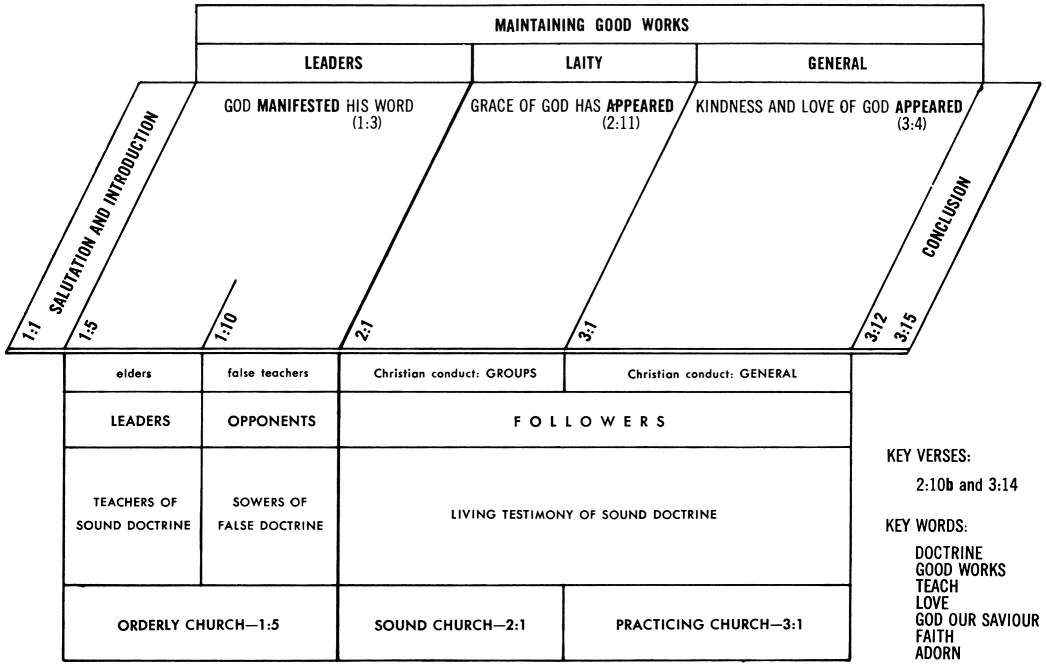
ADORNING THE DOCTRINE OF GOD
Click chart to enlarge
Charts from Jensen's Survey of the NT - used by permission
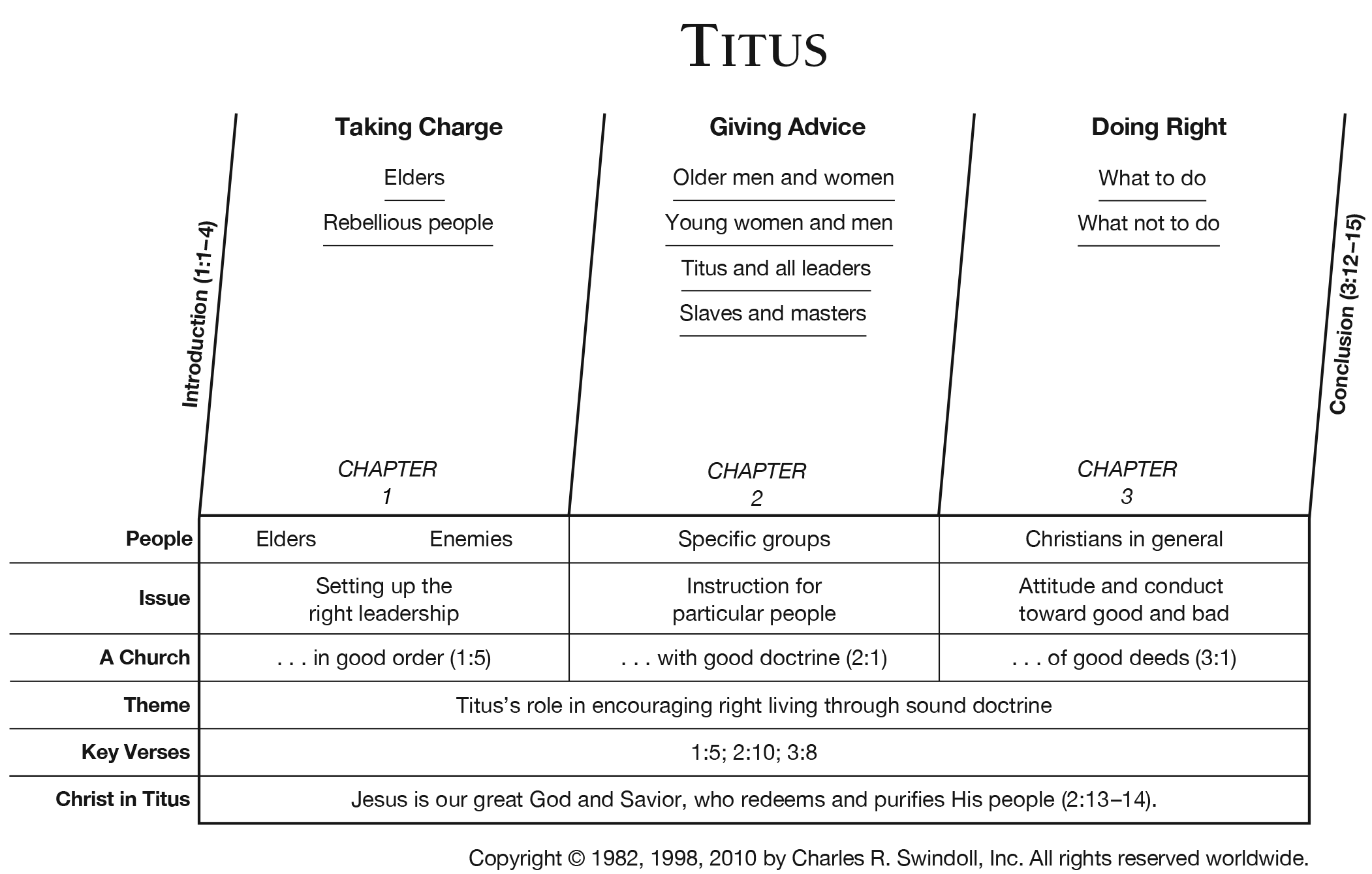
See Summary Chart by Charles Swindoll
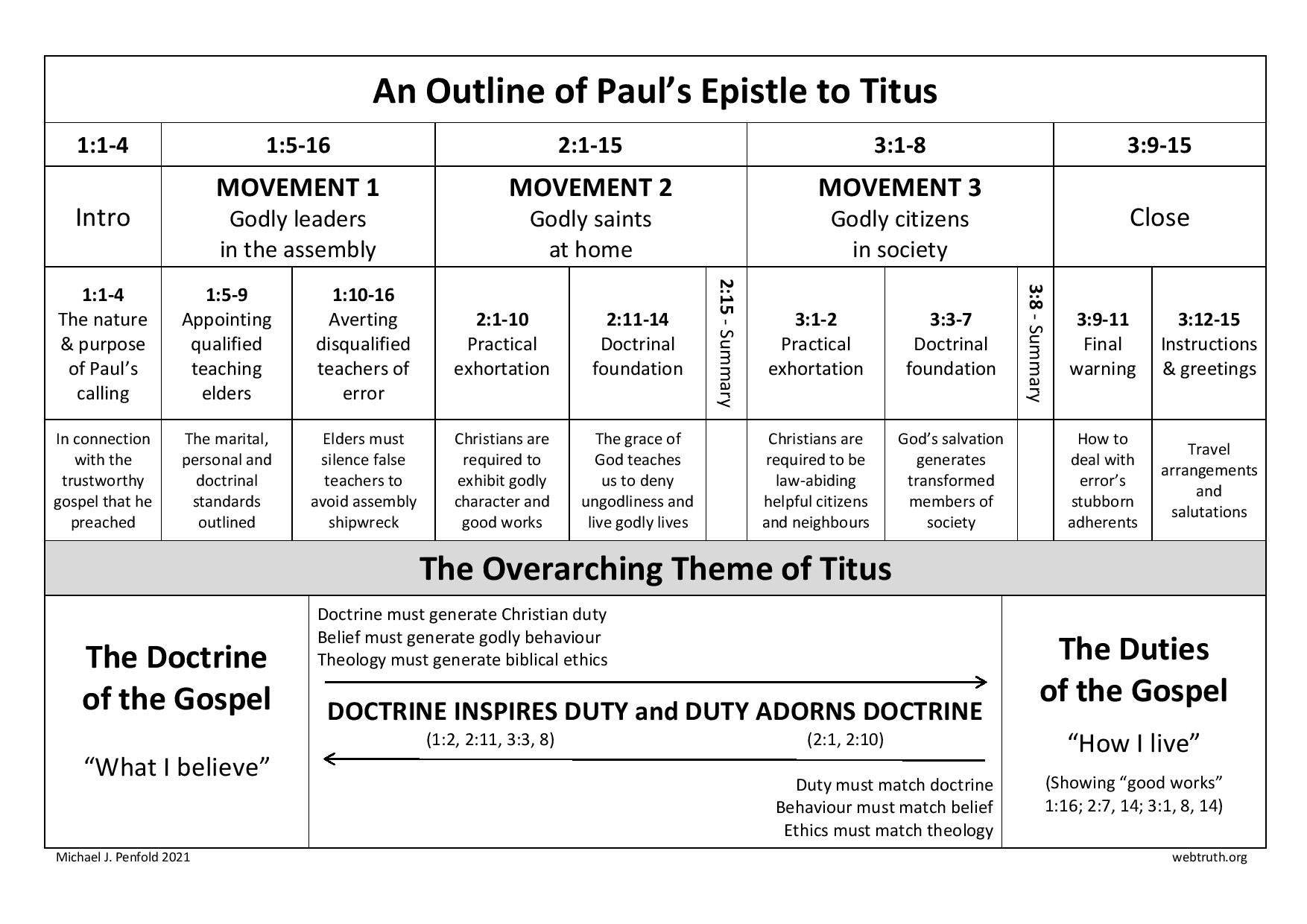
Chart below from Michael J. Penfold
|
Focus |
Appoint Elders |
|||
|
Divisions |
Rebuke |
Maintain |
||
|
Topics |
||||
|
Topics |
Organization |
Offenders |
Operation |
|
|
Place |
Probably Written from either Corinth or Nicopolis (cf. Titus 3:12). |
|||
|
Time |
Circa 63 AD |
|||
|
Modified from Talk Thru the Bible |
||||
Titus 3:4 But when the kindness of God our Savior and His love for mankind appeared (NASB: Lockman)
Greek: hote de e chrestotes kai e philanthropia epephane (3SAPI) tou soteron hemon theou,
Amplified: But when the goodness and loving-kindness of God our Savior to man [as man] appeared, (Amplified Bible - Lockman)
KJV: But after that the kindness and love of God our Saviour toward man appeared,
NLT: But then God our Savior showed us his kindness and love. (NLT - Tyndale House)
Phillips: But when the kindness of God our Saviour and his love towards man appeared (Phillips: Touchstone)
Wuest: But when the kindness and fondness of God our Saviour toward man appeared,
Young's Literal: and when the kindness and the love to men of God our Saviour did appear
BUT WHEN THE KINDNESS: he chrestotes hote de:
- Titus 2:11; Ro 5:20,21; Eph 2:4-10
- Titus 3 Resources - Multiple Sermons and Commentaries
When the kindness of God - Spurgeon says that…
“The philanthropy of God” would be a good translation, or rather, a sort of borrowing from the Greek itself. “After we had seen the philanthropy of God,”
Note that verses Titus 2:4-7 take the form of a single sentence in Greek.
Expositor's Bible Commentary remarks that "This beautiful summary of the whole gospel mentions the manifestation (Titus 3:4), the basis (Titus 3:5a), the means (Titus 3:5, 6), and the results (Titus 3:7) of our salvation. (Gaebelein, F, Editor: Expositor's Bible Commentary)
And I would add that then in (Titus 3:8) Paul specifies the fruit ("good deeds") that indicates the genuineness of the root of salvation!
John MacArthur puts this great section of Scripture in proper perspective writing that "In this short passage Paul sweeps across the glorious truths of salvation, every facet of which is sovereignly initiated and empowered by God alone. There are doctrines here that could be (Ed note: and should be!) studied and pondered for months without mining all their truth. (MacArthur. Titus: Moody Press)
"ROADBLOCKS" TO ETERNAL
SEPARATION FROM GOD!
But when interrupts and begins the contrast with the dismal picture of man’s depravity in the preceding section. How thankful we can be for these "nick-of-time" conjunctions that signal God’s marvelous intervention to save man from destroying himself (cf "but when" in NAS in Lk 21:28, Jn 16:13, 1Cor 15:54, Gal 4:4, Heb 9:11-note)!
Paul frequently uses the conjunction "but" by itself to introduce a striking contrast between we once were in Adam and what we now are in Christ
Study the striking contrast in the following passages - make a list - then take some time to praise God if you have been redeemed from darkness and transferred into His marvelous light! Ro 6:17, 18, 19, 20, 21, 22, 23; 1Cor 6:9, 10, 11; Eph 2:1-13; 5:7-12; Col 1:21, 22; 3:7, 8, 9, 10).
Someone has called these conjunctions "God’s roadblocks on man’s way to hell"! And so with this contrast Paul turns the focus from who we were in Adam to who we now are in Christ, furnishing us a powerful motive (and a powerful source - cp Ro 8:13-note, Gal 5:16-note) for Christian living.
The KJV Bible Commentary writes that…
"But for the grace of God we would all still be in the same wretched condition as the unbeliever in the world, therefore, beware how you speak against even them!" (Dobson, E G, Charles Feinberg, E Hindson, Woodrow Kroll, H L. Wilmington: KJV Bible Commentary: Nelson)
Bible Knowledge Commentary remarks that Paul's
contrast is startling. In verse 3 man is the actor, but in Titus 3:4, 5, 6, 7 man is merely the recipient and God becomes the actor. What man could in no wise do for himself, God initiated for him." (Walvoord, J. F., Zuck, R. B., et al: The Bible Knowledge Commentary. 1985. Victor).
Note the definite article (he) before "kindness" indicating this isn't just any kindness but is the specific kindness which comes from the Savior Himself!
Kindness (5544) (chrestotes from adjective chrestos = useful, profitable in turn from chraomai = to furnish what is needed in turn from chráo = lend, furnish as a loan) is a gracious attitude, and thus describes the quality of being helpful and beneficial.
Kindness is God's beneficial provision that meets the need of sinful man. Kindness reflects the tender concern of God, providing for helpless, hapless man what he never could have provided for himself. This is the "starting point" for our salvation. Expositors calls it God's "pitying kindness that prompts Him to bestow forgiveness and blessings".
Chrestotes -10 times in NAS - Ro 2:4; 3:12; 11:22; 2Co 6:6; Gal 5:22; Eph 2:7; Col 3:12; Titus 3:4 Translated - kindness 9x and good 1x.
Nelson's New Illustrated Bible Dictionary says that "Kindness is not an apathetic response to sin, but a deliberate act to bring the sinner back to God. (see Ro2:4 below) (Youngblood, R. F., Bruce, F. F., Harrison, R. K., & Thomas Nelson Publishers. Nelson's New Illustrated Bible Dictionary)
Kindness is an attribute of God and a quality desirable but not consistently found in men as discussed below.
Jesus taught that we are to "love (our) enemies, and do good and lend, expecting nothing in return and (our) reward will be great, and (we) will be sons of the Most High; for He Himself is kind (adjective chrestos) to ungrateful and evil men." (Lk 6:35)
John MacArthur writes that kindness (chrestotes) "connotes genuine goodness and generosity of heart. Our salvation from sin and lostness and death issued wholly from God’s kindness, His loving, benevolent, and entirely gracious concern to draw us to Himself and redeem us from sin forever."
Chrestotes - 15x in non-apocryphal Septuagint (LXX) - Esther 8:12; Ps 14:1, 3; 21:3; 25:7; 31:19; 37:3; 65:10; 68:10; 85:12; 104:28; 106:5; 119:65, 66, 68; 145:7.
Here is an example from the prayer of David in which he asks God to "not remember the sins of my youth or my transgressions; according to Thy lovingkindness (see word study on hesed/chesed/heced) remember Thou me, for Thy goodness’ (chrestotes - kindness) sake, O Lord. Good (adjective chrestos- kind) and upright is the Lord; therefore He instructs sinners in the way." (Ps 25:7, 8)
In other words David bases his appeal on God's attribute of kindness for he recognizes that it is God's kindness that leads sinners to repentance ("instructs sinners in the way.")
Trench describes chrestotes as a "beautiful word, as it is the expression of a beautiful grace… one pervading and penetrating the whole nature, mellowing there all which would have been harsh and austere (Ed note: this latter applicable only to men but not to God for He is never harsh or austere)… a goodness which has no edge, no sharpness in it… " (Trench, R. C. Synonyms of the New Testament. Hendrickson Publishers. 2000)
Kindness reflects benevolence in action, kindliness which disposes one to do good but not a goodness qualitatively but a goodness in action and expressed in deed. Kindness is that temper or disposition which delights in contributing to the happiness of others, which is exercised cheerfully in gratifying their wishes and which supplies their wants or alleviates their distresses. Kindness is not just a sweet disposition but is a serving trait.
Jesus used the adjectival form (chrestos) in His famous invitation to "all who are weary and heavy laden" to come to Him, take His yoke and learn from Him, for His "yoke is easy (chrestos) and (His) load is light." (Mt 11:28, 29, 30)
Jesus' yoke is pleasant, beneficial, useful, and causes no discomfort.
Paul asks the question "do you think lightly of the riches of His kindness (chrestotes) and forbearance and patience, not knowing that the kindness of God leads you to repentance?" (Ro 2:4-note)
God's kindness does not excuse men of their sin but convicts them of sin and leads them to repentance. In the next chapter of Romans Paul uses chrestotes to contrast the attitude and action of sinful men writing
all have turned aside. Together they have become useless. There is none who does good (chrestotes). There is not even one. (Ro 3:12-note)
And yet when men become beneficiaries of God's kindness and repent and believe, they are new creatures in Christ, now fitted to shine forth
the fruit of the Spirit… love, joy, peace, patience, kindness (chrestotes), goodness, faithfulness." (Gal 5:22-note)
Paul in his famous definition of "love" writes that
love is patient (present tense = continually, as the habit of one's life = only possible supernaturally, not naturally!), love is kind (chresteuomai - also in the present tense) (1Cor 13:4-note)
He instructs the Colossian saints as
"those who have been chosen of God, holy and beloved (to), put on a heart of compassion, kindness (chrestotes), humility, gentleness and patience." (Col 3:12-note)
Peter writes that believers
"have tasted the kindness (adjective chrestos) of the Lord." (1Pe 2:3-note)
And in another reflection of God's amazing grace, Paul records
"that in the ages to come He (will) show the surpassing riches of His grace in kindness (chrestotes) toward us in Christ Jesus." (Ep 2:7-note)
God's kindness initiating our salvation. His kindness continuing throughout eternity! Simply unfathomable! Even a glimpse of the true meaning of God's kindness is something that ought to cause us to drop to our knees in grateful adoration as expressed by Isaac Watts in the hymn below…
WHAT SHALL — I RENDER TO MY GOD
(Charles Wesley)
Click to play
What shall I render to my God
For all His kindness shown?
My feet shall visit Thine abode,
My songs address Thy throne.
The Tyndale Bible Dictionary summarizes "kindness" as that "state of being that includes the attributes of loving affection, sympathy, friendliness, patience, pleasantness, gentleness, and goodness. Kindness is a quality shown in the way a person speaks and acts. It is more volitional than emotional."
One of the most beautiful illustrations of this volitional aspect of human kindness is King David’s treatment of Mephibosheth (2Sa 9:1ff-note). Scripture records David's question -- "Is there yet anyone left of the house of Saul, that I may show him kindness for Jonathan's sake?" David’s desire was to show “the kindness of God” to King Saul’s family because of his covenant with Saul’s son, Jonathan. The young man chosen was Mephibosheth, Jonathan’s son, who "was lame in both feet." (2Sa 9:13-note) If David had acted according to justice, he would have condemned Mephibosheth who belonged to a condemned family. But David acted on the basis of kindness, seeking out Mephibosheth, assuring him he had no need to fear, inviting him to live in the king's palace as family and to eat at the king’s table. This is but a veiled picture of the infinite kindness of God! Indeed every believer has experienced even greater kindness, for we are now children of the King and shall revel in His majestic presence forever! What kindness!
THERE IS GLORY IN MY SOUL
(Grace Davis)
Click to play
Since He cleansed my heart, gave me sight for blindness,
There is glory in my soul!
Since He touched and healed me in loving kindness
There is glory in my soul!
In sum, how was God our Savior's undeserved kindness manifest to sinners who deserved hell? Paul sums it up this way: "And the Law came in that the transgression might increase; but where sin increased, grace abounded all the more, that, as sin reigned in death, even so grace might reign through righteousness to eternal life through Jesus Christ our Lord." (Ro 5:20, 21-note) This is divine kindness in action!
OF GOD OUR SAVIOR: tou soteros hemon theou:
- Titus 3 Resources - Multiple Sermons and Commentaries
Our Not just God the Savior but "our" Savior. What a glorious thought and bold confession of possession! Can you proclaim Him as "your" Savior? If not, then read on to see how you can and why you should.
Savior (4990) (soter from sozo = rescue from peril > from saos = safe; delivered) refers to the agent of salvation or deliverance, the one who rescues, delivers, saves and preserves. Anyone who saves or delivers can be called a deliverer or rescuer (a soter).
The Exegetical Dictionary notes that "In secular Greek usage the gods are deliverers both as helpers of human beings and as protectors of collective entities (e.g., cities); this is the case with Zeus, Apollo, Poseidon, the Dioscuri Castor and Pollux, Heracles, Asclepius as the helper of the sick, and Serapis; it is true also for philosophers (Dio Chrysostom Or. 32.8) and statesmen (Thucydides v.11.1; Plutarch Cor. 11, also in inscriptions and elsewhere). In the Hellenistic ruler cult "theos soter" (god our savior) is attested in writings and inscriptions as a title of the Ptolemies and Seleucids. Inscriptions in the eastern part of the Empire called Pompey “Soter and Founder,” Caesar “Soter of the World,” and Augustus “Soter of Humankind.” Hadrian had the title "Soter of the Kosmos" (Balz, H. R., & Schneider, G. . Exegetical Dictionary of the New Testament. Grand Rapids, Mich.: Eerdmans)
Greeks used soter as a title of divinities such as Asclepius, the god of healing. Soter was used by the mystery religions to refer to their divinities. At an early date soter was used as a title of honor for deserving men, e.g., Epicurus (300BC) was called "soter" by his followers. As discussed below, soter was used as a designation of the "deified" ruler, e.g., Ptolemy I Soter (323-285BC).
Thayer writes that the name soter "was given by the ancients to deities, especially tutelary deities, to princes, kings, and in general to men who had conferred signal benefits upon their country, and in the more degenerate days by way of flattery to personages of influence;
Soter was used of God as the source of salvation - the Deliverer, the Preserver, the Protector, the Healer, the One Who rescues man from danger or peril and unto a state of prosperity and happiness.
Soter was used of Jesus Christ as the agent sent by God to bring deliverance to sinful mankind.
Soter - 24x (7-8x = reference to God 17x = Christ) in NAS = always translated "Savior".
Lk 1:47, 2:11; Jn 4:42; Acts 5:31, 13:23; Eph 5:23; Phil 3:20; 1Ti 1:1; 2:3; 4:10; 2Ti 1:10; Titus 1:3 4; 2:10, 13; 3:4, 6; 2Pe 1:1, 11; 2:20; 3:2, 18; 1Jn 4:14; Jude 1:25.
Soter - 24x in the non-apocryphal Septuagint (LXX) -
Dt 32:15; Jdg 3:9, 15; 12:3; 1 Sam 10:19; Neh 9:27; Esther 5:1; 8:12; Ps 24:5; 25:5; 27:1, 9; 62:2, 6; 65:5; 79:9; 95:1; Isa 12:2; 17:10; 45:15, 21; 62:11).
In the Old Testament the NAS often has "God of my salvation" (Ps 18:46 25:5 27:9 51:14 88:1 Micah 7:7 Hab 3:18) whereas the Septuagint is usually rendered "God my Saviour".
Some of the first to call Jesus the Savior were not Jews but Samaritans!…
"and they (Samaritans) were saying to the (Samaritan) woman, "It is no longer because of what you said that we believe, for we have heard for ourselves and know that this One is indeed the Savior of the world." (John 4:42)
Soter is a frequent title given to the Father (as Source of salvation) and to the Son (as the Agent of salvation) in the epistle to Titus:
"the commandment of God our Savior" (Titus 1:3-note)
"Grace and peace from God the Father and Christ Jesus our Savior" (Titus 1:4-note),
"showing all good faith that they may adorn the doctrine of God our Savior" (Titus 2:10-note)
"looking for the blessed hope and the appearing of the glory of our great God and Savior, Christ Jesus" (Titus 2:13-note)
"Whom (the Spirit) He (Father) poured out upon us richly through Jesus Christ our Savior." (Titus 3:6-note).
Note the clear involvement of the Trinity in salvation in these verses from Titus.
Kenneth Wuest writes that the name soter "was given by the ancients to deities, to princes, kings, and in general, to men who had conferred signal benefits upon their country, and in the more degenerate days, by way of flattery, to personages of influence."
The Romans looked upon their emperor as a "savior" in that he held mankind together under the great Roman power, providing peace and order, prosperity and protection. In the Cult of Caesar, the state religion of Rome, the emperor was actually known as the "Saviour of the world" (at least 8 Roman emperors carried this title)! In contrast was the Lord Jesus Who was worshiped as the Saviour God. The Caesars ruled over the temporal affairs of their subjects and were one of their gods. The latter was Savior who saved the believer’s soul from sin and exercised a spiritual control over his life. To recognize Jesus as the Saviour of the world instead of the Emperor was a capital offense and a blow at the very heart of the Roman Empire and explains the reason for the bloody persecution of Christians.
Physicians who healed others were referred to in the Greek culture as "saviors". Human physicians might be able to heal physical sickness but only the Great Physician can heal sin sickness. As alluded to above, in Greek mythology various gods were called soteres (plural) an epithet applied especially to Asclepius, the "god of healing". How tragic to call mere mortals and figments of men's imagination "saviors".
God pronounced judgment long ago on those who worship these so-called "saviors" declaring that
They have no knowledge, who carry about their wooden idol, and pray to a god who cannot save (Hebrew word is yasha from which is derived Yeshua the Hebrew equivalent of "Jesus"!). (Isa 45:20b)
Soter is also used 24 times in the Greek translation of the OT (Septuagint), virtually always describing God as Savior. For example, Psalm 27:1 translated from the Greek reads "The Lord is my light and my Saviour" compared to the translation from Hebrew -- "The LORD is my light and my salvation."
Other OT uses soter describing God - Dt 32:15; 1Sa10:19; Neh 9:27; Ps 24:5; 25:5; 27:1, 9; 62:2, 6; 65:5; 79:9; 95:1; Isa12:2; 17:10; 45:15,21; 62:11; Mic7:7; Hab 3:18)
AND HIS LOVE FOR MANKIND APPEARED: kai e philanthropia epephane (3SAPI):
- Titus 1:3; 2:10; 1Ti 1:1; 2:3; 4:10
- Titus 2:11; 2Ti 1:10; Heb 9:26
- Titus 3 Resources - Multiple Sermons and Commentaries
More literally "His philanthropy for mankind shined forth"
Our salvation in one sense had its "historical starting point" when "the kindness of God our Saviour and His love for mankind appeared" which marks the incarnation and birth of Jesus Christ, the Savior of all mankind. However God is not constricted by time as we are and in His great plan and sovereignty He
"chose us in [Christ] before the foundation of the world, that we should be holy and blameless before Him” (Eph 1:4-note )
Our eternal destiny was determined and sealed before the world began. Paul opened the letter to Titus with a declaration of
"the hope of eternal life, which God, Who cannot lie, promised long ages ago." (Titus 1:2-note)
In 2 Timothy Paul writes that God
"has saved us and called us with a holy calling, not according to our works, but according to His own purpose and grace which was granted us in Christ Jesus from all eternity ("before the beginning of time" NIV, "before time began" NKJV)" (2Ti 1:9-note)
Spurgeon writes that "there was a Divine interposition. The love and kindness of God our Saviour, which had always existed, at length “appeared” when God, in the person of His Son, came hither, met our iniquities hand to hand, and overcame their terrible power, that we also might overcome.
Love for mankind (5363) (philanthropia from phílos = friend or phileō = to have affection for + anthropos = man; English = philanthropy = the desire to promote the welfare of others, especially through the donation of money to good causes) means benevolence or a friendly disposition toward people (friendliness). It describes an affectionate concern for mankind.
Webster defines philanthropy as "goodwill to fellowmen; especially active effort to promote human welfare" -- An apt description of what God does for man in salvation.
In the present context philanthropia describes God's compassion, especially the eagerness to deliver someone from pain, trouble, or danger. It involves more than mere emotion and always finds a way to express itself in some form of helpfulness. It is God's uninfluenced and unearned friendly disposition, affectionate concern for and interest in mankind (the very ones who outside of Christ who are "haters of God", Ro 1:30-note, "enemies" Ro 5:10-note, "alienated and hostile in mind" Col 1:21-note!). Amazing grace that loves and saves such wretches as we!
Paul understood this word well, for he himself had twice experienced philanthropia from unsaved Gentiles, Luke recording that before Paul boarded the ship to be taken as a prisoner to Rome, the centurion
Julius treated Paul with consideration (the related word philanthropos) and allowed him to go to his friends and receive care. (Acts 27:3)
Note the benevolent disposition of philanthropy is associated with a beneficial action, so it's not really always "the thought that counts" for actions really do "speak louder than words"! Again, after suffering shipwreck off the coast of Malta and managing to safely reach shore, just as God had promised (Acts 27:22, 23, 24, 25, 26),
Luke records that the unregenerate
natives showed us (Paul and Luke) extraordinary (uncommon, unusual, unexpected) kindness (philanthropia) for because of the rain that had set in and because of the cold, they kindled a fire and received us all. (Acts 28:2)
Once again their philanthropy spoke through their kind actions.
All men are "shipwrecked", helpless (Ro 5:6-note) and lost without God's philanthropia. And yet God stood eternally ready to help and welcome humanity drowning in the sea of sin, Scripture testifying that
God demonstrates (present tense - continually!) His own love toward us, in that while we were yet sinners, Christ died for us." (Ro 5:8-note)
for God so loved the world, that He gave His only begotten Son, that whoever believes in Him should not perish, but have eternal life. (John 3:16)
Hiebert - God's 'love-toward-man' (our English word "philanthropy") is expressive of the fact of His feeling of pity toward man and that it extends to all men. The divine attitude thus stands in sharp contrast to the human disposition pictured in v3. Although God hates the sinner's sin, He loves the sinner and yearns to save him. God was the first great Philanthropist. True human philanthropy must be rooted in the divine love. "The goodness and love of God to man on which our salvation is based, should lead us to show benevolence and gentleness to all men." (Huther)."
Barclay writes that "philanthrōpía… is defined as love of man as man. The Greeks thought much of this beautiful word. They used it for the good man’s kindliness to his equals, for a good king’s graciousness to his subjects, for a generous man’s active pity for those in any kind of distress, and specially for the compassion which made a man ransom a fellow-man when he had fallen into captivity. (Titus 3 Commentary - William Barclay's Daily Study Bible)
Milne comments that "Since philanthropy was publicly prized and praised by imperial rulers, its inclusion here may be meant to highlight the special and altogether superior type of philanthropy that lies at the heart of the Christian religion. Unlike the gods of the pagan cults, the God of Christianity is a God who really cares about men and women. (Focus on the Bible: 1 Timothy, 2 Timothy and Titus)
Appeared (2014) (epiphaino from epí = over, upon + phaíno = to shine) literally means to shine upon. It means to bring to light or to show upon. In the passive (as in the present verse) epiphaino means to appear or become visible. For example Luke recorded that "neither sun nor stars appeared" (Acts 27:20).
Figuratively epiphaino is equivalent to become clearly known or to show oneself as did God's kindness and His love for mankind here in Titus 3:4. God our Savior's kindness and love "has shined upon" us in the incarnation of the Messiah, Christ Jesus.
The ideas conveyed by epiphaino include to cause something to be seen, to give light to something (Luke 1:79), to make one's presence known and so to become apparent (Acts 27:20) and finally to show oneself or make an appearance (eg, as did God's grace in Titus 2:10 (note).
Epiphaino - 4x in NAS -Luke 1:79; Acts 27:20; Titus 2:11; 3:4 NAS = appeared , 3; shine, 1.
The aorist tense points to the incarnation as occurring at a specific point of time in history. Today we divide time as BC/AD based on this historical fact. Epiphaino in the passive voice means to show oneself openly or before others, and in secular writing was often associated with the idea of a sudden or unexpected appearance.
Interestingly, Messiah's epiphany should not have been unexpected because of over 300 OT Messianic prophecies and in fact was not unexpected by men such as "Simeon (who) was righteous and devout" and who was "looking for (present tense - continually, earnestly, expectantly) the consolation of Israel" (what a beautiful Name for the Messiah!) (Lk 2:25) and women such as the prophetess Anna who never left the Temple and
continued to speak of Him (the Messiah) to all those who were (earnestly and expectantly) looking for the redemption of Jerusalem (another beautiful Name for Messiah!) (Lk 2:36, 37, 38).
In Greek culture epiphaino was used to describe the visible manifestation of a hidden deity to men in order to bring help and deliverance. Paul extracted epiphaino from this pagan, mythological morass and elevated its use in this epistle in his description of the "epiphany" par excellence. Indeed, Christ's epiphany was not mythological but soteriological (theology of salvation) for it made available true help and deliverance to mankind held fast by the power of sin.
Our English word epiphany (from epiphaino) is defined by Webster as "an appearance or manifestation especially of a divine being; a usually sudden manifestation or perception of the essential nature or meaning of something; an illuminating discovery; a revealing scene or moment."
The use of the verb appeared clearly "implies that these qualities of God (kindness, philanthropy) were always there but received their clear manifestation in the coming of Christ and the consequent proclamation of the Gospel. Glimpses of these characteristics had been given in the OT, but it was especially in the proclamation of the Gospel that was announced to the world this benignity of "God our Saviour. (Hiebert)
Luke uses epiphaino in his beautiful description of the incarnation of the Christ, explaining that salvation was made possible "because of the tender mercy of our God, with which the Sunrise (Dayspring - Messiah's coming would be like coming of dawn, His light driving away darkness of sin, cf Jn 8:12) from on high shall visit us, to shine upon (epiphaino) those who sit in darkness and the shadow of death, to guide our feet into the way of peace." (Luke 1:78, 79)
Milne writes that "When everything on the human plane was pitch–dark and hopeless, the God of love burst into the darkness of this world in the person of his earth–born Son, in a definitive moment of divine epiphany. His advent was like the dawning of a bright new day, the beginning of a truly new age. (Milne, D. J. Focus On The Bible: 1 Timothy, 2 Timothy and Titus)
The first use of epiphaino in the Greek translation of the Septuagint (LXX) records that Jacob "built there an altar, and called the name of the place Bethel for there God appeared (epiphaino) to him… " (Ge 35:7)
Another use is in the well known Aaronic blessing --
The Lord make His face to shine upon (epiphaino) thee, and have mercy upon thee. (Nu 6:25)
It is interesting that a frequent prayer in the psalms is for God to make His face shine (epiphaino) upon His servants (see Ps 31:16, 67:1, 80:3, 80:7, 80:19, 119:135)
Three times in Psalm 80, the psalmist pleads with God to
cause Thy face to shine upon (epiphaino) us and we will be saved.
Have you ever prayed for God to shine His face upon you? You might consider doing so even as your read this note. Note how the psalmist links God's shining with God's salvation just as Paul does in this section of Titus.
In the previous chapter Paul declared that
the grace of God has appeared (epiphaino), bringing salvation to all men (Titus 2:11-note).
Clearly this glorious shining forth of God's grace was another way of picturing the incarnation of Christ, the Source of grace for salvation of sinners. Paul links grace with Christ in his closing benediction to the Corinthians asking that
The grace of the Lord Jesus Christ and the love of God, and the fellowship of the Holy Spirit, be with you all. (2Cor 13:14)
Writing to his young protégé Timothy, Paul instructed him that although grace in Christ Jesus was granted in eternity past
now (that grace) has been revealed (openly shown and made known) by the appearing (epiphaneia, noun form of epiphaino) of our Savior Christ Jesus, Who abolished death, and brought life and immortality to light through the gospel. (2Ti 1:10-note)
Clarke summarizes this section noting that
God the Savior flows from God the Philanthropist. Where love is it will be active, and will show itself. So the philanthropy of God appeared, or it shone out, in the incarnation of Jesus Christ, and in His giving His life for the life of the world.
In summary, Paul points to the incarnation of Christ Jesus Who stepped out of eternity, into time, in the form of a man, shining forth openly and making known His grace, kindness and love and making salvation available to all men. As the writer of Hebrews puts it
now once at the consummation of the ages He (Jesus) has been manifested to put away sin by the sacrifice of Himself." (Heb 9:26-note).
Peter adds that Christ
"was foreknown before the foundation of the world, but has appeared (brought out to public view at a given time in history) in these last times for the sake of you" (1Pe 1:20-note)
The incarnation of Christ is a historical event testified to by numerous witnesses and is the bedrock truth for the doctrine that follows.
F B Meyer - Our Daily Homily - THE emphasis must surely rest on appeared. Kindness and love toward man were always in the heart of God, but they were not clearly revealed. They might have been perceived in the order of nature and human life; but there are stormy winds as well as zephyrs in the one--and in the other deaths as well as births; knells of hope as well as marriage peals. But in Jesus the true heart of God toward man was manifested. It is thus in human life.
At first God blessed us anonymously.--In Cowper's memoirs we read how Theodora, his cousin, pursued him throughout his sad life with her gifts; but they always came without indication of their source. As the poet unwrapped his new-come treasure, he would say, "Dear Anonymous has come again; God bless him." So, through years of thoughtless childhood, and afterward in opening youth, we were the recipients of myriads of gifts contrived with the most exquisite skill to give us pleasure; but we did not trace them to their source. They were from God.
Since then His grace and loving kindness have appeared.--We have had eyes to see, and hearts to understand. The Anonymous Benefactor is now recognized as our Father and Friend. We no longer praise our earthly loves for our cornfields and vineyards, but our Heavenly Spouse (Hosea 2.). In the breaking of the bread we have recognized the Son of God, and we know now who it was that walked with us along the path of life, and why our hearts burned.
Oh to grace how great a debtor
Daily I'm constrained to be;
Let that grace, Lord, like a fetter,
Bind my wandering heart to Thee.
A LITTLE KINDER - Aldous Huxley (1894-1963), one of the world's leading intellects, was visiting with Houston Smith, a well-known professor of philosophy and religion. As they were driving to an engagement, Huxley said, "You know, Houston, it's rather embarrassing to have spent one's entire lifetime pondering the human condition and … find that I really don't have anything more profound to pass on by way of advice than, 'Try to be a little kinder.'"
The apostle Paul saw kindness in a different light. In Ephesians 4:32, he linked being kind, tenderhearted, and forgiving with the way God has treated us. In Titus 3:4, he said that it was "the kindness and the love of God" that provided eternal salvation.
In a world where callous thoughtlessness and selfish indifference are all too common, kindness can make our lives fruitful when motivated by Christlike love. When our walk harmonizes with our words of witness, it will make a compelling impact on others by pointing them to the kind of love God has for them in Jesus Christ. If Huxley had learned what Paul had learned, he would have seen that trying to be a little kinder is one of the most profound truths of all.
What motivates us to try? There's no better reason than the love of God as shown to us by Jesus. —Vernon C Grounds (Our Daily Bread, Copyright RBC Ministries, Grand Rapids, MI. Reprinted by permission. All rights reserved)
He saw me ruined by the fall,
Yet loved me notwithstanding all;
He saved me from my lost estate,
His lovingkindness, oh, how great! —Medley
Kindness is treating others
the way God treats you