Introduction These transcripts are from Kay Arthur's lectures on the old course on Daniel and not the new lecture series circa 2006. They are provided as a service to the body of Christ with the written permission of Precept Ministries International. This material is the property of Precept Ministries International and all rights are reserved.
The transcripts are for the most part verbatim with deletions identified by the characters (...). The utilization of italics, bolding, hyperlinks and pop up notes represent editorial additions. Any written additions are identified by the designation "Ed note". All references are the NASB unless otherwise indicated.
Please note that these lectures by Kay Arthur supplement the excellent Precept Upon Precept inductive Bible study on the Daniel. Click on the link below and note that you can download lesson 1 free of charge.
Below are links to the excellent Precept study of the Revelation. If you are planning on doing this four part study, I would strongly encourage you to first complete the Daniel study, as knowledge of the prophecies in Daniel is critical to a full understanding of the prophecies in the Revelation. Note that for each part, you may download a PDF of lesson one at no charge.
If you can find a local Precept class studying Revelation, I would strongly encourage you to join the class, as I know of no other study available anywhere in the world that will equip you so thoroughly to discern the signs of the times and cause you to live expectantly as you look for Christ's Return!
Related Resources:
- Daniel Resources from literal perspective
- Revelation Resources from a literal perspective
- Great Tribulation
- Day of the Lord
- Daniel's Seventieth Week - chart
- Daniel's Seventieth Week Charted Parallel with other Daniel prophecies
- Millennium 1 - Early Church drift from literal interpretation of Rev 20
- Millennium 2 - Context & events leading up to Millennium
- Millennium 3 - How OT describes Millennial Messianic Age
- Daniel 1 Commentary
- Daniel 2 Commentary -- Da 2:1-23
- Daniel 2 Commentary(2) -- Da 2:24-49
- Daniel 3 Commentary
- Daniel 4 Commentary
- Daniel 5 Commentary
- Daniel 6 Commentary
- Daniel 7 Commentary(1) -- Da 7:1-6
- Daniel 7 Commentary(2) -- Da 7:7-14
- Daniel 7 Commentary(3) -- Da 7:15-28
- Daniel 8 Commentary
- Daniel 9 Commentary(1)
- Daniel 9:24 Commentary
- Daniel 9:25 Commentary
- Daniel 9:26 Commentary
- Daniel 9:27 Commentary
- Daniel 10 Commentary
- Daniel 11 Commentary(1) -- Da 11:1-19
- Daniel 11 Commentary(2) -- Da 11:20-45
- Daniel 12 Commentary
THERE ARE SOME THINGS THAT WILL NOT ALTER OR CHANGE.
1). The first is the SURETY OF GOD'S WORD.
When God speaks, it is done. As it is written, it is done. It may not be done immediately, but be assured that it will happen. When God gives us details about the way it's going to happen, it will be fulfilled in every detail. Why? Because as Peter affirms...
'We have the prophetic word made more sure, to which you do well to pay attention as to a lamp shining in a dark place, until the day downs and the morning star arises in your hearts.' (see notes on 2 Peter 1:19)
2). Daniel 8‑12 is God's revelation to Israel of what is going to happen to the Jews in the future. They can know for certain that God loves them with an everlasting love for He declares through His prophet Jeremiah
"...I have loved you with an everlasting love, therefore I have drawn you with lovingkindness." (Jeremiah 31:3)
In Daniel 8‑12 God has some "hard things" to tell Israel. And so they need to remember that God loves them and that He has promises yet to be fulfilled for them as He declared in Jeremiah...
'For I know the plans that I have for you...
plans for welfare
and not for calamity
to give you
a future and a hope.'
(Jeremiah 29:11)
3). We can know with certainty of GOD'S INDIGNATION AGAINST SIN.
When we turn our back on God and refuse to obey Him, we can know that because He is true to His attributes of righteousness (see Righteous) and holiness (see Holy), that He is obligated to express His indignation against sin, even though He is also a God of Love. In the book of Numbers God issued a warning specifically to the tribes of Reuben, Gad and half the tribe of Manasseh, exhorting them to fulfill their commitment to participate with the other tribes in the campaign in Canaan. The specific warning quoted below expresses a universal principle that no sin against God or His Word will remain secret and unpunished.
"...if you will not do so, behold, you have sinned against our LORD, and be sure your sin will find you out." (Numbers 32: 23)
DANIEL 8 :
Daniel 8 occurred after Daniel's vision in Daniel 7. When did this vision take place? About 551BC
In the third year of the reign of Belshazzar the king a vision appeared to me, Daniel, subsequent to the one which appeared to me previously. (Daniel 8:1)
Review:
Daniel 2 God gave His choice servant a panorama of Gentile world dominion from the time of Babylon through to the second coming of Christ and the setting up of His Kingdom on earth (see Millennial Kingdom). (Ed note: some feel that Jerusalem's fall to Babylon in 586BC marks the beginning of the "times of the Gentiles" of which our Lord spoke in Luke 21:24 predicting that "Jerusalem will be trampled under foot by the Gentiles until the times of the Gentiles be fulfilled")
Daniel 7 (see other lectures that deal with Daniel 7: LECTURE 9 , Lecture 10, lecture 11, LECTURE 12) overviews the four "beastly" kingdoms which directly parallel the depiction of the kingdoms in the divisions of the "large...awesome" statue in Daniel 2.
Daniel 8 reveals more details about the of the Medo‑Persian and Greek kingdoms because God wants the Jews, His chosen people, to understand in detail what is going to come to pass.
Under the Medes and Persians, the Jews return from exile back to the land of Judah because God stirred up Cyrus the King of Persia to send the Jews back to Israel and rebuild the Temple (Even some 150 years before Cyrus was even born, through Isaiah Jehovah had prophesied that He would raise up Cyrus by the right hand and subdue nations before him for the sake of Israel, even though Cyrus did not know Him. [see Isa 45:1–7] Cyrus the King of Persia decreed that (after the 70 years of captivity) the Jews were to go back. The Jews that went back put away their idols, having learned their lesson that the Babylonian captivity was because of their idolatry in addition to having robbed the land of its Sabbath "rests" for 70 years as described in the following passage...
And those who had escaped from the sword he carried away to Babylon; and they were servants to him and to his sons until the rule of the kingdom of Persia, 21 to fulfill the word of the LORD by the mouth of Jeremiah (Jeremiah 25:11-12), until the land had enjoyed its sabbaths. All the days of its desolation it kept sabbath until seventy years were complete. 22 Now in the first year of Cyrus King of Persia-- in order to fulfill the word of the LORD by the mouth of Jeremiah (Jeremiah 25:11-12)-- the LORD stirred up the spirit of Cyrus king of Persia, so that he sent a proclamation throughout his kingdom, and also put it in writing, saying, (23)
"Thus says Cyrus King of Persia, 'The LORD, the God of heaven, has given me all the kingdoms of the earth, and He has appointed me to build Him a house in Jerusalem, which is in Judah. Whoever there is among you of all His people, may the LORD his God be with him, and let him go up!'" (2Chr 36:20-23)
(Editorial note: The LORD specifically required that every "seventh year the land shall have a sabbath rest, a sabbath to the LORD" Leviticus 25:4. Evidently this law had been ignored for some 490 years or since about the time of Solomon. Therefore, as recorded in Jeremiah 25:11-12 God enforced His Law in with 70 years of captivity, one year for each sabbath rest for the land which Israel had failed to keep [490 divided by 7 = 70 years of "punishment due"])
Unfortunately the Jews have still not completely learned the lesson God wanted to teach them. And so He is going to bring more of His wrath and indignation upon them.
WHY?
BECAUSE THEIR SIN IS NOT YET FINISHED
Daniel records his vision in Daniel 8..
Then I lifted my gaze and looked, and behold, a ram which had two horns was standing in front of the canal. Now the two horns were long, but one was longer than the other, with the longer one coming up last. 4 I saw the ram butting westward, northward, and southward, and no other beasts could stand before him, nor was there anyone to rescue from his power; but he did as he pleased and magnified himself... 20 "The ram which you saw with the two horns represents the kings of Media and Persia. (Daniel 8:3-4, 20)
The ram of Daniel 8 was pictured as the bear in Daniel 7. In his description of the ram, one "horn was longer" which corresponds to the bear being "raised up one side" (Daniel 7:5 "And behold, another beast, a second one, resembling a bear. And it was raised up on one side, and three ribs were in its mouth between its teeth; and thus they said to it, 'Arise, devour much meat!'). Note that many times in Scripture the word horn is not used literally but figuratively to symbolize power thus description pictures one nation stronger than the other, which historically was fulfilled in Persia being more dominant than the Medes.
God wanted to let His people know what was going to happen before it happened so that when it happened the Jews would see once again the surety and certainty of His Word. There is nothing that builds your faith and confidence more than seeing that God prophesies something and it comes to pass just as He declared.
But note that yes God told the Jews what would come to pass before it occurred, but this word of surety included the bad news and the good news, i.e., the consequences of their sin as well as their restoration. But this truth also should increase our faith beloved.
GOAT WITH ONE HORN = first king (Greece) knocks out the Medes and Persians.
What is the historical context of Daniel 8? First, Daniel writes...
"In the 3rd year of the reign of Belshazzar"
551 BC
The third year of the reign of Belshazzar
(Ed note: Daniel 7 occurs in the first year of Belshazzar's reign or about 553 BC and Daniel 8 in the third year of the reign of Belshazzar or about 551 BC both actually after the events of Daniel 4 and before the events of Daniel 5, this latter chapter occurring in 539BC marking the fall of Babylon to the Medo-Persians. The point is that when Daniel had the visions in both chapters, they were prophecy to him and not history. It should also be noted that Daniel 1:1-2:4a was written in Hebrew and Daniel 2:4b-7:28 was written in Aramaic the language of international commerce and government, because the subject matter centers more on future history of the Gentile nations. Beginning here in Daniel 8:1 through Daniel 12:13 the text switches from Aramaic back to Hebrew language because these prophecies are no longer focusing so much on the Gentile kingdoms as they are on the Jews and the nation of Israel)
550BC
Cyrus the Persian king arises and desires to unite Medes and Persians (Ed note: see the prophecy of Cyrus' rise to power give some 150 years before he took over power [Isa 45:1–7] As Daniel had so eloquently testified of Jehovah's sovereignty it is "He who changes the times and the epochs; He removes kings and establishes kings" Daniel 2)
539BC
Cyrus takes his army of 2 million men and moves west, north and south as Daniel had prophesied...
I saw the ram butting westward, northward, and southward, and no other beasts could stand before him, nor was there anyone to rescue from his power; but he did as he pleased and magnified himself.
Cyrus conquered Egypt, Babylon, and Turkey (which most observers interpret as the three ribs in the bear's mouth in Daniel 7:5). The Medo-Persian empire repeatedly attacked the buffer state of Macedonia. At this time in history Greece was not united but was composed of various independent city states.
331BC
Greece defeats the Medo-Persians
(Ed note: the ISBE records that "Darius [the third and last of 3 kings of Persia named Darius and often designated Darius III] was completely overthrown by Alexander the Great in the battle of Gaugamela or Arbela, 331 BC, [see The Battle of Gaugamela {Arbela}] and shortly after fell by an assassin's hand. This ended the Persian empire of the Achaemenides, the whole of the lands composing it becoming part of the empire of Macedon.)
Daniel's prophecy records that...
Daniel 8:5 While I was observing, behold, a male goat (Greece) was coming from the west over the surface of the whole earth without touching the ground; and the goat had a conspicuous horn between his eyes (Alexander the Great).
6 And he came up to the ram (Medes and Persians) that had the two horns, which I had seen standing in front of the canal, and rushed at him in his mighty wrath.
7 And I saw him come beside the ram, and he was enraged at him; and he struck the ram and shattered his two horns, and the ram had no strength to withstand him. So he hurled him to the ground and trampled on him, and there was none to rescue the ram from his power.
8 Then the male goat (Alexander the Great) magnified himself exceedingly. But as soon as he was mighty, the large horn was broken; and in its place there came up four conspicuous horns (horn ~ power) toward the four winds of heaven.
9 And out of one of them came forth a rather small horn which grew exceedingly great toward the south, toward the east, and toward the Beautiful Land (Israel).
Phillip of Macedonia has a plan to unite the Greek city states to resist the Medes and Persians. His son, Alexander the Great, was the "goat (with) a conspicuous horn between his eyes" who arose on the scene of world history. At age 13 Alexander was taught by Aristotle that all men except the Greeks are to be slaves. At age 21 Alexander became the head of the Grecian Empire and led an army of 35‑50,000 men. Alexander's tactics included marching for days (instead of giving his men rest) and attacking his enemy swiftly (cf the "leopard, which had on its back four wings of a bird" Daniel 7:6) so that within 10 years he had conquered the Medo-Persian empire (the goat with one horn conquered the ram).
There are reports that Alexander's troops logged some 20,000 miles in their conquests. But Alexander began to drink heavily and to live a life of debauchery. On May 29, 323BC Alexander drank excessively and on June 5 he retired to his room still sick with fever. On June 6 he handed his ring to his administrator. His troops began to file by to see him. Sadly his troops ere not greatly distressed because he was a hard general. On June 10, 323BC age 32 Alexander died in Babylon, fulfilling the prophecy of the "large horn (that) was broken" (Daniel 8:8). Alexander had made no provision for his successor, probably because he was so young and at the height of his career and manhood. In Biblical terms, Alexander had sown to the flesh and reaped accordingly.
In 310 BC Alexander's wife, Roxanne, and his 13yo son were murdered. At this time five generals competed for Alexander's kingdom (but prophecy points out that only 4 horns eventually came up) and within 20 years there were only 4 just as God had predicted. (compare to the European Union which as of Jan, 2006 has 25 members. Yet we know the beast of Daniel 7 is to have 10 horns. Could Daniel's prophecies of 10 toes or 10 horns in a loose confederation eventually be fulfilled in some future aspect of the European Union?)
THE ORIGIN OF KOINE GREEK
The NT is written in koine Greek, the common Greek language, used by all the countries that Alexander had conquered. God judged Alexander but since He has made even the wicked for Himself, (Pr 16:4 The LORD has made everything for its own purpose, even the wicked for the day of evil.) God used Alexander to develop the Koine Greek language, because all the Greek City States had different dialects and Alexander knew that to go to war and win, they would have to be able to communicate clearly. It is interesting and a clear reflection of God's providential control of the history of the world that koine Greek is the most exacting language ever developed. So it is little wonder that when the New Testament was written, it was written in Koine Greek!
Ed Note: DeMoss writes that "koine Greek" is...
The Greek language as it was spoken when the Mediterranean world was Hellenized (see Hellenic period). (koine is the fem. adj. of koinos, "common," implying dialektos) The convergence of cultures and the commingling of Greek dialects produced a type of Greek that lost some of the subtleties of classical Greek and that was less "refined" than literary Greek during the same period. The term is used interchangeably with "Hellenistic Greek". (DeMoss, M. S.: Pocket Dictionary for the Study of New Testament Greek. Page 77. Downers Grove, Ill.: InterVarsity Press)
For years people thought Koine Greek was just restricted to the Bible because there were no extra‑Biblical sources. In the late1800's on an archaeological dig in the sands of Egypt, came a revolutionary finding: stored away within Crocodiles (dead) they found thousands of papyri written in koine Greek, later shown to be the same form of Greek used in the common everyday language of Greek‑speaking people in the first century AD.
The Septuagint (abbreviated LXX = 70, the number of Jewish Scholars who translated in Alexandria, Egypt during the reign of Ptolemy II Philadelphus circa 295‑247 BC) is the Greek translation of the Hebrew Old Testament which was commissioned by a king (that came out of one of the 4 horns) so that he could have the OT Scriptures in his library. Once again we see God's providential control as the Septuagint became the version of the OT Scriptures that was read by Jews scattered throughout the ancient world. In fact the majority of the Old Testament quotations recorded in the New Testament are from the LXX and not from the Hebrew text.
This background clearly demonstrates that God wants all to know His sure word of prophecy and He makes it available to us. Our responsibility is to study diligently, to show ourselves approved so that we would know our God and so that we might be strong and do exploits (Da 11:32b).
FOUR CONSPICUOUS HORNS
and a
RATHER SMALL HORN (RSH)
The RSH grew great south, east and Beautiful land (Israel) Daniel recording that...
"Then the male goat (Alexander the Great) magnified himself exceedingly. But as soon as he was mighty, the large horn was broken (Alexander's death at age 32); and in its place there came up four conspicuous horns toward the four winds of heaven and out of one of them came forth a rather small horn which grew exceedingly great toward the south, toward the east, and toward the Beautiful Land (Israel). And it (the "RSH") grew up to the host (tsaba') of heaven and caused some of the host (tsaba') and some of the stars to fall to the earth, and it trampled them down." (Daniel 8:8-10)
What does the phrase "the host of heaven" and "the stars" refer to?
Host in Hebrew is the word "saba" (or tsaba) which means an army, especially mustering troops for war (cf "Jehovah Sabaoth - LORD of Hosts or LORD of the armies).
Editorial note:
The meaning of "host" in the present context is not completely clear. Some favor this phrase to be symbolic of the Jews whereas a few feel it somehow alludes to the angelic hosts. In Exodus 12:40-41 saba (tsaba') in context appears to be a reference to Israel and the Jews.
Exodus 12:40: Now the time that the sons of Israel lived in Egypt was four hundred and thirty years. And it came about at the end of four hundred and thirty years, to the very day, that all the hosts (tsaba') ("divisions" in NIV, "forces" in NLT) of the LORD went out from the land of Egypt.
In this preceding verse saba (tsaba') most clearly refers to Jews and not to angelic hosts. Thomas Constable has this note...
Many scholars regard the stars and the host of heaven as synonymous: 'the host even the stars' (cf. v. 13; see Exod. 12:41 ).' Alternatively the host of heaven may be angels who have some connection with the Jews (the stars). The falling of the host to the earth then would picture Antiochus’ victory over these angels, and his trampling the stars down would stress his persecution of the Jews. However verse 12 seems to indicate that the horn really controlled the host, which would be impossible if they were angels. (Tom Constable's Expository Notes on the Bible)
Israel is likened to stars several places in Scripture, so that "stars" is most likely a reference to the Jews. Consider Joseph's two dreams of "eleven stars" bowing down to him. Moses records Joseph's description (to his 11 brothers) of his dream
"Lo, I have had still another dream; and behold, the sun and the moon and eleven stars were bowing down to me." (Genesis 37:9)
In this dream Joseph's father (Jacob later called Israel) mother are depicted as the sun and the moon. The eleven stars are the eleven other sons of Jacob and with Joseph they serve as the fathers of the 12 tribes of Israel.
Ed note: Compare Rev 12:1 "And a great sign appeared in heaven: a woman clothed with the sun, and the moon under her feet, and on her head a crown of twelve stars" where the "twelve stars" in context also depict the 12 sons of Jacob.
In Genesis God...
"took (Abraham) outside and said, "Now look toward the heavens, and count the stars, if you are able to count them." And He said to him, "So shall your descendants (the literal Hebrew reads "seed" which is in the second person masculine singular) be." (Ge 15:5)
So in this verse God refers to Abraham's seed or offspring as "stars" of the sky. Note however that God was speaking primarily of One Seed, the Messiah as explained in Galatians where Paul wrote that
"the promises were spoken to Abraham and to his seed. He does not say, "And to seeds," as referring to many, but rather to one, "And to your seed," that is, Christ." (Gal 3:16)
Paul goes on to explain that
"if you belong to Christ, then you are Abraham's offspring (seed), heirs according to promise." (Gal 3:29)
So a multitude (like stars) would belong to God because they are believers with father Abraham.
The context also favors the explanation that the "host" and the "stars" (which the RSH tramples down) are Jews. The RSH
"magnified itself to be equal with the Commander (Prince) of the host; and it removed the regular sacrifice from Him, and the place of His sanctuary was thrown down. And on account of transgression the host will be given over to the horn along with the regular sacrifice; and it will fling truth to the ground and perform its will and prosper." (Da 8:11 8:12).
The "the place of His sanctuary" is clearly a reference to the Jewish Temple in Jerusalem. The RSH goes into the temple and stops the regular sacrifice.
How long will the RSH be allowed to trample the Holy Place and the Jews who worship there?
"For 2,300 evenings and mornings; then the holy place will be properly restored." (Da 8:14)
What Is God telling Daniel during the reign of Belshazzar?
He is revealing what will transpire in Israel when the two empires that follow Babylon come on the world scene. He is explaining that out of the goat will be one ruler who will be broken off, whose kingdom will be divided 4 ways and from this will come a RSH, who will stop regular sacrifices at the brazen altar and will desecrate the Holy of holies for 2300 evenings and mornings.
JUST AS IT IS WRITTEN,
SO IT COMES TO PASS
Alexander died and 4 generals divided his kingdom
THE 4 "HORNS" THAT AROSE
FROM THE "ONE HORNED MALE GOAT"
|
Lysimachus |
Thrace and Asia Minor (Bithynia) |
|
Cassander |
Macedonia (Greece) |
|
The above two kingdoms pass from the scene of History |
|
|
North - Syria & Babylon |
|
|
South - Egypt (cf Kings of South Da 11:5) |
|
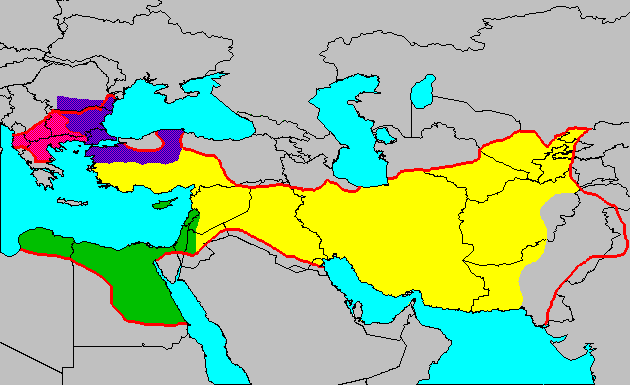
The Hellenistic world, circa 300 B.C. Alexander's empire contained everything within the red lines. It was eventually divided between 4 of his generals as follows: Ptolemy (dark green portion south of Israel), Seleucus (yellow portion north of Israel), Lysimachus (purple), and Cassander (pink). The latter two divisions are not discussed further in Daniel's prophecy as geographically and politically they do not interact with Israel and the Jews to the extent as the Seleucid dynasty (cf Antiochus IV "Epiphanes" and the Ptolemaic dynasty.
THE QUESTION IS THIS...
WHO IS THE "RATHER SMALL HORN"?
This RSH was prophecy to Daniel but is history to us. Again God's sure word of prophecy (2 Peter 1:19) lays out in detail for us and every time God shows the Jews something that is going to come to pass then that should build their faith so that more and more the Jews should understand that IF GOD HAS SPOKEN, THEN IT IS GOING TO HAPPEN!
History shows that the RATHER SMALL HORN is synonymous with the ruler named ANTIOCHUS IV EPIPHANES (175-163 BC) the eighth king of the Seleucid dynasty.
Ed note: Antiochus liked to be called Epiphanes which means Illustrious, but his enemies, the Jews, used a play on words giving him another name, Epimanes which means Madman! His story is told in the Apocryphal books of Maccabees/
In the 150 years that followed Alexander's death up to the time of Antiochus Epiphanes, the Jews began to become enthralled with Greek culture. Remember also that Syria and Egypt are not two separate empires that have nothing to do with the Goat. God sees 4 Horns connected to the Goat and thus as part of Greece, so don't make these 4 Horns other empires but consider them one empire (a leopard with 4 heads...our focus will however be on 2 of those heads - the dynasties begun by Ptolemy in the South and Seleucus in the North)
Over the 150 years following Alexander the Great, the Jews began to slide into apostasy because they neglected the Word of God and His commandments, and in place of His Word they began to substitute the philosophies of men (see notes on Colossians 2:8) such as Plato and Aristotle and they even began to worship the gods of the Greeks (apostasy gave way to idolatry). As a result, instead of living holy, godly lives, they slid into an unholy, ungodly lifestyle. This begs a practical question for each of us...
WHO DO YOU WORSHIP?
I can look at your life and tell you who you worship,
who you give value to and
who you follow.
So in the 170's BC there arises a RSH, God's rod of indignation and judgment on His people. WHY? Because God had repeatedly told them that if they would walk in His way, He would bless them (Blessings and Cursings). In preparation for Israel to enter the promised land God had clearly warned them
"I call heaven and earth to witness against you today, that I have set before you life and death, the blessing and the curse.
So choose life in order that you may live,
you and your descendants, by loving the LORD your God, by obeying His voice, and by holding fast to Him; for this is your life and the length of your days, that you may live in the land which the LORD swore to your fathers, to Abraham, Isaac, and Jacob, to give them." (Deut 30:19-20)
It is important in to distinguish the "rather small horn" (that comes out of the third beast, the four headed leopard of Daniel 7 and out of the "goat" with a "conspicuous horn" in Daniel 8 ) from the "little horn" of Daniel 7 for that "little horn" comes out of the 10 horns (the fourth beast, dreadful and terrible, and not the third beast). To reiterate, do not be confused by some of the commentaries, for these two "horns" clearly do not describe the same individual.
|
COMPARISON OF THE "HORN" |
|
| "Little Horn" Daniel 7 |
"Rather Small Horn" Daniel 8 |
| Origin from fourth beast (Rome) | Origin from third beast (Greece) |
| An eleventh horn that roots up three of the ten horns | A fifth horn, coming out of four conspicuous horns |
| Persecutes God's people for 42 months, time, times, half a time, 1260 days or 3.5 years | Persecutes God's people for 2300 days (over 6 years) |
|
CONCLUSION: The "Little Horn" is not the "Rather Small Horn" |
|
WHO WAS
ANTIOCHUS EPIPHANES?
Small horn = horn that comes out of littleness = a meager beginning = no strong roots or greatness.
ANTIOCHUS ascended to throne after the son of his brother (Seleucus IV Philopater, 187‑175 BC) was murdered by another man. ANTIOCHUS through flattery and bribes seized his brother's throne and grew in power toward the South (Egypt), toward the East (Babylon and Persia) and toward the Beautiful land, Israel.
Antiochus sought to conquer Egypt but ships from Kittim (from Rome) told him that he could not have Egypt or he would be forced into a war with Rome. Antiochus, angry because of this rebuff, headed back northward to his home in Samaria and on his way back through Israel he began to take out his anger on the Jews, wreaking havoc through a reign of treachery and intrigue. For example, he had coins minted with the inscription that stated in part that he was "Theos Epiphanes" or "god manifest" (corresponding perfectly to Daniel's description that the "rather small horn" "even magnified itself to be equal with the Commander of the host (Jehovah Himself)!" Da 8:11). Further desecrating the Jewish religion, Antiochus sold the priesthood to Jason, making the priesthood a political tool that he used as a bribe for Jewish support.

Greek inscription on coin from reign of Antiochus Epiphanes reads "King Antiochus God Manifest (Epiphanes) Victory (Nike) Bearing"
Daniel 8:23 "And in the latter period of their rule, when the transgressors have run their course, a king will arise Insolent and skilled in intrigue. 24 "And his power will be mighty, but not by his own power, and he will destroy to an extraordinary degree and prosper and perform his will. He will destroy mighty men and the holy people. 25 "And through his shrewdness He will cause deceit to succeed by his influence; and he will magnify himself in his heart, and he will destroy many while they are at ease. He will even oppose the Prince of princes, but he will be broken without human agency."
Daniel 8:23‑25 is a description of Antiochus who decreed that all the Jewish sacrifices were to cease (Ed note: In 167 BC Antiochus outlawed the Jewish religion, burned Jerusalem, killed multitudes of Jews, and forbade circumcision and other Jewish observances) On December 16, 167 BC, Antiochus Epiphanes offered a pig, an unclean animal and sacrificed it on the Jew's altar. This was the ultimate sacrilege for a Jew. Furthermore, Antiochus erected a statue of a false god (Zeus) in the sanctuary. He forbade the Jews to make sacrifices to their God. He forbade circumcision (any child found circumcised was hung publicly). He desecrated the Scriptures by putting blasphemous drawings and Greek "gods" on them.
Some of the Jews who had been taken in by the Grecian philosophy came over to Antiochus Epiphanes and were manipulated to his advantage.
HOW WAS HE ABLE TO DECEIVE SOME OF THE JEWS?
BECAUSE they did not STAND FIRM. They did not know the Word of God. They did not know the surety of God's Word and as a consequence did no stand fast upon His sure word of prophecy.
Some Jews which historically are known as the Maccabeans took a stand and said "That is enough!". They revolted against Antiochus and after three years of fighting ("The Maccabean Revolt") secured the Temple in Jerusalem, cleansing it of pagan pollutions, rededicating it to God, and restoring Temple worship. On December 25,165 BC, the festival of lights, known as Hanukkah was instituted to commemorate this triumph over their evil persecutor, Antiochus Epiphanes.
And so we see that there were a group of Jews who knew God's Word and who therefore were willing to take a stand against the evil pagan influences. Sadly, other Jews were ensnared by the pagan philosophy of the Greek culture. To reiterate, what was their problem? They did not know that God's Word is a sure word and what God says will indeed come to pass.
Is this king of Daniel 8:23‑25 the same one as the "little horn" described in the first part of the Daniel 8? Read it and you decide. Remember the vision is true.
Ed note: Many conservative commentaries interpret Daniel 8:23‑25 as having a "double fulfillment", first in Antiochus Epiphanes IV and finally in the Little Horn (Antichrist).
Many students of these verses have noticed striking similarities between Antiochus Epiphanes as described here and another political leader predicted to appear in the future... Therefore they, and I, conclude that these verses are prophetic of the Antichrist as well as of Antiochus. It seems that Antiochus did on a smaller scale what Antichrist will do on a larger one. (Tom Constable. Tom Constable's Expository Notes on the Bible)
The near fulfillment views Antiochus as the historical persecutor as in Da 8:9–14. His career down to 164 b.c. was “in the latter time of their kingdom,” that of the male goat in the Syrian territory. Rome conquered Greece by 146 b.c., only a few years later, and became the next dominant empire. Antiochus died, “broken without human means,” due to insanity and disease of the bowels. The far fulfillment sees Antiochus in Da 8:23–25 as prophetically illustrating the final tribulation period and the Antichrist. (MacArthur, John. The MacArthur Study Bible. Nashville: Word Pub)
|
CORRELATION |
||||
|
IMAGE |
Beasts |
Beasts |
Kingdom |
|
|
TIMES OF THE GENTILES |
Head of Gold |
Winged Lion |
Babylon | |
|
Arms and Breast of Silver |
Bear |
Ram with Two Horns |
Medo-Persia | |
|
Belly and Thighs of Bronze |
Winged, Four-Headed Leopard |
Male Goat with One Great Horn, Four Horns and Little Horn |
Greece | |
|
Legs of Iron |
"D T" Beast |
Rome | ||
|
TIME GAP |
||||
|
Feet and |
Ten Horns |
"Revived Rome" |
||
|
Endures |
Stone That Becomes a Great Mountain |
Messiah and Saints Give and Kingdom |
Kingdom of God |
|
HOW ARE WE TO LIVE IN LIGHT OF THIS HISTORY AND THE CERTAINTY OF GOD'S WORD?
When you walk In darkness
and don't understand what is happening,
"Hold fast the word"
"Be steadfast, immovable, always abounding
in the work of the Lord,
knowing that your toil is not in vain in the Lord"
"Behold, I am coming quickly, and My reward is with Me, to render to every man according to what he has done." (Rev 22:12)
Prayer: Father, thank You for Your Word. Thank You that It's a sure Word of prophecy. Father, may we look at It as a light that shines in a dark place and may we let it be a lamp unto our feet and a light unto our path. In Your Name. Amen