2 Chronicles 34:2
2 Chronicles 34:3
2 Chronicles 34:4
2 Chronicles 34:5
2 Chronicles 34:6
2 Chronicles 34:7
2 Chronicles 34:8
2 Chronicles 34:9
2 Chronicles 34:10
2 Chronicles 34:11
2 Chronicles 34:12
2 Chronicles 34:13
2 Chronicles 34:14
2 Chronicles 34:15
2 Chronicles 34:16
2 Chronicles 34:17
2 Chronicles 34:18
2 Chronicles 34:19
2 Chronicles 34:20
2 Chronicles 34:21
2 Chronicles 34:22
2 Chronicles 34:23
2 Chronicles 34:24
2 Chronicles 34:25
2 Chronicles 34:26
2 Chronicles 34:27
2 Chronicles 34:28
2 Chronicles 34:29
2 Chronicles 34:30
2 Chronicles 34:31
2 Chronicles 34:32
2 Chronicles 34:33
| SECOND CHRONICLES The Kingdom of Israel From Splendor to Disaster |
|||||
| Splendor | Disaster | ||||
| King Solomon of Judah 2 Chronicles 1-9 |
Successive Kings of Judah 2Chr 10-36 |
||||
| Kingdom United |
Kingdom Divided 2Chr 10:1-19 |
Rulers of the Southern Kingdom of Judah After the Split |
The Exile of Judah 2Chr 36:17-23 |
||
| Inaugural
2Chr 1:1-17 |
Solomon's Temple 2Chr 2:1-7:22 |
Solomon's Glory 2Chr 8:1-9:31 |
|||
| Building of the Temple |
Decline & Destruction of the Temple |
Temple Destroyed |
|||
| ~40 Years | ~393 Years | ||||
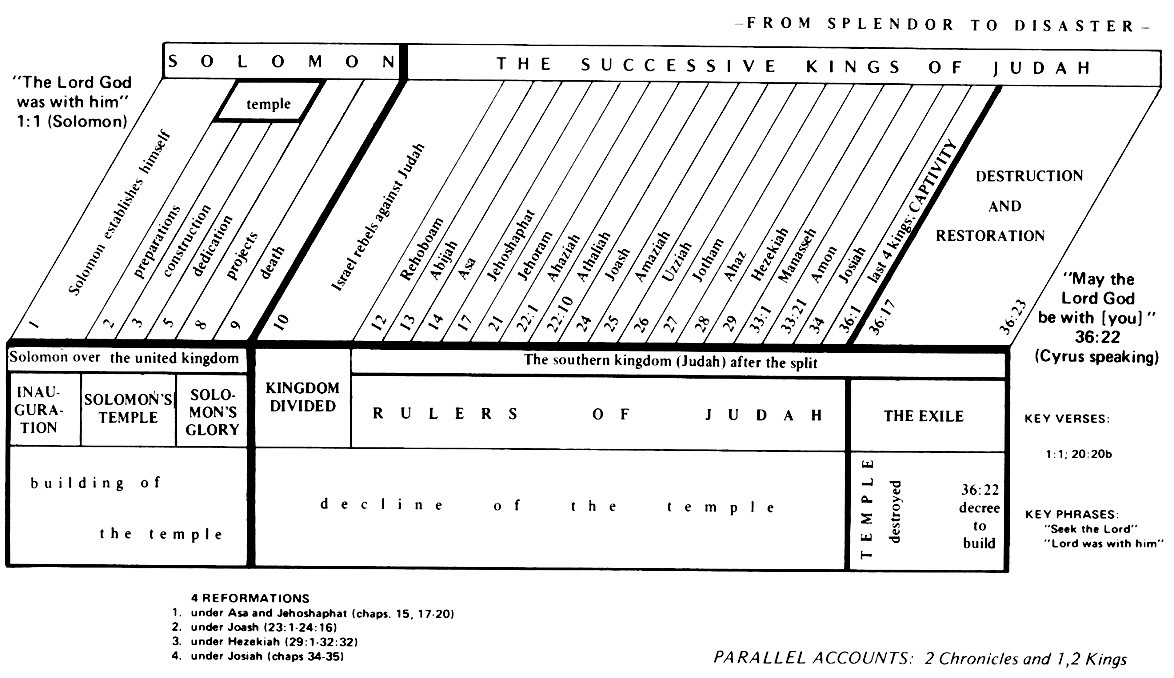
Click chart to enlarge
Chart from Jensen's Survey of the OT - used by permission
Click Chart from Charles Swindoll
|
1107 |
1011 |
971 |
931 |
853 |
722 |
586 |
||||
| 1Samuel | 2 Samuel | 1Kings | 1Kings | 2 Kings | ||||||
|
31 |
1-4 | 5-10 | 11-20 | 21-24 | 1-11 | 12-22 | 1-17 | 18-25 | ||
|
1 Chronicles 10
|
1Chr 11-19 |
1Chr 20-29 |
2 Chronicles |
2 Chronicles |
2 Chronicles |
|||||
|
Legend: B.C. dates at top of timeline are approximate. Note that 931BC marks the division of the Kingdom into Southern Tribes (Judah and Benjamin) and Ten Northern Tribes. To avoid confusion be aware that after the division of the Kingdom in 931BC, the Southern Kingdom is most often designated in Scripture as "Judah" and the Northern Kingdom as "Israel." Finally, note that 1 Chronicles 1-9 is not identified on the timeline because these chapters are records of genealogy. |
||||||||||
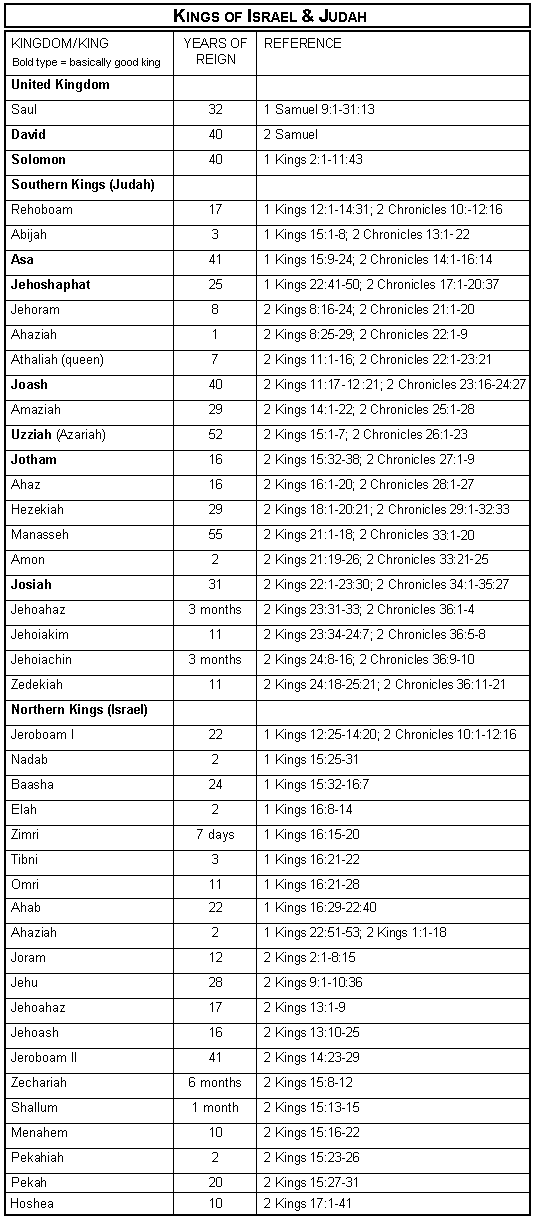
SEE ALSO:
ESV chart - kings of Israel - more information
ESV chart - kings of Judah - more information
Another Chart with Variable Dates for Reigns of Kings
2 Chronicles 34:1 Josiah was eight years old when he became king, and he reigned thirty-one years in Jerusalem.
- Josiah: 2Ch 33:25 1Ki 13:2 2Ki 22:1-20 1Ch 3:14,15 Jer 1:2 Zep 1:1 Mt 1:10,11, Josias
- eight years: 2Ch 24:1 26:1 33:1 1Sa 2:18,26 1Ki 3:7-9 Ec 4:13
- CLICK 2 CHRONICLES COMMENTARIES FOR MULTIPLE SERMONS AND COMMENTARIES
- See BELOW FOR BIBLIOGRAPHY FOR 1-2 CHRONICLES - adapted from Paul Apple's Bible Outlines
Related Passages:
2 Kings 22:1 Josiah was eight years old when he became king, and he reigned thirty-one years in Jerusalem; and his mother’s name was Jedidah the daughter of Adaiah of Bozkath.
Jeremiah 1:1-3 The words of Jeremiah the son of Hilkiah, of the priests who were in Anathoth in the land of Benjamin, 2 to whom the word of the LORD came in the days of Josiah the son of Amon, king of Judah, in the thirteenth year of his reign. 3It came also in the days of Jehoiakim the son of Josiah, king of Judah, until the end of the eleventh year of Zedekiah the son of Josiah, king of Judah, until the exile of Jerusalem in the fifth month.
THE BEGINNING OF
A GODLY REIGN
Josiah was eight years old when he became king, and he reigned thirty-one years in Jerusalem. Josiah became king at only eight years old, which means he began his reign as a child after the assassination of his father Amon (2Ki 21:23–24). Because of his youth, the early years of his reign were likely guided by counselors, priests, or royal advisors. Yet Scripture later shows that Josiah personally sought the Lord from a young age.
Here is a simple summary of the chronology of King Josiah:
- 640 BC: Began to reign (age 8) (2Ch 34:1)
- 632 BC: 8th year (age 16) began to seek God (2Ch 34:3)
- 628 BC: 12th year (age 20) began reforms to purge Jerusalem even BEFORE he heard the Book of the Law! (2Ch 34:3)
- 627 BC: 13th year - Word of the LORD came through Jeremiah in the 13th year of his reign (Jer 1:2)
- 622 BC: 18th yr (age 26) discovery of Book of the Law - Covenant Renewal & Passover (2Ki 23:23 2Ch 34:8, 2Ch 35:19)
- 612 BC: Nineveh falls - Predicted Zeph 2:13–15
- 609 BC: Nothing recorded age 26 to age 39. Josiah falls asleep. Assyrians defeated at Battle of Carchemish, Babylon rises.
A young unnamed prophet from Judah had predicted Josiah's birth, even his name, roughly 300 years before his birth...
1 Kings 13:1-2 Now behold, there came a man of God from Judah to Bethel by the word of the LORD, while Jeroboam was standing by the altar to burn incense. 2 He cried against the altar by the word of the LORD, and said, “O altar, altar, thus says the LORD, ‘Behold, a son shall be born to the house of David, Josiah by name; and on you he shall sacrifice the priests of the high places who burn incense on you, and human bones shall be burned on you.’”
Josiah ruled 31 years (640–609 BC) in Jerusalem, the capital of the southern kingdom of Judah.
John MacArthur - During Josiah’s reign, power in the ancient Near East passed from Assyria to Babylon. Nineveh, the capital of Assyria, was destroyed by the Babylonians in 612 B.C. and the whole Assyrian empire fell in 609 B.C. Josiah was the last good king of the Davidic line prior to the Babylonian exile. Jeremiah (Jer 1:2), possibly Habakkuk, and Zephaniah (Zep 1:1) were prophets to Judah during the reign of Josiah. (See MacArthur Study Bible)
James Barker: I read that at eight years of age, eighty percent of a person's character is formed. The apostle Paul wrote to Timothy, "And that from a child thou hast known the holy scriptures, which are able to make thee wise unto salvation through faith which is in Christ Jesus" (II Timothy 3:15).
Josiah means “Yahweh supports” “Yahweh heals” or “Yahweh upholds” -- “Yo / Yah” (יֹ / יָהוּ) refers to Yahweh (the LORD). The root idea: ʾāšāh / šāh (support / sustain / heal) gives us the sense is to uphold, sustain, or restore. In short Josiah expresses the idea that “The LORD is the One who sustains and restores.” Josiah's name beautifully fits his life for he restored true worship (2 Kings 22–23), he repaired the temple, he brought at least temporary spiritual healing to Judah and he upheld the Law of the LORD. In short Josiah was not just a label but was almost his mission statement.
Matthew Henry Notes: Chapter: 34
Summary During the reign of Josiah, Judah experienced a final opportunity for repentance before judgment. Though he became king at eight (2 Chronicles 34:1) and later “did right in the sight of the LORD” (2 Chronicles 34:2), seeking God from his youth (2 Chronicles 34:3), Josiah led a sweeping reform—destroying idolatry (2 Chronicles 34:3–7), repairing the temple, rediscovering the Law (2 Chronicles 34:14–19), and renewing the covenant (2 Chronicles 34:29–33). Yet despite this sincere revival, the people’s hearts were not fully changed, and after his reign, Judah quickly declined, leading to inevitable judgment (2 Kings 23:25–27).
Before we see Judah and Jerusalem ruined we shall yet see some glorious years, while good Josiah sits at the helm. By his pious endeavours for reformation God tried them yet once more; if they had known in this their day, the day of their visitation, the things that belonged to their peace and improved them, their ruin might have been prevented. But after this reign they were hidden from their eyes, and the next reigns brought an utter desolation upon them. In this chapter we have,
I. A general account of Josiah's character (2Ch 34:1, 2).
II. His zeal to root out idolatry (2Ch 34:3-7).
III. His care to repair the temple (2Ch 34:8-13).
IV. The finding of the book of the law and the good use made of it (2Ch 34:14-28).
V. The public reading of the law to the people and their renewing their covenant with God thereupon (2Ch 34:29-33). Much of this we had 2 Ki. 22.
2Ch 34:1-7 Concerning Josiah we are here told,
1. That he came to the crown when he was very young, only eight years old (yet his infancy did not debar him from his right), and he reigned thirty-one years (v. 1), a considerable time. I fear, however, that in the beginning of his reign things went much as they had done in his father's time, because, being a child, he must have left the management of them to others; so that it was not till his twelfth year, which goes far in the number of his years, that the reformation began, 2Ch 34:3. He could not, as Hezekiah did, fall about it immediately.
2. That he reigned very well (2Ch 34:2), approved himself to God, trod in the steps of David, and did not decline either to the right hand of to the left: for there are errors on both hands.
3. That while he was young, about sixteen years old, he began to seek after God, 2Ch 34:3. We have reason to think he had not so good an education as Manasseh had (it is well if those about him did not endeavour to corrupt and debauch him); yet he thus sought God when he was young. It is the duty and interest of young people, and will particularly be the honour of young gentlemen, as soon as they come to years of understanding, to begin to seek God; for those that seek him early shall find him.
4. That in the twelfth year of his reign, when it is probable he took the administration of the government entirely into his own hands, he began to purge his kingdom from the remains of idolatry; he destroyed the high places, groves, images, altars, all the utensils of idolatry, 2Ch 34:3, 4. He not only cast them out as Manasseh did, but broke them to pieces, and made dust of them. This destruction of idolatry is here said to be in his twelfth year, but it was said (2 Ki. 23:23) to be in his eighteenth year. Something was probably done towards it in his twelfth year; then he began to purge out idolatry, but that good work met with opposition, so that it was not thoroughly done till they had found the book of the law six years afterwards. But here the whole work is laid together briefly which was much more largely and particularly related in the Kings. His zeal carried him out to do this, not only in Judah and Jerusalem, but in the cities of Israel too, as far as he had any influence upon them.
QUESTION - Who was King Josiah in the Bible?
ANSWER - Josiah was the king of Judah from approximately 640 to 609 B.C. His reign in Jerusalem is discussed in 2 Kings 22–23 and 2 Chronicles 34–35. Josiah was the son of King Amon and the grandson of King Manasseh—both of them wicked kings of Judah. Yet Josiah was a godly king and known as one of the world’s youngest kings; he began his reign at age 8 after his father was assassinated. A highlight of Josiah’s reign was his rediscovery of the Law of the Lord.
2 Kings 22:2 introduces Josiah by saying, “And he did what was right in the eyes of the LORD and walked in all the way of David his father, and he did not turn aside to the right or to the left.” In the eighteenth year of his reign, he raised money to repair the temple, and during the repairs the high priest Hilkiah found the Book of the Law. When Shapan the secretary read it to Josiah, the king tore his clothes, a sign of mourning and repentance (2 Kings 22:10–11).
King Josiah called for a time of national repentance. The Law was read to the people of the land, and a covenant made between the people and the Lord: “The king stood by the pillar and made a covenant before the LORD, to walk after the LORD and to keep his commandments and his testimonies and his statutes with all his heart and all his soul, to perform the words of this covenant that were written in this book. And all the people joined in the covenant” (2 Kings 23:3).
Many reforms followed. The temple was cleansed from all objects of pagan worship, and the idolatrous high places in the land were demolished. Josiah restored the observance of the Passover (2 Kings 23:2–23) and removed mediums and witches from the land. 2 Kings 23:25 records, “Before him there was no king like him, who turned to the LORD with all his heart and with all his soul and with all his might, according to all the Law of Moses, nor did any like him arise after him.” God’s wrath would later come upon Judah due to the evil King Manasseh had done (2 Kings 23:25), but the judgment was delayed because of Josiah’s godly life and leadership (2 Kings 22:20).
Josiah died in battle against the Egyptian Pharaoh Necho at Megiddo. King Josiah was buried in Jerusalem in his own tomb, and his son Jehoahaz took the role of king.
Much can be learned from Josiah’s life that is positive. First, Josiah shows the influence a person can have from a very young age. Even children have enormous potential to live for God and to have great impact. Second, Josiah lived a life fully committed and obedient to God and was blessed for it. Third, Josiah properly responded to God’s Word. By the time he became king, the Scriptures had long been neglected, and Josiah’s heart was smitten by the failure of his people to honor God’s Word. Josiah had Scripture read to the people and made a commitment to live by it. “‘Because your heart was responsive and you humbled yourself before the Lord when you heard what I have spoken . . . I also have heard you,’ declares the Lord” (2 Kings 22:19).GotQuestions.org
D A Carson - For the Love of God, Combined Edition, Volumes One and Two (BORROW) - IN THE MEDITATION FOR November 9, I briefly reflected on the reforming zeal of Josiah, who led the last attempt at large-scale reformation in Judah (2 Kings 22). About three-quarters of a century had passed since the death of Hezekiah, but much of this was presided over by Manasseh, whose reign of more than half a century was almost entirely devoted to pagan evil. Now we return to the same event, this time recorded in 2 Chronicles 34. Here we may pick up some additional and complementary lessons.
(1) The rediscovery of the book of the Law (probably Deuteronomy) in the rubbish of the temple discloses to Josiah how dangerous is Judah’s position: the wrath of God hangs over her head. Josiah tears his clothes, repents, and orders reform. Moreover, he instructs his attendants to inquire of the prophetess Huldah (2Ch 34:22) as to how imminent these dangers are. God’s response is that disaster and judgment on Jerusalem are now inevitable—“all the curses written in the book that has been read in the presence of the king of Judah” (2Ch 34:24). The pattern of deliberate and repeated covenantal breach has become so sustained and horrific that judgment must come. However, the Lord adds, “Because your heart was responsive and you humbled yourself before God when you heard what he spoke against this place and its people, and because you humbled yourself before me and tore your robes and wept in my presence, I have heard you” (2Ch 34:27)—and Josiah is assured that the impending disaster will not occur during his lifetime.
There are two obvious lessons here. First, we are afforded a glimpse of what God expects from us if we live in a time of cataclysmic declension: not philosophizing, but self-humbling, transparent repentance, tears, contrition. Second, as so often in the Bible, precisely because God is so slow to anger and so forbearing, he is more eager to suspend and delay the judgment that is the necessary correlative of his holiness than we are to beg him for mercy.
(2) The picture of the king himself calling together the elders of Judah and solemnly reading to them the Scripture (2Ch 34:29–31) is enormously moving. There is nothing that our generation needs more than to hear the Word of God—and this at a time of biblical illiteracy rising at an astonishing rate. Moreover, it needs to hear Christian leaders personally submitting to Scripture, personally reading and teaching Scripture—not in veiled ways that merely assume some sort of heritage of Christian teaching while actually focusing on just about anything else, but in ways that are reverent, exemplary, comprehensive, insistent, persistent. Noth-ing, nothing at all, is more urgent.
PAUL APPLE - BIG IDEA: THE RECOVERY OF THE WORD OF GOD MOTIVATES REFORMATION (Covenant Renewal and Passover)
INTRODUCTION:
Iain Duguid: Josiah is another example of faithfulness expressed in temple worship cleansed of idolatry and performed in accordance with the laws of Moses and the prescriptions of David (2Ch 35:4, 6, 12, 15). He can be compared with Joash (2Ch 24:1–27): both became king as a child, collected funds for temple renovations, and led in covenant renewal, but, unlike Joash, Josiah remained faithful “all his days” (2Ch 34:33). A closer association is with Hezekiah (2Ch 29:1–32:33): in Chronicles only these two kings are said to be like David in doing “what was right in the eyes of the Lord” (2Ch 29:2; 34:2), with their reigns characterized by “good deeds” (2Ch 32:32; 35:26; a form of Heb. hesed, “loyalty, kindness, steadfast love”); and both narratives focus on temple renovation leading to Passover celebration involving people from the whole land. Both kings showed some flaw late in their reign: Hezekiah’s led to his “humbl[ing] himself” and the averting of wrath (2Ch 32:25–26), but Josiah’s led to his death, which through consequent Egyptian control was the beginning of the road to exile (35:20–24). For Kings, Josiah is the greatest king (2 Kings 23:25), while for Chronicles the Passover celebration is the pinnacle, “kept by Josiah, and the priests and the Levites, and all Judah and Israel who were present, and the inhabitants of Jerusalem” (2 Chron. 35:18).
August Konkel: In Chronicles, Josiah begins to seek the Lord in his eighth year, while still in his youth. His efforts to cleanse Jerusalem and Judah of idolatrous worship begin in his twelfth year, the earliest age at which he could officially carry out his duties as a king.
Frederick Mabie: The looming demise of Assyria created a power vacuum in the ancient Near East that Egypt and Babylon were eager to fill, particularly with respect to control of the land bridge known as Israel. Moreover, as a result of the weakening of the Assyrian Empire during the reign of Josiah, Judah began to experience what might be described as “pseudo-independence.” This newfound freedom likely played a significant role in the wide array of reforms enacted by Josiah in both Judah and the former territory of the northern kingdom (2Ch 34:6-7). Josiah’s reforms took place in three periods: his eighth year (ca. 633 BC; 2Ch 34:3), his twelfth year (ca. 629 BC; 2Ch 34:3), and his eighteenth year (ca. 623 BC; 2Ch 34:8). Note that the prophetic ministries of Zephaniah and Jeremiah likely supported the reforms enacted by Josiah.
J.A. Thompson: After a brief introduction (2Ch 34:1-2) the Chronicler’s narrative is presented in five sections spread over 2Ch 34-35:
a) introduction (2Ch 34:1-2);
b) the removal of pagan cults form Jerusalem, Judah, and Israel (2Ch 34:3-7);
c) temple repairs and the discovery of the law book (2Ch 34:8-28);
d) covenant renewal (2Ch 34:29-33); e) Josiah’s Passover (2Ch 35:1-19); and
f) Josiah’s death (2Ch 35:20-27).
2 Chronicles 34:2 He did right in the sight of the LORD, and walked in the ways of his father David and did not turn aside to the right or to the left.
- right in the sight: 2Ch 14:2 17:3 29:2 1Ki 14:8 15:5 2Ki 22:2
- did not turn aside to the right or to the left - De 5:32 17:11,20 28:14 Jos 1:7 23:6 Pr 4:27
Related Passages:
2 Kings 22:2 He did right in the sight of the LORD and walked in all the way of his father David, nor did he turn aside to the right or to the left.
A GOOD RHYME:
DOING RIGHT IN GOD'S SIGHT!
He did right (yashar) in the sight of the LORD (Pr 15:3), and walked in the ways of his father David and did not turn aside to the right or to the left - Note the writer uses 3 descriptions of his godly character - do right, walk right, walk straight! Josiah is notable in that not only did he walk in the ways of his father David, the writer adds a phrase not used of any of the other kings of Judah, not turning aside!
Josiah is a living illustration of the truth of 2Ch 16:9 "For the eyes of the LORD move to and fro throughout the earth that He may strongly support those whose heart is completely His."
🙏 THOUGHT- Oh, to have a heart that is completely His! Not only was that Josiah's heart but he followed the man after God's own heart (Acts 13:22) giving us a great pattern to seek to imitate in the power of the Spirit! LORD, enable us to each be "imitators of those who through faith and patience inherit the promises." In Jesus' Name. Amen. (Heb 6:12)
Right (03477)(yashar from the verb yashar = to be smooth, straight or right) is an adjective that means straight; reliable, level, pleasing; upright; righteous. Yashar only rarely is used literally of that which is straight (Ezek 1:7). Yashar can refer to something physical like a path, but even in those uses is often a metaphorical description of one's conduct or behavior (Ps 107:7). Most uses refer to that which is right in an ethical or an emotional sense, as agreeable or pleasing.
It is fitting that God is the standard of yashar (what is "straight") (Ps 92:15, called the "Upright One" - Isa 26:7). God's Word is described as upright (right) (Ps 19:7) as are His judgments (Ps 119:137) and His way (Ps 107:7). "God made men upright (Ge 1:27), but they have sought out many devices." (Eccl 7:29)
When God tore the kingdom from Solomon for his failure to obey (God had given him a promise conditioned on whether he would "do what is right [yashar]" in God's sight - 1Ki 11:38), he reminded him that he was not like David "who followed Me with all his heart, to do only that which was right (yashar) in My sight." (1Ki 14:8). Again we read "David did what was right (yashar) in the sight of the LORD, and had not turned aside from anything that He commanded him all the days of his life, except in the case of Uriah the Hittite." (1Ki 15:5). We see the phrase "did what was right (yashar) in the sight of the LORD" in the description of a number of the Kings of Judah (Asa - 1Ki 15:11, 2Chr 14:2, Asa's son Jehoshaphat - 1Ki22:43, 2Chr 20:32, Jehoash [Joash] = 2Ki 12:2, 2Chr 24:2, Amaziah = 2Ki 14:3, 2Chr 25:2, Azariah = 2Ki 15:3, Jotham = 2Ki 15:34, 2Chr 27:2, Hezekiah = 2Ki 18:3, 2Chr 29:2, 2Chr 31:20, Josiah = 2Ki 22:2, 2Chr 34:2, Uzziah = 2Chr 26:4) Ahaz "did not do what was right in the sight of the LORD." (2Ki 16:2, 2Chr 28:1)
Invisible Observer
[Josiah] did what was right in the sight of the Lord . . . ; he did not turn aside to the right hand or to the left. --2 Chronicles 34:2
Some people are demanding that the high school football coach in their community be fired because the team doesn't have a winning record. According to the mother of one player, they object to his demand that his players "don't cheat, play dirty, or try to take out an opposing player by hurting him."
I am told that some coaches expect their players to do whatever they think they can get away with to win a game. The primary concern is to escape the eyes of the referees.
Personally, I like the emphasis of the coach who was being criticized for his high standards. He's a Christian, and he wants his players to know that they are being observed by a much higher authority--One who sees everything, including what the referees miss.
The Bible tells us that Josiah "did what was right in the sight of the Lord" (2 Chr. 34:2). Undoubtedly, many people criticized him bitterly for tearing down their religious shrines, but that mattered little. He was more concerned about doing what was right in "the sight of the Lord."
Today, and every day, let's make it our aim to do what is right in the eyes of our invisible and all-important observer in heaven. That's what matters most. --H V Lugt (Reprinted by permission from Our Daily Bread Ministries. Please do not repost the full devotional without their permission.)
Thinking It Over
Have you been tempted to cheat or lie to get what you want? How do you feel when you give in to temptation? How do you feel when you do what is right? Why?
Doing right is never wrong.
Early Influences
[Josiah] did what was right in the sight of the Lord. —2 Chronicles 34:2
Josiah, whose father and grandfather were extremely wicked, became one of the best kings in Judah's history. What made him so different? What made him so committed to doing what was right? Undoubtedly he was influenced by the people who were close to him in his early years. His mother most likely shaped and molded his life, as did the "people of the land" who secured the throne for him when he was only 8 years old (2 Chronicles 33:25-34:1).
The people whose lives touch ours when we are young, or when we become believers, make a great impact on us. Looking back over my 80 years, I can see this clearly. My parents had the greatest influence in my decision to trust Christ at a tender age.
My blind grandmother also touched my life when she talked about the goodness of the Lord and recited Bible passages from memory. Several faithful pastors, school teachers, and others have left an imprint on my life for God and for good.
Thank God for all who helped and guided us as children, and who by their example pointed us to Christ. And let's always do our best to be a Christlike influence on the children and new believers in our lives. —H V Lugt (Reprinted by permission from Our Daily Bread Ministries. Please do not repost the full devotional without their permission.)
Thinking It Over
What people are within my sphere of influence?
Does my example impact others for good or for bad?
Whose example must I follow? (1 Corinthians 11:1).
Our best heritage is a godly example.
How Can A Parent Find Peace Of Mind?
2 Chronicles 34:3 For in the eighth year of his reign while he was still a youth, he began to seek the God of his father David; and in the twelfth year he began to purge Judah and Jerusalem of the high places, the Asherim, the carved images and the molten images.
- while he was still a youth 1Ch 22:5 29:1 Ps 119:9 Ec 12:1 2Ti 3:15
- he began to seek the God of his father David: 2Ch 15:2 1Ch 28:9 Pr 8:17 Mt 6:33
- purge: 2Ch 33:17,22 Lev 26:30 2Ki 23:4,14
- the high places: 2Ch 30:14
Related Passages:
2 Chronicles 33:15 He (MANASSEH) also removed the foreign gods and the idol from the house of the LORD, as well as all the altars which he had built on the mountain of the house of the LORD and in Jerusalem, and he threw them outside the city.
PURSUING GOD LEADS TO
PURGING GODLESSNESS
For in the eighth year of his reign while he was still a youth, he began to seek (darash; LXX - zeteo - investigate, try to find, look for) the God of his father David - Interesting he does not say the God of father Manasseh!
🙏 THOUGHT - Note that qualifying phrase "while he was still a youth." It is never too early to seek the LORD! But as an octagenarian I would add it is never too late to seek the LORD! "Seek the LORD while He may be found; Call upon Him while He is near." (Isaiah 55:6) "‘You will seek Me and find Me when you search for Me with all your heart." (Jer 29:13) "Seek first His kingdom and His righteousness, and all these things will be added to you." (Mt 6:33)
And - This "hinge word" connects the godly actions described below as the natural fruit of godly seeking.
in the twelfth year he began to purge (taher; LXX - katharizo - literally thoroughly clean for sacred use!) Judah and Jerusalem of the high places, the Asherim (Asherah), the carved images and the molten images (massekah) - Josiah had been pursuing the holy God and what was unholy in the kingdom became clearer and clearer, prompting him to begin to take radical action to purge idolatry from the land.
🙏 THOUGHT - Is there not a profound and practical lesson in this passage? Observe the unmistakable pattern: seeking God leads to the purging of sin. This is not merely a historical observation from Josiah’s life—it is a timeless spiritual principle meant to be reproduced in every believer. When our heart is truly set on pursuing God, sin begins to lose its grip. What once attracted, entertained, or entangled gradually becomes distasteful and disentangling! The process is not forced legalism, but the natural outflow of a transformed affection one sees in progressive sanctification. As we draw nearer to Him, His holiness shines the light on our inner person and exposes what is unclean. His beauty eclipses and surpasses what once seemed desirable.
Indeed, this is the divine pattern for sanctification: devotion precedes purification. We do not first cleanse ourselves in order to seek God; rather, as we seek Him, He cleanses us more and more. The more we behold His glory, the more the passing pleasures of sin fade into insignificance (Heb 11:25). As the hymn so beautifully expresses, “the things of earth grow strangely dim in the light of His glory and grace.” Thus, the call is clear: pursue Jesus earnestly, and trust that as you do, His Spirit and Word will faithfully and progressively refine your heart, reorder your desires, and empower you to turn from sin, including that sin that so easily entangles you (Heb 12:1).
Here is the chronology of King Josiah for context:
- 632 BC: 8th year (age 16) began to seek God
- 628 BC: 12th year (age 20) began reforms to purge Jerusalem even BEFORE he heard the Book of the Law!
- 627 BC: Word of the LORD came through Jeremiah in the thirteenth year of his reign
- 622 BC: 18th yr (age 26) discovery of the Book of the Law - Covenant Renewal & Passover (2Ki 23:23 2Ch 34:8, 35:19)
- 612 BC: Nineveh of Assyria falls
- 609 BC: Josiah falls asleep in Jesus. Final Assyrian forces were defeated at Battle of Carchemish
Henry Morris - Josiah was only eight years old when his wicked father, Amon, was slain. Amon had spent very little time with Josiah; in fact Amon himself was only sixteen years old when Josiah was born. After ruling only two years, Amon was slain at the age of twenty-four. Fortunately, Josiah had evidently been more influenced by the later reforms of his grandfather, Manasseh, than by his own immature and rebellious father. Josiah's training had perhaps been delegated to some faithful priest, but not even the latter would have had access to the Scriptures, which were accidentally recovered in the temple when Josiah was twenty-six years old, in the eighteenth year of his reign (2 Chronicles 34:8,15). Nevertheless, he began his great reforms when he was only sixteen years old, illustrating God's faithful ability to raise up His servants and to keep His Word even under the most unlikely of human circumstances.
Seek (search)(01875) darash means to seek, to inquire of, to examine, to require, consult, ask. One of the most frequent uses of this word is in the expression "to inquire of God," which sometimes indicates a private seeking of God in prayer for direction (Gen. 25:22), and often it refers to the contacting of a prophet who would be the instrument of God's revelation (1 Sam. 9:9; 1 Kings 22:8). At other times this expression is found in connection with the use of the Urim and Thummim by the high priest as he sought to discover the will of God by the throwing of these sacred stones (Nu 27:21).
We can get a good sense of one aspect of the meaning of darash when God says "You will seek (baqas; Lxx = ekzeteo intense seeking) Me and find Me when you search (darash; Lxx = zeteo) for Me with all your heart." (Jer. 29:13) What is the condition of seeking Yahweh and finding Him? It is seeking with one's whole heart!
We see a similar nuance in Dt 4:29 "But from there you will seek (baqas; Lxx = zeteo) the LORD your God, and you will find Him if you search (darash; Lxx = ekzeteo intense seeking) for Him with all your heart and all your soul." Notice the importance of the heart in
Norman Geisler - When Critics Ask - 2 CHRONICLES 36:6— If Josiah demolished idolatry, then why does it say Manasseh did it earlier?
PROBLEM: Here we are informed that Josiah destroyed the altars and idols, but earlier (in 2 Chron. 33:15) Manasseh had destroyed them.
SOLUTION: No human king can root out the depraved human desire for idolatry. Therefore, Josiah had to redo the same work that his predecessor had done. A good human king can destroy idols, but not the love of idols. And, as long as this love exists, idolatry will live to rear its ugly head again and again.
QUESTION: Why is idol worship such a powerful temptation? | GotQuestions.org
ANSWER: Ultimately, the answer to this question is “sin.” It is the sin nature of man that causes us to worship modern idols, all of which are, in reality, forms of self-worship. The temptation to worship ourselves in various ways is a powerful temptation indeed. In fact, it is so powerful that only those who belong to Christ and have the Holy Spirit within them can possibly hope to resist the temptation of modern idolatry. Even then, resisting the worship of idols is a lifelong battle that is part of the Christian life (Ephesians 6:11; 1 Timothy 6:12; 2 Timothy 2:3).
When we hear the word idol, we often think of statues and objects reminiscent of those worshiped by pagans in ancient cultures. However, the idols of the 21st century often bear no resemblance to the artifacts used thousands of years ago. Today, many have replaced the “golden calf” with an insatiable drive for money or prestige or "success" in the eyes of the world. Some pursue the high regard of others as their ultimate goal. Some seek after comfort or a myriad of other passionate, yet empty, pursuits. Sadly, our societies often admire those serving such idols. In the end, however, it doesn’t matter what empty pleasure we chase after or what idol or which false god we bow down to; the result is the same—separation from the one true God.
Understanding contemporary idols can help us to understand why they prove to be such a powerful temptation. An idol can be anything we place ahead of God in our lives, anything that takes God’s place in our hearts, such as possessions, careers, relationships, hobbies, sports, entertainment, goals, greed, addictions to alcohol/drugs/gambling/pornography, etc. Some of the things we idolize are clearly sinful. But many of the things we idolize can be very good, such as relationships or careers. Yet Scripture tells us that, whatever we do, we are to “do it all for the glory of God” (1 Corinthians 10:31) and that we are to serve God only (Deuteronomy 6:13; Luke 16:13). Unfortunately, God is often shoved out of the way as we zealously pursue our idols. Worse yet, the significant amount of time we often spend in these idolatrous pursuits leaves us with little or no time to spend with the Lord.
We sometimes also turn to idols seeking solace from the hardships of life and the turmoil present in our world. Addictive behaviors such as drug or alcohol use, or even something like excessive reading or television viewing, may be used as a means of temporarily “escaping” a difficult situation or the rigors of daily life. The psalmist, however, tells us that those who place their trust in this behavior will, essentially, become spiritually useless (Psalm 115:8). We need to place our trust in the Lord “who will keep [us] from all harm” (Psalm 121:7) and who has promised to supply all of our needs when we trust in Him. We also need to remember the words of Paul, who teaches us not to be anxious about anything, but rather to pray about everything so the peace of God, which surpasses all understanding, can guard our hearts and our minds (Philippians 4:6–7).
There is another form of idolatry prevalent today. Its growth is fostered by cultures that continue to drift away from sound biblical teaching, just as the apostle Paul warned us, “For the time will come when men will not put up with sound doctrine” (2 Timothy 4:3). In these pluralistic, liberal times, many cultures have, to a large degree, redefined God. We have forsaken the God revealed to us in Scripture and have recast Him to comply with our own inclinations and desires—a “kinder and gentler” god who is infinitely more tolerant than the One revealed in Scripture. One who is less demanding and less judgmental and who will tolerate many lifestyles without placing guilt on anyone’s shoulders. As this idolatry is propagated by churches around the world, many congregants believe they are worshiping the one, true God. However, these made-over gods are created by man, and to worship them is to worship idols. worshiping a god of one’s own making is particularly tempting for many whose habits and lifestyles and drives and desires are not in harmony with Scripture.
The things of this world will never fully satisfy the human heart. They were never meant to. The sinful things deceive us and ultimately lead only to death (Romans 6:23). The good things of this world are gifts from God, meant to be enjoyed with a thankful heart, in submission to Him and for His glory. But when the gift replaces the Giver or the created replaces the Creator in our lives, we have fallen into idolatry. And no idol can infuse our lives with meaning or worth or give us eternal hope. As Solomon beautifully conveys in the book of Ecclesiastes, apart from a right relationship with God, life is futile. We were created in God’s image (Genesis 1:27) and designed to worship and glorify Him as He alone is worthy of our worship. God has placed “eternity in man’s heart” (Ecclesiastes 3:11), and a relationship with Jesus Christ is the only way to fulfill this longing for eternal life. All of our idolatrous pursuits will leave us empty, unsatisfied, and, ultimately, on the broad road that most people take, the one that leads to destruction (Matthew 7:13).
[Josiah] began to seek the God of his father David. 2 Chronicles 34:3
Today's Scripture & Insight: 2 Chronicles 34:1–8
A stately sunflower stood on its own in the center of a lonely stretch of national highway, just a few feet from the fast lane. As I drove past, I wondered how it had grown there with no other sunflowers visible for miles. Only God could create a plant so hardy it could thrive so close to the roadway in the gray gravel lining the median. There it was, thriving, swaying gently in the breeze and cheerfully greeting travelers as they hurried by.
The Old Testament tells the story of a faithful king of Judah who also showed up unexpectedly. His father and grandfather had enthusiastically served other gods; but after Josiah had been in power for eight years, “while he was still young, he began to seek the God of his father David” (2 Chronicles 34:3). He sent workmen to “repair the temple of the Lord” (v. 8), and as they did they discovered the Book of the Law (the first five books of the Old Testament; v. 14). God then inspired Josiah to lead the entire nation of Judah to return to the faith of their ancestors, and they served the Lord “as long as [Josiah] lived” (v. 33).
Our God is the master of unanticipated mercies. He’s able to cause great good to spring up unexpectedly out of the hard gravel of life’s most unfavorable circumstances. Watch Him closely. He may do it again today. By: James Banks
What mercies have you seen from God that you never anticipated? How does the thought that He’s able to bring about unexpected good give you hope today?
Heavenly Father, I praise You for never changing. Your mercies are “new every morning!” (Lamentations 3:23). Help me to look forward to what You have for me today.
Norman Geisler - When Critics Ask - 2Ch 34:3–5—If Josiah demolished idolatry, then why does it say Manasseh did it earlier?
PROBLEM: Here we are informed that Josiah destroyed the altars and idols, but earlier (in 2 Chron. 33:15) Manasseh had destroyed them.
SOLUTION: No human king can root out the depraved human desire for idolatry. Therefore, Josiah had to redo the same work that his predecessor had done. A good human king can destroy idols, but not the love of idols. And, as long as this love exists, idolatry will live to rear its ugly head again and again.
2 Chronicles 34:4 They tore down the altars of the Baals in his presence, and the incense altars that were high above them he chopped down; also the Asherim, the carved images and the molten images he broke in pieces and ground to powder and scattered it on the graves of those who had sacrificed to them.
- tore down the altars of the Baals: 2Ch 33:3 Ex 23:24 Lev 26:30 De 7:5,25
- images: 2Ch 14:5 2Ki 23:4,5,11
- ground to powder : 2Ch 34:7 Ex 32:20 De 9:21 2Ki 23:12 Ps 18:42 Isa 27:9
- graves: Heb. face of the graves, 2Ki 10:26,27 23:4,6
Related Passages:
Exodus 32:20 He (MOSES) took the calf which they had made and burned it with fire, and ground it to powder, and scattered it over the surface of the water and made the sons of Israel drink it.
JOSIAH ATTACKS
THE IDOLS
They tore down the altars of the Baals in his presence - Josiah is doing in effect what God had commanded Israel to do in Deuteronomy 7:5 “But thus you shall do to them: you shall tear down their altars, and smash their sacred pillars, and hew down their Asherim, and burn their graven images with fire." Two points are worth noting - (1) He had the idols destroyed in his very presence, as if to make absolutely sure there was not even an idol fragment remaining. Indeed, that is what we must all do with our idols! They are like crabgrass and if they are not totally eradicated, pulled up from the roots so to speak, they will certainly return! (2) This action by Josiah appears to be even before he had heard the Book of the Law which had been found. This is fascinating because most writers think what Shaphan read to him was at least the book of Deuternomy and here he is already carrying out God's Word!
and the incense altars that were high above them he chopped down; also the Asherim, the carved images and the molten images he broke in pieces and ground to powder and scattered it on the graves of those who had sacrificed to them - The verbs reflecting Josiah's action are vivid and uncompromising - tore down...chopped down....broke in pieces...ground to powder....scattered it on the graves. This last act would result in defiling the graves of the very ones who had sacrificed to these dead idols. Dead idols defiling dead men, dead physically, but far worse dead spiritually and forever condemned to the Lake of Fire (Rev 20:11-15).
2 Chronicles 34:5 Then he burned the bones of the priests on their altars and purged Judah and Jerusalem.
- he: 1Ki 13:2 2Ki 23:16 Jer 8:1,2
- cleansed: 2Ch 34:7 Nu 35:33 Jer 3:10 4:14 Eze 22:24
THE PUNISHMENT
FITS THE CRIME
Then - Marks progression in the narrative. Josiah is on a roll to cleanse the promised land of perverted idolatry!
He burned the bones of the priests on their altars and purged Judah and Jerusalem. - To ensure the altar could never again be used, Josiah removed bones from the tombs and burned them on their altars. There were two effects: (1) This action fulfilled a prophecy given about the altar approximately 300 years before (1Ki 13:2). As noted earlier, according to Israel’s ceremonial law (Nu 19:16), contact with human bones rendered a person or place ritually unclean. By burning bones on their altars, Josiah deliberately defiled them permanently, ensuring that it could never again function as idolatrous altars.
The punishment is fitted to the crime: the priests who burned sacrifices
to Baal had their own bones burned on the same altar.
J.A. Thompson: Though not explicitly stated, the Chronicler implied that Josiah executed the priests of Baal (cf. 2 Kgs 23:20) following the precedent set by Jehu (2 Kgs 10) and Jehoiada (2Ch 23:17). The punishment is fitted to the crime: the priests who burned sacrifices to Baal had their own bones burned on the same altar. According to 2 Kgs 23:16 the bones of priests who had died were removed from their graves and burned (ON THE ALTAR). (SEE 1, 2 Chronicles: An Exegetical and Theological Exposition)
2 Chronicles 34:6 In the cities of Manasseh, Ephraim, Simeon, even as far as Naphtali, in their surrounding ruins,
- in: 2Ch 30:1,10,11 31:1 2Ki 23:15-20
- mattocks: or, mauls, 1Sa 13:20,21 Pr 25:18 Isa 7:25
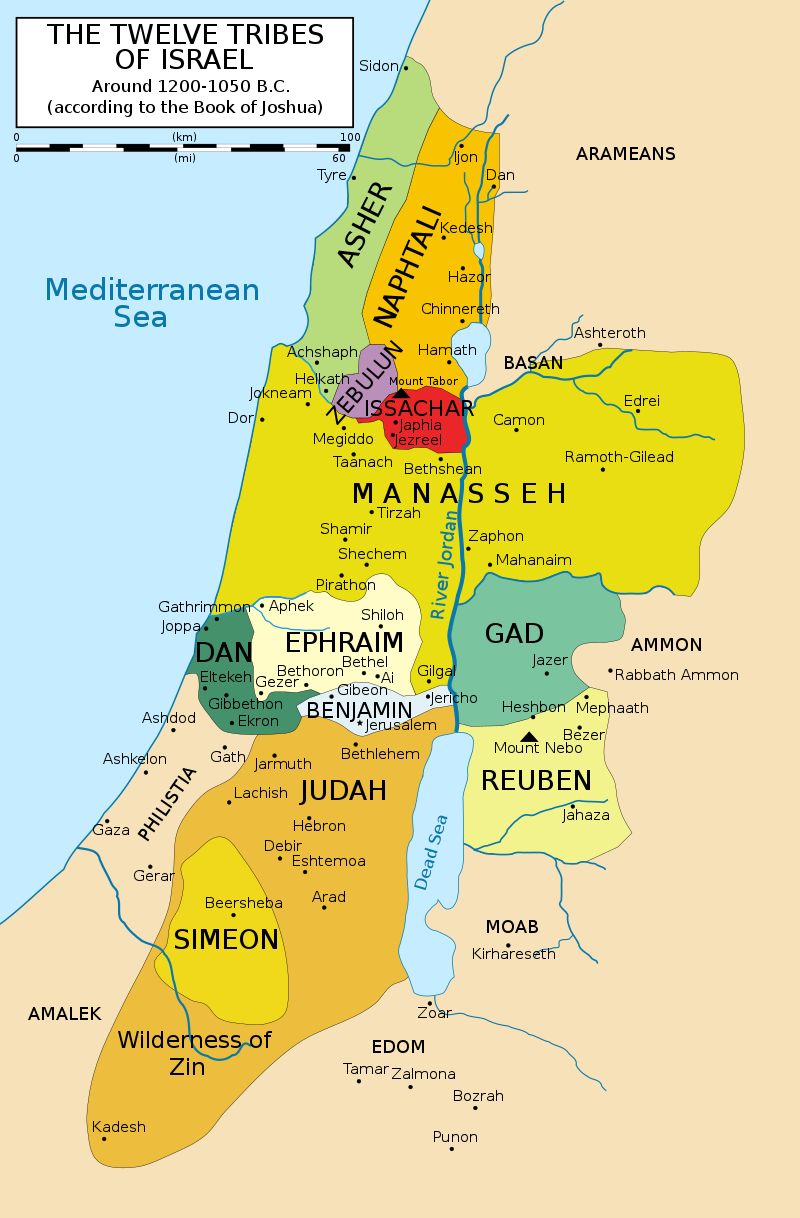
JOSIAH GOES NORTH
TO "CLEAN HOUSE"
In the cities of Manasseh, Ephraim, Simeon, even as far as Naphtali, in their surrounding ruins - See locations on map. These are areas that were in the Northern Kingdom that had been defeated by the Assyrians in 722 BC. The Assyrian power at the time of Josiah was waning and this likely allowed Josiah to move freely into the Northern Kingdom, where there clearly remained some Israelite citizens.
Henry Morris - Josiah's revivals extended far beyond his own nation (Judah, Benjamin, Levi) deep into the territories of the other tribes (see 2 Chronicles 15:9; 30:11,12). In fact only the tribes of Reuben, Gad and Dan are not specifically mentioned in 2 Chronicles as having come in some degree under the influence of Judah and Jerusalem and the true worship of God during the period of the divided kingdom.
Raymond Dillard: The Assyrian empire was in an advanced stage of disintegration by Josiah’s twelfth year (628 B.C.). Nineveh itself was under siege by Cyaxares and the Medes in 625 B.C. The Babylonians were newly independent, and mountain tribes from the north were raiding former Assyrian territory. During the death throes of the Assyrian empire the territories of the Northern Kingdom became a “no man’s land” (Soggin, 245). It is intrinsically probable in these circumstances that Josiah would seek to extend his control and influence into Israel (2Ch 34:6), even as far as the Upper Galilee (Naphtali) (See 2 Chronicles, Volume 15 - Page 278)
2 Chronicles 34:7 he also tore down the altars and beat the Asherim and the carved images into powder, and chopped down all the incense altars throughout the land of Israel. Then he returned to Jerusalem.
- beat: 2Ch 34:1 De 9:21
- he returned: 2Ch 31:1
IDOL ALTARS ALTERED
BY KING JOSIAH
He also tore down the altars and beat the Asherim and the carved images into powder, and chopped down all the incense altars throughout the land of Israel - Josiah cleared the idols out of the entire Northern Kingdom! Note the dramatic verbs. The language is intentionally vivid and forceful -- he tore down, crushed, ground to powder, and chopped down. These are not casual reforms but aggressive, decisive actions aimed at total eradication. Josiah was not content with mere removal; he sought complete destruction, reducing these objects of false worship to dust so they could never again become a snare. His actions reflect a holy intolerance for idolatry and a determination to restore exclusive devotion to the LORD throughout all Israel.
Then he returned to Jerusalem - A job well done allowed him to return home. But don't miss the fact that Josiah did not send others to do his purging but was personally presence to assure the purging was complete.
2 Chronicles 34:8 Now in the eighteenth year of his reign, when he had purged the land and the house, he sent Shaphan the son of Azaliah, and Maaseiah an official of the city, and Joah the son of Joahaz the recorder, to repair the house of the LORD his God.
- the eighteenth: Jer 1:2,3
- sent Shaphan: 2Ki 22:3,12,14 Jer 26:24 29:3 36:10 39:14 40:11 Eze 8:11
- Maaseiah: Jer 21:1 29:21,25
- recorder: 2Sa 8:16 20:24 1Ch 18:15
Related Passages:
2 Kings 22:3 Now in the eighteenth year of King Josiah, the king sent Shaphan, the son of Azaliah the son of Meshullam the scribe, to the house of the LORD saying,
REFORMS WELL UNDER WAY
NOW REPAIR THE TEMPLE
Now in the eighteenth year of his reign, when he had purged the land and the house - Idols had been largely eradicated. Now Josiah turns his attention to God's house.
Chronology repeated
- 632 BC: 8th year (age 16) began to seek God
- 628 BC: 12th year (age 20) began reforms to purge Jerusalem even BEFORE he heard the Book of the Law!
- 627 BC: Word of the LORD came through Jeremiah in the thirteenth year of his reign
- 622 BC: 18th yr (age 26) discovery of the Book of the Law - Covenant Renewal & Passover (2Ki 23:23 2Ch 34:8, 35:19)
- 612 BC: Nineveh of Assyria falls
- 609 BC: Josiah falls asleep in Jesus. Final Assyrian forces were defeated at Battle of Carchemish
He sent Shaphan the son of Azaliah, and Maaseiah an official of the city, and Joah the son of Joahaz the recorder, to repair the house of the LORD his God - This would turn out to be one of the most monumental years of Josiah's life. It had been over 200 years since there is any record of repair on the Temple (see Joash below) and during the long reign of Manasseh, the Temple was ignored for the majority of his reign, falling into disrepair.
Joash (c. 835–796 BC) initiated a major restoration of the temple (2Ki 12:4-16; 2Ch 24:4-14) after it had fallen into disrepair during the reigns of Athaliah and earlier apostate kings. Funds were collected (including the famous “chest at the doorway”), and the structure was repaired and restored.
Bob Utley - "in the eighteenth year" The reform apparently started in the eighth year (cf. 2 Chr. 34:3-8), therefore, it had been ongoing for ten years already.
In other words the discovery of the Book of the Law was not the impetus for many of Josiah's reforms which were already taking place.
Josiah’s reforms were both begun and to a large extent
complete before Hilkiah’s discovery of the Book of the Law
Dale Ralph Davis points out that "The writer of Kings focuses on Josiah’s eighteenth year (2Ki 22:3; 23:23); apparently he highlights one year of Josiah’s reign to give a flavor of the whole. And in his narrative it looks like Josiah’s reforms (2Ki 23:4–20) are the consequence of the discovery of the Book of the Law and the covenant renewal. Note, however, the broad order of 2 Kings compared with that of 2 Chronicles: (1) Law discovery, 2Ki 22:3–20 versus Worship reform, 2Ch 34:3–7
|
2 KINGS |
2 CHRONICLES |
|
Law discovery, 2Ki 22:3–20 |
Worship reform, 2Ch 34:3–7 |
|
Covenant renewal, 2Ki 23:1–3 |
Law discovery, 2Ch 34:8–28 |
|
Worship reform, 2Ki 23:4–20 |
Covenant renewal, 2Ch 34:29–33 |
|
Passover celebration, 2Ki 23:21–23 |
Passover celebration, 2Ch 35:1–19 |
Dale Ralph Davis goes on to point out - Here are clues to the interests of the respective writers: Chronicles spends far more time on the Passover than Kings, while Kings gives far more space to the purification of worship, something Chronicles briefly summarizes. However, though not fixated on chronology, the Chronicler does give us more chronological precision on the worship reforms (= 2Ch 34:3–7): (1) In Josiah’s eighth year (632 BC, when he was sixteen years old) he ‘began to seek the God of David his father’ (2Ki 22:3a); (2) in his twelfth year (628 BC, at twenty years old) he ‘began to purge’ Judah and then extended his image/altar-bashing to the former northern kingdom (2Ki 22:3–7); and (3) in his eighteenth year (622 BC, at twenty-six years of age) came the discovery of the Book of the Law and renewal of the covenant (2Ki 22:8ff.). Chronicles is clear: Josiah’s reforms were both begun and to a large extent complete before Hilkiah’s discovery of the Book of the Law. Why does Kings relate them after that discovery, giving the impression that the Book of the Law drove those reforms? Is that not deceptive or misleading? So we need to look at 2 Kings again. First, note that Kings implies that Josiah’s reforms were underway before Hilkiah’s discovery of the Law (2Ki 22:3–7), for it would seem likely that repairing the temple also involved at least some purging of the temple. Secondly, note that the covenant renewal (2Ki 23:1–3) and the Passover celebration (23:21–23) are specifically tied to the book that was found (2Ki 23:2, 3, 21), as are the reforms of 2Ki 22:24, but that nothing in the reforms of 2Ki 23:4–20 is related to that book. Thirdly, anyone in a reflective mood might wonder whether all the reforms (and travel required) in 2Ki 23:4–20 could have been carried out within the confines of one year (the eighteenth year of Josiah’s reign). Hence, I think the writer of Kings has left us clues about what he is doing in 2Ki 23:4–20: he is giving us a topical survey of Josiah’s reforms out of strict chronological order (a perfectly legitimate practice, by the way).13 . (BORROW 2 Kings : the power and the fury - may need to refresh page to view)
Raymond Dillard: In Chronicles the discovery of the law book in the temple was one incident in the course of a larger reform, whereas in Kings it was the precipitating incident and primary motivation for the entire reform. (See 2 Chronicles, Volume 15 - Page 279)
Frederick Mabie: The Chronicler emphasizes the involvement of the whole community through the giving of funds by both Judeans and those from the prior northern kingdom tribal areas (2Ch 34:9), the skill and commitment (“faithfulness”) shown by those involved in the refurbishment process itself (cf. 2Ch 34:10-13; vv. 16-17; cf. 2Ki 22:7), and the oversight provided by the high priest and Levites (2Ch 34:9, 12-13). (See The Expositor's Bible Commentary: 1 Chronicles-Job - Page 314)
John Schultz: It sounds amazing that it took so long before Josiah’s attention became fixed upon the place that should have been the center of Yahweh worship. It wasn’t until Josiah’s eighteenth year on the throne of Judah that the temple in Jerusalem came into focus. The extent of idol worship and the fact that the country had been littered by altars dedicated to various gods, must have taken most of the king’s attention up to this time. (2 Chronicles Commentary - 239 pages)
Matthew Henry Notes: Verses: 8-13
Summary: Josiah ordered the repair of the temple after first cleansing it from corruption, illustrating the principle that purification must precede restoration—just as the heart must be cleansed from sin before being renewed. Funds were gathered and entrusted to faithful workers and skilled overseers who carried out the work with diligence and integrity. The passage highlights the value of different roles—laborers and leaders—working together harmoniously, each contributing their God-given abilities for the good of the whole and the glory of God.
Here,
1. Orders are given by the king for the repair of the temple, 2Ch 34:8. When he had purged the house of the corruptions of it he began to fit it up for the services that were to be performed in it. Thus we must do by the spiritual temple of the heart, get it cleansed from the pollutions of sin, and then renewed, so as to be transformed into the image of God. Josiah, in this order, calls God the Lord his God. Those that truly love God will love the habitation of his house.
2. Care is taken about it, effectual care. The Levites went about the country and gathered money towards it, which was returned to the three trustees mentioned, 2Ch 34:8. They brought it to Hilkiah the high priest (2Ch 34:9), and he and they put it into the hands of workmen, both overseers and labourers, who undertook to do it by the great, as we say, or in the gross, 2Ch 34:10, 11. It is observed that the workmen were industrious and honest: They did the work faithfully (2Ch 34:12); and workmen are not completely faithful if they are not both careful and diligent, for a confidence is reposed in them that they will be so. It is also intimated that the overseers were ingenious; for it is said that all those were employed to inspect this work who were skilful in instruments of music; not that their skill in music could be of any use in architecture, but it was an evidence that they were men of sense and ingenuity, and particularly that their genius lay towards the mathematics, which qualified them very much for this trust. Witty men are then wise men when they employ their wit in doing good, in helping their friends, and, as they have opportunity, in serving the public. Observe, in this work, how God dispenses his gifts variously; here were some that were bearers of burdens, cut out for bodily labour and fit to work. Here were others (made meliori luto-of finer materials) that had skill in music, and they were overseers of those that laboured, and scribes and officers. The former were the hands: these were the heads. They had need of one another, and the work needed both. Let not the overseers of the work despise the bearers of burdens, nor let those that work in the service grudge at those whose office it is to direct; but let each esteem and serve the other in love, and let God have the glory and the church the benefit of the different gifts and dispositions of both.
2 Chronicles 34:9 They came to Hilkiah the high priest and delivered the money that was brought into the house of God, which the Levites, the doorkeepers, had collected from Manasseh and Ephraim, and from all the remnant of Israel, and from all Judah and Benjamin and the inhabitants of Jerusalem.
- Hilkiah: 2Ch 34:14,15,18,20,22 2Ki 22:4 23:4
- they delivered: 2Ch 24:11-14 2Ki 22:5-7 Php 4:8
- Manasseh: 2Ch 30:10,18 31:1
- and they returned: Instead of {wyyashuvoo}, "and they returned," as the Keri has, we should, with the Kethiv, read {weyoshevey,} "and the inhabitants of;" a reading which is supported by many MSS,; printed editions, and all the versions, as well as necessity and common sense. 2Ch 34:7
Related Passages:
2 Kings 22:4 “Go up to Hilkiah the high priest that he may count the money brought in to the house of the LORD which the doorkeepers have gathered from the people.
AN ORDERLY COLLECTION
AND DISTRIBUTION
They came to Hilkiah the high priest and delivered the money that was brought into the house of God, which the Levites, the doorkeepers, had collected from Manasseh and Ephraim, and from all the remnant of Israel, and from all Judah and Benjamin and the inhabitants of Jerusalem. - This describes how the funds for repairing the temple were gathered and properly delivered. The Levites, specifically the doorkeepers who were stationed at the temple gates, collected money that had been contributed by the people. What is striking is the wide scope of participation, so that the offerings came not only from Judah and Benjamin (the Southern Kingdom), but also from Manasseh, Ephraim, and “all the remnant of Israel”, that is, survivors from the former Northern Kingdom after the Assyrian exile.
The Levites carefully collected the money, and it was formally delivered to Hilkiah. This shows integrity, accountability, and order in handling what belonged to God. These collected funds were then brought to Hilkiah the high priest, indicating that the process was orderly, accountable, and centered in proper spiritual leadership. The money was not handled casually, but was entrusted to those responsible for overseeing the work of restoring the house of God.
Even though the kingdom had long been divided, this moment shows a spiritual reunification. People from the north (Manasseh, Ephraim) joined with Judah in supporting the temple. This reflects a shared identity as the people of Yahweh despite political division. Giving sacrificially to restore the temple demonstrates that the people’s hearts were being stirred. True revival is not just outward reform—it includes willing participation and generosity.
QUESTION - Who was Hilkiah in the Bible?
SUMMARY - Hilkiah means “Yahweh is my portion,” a fitting name for a priest since the Levites had no land inheritance—the Lord Himself was their inheritance (Deut. 18:1–2). The name ultimately reflects a timeless truth: God Himself—not status, possessions, or achievement—is the believer’s true inheritance.
ANSWER - The name Hilkiah literally means “portion of YHWH” or “YHWH is my portion.” This name would be especially fitting for a priest because, in Deuteronomy 18:1–2, God says that the tribe of Levi will not receive an allotment of land, but “the Lord himself is their inheritance.” The Levites’ identity would not be found in a physical territory in Israel but in their service to the God of Israel. Likewise, the Lord took the Levites as a special offering to Himself, instead of the firstborn from all the other tribes (Numbers 3:12). So, the Lord was the inheritance of the Levites, and the Levites were a special offering to the Lord. Of course, all of the priests came from the tribe of Levi.
The name Hilkiah is used 31 times in the Old Testament to refer to several different individuals.
In Nehemiah 12:7, Hilkiah is listed as one of the priests during the time of Joshua the high priest after the exile.
In 1 Chronicles 26:11 Hilkiah is listed as one of the gatekeepers in the temple.
The palace administrator under Hezekiah is Eliakim, son of Hilkiah (2 Kings 18:18, 26, 37; Isaiah 22:20; 36:3, 22). Eliakim figures into the story somewhat prominently, but we know little about Hilkiah other than he was the father of the palace administrator.
The most prominent of the Bible’s Hilkiahs is the priest who served under King Josiah. He is the one who found the Book of the Law when the temple was being restored. He helped Josiah in collecting money to repair the temple and to enact the reforms that were necessary (2 Kings 22:4, 8, 10, 12, 14; 23:4, 24; 2 Chronicles 34:9, 1, 15, 18, 20, 22; 35:8).
We are told that Jeremiah is the son of Hilkiah (Jeremiah 1:1). We do not know if he is the same Hilkiah that found the Book of the Law. Based on the fact that Jeremiah began his ministry during the reign of Josiah (Jeremiah 1:1–3), that link is possible. However, since Hilkiah is such a prominent figure, and Jeremiah’s father is simply described as “one of the priests at Anathoth in the territory of Benjamin” instead of “a priest in Jerusalem” or “the one who found the Book of the Law,” it is perhaps unlikely.
In the final analysis, the men named Hilkiah in the Old Testament all play supporting roles in the unfolding of God’s story. Some seem to be minor players, and some are known simply as the father of a more prominent son. Even Hilkiah the priest who served under Josiah, the most prominent Hilkiah in the Old Testament, still had a supporting role. This is entirely appropriate for someone named Hilkiah, “the Lord is my portion—my inheritance.” (cf Ps 73:25, 26)
In a sense, every Christian should be a Hilkiah. It is the Lord, not an earthly inheritance or a great name for ourselves (even if the great name is built in ministry) that we should be pursuing. Saul the Pharisee was a man who was making a name for himself. He had a stellar religious pedigree and was zealous in service and obedience to the law (Philippians 3:4–6). Yet, compared to Christ, none of that meant anything to him. “But whatever were gains to me I now consider loss for the sake of Christ. What is more, I consider everything a loss because of the surpassing worth of knowing Christ Jesus my Lord, for whose sake I have lost all things. I consider them garbage, that I may gain Christ and be found in him, not having a righteousness of my own that comes from the law, but that which is through faith in Christ—the righteousness that comes from God on the basis of faith” (Philippians 3:7–9).GotQuestions.org
2 Chronicles 34:10 Then they gave it into the hands of the workmen who had the oversight of the house of the LORD, and the workmen who were working in the house of the LORD used it to restore and repair the house.
- into the hands: 2Ki 12:11,12,14 22:5,6 Ezr 3:7
Related Passages:
2 Kings 22:5 “Let them deliver it into the hand of the workmen who have the oversight of the house of the LORD, and let them give it to the workmen who are in the house of the LORD to repair the damages of the house,
WORKERS COMPENSATED
FOR TEMPLE REPAIRS
Then they gave it into the hands of the workmen who had the oversight of the house of the LORD, and the workmen who were working in the house of the LORD used it to restore and repair the house. This verse describes the orderly and trustworthy process of restoring the temple. After the money was collected and brought to the proper authorities, it was entrusted to the overseers who were responsible for supervising the work on the house of the LORD. These overseers then directed the skilled workmen, who used the funds to carry out the actual repairs and restoration. The work was not chaotic. There was a clear chain: people → Levites → priests → overseers → workmen. Some gave, some oversaw, others labored. All were essential to ensure the integrity of God's house (and that is still the Biblical pattern!)
J.A. Thompson: The temple obviously needed more than a simple “cleansing.” It apparently had fallen into a state of disrepair, as indicated by the need for carpenters and stonemasons. Manasseh and Amon had seriously neglected the temple. (See 1, 2 Chronicles: An Exegetical and Theological Exposition)
2 Chronicles 34:11 They in turn gave it to the carpenters and to the builders to buy quarried stone and timber for couplings and to make beams for the houses which the kings of Judah had let go to ruin.
- floor: or, rafter
- the kings: 2Ch 33:4-7,22
They in turn gave it to the carpenters and to the builders to buy quarried stone and timber for couplings and to make beams for the houses which the kings of Judah had let go to ruin.
2 Chronicles 34:12 The men did the work faithfully with foremen over them to supervise: Jahath and Obadiah, the Levites of the sons of Merari, Zechariah and Meshullam of the sons of the Kohathites, and the Levites, all who were skillful with musical instruments.
- faithfully: 2Ch 31:12 2Ki 12:15 22:7 Ne 7:2 Pr 28:20 1Co 4:2
- all: 1Ch 6:31-48 15:16-22 16:4,5,41 23:5 25:1-31
FAITHFUL AND SKILLFUL
WORKERS ON GOD'S TEMPLE
The men did the work faithfully with foremen over them to supervise: Jahath and Obadiah, the Levites of the sons of Merari, Zechariah and Meshullam of the sons of the Kohathites, and the Levites, all who were skillful with musical instruments - The workers were trustworthy, diligent, and dependable. They did not cut corners or misuse resources—they carried out their task with integrity before God. Faithfulness, not fame, is what God desires (Heb 11:6). God’s work includes both laborers and leaders, and both roles matter. It is noteworthy that those who were skilled in worship were also capable leaders in practical matters.
Raymond Dillard: A considerable interest in the Levites, and especially the Levitical musicians, is a hallmark of the Chronicler’s history; the note that musicians would be in charge of the construction work shows just how concerned the Chronicler was to stress that the entire work was done under Levitical supervision. The use of music during a construction project is well attested from the ancient Near East (Rudolph, 323); it set the pace for the various tasks much as the ubiquitous radios on a contemporary construction site. While the Levitical musicians may have accompanied the work, the Chronicler does not specifically mention this task; he describes instead a supervisory role. (See 2 Chronicles, Volume 15 - Page 280)
PHILLIPS BROOKS. You cannot set the world right, or the times, but you can do something for the truth; and all you can do will certainly tell if the work you do is for the Master, Who gives you your share, and so the burden of responsibility is lifted off. This assurance makes peace, satisfaction, and repose possible even in the partial work done upon earth. Go to the man who is carving a stone for a building; ask him where is that stone going, to what part of the temple, and how is he going to get it into place, and what does he do? He points you to the builder’s plans. This is only one stone of many. So, when men shall ask where and how is your little achievement going into God’s plan, point them to your Master, Who keeps the plans, and then go on doing your little service as faithfully as if the whole temple were yours to build.
2 Chronicles 34:13 They were also over the burden bearers, and supervised all the workmen from job to job; and some of the Levites were scribes and officials and gatekeepers.
- the bearers: 2Ch 2:10,18 8:10 Ne 4:10
- and of the Levites: 1Ch 23:4,5
- scribes: Ezr 7:6 Jer 8:8 Mt 26:3
- officers: 2Ch 19:11 1Ch 23:4 26:29,30
- porters: 2Ch 8:14 1Ch 9:17 15:18 16:38,42 26:1-19 Ezr 7:7
They were also over the burden bearers, and supervised all the workmen from job to job; and some of the Levites were scribes and officials and gatekeepers.
2 Chronicles 34:14 When they were bringing out the money which had been brought into the house of the LORD, Hilkiah the priest found the book of the law of the LORD given by Moses.
- Hilkiah: 2Ki 22:8-20 De 31:24-26
- the law: 2Ch 12:1 31:4 35:26 De 17:18,19 Jos 1:8 Ezr 7:10 Ps 1:2 Isa 5:24 Isa 30:9 Jer 8:8 Lu 2:39
- Moses: Heb. the hand of Moses, Lev 8:36 10:11 26:46
HILKIAH FINDS THE
BOOK OF THE LAW
When they were bringing out the money which had been brought into the house of the LORD, Hilkiah the priest found the book of the law of the LORD given by Moses - What this book consisted of is not certain, but clearly it was the Word of God because it pierced Josiah's heart like only the Word can do.
Spurgeon -This was a very remarkable find. Of all the discoveries that they might have made, they could have discovered nothing that would work so much good to all the people as this “book of the law of the Lord given by Moses.”
Henry Morris - Some critics have popularized the notion that this was the time that the book of the law (especially the "Deuteronomic" document mentioned in the JEDP documentary theory) was first written and then made to look old. The "discovery" of the law was feigned by the priests, supposedly to gain influence over the king. This theory is best refuted merely by an open-minded reading of the Pentateuch, with its innumerable marks of authenticity, internal consistency, and archaeological confirmation.
Frederick Mabie: This episode often comes as a surprise to readers who cannot imagine a scroll of the OT being “lost” in the temple. However, the foundation and walls of temples in the biblical world were commonly used as repositories for dedicatory inscriptions, administrative documents, building plans, and religious texts. . . Despite no shortage of speculation, the exact identification of this book is not possible to determine. Points of comparison can be drawn with Exodus (e.g., Ex 20-24), Leviticus (e.g., Lev 26), Numbers (e.g., Nu 9-10), and Deuteronomy (e.g., Dt 28-31). Given the content of the subsequent narrative, it is probably preferable simply to conclude that some or all of the Pentateuch was discovered at this time. (See The Expositor's Bible Commentary: 1 Chronicles-Job - Page 316 includes comments thru v33)
Martin Selman: It is traditionally identified with Deuteronomy, though probably not the whole book, since it was read twice in one day (2 Kgs 22:8, 10). . . One of the strongest inks with Deuteronomy is its repeated references to a Book of the Law (Deut. 28:61; 29:21; 30:10; 31:26; cf. Josh. 1:8; 8:31, 34; 23:6; 24:26). Another is the phrase all the curses written in (v. 24; in place of “everything written in”, 2 Kgs 22:16), referring to the contents of the Book of the Law in Deuteronomy 29:20, 21, 27; Josh. 8:34. Further connections with Deuteronomy include the centralizing of worship (2Ch 34:3-7, 33; cf. Deut. 12), the centralized Passover (2Ch 35:1-19; cf. Deut. 16:1-8), and above all the covenant ceremony (2Ch 34:29-32; cf. Deut. 31:10-13). Hilkiah’s scroll was also recognized as having Moses’ authority (v. 14), just like the Book of the Law in Joshua’s day (Josh. 8:31, 34; 23:6), and there is little doubt that its antiquity increased its sense of authority. (See 2 Chronicles: An Introduction and Commentary - Page 553)
David Guzik: According to Jeremiah 1:1-2, the prophet Jeremiah was the son of this particular priest Hilkiah. Jeremiah began his ministry during the reign of King Josiah.
Matthew Henry Notes: Verses: 14-28
SUMMARY - This passage recounts the rediscovery of the Book of the Law and its powerful impact on King Josiah, drawing out enduring lessons for all generations. First, it calls us to gratitude that God’s Word is now abundant and accessible—no longer rare, but freely flowing like life-giving waters—making our accountability greater if we neglect it. Second, Josiah’s response models the proper posture toward Scripture: a tender, responsive heart marked by humility, conviction, and reverent fear, reminding us that familiarity with God’s Word must never dull its weight upon our souls. Third, it teaches that conviction of sin should drive us to seek the Lord earnestly, asking what we must do, trusting that He has provided His revealed Word as our guide. Fourth, it warns that persistent sin brings inevitable judgment upon individuals and nations, kindling the unquenchable fire of divine wrath. Finally, it offers hope: those who humble themselves before God, as Josiah did, find mercy for their own souls, and even death becomes a gracious deliverance from coming judgment—transformed into a promise of peace rather than a cause for fear.
1. We may hence take occasion to bless God that we have plenty of Bibles, and that they are, or may be, in all hands,-that the book of the law and gospel is not lost, is not scarce,-that, in this sense, the word of the Lord is not precious. Bibles are jewels, but, thanks be to God, they are not rarities. The fountain of the waters of life is not a spring shut up or a fountain sealed, but the streams of it, in all places, make glad the city of our God. Usus communis aquarum-These waters flow for general use. What a great deal shall we have to answer for if the great things of God's law, being thus made common, should be accounted by us as strange things!
2. We may hence learn, whenever we read or hear the word of God, to affect our hearts with it, and to get them possessed with a holy fear of that wrath of God which is there revealed against all ungodliness and unrighteousness of men, as Josiah's tender heart was. When he heard the words of the law he rent his clothes (2Ch 34:19), and God was well pleased with his doing so, 2Ch 34:27. Were the things contained in the scripture new to us, as they were here to Josiah, surely they would make deeper impressions upon us than commonly they do; but they are not the less weighty, and therefore should not be the less considered by us, for their being well known. Rend the heart therefore, not the garments.
3. We are here directed when we are under convictions of sin, and apprehensions of divine wrath, to enquire of the Lord; so Josiah did, 2Ch 34:21. It concerns us to ask (as they did, Acts 2:37), Men and brethren, what shall we do? and more particularly (as the jailor), What must I do to be saved? Acts 16:30. If you will thus enquire, enquire (Isa. 21:12); and, blessed be God, we have the lively oracles to which to apply with these enquiries.
4. We are here warned of the ruin that sin brings upon nations and kingdoms. Those that forsake God bring evil upon themselves (2Ch 34:24, 25), and kindle a fire which shall not be quenched. Such will the fire of God's wrath be when the decree has gone forth against those that obstinately and impenitently persist in their wicked ways. (ED: AMERICA BEWARE! REPENT! PRAY FOR REVIVAL!)
5. We are here encouraged to humble ourselves before God and seek unto him, as Josiah did. If we cannot prevail thereby to turn away God's wrath from our land, yet we shall deliver our own souls, 2Ch 34:27, 28. And good people are here taught to be so far from fearing death as to welcome it rather when it takes them away from the evil to come. See how the property of it is altered by making it the matter of a promise: Thou shalt be gathered to thy grave in peace, housed in that ark, as Noah, when a deluge is coming.
I have found the Book of the Law in the house of the Lord. —2 Chronicles 34:15
Today's Scripture: 2 Chronicles 34:14-21
The builders of the Panama Canal overcame many enormous challenges: the moving of tons of earth, the redirecting of a river, and the cutting down of miles of jungle. But the tiny mosquito threatened to shut down the whole project. The Isthmus of Panama was an ideal breeding ground for this pest. As mosquitos infected canal workers with yellow fever and malaria, the death toll began to soar.
Fortunately, a physician who had studied these diseases arranged for an army of workers to spray the area with a chemical to kill mosquitos. The number of illnesses dropped dramatically.
In the Old Testament, we read of Judah’s epidemic of idolatry and its accompanying moral sickness. When the Word of God was rediscovered, King Josiah exclaimed, “Great is the wrath of the Lord that is poured out on us, because our fathers have not kept the Word of the Lord” (2 Chron. 34:21). Josiah understood the Scripture’s preventive cure for moral sickness. He began to apply its spiritual truths, and soon a revival swept the land that restored the nation’s spiritual health.
When we neglect the reading of God’s Word, we invite spiritual illness. Let’s be sure to set aside time to absorb its life-giving message. By: Dennis Fisher (Reprinted by permission from Our Daily Bread Ministries. Please do not repost the full devotional without their permission.)
The Bible will transform our lives
And turn us from our sin,
If we will study and obey
God’s principles within.
—Sper
The Bible is God’s prescription for the health of our soul.
2 Chronicles 34:15 Hilkiah responded and said to Shaphan the scribe, “I have found the book of the law in the house of the LORD.” And Hilkiah gave the book to Shaphan.
Related Passages:
2 Kings 22:8 Then Hilkiah the high priest said to Shaphan the scribe, “I have found the book of the law in the house of the LORD.” And Hilkiah gave the book to Shaphan who read it.
THE GREATEST LOSS
THE GREATEST FIND!
Hilkiah responded and said to Shaphan the scribe, “I have found the book of the law in the house of the LORD.” And Hilkiah gave the book to Shaphan - The irony of course is that the Word of God was lost in the House of God!
🙏 THOUGHT - It is possible even today to have Bibles everywhere and yet for them to be effectively "lost" out of neglect God's Book. Like Hilkiah’s discovery, revival begins when the Word of God is not just possessed but rediscovered, read, and then obeyed. When was the last time your opened your Bible to read God's Word? If you are reading these notes you likely have not lost His Word in His house (for believers our bodies are His possession, His house or temple - 1Co 6:19), but someone in your family, some of your friends or some of your coworkers have likely "lost" His book. They are living on "life support" because Dt 32:47 says this Word is not "an idle word for you; indeed it is your life!" Jesus taught that "man does not live on bread alone, but on every word that proceeds from the mouth of God." (Mt 4:4). If they Word has been functionally lost, you are spiritually anemic and in desperate need of an infusion of His living and energetic Word which gives spiritual life. The psalmist echoes the importance of daily sustenance with the Word writing "My soul cleaves (sticks like glue) to the dust. Revive (bring me back to a fully functioning life, especially spiritual life) according to Thy Word." (Ps 119:25, cf Jn 6:63). (See The Secret of Revival - Mouth to Mouth Resuscitation)
F B Meyer - 2 Chronicles 34:15, 18—I have found the book of the law in the house of the Lord
It is supposed that this was the Book of Deuteronomy; though we have no sympathy whatever with a modern notion with respect to its discovery. In our judgment that book is rightly ascribed to Moses. Apparently, however, it had long been missing, and the young king was filled with horror when he heard the list of evils that were associated with apostasy. “He rent his clothes.”
We should read the Bible with a particular application to the days in which we live. It is well enough to accept its statements as being generally true and credible; but it is better to realize their pertinence to ourselves and our circumstances. The book of the law had been sadly neglected in the years preceding Josiah’s accession; and through the neglect of God’s Word the people had become indifferent to His commands, and deaf to the appeals of His prophets. Josiah turned the lantern on the evils of His time, and saw how God was feeling with respect to them.
The Bible is a book for all time. What it said, it says. What it was, it is. You tell me it was written so many centuries ago; but I reply the ink is still wet on its immortal pages. They have been read and pondered by generations; but the light of its eye is not dim, nor its natural force abated. Sin is the same, man the same, God the same, in all ages. And the Bible’s claim to be God’s Word is substantiated by the fact that it is possessed of living power, and of the same perennial freshness as the sun, or the spring, or the ocean, or the faces of the little children. Would that we might daily read it as we read the newspaper, damp from the press, realizing that it is our Father’s great message for the life of every day!
In summary, Josiah’s response to the rediscovered Book of the Law shows that God’s Word—though ancient—is living and powerfully relevant, calling every generation to personal conviction, repentance, and attentive application to present-day life.
I have found the Book of the Law in the house of the Lord. — 2 Chronicles 34:15
Today's Scripture: 2 Chronicles 34:14-21
In 1987, a West Michigan couple, the Zartmans, bought four books at an estate sale. They were excited to find that the books contained two collections of letters and sermons by the preacher and hymnwriter John Newton (1725–1807), who wrote the beloved hymn “Amazing Grace.” Also included was a two-volume set of his sermons based on Handel’s Messiah.
Newton’s family had preserved these writings by passing them down through the years. Then in the 1840s his heirs brought the books to the US. They are currently being used by an organization that plans to republish all of Newton’s works in 2007 in commemoration of the 200th anniversary of his death. The books will then be donated to a museum in England.
An even greater find is recorded in 2 Chronicles 34:15. During Josiah’s reign as king of Judah, he ordered the repair of the temple. In the temple, Hilkiah the high priest found the Book of the Law that had been given to Moses by the Lord. When Josiah “heard the words of the Law” (v.19), he felt convicted and later stood before his people to make a covenant to keep all that was written in the book (v.31).
The Bible is still the best book we can discover. In it we learn what God wants us to do to please Him. By: Anne Cetas (Reprinted by permission from Our Daily Bread Ministries. Please do not repost the full devotional without their permission.)
Amazing grace! How sweet the sound
That saved a wretch like me!
I once was lost, but now am found;
Was blind, but now I see.
—Newton
The written Word reveals the Living Word.
2 Chronicles 34:16 Then Shaphan brought the book to the king and reported further word to the king, saying, “Everything that was entrusted to your servants they are doing.
- Shaphan: 2Ki 22:9,10 Jer 36:20,21
- thy servants: Heb. the hand of thy servants
Related Passages:
2 Kings 22:9 Shaphan the scribe came to the king and brought back word to the king and said, “Your servants have emptied out the money that was found in the house, and have delivered it into the hand of the workmen who have the oversight of the house of the LORD.”
SHAPHAN MAKES A
SPECIAL DELIVERY
Then Shaphan brought the book to the king and reported further word to the king, saying, “Everything that was entrusted to your servants they are doing. - It is fascinating that Shaphan begins with the expected news (temple repairs) before introducing the unexpected discovery (the Book of the Law) in the next verse. The irony is that while the temple was being physically repaired, what Judah really needed was spiritual renewal that only comes from the Word of God. In short, the real “repair work” was not just on the building, but on the hearts of the people.
David Guzik: Throughout the history of God’s people, when the word of God is recovered and spread, then spiritual revival follows. It can begin as simply as it did in the days of Josiah, with one man finding and reading and believing and spreading the Book. Another example of this in history is the story of Peter Waldo and his followers, sometimes known as Waldenses. Waldo was a rich merchant who gave up his business to radically follow Jesus. He hired two priests to translate the New Testament into the common language and using this, he began to teach others. He taught in the streets or wherever he could find someone to listen. Many common people came to hear him and started to radically follow Jesus Christ. He taught them the text of the New Testament in the common language and was rebuked by church officials for doing so. He ignored the rebuke and continued to teach, eventually sending his followers out two by two into villages and market places, to teach and explain the scriptures. The scriptures were memorized by the Waldenses, and it was not unusual for their ministers to memorize the entire New Testament and large sections of the Old Testament. The word of God – when found, read, believed, and spread – has this kind of transforming power.
2 Chronicles 34:17 “They have also emptied out the money which was found in the house of the LORD, and have delivered it into the hands of the supervisors and the workmen.”
- They: 2Ch 34:8-10
SHAPHAN GIVES
ACCOUNTING REPORT
They have also emptied out (nāt̠ak̠) the money which was found in the house of the LORD, and have delivered it into the hands of the supervisors and the workmen - NET = "They melted down the silver in the LORD's temple and handed it over to the supervisors of the construction foremen." The verb emptied out (nathak) also means to be melted. In the ancient world, silver often functioned as weight-based currency, not coins, so “melting” or “pouring” fits the economic practice. The emphasis is on honest stewardship—the funds were not hoarded, misused, or delayed, but faithfully transferred to those actually doing the work.
2 Chronicles 34:18 Moreover, Shaphan the scribe told the king saying, “Hilkiah the priest gave me a book.” And Shaphan read from it in the presence of the king.
- And Shaphan read: De 17:19 Jos 1:8 Ps 119:46,97-99 Jer 36:20,21
SHAPHAN'S
DENOUEMENT
Denouement (pronounced day-noo-MAHN) is a term from storytelling which refers to the final part of a story where loose ends are tied up
Moreover, Shaphan the scribe told the king saying, “Hilkiah the priest gave me a book.” And Shaphan read from it in the presence of the king - Hilkiah knew this was not just any book, but surely recognized it as the Word of the LORD. We only wish he would have told us what part of the Word this signified. If this represented the entire Torah, it would have taken Shaphan from 9-11 hours to read completely. If it were just Deuteronomy, it would take about 2 hours.
2 Chronicles 34:19 When the king heard the words of the law, he tore his clothes.
- the words: Ro 3:20 7:7-11 Ga 2:19 3:10-13
- he tore his clothes: 2Ki 19:1 22:11,19 Jer 36:22-24 Joe 2:13
Related Passages:
2 Kings 22:11 When the king heard the words of the book of the law, he tore his clothes.
JOSIAH IMMEDIATE RESPONSE TO
GOD'S WORD - TORE HIS GARMENTS
When the king heard the words of the law, he tore his clothes (note) - This passage is a description of Josiah's reflex response - heard > tore. Clearly God's Word penetrated into his heart producing his immediate dramatic response. Remember that Josiah had been spiritually attuned to God for a number of years and he immediately recognized the Words as from God Himself.
Josiah's rending of his clothes reflects the fact that the Word cut him like a sword as described in Hebrews 4:12-13 - "For the word of God is living and active and sharper than any two-edged sword, and piercing as far as the division of soul and spirit, of both joints and marrow, and able to judge the thoughts and intentions of the heart. And there is no creature hidden from His sight, but all things are open and laid bare to the eyes of Him with whom we have to do." Josiah's tearing would prove not to be just an external response, but a response of his heart, his "control center."
As the prophet Joel commanded "rend your heart and not your garments.” Now return to the LORD your God, For He is gracious and compassionate, Slow to anger, abounding in lovingkindness And relenting of evil." (Joel 2:13)
Josiah's response was in marked contrast to that of his own son King Jehoiakim who when he heard the Word of God, rejected it, even cutting (cf "cutting" of Heb 4:12) the and burning the scroll. Jeremiah writes...
When Jehudi had read three or four columns, the king cut it with a scribe’s knife and threw it into the fire that was in the brazier, until all the scroll was consumed in the fire that was in the brazier. Yet the king and all his servants who heard all these words were not afraid, nor did they rend their garments. (Jeremiah 36:23-24)
Jehoiakim did not understand that physical destruction of the scroll could not destroy God's Word, for He Himself declares "Is not My word like fire?...And like a hammer which shatters a rock?." (Jer 23:29) Jehoiakim's heart hardened. Josiah's heart softened.
And here is another immutable principle regarding God's indestructible Word -
The Word of God can either soften the heart in repentance or harden it
in rebellion depending on the hearer's heart response.
Shaphan was reading the Law and as Paul wrote centuries later "by the works of the Law no flesh will be justified in His sight; for through the Law comes the knowledge (epignosis - full, experiential knowledge) of sin." (Ro 3:20) King Josiah received the knowledge of Judah's sin when he heard Shaphan read the Word of God. In Galatians Paul adds "Therefore the Law has become our tutor to lead us to Christ, so that we may be justified by faith." (Gal 3:24) Given Josiah's subsequent actions of bringing forth fruit in keeping with repentance (Mt 3:8), clearly Josiah came to saving faith in the Messiah.
🙏 THOUGHT - The same prinicple applies today that when God’s Word is rediscovered and read for it has the power, enabled by the Spirit (Jn 16:8,9,10,11), to bring conviction, repentance, and revival. Psalm 119:25 says "My soul cleaves to the dust; Revive me according to Your word." (See Secret of Revival: Mouth to Mouth Resuscitation) The power was not in the scroll Shaphan held but in the living Word of God he read that penetrated the king’s heart. That same Word has the same penetrating effect on our heart! "Therefore, putting aside all filthiness and all that remains of wickedness, in humility receive the Word implanted, which is able to save your souls." (James 1:21) Beloved, we all need not only the initial one time salvation of justification, but the daily salvation of progressive sanctification (including daily "revival"), because the spirit is willing but the flesh is weak (Mt 26:41) and each new day brings a new battle with our fallen flesh, "for the flesh sets its desire against the Spirit, and the Spirit against the flesh; for these are in opposition to one another, so that you may not do the things that you please." (Gal 5:17). How is the battle going in your heart beloved? May you and I today, yield to the Spirit so that we may "walk by the Spirit, and...not carry out the desire of the (sinful) flesh." (Gal 5:16). For the glory of the Lamb. Amen.
Addendum: Give the fact that God's Word is indestructible, let me recommend a 3.5 hour video series entitled The Indestructible Book (The Story of the Bible), a video that literally brought me to tears with several of the incredible stories. It is old and does not have AI enhanced graphics, but the truth is still very powerful, very engaging and very encouraging. Let me encourage you to set aside 3.5 hours some evening and watch God's gift of His indestructible Book with your family! You won't be disappointed!
Mark Boda: The response in 2Ch 34:19 is immediate (“When the king heard”) and passionate (“he tore his clothes in despair”), displaying a response typical of lament and penitence. He immediately sprang into action, giving orders to inquire at the Temple for a word from Yahweh “for me and for all the remnant of Israel and Judah” (2Ch 34:21). (See 1-2 Chronicles - Page 414)
Spurgeon - Such was his horror upon discovering how they had all sinned, and how many terrible judgments were to be inflicted upon them because of all that long time of sin, that he rent his clothes.
EXCURSUS ON TEARING CLOTHES IN SCRIPTURE - The tearing of garments in Scripture is an ancient and vivid expression of mourning, grief, shock, repentance, or holy outrage. Its earliest appearance occurs when Reuben and Jacob mourn the apparent death of Joseph (Genesis 37:29, 34). Throughout the Old and New Testaments, faithful individuals tore their clothes in response to devastating loss or spiritual crisis: David at the deaths of Saul and Jonathan (2 Samuel 1:11–12), Elisha when Elijah was taken up (2 Kings 2:11–12), Job in overwhelming calamity (Job 1:20), Jephthah upon realizing the cost of his vow (Judges 11:34–35), Mordecai after learning of Haman’s genocidal decree (Esther 4:1), Ahab when confronted with divine judgment (1 Kings 21:27), and Paul and Barnabas when blasphemously worshiped as gods (Acts 14:14). This act was often accompanied by other signs of humility such as sackcloth, dust, or shaved heads (Job 1:20; Job 2:12; 2 Samuel 3:31). Conversely, the refusal to tear garments could signal spiritual hardness, as when King Jehoiakim and his officials showed no fear or repentance while destroying God’s prophetic word (Jeremiah 36:23–24). Notably, the high priest was forbidden to tear his garments, reflecting the sanctity and distinctiveness of his office (Leviticus 21:10). While the practice continues today in the Jewish rite of keriah, Scripture ultimately insists that outward signs must correspond to inward reality: “Rend your heart and not your garments” (Joel 2:13), with the promise that the LORD is gracious, compassionate, and near to the brokenhearted (Joel 2:13; Psalm 34:18).
Dictionary of Biblical Imagery (online) has this note under "Garments" - Another major motif is the tearing of clothes as a ritual gesture of grief or as an act of uncontrollable rage. Indeed, one of the best indices to the emotionalism of the ancient Hebrews is the frequency with which we read about people tearing their garments in a display of strong feeling. To cite just three specimens, Reuben tears his clothes when he returns to the pit and finds Joseph missing (Ge 37:29), Ezra rends his garments when he learns about the Israelites’ intermarriage (Ezra 9:3), and King Hezekiah tears his clothes when he receives the threatening letter from the Assyrian king (Is 37:1). If we trace the three dozen explicit references to people’s tearing their clothing, we find four main categories of crisis-grief or mourning over the loss of something or someone, sorrow for sin in an act of repentance, fear or alarm and anger or frustration.
2 Chronicles 34:20 Then the king commanded Hilkiah, Ahikam the son of Shaphan, Abdon the son of Micah, Shaphan the scribe, and Asaiah the king’s servant, saying,
- Ahikam: 2Ki 25:22 Jer 26:24 40:6,9,14
- Abdon: This person seems to have borne both the name of Achbor and Abdon. 2Ki 22:12, Achbor, Jer 26:22, Michah, Michaiah, [Miykayehuw <Strong's H4321>,] as he is named in the parallel passage, is here called [Miykah <Strong's H4318>,] Michah, merely by the omission of [Yahh <Strong's H3050>,] {yah,} one of the Divine names.
- Asaiah: This variation only exists in the translation; the original being uniformly Asaiah, or rather, Asayah. 2Ki 22:12, Asahiah
Related Passages:
2 Kings 22:12 Then the king commanded Hilkiah the priest, Ahikam the son of Shaphan, Achbor the son of Micaiah, Shaphan the scribe, and Asaiah the king’s servant saying,
Then - This word usually shows progression in a narrative, in this case the immediate, almost "reflex," response of King Josiah. Josiah does not delay or procrastinate but immediately responds to God's Word he has just heard. What a template Josiah gives us for how quick and responsive we should be when we hear God's Word!
The king commanded Hilkiah - Notice Josiah's first response to to command the high priest, who under the Old Covenant was the "go between," the mediator, the one set aside to stand between men and God, the spiritual leader of Judah, and the one directly responsible for the temple and its worship. Josiah's first response was to seek the Lord’s guidance, and it was natural that he would begin by addressing Hilkiah, the man who had discovered the scroll and who held the highest spiritual office in the land. In addition, in 2Ki 23:4 we see that Hilkiah helped Josiah purge the temple of idolatry and restore true worship which supports Josiah’s decision to command Hilkiah first. In other words, Josiah was not merely following protocol but was proceeding spiritually, entrusting the nation’s repentance and renewal to the one most responsible for guiding Judah's worship.
Ahikam the son of Shaphan, Abdon the son of Micah, Shaphan the scribe, and Asaiah the king’s servant, saying - Josiah's addressing this critical issue to 5 men reflects the wisdom in Proverbs 11:14 which says "Where there is no guidance the people fall, but in abundance of counselors there is victory (safety, security, success, deliverance)." Josiah's willingness to seek counsel from 5 other men reflects his humility, saying in effect "I do not have all the answers brothers!" Each of the men he selected were men of integrity, which Josiah choose because he knew they would handle the sacred task with reverence, honor and obedience. Furthermore, these men were chosen because they represented both the priestly and governmental leadership of Judah.
Ahikam, the son of Shaphan, came from a family known for faithfulness to God. His father, Shaphan, had read the Book of the Law to Josiah (2 Kings 22:10), and Ahikam himself later protected the prophet Jeremiah from being killed (Jeremiah 26:24). This is the father of Gedaliah, the later governor of Judah under Nebuchadnezzar II (cf. Jer. 39:14; 40:7).
Achbor (also called Abdon in 2 Chronicles 34:20) was likely a royal official or counselor, a man of wisdom and standing in the court.
Shaphan, the scribe, was the royal secretary who had first brought the discovered scroll to the king, showing his reliability and devotion to truth.
Asaiah, described as “the king’s servant,” was a trusted personal aide or adviser, someone close to Josiah’s inner circle.
Josiah's choice of 5 godly men shows that Josiah wanted a unified response, from spiritual, prophetic, and administrative perspectives, to the conviction brought by God’s Word.
Frederick Mabie: Josiah’s words and actions reflect an implicit recognition of the divine nature and divine authority vested in the Book of the Law of the Lord, and hence the guilt and culpability of the people with respect to the covenant. As Paul notes, the knowledge of God’s law causes every mouth to be silenced and renders the whole world “guilty before God” (Ro 3:19) [KJV]). (See 1 and 2 Chronicles)
Andrew Hill: The king perceives that the message of the law scroll has profound implications for both him and his subjects (“the remnant in Israel and Judah” [2Ch 34:21] is another instance of the Chronicler’s emphasis on the unity of Israel). This explains Josiah’s decision to appoint envoys to seek an interpretation of the scroll and to ask for counsel in addressing the disturbing news about God’s anger revealed in the law scroll. The theme of God’s anger incited by the disloyalty of the people of Israel is prominent in 2 Chronicles (e.g., 2Ch 28:9; 29:8; 32:25). The king’s reference to the sins of the “fathers” (2Ch 34:21) implies some knowledge of the potential impact of the retribution principle across successive generations (cf. Ex. 20:5). (See 1 and 2 Chronicles - Page 24)
2 Chronicles 34:21 “Go, inquire of the LORD for me and for those who are left in Israel and in Judah, concerning the words of the book which has been found; for great is the wrath of the LORD which is poured out on us because our fathers have not observed the word of the LORD, to do according to all that is written in this book.”
- inquire: Ex 18:15 1Sa 9:9 1Ki 22:5-7 Jer 21:2 Eze 14:1-11 20:1-7
- that are left: 2Ch 28:6 33:11 2Ki 17:6,7 22:13 Isa 37:2-4 Jer 42:2
- great is the wrath: Lev 26:14-46 De 28:15 29:18-28 30:17-19 31:16-22 32:15-25 Ro 1:18 2:8-12 4:15
Related Passages:
Jeremiah 25:8 “Therefore thus says the LORD of hosts, ‘Because you have not obeyed (shama = listened to) My words,
Daniel 9:6 “Moreover, we have not listened (shama = "obeyed") to Your servants the prophets, who spoke in Your name to our kings, our princes, our fathers and all the people of the land.
Acts 7:51 “You men who are stiff-necked and uncircumcised in heart and ears are always resisting the Holy Spirit; you are doing just as your fathers did.
2 Kings 22:13 “Go, inquire of the LORD for me and the people and all Judah concerning the words of this book that has been found, for great is the wrath of the LORD that burns against us, because our fathers have not listened (shama = "obeyed") to the words of this book, to do according to all that is written concerning us.”
JOSIAH SEEKS A
PROPHETIC WORD
Go, inquire of the LORD for me and for those who are left in Israel and in Judah, concerning the words of the book which has been found - While Josiah clearly understood some of the words that were read to him, he desired to know the full picture of what this meant for Judah. Notice he includes those who are left in Israel indicating that there were still a remnant of Jews living in the conquered Northern Kingdom.
For - Term of explanation. Josiah quickly discerned the meaning of the words Shaphan had just read and now explains the consequences of disobeying God's Word.
Great is the wrath (chemah; LXX - thumos) of the LORD which is poured out (LXX - ekkaio) on us - Josiah clearly recognized that Israel had not only incurred God’s wrath, but that it was great and deserved wrath, the just and inevitable consequence of prolonged disobedience and unfaithfulness to the Mosaic covenant. His response shows a deep awareness that God’s judgment was neither arbitrary nor excessive, but righteous, measured, and fully warranted in light of the nation’s persistent rebellion. The Septuagint renders poured out with the rare verb ekkaio which is used of a fire and pictures something being set aflame and in the perfect tense pictures a past completed action with ongoing effect. This same verb ekkaio is used in Dt 29:20 (which was likely some of the text Josiah had just heard) “The LORD shall never be willing to forgive him, but rather the anger of the LORD and His jealousy will burn (ekkaio) against that man, and every curse which is written in this book will rest on him, and the LORD will blot out his name from under heaven."
Because (another term of explanation) our fathers have not observed (aka "obeyed") the word of the LORD, to do according to all that is written in this book - In short, the nation's persistent disobedience to God's Word was the impetus for God's great wrath on His chosen people.
Spurgeon - Oh, that all who read God’s Book now would do as young Josiah did I If there be any difficulty in a book, the short way to get to understand it is to inquire of the author; and, surely, never is there greater wisdom than having read any of the deep mysteries or solemn threatenings in this Volume and feeling ourselves staggered by them, we inquire of the Lord concerning them. I believe that there is many a puzzling passage in the Bible on purpose that we may be driven to inquire of the Lord about it. If the Book were all so easy of understanding that, at the first reading of it, we could comprehend all its meaning, we might, perhaps, keep away from God; but he has purposely given us many dark sentences, and made the sense to be somewhat obscure in order that we may wait upon his enlightening Spirit and so obtain instruction, for the Spirit of God is more useful to us even than the Word itself is. Great as the blessing of the Book is, the blessing of the living Spirit is greater still, and anything is good that drives us to him. That which had influenced the mind of Josiah was the terror of the Book.
Wrath (anger, fury, hot-tempered) (02534) chemah from yacham = to be hot, Delitzsch says it is related to an Arabic word hamiy = to glow) is a noun which can refer to physical heat, but more often is used figuratively to convey the picture of inner, emotional "heat" which rises and is fanned to varying degrees. And thus chemah can mean hot displeasure, indignation, anger, wrath, and even poison (figuratively speaking). This type of anger is anger at its fever pitch so to speak.
The first use of chemah describes Esau's "fury" (Lxx = thumos - describes a tumultuous welling up of the whole spirit; a mighty emotion which seizes and moves the whole inner man. Greeks likened thumos to a fire amongst straw, which quickly blazed and just as quickly burned itself out.) which Rebekah knew would flare up when Esau discovered that Jacob had tricked him out of the inheritance of the first born (Ge 27:44) Chemah describes God's prophetic promise to Israel if she disobeys the covenant, for then He "will act with wrathful hostility!" (Lev 26:28 - God's hostility would be bad enough but for it to be modified by "wrathful" is almost incomprehensible!) When Phinehas speared the unfaithful Israelite man and his Midianite mistress (Nu 25:6-7), the divine plague was checked (Nu 25:8), God testifying that Phinehas had "turned away (His) wrath (Lxx = thumos) from the sons of Israel." (Nu 25:11) Moses "was afraid of the anger and hot displeasure (chemah)" of the LORD, which was to such a degree that He was going to destroy the entire nation (until Moses interceded). (Dt 9:19). Chemah describes Jehovah's wrath which caused Him to overthrow Sodom and Gomorrah (Dt 29:23). It was Jehovah's "fury" which cause Him to uproot Israel from their land and into exile (Dt 29:28). In Dt 32:24, 33 chemah describes the "venom" of serpents. When Josiah heard the book of the Law which had been lost in the house of God (2Kings 22:8-11), he recognized that "great is the wrath of the LORD that" burned against Judah (2Ki 22:13). Because of Judah's idolatry, God said His "wrath" burned (2Ki 22:17). Chemah describes the great fury that kings of the North executed in their utter destruction (Dan. 11:44); a person’s burning anger (2Sa 11:20). A man’s jealousy is the source of his “rage” (Pr 6:34).
2 Chronicles 34:22 So Hilkiah and those whom the king had told went to Huldah the prophetess, the wife of Shallum the son of Tokhath, the son of Hasrah, the keeper of the wardrobe (now she lived in Jerusalem in the Second Quarter); and they spoke to her regarding this.
- the prophetess: Ex 15:20 Judges 4:4 Lu 1:41-45 2:36 Ac 21:9
- Hasrah: Hasrah is Harhas in 2Ki 22:14
Related Passages:
2 Kings 22:14 So Hilkiah the priest, Ahikam, Achbor, Shaphan, and Asaiah went to Huldah the prophetess, the wife of Shallum the son of Tikvah, the son of Harhas, keeper of the wardrobe (now she lived in Jerusalem in the Second Quarter); and they spoke to her.
HILKAIH PROCEEDS
TO HULDAH'S HOUSE
So Hilkiah and those whom the king had told went to Huldah the prophetess - Note the parallel passage mentions a group of 5 men (Hilkiah, Ahikam, Achbor, Shaphan, and Asaiah) visited Huldah's house.
The wife of Shallum the son of Tokhath, the son of Hasrah, the keeper of the wardrobe (now she lived in Jerusalem in the Second Quarter) - This description identifies Huldah by her family and social position, which was customary in ancient Israel. Her husband, Shallum, was the “keeper of the wardrobe,” a title that likely referred to his responsibility for maintaining the either priestly garments or royal court garments. In either case Shallum held a trusted rold. These details help explain why Josiah’s delegation sought her out, for clearly she was a respected prophetess probably living near the temple (as discussed below).
Second Quarter is sometimes translated “the New Quarter” or “the Second District” (called “second” because it comprised the city’s first major expansion) and gives a geographical note about her residence. While we cannot be dogmatic, most authorites agree that the Second Quarter was most likely located in the north-western part of Jerusalem, just north or northwest of the Temple Mount but within the expanded city walls. Archaeologists and historians generally associate it with the area that expanded during the reign of Hezekiah, when Jerusalem grew beyond the original City of David. Zeph 1:10 mentions the Second Quarter after mentioning the Fish Gate which was definitely in the northern section of the city.
And they spoke to her regarding this - - Josiah had commanded that they inquire of the LORD. Huldah’s prophetic authority was clearly genuine and respected, so that her message was received as the very Word of the LORD, as requested by King Josiah.
J.A. Thompson: Hilkiah, as was proper in such circumstances, consulted the prophetess Huldah, the wife of Shallum who was “keeper of the wardrobe.” Evidently his official role was as the temple functionary responsible for the production and maintenance of the priestly and Levitical vestments. (SEE 1, 2 Chronicles: An Exegetical and Theological Exposition)
Spurgeon - When God selects an instrument for his own service, how well he tunes it for the use to which it is to be put! Here is a woman, a married woman, and she is selected to be the Lord’s prophetess to the king; but never has any man spoken more bravely than she did. Her opening words show a holy courage which is lifted above all fear of men: “Thus saith the Lord God of Israel, Tell ye the man that sent you to me,” for before God kings are only men; and though Huldah was only a subject of Josiah, see with what real dignity God’s ordination had invested her. Josiah was not to succeed in the reformation of Israel. He was true and sincere, but the people were steeped in hypocrisy, and formality, and idolatry, and they did not go with the king in all his root and branch reforms. They still clung in their hearts to their idols, and therefore they must be destroyed, and the nation must be carried away captive. It was, however, a very singular promise that God gave to Josiah “I will gather thee to thy fathers, and thou shalt be gathered to thy grave in peace.” Yet he was mortally wounded in battle, so how could that promise be fulfilled ? You know how it could be. However we may die, — if sword or plague or fire consume the saints among the rest of mankind, their very deaths and graves are blest. There was no fighting about Josiah’s grave; he was buried in peace. Pharaoh-Necho had smitten him, but he did not destroy the land; and Josiah was allowed to be buried amid the great lamentations of a people who only began fully to appreciate him when he was taken away from them.
QUESTION - Who was Huldah the prophetess in the Bible?
ANSWER - Huldah the prophetess lived in Jerusalem during the reign of King Josiah, who was one of only a few good, God-fearing kings of Judah. There are not many details about Huldah other than where she lived and the fact that she was “the wife of Shallum son of Tokhath, the son of Hasrah, keeper of the wardrobe” (2 Chronicles 34:22). But Huldah’s prophecy and the events that precipitated it are quite amazing. During what was apparently a routine bookkeeping task being performed for the king, the high priest, Hilkiah, found a copy of the Book of the Law (which had been lost) and brought it to the king to be read. The details of this story make it clear that the Book of the Law had not been seen in many years, perhaps generations. The Book of the Law, given to the people by God through Moses, was the foundation of Israel’s entire religious and political system. The fact that it could have been lost for years is almost inconceivable. The neglect of the Law shows the depth of the apostasy during the reigns of Manasseh and Amon.
When the scroll was read, King Josiah discovered the extent of Judah’s disobedience and saw they were in danger of God’s wrath. The king was devastated, so much so that he tore his clothes in mourning (2 Chronicles 34:19). Imagine Josiah’s shock, considering that this book came from God Himself and warned of severe repercussions for the entire nation that Josiah governed. King Josiah needed guidance on what to do, so he sent his advisers to Huldah the prophetess, asking for a word from the Lord (verse 21).
Huldah the prophetess gave the king’s men a message from God: disaster would strike the nation because they had forgotten God and instead worshiped idols (2 Chronicles 34:23–25). But God had a different message for Josiah. Despite the absence of the Law, King Josiah had honored God by getting rid of idol worship in Judah and Jerusalem (2 Chronicles 34:1–7). As a result of Josiah’s action, the destruction of Judah would not occur during Josiah’s lifetime. Through Huldah the prophetess, God said, “Because your heart was responsive and you humbled yourself before God when you heard what he spoke against this place and its people, and because you humbled yourself before me and tore your robes and wept in my presence, I have heard you, declares the Lord. Now I will gather you to your ancestors, and you will be buried in peace. Your eyes will not see all the disaster I am going to bring on this place and on those who live here” (2 Chronicles 34:27–28).GotQuestions.org
Other women in the Bible who were called prophetesses or functioned like prophetesses:
- “Miriam the prophetess" (Ex 15:20), who played a leadership role during Israel’s exodus from Egypt. After the crossing of the Red Sea, she led the women of Israel in praise to the Lord.
- Deborah uniquely served both as a prophetess and a judge in Israel. God spoke through her to direct the nation, including instructing Barak regarding Israel’s battle against Sisera (Judges 4–5).
- Isaiah’s wife is called "the prophetess" (Isa. 8:3),
- In the NT Luke records "there was a prophetess, "Anna the daughter of Phanuel, of the tribe of Asher.” (Lk 2:36). Anna lived in the temple precincts and devoted herself to prayer and worship. When the infant Jesus was brought to the temple, she recognized Him as the Messiah and spoke about Him to those awaiting redemption.
- Philip the Evangelist’s 4 daughters Acts 21:9 “Now this man had four virgin daughters who were prophetesses.” These daughters were part of the early Christian church and exercised a prophetic gift, though Scripture does not record their specific prophecies.
- Other women who functioned prophetically but were not specifically designated prophetesses include:
Abigail – spoke prophetically about David’s future kingdom
Elizabeth – recognized the Messiah through the Spirit
Mary – proclaimed prophetic praise about God’s redemptionNoadiah is another womand mentioned as a false prophetess who opposed Nehemiah (Neh 6:14) indicating that not everyone who claimed prophetic authority truly spoke for God.
2 Chronicles 34:23 She said to them, “Thus says the LORD, the God of Israel, ‘Tell the man who sent you to Me,
- Tell the man: 2Ki 22:15-20 Jer 21:3-7 37:7-10
Related Passages:
2 Kings 22:15 She said to them, “Thus says the LORD God of Israel, ‘Tell the man who sent you to me
HULDAH'S "THUS
SAITH THE LORD"
She said to them, “Thus says the LORD, the God of Israel, ‘Tell the man who sent you to Me - Note she gives them a command and the progression is from Yahweh in heaven to Huldah in the Second Quarter to the king in his palace. The full name the LORD God of Israel reminds Hilkaih and other 4 men that the message comes from the covenant God Who had chosen Israel as His people and bound them to Himself through His law.
2 Chronicles 34:24 thus says the LORD, “Behold, I am bringing evil on this place and on its inhabitants, even all the curses written in the book which they have read in the presence of the king of Judah.
- I am bringing: 2Ch 36:14-20 Jos 23:16 2Ki 21:12 23:26,27 Isa 5:4-6 Jer 6:19 Jer 19:3,15 35:17 36:31
- all the curses: 2Ch 34:21
YAHWEH'S WRATH IS ON ITS
WAY AND UNSTOPPABLE
thus says the LORD, “Behold, I am bringing evil on this place and on its inhabitants - I am bringing was spoken in roughly 622 BC, 17 years before Babylon's first of three attacks on Jerusalem. The phrase I am bringing pictures the wrath already in process or on its way. The Septuagint substantiates this idea of wrath already in process, for bringing (epago) is in the present tense picturing continuous action.
Do not misunderstand what Yahweh is saying by using the word evil. Evil in this context does not mean moral wickedness on God’s part but describes the justifiable "curses" Israel had been warned about in Dt 28:15-68 should they break the covenant. (See Did God create evil?) God’s warnings are not empty threats, but they are expressions of His righteous character, calling His people to turn from sin and return to Him before judgment falls.
Even all the curses written in the book which they have read in the presence of the king of Judah. In effect Yahweh was announcing that the curses written in the Book of the Law, curses which Josiah had likely just heard, would now come to pass because the people had persistently disobeyed Him. We must understand that Yahweh's wrath is never impulsive but is always just and righteous punishment in response to persistent sin. For generations, Judah had ignored His Word, shed innocent blood, and filled the land with idols. God had sent prophets to call them to repentance, but they refused to listen. Yet even in this declaration of judgment, there is a reminder of God’s mercy. The very fact that He sent Huldah to deliver this message shows that He still desired repentance and humility. Josiah’s tender response delayed the judgment during his lifetime (2 Kings 22:19–20), proving that God’s justice is always tempered by grace toward those who turn to Him. Sin always brings consequences, but repentance can bring mercy.
G. Campbell Morgan: Josiah went on with the work of reformation, even when he knew that nationally it was foredoomed to failure.… She distinctly told him that there would be no true repentance on the part of the people, and therefore that judgment was inevitable. It was then that the heroic strength of Josiah manifested itself, in that he went on with his work.… No pathway of service is more difficult than that of bearing witness to God, in word and in work, in the midst of conditions which are unresponsive.
William Barnes: Yet, great as Josiah was, he could not save his nation from destruction. Manasseh could doom the nation, but Josiah could not save it (Hens-Piazza 2006:389). As Seow (1999:287) concludes: The most important lesson of all that the passage offers is a negative one. It teaches that human acts of righteousness, even those as thorough and as sincere as Josiah’s, are no guarantee of salvation.… Josiah initiated an ancient equivalent of a ‘back to the Bible’ movement, as it were, but the rediscovery of the law does not save. Despite his zealous adherence to ‘the book,’ there is no salvation for Judah. Salvation, if it comes at all, will be by the grace of God alone, through faith (Eph 2:8). Sobering words, I submit, for any generation, including our own, which tries so hard to legislate morality. (SEE Commentary - Page 372)
2 Chronicles 34:25 “Because they have forsaken Me and have burned incense to other gods, that they might provoke Me to anger with all the works of their hands; therefore My wrath will be poured out on this place and it shall not be quenched.”’
- Because: 2Ch 12:2 15:2 33:3-9 2Ki 24:3,4 Isa 2:8,9 Jer 15:1-4
- My wrath: Isa 42:25 Jer 7:20 La 2:4 4:11 Na 1:6 Rev 14:10,11
- shall not: 2Ki 22:17 Jer 4:4 7:20 Eze 20:48 Mk 9:43-48
Related Passages:
Jeremiah 25:8 “Therefore thus says the LORD of hosts, ‘Because you have not obeyed (shama = listened to) My words,
Daniel 9:6 “Moreover, we have not listened (shama = "obeyed") to Your servants the prophets, who spoke in Your name to our kings, our princes, our fathers and all the people of the land.
Acts 7:51 “You men who are stiff-necked and uncircumcised in heart and ears are always resisting the Holy Spirit; you are doing just as your fathers did.
2 Kings 22:17 “Because they have forsaken Me and have burned incense to other gods that they might provoke Me to anger with all the work of their hands, therefore My wrath burns against this place, and it shall not be quenched.
OUTPOURING OF GOD'S
WRATH WAS INEVITABLE
Because they have forsaken ('azab; LXX - egkataleipo - left behind, abandoned, deserted, separated connection with) Me and have burned incense to other gods - Remember God was Israel's Husband (Jer 31:32, Isa 54:5) in a covenant relationship (like a marriage covenant) they had entered at Mt Sinai. In effect God says the coming wrath was because they had been an "unfaithful wife" and forsaken the living God and pursued an "affair" with dead gods (recall one meaning of Baal is "husband"), inflaming His righteous jealousy! Their burning incense to other gods resulted in His anger burning against them! (See Israel the Wife of Jehovah)
That they might provoke Me to anger with all the works of their hands - Works of their hands refers especially to their idols and all the parenphenalia associated with idol worship (altars, etc).
Therefore - Term of conclusion. Because of the preceding unfaithfulness, the conclusion is inevitable!
My wrath (chemah; LXX - thumos) will be poured out (nāt̠ak̠) on this place and it shall not be quenched (kāb̠āh; LXX - sbennumi - extinguished, thwarted, blocked, restrained) - Poured out gives a vivid picture of not just God's judgment, but judgment that flows forth irresistibly and completely, like a flood that cannot be restrained.
Wrath (anger, fury, venom, hot-tempered) (02534) chemah from yacham = to be hot, Delitzsch says it is related to an Arabic word hamiy = to glow) is a noun which can refer to physical heat, but more often is used figuratively to convey the picture of inner, emotional "heat" which rises and is fanned to varying degrees. And thus chemah can mean hot displeasure, indignation, anger, wrath, and even poison (figuratively speaking). This type of anger is anger at its fever pitch so to speak.
Swanson says that chemah describes "a very strong feeling of displeasure, hostility, and antagonism, usually in relation to a wrong, real or imagined, as an extension of the heat and burning feeling one can have when one is emotionally worked up and in strife and turmoil."
Forsaken (leave) (05800) 'azab basically means to depart from something -- to leave, to forsake (48x), to leave (26x; "left" 22x), to loose, to depart, to abandon. Things that can left behind or forsaken include persons (Ge 44:22; Nu 10:30; Ru 1:16; 2Ki4:30), people who should left behind (Ge 2:24); places (2Ki 8:6; Jer 18:14; 25:38) and objects (Ge 39:12,13; 50:8; Ex 9:21). Men can forsake God (apostatize) (Dt 28:20, 31:16, Jer 1:16), can abandon qualities of virtue (1Ki 12:8, 2Chr 10:8, 13), the way (of righteousness) (Pr 15:10), instruction/wisdom (Pr 4:2, 6), reproof (Pr 10:17 - "ignore" = forsake), kindness (lovingkindness, faithfulness) (Pr 3:3). God promises to not forsake His people (Ge 24:27, 28:15, Dt 31:6,7 contrast what God's people will do = Dt 31:16). In a use similar to Pr 28:13, we are instructed to "forsake wrath." (Ps 37:8)
The phrase “they have forsaken Me” uses a strong covenant verb (ʿāzab, Qal perfect), meaning to abandon, desert, or turn away from someone with whom one has a relationship. In the Old Testament this verb often describes Israel abandoning the LORD and violating the covenant relationship. Moses warned that Israel would forsake God (Deut. 28:20; 31:16), and the historical books confirm this tragic pattern (1 Sam. 8:8; 2 Kgs. 21:22; 2 Chr. 12:5; 21:10; 24:20,24; 28:6; 29:6). At times Scripture states that the people forsook the covenant itself, meaning they rejected the obligations and loyalty required by their relationship with God (Deut. 29:25; 1 Kgs. 19:10,14; 2 Chr. 12:1; 24:18). Yet God repeatedly promised that He would never forsake His covenant people in the sense of abandoning His ultimate purposes for them (Deut. 31:6,8; Josh. 1:5; 1 Kgs. 6:13; 8:57). Nevertheless, because of persistent idolatry, the Lord sometimes “forsook” Israel in a disciplinary sense, withdrawing His protection and allowing judgment to come upon them (Deut. 31:17; Josh. 24:16,20; Judg. 2:12–13; 10:6,10,13; 1 Sam. 12:10; 1 Kgs. 9:9; 11:33; 18:18; 2 Kgs. 17:16–17; 2 Chr. 34:25). For this reason the leaders of Israel were repeatedly warned that if they abandoned the Lord, He would withdraw His blessing and presence (1 Chr. 28:9; 2 Chr. 7:19,22; 13:10–11; 15:2). Thus the verb “forsake” captures one of the central themes of the Old Testament: the tragic tendency of God’s people to abandon Him, contrasted with God’s faithful commitment to His covenant.
Poured out (05413) nāt̠ak̠ fundamentally means “to pour out” and, by extension, “to melt”—conveying the idea of something flowing, gushing, or being released with force. It is used literally of rain being poured out (Ex 9:33; 2Sa 21:10) and of money being emptied or poured out in temple service (2Ki 22:9; 2Ch 34:17). It can also describe physical melting, such as metals in a furnace (Ezek 22:20–22), illustrating transformation under intense heat.
More often, however, nāt̠ak̠ is used figuratively, especially to describe the outpouring of God’s wrath, anger, or covenant curses upon His people because of sin (Jer 7:20; Jer 42:18; 2Ch 34:25; Da 9:11, 27; Nah 1:6). In these contexts, the word emphasizes not just judgment, but judgment that flows forth irresistibly and completely, like a flood that cannot be restrained. It can also describe deep emotional expression, such as Job’s groanings being “poured out like water” (Job 3:24), or even God’s creative work in forming life (Job 10:10).
Overall, nāt̠ak̠ paints a vivid picture of something being released in full measure—whether blessing, emotion, or most soberingly, divine judgment—highlighting both the intensity and inevitability of what is poured out.
Nāt̠ak̠ - 21x/19v - emptied(2), melt(2), melted(3), pour(2), poured(11), rained(1). Exod. 9:33; 2 Sam. 21:10; 2 Ki. 22:9; 2 Chr. 12:7; 2 Chr. 34:17; 2 Chr. 34:21; 2 Chr. 34:25; Job 3:24; Job 10:10; Jer. 7:20; Jer. 42:18; Jer. 44:6; Ezek. 22:20; Ezek. 22:21; Ezek. 22:22; Ezek. 24:11; Dan. 9:11; Dan. 9:27; Nah. 1:6
Quenched (03518) kāb̠āh (כָּבָה) means “to quench,” “to extinguish,” or “to put out,” and it is consistently associated with fire, whether literal or figurative. At its most basic level, it describes the act of removing what sustains a flame so that it goes out. In a literal sense, it is used of actual fire, especially in sacred contexts. For example, the altar fire in the tabernacle was commanded to burn continually and never be quenched: “Fire shall be kept burning continually on the altar; it is not to go out” (Leviticus 6:13). Similarly, “the lamp of God had not yet gone out” (1 Samuel 3:3) indicates the ongoing presence of God in the sanctuary. When such fire was extinguished, as in “they have… put out the lamps” (2 Chronicles 29:7), it symbolized spiritual neglect and failure in worship.
More often, however, kāb̠āh is used figuratively to describe God’s wrath as an unquenchable fire. This is one of its most powerful theological uses. In the historical and prophetic books, God’s judgment is portrayed as a fire that no human being can extinguish: “My wrath… will be poured out on this place and it will not be quenched” (2 Kings 22:17), and “My anger and My wrath will be poured out… and it will burn and not be quenched” (Jeremiah 7:20). The prophets repeatedly warn that unless there is repentance, this fire will break out irresistibly: “My wrath will go forth like fire and burn with none to quench it” (Jeremiah 4:4); “He will break forth like a fire… with none to quench it” (Amos 5:6). In this sense, kāb̠āh underscores the inevitability and irresistibility of divine judgment—once ignited, it cannot be stopped except by God Himself.
This imagery reaches its fullest intensity in descriptions of final judgment, where the fire is not only unquenchable but eternal: “Their worm will not die and their fire will not be quenched” (Isaiah 66:24), a phrase later echoed by Jesus in “where their worm does not die, and the fire is not quenched” (Mark 9:48). Here, kāb̠āh conveys the sobering reality of ongoing, irreversible judgment. At the same time, the word is also used to describe human life as a flame that can be extinguished. David’s men warn him not to risk battle “so that you may not extinguish the lamp of Israel” (2 Samuel 21:17), and the woman of Tekoa fears losing her last son, saying it would “extinguish my coal which is left” (2 Samuel 14:7). In these cases, life itself is pictured as a fragile fire that can be snuffed out.
In a striking contrast, kāb̠āh is also used to express the indestructible nature of love: “Many waters cannot quench love, nor will rivers overflow it” (Song of Solomon 8:7). Here, instead of fire being extinguished, the emphasis is that true love cannot be put out, no matter how great the opposing force. Finally, one of the most tender uses of the word appears in the prophecy of the Messiah: “A bruised reed He will not break and a dimly burning wick He will not extinguish” (Isaiah 42:3), fulfilled in “a smoldering wick He will not put out” (Matthew 12:20). In contrast to the unquenchable fire of God’s wrath, the Messiah is portrayed as gentle and compassionate, refusing to extinguish even the faintest flicker of life or faith.
Taken together, kāb̠āh presents a rich and unified biblical picture: fire represents God’s presence, judgment, human life, and love. Some fires must never be quenched (worship and devotion), some cannot be quenched (God’s wrath), and some should not be quenched (weak or struggling faith). Ultimately, the word highlights both the severity of God’s judgment and the tender mercy of His character, especially as revealed in the Messiah.
Kabah - 24x/24v - extinguish(5), go(3), goes(1), gone(1), put(1), quench(4), quenched(8), quenched and extinguished(1). Lev. 6:12; Lev. 6:13; 1 Sam. 3:3; 2 Sam. 14:7; 2 Sam. 21:17; 2 Ki. 22:17; 2 Chr. 29:7; 2 Chr. 34:25; Prov. 26:20; Prov. 31:18; Cant. 8:7; Isa. 1:31; Isa. 34:10; Isa. 42:3; Isa. 43:17; Isa. 66:24; Jer. 4:4; Jer. 7:20; Jer. 17:27; Jer. 21:12; Ezek. 20:47; Ezek. 20:48; Ezek. 32:7; Amos 5:6
2 Chronicles 34:26 “But to the king of Judah who sent you to inquire of the LORD, thus you will say to him, ‘Thus says the LORD God of Israel regarding the words which you have heard,
- as for: 2Ch 34:21,23
Related Passages:
Jeremiah 37:7 (SPEAKING TO ZEDEKIAH, LAST KING OF JUDAH) “Thus says the LORD God of Israel, ‘Thus you are to say to the king of Judah, who sent you to Me to inquire of Me: “Behold, Pharaoh’s army which has come out for your assistance is going to return to its own land of Egypt. (Comment - Do not be deceived by Egypt’s appearance of help.)
YAHWEH'S MESSAGE
FOR THE KING
But - Term of contrast. This is a blessed "change of direction." In the midst of the description of His wrath, God remembers mercy!
to the king of Judah who sent you to inquire of the LORD, thus you will say to him - Unlike many kings before him, he did not rely on his own wisdom or political power but sought divine guidance through God’s prophet. This statement marks a turning point in the narrative, as God shifts from announcing general judgment upon Judah to addressing Josiah directly, acknowledging his humility and faithfulness. King Josiah will receive a direct prophetic reply from Yahweh.
Thus says the LORD God of Israel regarding the words which you have heard Huldah conveys Yahweh's unaltered word to Josiah again using God's full Name as she did in 2Ki 22:15. Yahweh is addressing Josiah directly through the prophetess Huldah, referring to the Word of God that had been read to the king from the rediscovered Book of the Law. It was the hearing of this divine revelation that deeply stirred Josiah’s heart and awakened his conscience. Thus the Word of God became the catalyst that motivated Josiah to inquire of the LORD, demonstrating the transforming power of Scripture when it is heard with a tender and responsive heart.
J.A. Thompson: The promised reward was that God would spare Josiah from witnessing the disaster he would bring on Jerusalem and its people, and Josiah would be buried in peace. Huldah’s prophecy is reminiscent of Jer 18:1-11 where the prophetic promise, whether hope or judgment, is contingent upon human response by either repentance to God or the forsaking of God. Although Josiah’s reign was one marked by religious reform based on the law of Moses, he disobeyed God when he fought Neco of Egypt (2 Chr 35:20-24). Huldah’s prophecy was fulfilled, since Judah did not suffer judgment from God, i.e., exile, until after the death of Josiah. (See An Exegetical and Theological Exposition)
August Konkel: The prophetic word was that Josiah would die in peace and not experience the curse of judgment that would come upon Judah (2 Chron 34:28). Josiah himself did not die in peace but was killed by the Egyptian pharaoh. A false prophecy would not have been tolerated by the Chronicler. The second half of the verse must explain the first. This place (the city) would be at peace at the death of Josiah as a reward for his faithfulness. His repentant spirit had averted disaster in his time, but the ultimate judgment of the city could not be averted. The discovery of the Torah increased Josiah’s zeal for the reform he had initiated (2 Chron 34:33). His demise at the hands of Necho was not a consequence of some failure in his life. This indicates that the Chronicler is not predictable in his assessment of retribution. Josiah dies in faithfulness and in battle, with the mercy that he does not endure the Babylonian siege. (1 & 2 Chronicles)
Frederick Mabie: the remark in question relates to his burial (“you will be buried in peace”) rather than his means of death. (See 1 and 2 Chronicles)
2 Chronicles 34:27 “Because your heart was tender and you humbled yourself before God when you heard His words against this place and against its inhabitants, and because you humbled yourself before Me, tore your clothes and wept before Me, I truly have heard you,” declares the LORD.
- heart: 2Ch 32:12,13 2Ki 22:18,19 Ps 34:18 51:17 Isa 57:15 66:2 Eze 9:4 Eze 36:26
- humbled: 2Ch 32:26 33:12,19 Jas 4:6-10
- tore: 2Ch 34:19 Jer 36:23,24
- I have: Ps 10:17 Isa 65:24
THE POWER OF A
TENDER, HUMBLE HEART
Because - Term of explanation. In this context it introduces the grounds or reason for God’s gracious response to Josiah. In other words, God is explaining why He will spare Josiah from witnessing the coming judgment (which is stated in the next verse). In other words this because introduces the reason for divine mercy and the next verse gives the details of the divine mercy. Instead, his conscience was deeply affected. The expression describes a heart that trembles at God’s Word and recognizes its authority.
(1) Your heart was tender - A tender heart is a heart that reponds rightly to God's holy Word. A tender heart is one that recognizes the seriousness of sin and the holiness of God. A tender heart is open to conviction and quick to repent. Josiah's heart was sensitive, responsive, and receptive to God’s Word. Josiah did not react with pride, denial, or indifference when he heard the Book of the Law read. His tenderness revealed a genuine reverence for God and a willingness to repent. Josiah's tender heart stands in contrast to a hard or stubborn heart that resists conviction and refuses correction.
It reminds us the individual that Jehovah describes in Isaiah 66:2 “For My hand made all these things, Thus all these things came into being,” declares the LORD. “But to this one I will look, To him who is humble and contrite of spirit, and who trembles at My word.
(2) and you humbled yourself before God when you heard His words against this place and against its inhabitants - Humbling oneself means recognizing one’s sin and submitting to God’s authority rather than defending oneself. This attitude stands in contrast to many of Judah’s previous kings who ignored God’s warnings.
Against this place and against its inhabitants refers to the covenant curses described in the Law, especially passages like Deuteronomy 28:15-68, which warned that persistent disobedience would bring destruction upon the land and people. When Josiah heard these words, he realized that Judah’s long history of idolatry had placed the nation in the "cross hairs" of Yahweh's judgment.
And because you humbled yourself before Me - His humility is emphasized.
(3) tore your clothes - This act was traditional ancient Near Eastern expression of deep grief, shock, repentance, or distress. In the Old Testament, tearing one’s garments was a visible outward act showing intense emotional anguish before God. Examples include grief or mourning (Ge 37:34), horror or shock at sin or blasphemy (2Ki 18:37) and repentance and humility before God (Joel 2:13). In short this action showed that the person’s heart was broken or at least deeply troubled. Josiah tearing his clothes was an act of deep conviction at God's Word of warning and repentance toward God.
Sometimes men would carry out this outward act of tearing garments but it was a sham as there was no genuine brokenness and no repentance. This led Joel to write "rend your heart and not your garments." (Joel 2:13)
(4) and wept before Me - Josiah was so convicted and grieved that he openly poured out his sorrow in God’s presence. Josiah’s response to hearing the Book of the Law was not merely outward. When he realized how seriously Judah had sinned and how severe the coming judgment would be, he humbled himself deeply before God. His weeping expressed genuine repentance, grief over sin, and reverence for the Word of the LORD. Before Me emphasizes that Josiah's sorrow was directed toward God Himself, and was not simply regret over consequences (like when a child gets caught and knows a spanking is coming soon!)
I truly have heard you,” declares the LORD - Yahweh personally acknowledged Josiah sincere repentance. Scripture consistently teaches that God gives grace to the humble and He would show grace and mercy to Josiah. In Scripture, when God says He has “heard,” it usually means He will act in response. In Josiah’s case, God promised that the coming judgment on Judah would not occur during his lifetime (2 Kings 22:20). In short, the principle we see here is of God’s gracious assurance that a humble and repentant heart never goes unnoticed by Him.
Spurgeon - Self-humbling
‘Because thine heart was tender, and thou didst humble thyself before God, when thou heardest his words against this place, and against the inhabitants thereof, and humbledst thyself before me, and didst rend thy clothes, and weep before me; I have even heard thee also, saith the LORD.’ 2 Chronicles 34:27
Do not mistake sham humility for real humility. There is a cant of humility which is infamous. People will say in prayer, ‘Thy poor dust,’ and use all sorts of depreciating expressions, when they are as proud as Lucifer; they will say before the Lord things concerning themselves which they are very far from believing, for from their manner and bearing it is clear that their estimate of themselves is far from being too low. There are others who think that laziness is humility; they cry, ‘Oh, I could not do this! I could not do the other!’ when they might do it, should do it, ought to do it and could do it, God the Holy Spirit helping them; but they shirk every duty because they have a sense of inability and they cover their idleness with the cloak of supposed humility. Moses was rebuked by God very strongly when he made excuses and would gladly have avoided going into the great work to which the Lord had called him. Let us not raise questions with our God when he calls us to labour but let us say, ‘Here am I; send me.’ Do not fall into that miserable counterfeit humility, but like men use all your strength for Jesus. Again, do not mistake unbelief for humility. ‘I hope I am,’ ‘I trust I am,’ and expressions of that kind savour far more of distrust of God than of humility of spirit, for the best form of humility is compatible with the highest degree of faith. In fact faith which is not humble is not true but spurious; and that is not genuine humility of the loveliest type which is not confident in God. Faith and humility should always walk together. Let the grace in you be real grace, and to that end ask the Spirit of God to work it in you.
Spurgeon - “Because your heart was tender and you humbled yourself before God when you heard his words against this place and against its inhabitants, and because you humbled yourself before me, and you tore your clothes and wept before me, I myself have heard.” It seemed a strange thing that so good a man, personally clear from blame, engaged in one of the holiest of works with a sincere heart devoting himself to the cause of his God, should meet with so sad and depressing a discovery just in the midst of his prosperous labors. Was there not another time the law could have been sent to him with its condemning power? Were there no other offenders far more grossly erring than he, who might have been humbled? Why need this king—with his large, royal, tender heart, all consecrated to God—to be set to weeping and to be made to go softly in the bitterness of his soul just in the moment of enthusiastic and successful labor? I take it that the reason was this—God had much love toward Josiah, and, having honored him to rebuild the temple, he knew the natural tendency of the human heart to pride. Therefore, with a holy jealousy for one whom he loved so well, he sent him this discovery of the book of the law to keep him humble at the time when otherwise he might have been exposed to peril by the lifting up of his heart.
Because your heart was tender, and you humbled yourself before God . . . , I also have heard you. — 2 Chronicles 34:27
Today's Scripture: 2 Chronicles 34:19-33
Josiah became a king when he was 8 years old, a seeker at 16, a reformer at 20, and a humble servant of God at age 26. His dramatic spiritual growth and leadership resulted from listening to God’s Word and then obeying what he heard.
While the temple in Jerusalem was being repaired and purified, the long-neglected Book of the Law was found and read aloud to young King Josiah. When he heard it, he humbled himself, tore his robes, and wept in the presence of God (2 Chronicles 34:19,27). Josiah realized the enormous sin of those who had led the nation before him, and he decided that deep and lasting change had to begin with him. His public renewal of the covenant and His commitment to follow the Lord and keep His commands ignited a revival that swept the entire nation (vv.31-33).
What’s wrong with the nation where you live today? Greed? Violence? Indifference toward God? How long has it been sinking into a moral and spiritual quagmire? Are you feeling too young, or too old, or too powerless to do anything about it?
Josiah—seeker, reformer, servant of God, a 20-something king who wept for his people—has shown us the way.
Lord, send a revival, and let it begin in me. By: David C. McCasland (Reprinted by permission from Our Daily Bread Ministries. Please do not repost the full devotional without their permission.)
O Lord, how we need a revival!
Please let it begin in me.
O God, may I seek You and serve You
With love and humility.
—Fitzhugh
To renew your love for Christ, review Christ's love for you.
2 Chronicles 34:28 “Behold, I will gather you to your fathers and you shall be gathered to your grave in peace, so your eyes will not see all the evil which I will bring on this place and on its inhabitants.”’” And they brought back word to the king.
- I will gather: 2Ch 35:24 2Ki 22:20 Isa 57:1,2 Jer 15:1 Eze 14:14-21
- in peace: Ps 37:37
- neither: 1Ki 21:29 2Ki 20:19 Isa 39:8
Related Passages:
2 Kings 22:20 “Therefore, behold, I will gather you to your fathers, and you will be gathered to your grave in peace, and your eyes will not see all the evil which I will bring on this place.”’” So they brought back word to the king.
2 Chronicles 35:24-25 So his servants took him (JOSIAH) out of the chariot and carried him in the second chariot which he had, and brought him to Jerusalem where he died and was buried in the tombs of his fathers. All Judah and Jerusalem mourned for Josiah. 25 Then Jeremiah chanted a lament for Josiah. And all the male and female singers speak about Josiah in their lamentations to this day. And they made them an ordinance in Israel; behold, they are also written in the Lamentations.
2 Kings 23:29-30 In his days Pharaoh Neco king of Egypt went up to the king of Assyria to the river Euphrates. And King Josiah went to meet him, and when Pharaoh Neco saw him he killed him at Megiddo. 30 His servants drove his body in a chariot from Megiddo, and brought him to Jerusalem and buried him in his own tomb. Then the people of the land took Jehoahaz the son of Josiah and anointed him and made him king in place of his father.
YAHWEH'S PROMISES
TO JOSIAH'S RESPONSE
Behold, (hinneh) I will gather you to your fathers This phrase was a common Old Testament expression meaning to die and join one’s ancestors. It does not merely refer to burial in the same tomb but to joining the company of previous generations who had died.
R. D. Patterson: “To be gathered to one’s fathers” may also contain an underlying hint of an OT hope for life after death. That the reality of a conscious afterlife existed in OT times may be seen from Gen 22:5; Job 14:14-15; 19:25-27; Pss 16:9-11; 22:22-24; 49:14-15; 73:23-26; Isa 25:8; 26:19; Dan 12:2-3; Hos 13:14.
and you shall be gathered to your grave in peace, - At first glance this seems contradictory because Josiah later died in battle against Pharaoh Neco at Megiddo (2Ki 23:29–30). So the key is the ask what “in peace” means in the context of the prophecy. And the answer is that peace means Josiah would die before the national disaster occurred. In fact, his death in 609 B.C. was four years before King Nebuchadnezzar's first attack on Jerusalem in 605 B.C. Although Josiah died in battle, his death occurred years before the fall of Jerusalem. The terrible events God predicted—siege, destruction, exile—did not happen during his lifetime. In that sense he “went to his grave in peace” compared to the horrific judgment that later befell Judah. Josiah was laid to rest in his own tomb in Jerusalem (gathered to your grave), honored by his people, and not subjected to the disgrace and turmoil. Several later kings of Judah died under much worse circumstances, including humiliation, exile, or violent judgment. Josiah’s death, though sudden, occurred before the nation collapsed.
so your eyes will not see all the evil which I will bring on this place and on its inhabitants.”’” God’s promise to King Josiah that, because of his humility and repentance, he would die before the coming national judgment and be spared witnessing the catastrophe that would fall upon Judah. In short, even though judgment on Judah was certain, Josiah would not live long enough to witness it.
Note that in the Old Testament (and in this context) the word evil often means calamity or disaster, not moral evil. Here it refers to the devastating judgment that would later come upon Judah, including the Babylonian invasions, the destruction of Jerusalem and the temple and the exile of the people.
And they brought back word to the king. - This ended God's Word to Josiah, so the 5 advisors return to give Josiah the answer to his inquiry of the LORD. In short, they would explain to King Josiah that although national punishment was unavoidable, God would graciously spare the king from seeing that disaster because of his humble and repentant response to His Word.
2 Chronicles 34:29 Then the king sent and gathered all the elders of Judah and Jerusalem.
- the king: De 31:28 2Sa 6:1 1Sa 12:23 1Ch 29:2-9 Mk 14:8
- gathered: 2Ch 30:2 2Ki 23:1-3
Related Passages:
2 Kings 23:1 Then the king sent, and they gathered to him all the elders of Judah and of Jerusalem.
JOSIAH PROMPTED TO CALL
FOR GATHERING OF ELDERS
Then - Marks a significant progression in the action of King Josiah. After hearing the Book of the Law read and then hearing Huldah's prophecy concerning Judah's fate, King Josiah realized the seriousness of Judah’s sin and the certainty of coming judgment. Josiah responded by sending out a summons for the leaders of the nation to gather. Josiah's response shows that true repentance leads to decisive action (brings forth fruit in keeping with repentance - Mt 3:8).
See Dale Ralph Davis' discussion of the timing of events in the parallel passages in 2Ki 22-23. Davis writes "Josiah’s reforms were both begun and to a large extent complete before Hilkiah’s discovery of the Book of the Law."
the king sent and gathered all the elders of Judah and Jerusalem. Instead of keeping the message to himself, Josiah called together the nation’s leaders in a formal national meeting. Such gatherings were often called for important political or religious decisions. Here the purpose was spiritual reform and covenant renewal. The elders were the recognized leaders and representatives of the people. By gathering the nation’s leaders, the king prepared the way for a public reading of Scripture and a national commitment to return to the covenant with the LORD.
Bob Utley - "the elders" This usually refers to the tribal leaders or local older leaders.
Peter Pett: Note the distinction between the elders of Jerusalem and the elders of Judah. As the city of David Jerusalem was administratively separate from Judah. In Jerusalem the king had direct authority and could act as he wished, in Judah he had to consider local custom and respect the authority of the elders of Judah, the princes and the tribal aristocrats.
John Walton - Function of the elders. The elders (patriarchal family heads) played a major role in the early tribal organization of Israel and evidently still had a function during the monarchy. Elders had been given authority in their local communities and may still have played a limited role in the political leadership during the monarchy. City elders also played a limited role in preserving stability and enacting laws in their communities in Babylonia. However, they did not initiate policy, as the central monarchy controlled the power source of the state, the economy and the armed forces. (IVP Bible Background Commentary: OT page 408)
Matthew Henry Notes: 2Ch 34:29-33
We have here an account of the further advances which Josiah made towards the reformation of his kingdom upon the hearing of the law read and the receipt of the message God sent him by the prophetess. Happy the people that had such a king; for here we find that,
1. They were well taught.
He did not go about to force them to do their duty, till he had first instructed them in it. He called all the people together, great and small, young and old, rich and poor, high and low. He that hath ears to hear, let him hear the words of the book of the covenant; for they are all concerned in those words. To put an honour upon the service, and to engage attention the more, though there were priests and Levites present, the king himself read the book to the people (2Ch 34:30), and he read it, no doubt, in such a manner as to show that he was himself affected with it, which would be a means of affecting the hearers.
2. They were well fixed.
The articles of agreement between God and Israel being read, that they might intelligently covenant with God, both king and people with great solemnity did as it were subscribe the articles. The king in his place covenanted to keep God's commandments with all his heart and soul, according to what was written in the book (2Ch 34:31), and urged the people to declare their consent likewise to this covenant, and solemnly to promise that they would faithfully perform, fulfil, and keep, all and every thing that was on their part to be done, according to this covenant: this they did; they could not for shame do otherwise. He caused all that were present to stand to it (2Ch 34:32), and made them all to serve, even to serve the Lord their God (2Ch 34:33), to do it and to make a business of it. he did all he could to bring them to it-to serve, even to serve; the repetition denotes that this was the only thing his heart was set on; he aimed at nothing else in what he did but to engage them to God and their duty.
3. They were well tended, were honest with good looking to.
All his days they departed not from following the Lord; he kept them, with much ado, from running into idolatry again. All his days were days of restraint upon them; but this intimated that there was in them a bent to backslide, a strong inclination to idolatry. Many of them wanted nothing but to have him out of the way, and then they would have their high places and their images up again. And therefore we find that in the days of Josiah (Jer. 3:6) God charged it upon treacherous Judah that she had not returned to him with all her heart, but feignedly (2Ch 34:10), nay, had played the harlot (2Ch 34:8) and thereby had even justified backsliding Israel, 2Ch 34:11. In the twenty-third year of this reign, four or five years after this, they had gone on to provoke God to anger with the works of their hands (Jer. 25:3-7); and, which is very observable, it is from the beginning of Josiah's reformation, his twelfth or thirteenth year, that the iniquity of the house of Judah, which brought ruin upon them, and which the prophet was to bear lying on his right side, was dated (Eze. 4:6), for thence to the destruction of Jerusalem was just forty years. Josiah was sincere in what he did, but the generality of the people were averse to it and hankered after their idols still; so that the reformation, though well designed and well prosecuted by the prince, had little or no effect upon the people. It was with reluctancy that they parted with their idols; still they were in heart joined to them, and wished for them again. This God saw, and therefore from that time, when one would have thought the foundations had been laid for a perpetual security and peace, from that very time did the decree go forth for their destruction. Nothing hastens the ruin of a people nor ripens them for it more than the baffling of hopeful attempts for reformation and a hypocritical return to God. Be not deceived, God is not mocked.
G Campbell Morgan - -2 Chron. 34.29.
The underlining in that sentence, as printed, is mine. By its use I desire to draw attention to the fact that Josiah went on with the work of reformation, even when he knew that nationally it was foredoomed to failure. The story of his life and reign is full of brightness. The conditions of the national life were indeed terrible, but in this boy-king, as he developed to manhood, testimony was borne to the government of God, which was unmistakable. Ascending the throne when only eight years of age, at the age of sixteen he began to seek after God. Four years later, at the age of twenty, he set himself to the actual work of reformation. Then at the age of twenty-six he turned to the work of repairing the house of God, and it was in connection with this that the Book of the Law was discovered. Filled with consternation at what it revealed of the will of God, and so of the appalling degradation of the people, he consulted Huldah the prophetess. She distinctly told him that there would be no true repentance on the part of the people, and therefore that judgment was inevitable. It was then that the heroic strength of Josiah manifested itself, in that he went on with his work, fulfilling his obligations as he saw them. Jeremiah began his ministry when Josiah was twenty-one years old (Jer. t. 2), and this fact may help to account for the-action of the king. No pathway of service is more difficult than that of bearing witness to God, in word and in work, in the midst of conditions which are unresponsive
2 Chronicles 34:30 The king went up to the house of the LORD and all the men of Judah, the inhabitants of Jerusalem, the priests, the Levites and all the people, from the greatest to the least; and he read in their hearing all the words of the book of the covenant which was found in the house of the LORD.
- great and small: Heb. from great even to small, 2Ch 15:12,13 18:30 De 1:17 Job 3:19
- he read: 2Ch 6:1-11 17:7-9 De 17:18-20 Ne 8:2-5 Ec 1:12 12:9,10
- the book: 2Ch 34:15,18,19,24 Ex 24:7 2Ki 23:2,21 Jer 31:31,32
Related Passages:
2 Kings 23:2 The king went up to the house of the LORD and all the men of Judah and all the inhabitants of Jerusalem with him, and the priests and the prophets and all the people, both small and great; and he read in their hearing all the words of the book of the covenant which was found in the house of the LORD.
The king went up to the house of the LORD - The house of the LORD refers to the temple in Jerusalem. The phrase “went up” reflects the elevation of the temple mount and also the common biblical expression for approaching God’s dwelling place. By going to the temple, Josiah brings the nation to the central place of worship and covenant relationship with God.
and all the men of Judah, the inhabitants of Jerusalem, This indicates a national assembly. Representatives from across Judah, along with the residents of Jerusalem, were gathered so that the entire community would hear the Word of God. The event was not limited to political leaders but involved the broader population.
the priests, the Levites - Their presence emphasizes that the gathering involved spiritual authority.
and all the people, from the greatest to the least - stresses the inclusiveness of the assembly. Everyone—regardless of social status, influence, or wealth—was present. The Word of God was intended for the entire covenant community, not just its leaders.
and he read in their hearing - Josiah read aloud so that the people could hear God’s commands directly. In the ancient world, public reading was essential because many people could not read personally. Hearing the Word proclaimed allowed the entire nation to understand the covenant obligations.
Bob Utley - "he read in their hearing" Public reading of the law was not a new thing (cf. Exodus 20; Deuteronomy 5; 31:10-13; Nehemiah 8)
Peter Pett: The emphasis is on the fact that the whole stratum of people were represented, rather than on suggesting that all the people would be literally present and able to hear the words that would be read out. The point that is being stressed was that the covenant was being made by the whole people.
all the words of the book (seper; LXX - biblion) of the covenant This refers to the Law of Moses, and as discussed earlier (2Ki 22:8), likely including at least Deuteronomy, and possibly a larger portion of the Pentateuch. The book of the covenant highlights that these writings contained the terms of Israel’s binding conditional covenant relationship with the LORD.
Bob Utley - the book of the covenant which was found in the house of the Lord" Most scholars assume this was some portion of the book of Deuteronomy (cf. 2 Kgs. 22:8-13), but we still just do not know how much of the Pentateuch was involved.
which was found in the house of the LORD - Josiah explains to the people that the book of the covenant had been lost in the Temple but was not providentially found.
John Walton - public reading of documents. Even after the invention of the alphabet, many of the people in the ancient Near East were illiterate, and thus the public reading of documents had an important function. Assyrian sources describe heralds standing at city gates reading royal pronouncements to groups of onlookers. 23:3. pillar. The king stood near a pillar or column (platform, according to the Jewish writer Josephus). It may have been a standing structure in the temple reserved for royalty. No clear parallels for this custom exist elsewhere in the Near East(IVP Bible Background Commentary: OT page 408)
Spurgeon -That was a grand Bible-reading, with a king for reader, and all his princes and all his people gathered to Listen to the Word of God. What could he have said better, had he been the greatest of orators ? To read out of this blessed Book must surely be to the edification of the hearers.
He read in their hearing all the words of the Book of the Covenant, which had been found in the temple of the Lord. 2 Chronicles 34:30
Today's Scripture & Insight: 2 Chronicles 34:29–31
In 1970, a car executive visiting Denmark learned that a 1939 Buick Dual Cowl Phaeton was owned by a local resident. Since the car never actually went into production, it was a rare find—a one-of-kind vehicle. Delighted with the discovery, the executive bought the car and spent his time and money to have it restored. Currently, this unique car is featured in a world-renowned collection of classic vehicles.
Hidden treasures can take many forms, and in the book of 2 Chronicles we read about another discovery of a lost treasure. Eighteen years into his reign as king of Judah, Josiah began to repair the temple in Jerusalem. During the process, the priest Hilkiah found the “Book of the Law in the temple” (2 Chronicles 34:15). The Book of the Law, the first five books of the Old Testament, had likely been hidden away decades earlier to keep it safe from invading armies. Over time it had been simply forgotten.
When King Josiah was told about this discovery, he realized the importance of the find. Josiah called all the people together and read the entire Book of the Law so they could commit themselves to keep all that was written in it (vv. 30–31).
Still important for our lives today, we have the amazing blessing of access to all sixty-six books of the Bible, a treasure of infinite worth. By: Lisa M. Samra (Reprinted by permission from Our Daily Bread Ministries. Please do not repost the full devotional without their permission.)
How did you come to know the Bible as a treasure? How have you grown in your understanding of its great worth?
Heavenly Father, help me to delight in the treasure of the Scriptures today.
2 Chronicles 34:31 Then the king stood in his place and made a covenant before the LORD to walk after the LORD, and to keep His commandments and His testimonies and His statutes with all his heart and with all his soul, to perform the words of the covenant written in this book.
- In his place: 2Ch 6:13 2Ki 11:4 23:3 Eze 46:2
- made a covenant: 2Ch 23:16 29:10 Ex 24:6-8 De 29:1,10-15 Jos 24:25 Ne 9:38 10:29 Jer 50:5 Heb 8:6-13
- and his testimonies: Ps 119:111,112
- with all: 2Ch 15:12,15 31:21 De 6:5 Lu 10:27-29
- to perform: Ps 119:106
Related Passages:
2 Kings 23:3 The king stood by the pillar and made a covenant before the LORD, to walk after the LORD, and to keep His commandments and His testimonies and His statutes with all his heart and all his soul, to carry out the words of this covenant that were written in this book. And all the people entered into the covenant.
NATIONAL COVENANT
RENEWAL CEREMONY
Then the king stood in his place In 2Ki 23:3 it has pillar which refers to a special place in the temple where the king stood during important public or covenant ceremonies. It was likely near the entrance to the temple court, a traditional location associated with royal authority and public proclamation. A similar scene occurred earlier when Joash was crowned 2 Kings 11:14 " the king was standing by the pillar, according to the custom." Standing at this pillar symbolized the king acting in his official capacity as the covenant leader of the nation.
Bob Utley - "The king stood by the pillar" This seems to be a prominent and special raised place of honor (i.e., a platform, cf. Targums) for the king (cf. 2 Kgs. 11:14; 16:18; 2 Chr. 23:13; Neh. 8:4), but we just do not know how much of the Pentateuch was involved.
and made a covenant before the LORD made (karath - cut) a covenant (beriyth) before the LORD - Literally "he cut a covenant" which alludes to the practice of cutting the carcass of an animal, separating the parts, allowing parties to seal their agreement by walking between them (cf. Ge 15:17; Jer 34:18) The text does not say this procedure was practiced in this instance. Nevertheless Josiah publicly declared his personal commitment to the LORD by "cutting covenant" but he did not create a new covenant. Rather, he renewed and reaffirmed the existing covenant given through Moses. Josiah led the people to publicly recommit themselves to the LORD and to obedience to His law. Before the LORD emphasizes that this was done in God’s presence, at His temple, and under His authority.
to walk after the LORD - As used frequently in the Bible to walk is a metaphor for one’s manner of life or daily conduct. To walk after the LORD means to follow Him in obedience, loyalty, and devotion, ordering one’s life according to His will (as specified in His Word). It describes a continual pattern of living under God’s authority.
and to keep His commandments and His testimonies and His statutes And to keep His commandments (mitsvah) and His testimonies (eduth) and His statutes (chuqqah/ḥuqqâ) - These three terms collectively describe the revealed will of God in the Law. In Jeremiah 44:23 God rebuked Judah for not walking “in his law and in his statutes and in his testimonies.” This shows that all three terms together represent the fullness of God’s revealed will
Bob Utley - "to keep" This was a covenant renewal ceremony (cf. Joshua 24; 1 Samuel 12; Josephus, Antiq. 10.4.3) to an ancient covenant that had been somehow lost, forgotten, or ignored! Obedience is crucial!
The word commandments (mitsvah) is the general term for God’s commands and refers to the comprehensive body of divine instruction given through Moses. These are the direct orders of God that express His moral will—such as the Ten Commandments (Exodus 20:1–17)—and they reveal what God requires of His people in their conduct and worship.
The word testimonies (eduth) emphasizes God’s covenantal witness to His people. His testimonies are the truths and declarations that bear witness to His character, faithfulness, and expectations. The Ark of the Covenant was sometimes called “the ark of the testimony” (Ex 25:22) because it contained the tablets of the Law—God’s own testimony to His covenant relationship with Israel. When the psalmist says, "Your testimonies also are my delight; They are my counselors.” (Psalm 119:24), he is rejoicing in God’s revealed truth that bears witness to who He is and how He calls His people to live.
The term statutes (chuqqah/ḥuqqâ) refers to specific, prescribed regulations or ordinances. These often relate to ceremonial, ritual, or civil matters—such as the observance of feasts, sacrifices, or priestly duties. For example, Exodus 12:14 calls the Passover a “statute forever,” meaning it was a divinely appointed ordinance to be observed continually. Statutes are the detailed applications of God’s broader commandments, showing how His people were to live out His holiness in daily and communal life.
His commandments reveal His moral standards, His statutes show how those standards are to be practiced, and His testimonies declare His faithfulness and truth. Psalm 19:7–8 beautifully summarizes this harmony: “The law of the LORD is perfect, reviving the soul; the testimony of the LORD is sure, making wise the simple; the precepts of the LORD are right, rejoicing the heart.”
In essence, while commandments, statutes, and testimonies differ slightly in focus, they all flow from the same divine source and serve the same purpose—to reveal God’s holy character and to guide His people into faithful obedience. Together, they remind us that loving God means treasuring and obeying every part of His Word, as Jesus affirmed in John 14:15: “If you love me, you will keep my commandments.”
with all his heart and with all his soul, The new king made a total commitment to walk in the ways of YHWH. The people followed, at least outwardly, the king's commitment.
In Hebrew thought the heart represents the inner person, the mind, will, and emotions, while the soul refers to one’s whole life or being. The expression means wholehearted commitment, not partial obedience. God does not want mere outward compliance but inward transformation.
This language echoes the central command of the Law Deuteronomy 6:5 "You shall love the LORD your God with all your heart and with all your soul and with all your might."
to carry out the words of the covenant (beriyth) that were written in this book (seper; LXX - biblion) - This stresses practical obedience. Not just hearing but doing! Josiah’s covenant was not merely verbal or ceremonial; it required actually doing what the Scriptures commanded.
THIS IS ONLY IN THE 2Kings 23:3 passage - And all the people entered into the covenant (beriyth) - After seeing their King's commitment and hearing the words of the Book of the Covenant read publicly in the temple, the entire covenant community of Judah who had gathered in Jerusalem, joined the king in recommitting themselves to obey God’s law. Entered into the covenant means that the people formally agreed to the covenant renewal proclaimed by Josiah. To reiterate, this was not the creation of a new covenant but a renewal of the Mosaic covenant originally established at Mount Sinai.
Statutes (02708) chuqqah/ḥuqqâ The Hebrew noun ḥuqqâ (חוּקָּה) is a rich theological term meaning “statute,” “ordinance,” “prescription,” or “something prescribed and fixed.” It comes from the root ḥāqaq, meaning to engrave, inscribe, or decree, conveying the idea of something permanently established, binding, and authoritative. As the feminine form of ḥōq, it often emphasizes specific prescribed regulations, especially in covenantal and ritual contexts. Because of its broad semantic range, ḥuqqâ takes its precise meaning from context, but it consistently refers to what God has fixed, ordained, or required. It appears over 100 times in the Old Testament and is especially concentrated in the Pentateuch, where it forms a key part of God’s revealed will alongside related terms such as commandments (מִצְוָה, miṣwâ), judgments (מִשְׁפָּט, mishpāṭ), and law (תּוֹרָה, tôrâ).
From the earliest biblical record, chuqqah/ḥuqqâ is associated with obedience to God’s revealed will, even before the Law was formally codified. God commended Abraham because “Abraham obeyed My voice and kept My charge, My commandments, My statutes, and My laws” (Genesis 26:5), showing that these divine requirements were known and binding prior to Sinai. Under Moses, these statutes were formally taught and codified, as leaders were instructed “to teach them the statutes and the laws, and make known to them the way in which they are to walk” (Exodus 18:20), and the priests were to “teach the sons of Israel all the statutes which the LORD has spoken” (Leviticus 10:11). These statutes governed every area of life, including moral conduct, ceremonial worship, and social relationships, and were given so that Israel would be distinct from the nations: “You shall not do what is done in the land of Egypt… nor are you to walk in their statutes. You are to perform My judgments and keep My statutes” (Leviticus 18:3–4). Obedience brought blessing—“If you walk in My statutes and keep My commandments… then I shall give you rains in their season” (Leviticus 26:3–4)—while disobedience brought covenant curses (Leviticus 26:15, 43).
A major nuance of chuqqah/ḥuqqâ is that it often refers to specific prescribed rituals or ordinances, especially those that are perpetual (“a statute forever”). For example, the Passover was instituted as “a memorial… throughout your generations… a permanent ordinance” (Exodus 12:14), and the Feast of Unleavened Bread likewise as “a permanent ordinance” (Exodus 12:17). The Day of Atonement was to be observed as “a permanent statute” (Leviticus 16:29, 31, 34), and the priesthood itself was established “by a perpetual statute” (Exodus 29:9). Other examples include regulations regarding sacrifices (Leviticus 3:17B), priestly conduct (Leviticus 10:9), and sacred festivals (Leviticus 23:41). Thus, chuqqah/ḥuqqâ frequently denotes fixed, divinely ordained practices that structure Israel’s worship and covenant life, highlighting the idea that these are not optional traditions but binding divine prescriptions.
Chuqqah/ḥuqqâ can also describe fixed orders in creation, showing that God’s decrees extend beyond Israel’s law into the structure of the universe itself. Job speaks of God who “set a limit for the rain and a course for the thunderbolt” (Job 28:26), and Jeremiah records God’s declaration: “If My covenant for day and night stand not… then I would reject the descendants of Jacob” (Jeremiah 33:25), referring to the fixed ordinances governing creation. Similarly, God “gives the sun for light by day and the fixed order of the moon and the stars for light by night” (Jeremiah 31:35). In this sense, chuqqah/ḥuqqâ reflects the idea that God’s decrees are not only moral laws but also the established order of reality itself, underscoring His sovereign authority over both nature and covenant.
Throughout Israel’s history, faithfulness to God’s statutes became a measure of covenant loyalty, and leaders were evaluated based on their obedience. David could say, “For all His ordinances were before me, and as for His statutes, I did not depart from them” (2 Samuel 22:23), and Solomon was warned that the Davidic covenant depended on walking “in My statutes and My ordinances” (1 Kings 6:12). However, many kings rejected these statutes, leading to national decline and judgment (2 Kings 17:15, 34). Even though Josiah sought to restore obedience and “made a covenant before the LORD… to carry out His commandments and His testimonies and His statutes with all his heart” (2 Kings 23:3), the accumulated disobedience of the nation still resulted in exile (2 Kings 23:25–27). The prophets consistently condemned Israel for rejecting God’s statutes—“They have not walked in My statutes and have rejected My ordinances” (Ezekiel 20:13; cf. Amos 2:4)—yet also looked forward to a future restoration when God would transform His people so that “they will walk in My statutes and be careful to observe My ordinances” (Ezekiel 36:27 NASB; cf. 37:24).
At the same time, Scripture contrasts God’s statutes with human or pagan “statutes,” which represent corrupt practices and false systems of worship. Israel was warned not to follow the “statutes of the nations” (Leviticus 20:23), and Micah condemned the people because “the statutes of Omri… are observed” (Micah 6:16), showing that not all “statutes” are righteous—only those established by God. Likewise, Isaiah pronounces woe on those who create unjust laws: “Woe to those who enact evil statutes” (Isaiah 10:1), demonstrating that human decrees can oppose God’s righteous standards.
Yet it also points forward to the need for inward transformation,
since Israel repeatedly failed to keep these statutes outwardly.Ultimately, chuqqah/ḥuqqâ reveals a profound theological truth: God’s will is not arbitrary but fixed, revealed, and binding, calling His people to a life of ordered obedience. Yet it also points forward to the need for inward transformation, since Israel repeatedly failed to keep these statutes outwardly. The promise of the New Covenant answers this failure, as God declares, “I will put My law within them and on their heart I will write it… for I will forgive their iniquity” (Jeremiah 31:33–34). Thus, chuqqah/ḥuqqâ moves from external prescription to internal transformation, showing that the ultimate goal of God’s statutes is not mere ritual compliance but a heart aligned with His will.
Summary - chuqqah/ḥuqqâ denotes a divinely established, binding ordinance—often fixed and perpetual—that governs worship, life, and even creation itself, revealing God’s authoritative will and ultimately pointing to the need for inward obedience through covenant transformation.
CHUQQAH - 100V - appointed(1), customs(5), due(1), fixed order(1), fixed patterns(1), ordinance(5), ordinances(1), statute(25), statutes(62), statutory(2). Gen. 26:5; Exod. 12:14; Exod. 12:17; Exod. 12:43; Exod. 13:10; Exod. 27:21; Exod. 28:43; Exod. 29:9; Lev. 3:17; Lev. 7:36; Lev. 10:9; Lev. 16:29; Lev. 16:31; Lev. 16:34; Lev. 17:7; Lev. 18:3; Lev. 18:4; Lev. 18:5; Lev. 18:26; Lev. 18:30; Lev. 19:19; Lev. 19:37; Lev. 20:8; Lev. 20:22; Lev. 20:23; Lev. 23:14; Lev. 23:21; Lev. 23:31; Lev. 23:41; Lev. 24:3; Lev. 25:18; Lev. 26:3; Lev. 26:15; Lev. 26:43; Num. 9:3; Num. 9:12; Num. 9:14; Num. 10:8; Num. 15:15; Num. 18:23; Num. 19:2; Num. 19:10; Num. 19:21; Num. 27:11; Num. 31:21; Num. 35:29; Deut. 6:2; Deut. 8:11; Deut. 10:13; Deut. 11:1; Deut. 28:15; Deut. 28:45; Deut. 30:10; Deut. 30:16; 2 Sam. 22:23; 1 Ki. 2:3; 1 Ki. 3:3; 1 Ki. 6:12; 1 Ki. 9:6; 1 Ki. 11:11; 1 Ki. 11:33; 1 Ki. 11:34; 1 Ki. 11:38; 2 Ki. 17:8; 2 Ki. 17:13; 2 Ki. 17:19; 2 Ki. 17:34; 2 Ki. 23:3; 2 Chr. 7:19; Job 38:33; Ps. 18:22; Ps. 89:31; Ps. 119:16; Jer. 5:24; Jer. 10:3; Jer. 31:35; Jer. 33:25; Jer. 44:10; Jer. 44:23; Ezek. 5:6; Ezek. 5:7; Ezek. 11:20; Ezek. 18:9; Ezek. 18:17; Ezek. 18:19; Ezek. 18:21; Ezek. 20:11; Ezek. 20:13; Ezek. 20:16; Ezek. 20:19; Ezek. 20:21; Ezek. 20:24; Ezek. 33:15; Ezek. 37:24; Ezek. 43:11; Ezek. 43:18; Ezek. 44:5; Ezek. 44:24; Ezek. 46:14; Mic. 6:16
2 Chronicles 34:32 Moreover, he made all who were present in Jerusalem and Benjamin to stand with him. So the inhabitants of Jerusalem did according to the covenant of God, the God of their fathers.
- made: 2Ch 14:4 30:12 33:16 Ge 18:19 Ec 8:2
- present: Heb. found, 2Ch 29:29
- did: Jer 3:10
Moreover, he made all who were present in Jerusalem and Benjamin to stand with him - Josiah gathered the people—leaders and common citizens and required them to take their stand with him. The phrase “stand” carries the idea of taking a firm position, entering into a binding commitment and publicly identifying with the covenant This was not a call for passive acquiescence but was a call to make a personal and intentional act of allegiance to the LORD.
So the inhabitants of Jerusalem did according to the covenant of God, the God of their fathers - The people responded by aligning their lives with the covenant, that is, the Law God had given through Moses. This involved a committment to renounce idolatry, return to exclusive worship of Yahweh and commit to obey His commandments. It was a corporate recommitment to live as God’s covenant people.This looks good, but as the say looks can be deceiving and almost immediately after Josiah died it appears the nation relapsed into evil, evil actually catalyzed by his own sons!
Andrew Hill: Covenant renewal for ancient Israel was repairing or restoring a relationship with God broken because of their willful violation of the stipulations regulating the relationship. Repentance or humbling oneself is the first step in renewing a covenant relationship with God, as King David well knew (cf. Ps. 51:17). (See The NIV Application Commentary on the Bible)
Martin Selman: There are hints that the people needed some coercion. Josiah made them serve [i.e. “worship”] the Lord, which they did, but only as long as he lived. Nevertheless all who were in Israel complied, as exemplified above all by the ensuing Passover (2Ch 35:1-19) to which representatives from north and south were presumably present (cf. 2Ch 35:3). (See 2 Chronicles: An Introduction and Commentary - Page 556)
2 Chronicles 34:33 Josiah removed all the abominations from all the lands belonging to the sons of Israel, and made all who were present in Israel to serve the LORD their God. Throughout his lifetime they did not turn from following the LORD God of their fathers.
- removed all the abominations: 2Ch 34:3-7 2Ki 23:4-20
- the abominations: 1Ki 11:5-7
- all his days: Jos 24:31 Jer 3:10 Ho 6:4
- from following: Heb. from after
JOSIAH'S REFORMS
SWEPT NORTH
Josiah removed all the abominations from all the lands belonging to the sons of Israel - Abominations” refers to idolatrous practices and objects—altars, Asherim, images, high places, and all forms of false worship (cf. 2 Chr 34:3–7). Josiah’s reforms extended beyond Judah into former northern territories (areas once belonging to Israel, now under Assyrian control or left desolate).
and made all who were present in Israel to serve the LORD their God - Josiah compelled outward conformity to the worship of Yahweh. “Made” indicates royal authority and enforcement. The people were required to abandon idols, participate in proper worship and align with the covenant. Again this national reformation did not continue into the reigns of Josiah's sons.
Throughout his lifetime they did not turn from following the LORD God of their fathers - As long as Josiah lived the nation remained externally faithful and idolatry was suppressed. The people continued to follow the LORD, at least outwardly (see note above). Josiah godly leadership had a restraining and preserving effect on the nation for as long as he lived.
Josiah’s reforms delayed judgment (cf. 2 Ki 22:20), brought a season of grace, but they did not ultimately change the nation’s long-term trajectory because God's wrath was now no longer quenchable!
Raymond Dillard: This verse is a summary statement and forms somewhat of an inclusio with 2Ch 34:6–7.
J.A. Thompson: This verse summarizes and concludes the events of 2Ch 34. The covenant renewal called for pure and unadulterated monotheism for the rest of his reign. The expression “all the territories belonging to the Israelites” draws attention to the Chronicler’s belief that Israel was now one and that all in Israel would serve the Lord their God as long as Josiah lived (640-609 B.C.).
Frederick Mabie: The statement that the people “did not fail to follow the Lord” while Josiah was alive foreshadows the rapid downfall that will happen in Judah following his death (see 2Ch 36; cf. 12:14). (See 1 and 2 Chronicles)
Steven Cole - 2 Chronicles 34-35 A Teenager Starts A Revival
Former Secretary of Education William Bennett writes about how teachers in the 1940’s were asked to identify the major problems they faced in the schools. They listed talking out of turn; chewing gum; making noise; running in halls; cutting in line; dress code infractions; and littering. When asked the same question in 1990, teachers listed drug and alcohol abuse; pregnancy; suicide; rape; robbery; and assault (cited in Liberty [Nov./Dec., 1994, p. 5).
Do you remember the story of the little Dutch boy who saved his city from destruction by sticking his finger in the hole in the dike? Do you ever feel like that little boy, except that you’re trying to plug holes with all your fingers and thumbs, but more leaks are breaking out every minute? I sometimes feel overwhelmed as I see our godless culture hurtling toward destruction.
King Josiah must have felt that way. He lived in an evil day; his culture was on the brink of God’s judgment. His grandfather, Manasseh, had been the most wicked king in Judah’s history, plunging the nation into worse sins than the Canaanites Israel had conquered centuries before. Even though Manasseh repented, he could not undo the damage he had done. It’s much easier to lead people into sin than it is to lead them out again. It’s like emptying a box of BB’s on a hardwood floor. It’s easy to scatter them, but it’s not so easy to get them all back in the box. Josiah’s father, the wicked Amon, reigned only two years before he was assassinated. He reestablished the pagan practices of his father’s earlier years. Into this wicked culture, plunging headlong toward destruction, little eight-year-old Josiah was thrust as king.
What could this boy-king do? He stuck all his fingers in the holes in the dike! He didn’t finally avert God’s judgment, but he did manage to hold it off for over 30 years. At age 16, Josiah began to seek the Lord (2Chr 34:3). As a young man of 20, he started a series of reforms in an attempt to turn the nation back from destruction. But even though Josiah himself “did right in the sight of the Lord”
(2Chr 34:2), if we read the contemporary prophets, Jeremiah and Zephaniah, we learn that his reforms weren’t able to go deeply enough. But he did manage to keep one generation from judgment. As such, Josiah should be an example to us as we seek to make a difference in our evil culture. Like Josiah,
Though we live in an evil day, we can see God work through us if we will seek Him and obey His Word.
1. Josiah lived in an evil day; so do we.
When you read 2 Chronicles 34:3-7 and the parallel passage (2 Kings 23:4-15, 19-20) you begin to see what Josiah was up against. Although the people in his kingdom would claim to be followers of the one true God, they had incorporated all sorts of worldly practices into their worship: idolatry, sexual immorality, and even child sacrifice, all under the guise of religion! It’s amazing how people can delve into anything and everything other than God’s Word in the name of religion! These people claimed to be God’s covenant people, but they were totally corrupt in their lifestyle.
In Josiah’s day, as in ours, there was a widespread lack of understanding of God’s Word. When we read of a copy of the Law being discovered in the Temple and read to the King, we get the distinct impression that even the godly Josiah had never heard it read before (2Chr 34:15-19)! We don’t know whether Manasseh and Amon had destroyed the copies used by the priests and Levites during Hezekiah’s reign. But apparently God’s Word was scarce. Whenever people do not read and understand the Bible, they have no basis for evaluating or confronting their behavior. And so they drift into the worst of sins without even knowing that they are thoroughly pagan.
I wish you all would read David Wells’ two excellent books, No Place for Truth and God in the Wasteland [both, Eerdmans], which show how worldly the American church has become because we have abandoned God’s truth and God-centered living and have replaced it with a human-centered, therapeutic approach in which human needs become sovereign. Wells argues that the church is in the business of truth, not of marketing its “feel-good” product to religious consumers. He states,
A business is in the market simply to sell its products; it doesn’t ask consumers to surrender themselves to the product. The church, on the other hand, does call for such a surrender. It is not merely marketing a product; it is declaring Christ’s sovereignty over all of life and declaring the necessity of obedient submission to him and to the truth of his Word (God in the Wasteland [Eerdmans], p. 76).
The evening before Thanksgiving I had an interesting conversation with Jim Owen, author of the excellent book, Christian Psychology’s War on God’s Word [EastGate]. He thinks that a major part of the problem in American Christianity is that we do not want to submit to authority, including the authority of Scripture that confronts our self-centered, fulfill-my-needs mentality. Thus we are abandoning the historical-grammatical-contextual approach to biblical interpretation and are accepting books in which popular authors subjectively read into the Bible the latest psychological “insights” and then claim that they are biblical. I think his analysis is correct.
The point was clearly illustrated earlier this year when Christianity Today ([5/16/94], pp. 38-40) ran a news article summarizing some of the far-out views set forth by the popular Christian writer, Karen Burton Mains, in her book, Lonely No More [Word)]. She holds to a number of Jungian psychological concepts about “the male-within-the-female and the female-within-the-male,” which she says “have always seemed exceptionally scriptural to me.” She describes a seven-year-old, emaciated “idiot child” in her mind’s eye, who turns out to be “the Christ child that is within me.” She explained to CT that this was metaphorical language representing “the repressed, malformed” part of herself with which Christ identifies.
In spite of these and many other weird things she says, which are at best a mixture of worldliness with Christianity, the article was slanted in favor of Mains and against the “self-appointed heresy hunters” who dare to criticize her! And, the subsequent letters to the editor were largely defensive of her! David Wells is correct:
American Christianity has abandoned the idea that we must submit to God’s revealed, absolute truth and has moved into a subjective, therapeutic hodgepodge of worldly ideas.
But even though, like Josiah, we live in an evil day when even those claiming to be God’s people are marked by worldliness, there is a way out of the darkness. It involves seeking the Lord and obeying His Word.
2. Josiah sought the Lord and obeyed His Word; so can we.
A. Josiah sought the Lord (2Ch 34:3a). There are two lessons to note here:
1) Seek the Lord early in life if you can. Josiah was 16 when he began seeking the Lord. He was not from a godly home. He lived in an evil day. And yet he began seeking the Lord during his teen years and never turned away.
Many Christians have the erroneous notion that teenagers must go through a phase of rebellion. It becomes a self-fulfilling prophecy, where Christian parents expect their teens to rebel! Some kids feel like they’ll never be well-adjusted if they don’t sow some wild oats. That’s baloney!
I want every young person to hear this: Even if you come from a bad home and even though we live in an evil world, you can seek the Lord. You’ll never regret avoiding drugs or drinking or sexual immorality, because sin always leaves scars. I thank God that He graciously preserved me from rebelling against Him or against my parents. I think I’m fairly well-adjusted in spite of it!
2) Keep on seeking the Lord. “He began to seek God.” Seeking the Lord is a lifelong process. You don’t just try it halfheartedly for a few months and then say that it didn’t work. Walking with the infinite God and learning His ways is a lifetime process.
You’ll go through dry times and difficult times. You’ll be tempted to turn to the world for the latest wisdom on how to deal with your problems. You’ll be tempted to give up on the Bible because “it doesn’t seem to work.” But always remember, what you need is the Lord! Let your problems drive you to depend on Him alone. Seek Him through His Word! Trust in Him and don’t lean on any other source. The renewing of our minds through Scripture isn’t a quick fix. We’ve got to run with endurance the race set before us. With Josiah we must keep seeking the Lord.
B. Josiah obeyed God’s Word (2Chr 34:2).
Verse 2 summarizes Josiah’s life:
“And he did right in the sight of the Lord, and walked in the ways of his father David and did not turn aside to the right or to the left.”
There’s a difference between doing right in the sight of people and doing right in the sight of the Lord, isn’t there? We can only do right in the sight of the Lord when we obey His Word. Josiah had, as you will have, many opportunities to turn aside to the right or to the left, but he didn’t do that (except at the end of his life). He obeyed God’s Word.
The story of the discovery of this copy of the Law of Moses (at least Deuteronomy, but probably the first five books of the Old Testament) is a marvelous example of how God has preserved His Word down through the centuries. Tyrants have tried to eradicate it. Even clergymen have tried to keep it from the common people. During the middle ages church authorities opposed the translation of the Bible into the vernacular because they feared that if lay people read the Bible, heresy would result. William Tyndale, one of the early translators of the Bible into English, was condemned for heresy, strangled, and burned at the stake in 1536 on account of his efforts. A letter he wrote from his prison cell requests a Hebrew Bible, grammar and dictionary so that he could continue translating. We take it for granted that we have several translations of the Bible lying around the house. But it has not always been so.
But whenever God’s Word is read and obeyed, great changes begin to take place in individuals and in society. But owning several copies of the Bible or keeping one on your coffee table won’t do you any good.
1) We must read the Word.
We can’t obey it if we don’t know what it says. And we must not just read our favorite sections which reinforce our prejudices. We must read it all. Read the sections that step on your toes. We don’t know for sure which portions for the Law Hilkiah read (maybe all of it). But I would guess that he read Deuteronomy 28 which spells out the grave consequences of disobedience for the nation.
2) We must respond to the Word.
Josiah’s response was to tear his clothes in horror. You don’t need to tear your clothes, but sometimes the Word ought to rend your heart. When Josiah heard what God’s Word said, he said, “We’re in a heap of trouble” (paraphrase of 2Chr 34:21). He had deep convictions about the truthfulness of God’s book. He knew that when God says something, He means it. He knew that sin has consequences. So Josiah responded with a tender heart and humbled himself before God (2Chr 34:27).
Even though Josiah’s reforms to purge the land of idolatry (2Chr 34:3-7) preceded the discovery of the Law, what he did illustrates what ought to take place when a person gets into God’s Word. It exposes things in our lives that are displeasing to God. You’ve got to take strong action against such things: chop them down, break them in pieces, grind them to powder, burn it and scatter the ashes, etc. (see 2Chr 34:4-5). Jesus said that if your eye causes you to lust, tear it out; or your right hand tempts you to adultery, cut it off (Matt. 5:29-30). He meant that we need to respond to God’s Word by dealing radically with our sin.
3) We must learn the Word from mature believers.
The king wanted to find out exactly what these words meant as applied to him and his kingdom. So he sent a delegation to Huldah the prophetess (2Chr 34:22-28). Apparently Jeremiah and Zephaniah weren’t nearby. While God prefers to use men in positions of spiritual leadership, when obedient men are not available, He will use women (Judges 5). Clearly, a woman like Huldah is an exception in Scripture, not the rule. Those who use such exceptional cases to build a feminist theology are grasping at straws. But even so, God does use godly, faithful women.
Huldah shoots straight by telling the messengers what the Lord says (2Chr 34:23). The job of a person teaching or preaching God’s Word of truth is to make plain what God says, even if it steps on some toes. The Word doesn’t always make you feel warm and fuzzy. It confronts sin and speaks of God’s judgment, as well as His love and mercy. But the Word always brings healing if we submit to and obey it.
As a hearer of the Word, Scripture warns you against shopping for teachers who tickle your ears and tell you what you want to hear rather than what you need to hear (2 Tim. 3:3). I’ve read church growth books that tell pastors if we want to build the church, we shouldn’t preach with authority or confront sin, because baby boomers don’t like that sort of thing. You can find many pastors who fall for that marketing approach. But they will turn away your ears from the truth (2 Tim. 4:4).
So, we must read the Word; respond to the Word; learn it from others.
4) We must seek to influence others with the Word.
Once we have read the Word and responded to it with personal obedience and have been taught it by others, we have an obligation to influence others with the Word. Josiah didn’t keep it to himself. He got everybody together and read the Word to them and sought to help them obey it too (2Chr 34:29-33). If God’s work in your life is real, you will want to bring others under its influence.
Some may say, “I wouldn’t want to offend somebody by telling them what the Bible says.” If you see someone with an illness and you’ve been cured of the same thing by taking a certain remedy, won’t you tell him what you’ve found? God’s Word gives us all that we need for life and godliness (2 Pet. 1:3-4). People with problems don’t need human wisdom; they need God’s Word. Every Christian should grow in being equipped with the Word so that you can help others discover its riches.
Thus even though Josiah lived in an evil day, he sought the Lord and obeyed His Word. So can we. The result?
3. God worked through Josiah; He can work through us.
Josiah purged the land of idolatry and immorality. He restored the Temple and reestablished worship in its proper place. He led the people in the greatest Passover in hundreds of years. Josiah’s Passover was greater than the one led by Hezekiah because all Israel participated and because it was observed in more accordance with the Mosaic law. He saved a generation from God’s judgment.
In our evil day God can do great things through us if we will seek Him and obey His Word. Although it seems impossible to see our nation restored to the place where school teachers complain about the kids chewing gum instead of carrying guns, God can do the impossible! We need spiritual revival!
Conclusion
Josiah’s story ends on a sad note. Pharaoh Neco passed through Judah on his way north to Carchemish where he intended to join with Assyria against Babylon (2Chr 35:20). He did not intend to fight Josiah, but Josiah insisted on fighting him. It probably seemed like the sensible thing to do. But no where do we read of Josiah seeking the Lord about this battle. In fact, he disguises himself before going into battle (2Chr 35:22), which reminds us of the ploy used by the wicked Ahab. Why disguise yourself if you’re in the will of God? But Josiah goes against Egypt, gets shot in battle and dies at 39. The revival stops. And in a few short years, Judah falls to Babylon.
What that says to me is, “Don’t get sidetracked from what God has called you to do.” The good is often the worst enemy of the best. We’ve got to be careful or the devil will entice us into the wrong arenas and it can nullify the eternal impact of what God has called us to do. Josiah got sidetracked from the spiritual work into political solutions. Didn’t the land need to be defended? Wasn’t that a king’s job? Yes, but he should have sought the Lord. In this case, God really was speaking through this pagan pharaoh (2Chr 35:22)! Josiah should have stuck to his spiritual reforms.
Just before the 1984 election, I heard a well-known pastor speak on “The Second Most Important Day of Your Life.” He said that the most important day of your life is when you trust Christ as Savior. But the second most important day would be when you went to vote for Ronald Reagan! In my opinion, he was putting far more faith in the political system than is warranted! While I’m pleased with the recent election, I’m not optimistic that the Republican Party can solve America’s problems. Only God can solve our problems and He will do it as His people turn from sin, seek Him and obey His Word. The world’s problems are essentially spiritual, not political. The church’s primary task is to proclaim the gospel and bring people under Christ’s lordship. Let’s not get sidetracked from our main mission!
At age 12 Robert Louis Stevenson was looking out into the dark from his upstairs window, watching a man light the street lanterns. His governess came into the room and asked what he was doing. He replied, “I am watching a man cut holes in the darkness.” Though we live in a dark day, we can be used of God to cut holes in the darkness, if we will seek Him and obey His Word.
Discussion Questions
1. How can we effectively proclaim God’s absolute truth to a relativistic world?
2. What is worldliness? How has it affected the church?
3. Some would argue that the church needs to experience God, not learn doctrine or theology. Why is this a false dichotomy?
4. Should Christians be involved in politics? How much time should God’s people commit to the political process?
PAUL APPLE - DEVOTIONAL QUESTIONS:
1) How do people today obscure, ignore and lose contact with the Word of God?
2) What type of impact can godly young people have for the Lord?
3) How can we be more aggressive in attacking and combating sin in our lives?
4) How important is it for spiritual leaders to set the example for reformation?
QUOTES FOR REFLECTION:
Russel Dilday: Historical Background: Momentous events were erupting around the biblical world in 638 BC when Josiah came to the throne in Jerusalem. As the powerful influence of Assyria was waning, the savage invasion of the Scythians (Nomadic Persians – ‘Iranians’) lasted until about 624 BC. In 612 BC the capital of Assyria (Nineveh) fell before a combined army of Scythians, Medes and Babylonians. That paved the way for the ominous rise to world power of Babylon, whose “innocent” envoys had visited the court of Josiah’s great grandfather Hezekiah (2 Kings 20:12). In 627 BC the articulate voice of Jeremiah, reinforced by the preaching of Zephaniah and Nahum, began to be heard in Judah. While not one of these events is mentioned in this historical account of Josiah’s reign, they must have had an enormous impact on the king, both during his formative years and during the active years of his national reforms.
Raymond Dillard: Many features of Josiah’s reign have parallels with the reign of Joash (2 Chr 23–24). Both came to the throne while children. Both were involved in collection of funds at the temple and in subsequent renovations. Both are reported to have stood in the temple precincts in the king’s place (34:31; 24:13); both led the nation in covenant renewal in the temple (2Ch 34:29–32; 23:16–17). But here the parallels end. While Joash would remain faithful only so long as Jehoiada lived (2Ch 24:2, 15–18), Josiah never turned from following the Lord to the right or left (2Ch 34:2), and “for the duration of his life they did not turn from following Yahweh” (2Ch 34:33). No foreign army would invade Judah in his day (2Ch 34:24–25, 28; contrast 2Ch 24:23–24). For the Chronicler’s audience the instruction regarding exile and restoration could not be missed. Josiah’s faithfulness forestalled the disaster that would come on Jerusalem (2Ch 34:28). Faithfulness was ever the path to enjoying the blessing of God.
August Konkel: Covenant renewal was central to the message of Deuteronomy. It was required at Shechem when the people entered the land (Deut 11:29-32; 27:1-8), but it was to be repeated every seven years (2Ch 31:9-13). Renewal of the covenant was the transforming event in the reformation of Josiah (2 Chron 34:29-32). The priests and the Levites had a prophetic role in carrying out the covenant renewal (2Ch 34:30). The Chronicler names Levites instead of prophets as assisting in the renewal (2 Kings 23:2), since they were the ones to carry out this prophetic role. There is no indication of resistance to such a commitment, just as in the days of Asa (cf. 2 Chron 15:12-15). Curses are a prominent feature in ancient covenants, and in Deuteronomy (e.g., 2Ch 27:9- 26; 28:15-68), a feature prominent in the warning of the prophet Huldah (2 Chron 34:24).
Frederick Mabie: The emphasis on obeying God with all one’s heart and soul, central to Josiah’s reforms (cf. Hiram’s stress of love [2Ch 2:11-12]), is an important theological principle of the spiritual life. Numerous texts in the Bible stress the necessity of obedience with respect to covenantal instructions and laws. Although often missed in Christian settings, love was a foundational element of OT law and was the basis for God’s covenantal choice of Israel (see Dt 7:6-9; Jer 31:3). In fact, the key underlying ethic of Israel’s law is arguably love – love of God and love of others. Thus Christ is able to summarize the Law and the Prophets as loving God with all one’s heart, soul, mind, and strength and loving one’s neighbor as oneself. (See 1 and 2 Chronicles)
Martin Selman: It is especially interesting that he regards the written form of God’s word as superior to inherited tradition and is willing to pay the cost of correcting his priorities. This is one of the clearer examples in the Old Testament of the underlying concept of an authoritative Scripture, which is equally at one with the spoken word of prophecy. Whatever form it takes, God’s word is never entirely comfortable for those whose lives it confronts.
Richard Rohlin: Josiah’s example:
- Josiah sought the Lord, like David sought the Lord
- Josiah cleaned house. Josiah built up what was broken
- Josiah rediscovered God’s Word
- Josiah pleaded helplessly
- https://media-cloud.sermonaudio.com/text/927121022372.pdf
NOTE: SOME CAN BE BORROWED FROM ARCHIVE.ORG
Archer, Gleason L. Jr. A survey of Old Testament introduction (BORROW). Chicago, IL: Moody Press, 1964.
Baxter, J. Sidlow. Explore the Book Vol. 2 Judges to Esther . Grand Rapids, MI: Zondervan, 1960.
Boda, Mark J. Cornerstone Biblical Commentary – 1-2 Chronicles. (Digital version) Carol Stream, IL: Tyndale House Publishers, 2010.
Braun, Roddy. Word Biblical Commentary – Volume 14 –1 Chronicles (BORROW). Grand Rapids, MI: Zondervan, 2018.
Cooper, Derek. Reformation Commentary on Scripture – Old Testament V – 1-2 Samuel, 1-2 Kings, 1-2 Chronicles. (Digital version) Downers Grove, IL: IVP Academic, 2016.
Constable, Thomas - 1&2 Chronicles (ONLINE)
Daniel, Ron - Teaching Notes - 1 Chronicles; 2 Chronicles (ONLINE)
Dillard, Raymond B. Word Biblical Commentary – Volume 15 – 2 Chronicles (BORROW) Grand Rapids, MI: Zondervan, 2018.
Ellison, H. L. The New Bible commentary, revised – 1 & 2 Chronicles (BORROW). Grand Rapids, MI: Wm. B. Eerdmans Publishing Co., 1970.
Guzik, David. Enduring Word Bible Commentary 1 Chronicles; 2 Chronicles (ONLINE)
Hill, Andrew E. The NIV Application Commentary – 1 & 2 Chronicles. (Digital version) Grand Rapids, MI: Zondervan, 2003.
Keil, C. F. and Delitzsch, F. Commentary on the Old Testament – 1 Chronicles & 2 Chronicles. Grand Rapids, MI: William B. Eerdmans Publishing Company, 1975.
Konkel, August H. Believers Church Bible Commentary – 1 & 2 Chronicles. (Multipart video series also available) Harrisonburg, VA: Herald Press, 2016.
Mabie, Frederick J. The Expositor’s Bible Commentary Revised Edition – 1 & 2 Chronicles. (Digital Version) Grand Rapids, MI: Zondervan, 2010.
MacArthur, John. The MacArthur Study Bible (BORROW). Nelson Bibles, 2006.
Olley, John W. (ED: IAIN DUGUID) ESV Expository Commentary, Vol. III – 1 Samuel – 2 Chronicles. (Digital Version) Wheaton, IL: Crossway, 2019.
Payne, J. Barton. The Expositor’s Bible Commentary – 1 & 2 Chronicles. Grand Rapids, MI: Zondervan Publishing House, 1988.
Schultz, John. - 1 Chronicles (177 pages), 2 Chronicles (239 pages) (ONLINE)
Selman, Martin J. Tyndale Old Testament Commentaries – 1 Chronicles. (BORROW)Downers Grove, IL: InterVarsity Press, 1994.
Selman, Martin J. Tyndale Old Testament Commentaries – 2 Chronicles. (BORROW) Downers Grove, IL: InterVarsity Press, 1994.
Sherwin, Simon & Mabie, Frederick J. Zondervan Illustrated Bible Backgrounds Commentary -- 1 & 2 Chronicles. (Digital Version) Grand Rapids, MI: Zondervan, 2009.
Thompson, J.A. The New American Commentary – Volume 9 – 1, 2 Chronicles. (Digital Version) Nashville, TN: B&H Publishing Group, 1994.
Utley, Bob. 1 Chronicles Table of Contents; 2 Chronicles Table of Contents
http://www.freebiblecommentary.org/old_testament_studies/VOL07BOT/VOL07BOT.html
Walton, John, et al - The IVP Bible Background Commentary Old Testament IVP - InterVarsity Press 2000.
Wiersbe, Warren W. Be Restored – Trusting God to See Us Through – OT Commentary – 2 Samuel & 1 Chronicles. (BORROW) Colorado Springs, CO: David C. Cook, 2010.
Wiersbe, Warren W. Be Distinct – Standing Firmly Against the World’s Tides – OT Commentary – 2 Kings & 2 Chronicles. (BORROW) Colorado Springs, CO: David C. Cook, 2010.
Williamson, H.G.M. New Century Bible Commentary – 1 and 2 Chronicles. Eugene, OR: Wipf and Stock Publishers 1982.
Wood, Leon. A Survey of Israel’s History. (BORROW) Grand Rapids: MI: Zondervan Publishing House, 1970.
Cyril Barber - 2 Chronicles: God’s Blessing of His Faithful People
Leslie Allen - 1, 2 Chronicles (BORROW)
Believer's Study Bible (Digital Version)
Ryrie Study Bible - BORROW
Defender's Study Bible - BORROW
NIV Study Bible - (BORROW)
ESV Study Bible - (BORROW)
Believer's Bible Commentary - (BORROW)