Daniel 2:2
Daniel 2:3
Daniel 2:4
Daniel 2:5
Daniel 2:6
Daniel 2:7
Daniel 2:8
Daniel 2:9
Daniel 2:10
Daniel 2:11
Daniel 2:12
Daniel 2:13
Daniel 2:14
Daniel 2:15
Daniel 2:16
Daniel 2:17
Daniel 2:18
Daniel 2:19
Daniel 2:20
Daniel 2:21
Daniel 2:22
Daniel 2:23
Daniel 2:24
Daniel 2:25
Daniel 2:26
Daniel 2:27
Daniel 2:28
Daniel 2:29
Daniel 2:30
Daniel 2:31
Daniel 2:32
Daniel 2:33
Daniel 2:34
Daniel 2:35
Daniel 2:36
Daniel 2:37
Daniel 2:38
Daniel 2:39
Daniel 2:40
Daniel 2:41
Daniel 2:42
Daniel 2:43
Daniel 2:44
Daniel 2:45
Daniel 2:46
Daniel 2:47
Daniel 2:48
Daniel 2:49
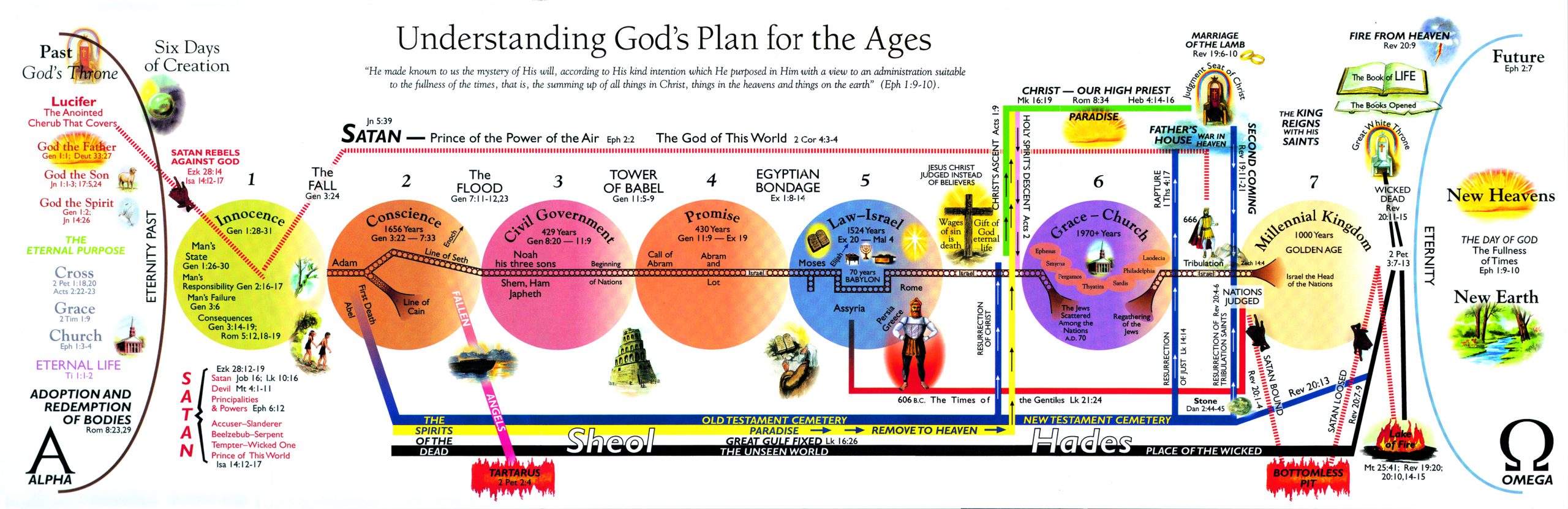
Source: Chart by Tim LaHaye and Thomas Ice - click to enlarge - Millenium on Right Side
Daniel 2:24 Therefore, Daniel went in to Arioch, whom the king had appointed to destroy the wise men of Babylon; he went and spoke to him as follows: "Do not destroy the wise men of Babylon! Take me into the king's presence, and I will declare the interpretation to the king."
KJV Therefore Daniel went in unto Arioch, whom the king had ordained to destroy the wise men of Babylon: he went and said thus unto him; Destroy not the wise men of Babylon: bring me in before the king, and I will shew unto the king the interpretation.
NET Then Daniel went in to see Arioch (whom the king had appointed to destroy the wise men of Babylon). He came and said to him, "Don't destroy the wise men of Babylon! Escort me to the king, and I will disclose the interpretation to him!"
NLT Then Daniel went in to see Arioch, whom the king had ordered to execute the wise men of Babylon. Daniel said to him, "Don't kill the wise men. Take me to the king, and I will tell him the meaning of his dream."
ESV Therefore Daniel went in to Arioch, whom the king had appointed to destroy the wise men of Babylon. He went and said thus to him: "Do not destroy the wise men of Babylon; bring me in before the king, and I will show the king the interpretation."
- Arioch: Da 2:15
- Destroy: Da 2:12,13 Ac 27:24
ANSWERED PRAYER PROMPTS
DANIEL TO PROCEED IN FAITH
Therefore - a strategic term of conclusion, always worthwhile to cause a pause to ponder. Daniel and his friends had prayed (Da 2:17–18). God had revealed the mystery (Da 2:19). Daniel had praised and thanked God (Da 2:20–23). Therefore, Daniel now acts.
Daniel went in to Arioch, whom the king had appointed to destroy the wise men of Babylon - The man who had faced Arioch under sentence of death now approaches him with confidence because God has spoken.
He went and spoke to him as follows: "Do not destroy the wise men of Babylon! Take me into the king's presence, and I will declare the interpretation to the king." The narrator reminds us that the danger is real and imminent. Nebuchadnezzar's decree has not been revoked. Daniel (as a wise man) is still technically under a sentence of death. Notice that Daniel's first recorded concern after worshiping God is not “Don't kill me or my friends” but do not destroy the wise men. Daniel put others before himself (cp Php 2:3, 4) and these were not even believers (but included pagan sorcerers, magicians, astrologers, etc!) which testifies to the selfless, humble spirit of this young man --young in age but not "young" in spiritual maturity or godly character!
Think also of the boldness and courage that Daniel manifested in addressing the king's executioner with what is essentially a command to "cease and desist"! But Daniel's boldness was not borne out of false bravado or brashness but was borne out of reception of a sure revelation from His trustworthy God. As Paul says in Romans 10:17 God's Word reinforces our faith which allows one to speak boldly as did Daniel.
🙏 THOUGHT - Believers today also have the same sure word of prophecy (2Pe 1:19) from the same trustworthy God and like young Daniel can be bold and courageous as we declare God's plan for the ages to those who are seeking answers. And do not underestimate the "evangelistic power" of eschatology (eschatos = last things + ology = study of) to open the door for the Gospel and conversion. I have been privileged to see conversions on more than one occasion as I spoke about God's plan for the ages.
What impact would Daniel's intervention and role in saying the life of these "wise men" have? A life well lived is a light (Mt 5:16, Php 2:15, cp Ps 126:6) and it appears quite likely that not all the "wise men" rejected the light, which could well explain the incredible vignette some 500 years later at the birth of a baby Boy in Bethlehem, Matthew recording…
Now after Jesus was born in Bethlehem of Judea in the days of Herod the king, behold, magi (Greek = magos) from the east arrived in Jerusalem, saying, "Where is He who has been born King of the Jews? For we saw His star in the east, and have come to worship Him."… Then Herod secretly called the magi, and ascertained from them the time the star appeared… And having heard the king, they went their way; and lo, the star, which they had seen in the east, went on before them, until it came and stood over where the Child was. And when they saw the star, they rejoiced exceedingly with great joy. And they came into the house and saw the Child with Mary His mother; and they fell down and worshiped (proskuneo) Him; and opening their treasures they presented to Him gifts of gold and frankincense and myrrh. And having been warned by God in a dream not to return to Herod, they departed for their own country by another way… Then when Herod saw that he had been tricked by the magi, he became very enraged, and sent and slew all the male children who were in Bethlehem and in all its environs, from two years old and under, according to the time which he had ascertained from the magi. (Mt 2:1, 2, 7, 9, 10, 11, 12, 16)
Tis' only one life,
Will soon be past.
Only what's done in Christ
Will last!
It is notable that the Greek word magos (plural magi) used by Matthew is the same word used by the translators of the Septuagint (LXX) to translate the Hebrew word for conjurers in Da 2:2, 10, who were among the leading wise men in Babylon.
John MacArthur writes about the possible impact of Daniel's testimony on the Magi in the book of Matthew…
We learn from the book of Daniel that the magi were among the highest-ranking officials in Babylon. Because the Lord gave Daniel the interpretation of Nebuchadnezzar’s dream-which none of the other court seers was able to do-Daniel was appointed as “ruler over the whole province of Babylon and chief prefect over all the wise men of Babylon” (Da 2:48). Because of his great wisdom and because he had successfully pleaded for the lives of the wise men who had failed to interpret the king’s dream (Da 2:24), Daniel came to be highly regarded among the magi. The plot against Daniel that caused him to be thrown into the lions’ den was fomented by the jealous satraps and the other commissioners, not the magi (Da 6:4-9). Because of Daniel’s high position and great respect among them, it seems certain that the magi learned much from that prophet about the one true God, the God of Israel, and about His will and plans for His people through the coming glorious King. Because many Jews remained in Babylon after the Exile and intermarried with the people of the east, it is likely that Jewish messianic influence remained strong in that region even until New Testament times… The magi from the east (Mt 2:1 - the word literally means “from the rising” of the sun, and refers to the orient) who came to see Jesus were of a completely different sort. Not only were they true magi, but they surely had been strongly influenced by Judaism, quite possibly even by some of the prophetic writings, especially those of Daniel. They appear to be among the many God-fearing Gentiles who lived at the time of Christ, a number of whom (e.g., Cornelius and Lydia - Acts 10:1, 2; 16:14) are mentioned in the New Testament… Though having had limited spiritual light, they (the magi from the East) immediately recognized God’s light when it shone on them. They had genuinely seeking hearts, hearts that the Lord promises will never fail to find Him (Je 29:13). (SEE Matthew Commentary - Page 27 - MacArthur has an extensive discussion of the Magi) (Bolding added)
As discussed above, the fact that Daniel says do not destroy the wise men supports the fact that the executions had not yet begun as suggested by some commentators. It also demonstrates God's prophet shares God's heart for all who are lost in spiritual darkness (even those ensnared by magic, witchcraft, sorcery, etc)…
The Lord is not slow about His promise, as some count slowness, but is patient toward you, not wishing for any to perish but for all to come to repentance (Note the good news that brings salvation includes teaching on repentance!). (2Pe 3:9, cp 1Ti 2:4)
I will declare - The confident assurance expressed by Daniel was founded on the sure revelation he had received from God. He knew his God and so he recognized His revelation as from Him (cp Jn 10:14, 27). Although in our day divine revelation has been completed in the Scriptures, as we go in faith to God's finished revelation and abide in it and it in us, we too can live with a "Daniel-like" confidence (cp Da 11:32b).
Daniel 2:25 Then Arioch hurriedly brought Daniel into the king's presence and spoke to him as follows: "I have found a man among the exiles from Judah who can make the interpretation known to the king!"
KJV Then Arioch brought in Daniel before the king in haste, and said thus unto him, I have found a man of the captives of Judah, that will make known unto the king the interpretation.
NET So Arioch quickly ushered Daniel into the king's presence, saying to him, "I have found a man from the captives of Judah who can make known the interpretation to the king."
NLT Arioch quickly took Daniel to the king and said, "I have found one of the captives from Judah who will tell the king the meaning of his dream!"
ESV Then Arioch brought in Daniel before the king in haste and said thus to him: "I have found among the exiles from Judah a man who will make known to the king the interpretation."
- brought: Pr 24:11 Ec 9:10)
- exiles of Judah: literally children of the captivity of Judah. Da 1:6 6:13 Neh 7:6 1Co 1:27,28
THE EXECUTIONER
BECOMES THE ESCORT
Then - Then continues the rapid progression following God's revelation of the mystery. God has providentially arranged circumstances so that Daniel was being escorted directly before the most powerful ruler in the world.
Arioch hurriedly (quickly, in haste) brought Daniel into the king's presence and spoke to him as follows - Hurriedly conveys urgency. This is understandable. A royal decree of execution was about to be carried out, but now Arioch has learned that someone claims to possess the answer that could abort the crisis.
Bob Utley - "hurriedly" This is a Hithpael INFINITIVE which normally denotes terror or confusion, but in this context, it denotes "rapid action." ▣ "among the exiles from Judah" All of the Babylonian wise men could not help, but a man from God's exiled people could! This is a way of magnifying YHWH. His people know because they know Him (ED: i.e., the believing remnant). Judah may seem small and insignificant, but its people are God's people. He has revealed Himself to them (ED: Daniel) and now through them (ED: Daniel) to Nebuchadnezzar II.
I have found a man among the exiles from Judah - Arioch "the opportunist" presents Daniel as his personal "find", a move surely calculated to curry favor with the king. Notice that Arioch does not say he found one of the "ten-times-better" graduates from the royal training program (Da 1:19,20), but identifies Daniel as a namelss man among the exiles from Judah. This reminds us of Paul's words "God has chosen the weak things of the world to shame the things which are strong.” (1Co 1:27) In any case, Arioch does deserve some credit for astutely recognizing and believing the significance of what Daniel was saying. Let us not forget that the underlying reason for the favor shown to Daniel was the fact that the good hand of His God was upon him (cp Daniel 1:9, 17).
The man Arioch had considered an insignificant exile
was the man heaven had prepared for the hour.
Who can make the interpretation known to the king! - Notice that Arioch emphasized Daniel's ability, but Daniel Himself would soon correct that in Da 2:26,27, 28. Daniel would not allow the spotlight to remain on himself.
NET NOTE - Arioch's claim is self-serving and exaggerated. It is Daniel who came to him, and not the other way around. By claiming to have found one capable of solving the king's dilemma, Arioch probably hoped to ingratiate himself to the king.
Daniel 2:26 The king said to Daniel, whose name was Belteshazzar, "Are you able to make known to me the dream which I have seen and its interpretation?"
KJV The king answered and said to Daniel, whose name was Belteshazzar, Art thou able to make known unto me the dream which I have seen, and the interpretation thereof?
NET The king then asked Daniel (whose name was also Belteshazzar), "Are you able to make known to me the dream that I saw, as well as its interpretation?"
NLT The king said to Daniel (also known as Belteshazzar), "Is this true? Can you tell me what my dream was and what it means?"
ESV The king declared to Daniel, whose name was Belteshazzar, "Are you able to make known to me the dream that I have seen and its interpretation?"
- Daniel: Da 1:7 4:8,19 5:12)
- Are you able: Da 2:3, 4, 5, 6, 7 4:18 5:16 Ge 41:15 1Sa 17:33
THE QUESTION THAT OPENS THE
DOOR FOR DANIEL TO POINT TO GOD
The king said to Daniel, whose name was Belteshazzar - Notice that Daniel does not speak until the king first addressed him, which was in accord with the accepted practice. Our King has spoken to us, so that we can now (daily) address Him in confidence and with no fear of condemnation! Hallelujah!
Are you able to make known to me the dream and its interpretation (Da 2:3, 5, 6) - No and yes. "No I cannot in my own resources, but yes I can in God's wisdom and revelation (Da 2:21, 22) and as His mouthpiece." He recognized and made clear that there was nothing supernatural about him, except the good hand of His Supernatural God upon him, and so too should we in all our spiritual endeavors (and "successes" He allows) for His glory!
J Vernon McGee - Quite obviously and, I think, logically, the king was rather skeptical. All of these wise men had not been able to come up with the dream and its interpretation, but here comes this young fellow Daniel who says he will be able to. The king asks him, "Do you mean to tell me that all the other wise men had no answer, but you think you can answer me? Maybe this is just another attempt of the wise men to stall for time!" His question sounds rather cynical, but Daniel has a marvelous answer for him. (SEE Thru the Bible Vol. 26: The Prophets - Daniel)
This would have been the perfect opportunity for Daniel to take personal credit and receive all the glory. Although Daniel never heard Jesus' Sermon on the Mount, he clearly understood the tenor of Mt 5:16. He knew that he was to perform good works so men could see the works, but he also understood that those visible good works were to bring glory (doxazo) to the invisible God in heaven.
Daniel 2:27 Daniel answered before the king and said, "As for the mystery about which the king has inquired, neither wise men, conjurers, magicians nor diviners are able to declare it to the king
KJV Daniel answered in the presence of the king, and said, The secret which the king hath demanded cannot the wise men, the astrologers, the magicians, the soothsayers, shew unto the king;
NET Daniel replied to the king, "The mystery that the king is asking about is such that no wise men, astrologers, magicians, or diviners can possibly disclose it to the king.
NLT Daniel replied, "There are no wise men, enchanters, magicians, or fortune-tellers who can reveal the king's secret.
ESV Daniel answered the king and said, "No wise men, enchanters, magicians, or astrologers can show to the king the mystery that the king has asked,
- Da 2:2,10,11 5:7, 5:8 Job 5:12,13 Isa 19:3 Isa 44:25 Isa 47:12-14
Related Passages:
Deuteronomy 29:29 “The secret things belong to the LORD our God, but the things revealed belong to us and to our sons forever, that we may observe all the words of this law.
Isaiah 44:7-8 ‘And who is like Me? Let him proclaim and declare it; Yes, let him recount it to Me in order, From the time that I established the ancient nation. And let them declare to them the things that are coming And the events that are going to take place. 8 ‘Do not tremble and do not be afraid; Have I not long since announced it to you and declared it? And you are My witnesses. Is there any God besides Me, Or is there any [other] Rock? I know of none.’”
Isaiah 44:25 Causing the omens of boasters to fail, Making fools out of diviners, Causing wise men to draw back And turning their knowledge into foolishness,
1 Corinthians 1:20; 25 Where is the wise man? Where is the scribe? Where is the debater of this age? Has not God made foolish the wisdom of the world?....(1:25) Because the foolishness of God is wiser than men, and the weakness of God is stronger than men.
THE FAILURE OF
HUMAN WISDOM
Daniel answered before the king and said, "As for the mystery (raz) about which the king has inquired, neither wise men, conjurers, magicians nor diviners are able to declare it to the king - The mystery which the wise men could not declare was the dream. The word mystery appears in the OT only in the Aramaic section of Daniel (mystery in fact is clearly a key word in Daniel 2 = Da 2:18, 19, 27, 28, 29, 30, 47; Da 4:9), where raz (Aramaic) is given the translation of musterion ("mystery") by the Septuagint (LXX). Daniel agrees with the proclamation of the not so "wise" wise men in Da 2:10, 11.
The mystery which the wise men could not declare was first of all the content of Nebuchadnezzar's dream, and ultimately included its divinely intended interpretation (Da 2:28–30, 36). The Aramaic noun raz denotes a secret, mystery, or hidden matter, something inaccessible to ordinary human knowledge unless it is disclosed. Nebuchadnezzar knew the dream because he had experienced it, but it remained a raz to everyone else until God chose to reveal it to Daniel (Da 2:19).
Mystery is clearly a key word in Daniel 2, occurring repeatedly in Da 2:18, 19, 27, 28, 29, 30, 47 (cf. Da 4:9). Significantly, the word occurs in the Old Testament only in the Aramaic portions of Daniel. The Septuagint (LXX) translates raz with the Greek musterion, the word subsequently used frequently in the New Testament for a “mystery.” Biblically, a mystery is not necessarily something strange or impossible to understand, nor is it a puzzle clever men can eventually solve. It is truth hidden from man which can be known only when God chooses to reveal it. This is the principle expressed in Dt 29:29: “The secret things belong to the LORD our God, but the things revealed belong to us.”
Daniel agrees with the proclamation of the not-so-“wise” wise men in Da 2:10–11. They had declared, “There is not a man on earth who could declare the matter for the king.” Daniel does not dispute their assessment of human ability. In fact, he confirms it. No wise man, conjurer, magician, diviner, or even Daniel himself possessed the inherent ability to penetrate this mystery.
This also highlights Daniel's humility. Nebuchadnezzar had asked him personally, “Are you able to make known to me the dream...and its interpretation?” (Da 2:26). Daniel could have answered, “Yes.” Instead, he effectively answers, “No human being possesses that ability.” Daniel refuses to present himself as a superior magician with greater occult powers.
Mystery (07328)(raz) is a masculine noun which refers to a secret, in the context of Daniel 2 referring “information or omens so enigmatic or baffling that only revelation from God can make it understandable.” Even Nebuchadnezzar recognized that it was the God of heaven Who alone could reveal mysteries (Da 2:47).
A mystery is not something God does not know.
It is something man cannot know unless God reveals it.
Swanson says raz refers to "information or omens so enigmatic or baffling that only revelation from God can make it understandable."
Raz - 9x in 8v - Dan 2:18-19, 27-30, 47; 4:9 - all translated mystery - mysteries(3), mystery(6).
The Septuagint translates raz with the noun musterion which is a truth never previously known, and a truth which human intellect could never discover, but one which has been made known by divine revelation. In Scripture "mystery" is not something that is impossible or difficult to know but is a truth that once was hidden but is now made known by God.
Raz - 9x in 8v - Dan 2:18-19, 27-30, 47; 4:9 (all are translated in Lxx with musterion)
Daniel 2:28 "However, there is a God in heaven who reveals mysteries, and He has made known to King Nebuchadnezzar what will take place in the latter days. This was your dream and the visions in your mind while on your bed
KJV But there is a God in heaven that revealeth secrets, and maketh known to the king Nebuchadnezzar what shall be in the latter days. Thy dream, and the visions of thy head upon thy bed, are these;
NET However, there is a God in heaven who reveals mysteries, and he has made known to King Nebuchadnezzar what will happen in the times to come. The dream and the visions you had while lying on your bed are as follows.
NLT But there is a God in heaven who reveals secrets, and he has shown King Nebuchadnezzar what will happen in the future. Now I will tell you your dream and the visions you saw as you lay on your bed.
ESV but there is a God in heaven who reveals mysteries, and he has made known to King Nebuchadnezzar what will be in the latter days. Your dream and the visions of your head as you lay in bed are these:
- a God: Ps 115:3 Mt 6:9
- reveals: Da 2:18,47 Ge 40:8 41:16 Isa 41:22,23 Am 4:13
- in the: Da 10:14 Ge 49:1 Nu 24:14 Dt 4:30 31:19 Isa 2:2 Jer 30:24 Jer 48:47 Ezek 38:8,16 Ho 3:5 Mic 4:1,2 2Ti 3:1 Heb 1:1 2Pe 3:3
Related Passages:
Luke 21:24 and they will fall by the edge of the sword, and will be led captive into all the nations; and Jerusalem will be trampled under foot by the Gentiles until the times of the Gentiles are fulfilled.
Daniel 10:14 “Now I have come to give you an understanding of what will happen to your people in the latter days, for the vision pertains to the days yet future.”
Genesis 49:1 Then Jacob summoned his sons and said, “Assemble yourselves that I may tell you what will befall you in the days to come.
Numbers 24:14 “And now, behold, I am going to my people; come, and I will advise you what this people will do to your people in the days to come.”
Deuteronomy 4:30; 31 “When you are in distress and all these things have come upon you, in the latter days you will return to the LORD your God and listen to His voice. 31 “For the LORD your God is a compassionate God; He will not fail you nor destroy you nor forget the covenant with your fathers which He swore to them.
Isaiah 2:2 Now it will come about that In the last days The mountain of the house of the LORD Will be established as the chief of the mountains, And will be raised above the hills; And all the nations will stream to it.
Jeremiah 30:24 The fierce anger of the LORD will not turn back Until He has performed and until He has accomplished The intent of His heart; In the latter days you will understand this.
Jeremiah 48:47 “Yet I will restore the fortunes of Moab In the latter days,” declares the LORD. Thus far the judgment on Moab.
Ezekiel 38:8; 16 “After many days you will be summoned; in the latter years you will come into the land that is restored from the sword, whose inhabitants have been gathered from many nations to the mountains of Israel which had been a continual waste; but its people were brought out from the nations, and they are living securely, all of them. (38:16) and you will come up against My people Israel like a cloud to cover the land. It shall come about in the last days that I will bring you against My land, so that the nations may know Me when I am sanctified through you before their eyes, O Gog.”
Hosea 3:5 Afterward the sons of Israel will return and seek the LORD their God and David their king; and they will come trembling to the LORD and to His goodness in the last days.
Micah 4:1; 2 And it will come about in the last days That the mountain of the house of the LORD Will be established as the chief of the mountains. It will be raised above the hills, And the peoples will stream to it. (4:2) Many nations will come and say, “Come and let us go up to the mountain of the LORD And to the house of the God of Jacob, That He may teach us about His ways And that we may walk in His paths.” For from Zion will go forth the law, Even the word of the LORD from Jerusalem.
2 Timothy 3:1 But realize this, that in the last days difficult times will come.
Hebrews 1:1-2 God, after He spoke long ago to the fathers in the prophets in many portions and in many ways, in these last days has spoken to us in His Son, whom He appointed heir of all things, through whom also He made the world.
2 Peter 3:3 Know this first of all, that in the last days mockers will come with their mocking, following after their own lusts,
THE GOD WHO
REVEALS MYSTERIES
However (KJV, ESV = "but") - This term of contrast. introduces a striking contrast.
Ray Pritchard - In many ways Da 2:27,28 might be taken as the theme of the whole chapter: “No wise man, enchanter, magician or diviner can explain to the king the mystery he has asked about, but there is a God in heaven who reveals mysteries.” Human inability is fully met by God’s almighty power. For nothing is impossible with God. (The World According to God)
A God in heaven Who reveals (gelah; LXX - apokalupto) mysteries (raz; LXX - usterion)- Notice the wonderful paradox - a God in heaven (far away) and yet at the same time so near that He hears His children! And so here Daniel picks up where the "wise men" left off in Da 2:11 when they stated no one except the gods could declare the dream and its interpretation. In so doing Daniel in essence issues a direct challenge to the impotent false religious system of Babylon with its plethora of dead "gods". And given that Babylon is the mother of harlots and of the abominations of the earth (Rev 17:5) or the "birthplace" of all the earth's false religions and idols, Daniel's declaration regarding a God in heaven sounds the death knell to these systems which sinful men have devised in their attempt to fill the void created by rejection of and rebellion against the One True, Living God!
Over 1000 years earlier Joseph another man with the gift from God of dream interpretation chose like Daniel to give God the glory "Joseph then answered Pharaoh, saying, “It is not in me; God will give Pharaoh a favorable answer.” (Ge 41:16)
Life Application Study Bible - Page 132. Before Daniel told the king anything else, he gave credit to God, explaining that he did not know the dream through his own wisdom but only because God revealed it. How easily we take credit for what God does through us! This robs God of the honor that he alone deserves. Instead, we should be like Daniel and point people to God so that we give him the glory.
Jon Courson commenting on Daniel's humility (cp importance of humility = Pr 15:33, 18:12, 22:4) comments "Daniel didn’t say, “I can tell you your dream.” He said, “Only the Lord can give you the information and understanding you seek.” I believe this was why Daniel was used from the time he was a young man all the way until he was eighty-five. He didn’t take credit. The fastest way to see the work of God through your life stopped is to begin to think it’s because you’re special. (See Jon Courson's Application Commentary) (Bolding added)
And He has made known to King Nebuchadnezzar what will take place in the latter days. This was your dream and the visions in your mind while on your bed - Daniel continues to direct Nebuchadnezzar's attention away from himself and toward God. Daniel does not say, “I have discovered” or even “I have made known,” but “HE has made known.” God is the Source of the revelation; Daniel is simply the channel through whom it is communicated. This is one of the great themes running through Daniel 2: “the mystery was revealed” (Da 2:19), “He reveals the profound and hidden things” (Da 2:22), “You have made known to us the king's matter” (Da 2:23), and now “He has made known to King Nebuchadnezzar.” Daniel will repeat the thought in Da 2:29, 30, 45. The emphasis could hardly be stronger: GOD REVEALS WHAT MAN CANNOT DISCOVER.
What will take place in the latter days - NET = "what will happen in the times to come" NLT = "what will happen in the future." This phrase establishes the predictive-prophetic nature of Nebuchadnezzar's dream. God is not merely explaining something that has already happened; He is revealing events that will take place. Daniel 2 is therefore not simply a lesson about God's omniscience but about His sovereignty over history. God can reveal the future because the future is completely known to Him and unfolds under His sovereign rule. This recalls Isaiah's declaration, “I am God, and there is no one like Me, declaring the end from the beginning, and from ancient times things which have not been done” (Isa 46:9–10; cf. Isa 41:22–23).
This also connects directly with Daniel's praise in Da 2:21: “It is He who changes the times and the epochs; He removes kings and establishes kings.” God is now going to show Nebuchadnezzar precisely what that truth looks like on the stage of world history. Kingdoms will rise, kingdoms will fall, rulers will come and go, but none of these developments will surprise the God of heaven. The God Who revealed the succession of kingdoms is the same God Who governs their times and boundaries.
THE TIME FRAME:
THE LATTER DAYS
Latter days (also in the ESV, KJV) (Aramaic - be'acharith yomayya) - Whenever you encounter a specific expression of time pause and ponder using the 5W/H'S questions. This time phrase clearly has eschatological (eschatos = last things) overtones and is synonymous with (and actually sometimes translated) last days (in the Lxx the phrase is "eschaton ton hemeron" = literally "last the days"). Last days is found in the NT and identifies a time period that from Hebrews 1:2 and Acts 2:17 begins with the first coming of Messiah. Isaiah 2:2 (and parallel passage in Micah 4:1) identifies events that will be consummated at the second coming of Messiah (Second Coming) coinciding with establishment of Messiah's Millennial Kingdom.
J Vernon McGee - The end of "the times of the Gentiles" runs concurrently with "the latter days" of the nation Israel: both come to their fulfillment during the Great Tribulation period. The day in which you and I live is "man's day." (See Thru the Bible Vol. 26: The Prophets - Daniel)
Latter days literally something like “in the latter part of the days” or “in the days to come.” The expression does not necessarily refer exclusively to the very last few days immediately preceding Christ's return. In this context it introduces the future period beginning from Nebuchadnezzar's standpoint and extending through the successive Gentile kingdoms portrayed in the image, ultimately reaching the establishment of God's everlasting kingdom (Da 2:31–45).
Keep in mind as you study the OT, that there are 3 expressions of time which are virtually synonymous (always check context though because Job 42:12 is clearly not eschatological)…
- Latter days = Dt 4:30 Dt 31:29 Je 30:24 48:47 Da 2:28 Dt 10:14
- Last days = Isa 2:2 Jer 23:20 Jer 49:39 Ho 3:5 Mic 4:1
- Days to come = Ge 49:1 Isa 27:6 Nu 24:14
Latter days- The corresponding Hebrew phrase (acariyth yowm) ("days to come," = NIV, NET; "in the future" = NLT; "last days,") occurs 13x in OT = Ge 49:1, Nu 24:14, Dt 4:30 [ESV = "tribulation" Dt 4:30ESV]; Dt 31:29; Isa 2:2; Jer 23:20, 30:24; 48:47; 49:39, Da 2:28 ; Da 10:14 (Written in Hebrew again).
Now, take a moment and Meditate on each of these passages on the latter/last days (or "days to come") examining the context remembering that context is the "king" in interpretation. See if you do not agree that this time phrase almost always speaks of a time just preceding or terminating with the Lord's return. After you have made your own observations you might read the notes on Discussion of Last Days in the prophecy in Isa 2:2.
And so we can see that in this passage Daniel uses the term latter days to define the scope of the prophecy is about to unfold. From the following context the latter days begins with the time of the Babylonian Empire and ends with the return of Christ (the Stone), a time period that parallels the "times of the Gentiles" (Lk 21:24).
The angelic messenger sent to interpret Daniel's vision (Da 10:7) declared "Now I have come to give you an understanding of what will happen to your people (Israel, the Jews) in the latter days, for the vision pertains to the days yet future." (Da 10:14)
Gen 49:1 Then Jacob summoned his sons and said, “Assemble yourselves that I may tell you what shall befall you in the days to come.
NET NOTE - The expression “in the future” (אַחֲרִית הַיָּמִים, ’akharit hayyamim, “in the end of days”) is found most frequently in prophetic passages; it may refer to the end of the age, the eschaton, or to the distant future. The contents of some of the sayings in this chapter stretch from the immediate circumstances to the time of the settlement in the land to the coming of Messiah.
Carl Armerding - Keil says that this “in prophetic language denotes not the future generally but the last future, the Messianic age of consummation.” According to Delitzsch the expression refers to “the future which forms the close of the course of history. The notion is eschatological, but limited by the horizon of the speaker.” Gesenius refers to it as a “prophetic formula” which means “in the future time, in the last days.”8 It occurs also in Numbers 24:14, Deuteronomy 4:30 and Dt 31:29, and about a dozen times in the Prophets. In each case the definitions given above would suit the context well. If, as Leupold remarks, “Jacob can see in one picture the occupation of Canaan and the Messiah’s kingdom but hardly anything that lies between,” we need not be surprised to find in the passage an intermingling of the near future with that which is more remote." (Bib Sac 112:448 - Oct 55)
Num 24:14 “And now behold, I am going to my people; come, [and] I will advise you what this people will do to your people in the days to come… 17 “I see him, but not now; I behold him, but not near; A star shall come forth from Jacob, and a scepter shall rise from Israel, And shall crush through the forehead of Moab, And tear down all the sons of Sheth.
Gleason Archer on latter days - [The phrase] first appears in Ge 49:1, where Jacob foretold the lot of the Twelve Tribes after their conquest of Canaan some four centuries later. In Dt 4:30 it refers to the period of Israel’s return to God after adversity, in Dt 31:29 of the period of Israel’s future rebellion. In Isa. 2:2 it points forward to the establishment of the millennial kingdom, in Ezek 38:16 to the eschatological war of Gog against restored Israel. Here (Da 2:28) it seems to refer to all the coming events subsequent to the lifetime of Nebuchadnezzar and including the final establishment of the fifth kingdom (the Millennial Age). The other occurrence in Da 10:14 seems to include both the “Proto-Tribulation” under Antiochus Epiphanes in the second century B.C. and the antitypical Great Tribulation under the Beast in the last days. (Expositor's Bible)
Donald Campbell - Because the Bible is a supernatural book, it can, and does, have a great deal to say about the future. And this should give comfort and security to the believer in contrast to the unbeliever who "bites his nails" and wonders how things will turn out. Two men were listening to a delayed broadcast of their school's crucial basketball game against a rival university. Suddenly one of them said, "Why am I so nervous? I know how it comes out." To which his friend replied, "Now you know how God must feel when we fret and get so depressed." After all, He knows how it comes out! (Borrow Daniel Decoder of Dreams - aka God's Man in a Secular Society page 22)
This was your dream and the visions in your mind while on your bed - With these words Daniel prepares to do what all the wise men of Babylon had declared impossible (Da 2:10–11). Notice also that Daniel's statement implies that Nebuchadnezzar did in fact rememeber his dream (contra some commentaries). Daniel makes no attempt to draw information from Nebuchadnezzar but simply declares, This was your dream. The king had deliberately withheld the dream as the test by which the authenticity of the interpretation would be established (Da 2:5–9). If Daniel could accurately tell Nebuchadnezzar what he had dreamed, the king would have compelling evidence that Daniel's interpretation came from a supernatural source. Can you imagine the thoughts going through Nebuchadnezzar's mind as he realized Daniel had "gotten into his head" while he was in his bed?
Reveals (01541) (gelah related to the Hebrew galah = to uncover, remove - like take the lid off so one can see what was previously invisible) means to bring over, to take away (as into exile = deport - Ezra 4:10, 5:12), to reveal (mysteries), to disclose hidden things.
The LXX (TH) translates all the uses of reveal in Daniel 2 (Da 2:19, 22, 28, 29, 30, 47) with the verb apokalupto (cp the noun which is the "title" of John's Revelation = apokalupsis) which means literally to "take the cover away from" and so to uncover, lay open that which had been veiled or covered up and so to disclose it.
Gelah - 9x in 8v - Ezra 4:10; 5:12; Da 2:19, 22, 28, 29, 30, 47. Translated - deported (2), reveal (1), revealed (2), revealer (1), reveals (3).
God Of The Stars - There is a God in heaven who reveals secrets. —Daniel 2:28 - A glance at the daily newspaper tells us that modern life is still infected by the ancient practice of astrology. Guests on talk shows discuss their astrological signs with the same ease that they discuss their divorces. Late-night television offers the services of stargazers by telephone at four dollars a minute. The wife of a recent president of the United States consulted an astrologer for advice on the travel schedule for her husband. As a young man, Augustine (354-430) consulted astrologers. In later years, however, he opposed the practice. Because astrology assumes that the position of the stars at the time of our birth determines personality and the course of our life, Augustine asked, “Why, in the life of twins—in their actions, the events that befall them, their professions, arts, honors, and other things pertaining to human life, as well as in their very deaths—is there often so great a difference that, as far as these things are concerned, many entire strangers are more like them than they are like each other?” Our lives aren’t shaped by lifeless stars, but by the God who created the stars and us as well. He has revealed to us in the Bible our destiny in Jesus Christ. (Reprinted by permission from Our Daily Bread Ministries. Please do not repost the full devotional without their permission.)
I will not seek to know the future years,
Nor cloud today with dark tomorrow’s fears;
I will but ask clear light from heaven to show
How step by step my pilgrimage should go.
—Anon.
You don’t need to know where you’re going
if you know God is leading.
Daniel 2:29 "As for you, O king, while on your bed your thoughts turned to what would take place in the future; and He who reveals mysteries has made known to you what will take place.
KJV As for thee, O king, thy thoughts came into thy mind upon thy bed, what should come to pass hereafter: and he that revealeth secrets maketh known to thee what shall come to pass.
NET "As for you, O king, while you were in your bed your thoughts turned to future things. The revealer of mysteries has made known to you what will take place.
NLT "While Your Majesty was sleeping, you dreamed about coming events. He who reveals secrets has shown you what is going to happen.
ESV To you, O king, as you lay in bed came thoughts of what would be after this, and he who reveals mysteries made known to you what is to be.
- Ezek 38:10
- Da 2:22,28,47 Am 4:13
Related Passages:
Daniel 2:22 “It is He who reveals the profound and hidden things; He knows what is in the darkness, And the light dwells with Him.
Daniel 2:47 The king answered Daniel and said, “Surely your God is a God of gods and a Lord of kings and a revealer of mysteries, since you have been able to reveal this mystery.”
Amos 4:13 For behold, He who forms mountains and creates the wind And declares to man what are His thoughts, He who makes dawn into darkness And treads on the high places of the earth, The LORD God of hosts is His name.
HISTORY WRITTEN
IN ADVANCE!
As for you, O king, while on your bed your thoughts turned to what would take place in the future ("the latter days," "what will take place") - Daniel now reveals something as remarkable as the content of Nebuchadnezzar's dream. God knew not only what Nebuchadnezzar dreamed, but also what Nebuchadnezzar had been thinking about before or in connection with the dream. Apparently, as the king lay upon his bed, his thoughts turned toward the future. As ruler of the mighty Babylonian Empire, he may naturally have wondered, “What will happen after me? What will become of this great kingdom? What lies ahead?” The text does not tell us the precise content of his thoughts, so we should not go beyond what is written, but it does tell us that his mind was occupied with what would take place in the future. Naturally any king would want to know what happens to his kingdom in the future.
🙏 THOUGHT - Do you desire to know the future? Then be diligent to study Daniel and the Revelation and you will know the future because our Great God has chosen to reveal to His children His Plan for the Ages. And when you learn it, be sure to teach it to others who are searching and/or skeptical. I have found that teaching the Scriptures on the end times stirs people deeply as they realize this is not a fairy tale but is irrefutable truth and some of them will receive the Gospel (as has been my experience).
And He Who reveals mysteries has made known to you what will take place - Mystery is "key word" in this chapter Da 2:18, 19, 27, 28, 29, 30, 47; 4:9) - What a great (descriptive) Name for our God. Mysteries are sacred secrets hitherto unknown, humanly unknowable, and now divinely revealed. The mysteries are not unintelligible nor mysterious (like a Sherlock Holmes "mystery"), but are merely God’s secret until in this case He has chosen to reveal them through a pagan king and to be interpreted by a divine prophet. The classic NT example of a mystery hidden but then revealed is the church, not revealed at all in the OT (see Ep 3:3).
Notice that Daniel did not impugn the names or reputations of Nebuchadnezzar’s gods, which is a great lesson for all of us that we need to be very careful when we witness for the only true and living God. Our tact should be to introduce them to the one and only true God and allow the convicting, illuminating ministry of the Holy Spirit to show them the difference (Jn 16:8). Give them truth which will allow them to discern that which is false. Or as Peter says to believers who were in various fiery trials "but sanctify (aorist imperative = Command to do this now and do it effectively. It is urgent!) Christ as Lord in your hearts, always being ready to make a defense to everyone who asks you to give an account for the hope that is in you, (How are we to present our defense of the God of heaven?) yet with gentleness and reverence (with our words) and (with our words that "back up" the veracity of our testimony of hope!) keep a good conscience so that in the thing in which you are slandered, those who revile y-our good behavior in Christ may be put to shame. (1Pe 3:15, 16)
Daniel's dream description and decryption are clear examples of the God Who "reveals the profound and hidden things" (Da 2:22).
Donald Campbell - Two men were listening to a delayed broadcast of their school's crucial basketball game against a rival university. Suddenly one of them said, "Why am I so nervous? I know how it comes out." To which his friend replied, "Now you know how God must feel when we fret and get so depressed." After all, He knows how it comes out! (Borrow Daniel Decoder of Dreams - aka God's Man in a Secular Society page 22)
Daniel 2:30 "But as for me, this mystery has not been revealed to me for any wisdom residing in me more than in any other living man, but for the purpose of making the interpretation known to the king, and that you may understand the thoughts of your mind.
KJV But as for me, this secret is not revealed to me for any wisdom that I have more than any living, but for their sakes that shall make known the interpretation to the king, and that thou mightest know the thoughts of thy heart.
NET As for me, this mystery was revealed to me not because I possess more wisdom than any other living person, but so that the king may understand the interpretation and comprehend the thoughts of your mind.
NLT And it is not because I am wiser than anyone else that I know the secret of your dream, but because God wants you to understand what was in your heart.
ESV But as for me, this mystery has been revealed to me, not because of any wisdom that I have more than all the living, but in order that the interpretation may be made known to the king, and that you may know the thoughts of your mind.
- this mystery: Ge 41:16 Ac 3:12 1Co 15:8, 9, 10, 11, 12
- but: Da 2:17,18,49 Isa 43:3,4 45:4 Mt 24:22 Mk 13:20 Ro 8:28 1Co 3:21, 22, 23 2Co 4:15) (Da 2:47
DANIEL'S HUMILITY
But - a term of contrast. What is being contrasted?
But as for me - Incredible humility in view of the fact that he has just received one of the greatest revelations ever given, a revelation that lays out the history of the entire world until Messiah returns. Paul made a parallel selfless statement…
Not that we are adequate in ourselves to consider anything as coming from ourselves, but our adequacy is from God, who also made us adequate as servants of a new covenant, not of the letter, but of the Spirit; for the letter kills, but the Spirit gives life. (2Cor 3:5,6, cp Jas 4:6, 1Pe 5:5, cp importance of humility = Pr 15:33, Pr 18:12, Pr 22:4)
Joseph exhibited a similar humility when he passed on to God the glory (Ps 115:1) declaring to Pharaoh "It is not in me. God will give Pharaoh a favorable answer." (Ge 41:16). Joseph and Daniel are great OT illustrations which emphasize that the man who chooses for God and refuses to compromise with the world (Da 1:8, Ge 39:9), will be a vessel of honor, set apart and useful to Him as their Master (2Ti 2:21, cp He 6:12).
Donald Campbell records the following story - Dr. H. A. Ironside, famed pastor and Bible teacher, was once convicted about his lack of humility. A friend recommended, as a remedy, that he march through the streets of Chicago wearing a sandwich board, shouting the Scripture verses inscribed on the board for all to hear. Dr. Ironside agreed to this challenging venture and when he returned to study and removed the board, he said "I'll bet there's not another man in town who would do that!" (Borrow Daniel Decoder of Dreams - aka God's Man in a Secular Society page 22)
Thoughts of your mind - Mind is more literally heart (Aramaic = lebab. See discussion of the related Hebrew word for heart =Heart (leb and lebad)
David Jeremiah makes an interesting comment noting that the dream "was not given to some pious preacher, but to the vilest world ruler at that time. It was like God revealing to Hitler what was going to happen with the Berlin Wall, the demise of the USSR, and the Second Coming." (Borrow The Handwriting On The Wall- Secrets From The Prophecies Of Daniel - see page 46)
Ultimately of course the full revelation was revealed to God's prophet in Babylon in accord with the word of another prophet Amos who wrote that "Surely the Lord GOD does nothing unless He reveals (Lxx = apokalupto = "removes the cover which conceals") His secret counsel (Hebrew = sod = speaks of intimacy, friendship, fellowship as used in Ps 25:14 = "secret" - Daniel was privy to these eschatological secrets) to His servants the prophets." (Amos 3:7)
J Vernon McGee - We will see in this section the history of the rule of this world by the Gentiles. Because of the failure of the house of David, God is now taking the scepter of this universe out from the hands of that line of David, and He is putting it in the hands of the Gentiles. It will be there until Jesus Christ comes again to this earth. Then Christ will take the scepter and rule on this earth as King of kings and Lord of lords. "The times of the Gentiles" (Lk 21:24) (ED: NOT THE FULLNESS OF THE GENTILES - Ro 11:25) is from the day of Nebuchadnezzar right on down through our day until the Lord comes to reign. (SEE Thru the Bible Vol. 26: The Prophets - Daniel)
Daniel 2:31 "You, O king, were looking and behold, there was a single great statue; that statue, which was large and of extraordinary splendor, was standing in front of you, and its appearance was awesome.
KJV Thou, O king, sawest, and behold a great image. This great image, whose brightness was excellent, stood before thee; and the form thereof was terrible.
NET "You, O king, were watching as a great statue– one of impressive size and extraordinary brightness– was standing before you. Its appearance caused alarm.
NLT "In your vision, Your Majesty, you saw standing before you a huge, shining statue of a man. It was a frightening sight.
ESV "You saw, O king, and behold, a great image. This image, mighty and of exceeding brightness, stood before you, and its appearance was frightening.
- and the: Da 7:3-17 Mt 4:8 Lk 4:5
- Isa 13:11 25:3, 4, 5 Eze 28:7 Hab 1:7
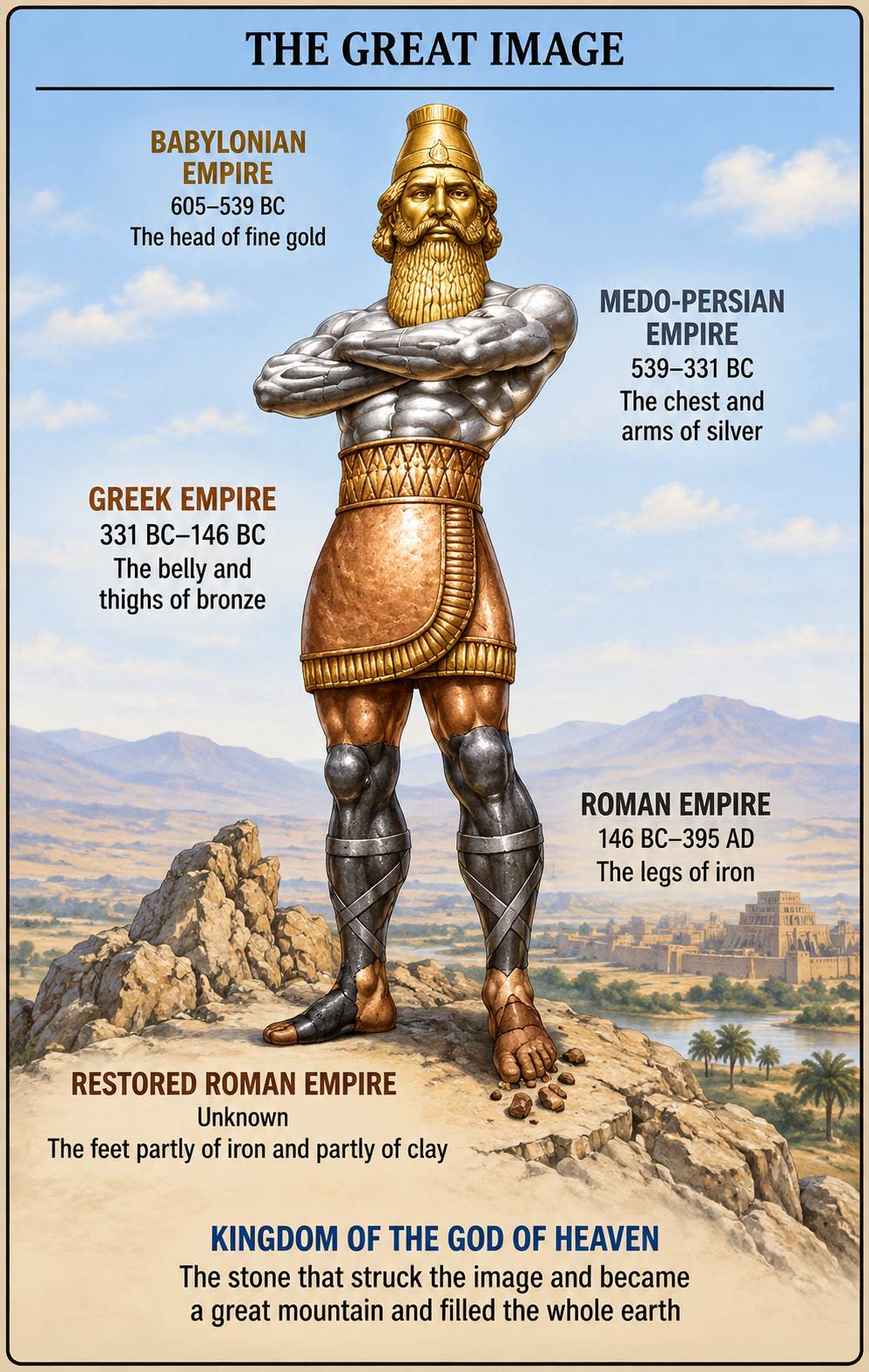
THE IMAGE OF A MAN
You, O king, were looking and behold, Daniel now begins to recount the dream that Nebuchadnezzar had seen but could not recover. Imagine the king's reaction as Daniel begins describing what no human being had told him! With each detail, Nebuchadnezzar would realize that Daniel truly knew his dream. The word behold ('aru) functions like an attention-getter: “Look! Pay attention!” Something astonishing suddenly dominates the king's vision.
Behold - This interjection is given to heighten the observer's attention - "Pay attention to what follows" is the idea. There are some 1058 "beholds" in the OT and they are all deserving of our careful attention. Every encounter to cause us to pause and ponder "What is being described or declared? Why now? What significance?, etc" Every use of "behold" by the Spirit is profitable for teachings! (cp 2Ti 3:16).
There was a single great statue The emphasis on single is significant. Although the statue is composed of several different materials representing successive kingdoms (Da 2:32-33, 36-43), they form one great image. In other words, God presents the entire course of Gentile world dominion as one unified whole, beginning with Babylon and moving through successive kingdoms until the final destruction of man's kingdoms and the establishment of God's everlasting kingdom (Da 2:44-45).
Single great statue - Emphasizes the continuity and integral relationship of the kingdoms represented. In other words the dominion would change, but elements of one kingdom would continue into the next. This one statue in a sense represented all of the Gentile kingdoms (specifically those that interacted with Israel, not every kingdom ever known in the world) that would exist until the end of this age (when the Stone returns to end Gentile dominion forever).
Tony Garland on single - The indefinite article, “a,” is from צְלֵם [ṣelēm] which can also denote “one and only one”—emphasizing the unity of the image. And so it is rendered in the LXX and OG, eikon mia , “an image one.” (Daniel Defended)
that statue, which was large The Aramaic idea is great, immense, enormous. Its sheer size conveyed overwhelming power and grandeur. This was no ordinary statue. It towered before Nebuchadnezzar, appropriately portraying the enormous political power of the kingdoms it represented.
and of extraordinary splendor - Splendor (ziw) refers to brightness, brilliance, radiance, or splendor. The statue was dazzling. Gold, silver, bronze and iron gave the image an imposing brilliance. From man's perspective, earthly kingdoms can appear magnificent, powerful, wealthy, and enduring. But the remainder of the dream will expose how temporary they really are. What appears magnificent to man can be demolished in a moment by God. (Da 2:34-35, 44-45)
J Vernon McGee - As Daniel began to describe the dream, I wish that I could have been there to see the expression on Nebuchadnezzar's face change from cynicism to unconcealed amazement. When Daniel began to say, "You saw a great image, the brightness of which was terrific and stupendous," I think the eyes of Nebuchadnezzar lighted up. He shifted to the edge of his throne and said, "Boy, that's it! You are starting out right!" (SEE Thru the Bible Vol. 26: The Prophets - Daniel)
was standing in front of you - The colossal image stood directly before Nebuchadnezzar, which helps us understand why his spirit was troubled (Da 2:1, anxious = Da 2:3).The greatest ruler of his day was confronted with a picture of human history that he could neither control nor prevent. Nebuchadnezzar ruled Babylon, but he did not rule history. The statue stood before the king, but the King of heaven stood over the statue! (Da 2:37, 44-45)
and its appearance was awesome - Awesome is the Aramaic word dechal (6x - Da 2:31; 4:5; Da 5:19; Da 6:26; 7:7, 19; LXX = phoberos - inspiring fear, terrible, formidable, frightful) which carries the sense of something terrifying, dreadful, or fear-inspiring. The image was simultaneously magnificent and frightening. No wonder Nebuchadnezzar's spirit had been troubled and his sleep had left him (Da 2:1).
Clarence Larkin draws our attention to significance of the fact that the statute is of a man - "This is the day of the “DEIFICATION OF MAN.” (Ed: See Tony Garland's topic "The Deification of Man") From the day when Nebuchadnezzar set up in the Plain of Dura that “Golden Image,” typical of himself, and commanded all the people of his realm to worship it (Da 3:1-7), until the False Prophet shall command that the people shall make an “Image to the Beast” (The Antichrist) and worship the same (Rev 13:13-17), the only suitable symbol to describe the character of the “Times of the Gentiles” (Lk 21:24) is the “Image of a Man.” (The Book of Daniel) (See Larkin's depiction of the Statute)
Larkin adds that "In the time of Nebuchadnezzar gigantic statues were common. We find them today among the ruins of Egypt. Now Nebuchadnezzar had just returned from Egypt, having conquered it. What more natural then than having seen the gigantic statues of Egypt, erected by the Kings of Egypt to commemorate their memory. Nebuchadnezzar, before he fell asleep had been thinking of such a method of preserving his own memory. But the difference was that the “Image” that Nebuchadnezzar saw was of metal, while the images of Egypt were of stone." (The Book of Daniel - scroll down to page 12)
Daniel 2:32 "The head of that statue was made of fine gold, its breast and its arms of silver, its belly and its thighs of bronze,
KJV This image's head was of fine gold, his breast and his arms of silver, his belly and his thighs of brass,
NET As for that statue, its head was of fine gold, its chest and arms were of silver, its belly and thighs were of bronze.
NLT The head of the statue was made of fine gold. Its chest and arms were silver, its belly and thighs were bronze,
ESV The head of this image was of fine gold, its chest and arms of silver, its middle and thighs of bronze,
- head: Da 2:37,38 Da 4:22,30 Da 7:4 Isa 14:4 Jer 51:7 Rev 17:4
- breast: Da 2:39 Da 7:5 Da 8:3,4 Da 11:2
- belly: Da 2:39 Da 7:6 Da 8:5-8 Da 11:3-20
FOUR METALS, FOUR KINGDOMS
INCREASING STRENGTH, DECREASING GLORY
The head of that statue was made of fine gold - Daniel now begins describing the statue from the head downward, corresponding to the chronological progression of Gentile kingdoms. The description “fine gold” emphasizes the magnificence and extraordinary wealth of Babylon. Gold was especially appropriate for Nebuchadnezzar's empire, a kingdom renowned for its splendor. Yet there is an important lesson even in the choice of gold: however precious the kingdom, it was still temporary.
Gold = Da 2:32, 38 = Lion Da 7:4 = Nebuchadnezzar (Babylon) (It began approximately 605BC when Nebuchadnezzar defeated the Assyrians and the Egyptians at the Battle of Carchemish and it fell in 539 BC - See Da 5:28, cp Da 8:20, 21, 22) (See Wikipedia article Neo-Babylonian Empire)
its breast and its arms of silver - The silver represents the kingdom that would succeed Babylon, identified later as the Medo-Persian Empire (cf. Da 5:28; 6:8, 12, 15; 8:20). The two arms provide an appropriate picture of the Medes and Persians, although we should be cautious about pressing every anatomical feature of the statue beyond what the text specifically interprets. Silver = Da 2:32,39; Bear = Da 7:5; Ram = Da 8:6, 20 = Media & Persia (539-331 BC) Silver is valuable, but it is less valuable than gold. Daniel explicitly says that this succeeding kingdom would be “inferior to you” (Da 2:39). This does not necessarily mean inferior in geographical extent or military strength, for Medo-Persia ultimately controlled more territory than Babylon. Rather, the decreasing value of the metals appears to portray a progressive deterioration in the character or concentration of governmental authority. Nebuchadnezzar possessed virtually absolute authority (Da 5:18-19), whereas even a Medo-Persian king could find himself constrained by “the law of the Medes and Persians, which may not be revoked” (Da 6:8, 12, 15).
its belly and its thighs of bronze - Daniel identifies this as “a third kingdom of bronze, which will rule over all the earth” (Da 2:39). Daniel 8 later identifies the kingdom that follows Medo-Persia as Greece (Da 8:20-21). Alexander the Great's astonishing conquests carried Greek dominion across the ancient Near East with remarkable speed, just as Daniel later portrays in the imagery of the rapidly moving goat (Da 8:5-8).
Bronze = Da 2:32, 39; Leopard Da 7:6; Male, Shaggy Goat = Da 8:8,21 = Greece under Alexander the Great (331-63 BC)
The metals decrease in preciousness, while they generally increase in hardness and strength. What man might interpret as increasing military power, God simultaneously portrays as decreasing intrinsic glory. All that glitters is not eternal! Babylon glittered like gold, but Babylon disappeared. Every human kingdom, no matter how wealthy, powerful, impressive, or apparently permanent, eventually passes from the stage of history. Only one kingdom carries the promise that “it will never be destroyed” (Da 2:44). Beloved, don't put eternal confidence in temporary kingdoms. The gold eventually becomes dust, but the Stone becomes a mountain that fills the whole earth! (Da 2:35)
Daniel 2:33 its legs of iron, its feet partly of iron and partly of clay.
KJV His legs of iron, his feet part of iron and part of clay.
NET Its legs were of iron; its feet were partly of iron and partly of clay.
NLT its legs were iron, and its feet were a combination of iron and baked clay.
ESV its legs of iron, its feet partly of iron and partly of clay.
- Da 2:40-43 Da 7:7,8,19-26
Related Passages:
Daniel 2:40-43 “Then there will be a fourth kingdom as strong as iron; inasmuch as iron crushes and shatters all things, so, like iron that breaks in pieces, it will crush and break all these in pieces. 41 “In that you saw the feet and toes, partly of potter’s clay and partly of iron, it will be a divided kingdom; but it will have in it the toughness of iron, inasmuch as you saw the iron mixed with common clay. 42 “As the toes of the feet were partly of iron and partly of pottery, so some of the kingdom will be strong and part of it will be brittle. 43 “And in that you saw the iron mixed with common clay, they will combine with one another in the seed of men; but they will not adhere to one another, even as iron does not combine with pottery.
FROM IRON LEGS
TO FRAGILE FEET
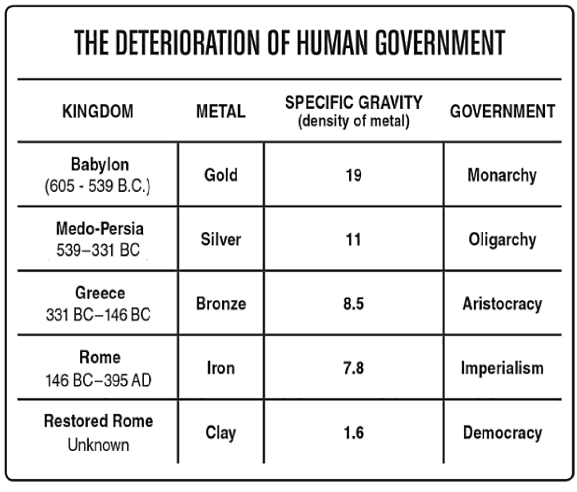
Its legs of iron, its feet partly of iron and partly of clay - Note (1) Decreasing value or preciousness of metals with each succeeding division (2) Decreasing specific gravity (of ? significance) (3) Increasing strength (of the empires) as one descends in the statute and if one looks on a map, each succeeding kingdom is larger than its predecessor.
Arnold Fruchtenbaum observes that the metals "increase in strength; but second, they decrease in value. The fulfillment will be in the decrease of the character of authority and rule: Babylon was an absolute monarchy with the monarch above the law; with Medo-Persia the monarch was not above the law and he did not have the authority to change his own decrees (cp Da 6:8, 11, 12, 15); the Hellenic kings had no dynastic or royal right to rule, and ruled by force of conquest and personal gifts; and Roman imperialism was a republic which degenerated into mob rule merging with the imperial form of government. Yet there will be an increase in strength of one empire over the other." (The Footsteps of the Messiah: A Study of the Sequence of Prophetic Events. 2003. Tustin, CA: Ariel Ministries)
Its feet partly of iron and partly of clay - (Da 2:33-35, 41, 43, 45) Baked clay would be hard but would also be fragile. Think of it as like tile work that was woven into the image, and certainly Babylonian architecture made frequent use of tile. Note the most fragile component of the statute is located at the strategic stabilizing base, the feet.
Every kingdom built by man
ultimately has feet of clay.
There is something fascinating about the statue. At the beginning it looks almost invincible. Its head is gold. Its chest is silver. Its belly is bronze. Its legs are iron. But when you reach the bottom, you discover its weakness. The mighty statue has feet of clay! What an appropriate picture of human government apart from God. Man's kingdoms may appear impressive, sophisticated, wealthy, and militarily powerful, but ultimately there is an inherent fragility in every human system.
J Vernon McGee - The image therefore consisted of a very strange assortment of metals. It was not an alloy of metals, but a multimetallic image of four metals plus a silicon (that is, sand or clay). (SEE Thru the Bible Vol. 26: The Prophets - Daniel)
Daniel 2:34 "You continued looking until a stone was cut out without hands, and it struck the statue on its feet of iron and clay and crushed them.
KJV Thou sawest till that a stone was cut out without hands, which smote the image upon his feet that were of iron and clay, and brake them to pieces.
NET You were watching as a stone was cut out, but not by human hands. It struck the statue on its iron and clay feet, breaking them in pieces.
NLT As you watched, a rock was cut from a mountain, but not by human hands. It struck the feet of iron and clay, smashing them to bits.
ESV As you looked, a stone was cut out by no human hand, and it struck the image on its feet of iron and clay, and broke them in pieces.
- Stone: Da 2:44-45 Da 7:13-14,27 Ps 118:22 Isa 28:16 Zec 12:3 Mt 16:18 Ac 4:11 1Pe 2:7 Rev 11:15
- cut: Da 8:25 Zec 4:6 Jn 1:13 2Co 5:1 Heb 9:24
- without hands - Da 2:45
- which - Ps 2:8-12 Ps 110:5,6 Ps 149:6-9 Isa 60:12 Zec 12:3 Rev 17:14 Rev 19:11-21
Related Passages:
Daniel 2:44-45 “In the days of those kings the God of heaven will set up a kingdom which will never be destroyed, and that kingdom will not be left for another people; it will crush and put an end to all these kingdoms, but it will itself endure forever. 45 “Inasmuch as you saw that a stone was cut out of the mountain without hands and that it crushed the iron, the bronze, the clay, the silver and the gold, the great God has made known to the king what will take place in the future; so the dream is true and its interpretation is trustworthy.”
Psalm 2:8-12 ‘Ask of Me, and I will surely give the nations as Your inheritance, And the very ends of the earth as Your possession. 9‘You shall break them with a rod of iron, You shall shatter them like earthenware.’” 10Now therefore, O kings, show discernment; Take warning, O judges of the earth. 11Worship the LORD with reverence And rejoice with trembling. 12Do homage to the Son, that He not become angry, and you perish in the way, For His wrath may soon be kindled. How blessed are all who take refuge in Him!
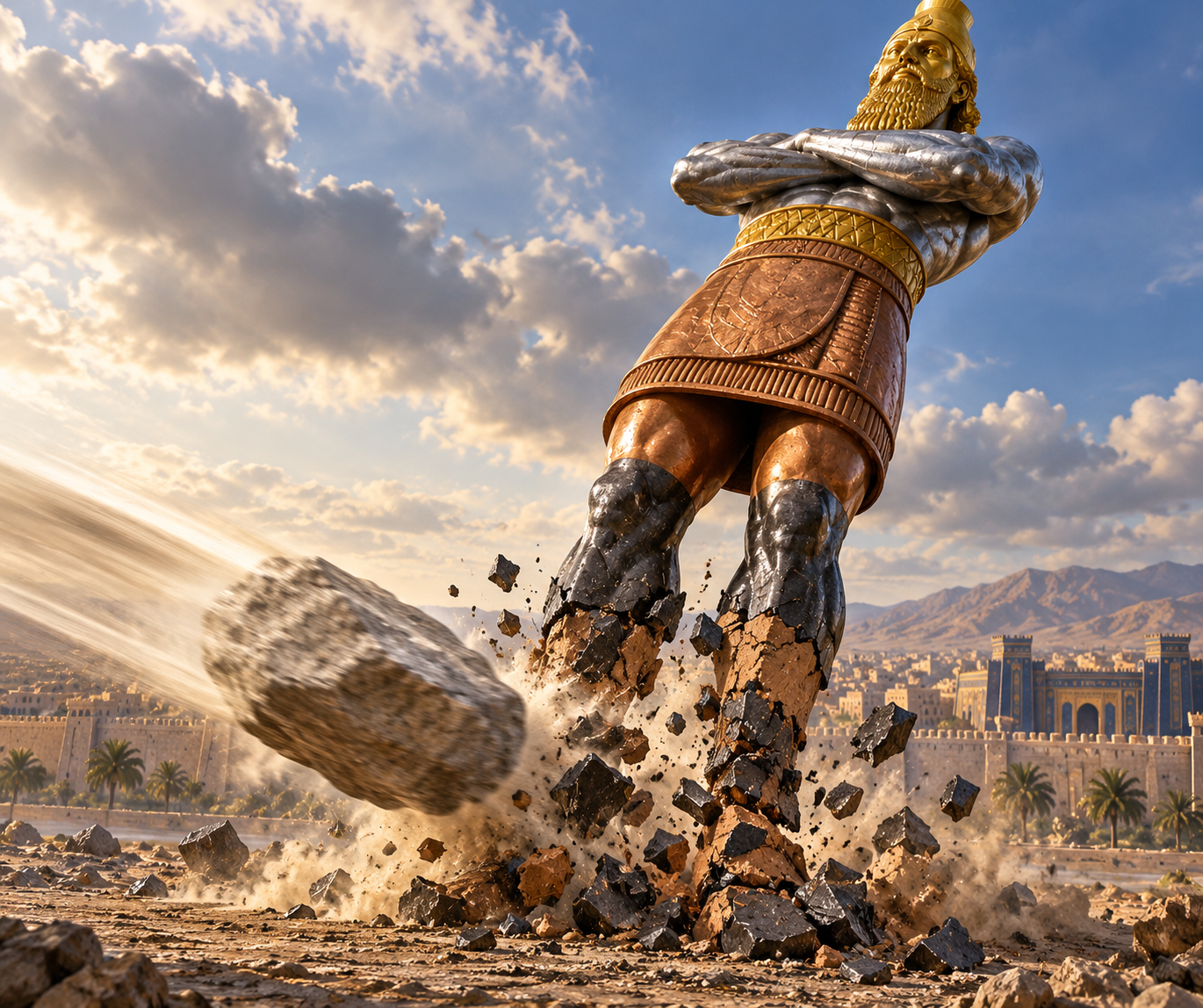
A STONE CUT
WITHOUT HANDS
You continued looking until a stone (eben) was cut out without hands - It is interesting that Daniel's vision was not a static picture but more like a motion picture, for here he describes not only the fact that the king continued looking but the fact that he witnessed the statue being struck on its feet by a Stone that crushed the feet of iron and clay.
Until (See until) is an expression of time which describes something existing (or happening) up to the time of something else which follows and comes into existence (or happens). In this case until signals the end of the Gentile kingdoms, which is synonymous with the terminus of the times of the Gentiles. (Lk 21:24) Those times will continue UNTIL the Stone strikes the statute on its feet. After that the Gentile kingdoms will cease to exist (Da 2:35).
A Stone (eben) - Comparing this Stone with other Scriptures that mention stone in the Old and New Testaments (see discussion below), it is clear that this is not just any Stone, but a supernatural Stone, the Stone of God, the Messiah (mashiach), the Rock of our salvation, the Lord Jesus Christ, the King of kings and Lord of lords (Rev 19:16). This prophecy could speak of no other, for none other than Christ, the Messiah, could accomplish the formidable task of striking and crushing all remnants of Gentile world power, forever and ever. Amen.
In a fascinating, somewhat ironic episode Jesus is riding into Jerusalem at the beginning of Passion week and as He rode the crowd was crying out "Hosanna (Ps 118:25 - "do save we beseech") to the Son of David; BLESSED IS HE WHO COMES IN THE NAME OF THE LORD (quoting Ps 118:26); Hosanna in the highest!" (Mt 21:9). In this same chapter Jesus Himself quotes from this section of Ps 118 in response to the chief priests and elders (Mt 21:23) and asks them "Did you never read in the Scriptures, 'THE STONE WHICH THE BUILDERS REJECTED, THIS BECAME THE CHIEF CORNER [stone]; THIS CAME ABOUT FROM THE LORD, AND IT IS MARVELOUS IN OUR EYES'? (quoting Ps 118:24-25) "Therefore I say to you, the kingdom of God will be taken away from you, and be given to a nation producing the fruit of it. "And he who falls on this stone will be broken to pieces; but on whomever it falls, it will scatter him like dust." (Mt 21:42-44)
In Peter's first epistle he identifies Jesus as "a living STONE, rejected by men, but choice and precious in the sight of God" (1Pe 2:4).
In clearly Messianic passages Isaiah refers to Jesus as a stone…
Isa 8:14 “Then He shall become a sanctuary; But to both the houses of Israel, a stone (Hebrew = eben; LXX = lithos = stone) to strike and a rock to stumble over, [And] a snare and a trap for the inhabitants of Jerusalem. (Peter quotes this in part in 1Pe 2:8 again referring to the Messiah).
Isa 28:16 Therefore thus says the Lord GOD, “Behold, I am laying in Zion a stone, a tested stone, A costly cornerstone [for] the foundation, firmly placed. He who believes [in it] will not be disturbed. (Peter quotes this passage in 1Pe 2:6)
And so there is no doubt that the STONE cut without hands is a clear reference to the Messiah, Who will return in Revelation 19:11-21, defeating all His foes, binding Satan for 1000 years (Rev 20:1-3) and setting up His Kingdom for 1000 years (Rev 20:4-6), a kingdom which the dream describes as "a great mountain which fills the entire earth." (How full? See Hab 2:14)
Israel stumbled over Christ; the Church is built upon Christ;
Gentile world dominion will be crushed by Christ.
In an interesting note on the identity of the Stone in Mt 21:42, Scofield writes "Christ as the Stone is revealed in a threefold way: (1) To Israel, Christ, coming not in Messianic glory but in the form of a servant, is a Stumbling Stone and Rock that leads to falling (Isa 8:14-15; Ro 9:32-33; 1Cor 1:23; 1Pe 2:7-8). (2) To the Church, Christ is the Foundation Stone and the Head of the corner (1Cor 3:11; Eph 2:20-22; 1Pe 2:4-5). And (3) to the Gentile world powers (cp Times of the Gentiles Luke 21:24; Rev 16:19), Christ is to be the Striking Stone of destruction (Dan 2:34). Israel stumbled over Christ; the Church is built upon Christ; Gentile world dominion will be crushed by Christ." Amen!
Cut without hands - This description is repeated in Da 2:45. Clearly, Daniel is using figurative language indicating that the cutting is not natural (normally one would cut a stone by hand to remove it) but clearly is supernatural. Although Daniel is using figurative language, remember that even figurative language always has a literal interpretation! (See Guidelines for Figuring our Figurative Language) Some figures of speech in God's Word defy dogmatic interpretation (e.g., the "locusts" in Rev 9:7-10), but in the case of the stone which is supernatural comparing Scripture with Scripture gives us an excellent clue as to the identity of the stone and the event to which this dynamic description points.
As an aside, some have interpreted cut without hands as a reference to the virgin birth (Note). While it is possible, that might be reading more into the text than the Spirit intended.
Tony Garland writes "Such an interpretation is certainly possible, but we notice mankind was involved in the virgin birth by way of Mary. It seems better to see “without hands” as speaking of the eternal origin of Christ (Isa. 9:6; Mic. 5:2; John 1:1; 8:58; 17:5; Rev. 22:13) as the final King and as denoting the origin of the final kingdom… The stone is produced without the effort or agency of man. Thus, it stands in stark contrast to the image of a man." (Commentary on Da 2:34)
David Guzik comments on the stone - This stone cut without hands is the Messiah, not the Church. Ps 118:22, Isaiah 8:14, Isaiah 28:16, and Zechariah 3:9 also refer to Jesus as a stone.
Isaiah's prophecy for example in Isa 28:16 and quoted in part (specifically in 1Pe 2:6) by Peter in 1Pe 2:4-8 leaves no doubt that the supernatural Stone is the Messiah.
And it struck the statue on its feet of iron and clay and crushed them - The feet correspond to the feet and toes described in Da 2:41-42. This detail is critically important if this prophecy is to be interpreted accurately. It will be discussed more fully below. The point is that the Stone did not strike at head, arms, belly or leg stage, but at the toe stage, a stage which cannot be readily identified by any previous kingdoms in the history of the world. For example, notice that all ten (making the assumption that there are 10 toes, which is reasonable given the parallel passage in Da 7:24 = "ten kings") would have to be existing at the same time to fulfill the prophecy. "Note the presence of clay when the stone strikes, indicating a time in the sequence of kingdoms when the clay has already mixed with the iron." (Garland)
How reminiscent this is of David's encounter with Goliath! There stood Goliath, a giant of a man, seemingly invincible, much like the towering image in Nebuchadnezzar's dream. Yet David confronted this giant who defied the living God (1Sa 17:45) and brought him down with a single stone. In both scenes, what appeared overwhelmingly powerful was suddenly brought down by a stone.
Stone (069)(eben related to Hebrew eben = stone) can refer to literal stones -- used to re-build the destroyed Temple of God in Jerusalem (Ezra 5:8, 6:4), used of the stone used to close Daniel in with the lions (Da 6:17). In Da 5:4, 23, eben describes idols as "gods of… stone." What a contrast with Da 2:34 where the Stone is a metaphor for the Messiah, the Living and True God (1Th 1:9).
Eben (Aramaic) - 8x in 8v - Ezra 5:8; 6:4; Da 2:34-35, 45; Da 5:4, 23; Da 6:17.
The first allusion to stone is found in Genesis. As the patriarch Jacob lay on his death bed, he described One Who was coming Who would be "the Shepherd, the Stone (Hebrew = eben; Lxx = lithos) of Israel." (Ge 49:24)
In this context the Stone metaphor speaks of the Messiah, Christ Jesus. This picture of Christ as a Stone (or Rock) is intimately woven by the Spirit throughout both the Old and New Testaments and makes for a fascinating and encouraging study.
Suggestion: This study would make an edifying series in a Sunday School class and would be very enlightening to those who are not that familiar with the Old Testament especially OT prophecies that speak of the Messiah. Remember to carefully observe the context to arrive at the most accurate interpretation, interrogating the primary verse with questions such as… When does this take place? Where does this take place? What are the circumstances surrounding the use of this metaphor? Who is in the "cast of characters"? Who used the name Stone or Rock? What attribute(s) do you discover about the Stone or Rock? How should we apply this truth to our life today -- not Can we? - it is God's Word of Truth and it is ALWAYS applicable to our life. The more relevant question is "Will we allow the Spirit to speak the Word of Truth to our innermost being and respond with unhesitating obedience"?… here are the Scriptures… and as they say when your meal (cp Mt 4:4, Job 23:12) is served in the restaurant… "Enjoy!"
Ge 49:24 > Ex 17:6 > Ex 33:21 > Nu 20:11 > Dt 32:4 > 2Sa 23:3 > Ps 18:2 > Ps 18:31 > Ps 18:46 > Ps 19:14 > Ps 27:5 > Ps 28:1 > Ps 31:2-3 > Ps 40:2 > Ps 42:9 > Ps 61:2 >Ps 62:2 >Ps 62:6-7 >Ps 71:3 >Ps 78:16 > Ps 78:20 > Ps 78:35 > Ps 81:16 > Ps 89:26 > Ps 92:15 > Ps 94:22 >Ps 95:1 >Ps 105:41 >Ps 114:8 >Ps 118:22 >Ps 144:1 >Isa 8:14 > Isa 17:10 > Isa 26:4 >Isa 28:16 >Isa 30:29 >Isa 32:2 >Isa 33:16 >Isa 44:8 >Isa 48:21 >Isa 51:1 > Da 2:34 > Da 2:35, 44, 45, 46 > Hab 1:12 > Zech 4:7 > Mt 7:24,25> Mt 16:18 >Mt 21:42 >Mk 12:10 >Lk 20:17 > Acts 4:11 >Ro 9:32-33 > Acts 4:11 >1Co 1:23>1Co 10:4 >Eph 2:20 >1Pe 2:4, 5, 6, 7, 8 (Which book of the Bible has the most allusions to Rock? Why might that be the case?)
|
(1) To God Jesus is…Smitten Stone
(2) To Israel Messiah is…Stumbling Stone
(3) To the Church the Lord Jesus is…Cornerstone
(4) To all the Gentile world powers Jesus is the…Stone cut without hands
Stone that grows and fills the earth
(5) To Israel at Second coming Messiah is…Capstone of the corner
(6) To unbelievers the Lord Jesus Christ is the…Crushing Stone of judgment
|
Daniel 2:35 "Then the iron, the clay, the bronze, the silver and the gold were crushed all at the same time and became like chaff from the summer threshing floors; and the wind carried them away so that not a trace of them was found. But the stone that struck the statue became a great mountain and filled the whole earth.
KJV Then was the iron, the clay, the brass, the silver, and the gold, broken to pieces together, and became like the chaff of the summer threshingfloors; and the wind carried them away, that no place was found for them: and the stone that smote the image became a great mountain, and filled the whole earth.
NET Then the iron, clay, bronze, silver, and gold were broken in pieces without distinction and became like chaff from the summer threshing floors that the wind carries away. Not a trace of them could be found. But the stone that struck the statue became a large mountain that filled the entire earth.
NLT The whole statue was crushed into small pieces of iron, clay, bronze, silver, and gold. Then the wind blew them away without a trace, like chaff on a threshing floor. But the rock that knocked the statue down became a great mountain that covered the whole earth.
ESV Then the iron, the clay, the bronze, the silver, and the gold, all together were broken in pieces, and became like the chaff of the summer threshing floors; and the wind carried them away, so that not a trace of them could be found. But the stone that struck the image became a great mountain and filled the whole earth.
- Ps 1:4,5 Isa 17:13,14 41:15,16 Ho 13:3 Mic 4:13
- not a trace - Job 6:17 Ps 37:10,36 103:16 Rev 12:8 20:11
- became: Isa 2:2,3 Mic 4:1,2)
A POWERFUL
PROVIDENTIAL "THEN"!
Then - Then (repeated in Da 2:35, 39, 40, 46, 48) is a crucial expression of time which marks a sequence in the events. In this case then marks the time of the feet stage of Da 2:33 when the feet were struck by the Stone and THEN the statue was crushed.
The iron, the clay, the bronze, the silver and the gold were crushed all at the same time - The point is that it is not just the feet which are crushed by the Stone but (1) the entire image was crushed and (2) all at the same time.
Is it any wonder that this stone smashing statue dream would trouble King Nebuchadnezzar and give him a bad case of divine insomnia! And notice that Nebuchadnezzar seems to be frozen in silence, as Daniel records no reply by the king to the dream description. The implication of course is that Nebuchadnezzar recognizes Daniel's description is "spot on!"
As we discuss below, the Stone represents the Lord Jesus Christ and the striking of the Stone marks the return of Christ, the Second Coming, and the eternal terminus of the Gentile attempt to dominate the earth. In short, man's day ends, and God's day begins!
and became like Chaff from the summer threshing floors Became like - This is a figure of speech (more specifically like introduces a simile) which depicts the worthless part of grain that has been threshed. The worthless part is carried away. This is an amazing, humbling thought, for what God is saying in essence is that all of man's empire building and all his vast and glorious achievements (that is all which have been accomplished apart from Christ as He explained in Jn 15:5) amount to ABSOLUTELY NOTHING in His eternal estimation! Jesus alludes to this with another figure of speech declaring "And everyone who hears these words of Mine (Sermon on the Mount - Matthew 5:1-7:29), and does not act upon them (cp similar warning in James 1:22-24-note), will be like a foolish man, who built his house upon the sand. And the rain descended, and the floods came, and the winds blew, and burst against that house; and it fell, and great was its fall. (Mt 7:26, 27e) In a very real sense all the godless Gentile empires throughout history are like this house built on sand (although clearly in context Jesus is speaking to individuals not empires) and they will not survive the rains and floods and wind of the outpouring of God's righteous wrath which will burst against them and forever destroy them. Does this somber truth not make you want to share the Gospel with someone today?
The psalmist uses this same figure of speech of chaff to describe the eternal fate of ungodly individuals - "The wicked are not so (their fate is not like that of the godly in Ps 1:3), but they are like chaff which the wind drives away. 5 Therefore the wicked will not stand in the judgment, nor sinners in the assembly of the righteous. 6 For the LORD knows the way of the righteous, But the way of the wicked will perish (Heb = abad = to be in a state of ruin and destruction; Lxx = apollumi = not the loss of being per se, but the loss of well-being = so that the person ruined can no longer serve the use for which they were designed!)." (Ps 1:4-6)
Jeremiah uses similar harvest imagery (cp Rev 14:15) in his prophecy of Babylon's defeat by the Medo-Persian Kingdom writing "thus says the LORD of hosts, the God of Israel: “The daughter of Babylon is like (introduces a simile) a threshing floor at the time it is stamped firm; yet in a little while the time of harvest will come for her (Ed: Alluding to her defeat by the Medo-Persian Kingdom).” (Jer 51:33)
Tony Garland points out that "The separation of wheat (valuable) from chaff (discarded) often pictures the place of God’s judgment (2Sa 24:16; 1Chr. 13:9 1Chr. 21:15; Pr. 20:26; Isa. 21:9-10; Isa 27:12; 41:15; Jer. 51:33; Mic. 4:12; Mt. 3:12; Lk 3:17).
THY KINGDOM COME!
and the wind carried them away so that not a trace of them was found - The Stone represents the return of Christ to completely and totally defeat His enemies and establish a new divine kingdom which is devoid of even a trace of the influences of any of the previous Gentile kingdoms - Babylonian, Medo-Persian, Hellenistic, Roman.
It is interesting to note that the fulfillment of this aspect of the prophecy will be a delayed answer to a prayer, a prayer that most of us quite likely have prayed many times! In short, the Stone striking of the statue brings about a great mountain (kingdom) which is the answer to the saints' pleas throughout the ages pleading with God - "Thy kingdom come" (Mt 6:10).
The psalmist alludes to this event as God the Father promises His Son…
“I will surely tell of the decree of the Lord: He said to Me, ‘You are My Son, Today I have begotten You. 8 ‘Ask of Me, and I will surely give the nations as Your inheritance, And the very ends of the earth as Your possession. 9 ‘You shall break them with a rod of iron, You shall shatter them like earthenware (Ps 2:7-9)
Warren Wiersbe comments on Ps 2:9 noting that "Before going to battle, ancient eastern kings participated in a ritual of breaking clay jars that symbolized the enemy army, and thus guaranteed the help of the gods to defeat them. Jesus needs no such folly; He smashes His enemies completely (Rev 19:11, 12, 13, 14, 15, 16; Da 2:42, 43, 44). Jesus is God, Jesus is King, and Jesus is Conqueror."
In the Gospel of Luke Jesus alludes to His "crushing" return "Everyone who falls on that stone will be broken to pieces; but on whomever it falls, it will scatter him like dust. (Lk 20:18)
W A Criswell comments that "In Isa 8:14-15, God is the Stone over which both Israel and Judah would stumble, fall and be broken. The phraseology is also used in Da 2:34-45. Men will stumble over Jesus to their own destruction."
Tony Garland - The threshing having been completed, the useless husks—the fragments from the previous kingdoms—are blown away by the wind. The destruction is so complete “no trace of them [the previous kingdoms] was found.” This is an important detail of the dream: it indicates the destruction of the image by the stone is 100% effective—as soon as the stone strikes. The pieces left over from the previous kingdoms do not gradually give way to the stone. No, they are immediately crushed and carried way and no trace of them remains. The philosophies, cultures, and kingdoms of man are considered as leaven and are not allowed to infect God’s ultimate kingdom (ED: MILLENNIAL KINGDOM) Traces of the previous kingdoms become as difficult to find as traces of the golden calf Aaron crushed into fine dust (Deut. 9:21). How could it be, in our day, some commentators believe the stone has already struck the image when we remain immersed in the influences of these very kingdoms and humanism remains as strong as ever (Ps. 1:4)? No, this passage has in view the future period when the meek literally inherit the earth (Mt 5:5KJV) and the wicked are no more. (Daniel Defended) (Bolding added)
STONE GROWS INTO
A "LIVING STONE"
But the Stone that struck the statue became a great mountain and filled the whole earth - The "but" highlights a striking contrast (see term of contrast) between the complete disappearance of the chaff and the eternal existence of the Stone. Became a great mountain is figurative language because it would be difficult to conceive of a great mountain filling the whole earth! And by comparing Scripture with Scripture we know that mountain is sometimes used figuratively to depict a kingdom. In fact, if we compare Da 2:35 with Daniel's description in Da 2:44 clearly parallels great mountain with a kingdom which will never be destroyed. So while great mountain is clearly figurative (a metaphor), remember that figurative language always has a literal meaning. In this context mountain refers to a literal kingdom that will fill the entire earth, a truth which argues against those systems of belief (eg, Replacement Theology) that teach this refers to an invisible spiritual kingdom. (See discussion regarding The Arrival of God’s Kingdom)
Mountain and kingdom - Through the writing of the prophet Jeremiah Jehovah addresses the Kingdom of Babylon - “I will repay Babylon and all the inhabitants of Chaldea for all their evil that they have done in Zion before your eyes,” declares the LORD. "Behold, I am against you (Kingdom of Babylon), O destroying mountain, who destroys the whole earth,” declares the LORD, “And I will stretch out My hand against you, and roll you down from the crags and I will make you a burnt out mountain." (Jer 51:24-25)
Tony Garland - The stone began as a smaller piece of rock cut from a mountain (Dan. 2:45‣) and smashes the image. After the image has been smashed and no trace of the previous kingdoms can be found, the stone becomes a great mountain. There is an correspondence between the stone and the mountain. Both are made of rock. The stone finds its origin in the mountain, but then becomes a mountain of its own. Elsewhere we find mountains used as symbols for kingdoms (Ps. 30:7; Ps. 68:15-16; Isa. 41:15; Jer. 51:25; 17:9-10; Zec. 4:7). It seems the stone represents a small piece cut out of God’s eternal kingdom—represented by the first Mountain. This would be Christ, having received the kingdom before returning at His second advent when He crushes the kingdoms of man. After crushing the kingdoms, He establishes the Millennial Kingdom and the knowledge of the Lord covers the earth (Isa. 11:9; Hab. 2:14). Thus, God’s eternal kingdom comes to earth fulfilling the Lord’s Prayer, “Your kingdom come Your will be done on earth as it is in heaven” (Mat. 9:10). This is the time when the Son literally inherits the nations and the ends of the earth (Ps. 2:8-12; 82:8; Dan. 7:14‣; Rev. 11:15‣). (Daniel Commentary)
In Revelation 17 we see a clear association of mountains with kingdoms, John recording "Here is the mind which has wisdom. The seven heads are seven mountains on which the woman sits, 10 and they are seven kings; five have fallen, one is, the other has not yet come; and when he comes, he must remain a little while." (Rev 17:9-10) Recall that the use of the word "king" implies a kingdom and so here the seven mountains are symbolic of these seven kingdoms.
In the following passage Isaiah uses mountain in both a literal and figurative sense - Now it will come about that in the last days, (we are in the "last days" - see note on "Last days" and discussion of "Last Days" in Isa 2:2) the mountain of the house of the Lord (Literal mountain = the Temple Mount area) will be established as the chief of the mountains (here mountains ~ kingdoms or nations = Christ's kingdom will reign supreme over all other nations in the Millennium) and will be raised above the hills; and all the nations will stream to it. (Isa 2:2; cf parallel passage in Mic 4:1)
Constable agrees writing on Isa 2:2 that "The mountain of the house of the LORD is Mt. Zion where the Temple, the LORD’s house, stood in the past and will stand in the future (cf. Ezek 40–43). In the future, Mt. Zion would become the chief of all the mountains on earth rising above all other hills in its importance (cf. Ge 12:3; Zech 8:3) Mountain is also a figure for a kingdom in the Old Testament (e.g., Da 2:35-see discussion of this great prophecy , Da 2:44-45). Here (Isaiah 2:2) it probably has the double significance of literal Mt. Zion (Jerusalem) and the whole kingdom of Israel that Mt. Zion represents (by metonymy).
Filled the whole earth - The Kingdom of Christ will know no limits of its rule. Isaiah prophesies that in that day "the earth will be full of the knowledge of the Lord as the waters cover the sea." (Is 11:9) (See other passages that allude to the coming Kingdom of Christ -- Ps 22:27, 28, Ps 46:9 Ps 66:4 Ps 67:1,2 72:8-11, 16-18, Ps 86:9, Da 7:14, Zec 14:8-11, Luke 1:32, 33, 1Co 15:25 Rev 11:15 20:2,3)
At present we do not see the whole earth under the rule of the Messiah, for as John explains in this present age "the whole world lies in the power of the evil one" (1Jn 5:19), Satan, who was given temporary rule over all the kingdoms of the world (Lk 4:5-6) when Adam forfeited his right to rule over the earth (cp Ge 1:26-28) with one act of sin. (Heb 2:7-10)
The prophet Zechariah records that "it will come about in that day that living waters will flow out of Jerusalem, half of them toward the eastern sea and the other half toward the western sea; it will be in summer as well as in winter. And the LORD (Jehovah = Jesus) will be King over all the earth; in that day the LORD will be the only one, and His name the only one. (Zech 14:9)
In the Revelation, the prophet John records that when "the seventh angel sounded; and there arose loud voices in heaven, saying, "The kingdom of the world (cp the single great statute that Nebuchadnezzar saw - Da 2:31 the component kingdoms of which were crushed all at the same time - Da 2:35) has become (known as the prophetic aorist = describes an event so certain it is spoken of as already completed) the kingdom of our Lord, and of His Christ; and He will reign forever and ever." (Rev 11:15)
Comment: The seventh trumpet occurs in the middle of the 7 year period known as Daniel's Seventieth Week (commonly referred to as the "Tribulation") and although 3.5 years will pass before the King returns, the events that are set in motion are irreversible so that the terminus, the Lord's reign over all the the earth in His Millennial Kingdom is as good as done!
This event is the answer to the Solomon's prayer "And blessed be His glorious name forever and may the whole earth be filled with His glory. Amen, and Amen. (Ps 72:19)
As Spurgeon says "For so bright a consummation our heart yearns daily, and we cry Amen, and Amen."
John Walvoord addresses those interpretations that see the kingdom (stone) that fills the whole earth as a spiritual kingdom, not a literal Millennial Kingdom - "Postmillenniarian and some amillennarian interpreters regard the stone as representing Jesus Christ in His first coming Who, by introducing the Christian Gospel, assured the ultimate victory of the saints over the evil powers of Gentile political rule. In amillenarianism this is fulfilled in the Second Coming of Christ and the eternal state. In postmillennialism it is consummated in the thousand-year glorious period of spiritual triumph, which they view as culminating in the Second Coming of Christ. Both the amillennial and postmillennial interpretations, of course, require considerable spiritualization (See "Rise of Allegorical Interpretation). Nothing is more clear from history than that the Roman Empire fell apart from internal decay and from invasion of Barbarian hosts from the north rather than from Christian influences. There is little evidence that the church as such constituted any decisive factor in the downfall of the Roman Empire, and it is certainly not true that the church grew and filled the whole earth as the imagery of the interpretation requires. This interpretation, therefore, requires considerable imagination and elasticity and a non-literal interpretation of the prophecy." (The Prophecy of The Ten-Nation Confederacy - online at Walvoord.com) (Bolding and italics added) (See also Tony Garland's discussion of when Stone strikes the statue)
And so as Walvoord notes a few commentaries (Montgomery) identify the Stone as the Church, but that interpretation simply makes no sense in the overall context of the prophecy. Yes, Jesus did say "upon this rock I will build My church," (Mt 16:18) but to use that passage to validate this interpretation is not using good hermeneutical principles.
I love the way Isaac Watts phrases this in his great hymn "Jesus Shall Reign". Take a moment and sing to the King of kings - let us practice today what will be our forever privilege in that new eternal day!
Jesus shall reign where’er the sun
Does his successive journeys run;
His kingdom stretch from shore to shore,
Till moons shall wax and wane no more.
(Click for tune and all 14 [!!] glorious verses)
Daniel 2:36 "This was the dream; now we will tell its interpretation before the king.
KJV Daniel 2:36 This is the dream; and we will tell the interpretation thereof before the king.
NET Daniel 2:36 This was the dream. Now we will set forth before the king its interpretation.
NLT Daniel 2:36 "That was the dream. Now we will tell the king what it means.
ESV Daniel 2:36 "This was the dream. Now we will tell the king its interpretation.
- Da 2:23,24
THE INTERPRETATION
OF THE DREAM
This was the dream - Daniel is demonstrative not interrogative! He does not ask meekly "Was that the dream you had?" He boldly declared that it was the dream. When you have God's Word of truth on a subject, you can be fearless and boldly declare the truth as did Daniel. This is another reason we have to be continually in the Word, that it might get into us, into our mind and heart, and then what comes out of our mouths will be what fills our heart.
Now we will tell its interpretation (peshar) - Why "we?" The best suggestion (Leupold) is that this represents an "editorial plural" which would convey a tone of humility, something Daniel has already clearly manifested. Note that the king has remained totally silent as Daniel described the king's dream. Had Daniel missed one detail, the king would have interrupted (or even worse) but he did not utter one objection as far as we can discern. Thus clearly Daniel declared the king's dream to perfection, because he had received a perfect divine revelation.
Tony Garland has another thought on we - The most natural explanation is this: although Daniel’s companions are not present before the king, Daniel desires his listeners to understand the information resulted from the intercession and spiritual discipline of both him and his companions. This paves the way for Nebuchadnezzar’s acceding to his subsequent request for favor on behalf of his companions (Dan. 2:49)....Daniel has now met the most difficult part of the test: divulging the king’s unknown dream itself. This was the part of the king’s test the wise men could not fake. Daniel will now give the accurate interpretation which is no less dependent upon divine revelation than the contents of the dream itself. (Daniel Commentary)
Donald Campbell tells a story of a modern day "Daniel", Billy Graham - In the early days of Dr. Billy Graham's evangelistic ministry, he held a series of meetings in the Dallas Cotton Bowl. As the services came to a climax, the challenge was to fill the 70,000 seat stadium for a final Sunday evening service. The word was out that certain gambling elements were betting it couldn't be done, but on the last night a cheer went up from the crowd as the last seat was taken. A well-known columnist for the Dallas Morning News devoted an entire column the next week to the event. He posed the question, "How can a young man without a semi-education draw such a crowd of people when some of highly educated and robed downtown ministers preach to half-filled churches on Sunday mornings?" Answering his own question, the columnist said, "It's because Billy Graham preaches what the Bible says. He has a note of authority in his message—a 'thus saith the Lord." And so did Daniel! (Borrow Daniel Decoder of Dreams - aka God's Man in a Secular Society page 22)
THE DREAM
DECRYPTION!
NLT Study Bible note - Hippolytus (170-236AD), one of the early church fathers, identified the four kingdoms as Babylonia, Media-Persia, Greece, and Rome. The church father and historian Eusebius of Caesarea (260-340AD) initially identified the first kingdom as Assyria (which once also controlled Babylon), but he later agreed with Hippolytus, as did most of the church fathers. Later, Jerome and Augustine accepted this same understanding, and conservative interpreters largely still agree. (Borrow NLT Study Bible page 1394)
ESV Study Bible - Traditional commentators through the history of the church have almost universally identified the four kingdoms as Babylon, Medo-Persia (established by Cyrus in 539 B.C.; specifically named in 8:20), Greece (under Alexander the Great, about 331; specifically named in 8:21), and Rome (the Roman Empire began its rule over Palestine in 63). Those scholars, however, who assume that Daniel’s detailed visions cannot be predictive prophecies, but had to have been written after the events they claim to “predict,” hold that Daniel was written not in the sixth century B.C. but in the second century, in the Maccabean period. Under this scheme the fourth kingdom cannot be the Roman Empire, which did not yet exist at that time. So they propose various other identifications for the kingdoms, such as (1) Babylon, (2) Media, (3) Persia, and (4) Greece; however, Media was never an independent world power after Babylon fell to Cyrus in 539 B.C. (it was also ruled by Cyrus). (Borrow The ESV Study Bible page 1590)
Interpretation (06591)(peshar from Aramaic verb peshar = to interpret) means the act of expounding or unfolding what is not understood or not obvious, such as a prophecy. Interpretation can also mean the explanation of unintelligible words in language that is intelligible (e.g., the writing on the wall - Da 5:7-8, 12, 15-17, 26). Most uses of peshar depict Daniel as the "interpreter" (obviously with divine enablement), but in Da 7:16 the prophet approached a supernatural being requesting interpretation.
Peshar - 30x in 26v - Da 2:4-7, 9, 16, 24-26, 30, 36, 45; 4:6-7, 9, 18-19, 24; 5:7-8, 12, 15-17, 26; Da 7:16
Broken Statues - In Moscow stands the New Tretyakov Gallery, a museum that displays art and artifacts from the days of the former Soviet Union. Scattered along the banks of the Moscow River near the museum are statues of once-powerful leaders that have been smashed and disfigured. Images of Stalin and Lenin have their noses knocked off and their heads separated from their bodies.
These gloomy scenes bring to mind the dream of King Nebuchadnezzar in Daniel 2. He saw a statue with a glorious head of gold, a chest and arms of silver, a torso of bronze, legs of iron, and feet of iron and clay (Da 2:31-33). It portrayed the succession of four great ruling nations of the world. From history we know they were Babylon, Medo-Persia, Greece, and Rome. Then a stone "cut out of the mountain without hands" (Da 2:45) rolled down (Ed: That is actually not a correct statement -- it is not said to "roll down.") and smashed the statue to smithereens. This pictured God's judgment of those four kingdoms and His supremacy over all the earth.
One day God will judge the nations of the world, and their monuments will lie in ruins (Ed: More accurately, there will be no trace of them!). No matter how powerful the nation, all will crumble beneath the outpouring of God's holy wrath. We can be confident that Jesus Christ, the King of kings, will rule the world in righteousness, justice, and peace. What a glorious prospect! — David C. Egner (Reprinted by permission from Our Daily Bread Ministries. Please do not repost the full devotional without their permission.)
Now evil prospers, falsehood reigns,
And darkness dims the light;
But soon the day will come when Christ
Returns to set things right.
—Sper
Nations rise and fall,
but Christ's kingdom stands forever.
Daniel 2:37 "You, O king, are the king of kings, to whom the God of heaven has given the kingdom, the power, the strength and the glory;
KJV Thou, O king, art a king of kings: for the God of heaven hath given thee a kingdom, power, and strength, and glory.
NET "You, O king, are the king of kings. The God of heaven has granted you sovereignty, power, strength, and honor.
NLT Your Majesty, you are the greatest of kings. The God of heaven has given you sovereignty, power, strength, and honor.
ESV You, O king, the king of kings, to whom the God of heaven has given the kingdom, the power, and the might, and the glory,
- king: 1Ki 4:24 Ezra 7:12 Isa 10:8 47:5 Jer 27:6,7 Eze 26:7 Ho 8:10 Rev 1:5 17:14
- the God: Da 4:25,32 5:18 2Ch 36:23 Ezra 1:2 Pr 8:15 Jer 28:14 Rev 19:16
- power: Da 4:3,34 Ps 62:11 Mt 6:13 Jn 19:11 Rev 4:11, 5:12
Related Passages:
Ezekiel 26:7 For thus says the Lord GOD, “Behold, I will bring upon Tyre from the north Nebuchadnezzar king of Babylon, king of kings, with horses, chariots, cavalry and a great army.
Jeremiah 27:4“Command them to go to their masters, saying, ‘Thus says the LORD of hosts, the God of Israel, thus you shall say to your masters, 5 “I have made the earth, the men and the beasts which are on the face of the earth by My great power and by My outstretched arm, and I will give it to the one who is pleasing in My sight. 6 “Now I have given all these lands into the hand of Nebuchadnezzar king of Babylon, My servant, and I have given him also the wild animals of the field to serve him. 7 “All the nations shall serve him and his son and his grandson until the time of his own land comes; then many nations and great kings will make him their servant. 8 “It will be, that the nation or the kingdom which will not serve him, Nebuchadnezzar king of Babylon, and which will not put its neck under the yoke of the king of Babylon, I will punish that nation with the sword, with famine and with pestilence,” declares the LORD, “until I have destroyed it by his hand.
NEBUCHADNEZZAR
"KING OF KINGS"
You, O king, are the king of kings, to whom the God of heaven has GIVEN the kingdom, the power (“royal power, i.e., might or force to rule or control"), the strength and the glory - Ponder this (1) God raised up this tyrannical pagan king to chasten rebellious Judah (2) Babylon was in power only about 70 years, the same time during which Israel (Judah) was disciplined (3) God used this pagan king to present His prophetic plan for the ages.
King of kings (6x in Scripture - Ezra 7:12, Ezek 26:7 [Ezek 26:7 For thus says the Lord GOD, “Behold, I will bring upon Tyre from the north Nebuchadnezzar king of Babylon, king of kings, with horses, chariots, cavalry, and a great army.] It is interesting that this title is ascribed to Nebuchadnezzar by Daniel's fellow exile Ezekiel!, Da 2:27, 1Ti 6:15, Re 17:14, Re 19:16) -
The idea of the repetition of king is the supreme king among kings. As earthly kings go, Nebuchadnezzar was indeed the supreme example of a human king (NB: Artaxerxes referred to himself as "king of kings" but here in Da 2:37 the declaration is by Daniel, God's prophet). Nebuchadnezzar the earthly, human king of kings is no match for the incomparable King of kings, (Re 17:14, Re 19:16) the Lord Jesus Christ, Who comes on the scene after the city of Babylon has been finally and forever destroyed (Rev 18:21). To the eternal King of kings may praises forever sound forth "Worthy is the Lamb that was slain to receive power and riches and wisdom and might and honor and glory and blessing." (Rev 5:12)
Tony Garland has an interesting comment on king of kings ("the king from (among other) kings") - This phrase designates the highest ruling authority on earth: not just any king, but the king among all kings. If we know the Scriptures, we immediately sense an historical tension because God previously promised this honor for a ruler seated upon the throne of David. "I have found My servant David; With My holy oil I have anointed him… I will make him My firstborn, The highest of the kings of the earth." (Ps 89:20, 27) If the Davidic rulers had been obedient to exercise righteous rule (1Ki 10:9; 2Chr. 9:8), this right would never have been transferred into Gentile hands. But, due to the ongoing sin of the rulers in the line of David, God had taken away their position as the highest king, invested with divine authority, and transferred it to Nebuchadnezzar. This is the condition prevailing during the Times of the Gentiles. At the end of the Times of the Gentiles, when the Stone strikes the image, dominion will once again return to a man seated on the throne of David. The man’s Name is Jesus the Christ, Who is the only true Potentate, “the King of kings and Lord of lords” (1Ti. 6:15; Rev. 17:14; 19:16). Nebuchadnezzar’s dream and its interpretation reveals that Gentile kings from this point forward will be no better than their sinful Jewish predecessors who were ultimately removed from the throne of David. The only lasting solution for righteous rule on the earth is found in the “king of righteousness” (Isa. 32:1; Jer. 23:5), who is also a priest forever according to the order of Melchizedek, translated: king of righteousness (Ps. 110:4; Heb. 5:6, 10; 6:20; 7:2, 17, 21). (Commentary)
Has GIVEN (cp Da 2:38, Da 1:2, Da 1:9, Da 1:17, cp Jer 27:6; 28:14) - The verb given is a clear example of God's sovereignty, the One Who changes the times and the epochs (Da 2:21) and establishes kings (Da 2:21) once again testifying to the fact that Jehovah is sovereign over all creation and all creatures. In Jeremiah, Yahweh refers to King Nebuchadnezzar as "My servant" (Jer 25:8, 9 in the context of God's final judgment on Judah; cp Pr 21:1).
Daniel 2:38 and wherever the sons of men dwell, or the beasts of the field, or the birds of the sky, He has given them into your hand and has caused you to rule over them all. You are the head of gold.
KJV And wheresoever the children of men dwell, the beasts of the field and the fowls of the heaven hath he given into thine hand, and hath made thee ruler over them all. Thou art this head of gold.
NET Wherever human beings, wild animals, and birds of the sky live– he has given them into your power. He has given you authority over them all. You are the head of gold.
NLT He has made you the ruler over all the inhabited world and has put even the wild animals and birds under your control. You are the head of gold.
ESV and into whose hand he has given, wherever they dwell, the children of man, the beasts of the field, and the birds of the heavens, making you rule over them all-- you are the head of gold.
- beasts: Da 4:21,22 Ps 50:10,11 Jer 27:5, 6, 7
- Da 2:32
Related Passages:
Jeremiah 27:5-7 “I have made the earth, the men and the beasts which are on the face of the earth by My great power and by My outstretched arm, and I will give it to the one who is pleasing in My sight. 6 “Now I have given all these lands into the hand of Nebuchadnezzar king of Babylon, My servant, and I have given him also the wild animals of the field to serve him. 7 “All the nations shall serve him and his son and his grandson until the time of his own land comes; then many nations and great kings will make him their servant.
Isaiah 14:4KJV That thou shalt take up this proverb against the king of Babylon, and say, How hath the oppressor ceased! the golden city ceased! (Isa 14:4 KJV)
Revelation 18:16 saying, ‘Woe, woe, the great city (BABYLON), she who was clothed in fine linen and purple and scarlet, and adorned with gold and precious stones and pearls;
NEBUCHADNEZZAR
HEAD OF GOLD
and wherever the sons of men dwell, or the beasts of the field, or the birds of the sky, He has given them into your hand and has caused you to rule over them all. You are the head of gold. - Obviously, “wherever the sons of men dwell” is comprehensive language and should not be pressed to mean that Nebuchadnezzar literally ruled every inhabited portion of the globe. Babylon, for example, exercised no dominion over the peoples of North America. Rather, the expression emphasizes the extraordinary extent and supremacy of Nebuchadnezzar's God-given dominion within the world of the biblical narrative. In other words, his was the dominant world empire of his day, but not a literally worldwide empire. The language recalls God's original grant of dominion to mankind over the creatures of the earth (Ge 1:26-28; cf. Ps 8:6-8).
Merrill Unger - The reference to Nebuchadnezzar’s dominion over mankind and the animal and bird creation envisions the dominion originally assigned unfallen man (Gen. 1:28; 2:19-20) and lost through the Fall. It was temporarily delegated to Nebuchadnezzar and the Gentile world powers; but, because of their abuse, it will be taken from them by the Son of Man, who at His second advent will restore the lost inheritance to mankind (Psalm 8:4-6). (BORROW Unger’s Commentary on the Old Testament)
He (God of heaven) has GIVEN (Da 2:37)…He has given them into your hand… has caused you to rule over - Notice that God's sovereignty is repeatedly emphasized (cp Da 1:2 "gave", Da 1:9 "granted", Da 1:17 "gave", Da 2:21 "gives", Da 2:23 "given", Da 2:37,38 "given" - read Jer 27:4-8)
Rule over - This recalls God's decree to Adam and Eve to "rule over the fish of the sea and over the birds of the sky, and over every living thing that moves on the earth.” (Ge 1:28)
Tony Garland - The emphasis found in this verse concerning authority over the animal realm recalls the dominion originally given to Adam over the entire creation on earth (Gen. 1:26-28; 2:19-20; 9:2; Ps. 8:4-8; 115:16). (Daniel 2 Commentary)
John Walvoord notes Daniel's "fearless declaration that Nebuchadnezzar owes all his power to the God of heaven Who has revealed this secret to Daniel. How different this is from the subservient respect given by the other wise men. Here is a voice of truth which even Nebuchadnezzar must receive with submission." (Daniel 2 Nebuchadnezzar’s Vision Of The Great Image)
You are the head of gold - Gold = Da 2:32, 38 = Lion Da 7:4 = Nebuchadnezzar (Babylon) (fell in 539 BC) Babylon was referred to as the "Golden City" because gold was used found all through the city in decorations of shrines, temples, and other public buildings.
Charles Boutflower - Why did God represent Babylon with gold in the dream? It was an appropriate representation for two reasons. First, Marduk, the chief god of Babylon, was called the god of gold. Second, Babylon used gold extensively in its buildings, images and shrines. Herodotus, who was at Babylon ninety years after the era of Nebuchadnezzar, was astonished at the amount of gold there. Even walls and buildings were overlaid with gold. (In and Around the Book of Daniel, p. 34)
Related Resource:
- Daniel's Seventieth Week - in chart format
Daniel 2:39 "After you there will arise another kingdom inferior to you, then another third kingdom of bronze, which will rule over all the earth.
KJV And after thee shall arise another kingdom inferior to thee, and another third kingdom of brass, which shall bear rule over all the earth.
NET Now after you another kingdom will arise, one inferior to yours. Then a third kingdom, one of bronze, will rule in all the earth.
NLT "But after your kingdom comes to an end, another kingdom, inferior to yours, will rise to take your place. After that kingdom has fallen, yet a third kingdom, represented by bronze, will rise to rule the world.
ESV Another kingdom inferior to you shall arise after you, and yet a third kingdom of bronze, which shall rule over all the earth.
- another kingdom - Da 2:32 5:28, 29, 30, 31 7:5 8:3,4,20 11:2 Isa 44:28 45:1, 2, 3, 4, 5
- Third - Da 2:32 7:6,7,23 8:5-14 10:20 11:3-20 Zec 6:3,6
ANOTHER AFTER BABYLON:
SILVER
After you there will arise another kingdom inferior to you, then another third kingdom of bronze, which will rule over all the earth - Keep in mind that the 4 kingdoms being described are Gentile powers who fulfill Jesus' prophecy of the times of the Gentiles (Lk 21:24) that will continue until the end of this age (cp Rev 11:2 for description of Gentiles still treading on Jerusalem in the last half of the 7 year period known as Daniel's Seventieth Week, equivalent to the last 3.5 years or 42 months known as the Great Tribulation). The power of the Gentiles will be finally and fully destroyed when the Stone strikes the great statue which represents Gentile power. At this time the Stone Christ Jesus crushes the Gentile powers so thoroughly that He utterly obliterates every trace of all previous past Gentile empires and their rule over the earth, at which time the Stone, Christ Jesus, assumes His throne in the Kingdom as the King of kings (cp Da 2:35, cp Ps 2:6, 8, 9, 12).
Related Resource:
After you - A very clear expression of time. After you means after Babylon. This specific time phrase also implies that Nebuchadnezzar would not lose his kingdom to a hostile force during his lifetime, a fact that should help remedy his insomnia! But just the fact that Babylon would pass off the stage as the dominant kingdom could have been enough to enrage this emotionally charged king. Even with that as a possibility Daniel was bold as a lion! (Pr 28:1)
Jeremiah predicted Babylon's demise declaring that "all the nations shall serve him, and his son, and his grandson, until the time of his own land comes; then many nations and great kings will make him their servant." (Jer 27:7, cp Jer 25:12-14) As Henry Morris says "The Babylonian empire would continue in power under Nebuchadnezzar and his son Nabonidus, but would be lost under his grandson, Belshazzar, who was serving as co-regent while Nabonidus was out of the capital (see Daniel 5)."
Will arise - Here we have another example of the truth that God removes kings (Babylon) and establishes kings (Medo-Persia) (Da 2:21)
Another kingdom inferior - Almost every conservative scholar interprets this kingdom as Medo-Persia. However the best "commentary" is to Compare Scripture with Scripture which clearly identifies this kingdom as Medo-Persia in Da 5:28, and Da 8:20 clealy linking the two branches (Medes and Persians) into a single entity (ram Da 8:3-4) which by implication would signify a single kingdom. These observations would refute the interpretations that say the Medes and Persians are two separate kingdoms (second - silver and third - bronze).
Inferior (0772)(ara) is "an Aramaic, feminine noun meaning earth. Functioning as an adverb, it also carries the idea of downward, below, or towards the earth." (Baker- Word Study Dictionary: OT) Ara is used twice in Da 2:39, first rendered as "inferior (Lxx = elasson = small, little, lower quality or Lxx [Theodoret] = esson = means of less evaluation, weaker - Mt 20:28) and then as literal "earth (Lxx = ge = land, earth)."
Ara - 20x in 16v - Ezra 5:11; Da 2:35, 39; Da 4:1, 10-11, 15, 20, 22f, 35; 6:25, 27; 7:4, 17, 23. Translated (NAS) earth (15), ground (3), inferior (1), land (1).
John Walvoord - The descending scale of value of the four metals suggests the degeneration of the human race through the ages, as implied in Genesis 4. Classical writers, such as Hesiod (Works and Days, 109-201), and Ovid (Metamorphoses I, 89-150), conceive of history in this way. This concept contradicts the evolutionist’s interpretation of human history. Instead of man beginning in the dust and consummating in fine gold, God reveals man in the times of the Gentiles to begin with fine gold and end in dust.The descending value of the metals, however, permits their ascending strength, which suggests increased military might during the times of the Gentiles, leading to the final world conflict of Revelation 16 and 19 to which Daniel refers (Da 11:36-45). (Nebuchadnezzar’s Vision Of The Great Image)
Tony Garland quotes Freeman (Introduction to the Old Testament Prophets-) - Freeman summarizes the evidence in favor of a single combined Medo-Persian Empire - "The critical school, assigning a Maccabean date for Daniel and denying the possibility of predictive prophecy, places all four kingdoms prior to the alleged date of the books composition (c. 167 B.C.) and thus identifies them as Babylonian, Median, Persian and Greco-Macedonian… However, this erroneous assumption by the critics is disproved by the book itself, which identifies the second kingdom quite specifically as Medo-Persian … Daniel does not say that the Babylonian kingdom will first be given to the Medes and then the Persians, but “given to the Medes and Persians,” [Da 5:28-30], the Persians being in fact emphasized in the usage of the word peres. Again in Daniel 6:8, 12, 15 Darius is said to have ruled according to “the law of the Medes and Persians.” If Persia constituted a separate kingdom following the alleged Median kingdom, it is obvious that Darius could not have know of, nor been bound by, the laws of the Persians… Moreover, 2Chronicles 36:20 disproves the alleged belief by the Jews of any intermediate Median empire before Persia… chapter 8 … also speaks of Media and Persia as parts of one realm (Dan. 8:20), which was to be followed by the Greek Empire (Da 8:21-22+. The two-horned ram is specifically said to be “Media and Persia,” and the he-goat … which succeeded it, is said to be Greece. (See Garland's more detailed discussion - Sequence of Kingdoms)
A C Gaebelein has a somewhat sarcastic comment addressing the thought of so many in our modern world that mankind is evolving, not devolving (as suggested by the decreasing worth of the metals in the succeeding kingdoms) - According to the modern day conception of the times of the Gentiles, this image should have been constructed in this wise: First a head, composed of the meanest good for nothing stuff, earth mixed with particles of iron. Gradually the clay gives way and becomes iron, the inferior parts are expelled. Then the refining process continues and iron is changed to brass and brass to silver, then coming to the enlightened days of the Nineteenth Century and the great Twentieth Century with its civilization, we reach the fine gold. Well, this is a dream too, but it is not a dream given of God, but the dream which the Father of lies has inspired." (The prophet Daniel - a key to the visions and prophecies)
THEN A THIRD:
BRONZE
Then (see then) is an expression of time which often marks a sequence of events as in this section of Daniel (Then = Da 2:35, 2:39, 2:40).
Third Kingdom - Comparing Scripture with Scripture the third kingdom was Greece headed by Alexander the Great and described by Daniel in a parallel passage (Da 8:21) The Greeks were well-known for their bronze armor and weaponry.
H A Ironside reminds us that "At the time that Nebuchadnezzar dreamed his dream the Persian kingdom did not exist. Persia was but a Babylonian province. A Grecian empire might have seemed an utter impossibility. The Hellenic states were a lot of warring tribes and kingdoms, giving little promise of their future greatness (See Map of Ancient Greece). The city of Rome was just being founded-an insignificant little village on the banks of the Tiber (See History of Rome - see Timeline). How did Daniel portray with such accuracy the future history of all these powers if unaided by the Holy Spirit of God? (Ed: A Rhetorical Question of course!)" (Daniel 2 Commentary - Ironside's Notes)
John Whitcomb - After the death of Nebuchadnezzar in 562 B.C., a drastic deterioration of the qualities of the kingdom occurred under the rule of his son Evil-Merodach, two usurpers of the throne (Neriglissar and Nabonidus), and finally his daughter's son Belshazzar. By 539 B.C. the golden qualities of brilliant and absolute dictatorial autocracy which had characterized the forty-three-year reign of Nebuchadnezzar were almost gone. Then it was that "the time of his own land" finally came, and Cyrus, though inferior to Nebuchadnezzar in the authority by which he ruled (being subject to the laws of the Medes and Persians, 6:8, 15), was nevertheless overwhelmingly greater than the morally rotten Belshazzar, who was weighed in God's balances and found wanting (Da 5:27). (SEE Daniel- Everyman's Bible Commentary - Page 45)
NLT Study Bible Note - In antiquity and in our era, some interpreters have argued that Greece is the fourth empire, and they treat the Medes as a separate kingdom. This interpretation is due in part to denying the possibility of prediction and assuming that the book was written about 164BC, when the Roman empire had not yet arisen. But Media and Persia are usually regarded as one empire, and the Median kingdom had been mostly assimilated by the Persians by the time Cyrus II conquered Babylon in 539BC. (SEE NLT Parallel Study Bible - Page 1537)
NET NOTE - The identity of the first kingdom is clearly Babylon. The identification of the following three kingdoms is disputed. The common view is that they represent Media, Persia, and Greece. Most conservative scholars identify them as Media-Persia, Greece, and Rome.
Daniel 2:40 "Then there will be a fourth kingdom as strong as iron; inasmuch as iron crushes and shatters all things, so, like iron that breaks in pieces, it will crush and break all these in pieces.
KJV And the fourth kingdom shall be strong as iron: forasmuch as iron breaketh in pieces and subdueth all things: and as iron that breaketh all these, shall it break in pieces and bruise.
NET Then there will be a fourth kingdom, one strong like iron. Just like iron breaks in pieces and shatters everything, and as iron breaks in pieces all of these metals, so it will break in pieces and crush the others.
NLT Following that kingdom, there will be a fourth one, as strong as iron. That kingdom will smash and crush all previous empires, just as iron smashes and crushes everything it strikes.
ESV And there shall be a fourth kingdom, strong as iron, because iron breaks to pieces and shatters all things. And like iron that crushes, it shall break and crush all these.
- fourth: Da 2:33 Da 7:19, 20-26 8:24 9:26 11:36-45 Jn 11:48
- Da 7:7 Jer 15:12 Am 1:3
Related Passages:
Daniel 7:7 “After this I kept looking in the night visions, and behold, a fourth beast, dreadful and terrifying and extremely strong; and it had large iron teeth. It devoured and crushed and trampled down the remainder with its feet; and it was different from all the beasts that were before it, and it had ten horns.
Daniel 7:19-26 “Then I desired to know the exact meaning of the fourth beast (COMPARE "FOURTH KINGDOM"), which was different from all the others, exceedingly dreadful, with its teeth of iron and its claws of bronze, and which devoured, crushed and trampled down the remainder with its feet, 20 and the meaning of the ten horns that were on its head and the other horn which came up, and before which three of them fell, namely, that horn which had eyes and a mouth uttering great boasts and which was larger in appearance than its associates. 21 “I kept looking, and that horn was waging war with the saints and overpowering them 22 until the Ancient of Days came and judgment was passed in favor of the saints of the Highest One, and the time arrived when the saints took possession of the kingdom. 23 “Thus he said: ‘The fourth beast will be a fourth kingdom on the earth, which will be different from all the other kingdoms and will devour the whole earth and tread it down and crush it. 24 ‘As for the ten horns, out of this kingdom ten kings will arise; and another will arise after them, and he will be different from the previous ones and will subdue three kings. 25 ‘He will speak out against the Most High and wear down the saints of the Highest One, and he will intend to make alterations in times and in law; and they will be given into his hand for a time, times, and half a time. 26 ‘But the court will sit for judgment, and his dominion will be taken away, annihilated and destroyed forever.
FOURTH KINGDOM
STRONG AS IRON
Then again is an expression of time marking the succession of kingdoms. Observe that the fourth kingdom warrants 5 verses of description emphasizing its significance prophetically.
Then there will be a fourth kingdom as strong as iron; inasmuch as iron crushes and shatters all things, so, like iron that breaks in pieces, it will crush and break all these in pieces - Daniel now comes to the final kingdom represented by the metallic portion of the statue. Daniel devotes considerably more attention to this fourth kingdom than to the second and third. Its importance lies not merely in ancient Rome, but in the fact that its imagery continues from the iron legs into the iron-and-clay feet and toes (Da 2:41-43), where the Stone finally strikes the statue (Da 2:34, 44-45). Daniel's language is deliberately forceful, because iron does not merely overcome what stands before it but it crushes and shatters it.
Tony Garland adds that "Scripture reveals far more details concerning this (FOURTH) kingdom, both here and in the parallel treatment of Daniel’s vision of beasts in chapter 7 and in the book of Revelation, than all the other kingdoms combined. Additional revelation is provided concerning the fourth kingdom because of its unique nature and role in God’s plan. (Daniel Commentary)
A fourth kingdom - While this kingdom is not named in Daniel from history we know this to be the Roman Empire, larger, stronger and longer lasting than the 3 preceding kingdoms. Unlike the 3 preceding kingdoms, the Roman Empire fell both internally (moral collapse) and externally (Barbarian invasion). Also unique is that there is no absolutely definite date of its fall as there is with the other 3 kingdoms.
J Vernon McGee - This brings us to the fourth kingdom. It is important to note that there are only four -- there is no fifth kingdom (ED: THERE IS THE MILLENNIAL KINGDOM OF MESSIAH BUT NO MORE GENTILE KINGDOMS). The period of the fourth kingdom is where we are today. (SEE Thru the Bible Vol. 26: The Prophets - Daniel)
Strong as iron - This describes the power of this kingdom. As previously noted gold is more valuable than iron, but iron is much stronger. The imagery has progressively moved from preciousness toward sheer strength:
Renald Showers on the description strong as iron - Iron was an excellent designation of Rome for at least two reasons. First, ancient Rome was noted for its use of iron in its military weaponry. Second, as Daniel indicated in Da 2:40, just as iron is able to crush gold, silver and bronze because it is stronger, so Rome would crush and shatter the ancient world. Ancient Rome did just that through its great military strength. (The Most High God- A Commentary on the Book of Daniel)
It will crush and break all these in pieces - Luke indirectly testifies to the fact that Rome crushed all resistance for at Jesus' birth "there went out a decree from Caesar Augustus, that all the world should be taxed (Luke 2:1). Caesar Augustus could hardly have levied a tax on all the world (See map of extent of Rome's rule) had he not first crushed them and subjugated them to Roman rule!

Donald Campbell - The mark of the fourth empire was strength, but it was destructive strength. The iron legions of Rome "crushed and demolished" all resistance. It is true that the world lived in peace—the Pax Romana—but it was a peace enforced by the iron heel of Rome, a peace that stamped out freedom (Borrow Daniel Decoder of Dreams - aka God's Man in a Secular Society page 24)
Summary of the historical fulfillment of the prophecy up to this point…
The head… fine gold - Gold = Da 2:32, 38 = Lion Da 7:4 = Nebuchadnezzar (Babylon) (fell in 539 BC - See Da 5:28, cp Da 8:20, 21, 22)
Breast and its arms - Silver = Da 2:32,39; Bear = Da 7:5; Ram = Da 8:6, 20 = Media & Persia (539-331 BC)
Its belly and its thighs - Bronze = Da 2:32, 39; Leopard Da 7:6; Male, Shaggy Goat = Da 8:8,21 = Greece under Alexander the Great (331-63 BC)
PROPHECY ABOVE…
FULFILLED IN HISTORY
Then comes a
"TIME GAP"
Therefore the…
PROPHECY BELOW…
YET TO BE FULFILLED IN THE FUTURE
Daniel 2:41 "In that you saw the feet and toes, partly of potter's clay and partly of iron, it will be a divided kingdom; but it will have in it the toughness of iron, inasmuch as you saw the iron mixed with common clay.
KJV And whereas thou sawest the feet and toes, part of potters' clay, and part of iron, the kingdom shall be divided; but there shall be in it of the strength of the iron, forasmuch as thou sawest the iron mixed with miry clay.
NET In that you were seeing feet and toes partly of wet clay and partly of iron, so this will be a divided kingdom. Some of the strength of iron will be in it, for you saw iron mixed with wet clay.
NLT The feet and toes you saw were a combination of iron and baked clay, showing that this kingdom will be divided. Like iron mixed with clay, it will have some of the strength of iron.
ESV And as you saw the feet and toes, partly of potter's clay and partly of iron, it shall be a divided kingdom, but some of the firmness of iron shall be in it, just as you saw iron mixed with the soft clay.
- the feet: Da 2:33, 34, 35 Da 7:7,24 Rev 12:3 13:1 17:12
Related Passages:
Daniel 7:7 “After this I kept looking in the night visions, and behold, a fourth beast, dreadful and terrifying and extremely strong; and it had large iron teeth. It devoured and crushed and trampled down the remainder with its feet; and it was different from all the beasts that were before it, and it had ten horns.
Daniel 7:24 ‘As for the ten horns, out of this kingdom ten kings will arise; and another will arise after them, and he will be different from the previous ones and will subdue three kings.
Revelation 12:3 Then another sign appeared in heaven: and behold, a great red dragon having seven heads and ten horns, and on his heads were seven diadems.
Revelation 13:1 And the dragon stood on the sand of the seashore. Then I saw a beast coming up out of the sea, having ten horns and seven heads, and on his horns were ten diadems, and on his heads were blasphemous names.
Revelation 17:3 And he carried me away in the Spirit into a wilderness; and I saw a woman sitting on a scarlet beast, full of blasphemous names, having seven heads and ten horns.
Revelation 17:7 And the angel said to me, “Why do you wonder? I will tell you the mystery of the woman and of the beast that carries her, which has the seven heads and the ten horns.
Revelation 17:12 “The ten horns which you saw are ten kings who have not yet received a kingdom, but they receive authority as kings with the beast for one hour.
Revelation 17:16 “And the ten horns which you saw, and the beast, these will hate the harlot and will make her desolate and naked, and will eat her flesh and will burn her up with fire.
THE KINGDOM OF IRON AND CLAY
STRENGTH WITHOUT STABILITY
In that you saw the feet and toes, partly of potter's clay and partly of iron, it will be a divided kingdom; but it will have in it the toughness of iron, inasmuch as you saw the iron mixed with common clay - Daniel now explains the unusual composition of the statue's feet. The iron does not disappear when the vision moves from the legs to the feet and toes. Rather, it continues, but is now mixed with potter's clay. This suggests both continuity and change: the final phase retains something of the iron character of the fourth kingdom, but it no longer possesses the same undivided strength.
The mention of toes is important because Daniel had previously mentioned only the feet (Da 2:33). Many futurist interpreters connect these toes with the ten horns of Daniel's fourth beast (Da 7:7, 20, 24) and the ten kings of Revelation 17:12-14.
🙏 THOUGHT - From our vantage point in 2026 the prophecies of Da 2:31-40 have been fulfilled in history while the prophecies of Da 2:41-45 are yet to be fulfilled.
The feet and toes - How many toes? Assuming no "congenital malformation" this implies ten toes. Compare to the 10 horns in the parallel passage in Da 7:7 where we learn that 10 horns = 10 kings (Da 7:24) (cp Rev 17:12).
John Walvoord on ten toes - An important point in the interpretation is that the ten horns (Da 7:7, 20), apparently corresponding to the ten toes of the image of Daniel 2, are pictured as reigning simultaneously and as subdued by the little horn of Daniel 7:8. This is a frontal refutation of the postmillennial and amillennial concept that the ten kingdoms were successive kingdoms in the latter phase of the Roman Empire or, as some would have it, fulfilled in the empire of Seleucids. (The Prophecy of The Ten-Nation Confederacy)
Tony Garland - It seems the prediction of ten toes/horns cannot find fulfillment in early Rome.362 See When Does the Stone Strike? We agree with the view held by numerous commentators regarding the ten toes: they correspond to the ten horns Daniel will be shown later and refer to ten simultaneous kings associated with the final stage of the fourth kingdom in the future (Da 7:7, 20, 24 cf. Rev. 12:3; 13:1; 17:3, 7, 12, 16). (Daniel Commentary)
It will be a divided kingdom - Daniel gives the central interpretation of the iron-clay mixture: division. In context this still refers to the fourth kingdom and as alluded to above it is divided into 10 kingdoms. This kingdom will therefore possess a strange combination of characteristics. It will have real strength, represented by iron, yet at the same time possess an inherent weakness and lack of cohesion, represented by clay.
Tony Garland - Daniel’s interpretation reveals the mixture of iron and clay represents division within the kingdom. The iron represents one aspect of the kingdom and the clay another: the simultaneous presence of both conveys a separation developing out of what was originally the unified all-iron kingdom. (Daniel Commentary)
But it will have in it the toughness of iron, - The word “but” introduces an important qualification. Although the kingdom is divided, we should not conclude that it is powerless. Something of the formidable strength represented by the iron legs remains in the feet.
Tony Garland - The presence of the iron amidst the clay indicates the original strength of the all-iron kingdom is still present in the latter stage of the fourth kingdom, although in a way which is fragmented and no longer unified. In the next verse, the mixture is said to be “partly strong and partly fragile.” (Daniel Commentary)
inasmuch as you saw the iron mixed with common clay - Iron and clay can be placed alongside one another, but they do not naturally form a strong, permanent bond. Da 2:43 adds "“And in that you saw the iron mixed with common clay, they will combine with one another in the seed of men; but they will not adhere to one another, even as iron does not combine with pottery." The weakness is therefore not necessarily a lack of military or political power. The weakness lies in the kingdom's inability to achieve genuine cohesion. One important observation is sometimes overlooked: the iron continues all the way from the legs into the feet and toes. Daniel does not introduce a completely new fifth metal representing an unrelated fifth Gentile kingdom. Instead, the iron of the fourth kingdom continues into its final divided form. This provides an important basis for the futurist understanding that the feet and toes represent a final phase of the fourth kingdom, ultimately present when the Stone strikes the statue (Da 2:34, 44-45).
Ray Pritchard - It is highly significant that no world empire ever arose after the Roman Empire broke up. It is out of the old Roman Empire that what we call “Western Civilization” arose. In a sense though the Roman Empire no longer exists, its influence is still felt through all the nations that came out of the territory it once ruled. And “Western Civilization” itself (which includes the United States in a broad sense) traces its history in large part back to ancient Rome and Greece. (The World According to God)
The question is "Has there ever been a contemporaneous [in contrast to a succession of] 10 king confederacy in the history of the world that would fulfill this prophecy?" And the answer is "No", which means that this aspect of the Great Statue is yet future to us (written March, 2015). And thus this component of the fourth kingdom which was historically identified as fulfilled in the form of the Roman Empire (in the "2 leg and foot" stage) has not yet materialized in the "ten toe" form in history, which means that there is a time delay (if you will) in the fulfillment of this detail of the king's Dream. In the study of prophecy this is commonly termed a time gap and is not uncommon in prophetic literature. For more discussion see Jesus' Incredible Teaching on "Time Gaps" in the fulfillment of prophecy. (He quotes part of Isa 61:1-2 in his first "sermon" in Lk 4:14-18. On "power of the Spirit" [cp Acts 10:37-38] see also discussion of The Holy Spirit). One practical implication of this truth is that if someone told us that Jesus is coming tomorrow to set up His Kingdom, we can say that they are wrong because we do not yet have a kingdom composed of a loose federation of ten kings, some strong, some weak. God says what He means, and means what He says and we can stake our lives on it, now and forevermore. Amen.
Daniel 2:42 "As the toes of the feet were partly of iron and partly of pottery, so some of the kingdom will be strong and part of it will be brittle.
KJV And as the toes of the feet were part of iron, and part of clay, so the kingdom shall be partly strong, and partly broken.
NET In that the toes of the feet were partly of iron and partly of clay, the latter stages of this kingdom will be partly strong and partly fragile.
NLT But while some parts of it will be as strong as iron, other parts will be as weak as clay.
ESV And as the toes of the feet were partly iron and partly clay, so the kingdom shall be partly strong and partly brittle.
- the toes: Da 7:24 Rev 13:1
Related Passages:
Daniel 7:24 ‘As for the ten horns, out of this kingdom ten kings will arise; and another will arise after them, and he will be different from the previous ones and will subdue three kings.
THE KINGDOM WITH
FEET OF CLAY
As the toes of the feet were partly of iron and partly of pottery, so some of the kingdom will be strong and part of it will be brittle - The toes share the same mixed composition as the feet: some iron, some pottery or clay. Thus the characteristics introduced in Da 2:41 continue into the toes. As noted above, when we examine world history there is no evidence that this toe stage has yet been fulfilled. And so I agree with most conservative evangelical commentators that this will be in one sense a form of the "Revived Roman Empire".
Tony Garland - The weakness represented by the clay is present in both the feet (Dan. 2:33‣) and toes (Dan. 2:41-42‣). This implies the feet and toes represent a single stage of the fourth kingdom since both contain the same mix of iron and clay. The toes, being the extremities of the feet (and in light of progressive revelation to be given to Daniel in chapter 7 and John in Revelation) would then represent the final days of the clay/iron phase. (Daniel Commentary)
Donald Campbell - Mussolini said, "I believe in the resurrection of the [Roman] Empire!" But his abortive attempts to resurrect it met with colossal failure for he was ahead of his, or rather God's, time. (Borrow Daniel Decoder of Dreams - aka God's Man in a Secular Society page 24) (Another quote by Mussolini)
Iron… some of the kingdom will be strong - Both the feet and the toes consist partly of iron and partly of clay. However, Daniel 2 never explicitly says “ten toes” or specifically interprets each toe as a king, so this identification should be presented as a strong inference rather than an explicit statement. That said, some of 10 kings (Da 7:7, 24, Rev 17:12-14) will be strong presumably politically and militarily.
The final kingdom will possess
unequal strength.
Pottery… part of it will be brittle - Implication is that some of these kings will be weaker. Pottery "breaks" much easier than iron. See the fate of 3 of the 10 kings in Da 7:24 and this would seem to be related to the facts Daniel expounds in the present passage. The iron represents strength; the pottery represents fragility. What makes this final phase remarkable is that these opposite qualities exist at the same time.
The Aramaic word translated “brittle” (tebar) conveys the idea of fragility or vulnerability to breaking. The irony is striking because the same fourth kingdom that was earlier characterized by its ability to “crush and break” others (Da 2:40) now contains within itself that which can be broken.
Tony Garland - the clay is said to introduce weakness into the fourth kingdom. It “divides” the fourth kingdom (Dan. 2:41) and renders the fourth kingdom partly fragile (Dan. 2:42). Thus, the strength of the fourth kingdom decreases over time through division and the introduction of a material compromising its original iron-like strength. Thus, the clay primarily represents a weakening element introduced within the fourth kingdom. (Daniel Commentary)
Pottery (02635)(hasap) is an Aramaic masculine noun which means clay which Webster says is "an earthy material that is plastic when moist but hard when fired, that is composed mainly of fine particles of hydrous aluminum silicates and other minerals, and that is used for brick, tile, and pottery. (See also Clay - Wikipedia) The Septuagint translates hasap with words that mean "made of clay/earth" (earthenware) (ostrakinos - used in 2Cor 4:7, 2Ti 2:20 and ostrakon = an earthen vessel - not found in NT, only OT, e.g., Job 2:8, Ps 22:15 = potsherd, Isa 30:14 = pottery)
Hasap - 9x in 7v only in Daniel 2 - Da 2:33-35, 41-43, 45. Translated (NAS) as clay (7), pottery (2).
Let's summarize (repeats some of the prior discussion) the answer to the question "Since the statue is a single statue or a unit and the legs of iron are fulfilled in the Roman Empire, how do we get to the 10 toe/10 king stage?"
The Roman Empire went off the scene as an active "player" in world history in about 476AD (animated map that depicts the progressive rise and then the progressive fall of the Roman Empire). So how does the "10 King Stage" fit into the prophecy puzzle? Remember that this stage is characterized as a loose "confederacy" of iron and clay. If Rome declined from the world scene and yet has a toe stage that has not yet occurred, one is forced to invoke a delay or gap of time between the historical fulfillment of the iron leg stage and future fulfillment of the feet and toe stage. (See Wikipedia's Decline of the Roman Empire and Fall of the Western Roman Empire)


Wikipedia writes - The Fall of the Western Roman Empire (commonly known as Fall of the Roman Empire or Fall of Rome) was the period of decline in the Western Roman Empire in which it disintegrated and split into numerous successor states. By 476 CE, when Odoacer deposed the Emperor Romulus, the Western Roman Empire wielded negligible military, political, or financial power and had no effective control over the scattered Western domains that could still be described as Roman. Invading "barbarians" had established their own polities on most of the area of the Western Empire. While its legitimacy lasted for centuries longer and its cultural influence remains today, the Western Empire never had the strength to rise again. (Ref)
Daniel did not state specifically that there was a time delay or time gap so one must ask does the Bible teach such a principle? The answer is that yes it does, so let's look at it. There are a number of excellent examples but one of the best is when Jesus indirectly "taught" the principle of a time gap in His first "sermon" (actually a short reading and terse closing exposition!) in the synagogue in Nazareth.
First take a moment and read Luke 4:14-21 - In context (Lk 4:1) Jesus is "full of the Holy Spirit" (How do we interpret this description? What you are "full of" is that which controls you. If you are "full of" wine you are controlled by wine as Paul says in Eph 5:18. In several passages (1Cor 11:1, 4:16, 1Jn 2:6, 1Pe 2:21) believers are commanded to live their Christian life just as Jesus did (1Jn 2:6). Since He lived as a Man filled and empowered with the Spirit, we too are commanded to "be continually filled with [controlled by] the Spirit" in Eph 5:18! To try to live this supernatural life in our natural power is doomed to failure! See more discussion of our need for The Holy Spirit). In the passage below notice how Luke describes Jesus' return to Galilee…
Luke 4:14 And Jesus returned to Galilee in the power of the Spirit; and news about Him spread through all the surrounding district. (APPLICATION? JESUS WHO WAS FULLY GOD/FULLY MAN LIVED HIS EARTHLY LIFE IN THE POWER OF THE HOLY SPIRIT LEAVING FOR EACH OF US "an example for you to follow in His steps" 1Pe 2:21. Similarly Paul commands us "Be imitators of me, just as I also am of Christ" 1Co 11:1) 15 And He began teaching in their synagogues and was praised by all. 16 And He came to Nazareth, where He had been brought up; and as was His custom, He entered the synagogue on the Sabbath, and stood up to read. 17 And the book of the prophet Isaiah was handed to Him. And He opened the book, and found the place where it was written (JESUS OPENED TO ISAIAH 61:1, 2 and began to read -- Notice what He read from Isaiah and what He said when He finished reading) 18 "THE SPIRIT OF THE LORD IS UPON ME, BECAUSE HE ANOINTED ME TO PREACH THE GOSPEL TO THE POOR. HE HAS SENT ME TO PROCLAIM RELEASE TO THE CAPTIVES, AND RECOVERY OF SIGHT TO THE BLIND, TO SET FREE THOSE WHO ARE DOWNTRODDEN, 19 TO PROCLAIM THE FAVORABLE YEAR OF THE LORD." 20 And He closed the book, and gave it back to the attendant, and sat down; and the eyes of all in the synagogue were fixed upon Him. 21 And He began to say to them, "Today this Scripture has been fulfilled in your hearing."
Below is the OT version of the passage Jesus read in the synagogue, a prophecy written by Isaiah somewhere between 740-680BC, more than 500 years prior to Jesus' first coming… compare what Isaiah wrote with what Jesus read…
Isaiah 61:1 The Spirit of the Lord GOD is upon me, Because the LORD has anointed me To bring good news to the afflicted; He has sent me to bind up the brokenhearted, To proclaim liberty to captives, And freedom to prisoners; 2 To proclaim the favorable year of the LORD, and the day of vengeance of our God; To comfort all who mourn,
What do you observe when comparing Isaiah 61:1-2 with what Jesus actually read?
What did Jesus state was fulfilled?
What did Jesus NOT read from Isaiah 61:2 and by deduction what was not yet fulfilled? What does Isaiah 61:2b say about "the day"?
What is the day of vengeance (punishment inflicted in retaliation for an offense)?
When will it be fulfilled?
So clearly Jesus stopped reading Isaiah's prophecy in "mid stream" so to speak. He stated that the favorable year of the LORD had been fulfilled = This fulfillment was His first coming which was to bring salvation ("the favorable year") to the Jews who were listening to Him in the synagogue on that very day and to all mankind (Jews and Gentiles). However when He returns the Second time (see Second Coming), He will bring JUDGMENT ("the day of vengeance of our God"). This truth is amplified in many other passages but is summarized by Daniel in Da 2:34, 35 when the Stone (Christ Jesus) strikes the Statue at the "10 King stage" and crushes it all at the same time. The Stone's striking will in fact be the fulfillment of Isaiah's ancient prophecy regarding God's judgment on this present evil world on "the day of vengeance of our God" (cp Isa 34:8, 35:4, 63:4, Micah 5:15, Ps 96:13, Ps 45:3, 4a, Rev 19:11, 12, 13, 14, 15, 16, 17, 18, 19, 20-see notes beginning @ Re 19:11). As an aside note Isaiah's prophecy of "to comfort all who mourn", which I personally think alludes to the events that follow the return of the Stone, the time when "all Israel will be saved" (Ro 11:26, 27, Ro 11:28, 29) and Messiah establishes His 1000 year Millennial Kingdom (the Messianic Age) (See the following Scriptures regarding mourning and comforting associated with His return = Rev 1:7, Mt 24:30, Zech 12:10, 11,12, Is 61:2b, Is 61:3, Mt 5:4)
So just as there was a TIME GAP (now almost 2000 years) between the fulfillment of Isaiah 61:2a (favorable year of the LORD = Christ's First Coming to bring salvation) and Isaiah 61:2b (the day of vengeance of our God = Judgment on the World), so too there is a TIME GAP (of almost 1500 years) between the fulfillment of Daniel 2:36-40 (and specifically the "fourth kingdom as strong as iron" = Rome which ended about 476AD) and Daniel 2:41-45 (As discussed below, the so-called "Revived Roman Empire" in the form of a loose confederacy composed of 10 kings). So the prophet Daniel writing between 605-536BC did not see nor did he describe a specific time gap (but neither did the prophet Isaiah in Isa 61:2). However, reasoning from Daniel's interpretation and what we know has already been fulfilled in history, we can see that there has to be a portion of Daniel's prophecy which is yet to be fulfilled. Daniel will fill us in on more details (especially in Daniel 7) describing this fascinating "Toe Stage" of the Statue. The apostle John also discusses this "Toe Stage" (10 Kings) in the Revelation of Jesus Christ. So we see that the progressive revelation of God's prophetic word building "precept upon precept, precept upon precept; line upon line, line upon line; here a little, and there a little" (Isaiah 28:13 KJV) Dear reader, don't be discouraged or frustrated if you don't yet have all the pieces of God's prophetic puzzle perfectly perceived! As alluded to God presents this truth in a number of other places in Scripture, but He begins in Daniel 2 with undoubtedly the best outline of future events (the "backbone of all Bible prophecy") in all of Scripture.
Now I think what we have observed leads to an accurate interpretation but not all commentators agrees with what we have observed and concluded for several reasons…
(1) they do not read the prophecy of Daniel literally (and do not seek the single meaning of Daniel's figurative descriptions),
(2) they are liberal and don't accept supernatural revelation/phenomena and/or
(3) they interpret the 10 toe stage as already fulfilled in history (but to read their explanations is like pushing a round peg in a square hold… in my humble opinion).
So let's assume you accept the "Toe Stage" (even if you do not fully understand it) as indicative of a Kingdom composed of a confederacy of 10 Kings that are somehow associated with the old Roman Empire. What do we do with that truth?
Well, first of all we believe the truth of God's Word and that is always to be our main objective. But He has given us these truths that we might know what is to come to pass before it happens, ultimately so that (one of many reasons) we might live as aliens and strangers as Peter called us and might be motivated to make daily, moment by moment choices "to abstain from fleshly lusts, which wage war against the soul." (1Peter 2:11) knowing that "our citizenship is in heaven, from which also we eagerly wait (Greek = a continual mindset of expectant looking and anticipation of seeing Jesus in the air!) for a Savior, the Lord Jesus Christ" (Php 3:20 - What/who you are LOOKING for will or should radically impact what/who you are LIVING for!)
Secondly, we are to understand the times (compare the "sons of Issachar, men who understood the times, with knowledge of what Israel should do" 1Chr 12:32) and watch the news and unfolding of geo-political events comparing them with Scripture. In so doing, most conservative, evangelical, literal Bible commentators believe that the European Union (EU) could possibly be the setting that allows for the fulfillment of the "Ten King Stage", (1) because the EU is a loose confederacy of individual "kingdoms" (2) some of the countries are strong and some are weak (3) the countries that compose the EU while currently more than the number "Ten", are predominantly from Western Europe in countries that were once part of the old Roman Empire which gives rise to the name the "Revived Roman Empire".
In sum, the 10 King Stage has not occurred in history. The EU could possibly be a precursor to the 10 King stage but we have to be careful not to try to make the Scriptures fit current events (a constant temptation when you begin to study prophecy and there is a lot of "bad" info on the web so be very cautious what and who you read in this area). Finally, although we have not studied it yet (we will), the Rapture (the removal of the church from earth - 1Thes 4:13-18) is always imminent (could happen at any time) and so the "Ten King" stage could come into existence after we have been removed from earth. .
Daniel 2:43 "And in that you saw the iron mixed with common clay, they will combine with one another in the seed of men; but they will not adhere to one another, even as iron does not combine with pottery.
KJV And whereas thou sawest iron mixed with miry clay, they shall mingle themselves with the seed of men: but they shall not cleave one to another, even as iron is not mixed with clay.
NET And in that you saw iron mixed with wet clay, so people will be mixed with one another without adhering to one another, just as iron does not mix with clay.
NLT This mixture of iron and clay also shows that these kingdoms will try to strengthen themselves by forming alliances with each other through intermarriage. But they will not hold together, just as iron and clay do not mix.
ESV As you saw the iron mixed with soft clay, so they will mix with one another in marriage, but they will not hold together, just as iron does not mix with clay.
AN ALLIANCE WITHOUT
ADHESION
And in that you saw the iron mixed with common clay, they will combine with one another in the seed of men; but they will not adhere to one another, even as iron does not combine with pottery Daniel continues to explain the strange mixture in the feet and toes. The final form of the fourth kingdom will contain both iron-like strength and clay-like weakness (Da 2:41-42). The key issue now becomes not simply their different strengths, but their inability to form a lasting union.
Iron mixed with common clay - They are together in one sense but only loosely combined. They are ten entities in themselves and yet they are considered as a common kingdom. Ten kingdoms in one kingdom, but loosely federated with each other. And remember that they came from the Roman Empire, which gives rise to the term "Revived Roman Empire" which you will encounter in most conservative commentaries (especially those that interpret the passages of Daniel literally). Some of these commentaries go on to speculate that these kingdoms could somehow be related to the modern day European Union. Although this latter thought is speculative, it behooves modern day "Daniels and Danielles" to keep a watchful eye on the development of the European Union, all the while keeping our main focus on the plumbline of God's Word that is the source of true wisdom and discernment in these last days (Isa 2:2, Jer 23:20, 2Ti 3:1, Heb 1:2, 2Pe 3:3 - these are not all of the uses of this phrase) in which we live.
Combine with one another in the seed of men - This is one of the more difficult expressions in Daniel 2. Literally, the phrase is “they will mingle themselves with the seed of men.” This could refer to potential alliances brought about my politically strategic marriages.
Daniel 2:44 "In the days of those kings the God of heaven will set up a kingdom which will never be destroyed, and that kingdom will not be left for another people; it will crush and put an end to all these kingdoms, but it will itself endure forever.
KJV And in the days of these kings shall the God of heaven set up a kingdom, which shall never be destroyed: and the kingdom shall not be left to other people, but it shall break in pieces and consume all these kingdoms, and it shall stand for ever.
NET In the days of those kings the God of heaven will raise up an everlasting kingdom that will not be destroyed and a kingdom that will not be left to another people. It will break in pieces and bring about the demise of all these kingdoms. But it will stand forever.
NLT "During the reigns of those kings, the God of heaven will set up a kingdom that will never be destroyed or conquered. It will crush all these kingdoms into nothingness, and it will stand forever.
ESV And in the days of those kings the God of heaven will set up a kingdom that shall never be destroyed, nor shall the kingdom be left to another people. It shall break in pieces all these kingdoms and bring them to an end, and it shall stand forever,
IN THE DAYS
OF THOSE KINGS
In the days of those kings the God of heaven will set up a kingdom which will never be destroyed, and that kingdom will not be left for another people; it will crush and put an end to all these kingdoms, but it will itself endure forever - These words are crucial for understanding the timing of the prophecy. What “kings”? The most natural antecedent in the immediate context is the rulers represented by the feet and toes of iron mixed with clay (Da 2:41-43). Thus God's kingdom is established while the final form of the fourth kingdom is still present.
From a futurist/premillennial perspective, this points to a future confederation of rulers corresponding to the ten horns/ten kings of Daniel 7:7, 24 and Revelation 17:12-14. Significantly, Revelation says these kings will be present when they “wage war against the Lamb, and the Lamb will overcome them” (Rev 17:14).
In the days of those kings - Daniel 2:42 = "the toes" = ten
the God: Da 2:28,37
set up: Ge 49:10 Ps 2:6-12 72:1-20 89:3,4,19-36 110:1, 2, 3, 4 Isa 9:6,7 Mt 3:2,3 28:18 Eph 1:20, 21, 22
shall never: Da 4:3,34 6:26 7:13,14 Ps 145:13 Eze 37:25 Mic 4:7 Lk 1:32,33 Jn 12:34 Rev 11:15
crush - Da 8:25 Ps 2:9 21:8,9 Isa 60:12 1Co 15:24,25 Rev 2:27 19:15, 16, 17, 18, 19, 20
A CRITICAL TIME PHRASE:
IN THE DAYS OF THOSE KINGS
The great statue of Daniel 2 teaches us that God is in control of the flow of all human history. Empires rise and fall in accordance with His divine purpose, which ultimately is moving toward day of coronation of His Beloved Son as the King of kings and Lord of lords, that glorious day when "at the name of "Jesus" EVERY KNEE SHOULD BOW, of those who are in heaven, and on earth, and under the earth and that every tongue should confess that Jesus Christ is Lord, to the glory of God the Father. (Php 2:10, 11)
In the days of those kings - This is a critically important time phrase and begs several questions including "which days" and "which kings"? The nearest antecedent is "they" in Da 2:43 which in turn is a description of the "toes of the feet". How many toes on 2 feet? Ten toes. How many kings "in those days"? Ten kings. Compare the parallel passage in Da 7:7, 24 (cp Da 7:20, 24) which describes "ten horns". (See Garland's comments on Daniel 2:44 regarding the various interpretations of the days of those kings)
Jamieson is one of the most literal of the older commentaries and therefore always worth consulting. In his comments on set up a kingdom we read - Moreover, the visible "setting up of the KINGDOM" of glory on earth by the God of heaven is plainly here meant, not the unobserved setting up of the kingdom of grace. That kingdom of glory is only to come Christ's second advent (Acts 1:6 - Ed: “Lord, is it at this time You are restoring the kingdom to Israel?” - notice Jesus did not rebuke them for asking this question!). We pray, "Thy kingdom come." (Mt 6:10) The kingdom was and is still preached as "at hand" (Matthew 4:17), but not yet come in manifestation (Luke 19:11-27). We live under the divisions of the Roman empire, which began 1,400 years ago, and which at the time of His coming shall be definitely ten. (Daniel 2: Commentary Critical and Explanatory on the Whole Bible - Unabridged) (Bolding added)
It is here where some commentators (especially those who do not believe in the millennium) see a fulfillment at the first coming of Christ. For example, amillennialist Bob Utley writes - "It is very important to realize that the coming of the Messiah will be during the fourth kingdom. This is why I believe that it refers to the incarnation of Jesus at Bethlehem during Roman occupation of Palestine; therefore, "those kings" would refer to Roman Caesars of the first century and not future kings." (Daniel 2) (Bolding mine)
The problem with Utley's view is that at no time were there 10 contemporaneous (or simultaneous) Roman Casesars. There was one Roman emperor when Jesus was born! Beloved, if you refuse to accept a literal interpretation of Scripture, you will be forced to come up with interpretations that spiritualize some of the specific details. In support of the fact that all 10 kings/kingdoms (confederacy) are in existence at the same time is the fact that the parallel passage in Daniel 7 makes it very clear that the so-called "little horn" arises from the 10 king stage (Da 7:7-8 where Daniel says a little horn "came up among them" that is to say he came up among the 10. Notice it says among and does not say after the ten! Thus Utley's interpretation is clearly faulty, as are all attempts to spiritualize the literal truth of Daniel 2!
A kingdom - It is interesting to note that our Lord alluded to His kingdom in His first coming declaring…
Jesus answered, "My kingdom is not of this world. If My kingdom were of this world, then My servants would be fighting so that I would not be handed over to the Jews; but as it is, My kingdom is not of this realm (i.e., it is not advanced by human weapons - but it is advanced by the "spiritual weapon" of truth as goes on to explain)." Therefore Pilate said to Him, "So You are a king?" Jesus answered, "You say correctly that I am a king. For this I have been born, and for this I have come into the world, to testify to the truth. Everyone who is of the truth hears My voice (i.e., all who are born again - which is also how His kingdom expands - not politically but spiritually!)." (John 18:36, 37)
Comment: At this time Jesus was referring not to an earthly, political kingdom but to spiritual kingdom. Every time a person is born again they are transferred from the kingdom of darkness to the kingdom of light in a spiritual sense (cp Col 1:13, Jn 3:3). When Jesus returns this spiritual kingdom will become His literal earthly kingdom for 1000 years in which He reigns as the Supreme King of kings. It is this latter phase of His kingdom which serves as the fulfillment of this prophecy. One might say that in view of the fact that the Roman Empire (the fourth kingdom in the statute) was in power when Jesus made this declaration regarding His kingdom, there is in a sense a partial fulfillment of this prophecy. In any event the perfect fulfillment will occur in the time of the ten nation confederation of the "revived Roman empire" in the last days.
C I Scofield gives a summary of Kingdom of God in the Old Testament beginning with Israel in the Old Testament and terminating in the future kingdom described in Daniel 2. It would be helpful to take a few moments and study these related passages to gain a good sense of the concept of "kingdom" as it refers to God's Kingdom (in contrast to the kingdoms of man, which began in Genesis 10:8, 9, 10 under a king named Nimrod whose name literally means something like "let us rebel", this rebellion being quickly manifest in Ge 11:1, 2, 3, 4, 5, 6 resulting in the LORD's confusing their language and scattering men over the face of the earth Ge 11:7, 8, 9).
I. Dominion over the Earth before the Call of Abraham.
(1) Dominion over creation was given to the first man and woman (Ge 1:26, 27, 28). Through the fall this dominion was lost, Satan becoming "prince of this world" (Mt 4:8, 9, 10; Lk 4:5, 6, Jn 14:30, cp Heb 2:5,6,7,8,9)
(2) After the flood, the principle of human government was established under the covenant with Noah (Ge 9:6; Ge 9:16). Biblically, this is still the charter of all government.
II. The Theocratic Kingdom in Israel.
(See also 1Sa 8:7) The call of Abraham involved, with much else, the creation of a distinctive people through whom great purposes of God toward the human race might be worked out (see Israel, Ge12:1, 2, 3; Ro 11:26). Among these purposes is the establishment of a worldwide kingdom.
The history of the divine mediatorial rule in Israel:
(1) Its establishment under Moses (Ex 19:3, 4, 5, 6, 7; cp. Ex 3:1-10; 24:12).
(2) Its administration under leader-judges (Jos 1:1, 2, 3, 4, 5; Jdg 2:16, 17, 18).
(3) Its administration under kings (1Sa10:1,24; 16:1-13; 1Ki 9:1, 2, 3, 4, 5).
(4) Its end at the captivity (Ezek 21:25, 26, 27; cp Je 27:6, 7, 8; Da 2:36, 37, 38)
III. The Future Restoration of the Theocratic Kingdom. (Click for more detailed description of the Millennium)
(1) The Davidic Covenant (2Sa 7:8-16, 16, cp Ro 1:3 "descendant of David" = Messiah; Ps 89:3, 4,20, 21,28-37).
(2) The exposition of the Davidic Covenant by the prophets (Isa 1:25, 26 to Zech 12:6, 7, 8). They describe the kingdom as follows:
(a) It will be Davidic, to be established under David's heir who is to be born of a virgin, therefore truly man, but also "Immanuel," "Mighty God, Everlasting Father, Prince of Peace" (Isa 7:13, 14; 9:6, 7; 11:1; Jer 23:5; Ezek 34:23, 24, 37:24; Hos 3:4, 5).
(b) It will be a kingdom heavenly in origin, principle, and authority (Da 2:34, 35,44, 45), but set up on the earth, with Jerusalem as the capital (Isa 2:2, 3, 4; 4:3,5; 24:23; 33:20; 62:1-7; Jer 23:5; 31:38, 39, 40; Joel 3:1,16, 17).
(c) The kingdom is to be established first over regathered, restored, and converted Israel, and is then to become universal (Ps 2:6, 7, 8; 22:1-31; 24:1-10; Isa 1:2, 3; 11:1,10, 11, 12, 13; 60:12; Jer 23:5, 6, 7, 8; 30:7, 8, 9, 10, 11; Ezek 20:33-40; 37:21, 22, 23, 24, 25; Zech 9:10; 14:16, 17, 18, 19).
(d) The moral characteristics of the kingdom are to be righteousness and peace. The meek, not the proud, will inherit the earth (Mt 5:5); longevity will be greatly increased; the knowledge of the LORD will be universal; beast-ferocity will be removed; absolute equity will be enforced; and open sin will be visited with instant judgment; whereas the enormous majority of earth's inhabitants will be saved (Ps 2:9; Isa 11:4,6, 7, 8, 9; 26:9; 65:20; Zech 14:16, 17, 18, 19, 20, 21). The NT (Rev 20:1-5) adds a detail of immense significance -the removal of Satan from the scene. It is impossible to conceive to what heights of spiritual, intellectual, and physical perfection humanity will attain in this, its coming age of righteousness and peace (Ps 72:1-10; Isa 11:4, 5, 6,7, 8, 9).
(e) The kingdom is to be established by power, not persuasion, and is to follow divine judgment upon the Gentile world powers (Ps 2:4, 5, 6, 7, 8, 9; Isa 9:7; Da 2:35,44, 45; 7:26, 27; Zech 14:1-19, Zech 6:11).
(f) The restoration of Israel and the establishment of the kingdom are connected with the advent of the LORD, yet future (Dt 30:3, 4, 5; Ps 2:1-9; Zech 14:4).
(g) The chastisement reserved for disobedience in the house of David (2Sa 7:14; Ps 89:30, 31, 32, 33) fell in the captivities and worldwide dispersion. Since that time, though a remnant returned under prince Zerubbabel, Jerusalem has generally been under the political authority of Gentiles. The Davidic Covenant has not been abrogated (Ps 89:33, 34, 35, 36, 37), however, but is yet to be fulfilled (Acts 15:14, 15, 16, 17).
Related Resources:
- Daniel's Seventieth Week - in chart format
- Volume 1 - Propositions 1 - 106 - George Peters magnus opus The Theocratic Kingdom
- Volume 2 - Propositions 107 - 164 - George Peters magnus opus The Theocratic Kingdom
- Volume 3 - Propositions 165 - 206 - George Peters magnus opus The Theocratic Kingdom
- Index of Scriptures & Subjects - George Peters magnus opus The Theocratic Kingdom
Daniel 2:45 "Inasmuch as you saw that a stone was cut out of the mountain without hands and that it crushed the iron, the bronze, the clay, the silver and the gold, the great God has made known to the king what will take place in the future; so the dream is true and its interpretation is trustworthy."
KJV Forasmuch as thou sawest that the stone was cut out of the mountain without hands, and that it brake in pieces the iron, the brass, the clay, the silver, and the gold; the great God hath made known to the king what shall come to pass hereafter: and the dream is certain, and the interpretation thereof sure.
NET You saw that a stone was cut from a mountain, but not by human hands; it smashed the iron, bronze, clay, silver, and gold into pieces. The great God has made known to the king what will occur in the future. The dream is certain, and its interpretation is reliable."
NLT That is the meaning of the rock cut from the mountain, though not by human hands, that crushed to pieces the statue of iron, bronze, clay, silver, and gold. The great God was showing the king what will happen in the future. The dream is true, and its meaning is certain."
ESV just as you saw that a stone was cut from a mountain by no human hand, and that it broke in pieces the iron, the bronze, the clay, the silver, and the gold. A great God has made known to the king what shall be after this. The dream is certain, and its interpretation sure."
- saw: Da 2:24,35 Isa 28:16 Zec 12:3 Mt 21:24
- without hands: Da 2:34 Lk 17:20 2Co 10:4,5
- the great: Dt 10:17 2Sa 7:22 1Ch 16:25 Neh 4:14 9:32 Job 36:26 Ps 48:1 Ps 96:4 135:5 145:3 Jer 32:18,19 Mal 1:11 Rev 19:17
- make known, Ge 41:28,32 Mt 24:35 Rev 1:19 4:1
THE GREAT GOD'S TRUSTWORTHY
REVELATION OF THE FUTURE
Inasmuch as you saw that a stone was cut out of the mountain without hands and that it crushed the iron, the bronze, the clay, the silver and the gold, the great God has made known to the king what will take place in the future; so the dream is true and its interpretation is trustworthy - Daniel returns to the central figure in the dream, the Stone. Earlier it was simply “a stone...cut out without hands” (Da 2:34); now Daniel adds that it was cut “out of the mountain.” Daniel does not explicitly identify the mountain from which the stone was cut, so caution is necessary in assigning it a specific symbolic meaning. The emphasis remains on its supernatural origin: “without hands.” This kingdom does not arise through human ingenuity, political evolution, military conquest, or diplomatic alliance. The God of heaven Himself establishes it (Da 2:44). The expression “without hands” is used elsewhere in Scripture for that which is not produced by ordinary human agency (Mk 14:58; 2Co 5:1; Col 2:11; Heb 9:11, 24). The statue represents the kingdoms of men. The Stone represents the kingdom from God.
Without hands - Repeated from Da 2:34, emphasizing the supernatural aspect of the stone.
that it crushed the iron, the bronze, the clay, the silver and the gold, - Da 2:35. Symbolizes Christ. Appartently even Jewish commentators such as Rashi and Eben-Ezra interpreted this as Messianic. Daniel emphasizes the complete destruction of the statue. Notice that all five materials are mentioned. Nothing survives the impact of the Stone. The Stone does not repair the statue. It does not become another part of the statue. It does not coexist permanently with the statue.
The great God has made known - In other words this interpretation is not Daniel's per se but that of "the great God". Earlier Daniel called Him “the God of heaven” (Da 2:28, 37, 44). Now He is “the great God.” This is particularly significant considering Daniel's audience. Nebuchadnezzar lived in a world filled with gods, including the gods of Babylon. Yet Daniel does not attribute the revelation to Marduk, Nabu, or any Babylonian deity.
God is revealing history
before it happens.
What will take place in the future - Literally, the Aramaic expression is “what will be after this” or “what will happen afterward.” Nebuchadnezzar had gone to bed wondering “what would take place in the future” (Da 2:29). God answered his question by revealing a sweeping panorama of Gentile world dominion culminating in the establishment of God's everlasting kingdom.
Although these notes are written with the assurance that Daniel penned this book between 605-536BC, the so called "higher critics" believe Daniel was a forgery written around 164BC. In light of this belief, they interpret the four kingdoms as Babylon, Media, Persia and Greece. The Apologetics Study Bible however notes that…
The traditional interpretation (Babylon, Medo-Persia, Greece, Rome) conforms to the text of Daniel, which considers the Medo-Persian Empire as one (e.g., "law of the Medes and Persians" in Da 6:8, 12, 15; cp. Da 8:20). It is supported by other OT testimony (2Chr 36:22, 23; Ezra 1:1, 2, 3, 4), the historical record, and more than two millennia of Jewish (Talmud, medieval Jewish commentators, etc.) and Christian (Church fathers, Jerome, Calvin, etc.) interpretation. (The Apologetics Study Bible: Understanding Why You Believe)
So the dream is true and its interpretation is trustworthy - Daniel does not say the dream is possible, probable, or one potential scenario. It is true. The Aramaic word (yatsib) conveys the idea of that which is certain, established, sure, or reliable. Trustworthy carries the sense of sure, reliable, dependable, certain.
A trustworthy God gives
a trustworthy revelation.
Why can Daniel speak with such certainty? Because the dream originated with the God Who knows the end from the beginning (Isa 46:10). Nebuchadnezzar could therefore stake his confidence on what God had revealed.
1) Stone ( = Christ - cp Isa 28:16, 1Pe 2:4, 5, 6, 7,8) not made by human hands - not natural = supernatural (Da 2:34, 2:45)
2) Stone struck the single great statue on its feet of iron and clay (Da 2:34)
3) Stone crushed the feet of iron and clay and the iron, clay, bronze, silver and gold all at the same time
4) Stone that struck the statue became a great mountain (Da 2:35, Mountain = Kingdom in Da 2:44, cp Rev 17:9,10, Isa 2:2)
5) The Kingdom (Great Mountain) filled the whole earth (Da 2:35)
6) The Kingdom will never be destroyed (Da 2:44)
7) The Kingdom will not be left for another people (Da 2:44)
8) The Kingdom will endure forever (Da 2:44)
9) This Kingdom will be set up in the future (Da 2:45)
Daniel 2:46 Then King Nebuchadnezzar fell on his face and did homage to Daniel, and gave orders to present to him an offering and fragrant incense.
KJV Then the king Nebuchadnezzar fell upon his face, and worshipped Daniel, and commanded that they should offer an oblation and sweet odours unto him.
NET Then King Nebuchadnezzar bowed down with his face to the ground and paid homage to Daniel. He gave orders to offer sacrifice and incense to him.
NLT Then King Nebuchadnezzar threw himself down before Daniel and worshiped him, and he commanded his people to offer sacrifices and burn sweet incense before him.
ESV Then King Nebuchadnezzar fell upon his face and paid homage to Daniel, and commanded that an offering and incense be offered up to him.
- fell: Lk 17:16 Ac 10:25 14:13 28:6 Rev 11:16 19:10 22:8
- fragrant incense - Lev 26:31 Ezra 6:10)
NEBUCHADNEZZAR'S REACTION
TO THE UNFOLDING OF THE FUTURE
Then King Nebuchadnezzar fell on his face and did homage to Daniel, and gave orders to present to him an offering and fragrant incense - What an extraordinary reversal! At the beginning of the chapter, Nebuchadnezzar sat on his throne demanding that Babylon's wise men reveal his dream under threat of death (Da 2:5, 12-13). Now the most powerful king in the world is flat on his face describing complete prostration, an outward act of profound reverence and submission to Daniel. Nebuchadnezzar falling on his face was recognizing that what Daniel had done was not the result of the ordinary human spirit (cp. Da 4:8, 5:11, Ge 41:38). And if you read the rest of the story on Nebuchadnezzar, I believe it becomes clear that he actually becomes a believer (cf Da 4:34-37)
🙏 THOUGHT - Here is the takeaway - Teaching of prophecy is not to make a person a smarter sinner, but to make a miserable sinner into a mighty saint! On more than one occasion, as I have taught prophecy, men have been saved from the guttermost to the uttermost. I am convinced that teaching prophecy (from a literal approach) stirs people's hearts deeply and convicts them to acknowledge that there is a God and that He is in control of these events (many of which have been fulfilled, especially in Daniel) and that this reaction calls for a response. Some will reject the Gospel but some will receive the Gospel, because their hearts were "prepared" by these great prophetic truths about God's Plan for the Ages!
Did homage - The Septuagint translates this Aramaic verb with the Greek word translated in the NT as worshiped (proskuneo). But I don't think Nebuchadnezzar is truly worshipping Daniel or at least that Daniel does not perceive it as "worship" for he is the same young man who did not seek credit for the dream interpretation (Da 2:29, 30). And although he did have access to the book of Acts, he clearly knew the principle that a believer was not to accept worship from another human being (Acts 10:25, 26, cp Acts 14:14, 15).
Donald Campbell - Certainly it is not possible for us to understand how every event of our day fits into God's plan, but we know that history is not drifting aimlessly on. Rather, God is ordering all things to the consummation that He has planned. Let us never forget that what is true for the world at large is also true for us as individuals. The sovereign Lord has a plan for our lives—and there is no true satisfaction till we find it and fulfill it! (Borrow Daniel Decoder of Dreams - aka God's Man in a Secular Society page 26)
Daniel 2:47 The king answered Daniel and said, "Surely your God is a God of gods and a Lord of kings and a revealer of mysteries, since you have been able to reveal this mystery."
KJV Daniel 2:47 The king answered unto Daniel, and said, Of a truth it is, that your God is a God of gods, and a Lord of kings, and a revealer of secrets, seeing thou couldest reveal this secret.
NET Daniel 2:47 The king replied to Daniel, "Certainly your God is a God of gods and Lord of kings and revealer of mysteries, for you were able to reveal this mystery!"
NLT Daniel 2:47 The king said to Daniel, "Truly, your God is the greatest of gods, the LORD over kings, a revealer of mysteries, for you have been able to reveal this secret."
ESV Daniel 2:47 The king answered and said to Daniel, "Truly, your God is God of gods and Lord of kings, and a revealer of mysteries, for you have been able to reveal this mystery."
- a God: Da 11:36 Dt 10:17 Jos 22:22 Ps 136:2
- Lord: Da 2:37 4:17,32 Job 12:19 Ps 2:10,11 72:11 82:1 Pr 8:15,16 1Ti 6:15 Rev 1:5 17:14 19:16
- reveal: Da 2:19,28 4:8,9 Ge 41:39 Am 3:7
NEBUCHADNEZZAR'S GROWING
KNOWLEDGE OF GOD
The king answered Daniel - Notice that Daniel's exaltation of the Lord as the revealer of mysteries was clearly understood by Nebuchadnezzar, who gives the glory to Daniel's God ("your God"). We need to maintain the same God exalting response to any praise or honor others would seek to bestow on us. (We need to continually remember 2 Cor 3:5, 6, Pr 15:33, Pr 18:12, 22:4).
Surely your God - How did he know about Daniel's God? In this section Daniel had clearly pointed not to men (Da 2:27) but to the "God in heaven Who reveals mysteries" (Da 2:28), a truth he immediately reiterated in Da 2:29 followed by a "disclaimer" that there was nothing special about him to warrant reception of this divine revelation. It's as if he had a giant "white board" and drew all lines pointing to God as the source of the dream and the interpretation. Had Daniel taken credit for the revelation, the only one the king would have honored would have been Daniel. Although Daniel had never heard the Sermon on the Mount, he obviously understood and practiced the spirit of Jesus' call to…
Let your light shine (aorist imperative = command to do this now. Do it effectively. Don't delay.) (Where?) before men (How?) in such a way that they may see your good works (Not self serving but God glorifying - the king saw, or better, heard Daniel's "good works"), and glorify (doxazo - in simple terms means to give a proper opinion of the invisible God by your visible good, supernatural works) your Father Who is in heaven. (Mt 5:16)
What paradox - not seen and yet seen! God is invisible and visible through His children's "good works" initiated and energized by His Spirit, the Spirit of Jesus, cp Jn 15:5, Jn 6:63).
Donald Campbell illustrates the truth that God is sovereign over the affairs of men but rarely recognized as such "A European ruler of a previous generation heard a Bible teacher who was touring the Continent and speaking on prophetic themes. He invited him to his palace, examined his charts concerning the future, and then asked him, "Are you telling me that Christ is to come as King and all kingdoms are to be subject to Him?" The Bible teacher replied, "Yes, that's exactly right!" "But," said the sovereign, "that can't be. Why, it would interfere with all my plans!" (Borrow Daniel Decoder of Dreams - aka God's Man in a Secular Society page 26)
God of gods… Lord of kings - Compare Daniel's similar address to the human king (Da 2:37, 38). Nebuchadnezzar was a polytheist and as such worshiped many so-called gods in Babylon. He is here acknowledging not that Jehovah is the ONLY living God (which He of course is) but that He is the supreme among a pantheon of lesser gods. In short he is saying Daniel's God is greater than his gods. By Daniel 4 we begin to see this "seed" of truth take root and bear "eternal fruit" (Read Daniel 4:34, 35, 36, 37).
- Da 2:18 - He is “the God of heaven”
- Da 2:19 - He reveals the mysteries men can otherwise not know
- Da 2:20 - Wisdom and power belong to Him
- Da 2:21 - "He… changes the times and the epochs”
- Da 2:21,37,38 - “He removes kings and establishes kings”
- Da 2:21 - “He gives wisdom to wise men and knowledge to men of understanding.”
- Da 2:22 - "He … reveals the profound and hidden things”
- Da 2:22 - “He knows … the darkness, And the light dwells with Him.”
- Da 2:44 - He “will set up a kingdom which will never be destroyed, and that kingdom will not be left for another people; it will crush and put an end to all these kingdoms, but it will itself endure forever.”
- Da 2:45 - He knows the future
- Da 2:47 - He “is a God of gods and a Lord of kings and a revealer of mysteries”
Daniel 2:48 Then the king promoted Daniel and gave him many great gifts, and he made him ruler over the whole province of Babylon and chief prefect over all the wise men of Babylon.
- great: Da 2:6 5:16 Ge 41:39, 40, 41, 42, 43 Nu 22:16,17 24:11 1Sa 17:25 25:2 2Sa 19:32 2Ki 5:1 Job 1:3 Jer 5:5
- ruler: Da 5:29 6:1,2
- chief: Da 4:9 5:11
FAITHFUL SERVANTS OF GOD
REWARDED NOW AND/OR IN ETERNITY
Then - Marks progession in the narrative.
The king promoted Daniel and gave him many great gifts, and he made him ruler over the whole province of Babylon and chief prefect over all the wise men of Babylon - What a remarkable reversal! At the beginning of the chapter Daniel was among those threatened with execution because of Nebuchadnezzar's decree against the wise men (Da 2:12-13). By the end of the chapter, the same king who had ordered their destruction promotes Daniel to one of the highest positions in Babylon.
And he made him ruler over the whole province of Babylon - Daniel's elevation was substantial. He was given administrative authority over the province of Babylon, the central province of Nebuchadnezzar's empire.
Daniel is honored just as was Joseph after he had interpreted Pharaoh's dream (Ge 41:25-37, 38-44). The compassionate God now had "His man in Babylon" and in a position to be of benefit to the Jews in captivity.
Donald Campbell - It would have been too bad if Daniel had compromised when he first arrived in the court. The fact that he didn't gives a strong clue to the subsequent success of his career. He was the kind of man God uses. (Borrow Daniel Decoder of Dreams - aka God's Man in a Secular Society page 26)
Daniel 2:49 And Daniel made request of the king, and he appointed Shadrach, Meshach and Abed-nego over the administration of the province of Babylon, while Daniel was at the king's court.
KJV Daniel 2:48 Then the king made Daniel a great man, and gave him many great gifts, and made him ruler over the whole province of Babylon, and chief of the governors over all the wise men of Babylon.
NET Daniel 2:48 Then the king elevated Daniel to high position and bestowed on him many marvelous gifts. He granted him authority over the entire province of Babylon and made him the main prefect over all the wise men of Babylon.
NLT Daniel 2:48 Then the king appointed Daniel to a high position and gave him many valuable gifts. He made Daniel ruler over the whole province of Babylon, as well as chief over all his wise men.
ESV Daniel 2:48 Then the king gave Daniel high honors and many great gifts, and made him ruler over the whole province of Babylon and chief prefect over all the wise men of Babylon.
- Appointed: Da 2:17 1:17 3:12-30 Pr 28:12
- sat: Es 2:19,21 3:2 Jer 39:3 Am 5:15
FROM PRAYER PARTNERS TO
PARTNERS IN SERVICE
And Daniel made request of the king, and he appointed Shadrach, Meshach and Abed-nego over the administration of the province of Babylon, while Daniel was at the king's court. Daniel had just been elevated to an extraordinary position of authority in Babylon (Da 2:48), but he did not forget the three men who had stood with him in prayer when his life was in danger (Da 2:17-18). This is a beautiful glimpse of Daniel's character. Promotion did not make him forget his prayer partners.
And Daniel made request - An important test of character is how do you accept praise and exaltation? Proverbs says "The crucible is for silver and the furnace for gold, And a man is tested by the praise accorded him." (Pr 27:21) In the Daniel remains humble and submissive, not haughty and presumptuous! Enabled by God's Spirit, may we become imitators of Daniel. Amen (Heb 6:11-12) Recall what happened when the chief cupbearer was restored and forgot Joseph (Ge 40:21-23)? A man of character remembers!
he appointed Shadrach, Meshach and Abed-nego over the administration of the province of Babylon, while Daniel was at the king's court. Nebuchadnezzar granted Daniel's request and appointed his three friends to positions of responsibility. Interestingly, here they are called by their Babylonian names rather than Hananiah, Mishael, and Azariah (Da 1:6-7). These are the names by which they will dominate the narrative of Daniel 3.
At the king's court - What a radical change from almost slain with the wise men (Da 2:13) to all powerful ruler over the wise men. While clearly this is a reflection of the providential, sovereign good hand of the Lord watching over His children, the children did their part -- they prayed! O divine mystery of prayer! We'll have to wait until heaven to find out what would have happened had the 4 Jewish boys not interceded with the Almighty God!
Over the administration of the province of Babylon - The expression indicates that Daniel's friends received important administrative responsibilities within the province. Daniel had been made “ruler over the whole province of Babylon” (Da 2:48), while his companions were appointed to assist in its administration. God had now placed four faithful Jewish exiles in influential positions at the very heart of the Babylonian Empire. This is remarkable providence. Nebuchadnezzar had brought these young men to Babylon intending that they be trained in Babylonian language, literature, and culture so that they could serve his kingdom (Da 1:3-5).
Life Application Study Bible - Page 133 - A competent leader never does all the work alone; he or she knows how to delegate and supervise. Moses, Israel's greatest leader, shared the burden of administration with dozens of assistants. (This story is in Ex 18:13-27.)
RESOURCES ON PRAYER:
- Pithy Prayer Phrases
- Prayer - Greek Words for Prayer
- Prayer Devotionals and Illustrations
- Prayer Hymns and Poems
- Prayer Quotes
David Jeremiah applies the truth of Daniel 2 to our daily lives...
Confidence! What a wonderful way to live—undaunted, unshaken! Does that sound like you? When we look at the culture around us, it’s easy to fall into despair. But when we keep an eye peeled above, we don’t have to spend our time griping or grappling with hopelessness.
Daniel didn’t lose heart. He evaluated everything with the end in mind, and he stayed calm and confident under stress. Confidence is a uniquely biblical attitude that affects all we do in the public arena.
So when facing tomorrow, be confident!
1. When surveying the political landscape, be confident. Remember that you have a way to influence things through prayer. At a moment of crisis, Daniel and his companions sought mercies from the God of heaven, and the rest of the chapter unfolds in answer to their prayer (Daniel 3:18).
2. When casting your vote, be confident. If elections don’t go your way or judicial decisions disappoint you, remind yourself that God is unaffected. He removes kings and raises up kings according to His plan (Daniel 2:21).
3. When hearing news of catastrophes and instability on earth, be confident. Remember: “There is a God in heaven” (Daniel 2:28). When you feel discouraged about the course of world affairs, don’t lose heart. One day the God of heaven will set up a Kingdom that will never be destroyed (Daniel 2:44).
4. When you think all is lost, think again! “The dream is certain, and its interpretation is sure” (Daniel 2:45). We know the script in advance, and we’re clued in to the ending.
Having studied this chapter of Daniel, we now know a divine secret: the framework of all of history, including its conclusion. So good-bye, insecurity! Good-bye, fearfulness! These are days that call for boldness. This is the time to be confident in Him who has begun a good work in us (Philippians 1:6). This is the time to pray, “Thy Kingdom come!”
When the future frightens us, remember that God is already there. Nebuchadnezzar was deeply troubled about what was coming (Da 2:1, 29), but God already knew the entire course of human history. Our unknown future is completely known to our sovereign God.
A crisis should drive us to prayer before it drives us to panic. Faced with a death sentence, Daniel immediately gathered his friends and urged them to seek God’s compassion (Da 2:17-18). When trouble comes, make prayer your first response, not your last resort. When was the last time you met with brethren to pray together?
There is great power in praying together. Daniel did not face the crisis alone. Hananiah, Mishael, and Azariah joined him in prayer (Da 2:17-18). Some burdens are meant to be carried to the throne of grace together. Are you sharing your burdens with brethren?
God sometimes permits impossible situations so that His sufficiency becomes unmistakable. Babylon’s wisest men admitted that no human being could do what the king demanded (Da 2:10-11). That impossibility prepared the stage for God to reveal Himself and a human being (Daniel) that would function as His instrument of revelation. Man’s extremity often becomes God’s opportunity to display His sufficiency. What impossible situation do you need to give over to your Father, the God of heaven.
Give God the glory when He answers prayer. Daniel’s first response after receiving the revelation was not to run to the king but to bless “the God of heaven” (Da 2:19-23). Answered prayer should produce our worship before it produces our work.
Wisdom and power belong ultimately to God, not to us. Daniel understood that his wisdom was received, not achieved (Da 1:17, 20, Da 2:20-23, cf Jas 3:17, 18). Later Daniel explicitly told Nebuchadnezzar that the mystery had not been revealed because he possessed greater wisdom (Da 2:30), but because he possessed communication with the great God. God’s gifts should make us grateful and humble.
God is sovereign over political power, for “He removes kings and establishes kings” (Da 2:21). Nebuchadnezzar appeared to rule the world, but Daniel understood the throne in heaven that was behind the throne on earth. Yes, political leaders may exercise authority, but God is the ultimate authority.
God can give calm in the middle of a crisis. Daniel responded to Arioch “with discretion and discernment” even though his life was threatened (Da 2:14). Faith does not eliminate the crisis, but it does enable us to respond wisely in the moment.
Do not let another person’s panic become your panic. Nebuchadnezzar was agitated, his wise men were terrified, and Arioch was carrying out a death decree, yet Daniel remained composed because he knew God was in control.
Use God’s blessings to help others. Daniel’s first words to Arioch after receiving the revelation were essentially, “Do not destroy the wise men of Babylon” (Da 2:24). Grace received should become grace extended.
Never take credit for what only God can do. Standing before the most powerful ruler in the world, Daniel redirected attention away from himself: “There is a God in heaven who reveals mysteries” (Da 2:28). Our lives should continually point beyond ourselves to the God Who enables us. The chief end of man is to glorify God.
Earthly power is impressive but it is passing (cf 1Jn 2:17). The enormous statue looked magnificent, but its gold, silver, bronze, iron, and clay would one day all disappear (Da 2:31-35). What looks permanent from man’s perspective is only temporary from God’s perspective.
Do not confuse present greatness with permanent greatness. Babylon was the “head of gold” (Da 2:38), yet Babylon would fall, as would all the other kingdoms. Every human empire eventually receives the same epitaph “Another kingdom arose after it.” Only one empire has the epitaph "It will endure forever."
Human history is moving to a final act. Daniel 2 does not present history as an endless cycle of meaningless events that repeat over and over. God revealed a succession of kingdoms culminating in His eternal kingdom (Da 2:36-45). History is not wandering aimlessly, but by God's sovereign direction is moving toward His appointed destination.
God’s kingdom will triumph without human assistance. The Stone was “cut out without hands” (Da 2:34, 45). Its origin was supernatural, not human. God does not need man’s strength to accomplish His ultimate purpose.
Everything opposed to God’s kingdom has an expiration date. The statue seemed enormous, while the stone initially seemed small. Yet the stone shattered the statue and became a great mountain filling the whole earth (Da 2:34-35). Do not judge the ultimate outcome by present appearances.
Build your life around the kingdom that cannot be destroyed (Daniel 2:44). Everything else in the vision eventually disappeared. The wise person invests their brief life in the one kingdom that will last forever (cf Mt 6:19-21, 1Ti 4:7,8).
God can use faithful witness in unlikely places. Daniel testified about God in the court of a pagan king, and Nebuchadnezzar was compelled to acknowledge Daniel’s God as “a God of gods and a Lord of kings and a Revealer of mysteries” (Da 2:47). Never underestimate what God can do through one faithful witness placed in the right place at the right time.
Promotion should not make us forget those who stood with us. After Daniel was promoted, he remembered Shadrach, Meshach, and Abed-nego and requested positions for them (Da 2:48-49). They had prayed with him before the answer came. Faithful friends who share our burdens should not be forgotten when God brings blessing.
The safest place in an uncertain world is confidence in the sovereign God. Nebuchadnezzar wanted to know “what would take place in the future” (Da 2:29). Daniel’s answer ultimately pointed beyond the details of prophecy to the God Who controls them. We do not need to know everything about tomorrow when we know the One Who rules tomorrow.
When earth is in turmoil, heaven is still in control.
Prayer turns our attention from the size of the crisis to the sovereignty of our God.
What is impossible for man is never mysterious to God.
The believer sees a throne above every earthly throne.
God’s answers should lead first to worship and then to action.
Never take credit for what only God could accomplish.
Kings change; kingdoms fall; God remains.
The kingdoms of men have expiration dates; the kingdom of God does not.
The statue looked enormous and the stone looked small, but appearances did not determine the outcome.
History is not out of control; it is under God’s control.
Our unknown future is perfectly known to God.
Do not build your life around what God has already declared will pass away.
The God Who reveals the future is the God Who rules the future.
When you cannot understand what God is doing, you can still trust the God Who is doing it.
A sleepless king was about to discover that heaven never sleeps.
Are you concerned about the future?
Daniel 2 does not tell us that the future will be peaceful. Quite the opposite. Kingdoms rise, kingdoms fall, rulers exercise enormous power, and human civilization ultimately proves fragile. But above every changing kingdom stands the unchanging God Who “changes the times and the epochs; He removes kings and establishes kings” (Da 2:21).
Therefore, our confidence is not that circumstances will remain stable but that our God remains sovereign. The great statue will eventually become like chaff carried away by the wind, but the Stone will become a mountain and fill the whole earth (Da 2:35). Everything man builds will eventually pass away, but everything God establishes will ultimately prevail.
Daniel 2 teaches us to live confidently in a temporary world because we belong to an everlasting Kingdom.